Abstract—Guard time length (GT) is one of the key OFDM parameters. It is implemented as Cyclic Prefix (CP) to completely alleviate Intersymbol Interference (ISI) and to preserve orthogonality among OFDM subcarriers as long as the guard time length is sufficiently greater than channel delay spread. Conventional OFDM system uses a large GT length to tolerate worst case channel condition irrespective of its current state. This technique, however, degrades the overall spectral efficiency as well as consumes transmitter energy proportional to the length of the guard time. In this paper, we optimize the guard time length for mobile WiMAX system over ITU-R M.1225 multipath fading channel. The overall system performance and resultant packet error rate (PER) are slightly improved as function of the guard time length
Index Terms— Guard Time; Mobile WiMAX; OFDMA; Delay Spread.
I. INTRODUCTION
Mobile WiMAX is an emerging technology developed under IEEE802.16e-2005 standard [1] to revolutionize broadband wireless access systems and to complement existing mobile communication systems. In a typical deployment scenario, mobile WiMAX expected to offer up to 15 Mbps throughput in a cell radius of up to 3 Km at vehicular speeds greater than 100 Km/h without the need of direct line-of-sight (LOS). To accomplish these goals and to overcome the problems associated with multipath channel, mobile WiAMX uses essential features like OFDMA, adaptive modulation and Multi Input Multi Output (MIMO) technology [2].
Orthogonal Frequency Division Multiple Access (OFDMA) is a multicarrier transmission technique that extends OFDM for use as a multiple access technology, in which the available bandwidth is split into equidistant narrow band subchannels, each consisting of a set of subcarriers. For each subcarrier, the modulation and coding can be adapted separately. By virtue of its long symbol time
Manuscript submitted December 10, 2007. This work was supported in part by the wireless communication center (WCC).
Waiel Elsayed Osman is with the University Technology Malaysia, Skudai, 81310 UTM, Johor Bahru, phone: +60-553-5305; fax: +60-553-5232; e-mail: [email protected].
Tharek Abd. Rahman , was with the wireless communication center (WCC), University Technology Malaysia, Skudai, 81310 UTM, Johor Bahru, Malaysia. Phone: +60-553-5305; fax: +60-553-5232, e-mail:
and use of Guard time length (GT) OFDMA can effectively cope with larger delay spreads, thereby increasing data throughput and minimizing the equalization process. Moreover, OFDMA presents a number of advantages such as high spectral efficiency, resilience to Radio Frequency (RF) interference and lower multipath distortion, which make it an attractive choice for next generation wireless communication systems [3].
Guard time length is one of the key OFDMA parameters. This length is a copy of the last portion of the useful symbol time appended to the beginning of each transmitted symbol to completely suppress ISI as long as the GT is greater than the channel delay spread. By implementing the GT as a cyclic prefix (CP) the system being immune to Intercarrier Interference (ICI) which causes a severe degradation of Quality of Service (QoS) in OFDMA systems. In addition, CP length has advantage of allowing perfect channel estimation as well as timing and frequency synchronization [4].
Conventional OFDMA system uses a static guard time length, usually kept four times more than the RMS delay spread of the channel, to tolerate worst case condition. For example, in 802.16e-2005 WiMAX, a fixed length of 1/8 of the time is spent on CP. In typical mobile environment, it is found that the channel delay spread is not constant. Therefore, fixing GT may force devices that encounter smaller delay spread to use unnecessarily large GT length, which in turn, causes a considerable loss in spectral efficiency and waste transmitter energy of the system. The wasted power has increased importance in an interference limited systems, causing interference to nearby users. By optimizing GT length, significant improvement in data throughput can be obtained specifically under ideal or moderate channel conditions whereas mobile user nearby base station or passing indoor environment. Since phones need to run on battery, optimal GT will provides the ability to reliably send information at the lowest possible power level, which has advantage of extending the battery life of mobile devices.
In this paper we optimize the guard time length for mobile WiMAX system over ITU-R M1.225 mutipath fading channel. We use disparate GT lengths to investigate the resultant packet error rate (PER) which used to describe the transmission channel quality. In the simulation, we use the standard mobile WiMAX parameters specified in [5]. The rest of this paper is organized as follows. In section II, we describe briefly the general concept of OFDMA systems. In particular, section II.A and II.B gives general overview about the need for variable guard time length and measured delay
Optimization of Guard Time Length for Mobile
WiMAX System over Multipath Channel
spread values, respectively. Section III shows how to calculate data rates and loss in SNR due to guard time insertion. In Section IV, simulation results are presented, while section V, discuss the conclusion.
II. SYSTEM DESCRIPTION
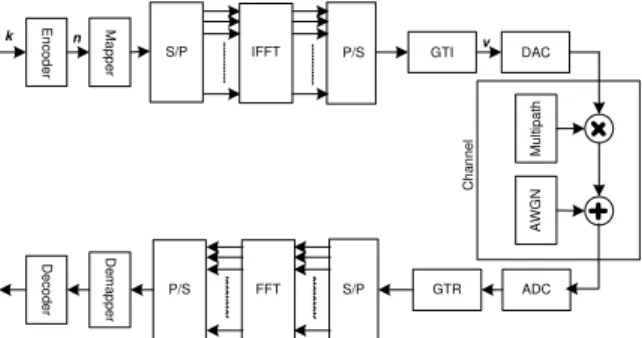
The block diagram of OFDMA transceiver based on mobile WiMAX system is shown in Figure 1. The serial k input binary bits are first forward error encoded (FEC), punctured and interleaved to allow detection and correction of errors that may occur during signal transmission. After encoding, the n coded bits are mapped to a sequence of complex data symbols. Symbols are further grouped to form transmitted frames, each with N symbols. For OFDMA, the mapping process depends on different parameters such as data transmit, zone type, segment and subchannel group [1]. The modulated data are serial to parallel converted (S/P) and then fed to the Inverse Fast Fourier Transform (IFFT) part, where each symbol is modulated by the corresponding subcarrier. Following the transformation process, the timed signal is serialized by using P/S converter. To make the system more immune to the time selectivity of the channel, a guard time samples v is inserted as a cyclic prefix at the beginning of each transmitted OFDMA symbol. The signal samples are then passed through Digital to Analogue (DAC) converter then transmitted in a frame along with preamble, which used for channel estimation and synchronization. In the receiver side the, the received signal is first filtered, sampled and then serial to parallel converted. The guard time v samples are discarded (guard time removal, GTR) and the remaining samples of each frame are demodulated by means of a FFT. Submit your manuscript electronically for review.
Figure 1: OFDMA Transceiver Block Diagram
A. Variable Guard Time Length
A common rule of thumb used to select guard time length is to characterize the propagation channel delay spread. Practically GT length is either chosen two to four times more than the anticipated delay spread of the environment or kept 25% of the OFDM symbol time, which implies a 1 dB reduction in Signal to Noise Ratio (SNR). But it is still desirable to minimize the SNR degradation due to GT length. However, in typical wireless mobile communication channel, mobile user expected to undergoes a wide range of operating conditions within short period of time or propagation distance. In such cases, the channel impulse response might
vary rapidly in some locations whereas in other vary slowly, with minimal delay spread. Based on that, fixing the GT length is impractical especially for mobile applications. This fact motivated the use of variable guard time length [7]. On the other hand, variation requires a form of accurate either estimation or actual field measurements of channel delay spread. The later method is expensive, time consuming and unreliable. Thus it is crucial to find out an estimation technique that can quantify and update delay spread values wherever the mobile user is [8]. Some other related works regarding the variation of GT have been reported [7], [9]-[11].
B. Delay Spread Estimation
Characterization of the mobile radio channel requires investigation of three propagation phenomena, namely: time dispersion, frequency dispersion and angular dispersion. Among these, delay spread is a key performance indicator of the channel since the ISI which causes high bit errors rate in a digital system is mainly related to this phenomenon. Intuitively, delay spread is a statistical measure of the multipath dispersion and it is value useful to specify the duration of the channel impulse response.
Practically, delay spread value found to be directly related to the propagation environment not on the system operating frequency [6]. Obviously, delay spread is not constant in wireless mobile communication channel and its values can span from very small values (tens of nanoseconds) to large values (microseconds) depending on the terrain, distances, and antenna directivity.
The large delay spreads are present in both vehicular and pedestrian mobility situations due to the small height of the antennas, and the fact that the mobile unit is typically using omnidirectional antennas. Measurements campaign made in [12] revealed that urban areas have RMS delay spreads on the order of 2-3 microseconds, about 5-7 microseconds in open and hilly residential areas, and high rise urban areas exhibit larger delay spreads in excess of 20 microseconds especially when the mobile traverses bridges. Measurements done by Seidel et al. [13] showed that delay spreads are less than 8 microseconds in macro-cellular channels, less than 2 microseconds in micro-cellular channels, and between 50 and 300 nanoseconds in pico-cellular channels. For indoor office building, the RMS delay spread is 35 nanoseconds, while at factory buildings the delay spread goes up to 300 nanoseconds [14].
Thus it is crucial to estimate the channel delay spread and consequently optimize the GT length. On the other hand, channel models defined by standard organization are heavily dependant especially when it is difficult to have an accurate description of the wireless channel. For example, ITU-R M.1225 [15] outdoor to indoor, pedestrian and vehicular channel models are baseline for design, development and testing of mobile WiMAX device.
III. CALCULATION EXAMPLE
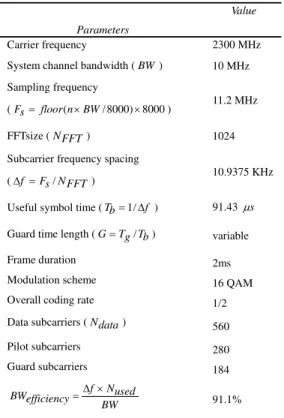
The following example shows how to calculate the loss in data rate and SNR due to guard time insertion based on OFDMA system. Table 1 summarizes the primitive parameters that used for calculation and simulation works.
Ch
a
n
nel
S/P
k Enco n v
der
Ma
p
p
er IFFT P/S GTI DAC
M
u
lt
ipath
AW
G
N
ADC GTR S/P FFT P/S
De
ma
pp
er
Deco
d
e
Table 1: Mobile WiMAX primitive parameters
Parameters
Value
Carrier frequency 2300 MHz System channel bandwidth (BW) 10 MHz Sampling frequency
(Fs=floor(n×BW/8000)×8000) 11.2 MHz FFTsize (NFFT) 1024 Subcarrier frequency spacing
(Δf =Fs/NFFT) 10.9375 KHz Useful symbol time (Tb=1/Δf ) 91.43 μs
Guard time length (G=Tg/Tb) variable Frame duration 2ms Modulation scheme 16 QAM Overall coding rate 1/2 Data subcarriers (Ndata) 560 Pilot subcarriers 280 Guard subcarriers 184
BW used N f efficiency
BW =Δ × 91.1%
A. Guard Time Length Calculation
The OFDMA symbol consists of subchannels that carry data subcarriers carrying information, pilot subcarriers that are dedicated for synchronization and channel estimation purposes, DC subcarrier and guard subcarriers to provide high inter-channel interference margin. To determine subcarrier spacing and useful symbol time, sampling factor
n is commonly set to be 8/7 for OFDMA PHY, yield sampling frequencyFs =11.2MHz . In order to keep the subcarrier spacing fixed at 10.9375 KHz across different channel bandwidth, scalability feature of OFDMA chooses 1024 FFT length with 10 MHz occupied bandwidth. This implies 91.1% bandwidth efficiency, but this percentage varies for other sampling factors and channel bandwidths. Thus, Tb is the inverse of the subcarrier spacingΔf. Then GT isTg=G×Tb , where G is
b g
T T
ratio. The choice of G made according to the radio channel condition. The OFDMA symbol time (Ts) comprising the guard time length (Tg) and useful symbol length (Tb), thusTs=Tb+Tg.
B. Data Rate
The goal of a communication system is to provide higher data rates to the end users while minimizing the probability of errors. As per IEEE 802.16e-2005 standard, the maximum transmission raw data rate can be obtained using:
b T g T
b data N R
+ ×
= (1) Where b is the number of bits per symbol for the modulation being used, Ndata is number of used subcarriers for data transmission. The useful channel capacity is:
n k R
C= × (2) Where
n k
is the overall coding rate given in Table 1. Further, it is also useful to describe channel capacity in terms of spectral efficiency using:
BW
C =
η (Bits/s/Hz) (3) It is clear that, by changing the guard time length from 3% of the symbol length to 25% decreases the amount of data transmitted significantly which make OFDMA guard time is basic parameters for data rate computations. Table 2 provides an optimistic data rates achieved as function of modulation, coding and guard time length taking into account that these values do not consider some overheads such as preambles and signaling messages present in every frame.
C. SNR Loss
While increasing GT length to resist ISI and ICI, the overall power efficiency degrades proportionally. In particular, the loss in Eb No at the transmitter side becomes:
10log10(1 )
b T g T
g T loss
SNR
+ − −
= (4) At the receiver, GT is removed before further processing, thus receiver energy remains unchanged. Table 2 shows the expected energy loss as function of GT. It can be noted that, minimizing power loss is needed because mobile terminals need to run on battery. Since OFDMA useful symbol length is fixed, minimization can be done only by varying GT length. One alternative to reduce transmitted energy is to use a zero prefix instead of using CP. This technique, however, increases the receiver power and causes high noise power.
Table 2: OFDMA data rate and SNR loss.
IV. COMPUTER SIMULATION
The optimization of guard time length for mobile WiMAX under multipath fading channel is evaluated using computer simulation.
A. System Parameters
The simulation parameters are selected according to the IEEE 802.16e standard and we chose the most relevant parameters that suit our local spectrum regularity. The parameters are; 10 MHz nominal bandwidth, 1024 FFT size and 2.3 GHz operating frequency. This spectrum is the most likely licensed band to roll out IEEE 802.16e services in Malaysia. To reduce the simulation time we use 2 ms frame duration instead of required 5 ms. For efficient downlink (DL)/uplink (UL) asymmetric traffic support, the TDD
b T
g T
Data rate (Mbps) Loss (dB)
QPSK 1/2
16 QAM 1/2
64 QAM 3/4
duplexing mode is used with more than 60% of the frame time occupied by the DL subframe. The DL subframe uses Partially Used Subcahnnels (PUSC) zone type with maximum two symbols per slot.
For system performance evaluation, we chose 16 QAM modulation scheme and convolutional turbo coding (CTC) with native rate ½. In this paper, the simulation results are obtained using ITU-R M.1225 pedestrian and vehicular channel models assuming perfect channel state information at the receiver. The channel modeled multipath fading with six power decaying taps characterized by Ralyeigh distribution. The associated channels parameters are found in [15]. The required bit energy per noise density 10 dB has been considered averaging over 1000 frames for probability of errors computation. In addition, the transmitted signal is corrupted by Additive White Gaussian Noise (AWGN) with noise density calculated as function of GT length using:
) log( 10 )
1 log(
10 R
N E G P
NDensity
o b
s− + − −
= (5)
WherePsis the signal power and
Eb
/
No
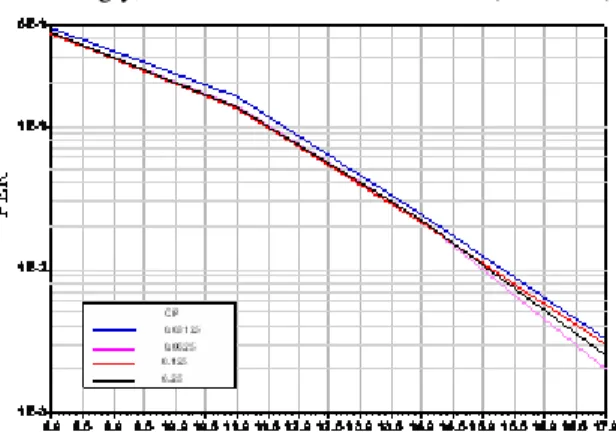
(the ratio of bit energy to noise power spectral density). The simulation assumptions for the evaluation are shown in Table 1. Furthermore, the PER vs. Eb/No results for various GT length are depicted in Figure 3 for pedestrian B channel model, and in Figure 4 for vehicular B channel model. Each figure shows four curves corresponding to the different GT lengths as specified in [1].B. Constellation Error
This test measures the transmitter modulation quality which is necessary to insure that the receiver can demodulate the signal with minimal errors. Figure 2 depicts two constellation diagrams using 16 QAM modulation scheme. Figure 2 (a) shows that whenever the GT length is greater than the multipath delay spread the constellation diagram is undistorted. Figure 2 (b), where delay spread exceed the GT length, the constellation is highly distorted and interference between subcarriers occurs, resulting in serious degradation due to error floor.
(a) (b)
Figure 2: 16 QAM Constellation diagram for: (a) GT> delay spread and (b) GT<< delay spread. C. Optimal Guard Time Length
One way to optimize the GT length is to examine OFDMA system under various channel delay spread. In this section, simulations have been carried out in accordance with the parameters of section IV.A using ITU-R pedestrian and ITU-R vehicular channel models.
D. ITU-R Pedestrian B Channel
Pedestrian B channel model is equivalent to pedestrian traveling through a simulated urban environment at speed of
3 Km/h and characterized by large number of multipaths compared to other low mobility channels. The multipath delay and power profile of the ITU Pedestrian B channel model is given in [15].
Examining Figure 3, we can observe that CP curves are almost identical for low Eb/No (in dB) and perform comparably at higher values (beyond 15 dB). Also, it reveals that CP ratio of 0.0625 slightly outperforms the other lengths in PER reduction. Consequently, data transmission rate is slightly increased (11.5 Mbps). In fact, this behavior of mobile receiver is expected when dealing with relatively small delay spread comparing with one OFDMA symbol. Accordingly, the CP overhead is also small (<0.26 dB)
Figure 3: PER versus Eb/No for ITU Pedestrian channel. E. ITU-R Vehicular B Channel
This channel model represents the worst case environment where the multipath delay spread is relatively large (20 us) causing a major impact on system performance.
Comparing the curves on figure 4, we can notice that the optimal GT length is 25% of the OFDMA symbol time. This length implies a loss of about 1 dB in SNR as well as 15 % reduction in data throughput
Figure 4: PER versus Eb/No for ITU Vehicular channel. V. CONCLUSION
REFERENCES
[1] IEEE Std 802.16e-2005, IEEE Std 802. 2004/Cor 1-2005, “IEEE Standard for Local and metropolitan area networks, Part 16: Air Interface for Fixed and Mobile Broadband Wireless Access Systems, Amendment 2: Physical and Medium Access Control Layers for Combined Fixed and Mobile Operation in Licensed Bands and Corrigendum 1.”
[2] WiMAX Forum. (2004). WiMAX’s technology for LOS and NLOS Environments. Available: www.wimaxforum.org.
[3] Hongwei Yang, “A Road to Future Broadband Wireless Access: MIMO-OFDM-Based Air Interface,” IEEE Communications Magazine, vol. 43, January 2005, pp. 53-60.
[4] Magnus Sandell, Jan-Jaap van de Beek, Per Ola Börjesson, “Timing and Frequency Synchronization in OFDM Systems Using the Cyclic Prefix,” in Proceedings of the 1995 IEEE International Symposium on Synchronization, Essen, Germany, December 1995, pp. 16-19. [5] WiMAX Forum. (2006, August). Mobile WiMAX – Part1: A Technical
Overview and Performance Evaluation. Available:
www.wimaxforum.org.
[6] R. Van Nee and R. Prasad, OFDM for Wireless Multimedia Communications, Boston, Artech House, 2000, ch. 1.
[7] Das S. S., Fitzek F. and Prasad R., “Variable Guard Interval OFDM in presence of carrier frequency offset,” IEEE Global Telecommunication conference, GLOBECOM 2005, November 2005, vol. 5, pp. 2937-2941.
[8] H. Arslan and T. Yucek, “Delay Spread Estimation for Wireless Communication Systems”, Proceedings of the Eighth IEEE International Symposium on Computers and Communication (ISCC’03), June 2003, pp. 282- 287.
[9] H. Steendam, M. Moeneclaey, “Guard Time Optimization for OFDM Transmission over Fading Channels,” Proceeding IEEE Fourth Symposium on Communications and Vehicular Technology SCVT’96, Ghent October 1996, pp. 42-48.
[10] M. Bakir, M. Belhachat, J. G. Liu, S. Z. Zhu, “Optimization of Guard Interval for OFDM Performance over Fading and AWGN Channels Using Genetic Algorithm,” IEEE 6th CAS Symposium on Emerging Technologies: Mobile and Wireless Communication, Shanghai, China, May 2004, pp. 457-460.
[11] M Heidi Steendam, Marc Moeneclaey, “Analysis and Optimization of the performance of OFDM on Frequency-Selective Time-Selective Fading Channels,” IEEE Transactions on Communications, vol. 47, pp. 1811-1819, December 1999.
[12] T. S. Rappaport, S. Seidel, R. Singh, “900 MHz Multipath Propagation Measurements for U.S. Digital Cellular Radiotelephone,” IEEE Transactions on Vehicular Technology, vol. 39, pp. 132-139, May 1990.
[13] Seidel, S.Y., Rappaport, T.S., Jain, S., Lord, M.L., Singh, R., “Path Loss, Scattering, and Multipath Delay Statistics in Four European Cities for Digital Cellular and Microcellular Radiotelephone,” IEEE Transactions on Vehicular Technology, vol. 40, pp. 721-730, November 1991.
[14] Rappaport, T. S., “Characterization of UHF Multipath Radio Channels in Factory Buildings,” IEEE Transactions on Antennas and Propagation, vol. 37, pp. 1058-1069, August 1989.