Abstract— Thermally stimulated depolarization current (TSDC) characteristics of Polyvinyl Pyrrolidone (PVP) electrets are studies in the temperature range 30 to 210 oC as functions of the polarizing field (5 to 100kV/cm) and polarizing temperature (40 to 80oC). The TSDC spectra comprise two maxima, namely, β and α with their respective locations around 90 oC and 172.5 oC. These are attributed to dipole-orientation and motion of space charge respectively. The space charge peak (α) is found to be more sensitive to the forming parameters than to that involving dipole. The observed dependence of the peak temperature parameter as well as the activation energy for various peaks on polarizing temperature is indicative of a continuous distribution of relaxations.
Index Terms —Polyvinyl Pyrrolidone (PVP) electrets.
I. INTRODUCTION
The Polyvinyl Pyrrolidone (PVP) is acknowledged as a material of immense fascinating application [1]. Its dielectric [2] and electrical conduction [3] has been the subject of some recent investigations.
In the wake of wide-spread practical applications of polymer electrets [4]-[8] a comprehensive knowledge of polarization and depolarization behavior of PVP foils takes on a great deal of significance.
Non-isothermal dielectric relaxation of a polymer exhibits a spectacular relaxation phenomenon dipoles and free charges of the polymer by frictional forces. Since internal friction depends exponentially on temperature, the response time τo of permanent dipoles and free charges changes
noticeably with temperature. On heating the polymer the response time τo get accelerated. It brings an idea of
thermally stimulating discharge of the sample and thus performing the decay experiment within a reasonable time. This new method first proposed by [9], is commonly known as thermally stimulated discharge current (TSDC) technique. The TSDC technique [10] has been widely used in order to establish and estimate the magnitude of volume electrical polarization. The various peaks appearing in the TSDC
Manuscript received on Thursday, 26/2/09, IAENG Conferences - WCE 2009 <[email protected]>.)
Dr. Vikram S Yadav is Reader with the Department of Applied Sciences, Bundelkhand Institute of Engineering and Technology, Jhansi-284128 (INDIA) ( phone: +91-9415030412; fax: +91-510-2320349; e-mail: [email protected]).
Dr. Devendra K Sahu is Lecturer with Department of Physics, Institute of Basic Sciences, Bundelkhand University, Jhansi-284128 INDIA. (Phone: +91-9415947697; e-mail: [email protected]).
Dr. Yashpal Singh is Reader and Head with the Computer Science and Engineering Department, Bundelkhand Institute of Engineering and Technology, Jhansi-284128 (INDIA) (phone: 9415030602; fax: +91-510-2320349;e-mail: [email protected])
spectrum characterize the operative molecular mechanism through which an electret stores its charge. Therefore, the charge storage and charge decay processes in PVP can be well understood through the study of thermo electrets by the simultaneous action of heat and electric field to the material, and subsequently monitoring the short circuit discharge current under a linear thermal programs. The present work reports the results of experimental studies on TSDC in PVP foil electrets. The variable parameters are polarizing fields and temperature, which are used to determine dipolar and space charge relaxations in PVP polymer.
II-EXPERIMENTAL DETAILS
Polyvinyl Pyrrolidone (PVP) used in the present work has been procured from Glaxo Laboratories, Mumbai. The circular samples of PVP (20μm thick and 34 mm in diameters) are prepared by first dissolving the polymer in pure chloroform and then immersing a cleaned optically plane glass slide in the solution at a constant temperature of 50oC for about 20min.The plate was then drawn slowly out of the solution, layering a uniform polymer film on the plate. The film so formed has been kept in an oven at 45oC for 24 hours to remove all the traces of solvent. This is followed by room temperature out gassing at 10-5 torr for further 24 hours. It is then gently lifted off the glass slide. Both surfaces of the samples then are vacuum aluminized over a central circular area of 4.0cm2. The samples then made polarized for 90 min with polarizing electric fields (EP) (EC 4800 high voltage unit) and then are cooled in
absence of electric field and then the samples be short circuited for an arbitrary time of 10 min so as to remove the frictional and stray charges present. Thereafter, the sample is heated at a uniform rate of 3oC/min from room temperature to about 210oC and the discharge current is recorded with a Keithley 600B electrometer which has been carefully shielded and grounded to avoid ground loops or extraneous electrical noise. The temperature of the sample is recorded with a pre-calibrated thermocouple attached in close neighborhood of the sample. The thickness of the sample (20μm) is estimated by measuring the capacitance of the sample [11, 12]. The depolarization kinetic data, i.e. activation energy (Ea), charge released (Q) and relaxation
time (τo) for the observed peaks have been calculated using
initial rise method [13] (see Table1).
Non - Isothermal Depolarization Current
Studies in Polyvinyl Pyrrolidone (PVP) Foil
Electrets
Vikram S Yadav, Devendra K Sahu, Yashpal Singh Proceedings of the World Congress on Engineering 2009 Vol I
WCE 2009, July 1 - 3, 2009, London, U.K.
Table-1 The Kinetic Data for β and α Relaxation of PVP Foil
Electrets
β- peak Ep
kVcm -1
Im Amp.
Tm o
C Ea
eV
τo Sec.
Q Coul.
5 3.0X10⁻¹² 90 0.282 4.6X10⁷ 5.0X10⁻⁹ 10 5.0X10⁻¹² 90 0.287 4.6X10⁸ 7.0X10⁻⁹ 25 8.0X10⁻¹² 90 0.291 4.8X10⁷ 1.2 X10⁻⁸ 50 1.2X10⁻¹¹ 90 0.297 2.8X10⁶ 4.6X10⁻⁸ 75 1.8X10⁻¹¹ 90 0.302 1.6X10⁷ 6.6X10⁻⁸ 100 3.0X10⁻¹¹ 90 0.309 6.2X10⁷ 6.8X10⁻⁸
α-peak Ep
kVcm -1
Im
Amp.
Tm o
C Ea
eV
τo Sec.
Q Coul.
5 2.0X10⁻¹¹ 170 0.596 9.2X10⁷ 7.6X10⁻⁸ 10 3.2X10⁻¹¹ 170 0.602 1.6X10⁸ 8.2X10⁻⁸ 25 8.0X10⁻¹² 175 0.607 4.4X10⁸ 4.4X10⁻⁸ 50 7.0X10⁻¹¹ 165 0.612 5.6X10⁶ 1.2X10⁻⁶ 75 1.2X10⁻¹⁰ 170 0.632 4.8X10⁷ 3.4X10⁻⁶ 100 5.0X10⁻¹⁰ 175 0.633 3.2X10⁷ 4.2X10⁻⁶
III- RESULTS AND DISCUSSION
The TSDC spectra of PVP foils in the temperature range 30 oC to 210oC indicate the presence of two well-resolved prominent maxima in all cases, situated around 90 and 172.5oC, identified as β and α peak, respectively. The locations, heights, and sharpness of peaks are found to be governed by forming parameters of the specimen.
A. Field (Ep) Dependence
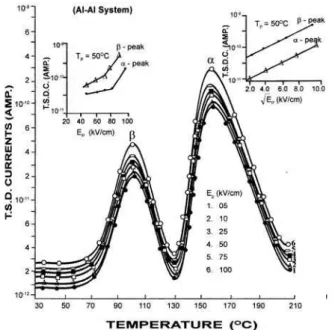
Fig. 1 shows TSDC characteristics of PVP samples polarized under identical conditions but different fields ranging from 5 to 100kV/cm. In each case, two peaks (β and
α) are observed with their peak temperatures (Tm) almost
independent of Ep but the peak current (Im) increasing with
the increase in Ep. This increment in case of α peak is more
pronounced than that in β peak. Peak current Im for β and α
peaks show a linear relationship with Ep (inset of Fig. 1).
The values of Ea, Q and τo associated with different
relaxations alter with Ep; however, the variations are not
systematic (see table 1).
B. Temperature (Tp) Dependence
The effect of polarizing temperature on the TSDC spectra of PVP electrets is shown in Fig. 2. An increase in Tp
enhances the height of both peaks, but this enhancement has been relatively more pronounced in case of α peak. The values of Ea for bothrelaxation increases linearly with Tp
(inset of Fig. 2)
The β-peak has been attributed to disorientation of polar groups. The polar side group of Pyrrolidone ring in PVP has carbonyl group of double bond. This group is attached to the main chain with an amide bond.
It may have different possible orientations / rotations with respect to the main chain of the polymer and thus a distributed energy is associated with the facts and verified that,
1) Its peak current (Im) varies linearly with Ep (inset of
Fig. 1) which is an indication of uniform induced bulk polarization [14].
2) In comparison to α peak, its magnitude is not much sensitive to Ep & Tp (in Fig. 1 and 2) [15].
Fig. 1: Thermally Stimulated Depolarization Current versus Temperature at constant polling fields (05, 10,25,50,75 and 100kV/cm) for the sample of PVP.
Fig. 2: Thermally Stimulated Depolarization Current versus
Temperature with different polling temperatures (i.e. 40,50,60,70 and 80 0C) at poling field 50 KV/cm.
3) Ea corresponding to this relaxation (seeTable1) is in
conformity with the theoretically predicted value of Ea=
0.2eV for the side group orientation in a polymer [16]. Proceedings of the World Congress on Engineering 2009 Vol I
WCE 2009, July 1 - 3, 2009, London, U.K.
The next α peak on which the effects of Ep, Tp have been
more pronounced (Fig. 1and 2), might be, attributed to space charge polarization. The corresponding Ea (see Table1) also
support its space charge origin [17].
The unsaturated carbonyl side groups (>C = o) present in PVP can act as traps for charge carriers [18] contributing to their transport and trapping. The fact that α peak current (Im)
varies non-linearly with Ep but linearly with √Ep ( in sets of
Fig. 1) reveals that one or more, intrinsic or extrinsic, space charge mechanisms should be jointly operative [18] resulting in an overall non-uniform polarization. These results are in good accord with reported earlier [2, 3]. The fact that the values of Ea for the corresponding decay
processes increase with the increase in Tp (see Table1) and
their τo are also not constant (see Table1) implies that the β
and α relaxations in the present case are due to a continuous distribution of relaxation time in which both Ea and τo
factors are distributed. The increase of Im and released
charge Q (see Table1) with the increase in poling fields and temperatures, suggests that peaks observed is contributed both by electronic and ionic processes [19] which arise in the bulk and ejected from the electrodes-subjected to higher fields.
IV CONCLUSION
The observed TSDC spectra in PVP confirm the presence of both dipolar and space charge relaxation. However, the effect of parameters are more pronounced on space-charge relaxations (i.e. α-peak) than on dipolar relaxation (i.e. β-peak). The other parameters, like thickness dependence, electrode dependence, ageing dependence, on TSDC of PVP foil electrets can further be studied.
REFERENCES
[1] J F FLOWLER, PROC.R. SOC. LONDON, SER.A, 236
(1956) 456.
[2] N M Bashara, and C.T. Doty, J.Appl.Phys, 35(1964) 3498
[3] R A Connel, and L V Gregor, J.Electrochem.Soc.112
(1965) 1198
[4] M M Christy, J Appl.Phys. 16 (1965) 1805
[5] Y Myioshisi, and Chino, J.Appl.Phys, 6 (1967) 181 [6] L V Gregor, IBM J. Res.Dev. 12 (1968) 140
[7] D W McCall, and EW Anderson, J.Chem.Phys.32 (1960) 237
[8] A Von Roggen, Phys.Rev.Lett. 9(1962) 368
[9] A Reiser, Lock, M.W.B. and Enight, J., Trans.Faraday Soc.65 (1969) 2168
[10] J.Van Turnhout, Thermally Stimulated Discharge of Polymers Electrets, Elsvier Publ. Co., Amsterdam 1975 [11] Khare P. K. & Shrivastava A. P. Indian J. Pure &
Appl.Phys. 30 (1992)102
[12] Khare P. K. & Shrivastava A. P., Indian J. Pure & Appl.Phys. 31 (1993)126
[13] Garlic C.F.J & Gibson A. F., Porc. Phys. Soc. 60
(19948) 574
[14] Gross B.,J.Chem.Phys. 17 (1949) 866
[15] Van Turnhout J, Electrets, Chap.3 Ed. G. M. Sesslar, Springer-Verlag, New York 1980
[16] Raddish W., Trans.Farady Soc.46 (1950) 459
[17] Mahendru P.C., V. K. Jain, et.al, J.Phys. D 8 (1975) 305
[18] Davies D.K. & Lock P.J, Electrets-Charge Storage and
Transport in Dielectrics, Ed.M.M Perlman,
Electrochemical Society, Princeton (N.J) 1973
[19] Pillai, P.K.C., Gupta B.K. & Goel Malti, J.Polyn Sci Phy 19 (1981) 1461
Proceedings of the World Congress on Engineering 2009 Vol I WCE 2009, July 1 - 3, 2009, London, U.K.