Abs the (UM Des new very Key mot B a te prev bes mea squ bec O exh find com app algo ada mot qua be rapi I ada bes diff it h Thi mot mot the T be algo (FD UM com mot
An
M
stract— In this Unsymme MHexagonS) a scent Search (F w algorithm ca
y minor bit rat
ywords
—
Vide tion estimationBlock matchin echnique used
vious frame f t matching b asurement, su uare error (M cause of its sim Obviously, the haustively sea
d the best mat mputational op plication. For y orithms ([1]-[ apt different
tion estimatio ality and the b
trapped in lo id motion scen In H.264 Re apted as the m
t matching b ferent kind of has the early te is algorithm
tion video seq tion vectors,
same as the fu Though the pe
improved a li orithm called DGDS) ([11]) MHexagonS.
mpressed vide tion scenes.
Impro
Multi-H
Vu T
Softwar
s paper, we pr etrical-cross
lgorithm and a FDGDS). The an reduce the m
te increase and
eo compressio n, video coding
I. INTR
ng motion est d to find the b from the im a block is foun uch as su m o SE). Howeve mplicity and e e simplest met arches all the
tching candid peration and years, research [9]) to tackle
search point on time with bit rate. These cal minimum nes.
eference Soft main search al lock in searc f patterns to fi ermination str works very quences. It ru
and good rate full search algo erformance of
ittle bit more d Fast Direct ). This new However, it eo, especially
oveme
Hexag
Thanh Nguyre Engineering
resent an new Multi-Hexag and the Fast D experiment re motion estimat d almost the sa
n, block matc g, UMHexagon
RODUCTION
timation in vid est matching age block in c
nd by using of absolute ( er, the SAD i
fficiency. thod is full se
points in the date. However is not feasible hers have prop the problem o patterns, try hout affecting algorithms, h m point, especi tware, UMHe lgorithm that
h window. T ind the best m rategy to redu well with bo uns quite fast
e-distortion p orithm. f UMHexagon
. Lai-Man Po ional Gradien algorithm run t increases y video sequ
ent of
gon-gr
yen(1), Tran Xg Department, Ho Chi Min
algorithm bas gon-grid S Directional Gra
esults show tha tion time with ame image qua
ching, improve nS.
deo compress image block current frame certain simi SAD) or me is commonly earch algorithm
search windo r, it requires l
e in most of posed many h of full search, ying to reduc g much the however, can e
ially in video exagonS ([10
is used to fin This algorithm matching block uce the search oth slow and and gives acc erformance, n nS is good, it o introduces a
nt Descent S ns faster tha the bit rat uences with
Unsym
rid Sea
Xuan Chien(2), University of nh City, Vietna
sed on Search adient at this just a ality. ement, ion is in the e. The ilarity an of used m that ow to ots of video hybrid , each ce the video easily o with 0]) is nd the m uses k, and time. d fast curate nearly could a new Search an the te of rapid
By apply UMH our i abou rate-d Th UMH descr UMH prese A. U Th diffe recta exten demo prese searc the e Fig. termi Th algor predi refer termi
mmetr
arch a
), Phan Cong
f Information am
y integrating ying new HexagonS alg
improvement ut 10% to 30%
distortion perf he paper is HexagonS and
ribe two HexagonS alg ented to demo II. UMH UMHexagonS his algorithm rent search p angular full s nded hexagon onstration of ented with th ch point is (0 early terminat 2 shows each ination is used
Fig.1. Search
here are fou rithm for pred iction, corresp
ence picture p ination are de
rical-C
algorith m
g Canh(3)
Technology
the FDGDS search patte gorithm. The can speed u % without m formance.
organized a d the FDGDS
improvement gorithm. Final onstrate the eff
EXAGONS AND
Algorithm m consists of
pattern: unsym search, uneve n based search f search pro he search ran , 0). The U M tion strategy t h step in UMH
d.
h process of UMH
ur methods diction. They a
ponding bloc prediction. A scribed in ([10
Cross
h
S into the U ern, we can
experiment r up the motion much loss o f v s follow: In S are pr esente s will be lly, the exper ficient of prop
D FDGDS ALG
many steps, mmetrical-cro en multi-hexa h, diamond se ocedure in U nge equals 16 MHexagonS al
to reduce the HexagonS and
HexagonS algorit
employed in are median pr ck prediction ll these metho 0]).
UMHexagonS n improve results show n estimation t video quality n section II,
ed. Next, we employed riment results posed algorith
GORITHM
, each step u oss search, s m agon-grid sea earch. In Fig. UMHexagonS 6 and the in lgorithm also e estimation ti d where the e
thm, W = 16
n UMHexag rediction, up l and neighbo ods and the e
and the that time and the will in s are hm.
B. T (OT dire In F algo hor vert dire
SAD is SAD is small
Fig. 2
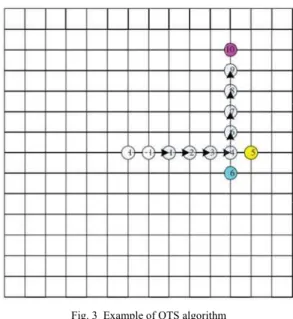
FDGDS Algo The FDGDS a TS). In OTS, ection until th Fig.3, an exam orithm ([1]) rizontal direc
tical direction ection.
S
Initial search
Early te
Early te Unsymmetri
Small rectan
Uneven multi‐h
Extended hexag
Diamond it
Fi SAD is
SAD is s small
l
2 Flow chart of U
orithm algorithm is b
, the search e minimum po mple of the f
is shown. Fi tion, and t he n from the min
Start
point prediction
ermination
ermination ical‐cross search
gular full search
exagon‐grid search
gon iterated searc
terated search
inish s very big
s very big SA
UMHexagonS alg
ased on the on is continued oint along tha first OTS-bas irst, the OTS en the OTS nimum point f h
h SAD is big
AD is big
gorithm
ne-at-a-time s in one part at direction is ed block mat S is pe rforme
is performe found on horiz
search ticular found. tching ed on ed on zontal
FD cente follo
Ste of t CUR Ste CUR
direc relati < T, and searc
Ste to St
Ste one round corre
Ste motio Th
Ac often motio demo Th the How espec
F
DGDS uses O er to s earch f
ws:
ep 1: Calcula the search RRENT_MIN
ep 2: For eac RRENT_MIN: (a) perfor (b) set t ction as a DIR (c) if DIR ive rate distor
update CURR repeat Step ches).
ep 3: If no po ep 5; Otherwi ep 4: DIREC is set as CUR d. Go to Step esponding pos
ep 5: The alg on vector poin he RDR for a
ccording to ([ n used becau on estimatio onstrates the e he FDGDS al UMHexagonS wever, the bit
cially the vide
Fig. 3 Example o
OTS strategy for the minim ate the block d
window cen ch of the eigh :
rm point-to-po the minimum RECTIONAL_ RECTIONAL rtion (RDR) fo RENT_MIN w 2 (i.e., ski oint with DIRE
ise go to Step CTIONAL_MI RRENT_MIN p 2 with u pd sition.
gorithm is com nting to the po
certain directi
[11]), the thre use it will ke on time and example of FD lgorithm is sh
S algorithm t rate o f vid eo sequences w
of OTS algorithm
on eight direc mum point. Th
distortion mea nter and set ht directions oint directiona m BDM foun
_MIN; L_MIN is fou
or the current with this DIRE
ip the rema ECTIONAL_
4.
INs are comp N. This is th e dated CURRE mpleted. Retu osition with C ion is calculat
_ _ eshold value T
eep the balan d the video DGDS algorith hown to be m
in motion deo sequence with rapid mo
m
ctions around he algorithm i asurement (BD
t the value of the point w al OTS;
d in the cur und, calculate direction. If R ECTIONAL_M aining directi _MIN is found pared. The l ow e end of a se ENT_MIN and
urn with the f CURRENT_M
ted as follow:
T equals to 0 nce between o quality. F
hm.
more efficient estimation ti es also incre otion scenes.
d the is as DM) as with
rrent e the RDR MIN onal d, go west arch d its final MIN.
T UM usin sear patt new com A I sear min usin to q com term sear adv FDG pro
S and
S CU
dire earl per RD DIR rem
F
The proposed MHexagonS a
ng unsymmet rch, the modi tern in uneven w octagon/dec mplexity. Thes A. A Modified
In UMHexag rch and small nimum point
ng these two s quickly find t mputational tim mination has
rch and sma vantage of the
GDS. The ne posed algorith Step 1: Calcu d set the value Step 2: For ea URRENT_MIN (a) perf (b) set ection as a DIR
(c) if D ly termination formed, calcu DR < T,
RECTIONAL maining directi
Fig.4.. Example o
III.PROPOSE
d algorithm algorithm in t
trical-cross se ified FDGDS n multi-hexag
cagon pattern se two aspects d FDGDS Algo gonS algorit l rectangular from the ini search method the minimum me. Moreover been used in ll rectangular e early termin ew FDGDS hm is as follow ulate the BDM as CURREN ach of the eig N:
form point-to-the minimum RECTIONAL DIRECTIONA n strategy. If ulate the RD update C L_MIN and r ional searches
of FDGDS algorit
ED ALGORITHM
is different two aspects. earch and sma
is used. Seco on-grid search n to reduce s are described orithm thm, the un
full search ar tial point. Bu ds, the FDGD
point on this r, in the origin n between un r full search. nation, it is i with early te ws:
M of the sear T_MIN ght directions -point directio m BDM fou L_MIN; AL_MIN is f o
early termina DR for the c u CURRENT_M
repeat Step s).
thm
M
from the or Firstly, inste all rectangula ondly, the hex h is replaced w the computa d in the follow
nsymmetrical-re used to fin ut here, inste S algorithm is step to reduc nal algorithm, nsymmetrical-. In order to integrated int ermination us rch window c s of the point onal OTS; und in the cu ound, try usin
ation could n urrent directio MIN with
2 (i.e., ski p riginal
ad of ar full xagon with a ational wing.
-cross nd the ead of s used ce the early -cross o take to the sed in center t with
urrent ng the not be on. If this p the
Ste to St
Ste one round corre
Ste motio
B. Th the u step to loo Li H algor 16-po our s bit ra with
ep 3: If no po ep 5; otherwis ep 4: DIREC is set as CUR d. Go to Step esponding pos
ep 5: The alg on vector poin
Fig.5. H
Octagon and he second imp uneven multi
adopts the hex ok for the min Hong-ye introd rithm ([12]) th oint hexagon simulation sho
ate of compr rapid motion
oint with DIRE se go to Step 4 CTIONAL_MI RRENT_MIN p 2 with u pd sition.
gorithm is com nting to the po
Hexagon pattern i
d Decagon Pa provement ap i-hexagon-grid
xagon pattern nimum point i duces the new hat use the 8-p pattern to red ows that Li H
essed video l scenes.
Fig.6. Octag
ECTIONAL_ 4.
INs are comp N. This is th e dated CURRE mpleted. Retu osition with C
in UMHexagonS
attern pplied into the
d search step n with 16 poin in large area o w fast block m
point octagon duce the searc ong-ye’s meth larger than ex
gon pattern
_MIN is found pared. The l ow e end of a se ENT_MIN and
urn with the f CURRENT_M
algorithm
e algorithm is p. Currently, nts shown in F
of search wind motion estima pattern instea ch time. Howe hod can make xpected on v
d, go west arch d its final MIN.
I patt com The and Fig help num Wh app the pro
T Sof seq disa 28, New on
Instead of usi terns are u mputational tim
e first pattern d the second p .6. In our e x p cover most mber of search hen performed plied alternativ decagon patt posed algorith
The proposed ftware 9.6 w quence is IP
abled, one r ef RD Optimza ws, Coastguar the first 100
PER
UMHex Proposed a Proposed a speedup UMHex Bitrate in
UMHex Proposed a Proposed a speedup UMHex Bitrate in
Fig.7. Deca
ing one hexa used alternati me at this step is the octagon pattern is the d xperiment, usi points in the h points each d the search at
vely. First, the tern, and so o hm is shown i IV.EXPERIM
d algorithm is with the fol PPPIPPP…,
ference frame ation is turne d
rd, Foreman, frames. The r
RFORMANCE COM
P
xagonS 3
algorithm 3
algorithm p over xagon ncrease
P
xagonS 34
algorithm 34
algorithm p over xagon ncrease
agon pattern B
agon pattern, ively to fu p without muc n with 12 poin decagon with
ing these two search windo round is redu t this stage, tw e octagon patt on. The whole
in Fig.8
MENT RESULTS
s implemented llowing conf sub-pel moti e, Quantizatio d off. Video Stefan and C reference softw
MPARISON OF PROP Aki PSNR
(dB) (kbitBitra
9.83 413.2
9.83 413.1
9.94
- 0.024
Coastg PSNR
(dB) (kbitBitra
4.34 1880.
4.34 1880.
22.4
- 0.009
here two dif urther reduce ch bit rate incr nts shown in F 12 points sho o alternatively
ow, meanwhi uced from 16 t
wo patterns w tern is used, n e search proce
S
d in JM Refe figurations: ion estimatio on Parameter
sequences: A Container are t ware is runnin
POSED ALGORITH iyo
ate
t/s) ME time(s)
22 1.660
12 1.495
4%
4%
guard ate
t/s) ME time(s) .53 4.212 .37 3.267
44%
9%
fferent e the rease. Fig.5, wn in y will le the to 12. will be next is ess of
erence frame on is value Akiyo, tested ng on
Wind proce UMH PSNR bit ra
TABLE I HM WITH UMHEX
e PSNR
(dB) 36.58 36.57
C
e PSNR
(dB) 36.44 36.44
dows operatin essor. The p HexagonS alg R (dB), avera ate (kbit/s). Th
U SAD is sm SAD is sm
Fig.8. XAGONS ALGORIT
Foreman Bitrate
(kbit/s) ME(
872.28 3.20
875.62 2.46
23.28%
0.383%
Container Bitrate
(kbit/s) ME(
856.08 2.12
856.05 1.77
16.08%
- 0.004%
ng system w proposed algo gorithm in th age Motion E he experiment
Sta
Initial search po
Early term
Uneven multi‐octagon
Extended hexago
Diamond iter
Fini SAD is ve
mall mall
FDGDS with ear
. Search process o THM IN H.264 REF
E time
(s) PSNR(dB)
09 35.16
62 35.16
E time
(s) PSNR(dB)
20 38.26
79 38.26
with the Intel orithm is com hree different
stimation tim t results are sh
art
oint prediction
mination
n/decagon‐grid search
n iterated search
rated search
ish ery big
SAD is
SAD rly termination
of proposed algor FERENCE SOFTWA Stefan R
) (kbit/s) Bitrate 2555.98 2557.31
27.62%
0.052%
News R
) (kbit/s) Bitrate 701.00 701.05
10.60%
0.007%
l Core i5-241 mpared with aspects: aver me (s) and ave r hown in Table
h big
D is big
rithm ARE
ME time (s) 3.928 2.843
ME time (s) 2.047 1.830
It can be seen that the proposed algorithm runs faster than UMHexagonS in all v ideo sequences, especially in video sequences with rapid mot ion scenes such as Coa stguard or Stefan. The bitrate of new algorithm is not much greater than the original algorithm with less than 0.5% increase, and it has even smaller bitrate in some videos such as Akiyo, Coastguard and Container. The PSNR does not change in most of the video sequences, except the Foreman with 0.01dB lost.
V. CONCLUSIONS
In this pape r, a new algorithm based on th e FDGDS and UMHexagonS algorithm is proposed. It takes advantage of the fast running time from FDGDS and accuracy from UMHexagonS to help reduce the computational complexity while maintaining the video quality and bitrate. And two new search patterns, octagon and decagon, are also presented to further reduce the motion estimation time. This new algorithm is shown to run fa ster than original UMHexagonS without much of PSNR lost and bitrate increase. It especially works well with videos with complex motion contents.
REFERENCES
[1] R. Srinivasan and K. R. Rao, “Predictive coding based on efficient motion estimation,” IEEE Trans. Commun., vol. 33, no. 8, pp. 888-896,
Aug. 1985.
[2] T. Koga, K. Iinuma, A. Hirano, Y. I ijima, and T. Ishiguro, “Motion compensated interframe coding for video conferencing,” in Proc. Nat. Telecommun. Conf., New Orleans, LA, Dec. 1981, pp. G5.3.1-G5.3.5.
[3] R. Li, B. Zeng, and M. L. Lio, “A new three-step search algorithm for block motion estimation,” IEEE Trans. Circuits Syst. Video Technol.,
vol. 4, no. 4, pp. 438-443, Aug. 1994.
[4] L. M. Po and W. C. Ma, “A nove l four-step search algorithm for fast block motion estimation,” IEEE Trans. Circuits Syst. Video Technol.,
vol. 6, no. 3, pp. 313-317, Jun. 1996.
[5] L. K. Liu and E. Feig, “A blo ck-based gradient descent search algorithm for block motion estimation in video coding,” IEEE Trans. Circuits Syst. Video Technol., vol. 6, no. 4, pp. 419-422, Aug. 1996.
[6] J. Y. Tham, S. Ranganath, M. Ranganath, and A. A. Kassim, “A novel unrestricted center-biased diamond search algorithm for block motion estimation,” IEEE Trans. Circuits Syst. Video Technol., vol. 8, no. 4,
pp. 369-377, Aug. 1998.
[7] C. H. Cheung and L. M. Po, “A novel cross-diamond search algorithm for fast block motion estimation,” IEEE Trans. Circuits Syst. Video Technol., vol. 12, no. 12, pp. 1168-1177, Dec. 2002.
[8] C. Zhu, X. Lin, and L. P. Chau, “Hexagon-based search pattern for fast block motion estimation,” IEEE Trans. Circuits Syst. Video Technol.,
vol. 12, no. 5, pp. 349-355, May 2002.
[9] C. H. Cheung and L. M. Po, “Novel cross-diamond-hexagonal search algorithms for fast block motion estimation,” IEEE Trans. Circuits Syst. Video Technol., vol. 7, no. 1, pp. 16-22, Feb. 2005.
[10] Z. B. Chen, P. Zhou, and Y. He, “Fast integer pel and factional pel motion estimation for JVT”, in Proc. 6th Meeting: JVT-F017, Awaji,
Island, Japan, 2002.
[11] Lai-Man Po, Ka-Ho Ng, Kwok-Wai Cheung, Ka-Man Wong, Yusuf Md. Salah Uddin, and Chi-Wang Ting, “Novel Directional Gradient Descent Searches for Fast Block Motion Estimation”, IEEE Trans. Circuits Syst. Video Technol., vol. 19, no. 8, August 2009.
[12] Li Hong-ye, Liu Ming-jun and Zhang Zhi-qiang, “A New Fast Motion Estimation Algorithm Based on H.264,” International Conference on Multimedia Information Networking and Security, vol. 1, pp. 287-290,