UM SISTEMA DE RECOMENDAÇÃO PARA
REPARAÇÃO DE EROSÃO ARQUITETURAL
RICARDO TERRA NUNES BUENO VILLELA
UM SISTEMA DE RECOMENDAÇÃO PARA
REPARAÇÃO DE EROSÃO ARQUITETURAL
DE SOFTWARE
Tese apresentada ao Programa de Pós--Graduação em Ciência da Computação do Instituto de Ciências Exatas da Universi-dade Federal de Minas Gerais como requi-sito parcial para a obtenção do grau de Doutor em Ciência da Computação.
Orientador: Roberto da Silva Bigonha
Coorientador: Marco Túlio de Oliveira Valente
RICARDO TERRA NUNES BUENO VILLELA
A RECOMMENDATION SYSTEM FOR
REPAIRING SOFTWARE ARCHITECTURE
EROSION
Thesis presented to the Graduate Program in Computer Science of the Universidade Federal de Minas Gerais. Departamento de Ciência da Computação. in partial fulfill-ment of the requirefulfill-ments for the degree of Doctor in Computer Science.
Advisor: Roberto da Silva Bigonha
Co-Advisor: Marco Túlio de Oliveira Valente
c
2013, Ricardo Terra Nunes Bueno Villela. Todos os direitos reservados.
Villela, Ricardo Terra Nunes Bueno
V735r A recommendation system for repairing software architecture erosion / Ricardo Terra Nunes Bueno Villela. — Belo Horizonte, 2013
xxv, 104 f. : il. ; 29cm
Tese (doutorado) — Universidade Federal de
Minas Gerais. Departamento de Ciência da Computação.
Orientador: Roberto da Silva Bigonha
Coorientador: Marco Túlio de Oliveira Valente
1. Computação – Teses. 2. Engenharia de software – Teses. 3. Software – Arquitetura – Teses. 4. Sistemas de recomendação – Teses. I. Orientador. II. Coorientador. III. Título.
This thesis is dedicated to Ryta, who has always been supporting me. ≫5
Acknowledgments
This work would not have been possible without the support of many people.
I thank Godto provide me with intellect and persistence to reach a Ph.D. degree.
I thank my whole family—especially Maurício, Vânia, Lorena, Jéssica e Patrícia—for having always supported me.
I thank my girlfriend Carol for always being by my side.
I thank my advisors R. S. Bigonha and M. T. Valente for being abundantly helpful and offered invaluable assistance, support, and guidance.
I thank my co-advisor K. Czarnecki for giving me the opportunity to work under his supervision for a year.
I thank thewelcomerL. Passos for receiving me as a brother in his home in Waterloo. As well as T. Bartolomei and C. Vargas for taking care of me like a brother.
I thank the encouragers L. Ishitani and M. A. J. Song for writing the recommenda-tion letters that contributed to my acceptance into this Ph.D. program.
I thank the program officers R. Vieira, S. Borges, and S. L. Santos for the attention and patience over these years.
I thank the software architectsG. Dafé (BrTCom) and R. Garcia(Geplanes) for the
valuable collaboration in the case studies.
I thank the members of the research groups (e.g., LabSoft, GSD, and ASERG)—
especially C. Couto and J. Brunet—for pursuing collaborative research.
I’d like to express my gratitude to the members of my thesis defense—D. Serey
(UFCG), E. Figueiredo (UFMG), K. Czarnecki (UWaterloo), and P. Borba(UFPE).
It has been slightly over four years, two different countries, and a bunch of conferences. Therefore, like the approach proposed in this thesis, I cannot claim that this list of acknowledgments is complete, which is far ahead of my objective.
“The formulation of a problem is often more essential than its solution, which may be merely a matter of mathematical or experimental skill.” (Einstein, Albert)
Resumo
Erosão arquitetural é um problema recorrente enfrentado por arquitetos de software. Embora um grande número de técnicas de conformidade arquitetural tenham sido pro-postas para detectar violações arquiteturais (por exemplo, modelos de reflexão, ma-trizes de dependência estrutural, linguagens de consulta em código fonte, linguagens de restrição, linguagens de descrição arquitetural e testes de desenho), a tarefa de reparação de violações arquiteturais ainda não tem o suporte adequado. Como con-sequência direta, desenvolvedores costumam corrigir violações arquiteturais de forma ad hoc e ainda sem o auxílio de ferramentas no nível arquitetural. Isso pode fazer com que desenvolvedores gastem um tempo considerável para descobrir como reparar as violações arquiteturais ou mesmo introduzam novas violações ao reparar violações existentes.
Diante disso, esta tese propõe um sistema de recomendação de reparação arquite-tural que provê diretrizes de correção para desenvolvedores e arquitetos encarregados de reverter processos de erosão arquitetural. Formalizou-se um catálogo de recomendações de reparação para corrigir violações detectadas por abordagens estáticas de conformi-dade arquitetural; elaborou-se uma heurística para determinar o módulo correto para entidades de código-fonte; desenvolveu-se uma ferramenta – chamada ArchFix – que
automatiza as recomendações propostas; e avaliou-se a aplicabilidade da abordagem em um sistema de médio porte e em um sistema de grande porte. Para o primeiro sis-tema – um sissis-tema de gestão estratégica de 21 KLOC – a abordagem proposta indicou reparações corretas para 31 das 41 violações detectadas pelo processo de conformi-dade arquitetural. Para o segundo sistema – um sistema de atendimento a clientes de 728 KLOC utilizado por uma empresa de telecomunicações nacional – a abordagem proposta sugeriu recomendações corretas de acordo com o arquiteto do sistema para 632 das 787 violações. Além disso, os arquitetos apontaram 80% dessas recomendações como tendo complexidade moderada ou alta.
Palavras-chave: Erosão arquitetural, reparação arquitetural, sistema de recomen-dação.
Abstract
Architectural erosion is a recurrent problem faced by software architects. Although several architecture conformance techniques have been proposed to detect architec-tural violations (e.g., reflexion models, dependency structure matrices, source code query languages, constraint languages, architecture description languages, and design tests), less research effort has been dedicated to the task of repairing such violations. As a consequence, developers usually perform the repairing task in ad hoc ways, with-out tool support at the architectural level. This fact may lead developers to spend a long time to discover how to repair the architectural violations and even to introduce new violations when repairing one.
In view of such circumstances, this thesis proposes an architectural repair recom-mendation system that provides fixing guidelines for developers and maintainers when tackling architectural erosion. We have formalized a catalog of repairing recommenda-tions to repair violarecommenda-tions raised by static architecture conformance checking approaches; we have elaborated a suitable module heuristic to determine the correct module for source code entities; we have designed a tool—called ArchFix—that triggers the
pro-posed recommendations; and we have evaluated the application of our approach in two industrial-strength systems. For the first system—a 21 KLOC open-source strategic management system—our approach indicated correct repairing recommendations for 31 out of 41 violations detected as the result of an architecture conformance process. For the second system—a 728 KLOC customer care system used by a major telecom-munication company—our approach triggered correct recommendations for 632 out of 787 violations, as asserted by the system’s architect. Moreover, the architects scored 80% of these recommendations as having moderate or major complexity.
Keywords: Architectural erosion, architectural repair, recommendation system.
List of Figures
1.1 Proposed architectural repair recommendation system . . . 3
2.1 RM approach . . . 8
2.2 DSM approach . . . 10
3.1 Proposed approach . . . 24
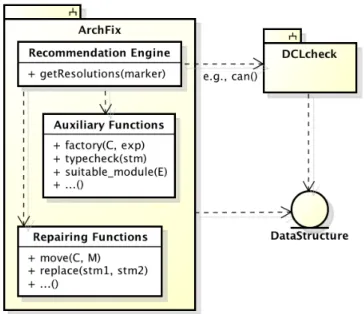
3.2 ArchFixarchitecture . . . 36
3.3 ArchFixinterface . . . 38
4.1 Distribution of the metric values in systems from the Qualitas.class Corpus 43 4.2 Top 3 ranking of similarity coefficients using all strategies . . . 51
4.3 General ranking using strategy [set,tt] . . . 54
4.4 # systems in which a particular coefficient presented the best result . . . . 54
5.1 Methodology followed in the evaluation . . . 59
5.2 Geplanes’ reflexion model . . . 62
A.1 inline( [ctx.getFoo()], foo, S) . . . 89
A.2 promote_param(setup(Foo), d, [foo.getDate()] ) . . . 90
A.3 unwrap_return(retrieve(), Foo,[obj] ) . . . 90
B.1 delegate(Bar::save(Connection) ) =Persistence::persist(Bar) . . . . 93
B.2 factory(Bar,{[5]}) =DAOFactory::getBar(int) . . . 94
B.3 gen_factory(Bar,{[‘a’],[5]}) . . . 94
List of Tables
3.1 Code templates . . . 27
3.2 Repairing functions . . . 28
3.3 Auxiliary functions . . . 30
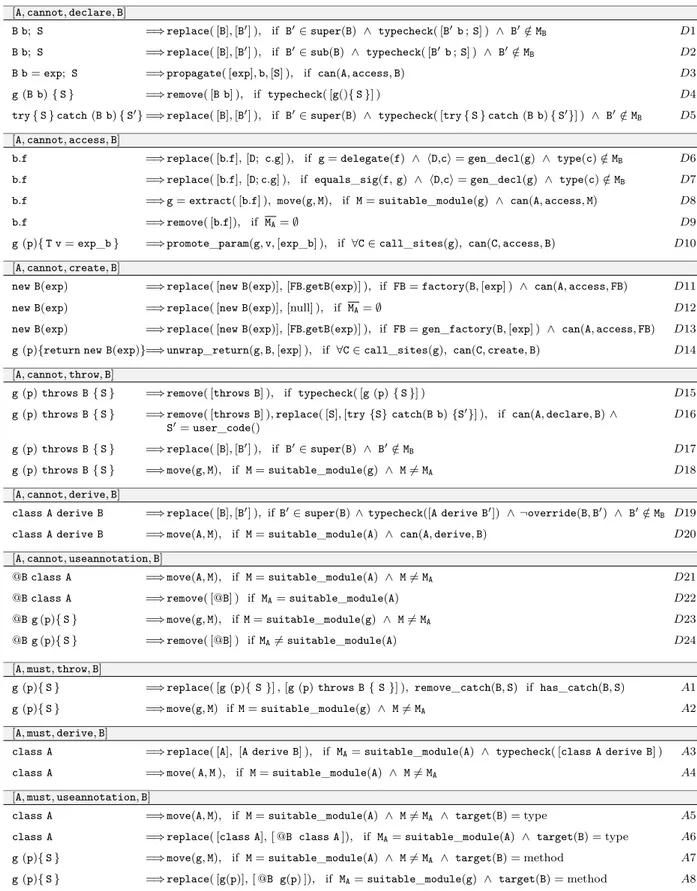
3.4 Repairing Recommendations . . . 32
4.1 Qualitas.class Corpus . . . 42
4.2 General Purpose Similarity Coefficients . . . 46
5.1 Target systems used in the evaluation . . . 58
5.2 Recommendations and correctness evaluation (Geplanes) . . . 62
5.3 Recommendations and correctness evaluation (BrTCom) . . . 65
5.4 Classification of the detected violations (focusing on correctness) . . . 66
5.5 Classification of the detected violations (focusing on complexity) . . . 69
D.1 The Qualitas.class Corpus . . . 103
Contents
Acknowledgments xi
Resumo xv
Abstract xvii
List of Figures xix
List of Tables xxi
1 Introduction 1
1.1 Problem . . . 1 1.2 An Overview of the Proposed Approach . . . 3 1.3 Outline of the Thesis . . . 4 1.4 Publications . . . 5
2 Background 7
2.1 Architectural Models . . . 7 2.2 Architecture Conformance . . . 8 2.3 Refactoring . . . 12 2.4 Remodularization . . . 16 2.5 Recommendation System . . . 18 2.6 Final Remarks . . . 20
3 The Proposed Recommendation System 23
3.1 Overview . . . 23 3.2 Basic Concepts . . . 24 3.3 Architectural Repairing Recommendations . . . 29 3.3.1 Training System . . . 29 3.3.2 Syntax and Auxiliary Functions . . . 29
3.3.3 Recommendations . . . 30 3.3.4 Algorithm . . . 33 3.3.5 Module Suitability . . . 34 3.4 TheArchFix Tool . . . 35
3.5 Discussion . . . 37 3.6 Final Remarks . . . 39
4 Evaluation of the Suitable Module Heuristic 41
4.1 The Qualitas.class Corpus . . . 41 4.1.1 Compilation Process . . . 42 4.1.2 Measurements . . . 43 4.2 Empirical Study on the Module Suitability . . . 44 4.2.1 Similarity Coefficients . . . 45 4.2.2 Strategies . . . 47 4.2.3 Evaluation . . . 49 4.3 Final Remarks . . . 55
5 Evaluation of the Recommendation System 57
5.1 Research Questions . . . 57 5.2 Target Systems . . . 58 5.3 Methodology . . . 58 5.3.1 Triggering Recommendations . . . 58 5.3.2 Correctness Evaluation . . . 59 5.3.3 Complexity Evaluation . . . 60 5.4 Geplanes Results . . . 61 5.5 BrTCom Results . . . 64 5.6 Analysis of Results . . . 66 5.7 Lessons Learned . . . 69 5.8 Threats to Validity . . . 70 5.9 Final Remarks . . . 71
6 Conclusion 73
6.1 Contributions . . . 74 6.2 Limitations . . . 74 6.3 Future Work . . . 75
Bibliography 77
Appendix A Repairing Functions 89
Appendix B Auxiliary Functions 93
Appendix C Description of Repairing Recommendations 95
Appendix D Metrics Data from the Qualitas.class Corpus 101
Chapter 1
Introduction
In this chapter, we state the problem and present our motivation(Section 1.1). We then
provide an overview of our proposed approach (Section 1.2). Finally, we present the
outline of the thesis (Section 1.3) and our publications (Section 1.4).
1.1
Problem
Software architecture erosion is one of the most evident manifestations of software ag-ing [76, 78, 25]. The phenomenon designates the progressive gap normally observed between two architectures: the intended architecture defined during the architectural design phase and the concrete architecture defined by the current implementation of the software system [111, 48, 55]. Causes of architectural erosion include deadline pressures, conflicting requirements, miscommunication, developers’ unawareness, and the lack of an explicit correspondence between architectural and programming lan-guage abstractions. Regardless the causes, when the erosion is neglected over long periods, it may reduce the concrete architecture to a small set of strongly-coupled and weakly-cohesive components, whose maintenance and evolution become increasingly more difficult and costly [88, 25].
To tackle the erosion process, the first task is to check whether the concrete ar-chitecture conforms to the intended one [50, 77, 26, 25]. More specifically, the goal of an architecture conformance process is to reveal the implementation decisions that denote architectural violations, i.e., the concrete statements, expressions, or declara-tions in the source code that do not match the constraints imposed by the intended architecture. For this purpose, several architecture conformance techniques have been proposed, including reflexion models [68], dependency structures matrices [96], source
2 Chapter 1. Introduction
code query languages [23], constraint languages [102, 44, 27], architecture description languages [2], and design tests [16].
After the conformance phase, the next task is to replace the detected violations with implementation decisions consistent with the intended architecture. However, this reengineering effort is usually a non-trivial and time-consuming task because software erosion is mostly a silent process that accumulates over years. For example, Knodel et al. described their experience of applying an architecture conformance process to a product line in the domain of portable measurement devices [47]. As a result, they identified almost 5,000 architectural divergences in three products of this product line. In a previous work [102], we described our own experience in applying conformance techniques to a human-resource management system. In this process, we were able to detect more than 2,200 architectural violations. As a last example, Sarkar et al. re-ported their experience in remodularizing a large banking application [88]. Recon-structing the original architecture of this system demanded 2,100 person-days just for coding and testing.
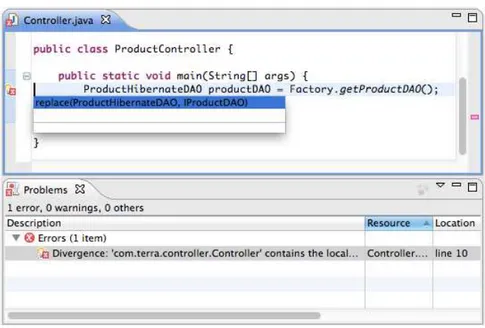
However, despite of its relevance and in contrast to the variety of techniques available for architecture conformance, the task of fixing architectural violations is usually performed in an ad hoc way. The only employed tools are often the automatic refactorings provided by today’s IDEs or simple program analysis tools, such as those that extract function-call information [88]. However, their application is too generic in most scenarios. As a first example, assume that a developer has created an object of type Product in a module where the creation of this object is not allowed. To fix
1.2. An Overview of the Proposed Approach 3
1.2
An Overview of the Proposed Approach
As stated in the previous section, the task of repairing architectural violations is non-trivial, time-consuming, and usually performed in ad hoc ways without adequate tool support at the architecture level. In order to address the lack of support for removing architectural violations, this thesis describes a solution based on recommendation sys-tem principles that provides repairing guidelines for developers and maintainers when fixing violations in the module architecture view of object-oriented systems.
As illustrated in Figure 1.1, considering a set of architectural violations raised by a static architecture conformance tool, the proposed recommendation system— calledArchFix—provides repairing recommendations to guide the process of fixing each
detected violation. For illustration purposes, we reconsider the motivating examples of the previous section. In the first example, when a developer creates an object of type
Product in a module where the creation of this object is not allowed, our system not
only suggests the application of aReplace Constructor by a Factory Method, but it also complements this information with the name of the Factory method that should be called in this particular context. In the second example, when a developer mistakenly implements a database operation outside a DAO, our system not only suggests the application of the Extract Method and Move Method refactorings, but it also indicates the most suitable target class where the extracted method should be moved to.
Figure 1.1: Proposed architectural repair recommendation system
First, we have formalized a catalog of repairing recommendations for addressing architectural violations, including violations due to divergences and absences. This set of 32 recommendations emerged after an in-depth investigation of possible fixes for more than 2,200 architectural violations we detected in a previously evaluated sys-tem [102]. Second, we have elaborated a suitable module heuristic to determine the correct module for source code entities based on their structural similarity. Third, we have designed a tool—called ArchFix—that implements our approach and hence
4 Chapter 1. Introduction
company—our approach triggered correct recommendations for 80% of the violations, as endorsed by the architects. Furthermore, the architects scored 80% of these recom-mendations as havingmoderate or majorcomplexity [106, 98, 99, 104, 105, 77].
Such a solution may represent a promising approach, i.e., it may represent a significant improvement to the state of the practice in architecture repair. On the other hand, it is worthwhile to mention that, by definition, an approach based on recommendations does not have the ambition to provide a fully sound and complete solution to remove architectural violations, which is certainly a task ahead of the state of the art in reengineering tools. In fact, even a bug-free implementation for typical refactorings, i.e., refactorings whose scope are limited to a few classes, has proved to be a complex task [95, 93].
1.3
Outline of the Thesis
We organized the remainder of this work as follows:
• Chapter 2 covers background work related to our research, such as archi-tectural models, architecture conformance approaches, refactoring techniques, remodularization methods, and recommendation systems;
• Chapter 3 provides a specification of the proposed architectural repair recom-mendation system, including the description of a subset of recomrecom-mendations, underlying algorithms, and the design of the ArchFixtool;
• Chapter 4 introduces the Qualitas.class Corpus and provides empirical evi-dences supporting the implementation decisions related to our suitable module heuristic. This heuristic is used by our approach to trigger recommendations that may involve moving methods or classes;
• Chapter 5 evaluates our approach by presenting and discussing results on applying the repairing recommendations in two real-world systems; and
1.4. Publications 5
1.4
Publications
This thesis generated the following publications and therefore contains material from them:
• Reference #106: Terra, R., Valente, M. T., Czarnecki, K., and Bigonha, R. S. (2013c). A recommendation system for repairing violations detected by static architecture conformance checking. Software: Practice and Experience, pages 1– 28.
• Reference #98: Terra, R., Brunet, J., Miranda, L. F., Valente, M. T., Serey, D., Castilho, D., and Bigonha, R. S. (2013a). Measuring the structural similar-ity between source code entities. In 25th International Conference on Software Engineering and Knowledge Engineering (SEKE), pages 753–758.
• Reference #99: Terra, R., Miranda, L. F., Valente, M. T., and Bigonha, R. S. (2013b). Qualitas.class Corpus: A compiled version of the Qualitas Corpus. Soft-ware Engineering Notes, 38(5):1–4.
• Reference #104: Terra, R., Valente, M. T., Bigonha, R. S., and Czarnecki, K. (2012a). DCLfix: A recommendation system for repairing architectural violations. In III Brazilian Conference on Software: Theory and Practice (CBSoft), Tools Session, pages 1–6. (2nd
best tool)
• Reference #105: Terra, R., Valente, M. T., Czarnecki, K., and Bigonha, R. S. (2012b). Recommending refactorings to reverse software architecture erosion. In 16th European Conference on Software Maintenance and Reengineering (CSMR), Early Research Achievements Track, pages 335–340.
Chapter 2
Background
In this chapter, we discuss background work related to our thesis. First, Section 2.1 describes different Architectural Models, including the one this thesis is based on. Sec-ond, Section 2.2 introduces Architecture Conformance approaches, which are related to our work in terms of providing the input of our approach. Third, Section 2.3 presents Refactoring techniques, since our approach also relies on primitive refactor-ings to repair architectural violations. Fourth, Section 2.4 discusses Remodularization approaches because they represent potential alternatives to architecture degradation. Fifth, Section 2.5 provides an overview on Recommendation Systems, since our ap-proach is based on recommendation principles. Finally, Section 2.6 concludes this chapter with a general discussion.
2.1
Architectural Models
Kruchten defines software architecture using the following five concurrent views: logical view (which defines the conceptual decomposition of the system), process view(which partitions the software in independent tasks),physical view(which maps software tasks to hardware elements),development view(which partitions a system into physical mod-ules or subsystems), and use case view (which defines the functions provided to the users by listing use cases) [53]. Each view addresses concerns of interest to different stakeholders. Particularly, our work is centered on thedevelopment view(a.k.a.module view), which describes the software’s static organization in its development environ-ment. It concerns low-level design decisions, patterns, and best practices. In practice, there are studies that refer to the development viewas a high-level software model [68]. Similarly, there are studies that ascribe the violations tackled by our approach as due to design erosionrather than architectural erosion [111, 16].
8 Chapter 2. Background
2.2
Architecture Conformance
Over the past decade, several techniques have been proposed to deal with the architecture erosion problem [77, 79]. Since our approach works on the violations detected as the result of a static architecture conformance process, an overview on architecture conformance techniques is relevant. This section therefore presents an overview of the following state-of-the-art techniques:
Reflexion Models (RM): The reflexion model technique was initially proposed by Murphy et al. [68, 69]. The main idea is to compare two models—representing a high-level and a low-high-level view of the target system [68, 69]. As a result, the technique highlights the detected differences in terms of divergences and absences in what the authors called a reflexion model. Basically, a divergence occurs when a relation not prescribed by the high-level model exists in the source code, whereas an absence occurs when a relation prescribed by the high-level model does not exist in the source code. There are commercial tools based on reflexion model principles [48, 55, 50, 49], besides several works extending the original reflexion model to support, for example, continuous conformance checking [11, 10], hierarchical structures [52], behavioral design [1], and software variants [51, 34].
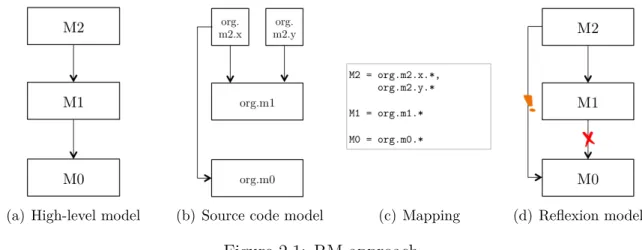
As an illustrative example, we rely on Fraunhofer IESE’s SAVE (Software
Archi-tecture Visualization and Evaluation) tool.1 The architect must first build a high-level model that captures the intended architecture of the system(Figure 2.1a). Such model
includes the main components of the system and the relations between them (e.g., calls, creates, and inherits). In this example, we assume a strictly layered system with mod-ulesM2,M1, andM0 (whereM0 represents the module in the lowest level of the hierarchy).
Hence, in this system, onlyMi must use services provided by module Mi−1, i >0.
(a) High-level model (b) Source code model (c) Mapping (d) Reflexion model
Figure 2.1: RM approach
1
2.2. Architecture Conformance 9
SAVE provides the automatic extraction of the source code model, i.e., the
im-plemented architecture of the system (Figure 2.1b). Next, the architect must define
a declarative mapping between the source code model and the high-level model
(Fig-ure 2.1c). In our example, module M2 contains all classes from packages org.m2.x
and org.m2.y, moduleM1 corresponds to packageorg.m1, and moduleM0 corresponds
to package org.m0. Finally, SAVE automatically computes the reflexion model
(Fig-ure 2.1d). In our example, a divergence was found because module M2 is directly using
services provided by moduleM0(as indicated by an exclamation mark). In addition, an
absence was also found since moduleM1 is not using the services provided by moduleM0
(as indicated by a cross mark).
Dependency Structure Matrices (DSMs): The concept of DSM was originally proposed by Baldwin and Clark to demonstrate the importance of modular design principles in the hardware industry [7]. Afterwards, Sullivan et al. argued that DSM could also be used in the software industry [96]. DSMs provide a scalable view of the established dependencies among classes of a system [87, 96]. A DSM is a weighted square matrix whose both rows and columns denote classes from an object-oriented system. An x in row A and column B of a DSM denotes that class (or module) B
depends on class (or module) A, i.e., B has explicit references to syntactic elements
of A. Another possibility is to represent in cell (A,B) the number of references that B
contains to A.
As an illustrative example, we rely on a DSM as computed by Lattix Inc’s Depen-dency Manager (LDM) tool.2 LDMincludes a simple language to declare design rules that
the target system implementation must follow. Basically, design rules have two forms:
A can-use BandA cannot-use B, indicating that classes in the setAcan (or cannot)
depend on classes in B. Violations in design rules are automatically detected by LDM
and visually represented in the extracted DSM. We assume again the aforementioned strictly layered system. Figure 2.2a illustrates the DSM automatically extracted from the source code. As can be observed, package org.m2.x depends on packages org.m1
and org.m0, and package org.m2.ydepends on package org.m1. In order to improve
the visualization, LDMsupports grouping and renaming of packages. Figure 2.2b
illus-trates the extracted DSM after packages org.m2.x and org.m2.y have been grouped
in a module named M2, and packages org.m1 and org.m0 have been renamed to M1
and M0, respectively.
In order to check architectural conformance, architects can define design rules. For example, Figure 2.2c shows a design rule that allows only M1 to depend on M0.
2
10 Chapter 2. Background
(a) Extracted DSM (b) DSM after grouping (c) Design rules (d) Checked DSM
Figure 2.2: DSM approach
First, this rule specifies that $root, which denotes all types of the system, cannot
access services provided by module M0. Next, an exception to the previous rule is
defined, specifying that classes in module M1 are able to use services of M0. As a
result, LDM highlights the existing dependencies from M2 to M0 as potential
viola-tions(Figure 2.2d). In contrast toSAVE,LDMdoes not provide means to detect absences.
Source Code Query Languages (SCQLs): SCQLs are usually employed to auto-mate a broad range of software development tasks, such as checking coding conventions, searching for bugs, computing software metrics, and detecting refactoring opportuni-ties [23]. In this section, we present how to apply a particular SCQL—Semmle’s.QL3—
to find potential architectural violations. As a concrete example, De Schutter success-fully used Semmle’s .QL to implement automated architectural reviews in a Belgian
electronic communications company [24].
.QL adopts an SQL-like syntax, which makes its query constructs familiar to
most software developers. Therefore, in order to check conformance, the architect is supposed to write queries for each architectural constraint. Assuming again the aforementioned strictly layered system, the architect can write the following query to detect unauthorized accesses to M0:
1 from R e f T y p e ref , R e f T y p e m0
2 where
3 ref .f r o m S o u r c e()
4 and not ( ref .g e t P a c k a g e(). getName (). matches ( " org . m0 " )
5 or ref .g e t P a c k a g e(). getName (). matches ( " org . m1 " ))
6 and m0 .g e t P a c k a g e(). getName (). matches ( " org . m0 " )
7 and d e p e n d s( ref , m0 )
8 select ref as Type ,
9 " A r c h i t e c t u r a l V i o l a t i o n : " + ref . g e t Q u a l i f i e d N a m e ()
10 + " uses " + m0 . g e t Q u a l i f i e d N a m e () as V i o l a t i o n
3
2.2. Architecture Conformance 11
In .QL queries, RefType represents any type for which references can be
estab-lished in the source code. RefType has functions such as getPackage() (that returns
the package where the type has been declared) and predicates such as fromSource()
(that checks whether the target type is part of the current project). The previous query checks whether there is a type ref in the current project that is not part of
the module M0 or M1 (lines 4-5) and that depends on a type of module M0 (lines 6-7).
The query returns the type ref that contains the architectural violation and its
description (lines 8-10). Despite the expressiveness of .QL, we consider SAVE and LDM
more suitable to architecture conformance purposes. On the other hand, SCQLs have a broader scope and hence they can be used for many other software engineering tasks.
Constraint Languages: The rationale behind constraint languages is to pro-vide architects with means to restrict the spectrum of structural dependencies. In this section, we describe DCL (Dependency Constraint Language), a domain-specific language that supports the definition of structural constraints between mod-ules [102, 100, 101, 91, 103]. Nevertheless, there is a wide range of constraint languages. For instance, SCL (Structural Constraint Language) [44], its predecessor FCL (Frame-work Constraint Language) [45], and LogEn [27] are first-order logic-based languages for specifying structural design constraints.
DCL provides constraints to capture both divergences and absences [68, 77]. To capture divergences, DCL allows architects to specify that dependencies only can,can only or cannot be established by specified modules. In addition, to capture absences, architects can specify that particular dependencies mustbe present in the source code. Moreover, DCL supports a fine-grained model for the specification of structural depen-dencies common in object-oriented systems, which can be generic (depend) or more
specific (e.g., access, declare, create, extend, etc.). However, since DCL relies on
static analysis techniques, it is not able to handle dynamic information or dependencies generated using reflection. A complete description of DCL is found at [102].
In order to check architectural conformance, the architect specifies the DCL con-straints, which are continuously enforced by the dclcheck tool.4 Assuming again
the aforementioned strictly layered system, the architect could specify the following constraints:
1 m o d u l e M0 : org . m0 .*
2 m o d u l e M1 : org . m1 .*
3
4 only M1 can-d e p e n d M0
5 M1 must-d e p e n d M0
4
12 Chapter 2. Background
First, we define the modules. Modules M0 and M1 include respectively all classes
from packages org.m0 and org.m1 (lines 1–2). To capture divergences, a constraint
states that onlyM1 can establish dependencies with M0 (line 4). On the other hand, to
capture absences, another constraint requires that classes fromM1depend onM0(line 5).
Other Techniques: Architecture Description Language (ADL), such as Darwin [60], Rapide [56, 57], Wright [3], and ACME [37], represent alternatives that can be used to provide architectural conformance by construction [63]. Such languages allow develop-ers to express the architectural behavior and the structure of software systems in an abstract and declarative language. Code generation tools can then be used to map ar-chitectural descriptions to source code in a given programming language. Nevertheless, ADLs require the use of specific architecture-based development tools and compilers, in order to keep the generated code synchronized with the architectural specification. A variant of this approach—such as ArchJava [2]—advocates the extension of
cur-rent programming languages with architectural modeling constructs, which in practice requires developers to use a new programming language.
In a novel line of research, Brunet et al. introduced the concept of design tests, which are test-like programs that automatically check whether the current implemen-tation conforms to a specific design rule [15, 16]. In contrast to DCL, where constraints are defined using a DSL, design rules are implemented as Java code in traditional JUnit test cases. As another approach to architecture conformance, Maffort et al. proposed a data mining approach for architecture conformance based on a combination of static and historical source code analysis that frees architects from specifying the architec-tural constraints [58, 59]. For this purpose, data mining techniques automatically extract architectural patterns and their tool—calledArchLint—uses these patterns to
indicate both absences and divergences in source-code based architectures.
2.3
Refactoring
2.3. Refactoring 13
Refactoring Basics: The concept of refactoring was first coined by Opdyke [75] and has been consolidated by Fowler [32] who has cataloged a collection of pro-gram transformations to improve the structural design of systems, i.e., refactorings. Refactoring is the process of changing a software system without modifying its exter-nal behavior in order to improve the design and understanding of the code. Refactorings are usually guided by bad smells, i.e., certain structures in the code or even intuitive signals that indicate the need for refactoring [32, 46]. As an example, the Extract Method refactoring turns a code fragment into a new method whose name explains its purpose. Some bad smells might motivate this refactoring, e.g., too long method or duplicated code. As another example, the Move Methodrefactoring moves a method f from a class C to another classC′ because f depends more on C′ than on its current
class C (Feature Envy).
Kerievsky proposes a set of coarse-grained refactorings that focus on improving the structure of systems with design patterns by applying sequences of well-known refactorings [46]. For example, he proposes the Move Creation Knowledge to Factory refactoring when data and code used to instantiate a class is spread across numerous classes (a bad smell). In this case, the author suggests the creation of a factory class to contain the factory methods and then update all direct instantiations to call the factory method. Analogously in this thesis, we intend to rely as much as possible on traditional refactorings to repair code that violates the existing system design.
By using four large data sets, Murphy-Hill et al. cast doubt on several previously stated assumptions about how programmers refactor the code, while supporting oth-ers [71]. They found that, for instance, programmoth-ers usually do not indicate refactoring activities in commit logs; refactoring tools are underused; and different refactorings are performed with and without tools. As one of the most relevant results related to this study, although they found that refactoring is indeed commonly practiced, manual refactoring is performed much more often than with a tool. Only very sim-ple refactorings showed the opposite tendency, e.g.,Rename MethodandRename Type.
Complexity: Although the understanding of refactorings is straightforward, the task of formalizing and automating them is not trivial [90, 12, 95, 108, 112, 75, 94, 93]. The mechanics behind refactorings is usually specified in natural language and does not cover all possible scenarios and preconditions. In fact, even a bug-free implementation for typical refactorings—i.e., refactorings whose scope are limited to few classes—has proved to be a complex task [95].
mod-14 Chapter 2. Background
ifiers (public, private, etc.) [95]. They argue that the problem is not caused by negli-gence of the programmers who implemented the tools, but due to the high complexity of object-oriented programming languages. In order to address accessibility problems, they formalized accessibility in Java as a set of constraints rules and provided a frame-work to check whether a refactoring affects the accessibility of program elements.
Whilst many refactorings have been proposed, Verbaere et al. argue that it would be desirable for programmers to script their own refactorings [112]. For this purpose, they proposed JunGL—a domain-specific language for refactoring—which can be seen as a hybrid of a functional language and a logic query language. For example, the authors were able to implement the well-known Rename Variableand Extract Method refactorings. Nevertheless, as a limitation, they have not regarded two major features of object-oriented languages: inheritance and accessibility.
Schäfer et al. described a new approach to specify how the refactorings should work using the concepts of dependency preservation, language extensions, and mi-crorefactorings [89]. Because refactoring implementations are commonly complex, hard to understand and maintain, their main goal is to provide modular specifications that are precise enough to serve as the basis of a reimplementation of existing refactorings. Indeed, they re-implemented all Eclipse refactorings and they noticed an improvement on size and clarity of the implementation.
Since it is known that mainstream refactoring engines contain critical bugs, Soares et al. proposed a technique to test Java refactoring engines [94, 93]. Basically, the refactoring under test is applied to hundreds of programs—exhaustively generated by a Java program generator— in order to detect behavioral changes. Their evaluation on 29 refactorings in Eclipse, NetBeans and the JastAdd Refactoring Tools identified 57 bugs related to compilation errors and 63 bugs related to behavioral changes.
In short, the aforementioned studies indicate problems and limitations on automating refactorings. For this reason, we do not intend to address such problems, but to delegate the repairing execution tasks to state-of-the-practice tools, such as the automatic refactorings provided by today’s IDEs.
2.3. Refactoring 15
Kerievsky proposed a set of refactorings that focus on design patterns [46]. On the one side, some of the proposed refactorings are motivated by existing bad smells, e.g., a too long method is a bad smell that may motivate a Replace Conditional Logic with Strategy refactoring. On the other side, other refactorings are motivated by new bad smells, e.g., the lack of information hiding—a new bad smell named Indecent Exposure—may motivate anEncapsulate Classes with Factory refactoring. Roock and Lippert proposed a set of complex refactorings, i.e., large restructurings that takes longer than a day and change significant parts of a system [84]. They mainly presented refactorings of API and relational database refactorings. More important, they identi-fied several architectural bad smells—i.e., bad smells that occur at a higher level of the design of a system—and indicated techniques to detect and to avoid them.
In the same line, Garcia et al. described four representative architectural smells— namely Connector Envy, Scattered Functionality, Ambiguous Interfaces, and Extra-neous Connector—that emerged from the re-engineering of two large industrial sys-tems [35, 36]. As an example, an Ambiguous Interface is an interface that offers only a single, general entry-point into a component. As the system evolves, ambiguous inter-faces reduce the system’s analyzability and understandability because developers have to inspect the component implementation to be aware of its provided services.
Tsantalis and Chatzigeorgiou proposed a semi-automatic approach to identify Move Method refactoring opportunities [108]. Their general goal is to tackle coupling and cohesion anomalies manifested in the form of the Feature Envy bad smell [32]. Similarly to our approach, they employed the notion of a similarity between an entity (attribute or method) and a class. For each method of the system,JDeodorantsuggests
the most appropriate class to be moved to—which is the class that has lower Jaccard distance and satisfies particular preconditions. JDeodorant has been recently extended to also identify Extract Method refactorings using an adaptation of program slicing techniques [109] and Extract Class refactorings [31].
In the same line, Sales et al. proposed a similar approach also based on the notion of similarity [86, 85]. However, while JDeodorantrelies on the set of accesses to
attributes and methods, JMove relies on the set of types that the method establishes
dependency with. Their evaluation on thirteen open-source systems indicated that
JMove was 49% more effective to detect misplaced methods than JDeodorant.
16 Chapter 2. Background
spec.benchmarksand demonstrated that some programs can be automatically
refac-tored to improve quality in terms of flexibility, reusability, and understandability. Wong et al. proposed an approach that detects modularity violations through algorithms that compare how components should change together according to their modular structure (structural coupling) with how components actually change together as revealed in version histories (change coupling) [114]. They evaluated their tool— called Clio—in 15 releases of Hadoop Common and 10 releases of Eclipse JDT. As
a result, they identified hundreds of violations that represent design problems or that were refactored in later versions.
In general terms, the ultimate goal of the aforementioned tools is to suggest refactorings that improve the internal quality of the code—for example, in terms of coupling and cohesion. On the other hand, the repairing recommendation system we propose in this thesis aims to help developers to handle violations exposed as the result of an architecture conformance process.
2.4
Remodularization
Remodularization approaches have been proposed as a potential solution for software aging [76, 78, 25, 111]. Remodularization is a process that changes the modular design of the system for the purposes of adaptation, evolution, or correction.5 As a matter of fact, architectural erosion is one of the most evident manifestations of software aging. When architecture erosion is neglected over the years, it may reduce the architecture to a set of strongly-coupled and weakly-cohesive components [13]. At a certain point, architecture conformance and refactoring techniques present themselves mostly inef-fective and a complete remodularization can be the only solution [42]. Therefore, this section describes some of the most relevant remodularization approaches reported in the literature.
Rama and Patel analyzed several remodularization efforts in order to define re-curring modularization operators [80]. More specifically, they formalized the following operators: module decomposition/union, file/function/data transfer, and function to API promotion. Their case study on Linux shows that some operators are continuously applied as the software evolves and therefore they argue that remodularization is not necessarily a one shot process. However, Rama and Patel do not provide tool support
5
2.4. Remodularization 17
for applying the proposed operators. Particularly in this thesis, we intend to design an approach that provides tool support and that can also be continuously applied as the system evolves.
Moghadam et al. proposed a remodularization approach that automatically refac-tors the source code of a system towards a desired design, provided in the format of a UML class diagram [65]. The proposed approach automatically compares the current and desired models and expresses the design differences as a set of detected refac-torings [115]. Although their evaluation indicated a high degree of accuracy, it was conducted in a very restricted context and hence the results may not be as good in real scenarios. Therefore, we intend to evaluate our architectural repair recommenda-tion system using real-world systems in order to avoid similar complaint. Although we would not be either able to extrapolate our results to other systems, we can argue that our evaluation was conducted in a real development scenario.
Bourquin and Keller argue that bad smells and code metrics should be comple-mented with the analysis of architectural violations to spot opportunities for high-impact refactorings, which are refactorings with a strong high-impact on the quality of the system’s architecture [14]. They report an experience of applying an iterative refactor-ing process that uses—besides traditional code metrics and well-known bad smells—an architectural conformance tool called Sotograph [9].
Hierarchical clustering is another technique commonly proposed to evaluate al-ternative software decompositions [5, 64]. However, the effectiveness of clustering in reengineering tasks is often challenged. For example, Glorie et al. reported an ex-periment in which clustering and formal concept analyses have failed to produce an acceptable partitioning of a monolithic medical imaging application [39]. As another example, using Eclipse as case study, Anquetil et al. reported that restructurings man-ually performed by developers do not necessarily improve modularity in terms of cohe-sion/coupling/cyclic dependencies [4]. Regardless the reasons, this finding undermines the validity of clustering techniques that aims to minimize coupling and maximize cohe-sion. For this reason, we do not intend to rely on traditional metrics in this thesis, but on structural similarity among source code entities to recommend move refactorings.
im-18 Chapter 2. Background
portant, reconstructing the original architecture of this banking application demanded 2,100 person-days. As another example, High and Sutton described the modulariza-tion approach adopted to reengineer Xenon, a large system that had outgrown its initial design [41]. The authors indicated design erosion as the most relevant signal of decay. More important, they employed tools for communication and enforcement— such as SVN commit hooks, FindBugs6, and Structure1017—to prevent architecture decay and consequently to avoid the need of further remodularizations. Besides pro-viding evidence of the complexity behind remodularizations, these studies motivate the development of new approaches and techniques—such as the one proposed in this thesis—that aim to prevent remodularization processes.
Chern and De Volter claimed that the static-dynamic coupling—i.e., the degree to which changes in a program’s modular structure imply changes in its dynamic behavior—is a major obstacle to software remodularization [18]. To alleviate this kind of coupling, they proposed a new language, called SubjectJ, which allows class implementations to be split across different files.
In conclusion, most of the difficulties faced during remodularizations are caused by the accumulation of the architectural erosion process over the years. As an evidence, Silva and Balasubramaniam claim thatarchitecture restoration strategies should com-plementarchitecture conformancestrategies in order to control architecture erosion [25]. For this reason, our goal in this thesis is to propose an approach that prevents large restructurings by providing suggestions to repair a violation as soon as it is detected.
2.5
Recommendation System
Recommendation Systems for Software Engineering (RSSEs) is an emerging research area [82]. An RSSE is a software application that provides potential valuable in-formation for a software engineering task in a given context. These systems com-bine computer science and engineering methods to proactively trigger suggestions that meet developers’ particular needs. From reusing code (e.g.,CodeBroker [116]) to
rec-ommending existing artifacts for development tasks (e.g., Hipikat [21]), RSSEs help developers in a wide range of activities. This section presents some RSSEs with the central objective to demonstrate the feasibility of a solution based on recommendation system principles with focus on software architecture repair.
Murphy-Hill et al. proposed seven principles for the design of code smell detec-tors [70]. For example, a code smell detector cannot block the programmer
(unob-6
http://findbugs.sourceforge.net
7
2.5. Recommendation System 19
trusiveness) and must explain why the smell exists (expressiveness). Particularly in this thesis, we intend to contemplate these principles in the design of our architectural repair recommendation system.
Some recommendation systems aim to raise the effectiveness and efficiency of software quality assurance tasks. As an example, Nagappan et al. proposed an ap-proach called Suade that provides suggestions for software investigation [72]. Suade
collects input data from several sources (bug database, version history, and source code), maps historical failures to existing entities, and then use a combination of metrics to best predict the failure probability of new entities. As another example, Zimmermann et al. proposed an approach called eRose that identifies program
arti-facts that are usually changed together [117]. For instance, when developers need to add a new preference to the Eclipse IDE and therefore have to change the fKeys[]
field and the initDefaults() method, eRose would recommend changing also the Plugin.properties file, because, according to previous software repository mining
results, they are always changed together. In contrast, instead of detecting poten-tial issues, our goal is to assist developers on repairing architectural violations already detected by a conformance technique.
Several recommendation systems have also been proposed to assist developers in using frameworks and APIs. McMillan et al. developed a recommendation system to provide source code examples to developers by querying against API calls and their official documentations [62]. On the other hand, Ye et al. proposed an approach that frees the developers from making queries [116]. They designed a reuse-conducive de-velopment environment called CodeBroker that analyzes comments and the signature
of the method under development to detect similarities to class library elements in order to help developers implement the described functionality. Similarly, Holmes et al. proposed a recommendation system, called Strathcona[43], which locates relevant
20 Chapter 2. Background
Dagenais et al. claim that finding suitable replacements for program elements deleted as part of a framework evolution can be a challenging task. Therefore, they pro-posed an approach called SemDiff that recommends replacement methods for
adapt-ing code to a new framework version, i.e., the tool finds suitable replacements for framework elements that are accessed by a client program but removed as part of the framework’s evolution [22]. Analogously, we intend to provide suitable replacements for implementation decisions that denote violations in the planned architecture of a software system.
RSSEs usually present little or no information about the consequences of the recommended changes. An exception is the system proposed by Muşlu et al. to inform developers on the consequences of code transformations [67]. They built an Eclipse plug-in—called QuickFixScout—that augments the Quick Fix dialog by adding the
number of compilation errors that remain after each proposal’s application (a technique they called speculative analysis). Their experiments demonstrate that developers can remove compilation-errors 10% faster when using their tool. Although their technique originally focuses on compilation errors, we intend to reuse it to prioritize our repairing recommendations when more than one can be triggered to fix an architectural violation. In spite of the fact that several recommendation systems have been proposed to assist developers in many software engineering tasks, there is no system whose precise goal is to help developers in tackling the architectural erosion process. In practice, to repair architectural violations, developers rely solely on their expertise to determine the most appropriate repair action, which may be a time-consuming task. In this thesis, we intend to address this shortcoming through a recommendation system that provides repairing guidelines for developers and maintainers when fixing architectural violations.
2.6
Final Remarks
This chapter provided the background necessary to the fully understanding of the ar-chitectural repair solution proposed in this thesis. In Section 2.1, we described different Architectural Models, including the one this thesis is based on. According to the soft-ware architecture definition by Kruchten [53], our work is centered on thedevelopment view, which describes the software’s static organization in its development environment. This view concerns low-level design decisions, patterns, and best practices.
2.6. Final Remarks 21
existence of a large number of conformance approaches, our goal in this thesis is to design an approach generic enough to be integrated to existing techniques and tools.
In Section 2.3, we emphasized the importance of refactorings to improve the design of software systems. We focused on the relevance of bad smells to spot oppor-tunities for refactoring. In this thesis, we intend to identify recurrent architectural violation repair tasks to define a catalog of architectural repairing recommendations.
In Section 2.4, we described several remodularization tools and techniques. We reported studies that show that remodularizations are usually performed when archi-tecture erosion is neglected over the years and consequently archiarchi-tecture conformance and refactoring techniques present themselves mostly ineffective.
Finally, in Section 2.5, we presented several Recommendation Systems for Soft-ware Engineering. Despite the fact that RSSEs can assist developers in a variety of software engineering tasks, we have not found recommendation systems whose precise goal is to help developers in tackling the architectural erosion process.
Chapter 3
The Proposed Recommendation
System
Chapter 2 provided the background for the full understanding of this thesis. This chap-ter then describes our approach: an architectural repair recommendation system that provides repairing guidelines for developers and maintainers when fixing architectural violations.
We organized this chapter as follows. Section 3.1 provides an overview of the proposed approach. Section 3.2 provides definitions for central concepts needed to fol-low our approach, such as architectural model, architectural violations, architecturally defective code, and repairing recommendations. Section 3.3 presents a specification of the proposed architectural repair recommendation system, including the descrip-tion of a subset of recommendadescrip-tions, underlying algorithms, and similarity funcdescrip-tions. Section 3.4 describes the design and implementation of theArchFixtool. Finally,
Sec-tion 3.5 provides a critical discussion about the proposed approach and SecSec-tion 3.6 concludes with a general discussion.
3.1
Overview
As outlined in Chapter 2, although several architecture conformance techniques have been proposed to detect architectural violations (e.g., reflexion models [68], dependency structure matrices [87], source code query languages [23], constraint languages [102], architecture description languages [2], and design tests [16]), the task of repairing archi-tectural violations is still conducted without the adequate support. More specifically, developers usually perform the repairing task in ad hoc ways, without tool support at the architectural level. As a consequence, developers may spend a long time discovering
24 Chapter 3. The Proposed Recommendation System
how to repair architectural violations and they can even introduce new violations when repairing one. Thereupon, we argue that the task of repairing architectural violations should not be addressed in an ad hoc way because architecture repair—although not trivial—is as important asarchitecture conformance checking.
In view of such circumstances, we propose an architectural repair recommenda-tion system whose main purpose is to provide repairing guidelines for developers and maintainers when fixing violations in the module architecture view of object-oriented systems. As illustrated in Figure 3.1, considering a set of architectural violations raised by a static architecture conformance tool, the proposed recommendation engine—called
ArchFix—provides repairing recommendations to guide the process of fixing each
de-tected violation.
Figure 3.1: Proposed approach
For example, when a class implemented in a wrong module is detected, ArchFix
may suggest a Move Method refactoring to fix the violation, including a suggestion of a target class. As another example, when misusing the programming to interfaces principle [33], our approach may suggest the replacement of a type with one of its most appropriate supertypes. As a last example, when bypassing layers, our recommendation system may suggest the replacement of an unauthorized call with a call to a delegate method. A complete list of the proposed recommendations is presented in Section 3.3.3.
3.2
Basic Concepts
In this section, we provide definitions for the following fundamental concepts employed in this thesis: recommendation system, architectural model, architectural violation, architecturally defective code, and repairing recommendation.
Recommendation System: A recommendation system is a software system that provides potentially valuable information in a given context [82, 81, 17]. As mentioned in Section 2.5 (page 18), in the particular context of software engineering,
3.2. Basic Concepts 25
code to a new library version (e.g., SemDiff [22]). In this thesis, we propose a novel recommendation system, calledArchFix, which provides repairing recommendations to
fix architectural violations. The proposed system is defined by the following function:
Arch. Model x Arch. Violation x Arch. Defective Code−→Repairing Recommendation
In short, our system receives as input the intended architectural model (Arch. Model), the description of the violation (Arch. Violation), and the piece of source code that raised the architectural violation (Arch. Defective Code). ArchFix then returns a
Repairing Recommendationthat might be useful to fix such violation. In the remainder of this section, we discuss such elements in more detail.
Architectural Model: Kruchten defines software architecture using five concurrent views, each one addressing a specific set of concerns of interest to different stakehold-ers [53]. Particularly, our work is centered on the development view (a.k.a. module view), which describes the software’s static organization in its development environ-ment. It concerns low-level design decisions, patterns, and best practices. From this viewpoint, an object-oriented software architecture is defined by a set of modules and their interactions, where we consider a module as a set of classes [102]. Therefore, we model relations at the level of classes. More specifically, a dependency (A,dep,B) is
established whenever a class A uses services provided by a target class B. We consider
that dependencies can be established using the following types of common operations in object-oriented languages (i.e., these types are possible values of thedepfield):
call-ing methods or attributes (access), declaring variables (declare), creating objects
(create), extending classes (extend), implementing interfaces (implement), throwing
exceptions (throw), or using annotations (useannotation). For example, the relations
(A,create,B) and (A,access,B) indicate that class A creates and calls methods of an
object of type B, respectively.
The architectural model considered by ArchFixis expressed in terms of
architec-tural constraints, which are formalized as follows:
M odule1 [cannot|must]−dep M odule2
where dep denotes the dependency type, i.e., dep can be access, declare, create,
etc. As an illustrative example, assume thatMA andMB are modules, i.e., sets of classes.
A constraint in the form MA cannot-dep MB indicates that types from module MA
cannot establish a dependency of the dep kind with types from module MB, e.g.,
26 Chapter 3. The Proposed Recommendation System
MA must-dep MB indicates that types from module MA must establish a dependency of
the depkind with types from module MB, e.g., DTO must-implement Serializable.
Architectural Violation: Basically, there are two types of violations in the static ar-chitecture of software systems: divergences(when an existing dependency in the source code violates the architectural model) andabsences(when the source code does not es-tablish a dependency that is prescribed by the architectural model) [68, 50, 77]. In our approach,divergences occur when architectural constraints of type cannot are not
re-spected by the source code. Conversely, absences occur when architectural constraints of typemust are not respected.
We consider that an architectural violation is defined by a tuple [A,viol_type,dep,B], where (A,dep,B) is the dependency that caused the
vio-lation and viol_type indicates whether the violation is due to a divergence or an
absence. To increase readability, when expressing a value for viol_type we use the
wordscannotandmustto denote divergences and absences, respectively. For example,
a violation [ProductView,cannot,access,ProductModel] denotes a divergence where
a classProductViewisaccessing an object of typeProductModel. As another example,
a violation [ProductDTO,must,implement,Serializable] denotes an absence when
the classProductDTO is not implementing the interface Serializable.
Formal Definition: Assume that MA and MB are modules, A and B are classes, and
that dep denotes a dependency type, i.e., dep can be access, declare, create, etc.
A violation of a constraint in the form MA cannot-dep MB happens whenever
∃A∃B [A∈MA ∧ B∈MB ∧ establishes(A,dep,B) ]
where the predicate establishes checks whether there is a dependency of type dep
fromAtoB. Conversely, a violation of a constraint in the formMA must-dep MB happens
whenever
∃A∄B [A∈MA ∧ B∈MB ∧ establishes(A,dep,B) ]
cov-3.2. Basic Concepts 27
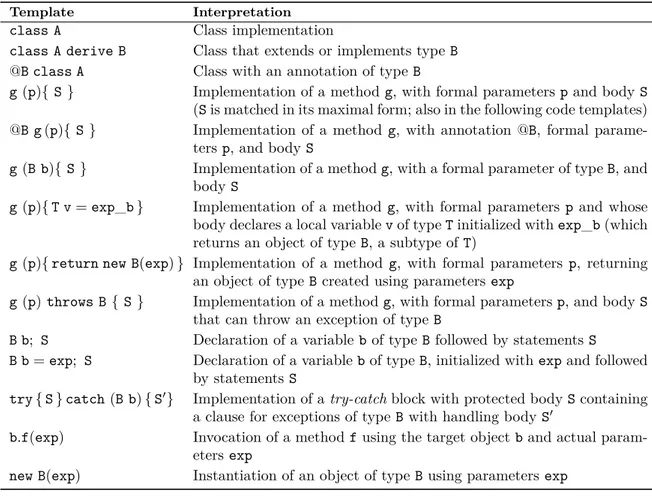
Table 3.1: Code templates
Template Interpretation
class A Class implementation
class A derive B Class that extends or implements typeB
@B class A Class with an annotation of typeB
g(p){S} Implementation of a methodg, with formal parameterspand bodyS
(Sis matched in its maximal form; also in the following code templates) @B g(p){S} Implementation of a method g, with annotation @B, formal
parame-tersp, and bodyS
g(B b){S} Implementation of a methodg, with a formal parameter of typeB, and bodyS
g(p){T v=exp_b} Implementation of a method g, with formal parameters pand whose body declares a local variablevof typeTinitialized withexp_b(which returns an object of typeB, a subtype ofT)
g(p){return new B(exp)} Implementation of a method g, with formal parameters p, returning
an object of typeBcreated using parametersexp
g(p)throws B{S} Implementation of a methodg, with formal parametersp, and bodyS
that can throw an exception of typeB
B b; S Declaration of a variablebof typeBfollowed by statementsS
B b=exp; S Declaration of a variablebof typeB, initialized withexpand followed by statementsS
try{S}catch(B b){S′} Implementation of atry-catchblock with protected bodyScontaining
a clause for exceptions of typeBwith handling bodyS′
b.f(exp) Invocation of a methodfusing the target objectband actual param-etersexp
new B(exp) Instantiation of an object of typeBusing parameters exp
ers instantiations of a given class B. As another example, consider the architectural
constraint UI cannot−access Barand the class Screen presented in Code 3.1.
1 p u b l i c c l a s s S c r e e n {
2 p r i v a t e Bar bar;
3 ...
4 p u b l i c void init () {
5 ...
6 bar.foo(13 , ’b ’ );
7 }
8 }
Code 3.1: Code template matching example
Assuming that Screen is located in module UI, a violation
[Screen,cannot,access,Bar] is raised by the call bar.foo(13,‘b’) located at
28 Chapter 3. The Proposed Recommendation System
Repairing Recommendation: In our approach, the recommendations consist in a repair activity to fix an architectural violation. In fact, arepairing recommendationis a sequence of repairing operations, using the functions described in Table 3.2. Although most repairing functions are familiar, Appendix A provides a detailed description of the following particular functions: inline, promote_param, andunwrap_return.
Partic-ularly, we may suggest transformations that may change the semantics/behavior of the system and may also not be well-formedness preserving. An in-depth discussion on the behavior preservation of our repairing recommendations is presented in Section 3.5.
Table 3.2: Repairing functions
Function Description Type
extract(stm) Applies anExtract Methodrefactoring [32] with the set of
state-mentsstm
ct
inline(exp,v,S) Inlinesexpin the uses of variablevin the block of codeS(see
Appendix A)
ct
move(f,M) Moves method fto the most suitable class in module M, i.e., applies aMove Methodrefactoring [32]
mv
move(C,M) Moves classCto moduleM, i.e., applies aMove Class refactor-ing [32]
mv
promote_param(f,v,exp) Promotes variablev to a formal parameter of methodf; exp
is used as the additional argument in the calls to f(see Ap-pendix A)
ct
replace(S1,S2) Replaces block of codeS1 withS2 ct
remove(S) Removes block of codeS, which is equivalent toreplace(S, φ) ct
remove_catch(Ex,S) Removes the catch clause for exception Exfrom thetry-catch
blockS
ct
unwrap_return(f,T,exp) Modifies the return type of methodfto the type of expand
moves the instantiations of the wrapper typeTto the respective call sites (see Appendix A)
ct
As reported in Table 3.2, the recommendations include two types of transforma-tions:
• (ct) stands for a code transformation, which is a repair action more common to handle divergences. For instance, suppose that a given module should not use List objects, but it can use Collection. In this case, function replace([List],[Collection]) locally replaces a declaration of the unauthorized
type List with its supertype Collection. As another example, we can
men-tion a repair acmen-tion that promotes a local variable to a formal parameter. In this case, function promote_param(f,v,exp) locally modifies the method and
globally adjusts call sites of the respective method.