In Vivo
Sensitivity of Fluconazole to
Candida albicans via
Rta2p
Yu Jia1,2., Ren-Jie Tang1., Lin Wang1
, Xiang Zhang3, Ying Wang4, Xin-Ming Jia2*, Yuan-Ying Jiang1*
1School of Pharmacy, Second Military Medical University, Shanghai, China,2Department of Immunology, Tongji University School of Medicine, Shanghai, China,
3Department of Neurosurgery, Tenth People’s Hospital, Tongji University School of Medicine, Shanghai, China,4Department of Dermatology, Changhai Hospital, Second Military Medical University, Shanghai, China
Abstract
Due to the emergence of drug-resistance, first-line therapy with fluconazole (FLC) increasingly resulted in clinical failure for the treatment of candidemia. Our previous studies found that in vitro RTA2 was involved in the calcineurin-mediated resistance to FLC inC. albicans. In this study, we found that calcium-activated-calcineurin significantly reduced thein vitro sensitivity ofC. albicansto FLC by blocking the impairment of FLC to the plasma membraneviaRta2p. Furthermore, we found thatRTA2 itself was not involved inC. albicans virulence, but the disruption ofRTA2 dramatically increased the therapeutic efficacy of FLC in a murine model of systemic candidiasis. Conversely, both re-introduction of oneRTA2allele and ectopic expression ofRTA2significantly reduced FLC efficacy in a mammalian host. Finally, we found that calcium-activated-calcineurin, through its target Rta2p, dramatically reduced the efficacy of FLC against candidemia. Given the critical roles of Rta2p in controlling the efficacy of FLC, Rta2p can be a potential drug target for antifungal therapies.
Citation:Jia Y, Tang R-J, Wang L, Zhang X, Wang Y, et al. (2012) Calcium-Activated-Calcineurin Reduces theIn VitroandIn VivoSensitivity of Fluconazole to Candida albicans viaRta2p. PLoS ONE 7(10): e48369. doi:10.1371/journal.pone.0048369
Editor:Gustavo Henrique Goldman, Universidade de Sao Paulo, Brazil
ReceivedMay 21, 2012;AcceptedSeptember 24, 2012;PublishedOctober 30, 2012
Copyright:ß2012 Jia et al. This is an open-access article distributed under the terms of the Creative Commons Attribution License, which permits unrestricted use, distribution, and reproduction in any medium, provided the original author and source are credited.
Funding:This study was supported by the National Science Foundation of China (30900055, 30825041 and 90913008). The funders had no role in study design, data collection and analysis, decision to publish, or preparation of the manuscript.
Competing Interests:The authors have declared that no competing interests exist. * E-mail: [email protected] (X-MJ); [email protected] (Y-YJ)
.These authors contributed equally to this work.
Introduction
Candida species are serious human fungal pathogens among immuno-compromised individuals such as patients with AIDS and patients undergoing organ transplantation, parenteral nutrition and radiation treatment for cancer [1]. Candida blood stream infections (candidemia) are life threatening among hospitalized immune-compromised patients, including neonates [2,3]. Despite available therapy options, the mortality rate directly attributable to candidemia is high, ranging from 32% to 54%, depending on the population and the species studied [4,5,6]. Today, candidemia leads to additional ICU length of stay and costs, the annual treatment cost is at least £16.2 million [7,8]. Although infections with non-albicansCandida species have emerged in recent years, Candida albicansis still responsible for the majority of cases [9,10]. To date, only four classes of antifungal drugs are clinically available for treatment of systemic fungal infections: polyenes (amphotericin B), pyrimidines (particularly 5-fluorocytosine), azoles (e.g. fluconazole, FLC) and echinocandins (e.g. caspofungin) [11,12]. Among these, azole antifungal drugs, such as FLC, are commonly used in the treatment of invasive candidiasis, and the mechanism of action of these drugs involves the blockade of ergosterol synthesis through the competitive inhibition of 14a -demethylase, which is encoded byERG11gene. Consequently, the inhibition of the enzyme leads to accumulation of 14-methylated sterols that can cause disruption of fungal membranes [13].
We previously established that calcium-upregulated expression ofRTA2dramatically reduced the sensitivity ofC. albicansto FLC by blocking its impairment to the fungal plasma membrane [22]. The expression of RTA2 was under the control of the calcium-activated-calcineurin via its transcriptional factor Crz1p in C. albicans [22]. However, it is unclear whether calcium-activated-calcineurin mediatesin vitroandin vivoresponses to FLCviaRta2p in C. albicans. Moreover, the therapeutic potential of targeting Rta2p remains elusive. Here, we investigated the possible influences ofRTA2expression on thein vitroandin vivoresponses to FLC mediated by the calcium-activated-calcineurin in C. albicans.
Results
Calcium-activated-calcineurin Dramatically Reduces
in vitroSensitivity to FLCviaRta2p inC. albicans
It has been well documented that the phosphatase activity of calcineurin, consisted of a catalytic subunit A (encoded byCNA) and a regulatory subunit B (encoded byCNB1), can be activated by calcium ions and then regulate its target gene expression via transcriptional factor Crz1p [23]. In order to identify whether calcium-activated-calcineurin mediates thein vitroresponse to FLC viaRta2p in C. albicans, we sequentially disrupted two alleles of RTA2 gene in either cnaD/D or crz1D/D null mutant strains (Table 1), which were verified by Southern blot analysis with a probe specific to theRTA2promoter (Figure S1). And thenRTA2, CNA or CRZ1 was selectively re-introduced into either cnaD/D
rta2D/D or crz1D/D rta2D/D mutant at the ade2 locus as determined by PCR (Figure S2A and S2B). Calcium treatment significantly up-regulated the expression ofUTR2, a known target gene of the calcineurin pathway [23] in both rta2D/D cnaD/ D::CNA and rta2D/D crz1D/D::CRZ1 complemented strains (Figure S3A), which confirmed that the function of the calcineurin pathway had been restored. The expression of RTA2 had no changes in both cnaD/D rta2D/D::RTA2 and crz1D/D rta2D/ D::RTA2complemented strains when treated with calcium (Figure S3B). These results confirmed that the expression ofRTA2 was under the control of the calcium-activated-calcineurin via its transcriptional factor Crz1p inC. albicans.
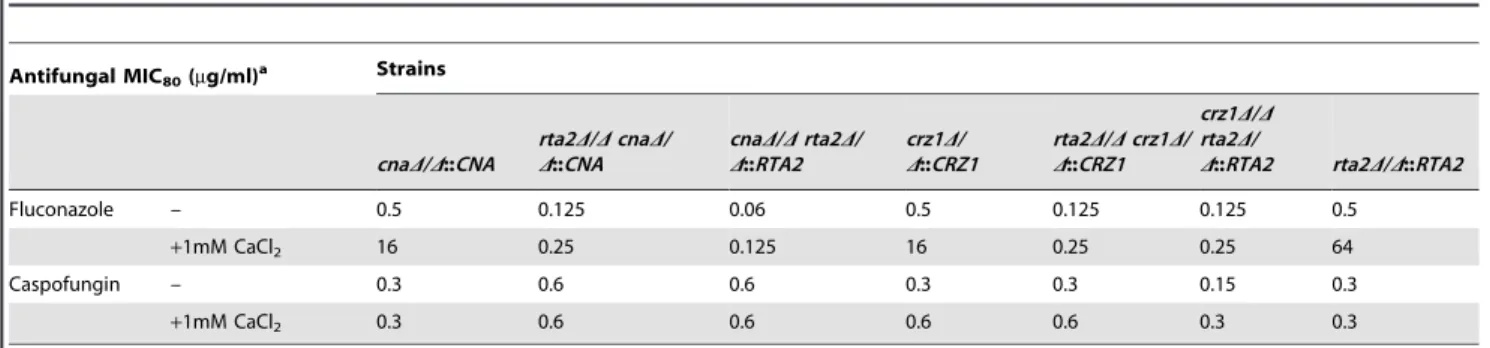
And then the influences of calcium signaling on the sensitivities of above-constructed mutants to FLC were examined. The addition of calcium (1 mM) significantly reduced the sensitivities of FLC to bothcnaD/D::CNAandcrz1D/D::CRZ1complemented strains, with an increase of MIC80s(Minimum Inhibitory Concen-tration for 80%)from 0.5 to 16mg/ml (Table 2). However, re-introduction of anyone ofCNA,CRZ1andRTA2could not restore the effect of calcium on reducing FLC sensitivities to comple-mented strains including rta2D/D cnaD/D::CNA, cnaD/D rta2D/ D::RTA2, rta2D/D crz1D/D::CRZ1 and crz1D/D rta2D/D::RTA2 (Table 2). But the effect of calcium on reducing FLC sensitivity was completely restored in the rta2D/D::RTA2 complemented strain, with an increase of MIC80s from 0.5 to 64mg/ml (Table 2). In contrast to the results presented above, the addition of calcium (1 mM) had no effect on the antifungal activity of caspofungin in all tested strains (Table 2). Taken together, these results suggested that calcium-activated-calcineurin dramatically reduced thein vitro sensitivity to FLCviaRta2p inC. albicans(Figure S4).
Calcium-activated-calcineurin Blocks the Impairment of FLC to the Plasma Membrane of
C. albicans
viaRta2pIn our previous study, it was found that the depletion ofRTA2 made the plasma membranes ofC. albicansliable to be destroyed by FLC and calcium-upregulated expression ofRTA2attenuated
the destroying effects [22]. In the present study, transmission electron microscopy was performed to observe the ultra-structure changes ofcrz1D/D::CRZ1,rta2D/Dcrz1D/D::CRZ1andcrz1D/D
rta2D/D::RTA2complemented strains in the presence or absence of FLC or FLC plus calcium. High magnification of these three untreated or calcium-treated complemented strains showed intact cell membranes (Figure 1 A to F). As shown in Figure 1G and 1M, the cell membranes of thecrz1D/D::CRZ1 complemented strain remained intact when treated with 2mg/ml FLC and were modestly damaged when treated by 8mg/ml FLC. Surprisingly, the addition of calcium could completely attenuate the destroying effects of FLC to the plasma membrane of crz1D/D::CRZ1 complemented strain (Figure 1N). However, re-introduction of one CRZ1 or RTA2 allele into crz1D/D rta2D/D mutant failed to attenuate the destroying effects of 2mg/ml FLC to the plasma membranes of eitherrta2D/Dcrz1D/D::CRZ1orcrz1D/Drta2D/ D::RTA2complemented strains (Figure 1I and 1K). And extensive
solubilization of intracytoplasmic inclusion bodies was seen in eitherrta2D/Dcrz1D/D::CRZ1 orcrz1D/D rta2D/D::RTA2 com-plemented strains when treated by 8mg/ml FLC (Figure 1O and 1Q). The addition of calcium also failed to attenuate the destroying effects of FLC to the plasma membranes of either rta2D/Dcrz1D/D::CRZ1orcrz1D/Drta2D/D::RTA2 complement-ed strains (Figure 1 P and R). Taken together, these results suggested a model in which the calcium-activated-calcineurin blocked the impairment of FLC to the plasma membrane ofC. albicans viaRta2p.
Rta2p is Critical for the Therapeutic Efficacy of FLC Against Candidemia
It has been well documented that calcineurin is essential for the virulence of C. albicansin systemic infection models and for the emergence of FLC resistance to C. albicans [24,25]. As a target gene of the calcineurin pathway [22], the influence ofRTA2on either virulence or efficacy of FLC remains unknown. To examine the influence ofRTA2onC. albicansvirulence, groups of 20 mice were intravenously injected with the wild type,rta2D/Dmutant and rta2D/D::RTA2 complemented strains, and the survival of mice was monitored for 30 days. As shown in Figure 2A, the comparison of the survival times among groups of mice infected by the wild-type,rta2D/Dmutant andrta2D/D::RTA2complemented strains showed no significant differences. Furthermore, both the tissue burdens and histological analysis determined at day 3 post-inoculation consistently showed similar phenotypes (Figure 2 B and 2C). These findings proved thatRTA2was not involved in the virulence ofC. albicans.
Ectopic Expression of RTA2Reduced the Efficacy of FLC Against Candidemia
In order to verify the direct influences ofRTA2on the efficacy of FLC, the expression ofRTA2ORF was put under the control of the oestradiol-inducibleCDR2promoter (pCDR2) and the plasmid pCDR2-RTA2 was introduced into aC. albicansmutant (DSJ101) with deletion of drug-resistance-related genes including CDR1, CDR2,CaMDR1,FLU1andRTA2at theade2locus as determined by PCR (Figure S2C). Up-regulation of RTA2 in DSJRTA2 harboring the plasmid pCDR2-RTA2 by oestradiol was confirmed by quantitative RT-PCR (Figure S3C).
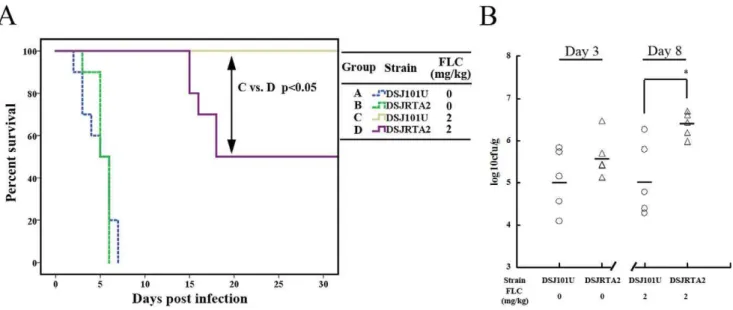
Survival analysis showed that DSJRTA2 and its parental strain (DSJ101U) had similar virulence, and all mice died within 10 days
(Figure 3A). The kidney fungal burdens, determined at day 3 post-inoculation, consistently reflected virulence phenotypes observed between DSJRTA2 and DSJ101U (Figure 3B), which confirmed thatRTA2was not involved inC. albicansvirulence. Of note, FLC treatment made all DSJ101U-infected mice survive during the experiments (Figure 3A). However, only 50% of the DSJRTA2-infected mice survived after treatment with FLC (Figure 3A). Kidneys of mice infected with DSJRTA2 exhibited a significantly higher fungal burden than mice infected with its parental strain DSJ101U (P,0.05, Figure 3B). Therefore, these results suggested that Rta2p directly affects the efficacy of FLC against candidiasis.
Table 1.C. albicansstrains used in this study.
Strain Parental strain Genotype Reference
RM1000 RM100 ura3D::imm434
/ura3D::imm434
, his1D::HisG/his1D::HisG, iro1D::imm434
/iro1D::imm434
[55]
RM1000U RM1000 RM1000*ADE2/ade2::URA3 This study
JXM101 JXM100 RM1000*rta2D::hisG/rta2D::hisG [22]
JXM201 JXM101 RM1000*rta2
D::hisG/rta2D::hisG ADE2/ade2::RTA2/URA3 [37] JXM101U JXM101 RM1000*rta2D::hisG/rta2D::hisG ADE2/ade2::URA3 This study
CAF2-1 SC5314 ura3D::imm434/URA3 [56]
DSY2091 CAF4-2 cnaD::hisG/cnaD::hisG::URA3::hisG [23]
DSY2115 DSY2101 cnaD::hisG/cnaD::hisG; LEU2::CNA::URA3 [18]
DSY2195 DSY2188 crz1D::hisG/crz1D::hisG::URA3::hisG [23]
MKY268 MKY59 crz1D::hisG/crz1D::hisG LEU2::CRZ1/URA3 [23]
DSY2101 DSY2091 cnaD::hisG/cnaD::hisG [18]
DJY201 DSY2101 rta2D::hisG/rta2D::hisG cnaD::hisG/cnaD::hisG This study
DJYCNA DJY201 rta2D::hisG/rta2D::hisG cnaD::hisG/cnaD::hisG ADE2/ade2::CNA/URA3 This study
DJYRTA2 DJY201 cnaD::hisG/cnaD::hisG rta2D::hisG/rta2D::hisG ADE2/ade2::RTA2/URA3 This study
MKY59 DSY2195 crz1D::hisG/crz1D::hisG [23]
MJY201 MKY59 rta2D::hisG/rta2D::hisG crz1D::hisG/crz1D::hisG This study
MJYCRZ1 MJY201 rta2D::hisG/rta2D::hisG crz1D::hisG/crz1D::hisG ADE2/ade2::CRZ1/URA3 This study
MJYRTA2 MJY201 crz1D::hisG/crz1D::hisG rta2D::hisG/rta2D::hisG ADE2/ade2::RTA2/URA3 This study DSY9u DSY1024 cdr1D::hisG/cdr1D::hisG cdr2D::hisG/cdr2D::hisG camdr1D::hisG/camdr1D::hisG flu1D::hisG/flu1D::hisG This study
DSJ101 DSJ100 DSY9u#
rta2D::hisG/rta2D::hisG [57]
DSJRTA2 DSJ101 DSY9u#
rta2D::hisG/rta2D::hisG ADE2/ade2::pCDR2-RTA2/URA3 This study
DSJ101U DSJ101 DSY9u#
rta2D::hisG/rta2D::hisG ADE2/ade2::URA3 This study
*RM1000 background; #
DSY9u background.
doi:10.1371/journal.pone.0048369.t001
Table 2.Effects of calcium on the antifungal activityversusmutantC. albicansstrains.
Antifungal MIC80(mg/ml)a Strains
cnaD/D::CNA
rta2D/DcnaD/
D::CNA
cnaD/Drta2D/
D::RTA2
crz1D/
D::CRZ1
rta2D/Dcrz1D/
D::CRZ1
crz1D/D
rta2D/
D::RTA2 rta2D/D::RTA2
Fluconazole – 0.5 0.125 0.06 0.5 0.125 0.125 0.5
+1mM CaCl2 16 0.25 0.125 16 0.25 0.25 64
Caspofungin – 0.3 0.6 0.6 0.3 0.3 0.15 0.3
+1mM CaCl2 0.3 0.6 0.6 0.6 0.6 0.3 0.3
aMIC
80s were determined after 48 h incubation and all experiments were performed in triplicate.
Calcium-activated-calcineurin, through its Target Rta2p, Significantly Reduces the Efficacy of FLC Against Candidemia
The expression ofRTA2 has been reported to be under the control of the calcium-activated-calcineurinviaits transcriptional factor Crz1p inC. albicans[22,23]. Since mammalian contains a range of ionized calcium in whole blood (0.94–1.33 mM) [26], it was examined whether the calcineurin pathway ofC. albicanscould be activated by ionized calcium in serum and then the calcium-activated-calcineurin mediated in vivo responses of C. albicans to FLCviaRta2p.
After receiving FLC treatment, survival analysis showed that re-introduction of either one CRZ1 or RTA2 allele into crz1D/D
rta2D/Dmutant led to 100% of survival (Figure 4A). However, re-introduction of oneCRZ1allele intocrz1D/Dmutant significantly reduced survival rate to 50% (Figure 4A). The fungal burdens of mice infected with thecrz1D/D::CRZ1complemented strain were significantly higher than those infected with either the rta2D/D
crz1D/D::CRZ1orcrz1D/Drta2D/D::RTA2complemented strains (P,0.05 and P,0.01, respectively; Figure 4B). Histological analysis with HE staining also showed that kidney damage was aggravated in mice infected with crz1D/D::CRZ1 complemented strain infected when compared with either rta2D/D crz1D/ D::CRZ1 or crz1D/D rta2D/D::RTA2 complemented strains (Figure 4C). PAS staining also revealed a large number of fungi
in kidneys from thecrz1D/D::CRZ1complemented strain infected mice and hardly any fungi in mice infected with either therta2D/D
crz1D/D::CRZ1orcrz1D/Drta2D/D::RTA2complemented strains (Figure 4C). Therefore, the results of H&E and PAS staining were consistent with those of survival analysis and kidney fungal burdens. Overall, ionized calcium in mice serum could not reduce the efficacy of FLC against bloodstream infection withC. albicans mutants due to their lack of eitherCRZ1orRTA2, which indicated that calcium-activated-calcineurin affects the efficacy of FLC against candidemiaviaRta2p.
Discussion
FLC has long been the drug of choice for candidemia, owing to its excellent safety profile and efficacy against key causative pathogens. However, because of the associated rise in FLC-resistantCandidainfections and the increased risk of death due to FLC failure as first-line therapy [9,27], the need of identifying new antifungal strategies to enhance FLC efficacy against Candida infections is pressing. A major limitation of FLC is its emergence of tolerance. As a result, many individuals require long-term treatment of FLC, and this in turn frequently results in the selection of FLC-resistant fungal strains. InC. albicans, calcineurin has been shown to be essential for virulence and emergence of FLC tolerance [24,25]. Inactivation of the pathway by CsA or
FK506, or by deletion of the gene encoding one of the calcineurin subunits, in combination with FLC resulted in the killing of cells by this otherwise fungistatic drug [18,28,29]. Amiodarone (a calcium channels inhibitor) was also reported to be significantly synergistic with FLC against fluconazole-resistant C. albicans in a calci-neurin/Crz1p dependent manner [30,31]. Several lines of evidence suggested that iron, AGE3 and HSP90 mediated antifungal drug susceptibilities cross talk with the calcineurin signaling pathway [17,32,33,34] and calcineurin could be targeted to enhance FLC therapy [16,35,36]. Our previous study showed that the disruption ofRTA2could block the emergence of calcium-mediated tolerance to FLC by aggravating its impairment to the plasma membrane ofC. albicans[22]. The expression ofRTA2was found to be under the control of the Ca2+
-activated-calcineurinvia its transcriptional factor Crz1p inC. albicans[22,23].
In the present study, we found thatRTA2itself was not involved inC. albicansvirulence (Figure 2). However, the disruption ofRTA2 significantly augmented the therapeutic efficacy of FLC against systemic candidiasis. Conversely, both re-introduction of one RTA2allele and ectopic expression ofRTA2significantly reduced FLC efficacy in a murine model of systemic candidiasis (Figure 2 and 3). Furthermore, calcium-activated-calcineurin could not
complement thein vitro calcium-mediated tolerance to FLC and attenuate its impairment to the plasma membrane ofC. albicans when genetically compromising the function of Rta2p (Table 2 and Figure 1). The consistent conclusion was drawn by thein vivo experiments that FLC treatment was significantly more efficacious when CRZ1 was restored in crz1D/D rta2D/D mutant but not crz1D/Dmutant (Figure 4). Taken together, our study implies that calcium-activated-calcineurin mediates the in vitro and in vivo responses ofC. albicansto FLCviaRta2p, which is an important determinant of FLC tolerance inC. albicans. Given the critical roles by Rta2p in controlling the efficacy of FLC, Rta2p can be an attractive target for the development of powerful and effective therapy strategies against life-threatening fungal infections. How-ever, the molecular mechanisms involved remain unknown. Our previous studies showed that Rta2p acted as a sphingolipid long chain base transporter protein and was critical for the association of certain transmembrane (TM) and glycosylphosphatidylinositol (GPI)-anchored proteins with lipid rafts inC. albicans[22,37]. And ceramide biosynthesis is also essential for the association of TM and GPI-anchored proteins with lipid rafts [38,39,40]. In Saccharomyces cerevisiae, calcineurin signaling is necessary for normal sphingolipid metabolism by regulating ceramide production
Figure 2. Rta2p played an important role in FLC efficacy against systemic candidiasis.(A) Survival curves of different groups of mice infected byC. albicansstrains. If indicated, groups of mice received intraperitoneal FLC therapy at 1 mg/kg or placebo once a day for a week. (B) Kidney c.f.u. assay in mice with systemic candidiasis. Paired kidneys of untreated and FLC-treated mice were removed aseptically for c.f.u. assay on day 3 and 8 post infection, respectively.*P
,0.05 compared with groups of mice infected with either wild-type orrta2D/D::RTA2complemented strains after receiving FLC therapy. (C) Histopathological analysis of kidneys from mice with systemic candidiasis. Paired kidneys of untreated and FLC-treated mice were removed aseptically for histopathological analysis on day 3 and 8 post infection, respectively. The top panels show H&E sections; the bottom panels show PAS staining in kidney sections. Arrows indicate abscesses; arrow heads indicate fungi.
[41,42]. Therefore, we speculate that Rta2p, as a target of the calcineurin pathway, may mediatein vitroandin vivoresponses of C. albicansto FLC by regulating the biosynthesis of ceramides.
During an infection, theC. albicanscells exist in the host body and are surrounded by blood and other body fluid, where they encounter the antifungal drugs. Previous studies have demonstrat-ed that biological fluids such as serum can have profound effects on antifungal susceptibilities [43,44,45,46]. Of particular note was the blood ionized calcium (0.94–1.33 mM) [26], which wasin vitro sufficient to activate the protein phosphatase activity of calcineurin inS. cerevisiae and C. albicans[22,47,48]. However, the standard antifungal susceptibility testing [49], which is conducted in RPMI-1640 media containing only 0.42 mM ionized calcium [50], is unreliable in predicting the clinical outcome of therapies, especially for systemic infections [51,52]. Our finding may partially explain the existence and persistence of such a discrepancy between the susceptibilities of in vivo and in vitro environments.
Materials and Methods
Drugs and Agents
FLC was from Pfizer Inc (New York, N.Y.). Caspofungin was purchased from Merck (Whitehouse Station, N.J.). RPMI 1640 medium (with L-glutamine and without sodium bicarbonate), morpholinepropanesulfonic acid (MOPS), and CaCl2 were pur-chased from Sigma Chemical Co. (Cleveland, Ohio).
C. albicans Strains and Culture Media
C. albicansstrains used in this study are listed in Table 1 and cultured in YPD medium (1% yeast extract, 2% Bacto peptone, and 2% dextrose) or SC medium (0.67% yeast nitrogen base with ammonium sulfate without amino acids, 2% glucose, 0.077% complete supplement mixture minus uracil) supplemented with 50mg/mluridine as required.
Construction of Mutant Strains
All the primer sequences are listed in Table S1. The XhoI digested fragment of pUC-RTA2-URA3, constructed by us previously [22], was transformed into the ura3D/D cnaD/D (DSY2101) or ura3D/D crz1D/D(MKY59) mutant (Table 1) by standard methods [53].
Construct of the CNA and CRZ1 Revertant Strains The genes (CNA, CRZ1andRTA2) containing their ORFs and 1 kb up/downstream were amplified by PCR with Pyrobest polymerase (TaKaRa). ThePstI-KpnIdigested PCR fragments of CNAandRTA2was ligated into plasmid pBes116 [54], and then plasmids pBes-CNA and pBes-RTA2 were obtained.TheNotI-KpnI digested PCR fragment ofCRZ1 was ligated into pBes116, and plasmid pBes-CRZ1 was obtained. And then, the AscI digested fragment of pBes-CNA, pBes-CRZ1 or pBes-RTA2 was trans-formed into DJY201 (cnaD/Drta2D/D), MJY201 (crz1D/Drta2D/ D) or JXM101 (rta2D/D) as before [22].
Construct of RTA2 Fused to pCDR2 inRTA2Mutants The fragment containingCDR2promoter sequence and ORF of RTA2was obtained by the Fusion PCR methods. ThePstI-KpnI digested PCR fragment was ligated into pBes116, and recombi-nant plasmid pBesCDR2-RTA2 was obtained. DNA sequencing confirmed that the sequence of the insert was identical toCDR2 and RTA2 sequence reported in the Candida Genome Database (http://www.candidagenome.org/). The C. albicans mutant DSJ101 with deletion of drug-resistance related genes including CDR1, CDR2, CaMDR1, FLU1and RTA2was transformed with the linearized plasmid pBesCDR2-RTA2 byAscIand selected on SC medium without uridine as before [22].
Relative Quantification of Genes by Quantitative RT-PCR All the primer sequences are listed in Table S1. Quantitative RT-PCR was done as described previously [22].
Figure 3. Ectopic expression ofRTA2 in vivosignificantly reduced FLC efficacy against candidiasis.(A) Survival curves of different groups of mice infected by DSJ101U with deletion of drug-resistance-related genes (CDR1,CDR2,CaMDR1,FLU1andRTA2) or DSJRTA2 carrying the plasmid pCDR2-RTA2. If indicated, groups of mice received intraperitoneal FLC therapy at 2 mg/kg or placebo once a day for a week. (B) Kidney c.f.u. assay in mice with systemic candidiasis. Paired kidneys of untreated and FLC-treated mice were removed aseptically for c.f.u. assay on day 3 and 8 post infection, respectively.*P,0.05 compared with groups of mice infected by DSJ101U with FLC therapy.
Susceptibility Testing
Drug sensitivities were assayed by the modified broth micro-dilution method as described previously [22]. Briefly, RPMI 1640 medium was adjusted to pH 7 at 25uC using 3-[N-morpholino]-propanesulphonic acid (MOPS).The initial concentration of the fungal suspension in the RPMI 1640 medium was 1–56103c.f.u./ mL, 0.1 ml of cells were inoculated into successive wells of a 96-well microtiter plate containing serial two-fold dilutions of antifungal drugs. Drug-free medium with fungi and a fungi-free medium were used as the positive and negative controls, respectively. After incubation at 35uC for 48 h, absorbance at 630 nm was determined in a microplate reader. MIC80 were estimated. Assays for susceptibility to FLC and caspofungin were also performed in the presence of a fixed concentration (1 mM) of CaCl2.
Transmission Electron Microscopy
With or without treatment of FLC, CaCl2or FLC plus CaCl2, transmission electron microscopies ofC. albicanscells including the crz1D/D::CRZ1, rta2D/D crz1D/D::CRZ1 and crz1D/D rta2D/ D::RTA2complemented strains (Table 1) were obtained according
to our previously described protocol [22].
Systemic Murine Candidiasis Model
Groups of ICR female mice (18–22 g) were inoculatedvialateral tail vein with 200ml of a suspension containing 16106 c.f.u differentC. albicansstrains in sterile saline. The following regimens were administered to the infected mice: FLC at 1 mg/kg or 2 mg/ kg once a day intraperitoneally for a week, or placebo once a day. Mice were monitored daily for survival for a period of 30 days. Duplicate independent experiments were conducted (n = 10 in each group). Kaplan–Meier and Life Table analyses were used to estimate survival probabilities. Log-rank testing was used to evaluate the equality of survival curves.P,0.05 was considered significant.
Kidney c.f.u. Assay and Histopathological Analysis Paired kidneys of untreated and FLC-treated mice were removed aseptically on day 3 and 8 post inoculation, which were weighed and homogenized in 5 ml sterile physiological saline. Serial dilutions were carried out in Sabouraud chloramphenicol agar to determine the c.f.u./g kidney. Statistical analyses were performed using anova and post hoc (Bonferroni and Student– Newman–Keuls’) tests. P,0.05 was considered significant. For histopathological analysis, paired kidneys of untreated and FLC-treated mice were removed aseptically on day 3 and 8 post
Figure 4. Calcium-activated-calcineurin mediated thein vivoresponse to FLCviaRta2p inC. albicans.(A) Survival curves of among
groups of mice infected bycrz1D/D::CRZ1, rta2D/Dcrz1D/D::CRZ1orcrz1D/Drta2D/D::RTA2complemented strains. If indicated, groups of mice received received intraperitoneal FLC therapy at 1 mg/kg or placebo once a day for a week. (B) Kidney c.f.u. assay in mice with systemic candidiasis. Paired kidneys of untreated and FLC-treated mice were removed aseptically for c.f.u. assay on day 3 and 8 after the infection, respectively.*P
,0.05 or
*P
,0.01 compared with groups of mice infected bycrz1D/D::CRZ1after receiving FLC therapy. (C) Histopathological analysis of kidneys from mice with systemic candidiasis. Paired kidneys of untreated and FLC-treated mice were removed aseptically for histopathological analysis on day 3 and 8 post infection, respectively. The top panels show H&E sections; the bottom panels show PAS staining in kidney sections. Arrows indicate abscesses; arrowheads indicate fungi.
infection from each mouse before being fixed in 10% neutral buffered formalin. Kidneys were stained using haematoxylin and eosin (H&E) and periodic acid-Schiff (PAS) to reveal inflammatory infiltration, microabscesses, abscesses and necrosis (H&E staining) and the hyphal structure of the fungal pathogens (PAS). Tissues were examined microscopically.
Ethics Statement
The animal experiments were approved by the Animal Ethics Committee of Second Military Medical University (Shanghai, China). All surgery was performed under sodium pentobarbital anesthesia, and all efforts were made to minimize suffering of the animals.
Supporting Information
Figure S1 Schematic representation of disruption of RTA2 using the URA3 selection marker. (A) Sequential targeted disruption of the twoRTA2alleles inC. albicanswith the disruption cassette. (B) Southern analysis of the genomic DNA digested with BglII and SalI. The exact size and genotype of the expected hybridizing DNA fragment are indicated on the right. (TIF)
Figure S2 (A)Strains, with one allele ofRTA2reintroduced into ADE2 locus, yielded only one 3.8 kb PCR product by PCR analysis with primer specific toADE2and primer specific toRTA2, with plasmid pBes-RTA2 as control.(B)Strains, with one allele of CNA or CRZ1 reintroduced into ADE2 locus, yielded only one 2.5 kb PCR product by PCR analysis with primer specific to ADE2 and primer specific to URA3, with plasmid pBes116 as control.(C)Strains, with the fusion fragment ofCDR2promoter and ORF ofRTA2reintroduced intoADE2locus, yielded only one 3.9 kb PCR product by PCR analysis with primer specific to ADE2 and primer specific to RTA2, with plasmid pBesCDR2-RTA2 as control.
(TIF)
Figure S3 (A) Expression levels of UTR2 were examined by quantitative RT-PCR in the wild-type strain (CAF2-1), DJYCNA (rta2D/DcnaD/D::CNA) and MJYCRZ1 (rta2D/Dcrz1D/D::CRZ1) after exposure to CaCl2(200 mM) for 2 h, with their correspond-ing drug-free strains as controls. (B) Expression levels of RTA2 were examined by quantitative RT-PCR in the wild-type strain (CAF2-1), DJYRTA2 (cnaD/D rta2D/D::RTA2) and MJYRTA2 (crz1D/D rta2D/D::RTA2) after exposure to CaCl2 (1 mM) for 16 h, with their corresponding drug-free strains as controls.(C) Expression levels of RTA2 were examined by quantitative RT-PCR in the parental strain (DSJ101U), DSJ-RTA2 carrying the fusion of the oestradiol-inducible CDR2 promoter and ORF of RTA2,in the presence of oestradiol (OST, 10 ug/ml), with their corresponding drug-free strains as controls. Data are represented as means6standard deviation.
(TIF)
Figure S4 Schematic view of the calcineurin pathway in Candida albicans.
(TIF)
Table S1 Primers used in this study. (DOCX)
Acknowledgments
We thank J. Pla for kindly providing theC. albicansstrain RM1000, W. A. Fonzi for plasmid p5921, Jiang-Ye Chen for plasmid pBes116, D. Sanglard for the gifts of DSY1024 and MKY59.
Author Contributions
Conceived and designed the experiments: XMJ YYJ. Performed the experiments: YJ RJT LW. Analyzed the data: XMJ YJ. Contributed reagents/materials/analysis tools: XZ YW. Wrote the paper: XMJ YJ.
References
1. Schelenz S, Abdallah S, Gray G, Stubbings H, Gow I, et al. (2011) Epidemiology of oral yeast colonization and infection in patients with hematological malignancies, head neck and solid tumors. J Oral Pathol Med 40: 83–89. 2. Pagano L, Caira M, Valentini CG, Posteraro B, Fianchi L (2010) Current
therapeutic approaches to fungal infections in immunocompromised hemato-logical patients. Blood Rev 24: 51–61.
3. Zaoutis T (2010) Candidemia in children. Curr Med Res Opin 26: 1761–1768. 4. Ortega M, Marco F, Soriano A, Almela M, Martinez J, et al. (2011) Candida species bloodstream infection: epidemiology and outcome in a single institution from 1991 to 2008. J Hosp Infect 77: 157–161.
5. Bassetti M, Taramasso L, Nicco E, Molinari MP, Mussap M, et al. (2011) Epidemiology, Species Distribution, Antifungal Susceptibility and Outcome of Nosocomial Candidemia in a Tertiary Care Hospital in Italy. PLoS One 6: e24198.
6. Jutiamornlerd N, Chusri S, Siripaitoon P (2011) Epidemiology of Candidemia in Songklanagarind Hospital. J Med Assoc Thai 94: 927–932.
7. Wilson LS, Reyes CM, Stolpman M, Speckman J, Allen K, et al. (2002) The direct cost and incidence of systemic fungal infections. Value Health 5: 26–34. 8. Hassan I, Powell G, Sidhu M, Hart W, Denning D (2009) Excess mortality,
length of stay and cost attributable to candidaemia. J Infect 59: 360–365. 9. Horn DL, Neofytos D, Anaissie EJ, Fishman JA, Steinbach WJ, et al. (2009)
Epidemiology and outcomes of candidemia in 2019 patients: data from the prospective antifungal therapy alliance registry. Clin Infect Dis 48: 1695–1703. 10. Cortes JA, Reyes P, Go´mez C, Buitrago G, Leal AL (2011) Fungal bloodstream infections in tertiary care hospitals in Colombia. Rev Iberoam Micol 28: 74–78. 11. Cowen LE (2008) The evolution of fungal drug resistance: modulating the
trajectory from genotype to phenotype. Nat Rev Microbiol 6: 187–198. 12. Chapman SW, Sullivan DC, Cleary JD (2008) In search of the holy grail of
antifungal therapy. Trans Am Clin Climatol Assoc 119: 197–215.
13. Sionov E, Chang YC, Garraffo HM, Dolan MA, Ghannoum MA, et al. (2012) Identification of a Cryptococcus neoformans Cytochrome P450 Lanosterol 14a -Demethylase (Erg11) Residue Critical for Differential Susceptibility between Fluconazole/Voriconazole and Itraconazole/Posaconazole. Antimicrob Agents Chemother 56: 1162–1169.
14. Cannon RD, Lamping E, Holmes AR, Niimi K, Baret PV, et al. (2009) Efflux-mediated antifungal drug resistance. Clin Microbiol Rev 22: 291–321. 15. Traeder C, Kowoll S, Araste´h K (2008) Candida infection in HIV positive
patients 1985–2007. Mycoses 51: 58–61.
16. Steinbach WJ, Reedy JL, Cramer RA, Perfect JR, Heitman J (2007) Harnessing calcineurin as a novel anti-infective agent against invasive fungal infections. Nat Rev Microbiol 5: 418–430.
17. Singh SD, Robbins N, Zaas AK, Schell WA, Perfect JR, et al. (2009) Hsp90 governs echinocandin resistance in the pathogenic yeast Candida albicans via calcineurin. PLoS pathogens 5: e1000532.
18. Sanglard D, Ischer F, Marchetti O, Entenza J, Bille J (2003) Calcineurin A of Candida albicans: involvement in antifungal tolerance, cell morphogenesis and virulence. Mol Microbiol 48: 959–976.
19. Cowen LE, Lindquist S (2005) Hsp90 potentiates the rapid evolution of new traits: drug resistance in diverse fungi. Science 309: 2185–2189.
20. Hoon S, Smith AM, Wallace IM, Suresh S, Miranda M, et al. (2008) An integrated platform of genomic assays reveals small-molecule bioactivities. Nat Chem Biol 4: 498–506.
21. Cowen LE, Singh SD, K hler JR, Collins C, Zaas AK, et al. (2009) Harnessing Hsp90 function as a powerful, broadly effective therapeutic strategy for fungal infectious disease. Proc Natl Acad Sci U S A 106: 2818–2823.
22. Jia XM, Wang Y, Jia Y, Gao PH, Xu YG, et al. (2009) RTA2 is involved in calcineurin-mediated azole resistance and sphingoid long-chain base release in Candida albicans. Cell Mol Life Sci 66: 122–134.
23. Karababa M, Valentino E, Pardini G, Coste AT, Bille J, et al. (2006) CRZ1, a target of the calcineurin pathway in Candida albicans. Mol Microbiol 59: 1429– 1451.
24. Blankenship JR, Wormley FL, Boyce MK, Schell WA, Filler SG, et al. (2003) Calcineurin is essential for Candida albicans survival in serum and virulence. Eukaryot Cell 2: 422–430.
25. Bader T, Bodendorfer B, Schroppel K, Morschhauser J (2003) Calcineurin is essential for virulence in Candida albicans. Infect Immun 71: 5344–5354. 26. Moore EW (1970) Ionized calcium in normal serum, ultrafiltrates, and whole
27. Pfaller MA, Diekema DJ, Rinaldi MG, Barnes R, Hu B, et al. (2005) Results from the ARTEMIS DISK Global Antifungal Surveillance Study: a 6.5-year analysis of susceptibilities of Candida and other yeast species to fluconazole and voriconazole by standardized disk diffusion testing. J Clin Microbiol 43: 5848– 5859.
28. Cruz MC, Goldstein AL, Blankenship JR, Del Poeta M, Davis D, et al. (2002) Calcineurin is essential for survival during membrane stress in Candida albicans. Embo J 21: 546–559.
29. Sun S, Li Y, Guo Q, Shi C, Yu J, et al. (2008) In vitro interactions between tacrolimus and azoles against Candida albicans determined by different methods. Antimicrob Agents Chemother 52: 409–417.
30. Gamarra S, Rocha EMF, Zhang YQ, Park S, Rao R, et al. (2010) Mechanism of the synergistic effect of amiodarone and fluconazole in Candida albicans. Antimicrob Agents Chemother 54: 1753–1761.
31. Zhang YQ, Gamarra S, Garcia-Effron G, Park S, Perlin DS, et al. (2010) Requirement for ergosterol in V-ATPase function underlies antifungal activity of azole drugs. PLoS pathogens 6: e1000939.
32. Epp E, Vanier G, Harcus D, Lee AY, Jansen G, et al. (2010) Reverse genetics in Candida albicans predicts ARF cycling is essential for drug resistance and virulence. PLoS Pathog 6: e1000753.
33. Cowen LE (2009) Hsp90 orchestrates stress response signaling governing fungal drug resistance. PLoS Pathog 5: e1000471.
34. Hameed S, Dhamgaye S, Singh A, Goswami SK, Prasad R (2011) Calcineurin signaling and membrane lipid homeostasis regulates iron mediated multidrug resistance mechanisms in Candida albicans. PLoS One 6: e18684.
35. Marchetti O, Entenza JM, Sanglard D, Bille J, Glauser MP, et al. (2000) Fluconazole plus cyclosporine: a fungicidal combination effective against experimental endocarditis due to Candida albicans. Antimicrob Agents Chemother 44: 2932–2938.
36. Onyewu C, Afshari NA, Heitman J (2006) Calcineurin promotes infection of the cornea by Candida albicans and can be targeted to enhance fluconazole therapy. Antimicrob Agents Chemother: 3963–3965.
37. Wang L, Jia Y, Tang RJ, Xu Z, Cao YB, et al. (2012) Proteomic Analysis of Rta2p-Dependent Raft-Association of Detergent-Resistant Membranes in Candida albicans. PLoS One 7: e37768.
38. Lee MCS, Hamamoto S, Schekman R (2002) Ceramide biosynthesis is required for the formation of the oligomeric H+-ATPase Pma1p in the yeast endoplasmic reticulum. J Biol Chem 277: 22395–22401.
39. Gaigg B, Timischl B, Corbino L, Schneiter R (2005) Synthesis of sphingolipids with very long chain fatty acids but not ergosterol is required for routing of newly synthesized plasma membrane ATPase to the cell surface of yeast. J Biol Chem 280: 22515–22522.
40. Gaigg B, Toulmay A, Schneiter R (2006) Very long-chain fatty acid-containing lipids rather than sphingolipids per se are required for raft association and stable surface transport of newly synthesized plasma membrane ATPase in yeast. J Biol Chem 281: 34135–34145.
41. Mulet JM, Martin DE, Loewith R, Hall MN (2006) Mutual antagonism of target of rapamycin and calcineurin signaling. Journal of Biological Chemistry 281: 33000–33007.
42. Aronova S, Wedaman K, Aronov PA, Fontes K, Ramos K, et al. (2008) Regulation of ceramide biosynthesis by TOR complex 2. Cell metabolism 7: 148–158.
43. Odabasi Z, Paetznick V, Rex JH, Ostrosky-Zeichner L (2007) Effects of serum on in vitro susceptibility testing of echinocandins. Antimicrob Agents Che-mother 51: 4214–4216.
44. Yang YL, Lin YH, Tsao MY, Chen CG, Shih HI, et al. (2006) Serum repressing efflux pump CDR1 in Candida albicans. BMC Mol Biol 7: 22.
45. Nakayama H, Tanabe K, Bard M, Hodgson W, Wu S, et al. (2007) The Candida glabrata putative sterol transporter gene CgAUS1 protects cells against azoles in the presence of serum. J Antimicrob Chemother 60: 1264–1272. 46. Paderu P, Garcia-Effron G, Balashov S, Delmas G, Park S, et al. (2007) Serum
differentially alters the antifungal properties of echinocandin drugs. Antimicrob Agents Chemother 51: 2253–2256.
47. Edlind T, Smith L, Henry K, Katiyar S, Nickels J (2002) Antifungal activity in Saccharomyces cerevisiae is modulated by calcium signalling. Mol Microbiol 46: 257–268.
48. Withee JL, Mulholland J, Jeng R, Cyert MS (1997) An essential role of the yeast pheromone-induced Ca2+signal is to activate calcineurin. Mol Biol Cell 8: 263– 277.
49. Galgiani JM, Standards NCfCL (1997) Reference method for broth dilution antifungal susceptibility testing yeast: approved standard: National Committee for Clinical Laboratory Standards.
50. Kawaai H, Seino H, Yamazaki S, Taki K (2009) Changes in leukocyte migration during carbonic anhydrase activity inhibition. Burns 35: 397–404.
51. Rex JH, Pfaller MA, Galgiani JN, Bartlett MS, Espinel-Ingroff A, et al. (1997) Development of interpretive breakpoints for antifungal susceptibility testing: conceptual framework and analysis of in vitro-in vivo correlation data for fluconazole, itraconazole, and Candida infections. Clin Infect Dis 24: 235–247. 52. White TC, Marr KA, Bowden RA (1998) Clinical, cellular, and molecular factors that contribute to antifungal drug resistance. Clin Microbiol Rev 11: 382–402.
53. Sanglard D, Ischer F, Monod M, Bille J (1996) Susceptibilities of Candida albicans multidrug transporter mutants to various antifungal agents and other metabolic inhibitors. Antimicrob Agents Chemother 40: 2300–2305. 54. Feng Q, Summers E, Guo B, Fink G (1999) Ras Signaling Is Required for
Serum-Induced Hyphal Differentiation in Candida albicans. J Bacteriol 181: 6339–63469.
55. Negredo A, Monteoliva L, Gil C, Pla J, Nombela C (1997) Cloning, analysis and one-step disruption of the ARG5,6 gene of Candida albicans. Microbiology 143 (Pt 2): 297–302.
56. Fonzi WA, Irwin MY (1993) Isogenic strain construction and gene mapping in Candida albicans. Genetics 134: 717–728.