Bioactive pyrones and flavonoids from
Cryptocarya ashersoniana
seedlings
Maria A. G. Ricardo, Márcio A. Andreo, Alberto J. Cavalheiro, Ian C. Gamboa, Vanderlan S. Bolzani, and Dulce H. S. Silva*
Instituto de Química, Universidade Estadual Paulista, CP. 359, Araraquara, CEP 14800-900, São Paulo, SP, Brazil
E-mail: [email protected]
Dedicated to Professor Otto Richard Gottlieb
(received 31 Jan04; accepted 14 Sep 04; published on the web 19 Sep 04)
Abstract
The bioassay directed fractionation of the EtOH extract from leaves of Cryptocarya ashersoniana seedlings led to the isolation of two flavonol glucosides: iso-quercitrin and hyperin, which exhibited free radical scavenging activity towards DPPH (IC50 34.4 µM and 32.7
µM, respectively) and were compared to standard compounds rutin (IC50 27.0 µM) and catechin
(IC50 41.4 µM). Investigation of extracts from the seedlings roots and stems afforded one
antifungal styrylpyrone: goniothalamine, and two dihydropyrones: 6-propyl-5,6-dihydro-2-pyrone and the new 6-[(4′-ethyl-9′-oxabicyclo[3.3.1]non-6′-en-3′ -yl)methyl]-5,6-dihydro-2H-pyran-2-one, which had its structure determined by detailed analysis of MS and NMR data, including 2D experiments.
Keywords: Cryptocarya ashersoniana, Lauraceae, pyrone, flavonoid, antioxidant, free radical scavenger, DPPH
Introduction
Cryptocarya genus belongs to Lauraceae family and comprises more than 350 species which occur in South America, Asia and Australia. Only three Cryptocarya species occurring in the Brazilian Atlantic Rain Forest have been chemically studied so far, and have shown to contain pyrones, flavonoids and alkaloids, in addition to sesquiterpenes in the essential oil. 1-4 Alkaloids and pyrones are widely distributed in this genus in contrast to the chemical profile of Lauraceae family, in which lignans and neolignans are considered chemotaxonomical markers. 5
8-11
In this work, the chemical composition of C. ashersoniana seedlings has been assessed, in the search for bioactive compounds. Additionally, as the chemical profile of seedlings may be quite diverse from adult specimens,12 resulting from the developing enzymatic apparatus of the former, this work has also focused on chemical data to be used in chemical variability studies on Cryptocarya species currently performed in our lab.13 Seedlings of C. ashersonian were grown in our greenhouse and the extracts of their leaves, stems and roots were chemically investigated and led to the isolation of flavonol glucosides 1 and 2 from leaves, and pyrones 3-5 from stems and roots. Compounds 1-5 were tested against the phytopathogen fungi Cladosporium cladosporioides and C. sphaerospermum growth, and flavonol glucosides 1 and 2 were further evaluated for their free radical scavenging activities by spectrophotometric test using DPPH.
Results and Discussion
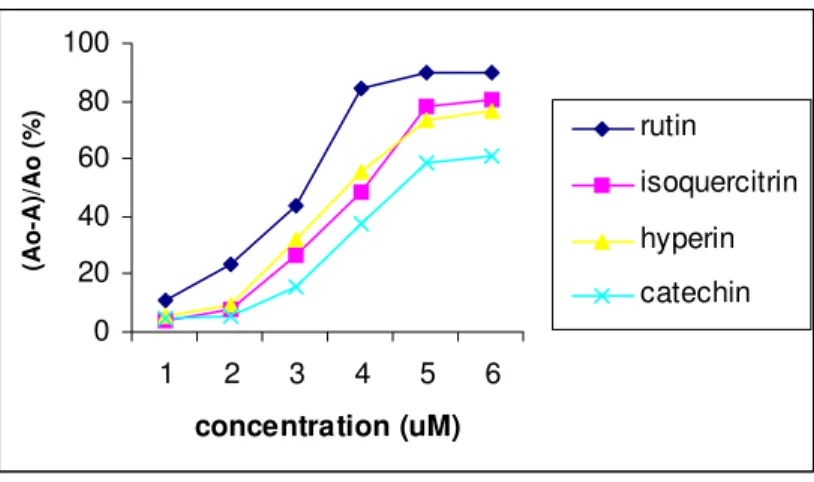
The EtOH extract from leaves of C. ashersoniana seedlings showed the presence of antioxidant compounds on the β-carotene test on TLC and afforded flavonol glucosides iso-quercitrin (1) and hyperin (2), which were identified by MS and NMR spectral analysis and comparison with literature data. 14-16 They showed moderate free radical scavenging activity (IC50 34.4 µM and 32.7 µM), respectively when compared to standard compound rutin (IC50 27.0
µM) and higher activity than catechin (IC50 41.4 µM) (Figure 1), which is probably due to the
α,β-unsaturated carbonyl moiety conjugated to ring B and the catechol group. Compounds 1 and
2 showed no antifungal activity as they did not inhibit Cladosporium cladosporioides and C. sphaerospermum growth on TLC plates.
O
OH
OH
OR
O OH HO
0 20 40 60 80 100
1 2 3 4 5 6
concentration (uM) (Ao-A)/Ao (%) rutin isoquercitrin hyperin catechin
Figure 1. Free-radical scavenging activity of flavonol glucosides 1 and 2, and reference compounds rutine and catechin.
From the EtOH extract of stems and roots of C. ashersoniana seedlings, pyrones 3-5 were isolated and had their structures determination based on MS and NMR analysis, as well as comparison with literature data.
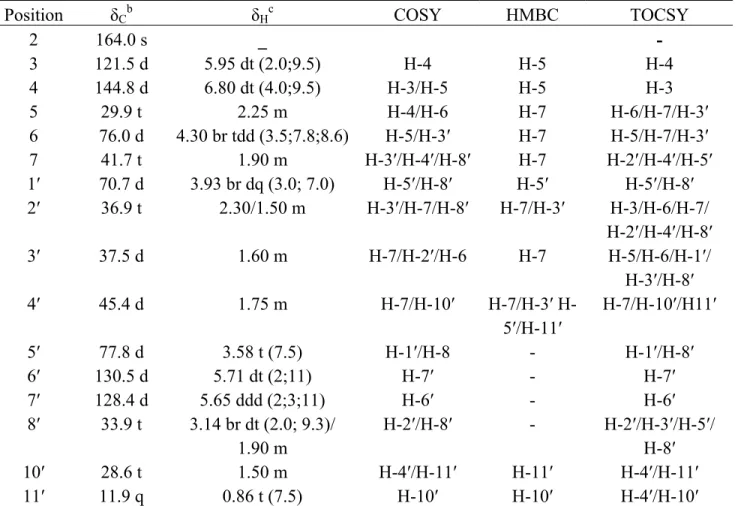
The 1H NMR spectrum of compound 3 showed four signals at 5.65, δ 5.71, 5.95 and 6.80 suggesting the presence of two disubstituted double bonds, including one α,β-unsaturated carbonyl moiety; and three signals at 3.58, 3.93 and 4.30, assigned to oxymethine hydrogens. The 13C NMR spectrum of compound 3 showed five signals for sp2 carbons, including one α,β-unsaturated carbonyl moiety and 11 signals for sp3 carbons, including three oxymethine carbons at 70.7, 76.0 and 77.8. Combined with DEPT 135o data, which evidenced only five methylene carbons, and MS data, which showed the molecular ion peak at M+. 262, the formula C16H22O3 was established, suggesting the structure of a pyrone ring
attached to an unsaturated bicyclized C11 aliphatic chain. One triplet at 0.86 (3H), correlating to
a multiplet at 1.50 (2H) in the HOMOCOSY spectrum and to signals at 11.9 (C-11′) and 28.6 (C-10′), in the HMQC and HMBC spectra, respectively, evidenced an ethyl unit, which is linked to a methine carbon ( C 45.4, H 1.75), assigned to C-4′, as shown by HMBC cross-peaks
between H-11′ and C-4′, as well as by HOMOCOSY correlations of signals for H-4′ and H-10′.
Table 1. – NMR data for compound 3a
Position Cb Hc COSY HMBC TOCSY
2 164.0 s _ -
3 121.5 d 5.95 dt (2.0;9.5) H-4 H-5 H-4
4 144.8 d 6.80 dt (4.0;9.5) H-3/H-5 H-5 H-3
5 29.9 t 2.25 m H-4/H-6 H-7 H-6/H-7/H-3′
6 76.0 d 4.30 br tdd (3.5;7.8;8.6) H-5/H-3′ H-7 H-5/H-7/H-3′ 7 41.7 t 1.90 m H-3′/H-4′/H-8′ H-7 H-2′/H-4′/H-5′ 1′ 70.7 d 3.93 br dq (3.0; 7.0) H-5′/H-8′ H-5′ H-5′/H-8′
2′ 36.9 t 2.30/1.50 m H-3′/H-7/H-8′ H-7/H-3′ H-3/H-6/H-7/ H-2′/H-4′/H-8′ 3′ 37.5 d 1.60 m H-7/H-2′/H-6 H-7 H-5/H-6/H-1′/
H-3′/H-8′ 4′ 45.4 d 1.75 m H-7/H-10′ H-7/H-3′
H-5′/H-11′
H-7/H-10′/H11′
5′ 77.8 d 3.58 t (7.5) H-1′/H-8 - H-1′/H-8′
6′ 130.5 d 5.71 dt (2;11) H-7′ - H-7′
7′ 128.4 d 5.65 ddd (2;3;11) H-6′ - H-6′
8′ 33.9 t 3.14 br dt (2.0; 9.3)/ 1.90 m
H-2′/H-8′ - H-2′/H-3′/H-5′/ H-8′ 10′ 28.6 t 1.50 m H-4′/H-11′ H-11′ H-4′/H-11′
11′ 11.9 q 0.86 t (7.5) H-10′ H-10′ H-4′/H-10′
a
CDCl3, 500 MHz and 125 MHz for 1H and 13C NMR, respectively. Assignments were mostly
based on HMQC and HOMOCOSY experiments.
b
multiplicities were obtained from DEPT 135o experiment.
c
, multiplicity, J (Hz).
Two signals at 2.25 (m, 2H) and 4.30 (br tdd, 1H) in the 1H NMR spectrum were assigned to H-5 and H-6 of the pyrone ring, respectively, and showed correlations with signals at
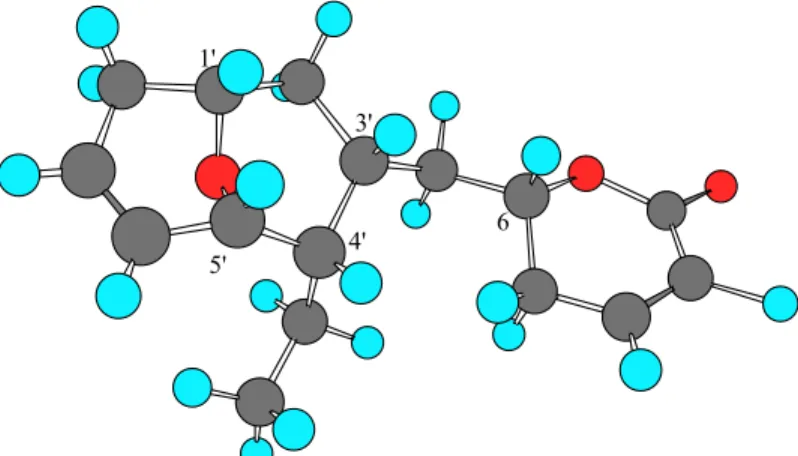
suggested an additional cyclization between C-3′ and C-4′, leading to a bicyclic moiety. This explains further correlations, e.g. from H-7 ( 1.90) and H-3′ ( 1.60) to C-4′ ( 45.4), observed in the HMBC spectrum; and a long distance correlation (J4) between H-7 and H-4′ in the HOMOCOSY spectrum. Additional HMBC and HOMOCOSY correlations confirmed the proposed structure for compound 3 (Table 1). The relative configuration of asymmetric centers C-1′, C-3′, C-4′ and C-5′ was established by analysis of coupling constants, e.g. JH-4′/H-5′ = 7.5
Hz, which evidenced the cis relationship of H-4′ and H-5′; and additionally by NOESY experiments, which showed correlations between H-3′/H-4′and H-4′/H-5′, and confirmed the cis orientation for these hydrogens. The cis relationship of H-1′/H-5′ was assumed due to high steric hindrance of the (H-1′/H-5′) trans isomer, as observed by molecular modeling and theoretical studies on steric energy minimization using the MM2 software and on heats of formation using the semiempirical PM3 and AM1 methods on SCF-MO-MOPAC-2000 software. 17 A positive Cotton effect due to the carbonyl n→Π* transition of the α,β-unsaturated- -lactone moiety was observed at λmax 255 nm (∆ +2.84) in the CD spectrum of 3. This observation indicated that the
absolute configuration a C-6 was (S) on the basis of the rule first proposed by Snatzke18 and later modified by Beecham,19 considering the conformation of the α-pyrone ring, which was inferred due to steric factors.20 These observations led to the establishment of the new pyrone as 1′R*,3′S*,4′R*,5′S*,6S-6-[4′-ethyl-9′-oxabicycle[3.3.1]non-6′-en-3′ -yl)methyl]-5,6-dihydro-2H-pyran-2-one.
O
O O
Figure 2. Selected HMBC correlations for compound 3.
O
O O
1'
3'
4' 5'
6
Figure 4. Structure of pyrone 3 evidencing the cis relationship of H-1′, H-3′, H-4′ and H-5′.
The biogenetic pathway leading to this novel pyrone was proposed, in which an acetate derived C16 chain has gone through cyclization reactions to originate the pyrone ring via
nucleophyllic attack followed by dehydration steps (Scheme 1). The subsequent attack of HO-5′ onto C-1′ with the ring closure via an ether linkage followed by dehydration and reduction steps might yield intermediate 8.Two additional dehydration steps would yield intermediate 9, which might go through a final cyclization, resulting from nucleophilic attack of C-4′ onto C-3′, and the subsequent formation of compound 3. Bicyclic pyrones resulting from cyclization of the side-chain onto the α,β-unsaturated carbonyl ring as cryptocaryolone (10) and goniopyrone (11) have been reported solely from other Cryptocarya (Lauraceae) and Goniothalamus (Annonnaceae) species, respectively 21,22 and led to structures in which the pyrone C-C double bond is lost. Compound 3 differs from those as the driving force for both cyclization steps do not involve the
3
+
O
O O
8
O OH
O O
H
H2O
OH OH
O O O O O O O O
6
7
9
..
O OH O OH2 O
O O
+
+ O H
H O O
OH2
Scheme 1. Biogenetic proposal for compound 3.
O O
O OH
OH
10
O O
O HO
OH
11
Experimental Section
General Procedures. Silica gel (Merck, 230-400 and 70-230 Mesh), Sephadex LH-20 (Pharmacia) and polyvinylpolypyrrolidone (PVPP) were used for column chromatography unless otherwise stated and solvents were redistilled prior to use. NMR spectra were recorded on Bruker AC-200 or Varian INOVA 500 spectrometers at 200 or 500 MHz, respectively, for 1H NMR, and at 50 or 125 MHz, respectively, for 13C NMR, with TMS as internal standard and DMSO-d6 or CDCl3 as solvent. ES-MS were recorded on a VG Platform II spectrometer and
elemental analysis was performed on a Perkin-Elmer Analyser model 2400CHN. Theoretical study was done using the semiempirical PM3 and AM1 methods on SCF-MO-MOPAC-2000 software. CD curves were obtained using a ISA Jobin Yvon CD6 dichrograph and optical rotation was measured on a Perkin-Elmer 241 polarimeter using a quartz cuvette (length 1 cm).
Plant material. Seedlings of C. ashersoniana were grown in the greenhouse at Chemistry Institute, Sao Paulo State University in Araraquara, Brazil and were harvested when the seedlings were ca. 10 months old and 45 cm high.
Extraction and isolation. Leaves, stems and roots were dried at 40oC and ground separately. Each plant material was extracted with ethanol, which was then evaporated under vacuum and afforded the EtOH extracts of leaves (30.7 g), stems (3.7 g) and roots (16.7 g). The EtOH extract from leaves (10.0 g) was partitioned with organic solvents o afford the hexane (4.6 g), chloroform (1.1 g), EtOAc (3.3 g) and hydroalcoholic (0.3 g) fractions. The EtOAc fraction (3.0 g) was applied to a Sephadex LH-20 column (300.0 g), eluted with MeOH to give 10 fractions. Fraction 7 (0.234 g) was submitted to HPLC separation (RP-18; MeOH/H2O 72:28;
flow 9 mL/min; UV detection at 280 nm) and afforded compounds 1 (12 mg) and 2 (7 mg). The EtOH extract (8.2 g) of roots and stems were combined after comparison by TLC analysis and submitted to MPLC (RP-18, H2O/MeOH gradient), affording 11 pooled fractions (A-K). Fraction
E (830 mg) was submitted to MPLC (silica gel, hexane/EtOAc gradient) and afforded 14 fractions (E1-E14). Fractions E4 (39 mg) and E9 (48 mg) were further purified by preparative TLC (CH2Cl2/MeOH/iso-PrOH 97:2:1) and yielded compounds 4 (16 mg) and 5 (8 mg),
respectively. Fraction G (480 mg) was also submitted to MPLC (silica gel, hexane/EtOAc gradient) and afforded 9 fractions (G1-G9). Fraction G6 (27 mg) was purified by HPLC (RP-18; MeOH/H2O 87:13; flow 9 mL/min; UV detection at 240 nm) and afforded compound 3 (6 mg).
Compound 3. 1′R*,3′S*,4′R*,5′S*,6S-6-[(4′-ethyl-9′-oxabicycle[3.3.1]non-6′-en-3′-yl)methyl]- 5,6-dihydro-2H-pyran-2-one. Brown oil, C16H22O3 (calc. 73.25% C, 8.45% H; obs. 73.21% C; 8.48%
H); [α]D25 =+57.7o (CHCl3, c 0.52); ∆ Max (255nm) = 2.84 (MeOH, c 2.0); ESIMS, m/z (rel. int.)
(40V, positive mode): 285 [M+Na]+ (100), 263 [M+H]+ (35), 262 [M]+ (17). 1H and 13C NMR spectral data, see Table 1.
fungi grow all over the plates, except for spots where antifungal compounds are present, which remain white. The inhibition zones are measured and compared to standard compounds nystatin and myconazol.
Bleaching experiments on β-carotene. 26Each extract (ca. 10 µg) was assayed for the presence of antioxidants using a TLC test and two eluents (CHCl3/MeOH 7:3 and hexane/EtOAc 1:1).
After developing and drying, TLC plates were sprayed with a 0.02% solution of β-carotene (Aldrich) in CH2Cl2. Plates were placed under natural light until discoloration of background.
The remaining yellow spots indicated the presence of antioxidant substances.
Spectrophotometric assay on the reduction of 2,2-diphenyl-1-picrylhydrazyl radical. 27
Reaction mixtures containing test samples (dissolved in MeOH) at several concentrations and 0.004% DPPH methanolic solutions were incubated at 25ºC for 30 min. Absorbances of the resulting solutions were measured using a Milton Roy 20D spectrophotometer at 517 nm and the percent inhibition was determined by comparison with a MeOH treated control group.
Acknowledgments
This work was funded by grants of the State of São Paulo Research Foundation (FAPESP) within the Biota-FAPESP – The Biodiversity Virtual Institute Program (www.biotasp.org.br); Grant # 98/05074-0. MAGR and MAA thank FAPESP for providing them scholarships.
References
1. Cavé, A.; Leboeuf, M.; Moskowitz, H.; Ranaivo, A.; Bick, I. R. C.; Sinchai, W.; Nieto, M.; Sevenet, T.; Cabalion, P. Austr. J. Chem.1989, 42, 2243.
2. Naves, Y. R.; Arndt, V. H.; Magalhães, M. T.; Gottlieb, O. R.; Alves, H. M. Helv. Chim. Acta1963,46, 1056.
3. Spencer, G. F.; England, R. E.; Wolf, R. B. Phytochemistry1984, 23, 2499.
4. Govindac,T. R.; Parthasa, P. C.; Desai, H. K.; Shanbhag, M. N. Tetrahedron1973, 29, 3091. 5. (a) Gottlieb, O. R. Phytochemistry 1972, 11, 1537. (b) Gottlieb O. R. Abstr. Papers Am.
Chem. Soc. 1971, A, 83. (c) Gottlieb, O.G.; Yoshida, M. In Natural Product of Wood Plants; Rowe, J. W., Ed.; Springer-Verlag: Berlin, 1989; p 439.
6. Zschocke, S.; van Staden, J. J. Ethnopharmacol. 2000, 71, 473. 7. Drewes, S. E.; Horn, M. H.; Mavi, S. Phytochemistry1997, 44, 437. 8. Hawariah, A.; Stanslas, J. Anticancer Res. 1998, 18, 4383.
9. Pihie, A. H. L.; Stanslas, J.; Bin Din, L. Anticancer Res. 1998, 18, 1739.
12. Lopes, N. P.; Franca, S. C.; Pereira, A. M. S, Maia, J. G. S.; Kato, M. J.; Cavalheiro, A. J.; Gottlieb, O. R.; Yoshida, M. Phytochemistry1994, 35, 1469.
13. Nehme, C. J.; Moraes, P. L. R.; Cavalheiro, A. J. Biochem. Syst. Ecol.2002, 30, 613. 14. Agrawal, P. K.; Bansal, M. C. Carbon-13 NMR of Flavonoids; Elsevier: Amsterdam, 1989 15. Douglass, C. D.; Howard, W. L.; Wender, S. H. J. Am. Chem. Soc. 1949, 71, 2658.
16. Nair, G. V.; Vonrudloff, E. Can. J. Chem-Revue Canadienne de Chimie1960, 38, 2531. 17. Stewart, J. J. P. MOPAC 2000; Fujitsu Limited: Tokyo, Japan, 1999.
18. Snatzke, G. Angew. Chem., Internat. Edit.1968, 7, 14. 19. Beecham, A. F. Tetrahedron1972, 28, 5543.
20. Davis-Coleman, M. T.; Rivet, D. E. A. Progress Chem. Org. Nat. Prod.1989, 55, 1.
21. Drewes, S. E.; Sehlapelo, B. M.; Horn, M. M.; Shaw, R. S.; Sandor, P. Phytochemistry
1995, 38, 1427. Drewes, S. E.; Horn, M. M.; Shaw, R. S. Phytochemistry1995, 40, 321. 22. Fang, X. P.; Anderson, J. E.; Chang, C. J.; Fanwick, P. E.; Mclaughlin, J. L. J. Chem. Soc.
Perkin Trans.1,1990, 1655.
23. Hlubucek J.R.; Robertso, A. U. Austr. J. Chem.1967, 20, 2199. 24. Cavalheiro A. J.; Yoshida, M. Phytochemistry2000, 53, 811.
25. Bastos, W. L. Ph.D. Thesis, Chemistry Institute, São Paulo State University, Brazil, 2003. 26. Jewers, K.; Blunden, G, Wetchapi, S, Dougan, J, Manchand, A. H.; Davis, J. B.; Kyi, A.
Phytochemistry1972, 11, 2025.
27. Sam, T. W, Chew, S. Y.; Matsjeh, S.; Gan, E. K.; Razak, D.; Mohamed, A. L. Tetrahedron Lett.1987, 28, 2541.
28. Matsumoto, M.; Nago, H. Biosci. Biotech. Biochem. 1994, 58, 1262. 29. Homans, A. L.; Fuchs, A.; J.Chromat. 1970, 51, 325.