R E S E A R C H
Open Access
Techniques to improve the maintenance of
a laboratory colony of
Nyssomyia neivai
(Diptera: Psychodidae)
Thais Marchi Goulart
1, Camila Feitosa de Castro
2, Vicente Estevam Machado
2, Flávia Benini da Rocha Silva
2and Mara Cristina Pinto
2*Abstract
Background:The most critical phase in sand fly colonization is the high mortality in the larval instars. In this study, we sought out strategies for improving the colonization ofNyssomyia neivai, one of the vectors of cutaneous leishmaniasis agent in South America.
Methods:A colony ofNy. neivaiwas established in the laboratory from a field population, and the productivity of adults was evaluated considering carrying capacity, diet for larvae and surface for oviposition.
Results:The highest emergency rate of adults was achieved with the fewest couples inside 150 mL rearing chambers on a sterilized diet made of rabbit feces, rabbit food, soil and fish food and with vermiculite as a substrate for oviposition and the development of larvae.
Conclusion:Our data onNy. neivaicolonization showed that the best adult productivities were achieved with fewer couples inside the rearing chambers; smaller rearing containers of 150 mL (due to less fungi growth); sterilized diet made of rabbit feces, rabbit food, soil and fish food; and vermiculite as the substrate for oviposition and development of larvae.
Keywords:Sand flies, Phlebotomine, Immature stages, Larval diet,Nyssomyia neivai, Substrates, Sterilized diet
Background
Colonies of insect vectors are suitable for a wide range of investigations, from basic biological aspects to applied research. Despite the importance of laboratory colonies of the vectors of leishmaniasis agent, the difficulty in providing the specific requirements of the more than 900 sand fly species [1] explain why less than 60 species have been successfully reared in the laboratory [2]. The main problem in rearing sand flies is the high mortality during the immature phases. Sand fly larvae are detriti-vores, and the conventional diet for larvae in laboratory colonies consists of a variety of substrates that are mainly rich in fungal, bacterial and plant material [3]. Although some studies have focused on diets for sand fly larvae, there is not a universal recipe for all species. There
have been discussions on whether the different alimentary requirements of phlebotomine larva can contribute to reducing the competition among sand fly species under natural conditions [4].
Nyssomyia neivaiis incriminated as one of the vector of cutaneous leishmaniasis agents in South America [5–8].
The aim of this research was to evaluate the carrying capacity, attraction of the immature stages ofNy. neivai to different diets, survival of the larvae on distinct diets and different rearing surfaces.
Methods
Collection and maintenance of sand flies
Sand flies were collected in Santa Eudóxia, São Paulo state - Brazil (along the edges of the Mogi Guaçu River) on the wall of a house, using a manual aspirator between 18:00 and 23:00 h. In the laboratory, the sand flies were maintained in cages covered with voile (30x30x30 cm) at 26 ± 1 °C, 80–90 % humidity, and a * Correspondence:[email protected]
2Departamento de Ciências Biológicas, Faculdade de Ciências Farmacêuticas,
UNESP - Univ Estadual Paulista, Araraquara, SP 14801-902, Brazil Full list of author information is available at the end of the article
12:12 (L:D) photoperiod. The sand flies had access to a piece of cotton soaked in a 30 % sucrose solution. The non-bloodfed field-collected females were exposed to BALB/c mice as a blood source. The bloodfed females were individually transferred to vials to oviposition. After oviposition, sand flies were clarified and identified under an optical microscope following the identification key by Galati [9].Ny. neivaieggs were placed in a 150 mL polystyrene container filled with 2 cm of plaster of Paris on its bottom (oviposition container). The following experiments were carried out in oviposition containers that were kept in the dark at 26 ± 1 °C, 80–90 % humidity.
Ny. neivaicarrying capacity in rearing containers of different sizes
Groups of bloodfed females and an equal number of males were selected and transferred to 250 mL and 150 mL polystyrene oviposition chambers. Pairs of male and female sand flies were placed in 250 mL containers in groups of 5, 10, 15, 20, 25 and 30. For the 150 mL containers, 5, 10 and 15 bloodfed females were placed to verify the carrying capacity. The experiments were repeated four times. The chambers were observed daily to check the humidity levels, the mortality of gravid females and the number of eggs. The sucrose solution was changed daily. At the end of the experiments, the productivity of adults was evaluated for each group.
Attractiveness of different diets forNy. neivailarvae In the laboratory, we use diets made of rabbit feces, rabbit food from Evialis®, fish food from Alcon® Colours and soil (modified from a personal communication with José Carlos Miranda). We tried other combinations to evaluate their attractiveness for larvae.
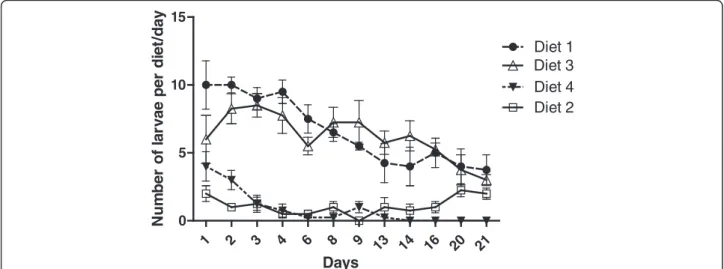
Fifty eggs of Ny. neivaiwere placed in the center of a 250 mL plastic container. The lining of plaster of Paris in the container bottom was divided into four quadrants, and over each of them a specific diet was added on 7th day after oviposition: diet 1 (traditional diet - used in routine rearing of sand flies), diet 2 (rabbit feces and soil), diet 3 (rabbit feces, soil and fish food) and diet 4 (soil and mud – Barretto, 1942). The number of larvae on each quadrant was observed and counted daily until the pupal phase. The experiments were repeated four times.
Diet preparation: rabbit feces were collected from the Veterinary Institute of Universidade de São Paulo (USP) and dried by solar heat for 3 days. The feces, rabbit food, fish food and soil were triturated and sieved through 0.297 mm, 0.125 mm and 0.074 mm meshes. All of the components, except the fish food, were sterilized in an autoclave.
Attractiveness and development ofNy. neivailarvae on two different diets
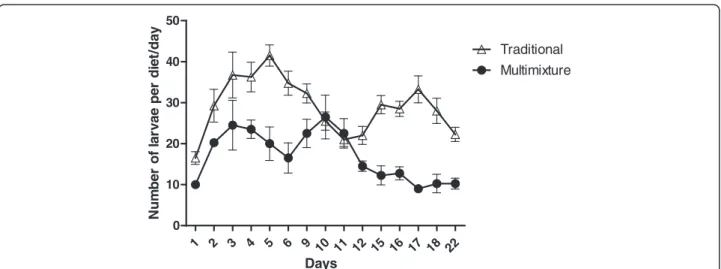
One hundred eggs were placed in the center of each container (250 mL). The plaster of Paris was divided into four quadrants, and over each one, of the two dif-ferent diets was added: diet 1 (rabbit feces, rabbit food, fish food and soil) and diet 2 (multimixture flour - a food supplement for pregnant women and children to combat malnutrition - containing rice and wheat bran, wheat flour, corn meal, sesame, soybean, linseed, Moringa oleifera leaves, sunflower or pumpkin seeds and cassava leaf powder). Neighbouring quadrants re-ceived different diets. The number of larvae on each quadrant was observed and counted daily until the pupal phase.
To analyse which diet was better for the development of the insects, each diet was added in different con-tainers with 100 eggs each. The diet was added accord-ing to the needs of the larvae in different instars. Both experiments were repeated four times.
Development of immature stages on non-sterilized and sterilized diets
One hundred eggs were placed in the center of clean containers (150 mL) and Diet 1 (rabbit feces, rabbit food, fish food and soil) was added daily in the following way: non-sterilized and sterilized (by autoclave or tyn-dallization). The tests were carried out until the adult phase and were replicated five times.
Evaluation of different substrates for rearing the colony The substrates that were evaluated individually were plaster of Paris and plaster with a fine layer of vermicu-lite over it. Five engorged females and five males were placed in the oviposition containers (150 mL). A piece of plaster of Paris was put in the center of the container and used as resting spot. A piece of cotton soaked in a 30 % sucrose solution was offered to the couples. Emerged adults were counted, and the results were ana-lysed. The experiments were repeated 10 times.
Statistical analysis
Data were analysed by Analysis of Variance (ANOVA) and Tukey’s tests or t-tests performed using GraphPad Prism version 5.00.
Ethical approval
Results
Ny. neivaicarrying capacity in rearing containers of different sizes
The female mortality before oviposition was random and was not dependent on the number of couples in the containers (data not shown). The mean number of eggs per female varied between the different sizes of the rear-ing containers. For the smallest containers (150 mL), five couples presented the highest mean number of eggs per female (67.2 eggs; p< 0.05). For the largest containers (250 mL), there was no statistical difference among the number of couples in the pots (from 47.1 to 56.5 eggs; p> 0.05) (Table 1).
The number of adults emerged was negatively corre-lated with the number of eggs per rearing container. Adult emergency rates were over 50 % in the 250 mL containers that contained approximately 400 eggs. For 150 mL containers, the emergency rates were 30 % (around 600 eggs per pot). The best results for both the smaller and larger containers were seen with five to ten insect couples (Fig. 1).
Attractiveness of different diets toNy. neivailarvae According to the results, the most attractive larval food was diet 1, followed by diet 3 (Fig. 2). Both diets con-tained fish food. Differences were significant among the four diets (p< 0.05), but there were no significant dif-ferences between diets 1 and 3 (p> 0.05) or 2 and 4 (p> 0.05). The presence of fish food appears to be an important factor in the attractiveness of a diet to the larval instars ofNy. neivai.
Attractiveness and development ofNy. neivailarvae on two different diets
The number of larvae on diet 1 (traditional) was higher than on the multimixture (p< 0.05) (Fig. 3).
The productivity of adults was much higher on diet 1 (164 adults; 41 %) than on the multimixture (19; 9.5 %) (p> 0.05).
Development of immature stages on non-sterilized and sterilized diets
There were no significant differences among the treat-ments (p> 0.05). However, the means were higher with both of the sterilized methods, autoclave (46.7 insects) and tyndallization (47.8 insects), compared to only 38.4 insects in the non-autoclaved diet (Fig. 4).
Evaluation of different substrates for rearing the colony There was a significant difference between the plaster of Paris and the vermiculite (p< 0.05). The mean emer-gence of adults on the vermiculite was 690 insects, compared to 428 insects on the plaster of Paris (Fig. 5).
Discussion
Rearing sand fly colonies in the laboratory provides the opportunity to improve the techniques for obtaining a large number of insects for basic or applied studies. Many aspects of the rearing process need to be consid-ered for the success of a laboratory colony, such as carrying capacity, the right conditions for the immature stages, diet and substrate.
The concept of evaluating carrying capacity consists of determining the ideal number of individuals for a spe-cific environmental condition [10, 11].
The maximum number of couples used in this work was 30, and with that number, the density of couples did not affect the mortality of females prior to oviposition. ForNy. neivai, our results showed that the carrying cap-acity was between five and ten couples for both sizes of containers (150 and 250 mL), where the highest number of adults were achieved.
Santamaría et al. studied the carrying capacity of Pintomyia serranaand verified that the density of flies negatively affected the survival of the females prior to oviposition [11]. However, those authors worked with 1 to 50 couples, which is more than the number of pairs used in our experiments. Their best productivity was with 22 females per container. Under those condi-tions, female mortality was low and the numbers of eggs and adults emerged were the highest. Apart from the different experimental conditions between the studies, it is probable that other specific characteris-tics could be involved.
A previous study with a colony of Ny. neivaishowed a rate of adults emerged of 20.7 % [12]. Our results showed that a lower number of couples inside the rear-ing container produced a higher number of adults (Fig. 1). This could be explained by the intraspecific competition for food and space among the larvae. When the container is too crowded, the larvae climb the walls and end up dying of dehydration. The same behaviour was observed by Hertig & Johnson, who called this phenomenon a “suicidal mass migration” Table 1Mean number of eggs per females and standard error
in rearing chambers of 150 mL (5, 10 and 15 couples) and 250 mL (5, 10, 15, 20, 25, 30 couples)
Containers Number of couples per chamber
5 10 15 20 25 30
150 mL 67.2a 44.4b 41.6b - -
-(±5.2) (±4.4) (±4.6)
250 mL 47.1a 50.5a 51a 51.1a 56.5a 51a
(±10.6) (±3.3) (±2.0) (±6.4) (±3.9) (±5.5)
[13]. Experiments with Culex sitiensshowed that when subjected to overcrowding, the larvae compete for space to feed, increasing their mortality [14].
Many authors have been studying diets for the imma-ture stages of different sand fly species. A miximma-ture of aged rabbit feces and rabbit food was used to rear Lutzo-myia cruciata, Dampfomyia anthophora, Psathyromyia shannoni, and Micropygomyia vexator under laboratory conditions. This diet was successful in reducing the growth of fungi [15]. Some modifications of this diet have been used in many sand fly colonies: Phlebotomus papatasi,Phlebotomus argentipes, Phlebotomus duboscqi, Lutzomyia longipalpis[16, 17] andPi. serrana[2].
Industrialized animal food (for rabbits, dogs, hamsters and aquarium fishes) was compared with aged food for larvae ofNyssomyia intermediaandLu. longipalpis. Both species developed very well with the aged food, but
unlike Lu. longipalpis, Ny. intermedia also presented good results with industrialized animal food [4]. It has been suggested that variability in sand fly species dietary preferences can be important in reducing competition under natural conditions [18].
We did not use aged food in this study. Our results showed that diets that were enriched with fish food were more attractive to sand fly larvae compared to ones without this component. This observation is in agree-ment with the previous experiagree-ments of Rangel et al. [19], and this should be investigated in further studies on the possible attractants for larvae. In our experiments, the survival of adults was higher with traditional food (rabbit feces, rabbit food, fish food and soil) than with other diets that were made up only of plants and different grains (multimixture diet). The multimixture also pre-sented a huge growth of fungi, which cause damage to Fig. 1Percentages of adult emerged per number of eggs in different size containers.a●five couples,▄ten couples,▲fifteen couples,○twenty
couples,♦twenty five couples,
*thirty couples in 250 mL andb●five couples,▄ten couples,▲fifteen couples in 150 mL containers
1 2 3 4 6 8 9 13 14 16 20 21
0 5 10 15
Diet 1
Diet 2 Diet 3 Diet 4
Days
N
u
m
b
er
of
l
a
rv
ae per
di
et
/d
ay
the lifecycle of the insect. The fungi that grew on the multimixture were extremely dense and had to be re-moved daily during the insect counting. There is a con-troversy surrounding the relevance of fungus in diets for sand flies. According to some authors, the fungi on the diet could be fatal to the early instar of the larvae by trapping them on fungi hyphae [13, 18, 20]. Otherwise, the fungi can be profitable for the larvae, complement-ing their nutrition [4].
Considering the disagreement of many authors about fungi growth on sand fly diets, we decided to compare non-sterilized and sterilized diets. Even though our re-sults did not show a significant difference between steril-ized and non-sterilized diets, the autoclave and tyndallization methods (sterilized diets) retarded fungal growth for at least three days, giving enough time for the first instar larvae to develop. Under these conditions,
the first instar larvae can grow a little more and avoid being trapped by the hyphae.
Some sand fly species of thePhlebotomusgenus prefer non-autoclaved food, but for other species, likeLu. long-ipalpis, the food can be autoclaved [2]. We observed that the larvae of Ny. neivaidid not refuse, in any stage, the sterilized diet, which had the advantage of a decrease in fungi growth; thus, we strongly advise the sterilization method for fungal control inNy. neivaicolonies.
The oviposition experiments on different substrates showed that an irregular surface (vermiculite) presented a higher productivity of adults compared to a flat surface (plaster of Paris). The gravid females were able to ovi-posit among vermiculite grains. The vermiculite also provided a “refuge” from the fungi hyphae among the grains for the first larval instars. Shaking the containers with grains would break the hyphae. Studies on the 1 2 3 4 5 6 9 10 11 12 15 16 17 18 22
0 10 20 30 40 50
Multimixture Traditional
Days
N
u
m
b
er
o
f l
a
rv
ae per
di
et
/d
ay
Fig. 3Number of larvae on two different diets over time. Traditional diet (rabbit feces, rabbit food, fish food, and soil) and multimixture diet (plants and grains).P< 0.05
a
a
a
physical factors showed that temperature and humidity are important factors in the oviposition behaviour ofNy. neivai[21, 22]. Rough and irregular substrates stimulate a thigmotropic response in gravid flies of L. longipalpis and L. migonei and also provide greater protection, higher humidity and possibly more food for newborn larvae than flat surfaces [23, 24].
Conclusion
In conclusion, our data on Ny. neivai colonization showed a variable emergency rate of adults in different tests, depending on larval population density, diet and oviposition surface. The best adult productivities were achieved with fewer couples inside the rearing chambers (400–600 eggs depending on the size of the container); smaller rearing containers of 150 mL (due to less fungi growth); sterilized diet made of rabbit feces, rabbit food, soil and fish food; and vermiculite as the substrate for oviposition and development of larvae.
Competing interests
The authors declare that they have no competing interests.
Authors’contributions
MP and TG conceived and executed the study and drafted the manuscript. TG, CC, VM and FS conducted field captures of sandflies and bioassay experiments. All authors read and approved the final manuscript.
Acknowledgements
We thank financial support of FAPESP (Fundação de Amparo à Pesquisa do Estado de São Paulo–Process 2012/23832–9) and Programa de Apoio ao
Desenvolvimento Científico da Faculdade de Ciências Farmacêuticas at UNESP (PADC/FCFAr).
Author details
1
Departamento de Zoologia Animal, Universidade Estadual de Campinas, Campinas, SP 13083-970, Brazil.2Departamento de Ciências Biológicas, Faculdade de Ciências Farmacêuticas, UNESP - Univ Estadual Paulista, Araraquara, SP 14801-902, Brazil.
Received: 15 June 2015 Accepted: 5 August 2015
References
1. Ready PD. Biology of phlebotomine sand flies as vectors of disease agents. Annu Rev Entomol. 2013;58:227–50.
2. Volf P, Volfova V. Establishment and maintenance of sand fly colonies. J Vector Ecol. 2011;36 Suppl 1:S1–9.
3. Moraes CS, Lucena SA, Moreira BH, Brazil RP, Gontijo NF, Genta FA. Relationship between digestive enzymes and food habit ofLutzomyia longipalpis(Diptera: Psychodidae) larvae: Characterization of carbohydrases and digestion of microorganisms. J Insect Physiol. 2012;58(8):1136–45.
4. Wermelinger ED, Zanuncio JC. Development ofLutzomyia intermediaand
Lutzomyia longipalpis(Diptera: Psychodidae: Phlebotominae) larvae in different diets. Braz J Biol. 2001;61(3):405–8.
5. Córdoba-Lanús E, De Grosso ML, Piñero JE, Valladares B, Salomón OD. Natural infection ofLutzomyia neivaiwithLeishmaniaspp. in northwestern Argentina. Acta Trop. 2006;98(1):1–5.
6. Casanova C, Natal D, Santos FA. Survival, population size, and gonotrophic cycle duration ofNyssomyia neivai(Diptera: Psychodidae) at an endemic area of American cutaneous leishmaniasis in southeastern Brazil. J Med Entomol. 2009;46(1):42–50.
7. Marcondes CB, Bittencourt IA, Stoco PH, Eger I, Grisard EC, Steindel M. Natural infection ofNyssomyia neivai(Pinto, 1926) (Diptera: Psychodidae, Phlebotominae) byLeishmania(Viannia) spp. in Brazil. Trans R Soc Trop Med Hyg. 2009;103(11):1093–7.
8. Brazil RP, Rodrigues AAF, Filho JDA. Sand Fly Vectors of Leishmania in the Americas - A Mini Review. Entomol Ornithol Herpetol. 2015;4:144. 9. Galati EAB. Classificação de Phlebotominae. In: Rangel EF, Lainson R, editors.
Flebotomíneos do Brasil. Rio de Janeiro, Brazil: Fiocruz; 2003.
10. Price WP. Insect Ecology, Second edn. USA: John Wiley & Sons, Inc; 1984. 11. Santamaría E, Munstermann LE, Ferro C. Estimating carrying capacity in a newly colonized sand flyLutzomyia serrana(Diptera: Psychodidae). J Econ Entomol. 2002;95(1):149–54.
12. Andrade Filho JD, Galati EA, Falcão AL. Biology of the first generation of a laboratory colony ofNyssomyia intermedia(Lutz & Neiva, 1912) and
Nyssomyia neivai(Pinto, 1926) (Diptera: Psychodidae). Mem Inst Oswaldo Cruz. 2004;99(6):597–601.
13. Hertig M, Johnson PT. The rearing of Phlebotomus sandflies (Diptera:Psychodidae). 1 Technique. Ann Entomol Soc Am. 1961;54:753–66.
14. Roberts D. Overcrowding ofCulex sitiens(Diptera: Culicidae) larvae: population regulation by chemical factors or mechanical interference. J Med Entomol. 1998;35(5):665–9.
15. Young DG, Perkins PV, Endris RG. A Larval diet for rearing Phlebotomine sand flies (Diptera:Psychodidae). J Med Entomol. 1981;18:446.
a
b
16. Modi GB, Tesh RB. A simple technique for mass rearingLutzomyia longipalpisandPhlebotomus papatasi(Diptera: Psychodidae) in the laboratory. J Med Entomol. 1983;20(5):568–9.
17. Lawyer PG, Rowton ED, Perkins PV, Johnson RN, Young DG. Recent advances in laboratory mass rearing of phlebotomine sand flies. Parassitologia. 1991;33(Suppl):361–4.
18. Barreto MP. Contribuição para o estudo da biologia dos flebótomos em condições experimentais (Diptera:Psychodidae). São Paulo: Universidade de São Paulo; 1942.
19. Rangel EF, Souza NA, Wermelinger ED, Barbosa AF, Andrade CA. Biologia de
Lutzomyia intermediaLutz & Neiva, 1912 eLutzomyia longipalpisLutz & Neiva, 1912 (Diptera:Psychodidae) em condições experimentais. 1. Aspectos da alimentação de larvas e adultos. Mem Inst Oswaldo Cruz.
1986;81(4):431–8.
20. Sherlock IA, Sherlock VA. Métodos práticos para a criação de flebotomíneos em laboratório. R Bras Biol. 1972;32:209–17.
21. Foster WA, Tesfa-Yohannes TM, Tecle T. Studies on leishmaniasis in Ethiopia. II. Laboratory culture and biology ofPhlebotomus longipes(Diptera: Psychodidae). Ann Trop Med Parasitol. 1970;64(4):403–9.
22. Chaniotis BH. Successful colonization of the sand flyLutzomyia trapidoi
(Diptera: Psychodidae), with enhancement of its gonotrophic activity. J Med Entomol. 1986;23(2):163–6.
23. Elnaiem DA, Ward RD. The thigmotropic oviposition response of the sandfly
Lutzomyia longipalpis(Diptera: Psychodidae) to crevices. Ann Trop Med Parasitol. 1992;86(4):425–30.
24. Nieves E, Ribeiro A, Brazil R. Physical factors influencing the oviposition of
Lutzomyia migonei(Diptera: Psychodidae) in laboratory conditions. Mem Inst Oswaldo Cruz. 1997;92(6):733–7.
Submit your next manuscript to BioMed Central and take full advantage of:
• Convenient online submission
• Thorough peer review
• No space constraints or color figure charges
• Immediate publication on acceptance
• Inclusion in PubMed, CAS, Scopus and Google Scholar
• Research which is freely available for redistribution