Borneol Is a TRPM8 Agonist that Increases
Ocular Surface Wetness
Gui-Lan Chen1,2, Ming Lei2, Lu-Ping Zhou2, Bo Zeng2*, Fangdong Zou1*
1Ministry of Education Key Laboratory of Bio-resources and Eco-environment, College of Life Sciences, Sichuan University, Chengdu, China,2Key Laboratory of Medical Electrophysiology, Ministry of Education, and Institute of Cardiovascular Research, Sichuan Medical University, Luzhou, China
*[email protected](BZ);[email protected](FZ)
Abstract
Borneol is a compound widely used in ophthalmic preparations in China. Little is known about its exact role in treating eye diseases. Here we report that transient receptor potential melastatin 8 (TRPM8) channel is a pharmacological target of borneol and mediates its ther-apeutic effect in the eyes. Ca2+measurement and electrophysiological recordings revealed that borneol activated TRPM8 channel in a temperature- and dose-dependent manner, which was similar to but less effective than the action of menthol, an established TRPM8 agonist. Borneol significantly increased tear production in guinea pigs without evoking noci-ceptive responses at 25°C, but failed to induce tear secretion at 35°C. In contrast, menthol evoked tearing response at both 25 and 35°C. TRPM8 channel blockers N-(3-Aminopro-pyl)-2-[(3-methylphenyl)methoxy]-N-(2-thienylmethyl)benzamide hydrochloride (AMTB) and N-(4-tert-butylphenyl)-4-(3-chloropyridin-2-yl)piperazine-1-carboxamide (BCTC)
abol-ished borneol- and menthol-induced tear secretion. Borneol at micromolar concentrations did not affect the viability of human corneal epithelial cells. We conclude that borneol can activate the cold-sensing TRPM8 channel and modestly increase ocular surface wetness, which suggests it is an active compound in ophthalmic preparations and particularly useful in treating dry eye syndrome.
Introduction
Borneol is a bicyclic monoterpenoid compound extracted from medicinal plants such as Blu-mea balsamifera[1] andDryobalanops aromatica[2], or synthesized by chemical reactions [3]. In China, borneol is widely used in ophthalmic preparations and classic formulas of Tradi-tional Chinese Medicine to treat various diseases including oculopathies, oral ulcers, sore throat, skin diseases and mild neurological disorders [4], and found to produce anti-inflamma-tory, anti-bacterial and analgesic effects [5]. Borneol-containing eye drops account for a large proportion of over-the-counter (OTC) eye drops sold in China. It was reported that borneol can promote the penetration of various drugs through the cornea, including puerarin, timolol maleate [6], indomethacin, dexamethasone [7], fluconazole [8] and geniposide [9]. This effect was confirmed by using fluorophores with different hydrophilicities and molecular sizes [10]. Apart from this, little is known about the effects of borneol in the eyes.
a11111
OPEN ACCESS
Citation:Chen G-L, Lei M, Zhou L-P, Zeng B, Zou F (2016) Borneol Is a TRPM8 Agonist that Increases Ocular Surface Wetness. PLoS ONE 11(7): e0158868. doi:10.1371/journal.pone.0158868
Editor:Shang-Zhong Xu, University of Hull, UNITED KINGDOM
Received:February 4, 2016
Accepted:May 17, 2016
Published:July 22, 2016
Copyright:© 2016 Chen et al. This is an open access article distributed under the terms of the Creative Commons Attribution License, which permits unrestricted use, distribution, and reproduction in any medium, provided the original author and source are credited.
Data Availability Statement:All relevant data are within the paper and its Supporting Information files.
Transient receptor potential melastatin 8 (TRPM8) is a non-selective cation channel belong-ing to the TRP channel family. The most important physiological function of TRPM8 discov-ered so far is its role in peripheral sensory neurons as the cold thermoreceptor [11]. Activation of TRPM8 channels by cold temperatures (below 22–26°C) leads to depolarization of mem-brane potential and initiation of action potentials in neurons [12–14]. In addition to cold tem-peratures, TRPM8 can also be activated by cool sensation-producing compounds such as menthol and icilin [15]. Previous studies have shown that TRPM8 channels are present in the corneal afferent neurons and mediate tear production induced by cooling ocular surface tem-perature or corneal application of menthol [16,17]. Ca2+influx through TRPM8 channels trig-gers action potential in the afferent neurons and transduction of cold stimuli in the neural circuit [18,19], which consequently results in reflex tearing response [20,21].
Dry eyes occur when the lachrymal glands are unable to secret sufficient tears to maintain a healthy coating on the corneal surface. If the dry eye condition becomes chronic and progres-sive, and is associated with uncomfortable feelings like sting, burn or itch, it is termed as dry eye syndrome [22]. Dysfunction of corneal cold thermoreceptors has been found to contribute to the development of dry eye disease [23]. As borneol-containing eye drops can elicit a cooling sensation when applied to the corneal surface [24], and application of borneol directly on the eyes or in ultrasonic cool mist therapy has been shown to improve basal tearing in dry eye patients [25,26], we hypothesized that it may modulate corneal cold thermoreceptor directly and hence regulate ocular surface wetness. In the present study we examined the action of bor-neol on TRPM8 channels and investigated its effect on tear production in guinea pigs.
Materials and Methods
Chemicals
General salts, (+)-borneol and (-)-menthol were purchased from Sangon (Shanghai, China). N-(3-Aminopropyl)-2-[(3-methylphenyl)methoxy]-N-(2-thienylmethyl)benzamide hydro-chloride (AMTB) was purchased from Santa Cruz Biotechnology (Dallas, USA). N-(4-tert -butylphenyl)-4-(3-chloropyridin-2-yl)piperazine-1-carboxamide (BCTC) and Fura-2/AM were purchased from Sigma-Aldrich (Shanghai, China).
Cell culture, transfection and viability assay
Human embryonic kidney (HEK) 293 and primary human corneal epithelial (HCE) cells were purchased from ATCC (Manassas, USA), cultured in D-MEM/F-12 medium (HyClone, Shanghai, China) supplemented with 10% fetal bovine serum, 100 units/ml penicillin and
100μg/ml streptomycin, and maintained at 37°C under 95% air and 5% CO2. The coding
sequence of human TRPM8 gene (NM_024080) was synthesized by FulenGen (Guangzhou, China) and cloned into the pcDNA3.1(+) vector. The pcDNA3.1-TRPM8 plasmids were trans-fected into HEK293 cells with Lipofectamine 2000 (Invitrogen, Shanghai, China). The stably transfected cells were selected with 400μg/ml G418 in the cell culture medium for 2 weeks and functionally characterized by patch-clamp recordings. The cells with resistance to G418 and TRPM8 currents were cultured for long-term use.
The viability of HEK293 and HCE cells was measured with WST-1 reagent (Roche, Shang-hai, China) according to the manufacture’s instruction. Briefly, cells were seeded in 96-well plates to reach a confluency of 50–60%. Borneol or menthol was added into the cell culture medium and incubated for 24 h. WST-1 (10μl) was then added into each well and incubated for 2 h. Absorbance at 450 nm (A450) and 690 nm (A690) was measured in a plate reader
(Tecan, Switzerland). The subtracted value (A450-A690) was used to evaluate viability of the
cells.
Ca
2+measurement
The TRPM8-expressing HEK293 cells were seeded on 13-mm glass coverslips and cultured for 24–48 h. Before the measurement cells were loaded with 2μM Fura-2 AM in standard bath solution for 30 min at 37°C, and then washed for 5 min with standard bath solution. Ca2+ mea-surement was performed in a heating chamber to maintain solution temperature at 25 or 35°C. Cells were excited alternately by 340- and 380-nm light, and emission was collected via a 510-nm filter. Images were sampled every 5 s in pairs for the two excitation wavelengths by a CCD camera. The ratio of 340/380 nm fluorescence was used to represent the intracellular Ca2+level. The standard bath solution contained (mM): NaCl 130, KCl 5, MgCl21.2, HEPES
10, Glucose 8, and CaCl21.5 (pH 7.4). Ca2+-free solution contained (mM): NaCl 130, KCl 5,
MgCl21.2, HEPES 10, Glucose 8, and EGTA 0.4 (pH 7.4). Thenvalues given are the numbers
of cells from at least three independent Ca2+imaging experiments.
Electrophysiology
Patch-clamp recordings were performed in a heating chamber to maintain solution tempera-ture at 25 or 35°C. The signal was amplified with an Axon CNS MultiClamp 700B or a HEKA EPC10 USB amplifier controlled by the software pClamp 10.6 or Patchmaster 2.90, respec-tively. In whole-cell recordings, the standard bath solution in Ca2+measurement was used as external solution. The resistances of glass microelectrodes were 3–5 MOwhen filled with 200 nM Ca2+buffered pipette solution: 115 CsCl, 10 EGTA, 2 MgCl2, 10 HEPES, and 5.7 CaCl2(in
mM, pH 7.2 adjusted with CsOH, and osmolarity ~290 mOsm adjusted with mannitol). The sampling rate was 4 kHz. A 1-s ramp voltage protocol from–100 mV to +100 mV was applied at a frequency of 0.2 Hz from a holding potential of 0 mV. The junction potential between the intracellular and extracellular solution, and fast and slow capacitance transients were compen-sated by the software of the amplifier. Series resistance (Rs) was compensated up to 51% and
the access resistances were limited to<10 MOto reduce voltage errors. Membrane capacitance
was calculated by the software and the mean value was 13.90±3.41 pF (n= 45). Current record-ings with seal resistance close to or over 1 GOwere used for analyses after leak-subtraction (leak currents<100 pA). For inside-out patches, the bath solution contained (in mM) 140 KCl,
10 HEPES, and 1 EGTA (pH 7.2 adjusted with KOH). The pipettes were 15–20 MOand filled with symmetrical high K+solution (in mM): 140 KCl, 10 HEPES, 1 EGTA (pH 7.4 adjusted with KOH). The signals were sampled at 10 kHz and digitally filtered off-line at 0.8 kHz. The sampling time of each inside-out recording was 25 s and the holding potential was +100 mV.
Animal experiment
saline solution containing borneol, menthol or vehicle (0.1% DMSO) were dropped into each eye with a micropipette. Channel blockers AMTB and BCTC were combined with borneol or menthol and applied to the eyes in a same way. After 2 min, a phenol red thread with diameter of ~0.5 mm and length of 75 mm (Jingming, Tianjin, China) was placed in the inferior con-junctival sac of the eye for 15 s. The length of color-changed part of the thread was measured under a microscope immediately after removal from the eye. Nociceptive responses of freely moving animals were measured by recording the times and duration of eye closure, eye wiping with paws and blink within 5 min after the application of saline, vehicle, borneol or menthol solution at room temperature. Guinea pigs were sacrificed by intraperitoneal injection of sodium pentobarbital (100 mg/kg) after the experiment, and exsanguination was performed 30 min later. Corneas were then dissected from the eye balls for further use. All the procedures above were approved by the Ethical Committee of Sichuan Medical University (Permit Num-ber: KY2013-024) and meet internationally accepted principles for the use of experimental animals.
Reverse transcription-polymerase chain reaction (RT-PCR)
Total RNA was extracted from corneas of guinea pigs, primary HCE cells, TRPM8-transfected and control HEK293 cells using an RNAprep Pure Tissue Kit (TIANGEN, Beijing, China). First-strand cDNA was synthesized with a ReverTra Ace -α- Kit (TOYOBO, Shanghai, China). A 259-bp TRPM8 fragment was amplified from the cDNA with OneTaqQuick-Load 2X Mas-ter Mix (New England BioLabs, Beijing, China) and following primers: gpTrpm8-F, TCCGTC TGTCCTGCGATAC and gpTrpm8-R, TTCCTGCTGATGGTGTTGTC (synthesized by San-gon, Shanghai, China). PCR program consisted of an initial denaturation at 95°C for 2 min, and 35 cycles of 95°C 20 s, 56°C 20 s and 72°C 20 s. PCR product was analyzed in 1.5% agarose gel and sequenced.
Statistics
All values are expressed as mean ± S.E.M.. Unpaired Student’sttest was used to assess the sta-tistical difference between two groups. One way ANOVA was used in comparison of more than two groups.Pvalue less than 0.05 was considered as significant.
Results
Borneol evokes Ca
2+influx through TRPM8 channel
release from intracellular stores, such as endoplasmic reticulum and mitochondria. We also com-pared the potency of borneol and menthol on the activation of TRPM8 channel at 25°C by Ca2+ measurement. The result showed that borneol was much less effective than menthol at the same concentration within the range of 10μM to 2 mM (Fig 1E).
Borneol activates TRPM8 currents
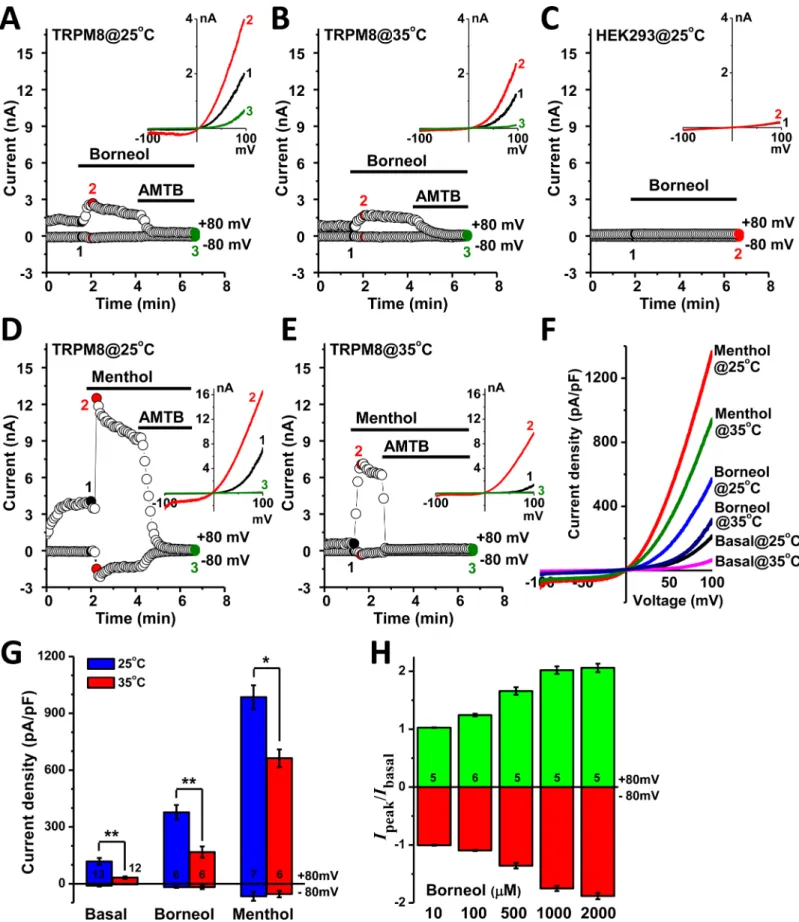
In whole-cell configuration, TRPM8 channels expressed in HEK293 cells exhibited some basal activities at 25°C before drug application (Fig 2). Superfusion of 100μM borneol immediately
Fig 1. Borneol stimulated Ca2+influx in HEK293 cells overexpressing TRPM8 channel.(A-B) In the presence of 1.5 mM extracellular Ca2+, borneol and menthol induced an increase of cytosolic Ca2+in TRPM8-expressing cells, but not in the control HEK293 cells without TRPM8 expression at 25 and 35°C. The rise of Ca2+was inhibited by 10
μM AMTB, a selective TRPM8 blocker. (C) Efficacy of 100μM borneol and menthol
on inducing Ca2+influx into TRPM8-expressing cells at 25 and 35°C. (D) In the absence of extracellular Ca2+, borneol did not change the intracellular Ca2+level, while subsequent addition of extracellular Ca2+resulted in robust Ca2+influx. (E) Comparison between the effects of borneol and menthol at different concentrations on the induction of Ca2+influx in TRPM8-expressing cells.
**P<0.01,***P<0.001. Sample numbers are shown in the bars.
increased the amplitudes of both inward and outward currents at 25 and 35°C, which were then completely abolished by 10μM AMTB (Fig 2A and 2B) and 20μM BCTC (S2 Fig). In consistent with the observation in Ca2+-imaging experiment, 100μM borneol did not evoke any signal in control cells without TRPM8 expression (Fig 2C), which confirmed that TRPM8 channel was responsible for the stimulatory effect of borneol. The currents activated by
100μM menthol were much larger and exhibited a gradual desensitization, and were fully
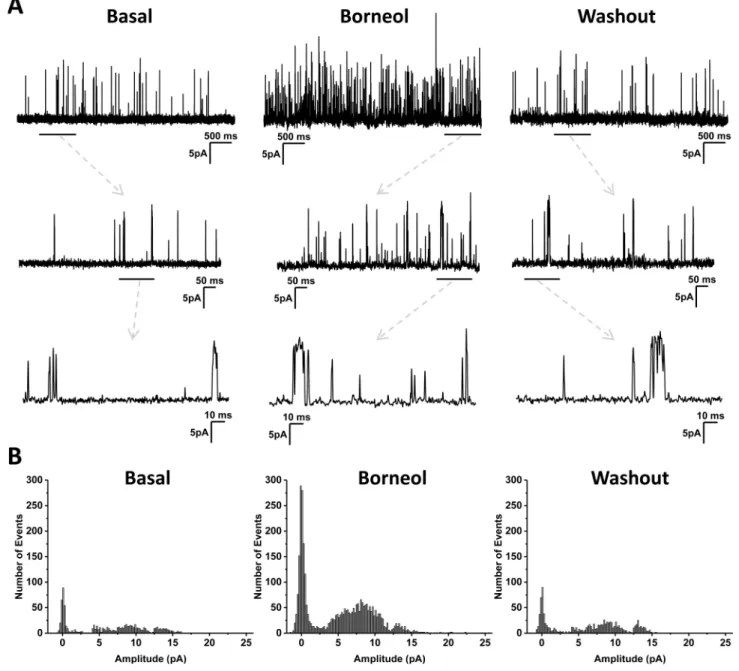
inhibited by 10μM AMTB (Fig 2D and 2E). The densities of whole-cell currents recorded at 25°C were significantly higher than that recorded at 35°C under the same condition, and men-thol was found more potent than borneol at both temperatures (Fig 2F and 2G). The activation of TRPM8 channel by borneol was concentration-dependent within the range of 10μM to 2 mM (Fig 2H). Inside-out patch-clamp recording revealed that application of borneol on the intracellular side of plasma membrane stimulated channel activities, and the currents decreased to the basal level after the drug was washed away (Fig 3A). The action of borneol was mainly attributed to the increase of channel opening probability (Fig 3B).
Borneol stimulates lacrimation without evoking nociceptive responses in
guinea pigs
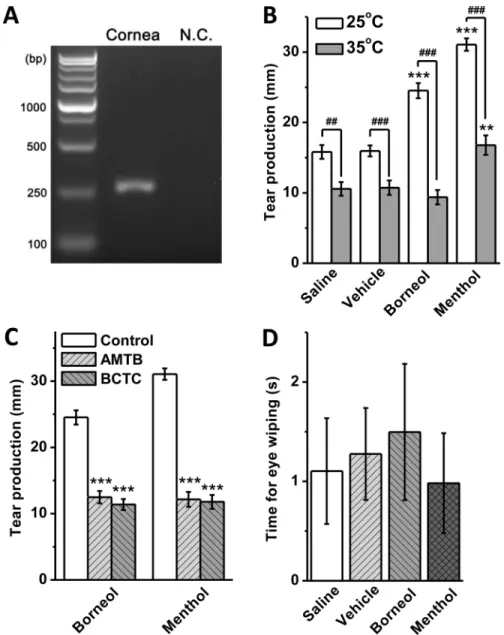
Expression of TRPM8 transcripts in the cornea of guinea pig was detected by RT-PCR (Fig 4A) and confirmed by sequencing. In tear measurement, the animals started tearing soon after the solution was dropped to the ocular surface. The tearing process lasted about 5 min; however, the animals always shook away excessive tears after 2 min, making it difficult to collect all tears through the whole tearing process. To make an exact quantitative comparison, we collected tears from the canthi at 2 min after the drop of solution. At 25°C, both borneol and menthol at
100μM increased tear secretion, which was significantly higher than that in the saline and
vehicle groups (Fig 4B). When the solution was prewarmed to 35°C, the tear secretion was greatly reduced compared to the results at 25°C, and no significant difference was observed between borneol-treated and control groups at 35°C (Fig 4B). A significant increase of tear secretion at 35°C was observed in menthol-treated group; however it was still much lower than that induced by menthol at 25°C (Fig 4B). The application of TRPM8 channel blockers AMTB
(10μM) and BCTC (20μM) abolished the stimulatory effect of borneol and menthol on tear
production at 25°C (Fig 4C). In the test for nociceptive responses, eye closure and blink were not observed during the 5 min of drug application in all animals. Total time of eye wiping with paws within 5 min was comparable between the borneol, menthol, vehicle and saline groups (Fig 4D).
The effects of borneol and menthol on cell viability
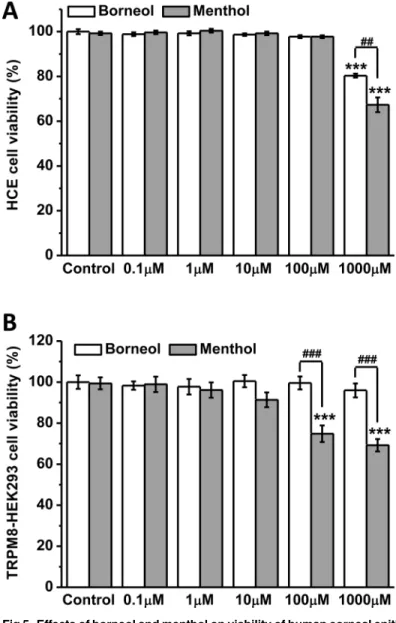
We used WST-1 assay to assess the impact of borneol and menthol on the viability of human corneal epithelial (HCE) cells and TRPM8-expressing HEK293 cells. After incubation with the drugs for 24 h, the viability of HCE cells was not affected by borneol and menthol at 0.1–
100μM, while both drugs at 1 mM significantly inhibited the growth of the cells (Fig 5A). The
inhibitory effect of borneol was weaker than that of menthol, suggesting a lower toxicity of bor-neol to corneal epithelium. For TRPM8-HEK293 cells, borbor-neol at 0.1–1000μM showed no collected from the time points 1, 2 and 3. (C) Borneol (100μM) showed no effect on the whole-cell currents in non-transfected HEK293 cells. (D-E) Menthol
(100μM) potently augmented the whole-cell currents in TRPM8-expressing cells at 25 and 35°C. (F) Traces for the mean values of whole-cell current
density-voltage relationships at conditions indicated. (G) Statistical results for values extracted from±80mV in panel F. Sample numbers are shown in the bars. (H) Dose-dependency of borneol on the activation of whole-cell TRPM8 currents at 25°C. The ratio between borneol-induced peak current and the basal current before borneol application was used.
effect on cell viability. In contrast, menthol at 100 and 1000μM strongly reduced the viability of the cells (Fig 5B). These results indicate that at the same concentration as borneol, menthol is prone to induce intracellular Ca2+overload and cell death mediated by TRPM8 channel.
Discussion
Borneol has long been used in China with other herbal extracts to treat oculopathies, including dry eye syndrome [29]. The treatment with borneol and other compounds produced beneficial effects to the patients [26], but the contribution of each component and the therapeutic
Fig 3. Effect of borneol on TRPM8 currents in transfected HEK293 cells recorded under inside-out configuration.(A) Typical recordings of single channel currents at +100 mV and 25°C. Borneol at 100μM was used. Dashed arrows indicate expansions from
underlined region above. (B) Amplitude histograms of the single channel activity. The histograms could not be fitted with a simple Gaussian function, reflecting the existence of multiple conducting states.
mechanism are unclear. In the present study we demonstrated that micromolar borneol can significantly increase lacrimation in guinea pigs at 25°C but not 35°C, suggesting a tempera-ture-sensitive target of borneol in the cornea. In addition, the TRPM8 channel blockers AMTB and BCTC dramatically inhibited tear secretion induced by borneol and menthol. In the mea-surement of nociceptive behaviors, the response to borneol was similar to that of menthol, which has been proved to be non-irritating for rodents at micromolar concentration [17]. These results strongly suggest the TRPM8-expressing afferent cool cells in the cornea are responsive to borneol, since these cells are the only type of neurons that trigger lacrimation
Fig 4. Borneol evoked tear secretion without nociceptive effect in guinea pigs.(A) RT-PCR of TRPM8 mRNA expressed in the cornea of guinea pig. N.C., negative control. (B) 100μM borneol and menthol were
applied to the ocular surface at 25 and 35°C to induce tear production (**P<0.01,***P<0.001vsvehicle at the same temperature;##P<0.01,###P<0.001 between groups indicated;n= 10 in each group). (C) TRPM8 channel blockers AMTB (10μM) and BCTC (20μM) inhibited borneol- and menthol-induced tear production
(***P<0.001vscontrol;n= 10 in each group). (D) Total time spent for eye wiping with paws by the animals within 5 min after the drop of 100μM borneol and menthol solution to the corneas. No significantly difference
was observed between groups (n= 4 in each group).
without nociceptive response upon activation [17,30]. The expression of TRPM8 in the cornea of guinea pig has been previously detected by Madrid et al. [18] and confirmed in current study. Using TRPM8-expressing HEK293 cells, we found that TRPM8 channel is indeed a pharmacological target of borneol, and the drug-channel interaction at the intracellular side leads to channel opening and Ca2+influx into the cells. As that established in mice [16,17] and rats [20], TRPM8-mediated Ca2+signaling eventually triggers lacrimation through a neurore-gulation pathway [21].
In addition to corneal nerve fibers, expression of TRPM8 has been detected in cultured human corneal epithelial (HCE) [31] and endothelial cells [32], corneal stromal keratocytes [33], and conjunctival epithelial cells [34]. We also examined the expression of TRPM8 in pri-mary HCE cells. The results showed that the level of TRPM8 mRNA was very low, and TRPM8
Fig 5. Effects of borneol and menthol on viability of human corneal epithelial (HCE) cells and TRPM8-expressing HEK293 cells.(A) Both borneol and menthol at 1 mM significantly reduced the viability of HCE cells. (B) Borneol at 0.1–1000μM did not affect the viability of TRPM8-HEK293 cells, while menthol at
100 and 1000μM showed strong inhibition on cell viability. (***P<0.001vscontrol;##P<0.01,###P<0.001 between indicated columns;n= 8 in each column).
protein in these cells was undetectable (S1 Fig). This is inconsistent with the previous study that demonstrated functional expression of TRPM8 in immortalized HCE cells [31], suggesting the expression of TRPM8 in HCE cells may be sensitive to viral infection and culture condi-tions. As the primary HCE cells we used have been transported overseas and proliferatedin vitro, it will be more reliable to perform immunostaining for TRPM8 in intact cornea to exam-ine the expression in different cell types.In situdistribution of TRPM8 in the cornea was observed by using transgenic mice carrying a GFP gene driven by the TRPM8 promotor [19]. The intensity of GFP in nerve fibers was much higher than that in corneal stroma and epithe-lium, suggesting higher expression of TRPM8 channel in corneal sensory neurons, so that action potential can be initiated by cold stimulus. Nonetheless, since the expression level may not be proportional to the functionality of channels, it would be interesting to investigate the current density of TRPM8 in corneal sensory neurons and surrounding non-excitable cells, and also the interplay of channels between excitable and non-excitable cells. The presence of TRPM8 in corneal epithelial cells may relate to corneal functions such as the permeability of corneal epithelium. As mentioned in the introduction section, a number of studies have dem-onstrated that borneal can increase corneal permeability and promote the penetration of other drugs through this barrier tissue. Activation of TRPM8 channels and other potential targets of borneol in corneal epithelial cells may be responsible for this effect. Borneol has been found to activate TRPV3 channel [35], which belongs to the heat-activated vanilloid family of TRP channels. The members of this family are expressed in corneal nerve fibers (TRPV1) [36], and epithelial [37,38] and endothelial cells (TRPV1/2/3/4) [39,40]. TRPV1 is well known as the receptor for capsaicin [41], the pungent ingredient of chilli pepper that induces strong nocicep-tive responses upon eye contact. Considering the wide use of borneol-containing eye drops in China, and our finding that borneol did not cause nociceptive response in guinea pigs, it can be deduced that borneol is unlikely to excite TRPV1-expressing nociceptive sensory neurons in the cornea. In corneal epithelium, TRPV1 plays a pro-inflammatory role [42,43] and is involved in wound healing by regulating proliferation and migration of epithelial cells [44]. TRPV4 is required for regulatory cell volume decrease in response to hypotonic challenge [45]. Although the expression of temperature-sensitive TRP channels in the cornea has been demon-strated in recent years, the functions of these channels are still largely unknown, except their general role as temperature sensors [39,46]. To better understand the ocular pharmacology of borneol, further studies to test the effects of borneol on TRPV channels are required.
safety, it is strongly suggested to reduce the dose of borneol in ophthalmic preparations to less than 1 g/L. The ocular toxicity of borneol should be further examined to critically evaluate the risk of overdose in eye drops.
The effect of borneol on TRPM8 channel was first and briefly examined by Vogt-Eisele et al. [35]. The authors found that 2 mM borneol was not sufficient to potentiate large currents in TRPM8-expressing HEK293 cells. In the present study we performed Ca2+imaging and patch clamp experiments on the same type of cells. The results from both experiments came to the same conclusion that borneol is indeed an activator of TRPM8 channel, though the potency is much lower than menthol. In the previous study Vogt-Eisele et al. [35] used a voltage clamp protocol holding at -40 mV, and the amplitudes of TRPM8 currents induced by 2 mM borneol were less than 10% of that induced by 2 mM menthol. We used the same protocol on our cells and found that the currents potentiated by 2 mM borneol accounted for ~60% of that by 2 mM menthol (S3 Fig). Compared to the relatively small menthol-induced current (~0.7 nA) in the previous study, the currents we recorded were always larger (1.4–2.0 nA). This suggests that the expression level of TRPM8 in our stably transfected cells may be higher than that used in the previous study. For drug testing on TRPM8 channel, these cells may be particularly useful for compounds with relatively lower efficacy. Taking this advantage, we were able to demon-strate the concentration-dependent activation of TRPM8 channel by borneol. However, as the highest concentration we tested (2 mM) is very close to solubility limit of borneol in the stan-dard bath solution (diluted from 2 M stock in DMSO), the EC50was not calculated due to the
lack of maximum activation data. Higher concentrations of borneol in eye drops are achieved by using cosolvent mixed with ethanol, phenoxyethanol and polyvinyl alcohol, and adding sur-factant tween-80 and solubilizing agents such as sodium citrate. Therefore, the activation of corneal TRPM8 channels and induction of tearing response by borneol could be more pro-found when these eye drops are used.
We conclude that borneol can increase tear secretion via activating the cold-sensing TRPM8 channel in the cornea, which is a novel therapeutic mechanism of borneol-containing ophthalmic preparations.
Supporting Information
S1 Fig. Detection of TRPM8 expression in HEK293 and human corneal epithelial cells. Western blot (A) and RT-PCR (B) of HEK293 cells transfected with TRPM8 cDNA plasmids (lane 1), mock transfected HEK293 cells (lane 2), primary human corneal epithelial cells (lane 3) and no-RT control (lane 4). Rabbit polyclonal anti-TRPM8 primary antibody (D122681, Sangon, Shanghai, China) was used at 1:500 dilution. The expected size of TRPM8 protein is ~120kDa.
Primers:
TRPM8-F: 5’-CAATGCCATCTCCTACGCTC-3’
TRPM8-R: 5’-CAGCAGGAGGAAGGCGATGTAG-3’(product size: 1039bp) beta-actin-F: 5’-ACAGAGCCTCGCCTTTGC-3’
beta-actin-R: 5’-GGAATCCTTCTGACCCATGC-3’(product size: 211bp). (TIF)
S2 Fig. Inhibition of borneol-induced TRPM8 activity by BCTC.(A) Ca2+imaging. (B) Whole-cell patch clamp.
(TIF)
The interval time for washout is 2 min. (B) Mean±SD of currents induced by 2 mM menthol and borneol (n= 4).
(TIF)
Acknowledgments
This project was supported by the National Natural Science Foundation of China (31300949 to B. Z. and 31300965 to G.L. C.), Department of Science & Technology of Sichuan Province (Youth Foundation, 2014JQ0021 to B. Z.), and Joint Projects of Luzhou City and Luzhou Medi-cal College (2013LZLY-J47 to B. Z. and 14JC0127 to G.L. C.).
Author Contributions
Conceived and designed the experiments: GLC BZ FZ. Performed the experiments: GLC ML LPZ BZ. Analyzed the data: GLC ML BZ. Contributed reagents/materials/analysis tools: GLC BZ. Wrote the paper: BZ FZ.
References
1. Pang YX, Wang WQ, Zhang YB, Yuan Y, Yu JB, Zhu M, et al. Genetic diversity of the Chinese tradi-tional herb Blumea balsamifera (Asteraceae) based on AFLP markers. Genetics and molecular research: GMR. 2014; 13(2):2718–26. doi:10.4238/2014.April.14.1PMID:24782086
2. Park TJ, Park YS, Lee TG, Ha H, Kim KT. Inhibition of acetylcholine-mediated effects by borneol. Bio-chem Pharmacol. 2003; 65(1):83–90. PMID:12473382
3. Lu Y, Du S, Yao Z, Zhao P, Zhai Y. [Study on natural borneol and synthetic borneol affecting mucosal permeability of gardenia extract]. Zhongguo Zhong yao za zhi = Zhongguo zhongyao zazhi = China journal of Chinese materia medica. 2009; 34(10):1207–10. PMID:19673377
4. Xiong ZY, Xiao FM, Xu X, Wu YF, Jiang XM. Studies on pharmacological activity of borneol. Zhongguo Zhong yao za zhi = Zhongguo zhongyao zazhi = China journal of Chinese materia medica. 2013; 38 (6):786–90. PMID:23717952
5. Silva-Filho JC, Oliveira NN, Arcanjo DD, Quintans-Junior LJ, Cavalcanti SC, Santos MR, et al. Investi-gation of mechanisms involved in (-)-borneol-induced vasorelaxant response on rat thoracic aorta. Basic Clin Pharmacol Toxicol. 2012; 110(2):171–7. doi:10.1111/j.1742-7843.2011.00784.xPMID:
21883938
6. Wu CJ, Huang QW, Qi HY, Guo P, Hou SX. Promoting effect of borneol on the permeability of puerarin eye drops and timolol maleate eye drops through the cornea in vitro. Pharmazie. 2006; 61(9):783–8.
PMID:17020156
7. Yang H, Xun Y, Li Z, Hang T, Zhang X, Cui H. Influence of borneol on in vitro corneal permeability and on in vivo and in vitro corneal toxicity. The Journal of international medical research. 2009; 37(3):791–
802. PMID:19589262
8. Liu J, Fu S, Wei N, Hou Y, Zhang X, Cui H. The effects of combined menthol and borneol on fluconazole permeation through the cornea ex vivo. Eur J Pharmacol. 2012; 688(1–3):1–5. doi:10.1016/j.ejphar.
2011.12.007PMID:22200629
9. Song J, Bi H, Xie X, Guo J, Wang X, Liu D. Natural borneol enhances geniposide ophthalmic absorption in rabbits. Int J Pharm. 2013; 445(1–2):163–70. doi:10.1016/j.ijpharm.2013.01.047PMID:23376228
10. Qi HP, Gao XC, Zhang LQ, Wei SQ, Bi S, Yang ZC, et al. In vitro evaluation of enhancing effect of bor-neol on transcorneal permeation of compounds with different hydrophilicities and molecular sizes. Eur J Pharmacol. 2013; 705(1–3):20–5. doi:10.1016/j.ejphar.2013.02.031PMID:23458068
11. Journigan VB, Zaveri NT. TRPM8 ion channel ligands for new therapeutic applications and as probes to study menthol pharmacology. Life Sci. 2013; 92(8–9):425–37. doi:10.1016/j.lfs.2012.10.032PMID:
23159643
12. Peier AM, Moqrich A, Hergarden AC, Reeve AJ, Andersson DA, Story GM, et al. A TRP channel that senses cold stimuli and menthol. Cell. 2002; 108(5):705–15. PMID:11893340
14. Bautista DM, Siemens J, Glazer JM, Tsuruda PR, Basbaum AI, Stucky CL, et al. The menthol receptor TRPM8 is the principal detector of environmental cold. Nature. 2007; 448(7150):204–8. PMID:
17538622
15. Alexander SP, Benson HE, Faccenda E, Pawson AJ, Sharman JL, Catterall WA, et al. The Concise Guide to PHARMACOLOGY 2013/14: Ion Channels. Br J Pharmacol. 2013; 170(8):1607–51. doi:10.
1111/bph.12447PMID:24528239
16. Parra A, Madrid R, Echevarria D, del Olmo S, Morenilla-Palao C, Acosta MC, et al. Ocular surface wet-ness is regulated by TRPM8-dependent cold thermoreceptors of the cornea. Nat Med. 2010; 16 (12):1396–9. doi:10.1038/nm.2264PMID:21076394
17. Robbins A, Kurose M, Winterson BJ, Meng ID. Menthol activation of corneal cool cells induces TRPM8-mediated lacrimation but not nociceptive responses in rodents. Invest Ophthalmol Vis Sci. 2012; 53 (11):7034–42. doi:10.1167/iovs.12-10025PMID:22952122
18. Madrid R, Donovan-Rodriguez T, Meseguer V, Acosta MC, Belmonte C, Viana F. Contribution of TRPM8 channels to cold transduction in primary sensory neurons and peripheral nerve terminals. J Neurosci. 2006; 26(48):12512–25. PMID:17135413
19. Carr RW, Pianova S, McKemy DD, Brock JA. Action potential initiation in the peripheral terminals of cold-sensitive neurones innervating the guinea-pig cornea. The Journal of physiology. 2009; 587(Pt 6):1249–64. doi:10.1113/jphysiol.2008.167023PMID:19171652
20. Hirata H, Oshinsky ML. Ocular dryness excites two classes of corneal afferent neurons implicated in basal tearing in rats: involvement of transient receptor potential channels. J Neurophysiol. 2012; 107 (4):1199–209. doi:10.1152/jn.00657.2011PMID:22114162
21. Kurose M, Meng ID. Dry eye modifies the thermal and menthol responses in rat corneal primary afferent cool cells. J Neurophysiol. 2013; 110(2):495–504. doi:10.1152/jn.00222.2013PMID:23636717
22. Marshall LL, Roach JM. Treatment of Dry Eye Disease. The Consultant pharmacist: the journal of the American Society of Consultant Pharmacists. 2016; 31(2):96–106.
23. Kovacs I, Luna C, Quirce S, Mizerska K, Callejo G, Riestra A, et al. Abnormal activity of corneal cold thermoreceptors underlies the unpleasant sensations in dry eye disease. Pain. 2016; 157(2):399–417.
doi:10.1097/j.pain.0000000000000455PMID:26675826
24. Hu S, Yu J, Ning L, Lv D. Study on colling-agent of ophthalmic preparation. Chinese J Appl Pharm. 2010; 27(1):38–9.
25. Bao L, Yuan X, Lv W, Shen Y, Yang L, Zhao Z. Clinical observation on dry eye treatment by application of Chinese medicine to acupoint and oral medication. J Tradit Chinese Ophthalmol. 2014; 24(3):162–4.
26. Song L, Su YL, Xu JJ, Jiao H, Wang YZ, Zhang N. Therapeutic effectiveness of ultrasonic cool mist of Chinese medicine on dry eye syndrome. J Tradit Chinese Ophthalmol. 2011; 21(5):273–5.
27. Lashinger ES, Steiginga MS, Hieble JP, Leon LA, Gardner SD, Nagilla R, et al. AMTB, a TRPM8 chan-nel blocker: evidence in rats for activity in overactive bladder and painful bladder syndrome. American journal of physiology Renal physiology. 2008; 295(3):F803–10. doi:10.1152/ajprenal.90269.2008
PMID:18562636
28. Valero ML, Mello de Queiroz F, Stuhmer W, Viana F, Pardo LA. TRPM8 ion channels differentially mod-ulate proliferation and cell cycle distribution of normal and cancer prostate cells. PLOS ONE. 2012; 7 (12):e51825. doi:10.1371/journal.pone.0051825PMID:23251635
29. Peng QH, Wang F, Peng J. Progress of Traditional Chinese Medicine treatment on dry eyes in recent years. Chinese Arch Tradit Chinese Med. 2011; 29(5):941–5.
30. Hirata H, Meng ID. Cold-sensitive corneal afferents respond to a variety of ocular stimuli central to tear production: implications for dry eye disease. Invest Ophthalmol Vis Sci. 2010; 51(8):3969–76. doi:10.
1167/iovs.09-4744PMID:20335617
31. Lucius A, Khajavi N, Reinach PS, Kohrle J, Dhandapani P, Huimann P, et al. 3-Iodothyronamine increases transient receptor potential melastatin channel 8 (TRPM8) activity in immortalized human corneal epithelial cells. Cellular signalling. 2016; 28(3):136–47. doi:10.1016/j.cellsig.2015.12.005PMID:26689735
32. Mergler S, Mertens C, Valtink M, Reinach PS, Szekely VC, Slavi N, et al. Functional significance of ther-mosensitive transient receptor potential melastatin channel 8 (TRPM8) expression in immortalized human corneal endothelial cells. Experimental eye research. 2013; 116:337–49. doi:10.1016/j.exer.
2013.10.003PMID:24135298
33. Reinach PS, Mergler S, Okada Y, Saika S. Ocular transient receptor potential channel function in health and disease. BMC ophthalmology. 2015; 15 Suppl 1:153. doi:10.1186/s12886-015-0135-7PMID: 26818117
34. Khajavi N, Reinach PS, Slavi N, Skrzypski M, Lucius A, Strauss O, et al. Thyronamine induces TRPM8 channel activation in human conjunctival epithelial cells. Cellular signalling. 2015; 27(2):315–25. doi:
35. Vogt-Eisele AK, Weber K, Sherkheli MA, Vielhaber G, Panten J, Gisselmann G, et al. Monoterpenoid agonists of TRPV3. Br J Pharmacol. 2007; 151(4):530–40. PMID:17420775
36. Murata Y, Masuko S. Peripheral and central distribution of TRPV1, substance P and CGRP of rat cor-neal neurons. Brain research. 2006; 1085(1):87–94. PMID:16564032
37. Yamada T, Ueda T, Ugawa S, Ishida Y, Imayasu M, Koyama S, et al. Functional expression of transient receptor potential vanilloid 3 (TRPV3) in corneal epithelial cells: involvement in thermosensation and wound healing. Experimental eye research. 2010; 90(1):121–9. doi:10.1016/j.exer.2009.09.020PMID:
19793539
38. Mergler S, Garreis F, Sahlmuller M, Reinach PS, Paulsen F, Pleyer U. Thermosensitive transient recep-tor potential channels in human corneal epithelial cells. Journal of cellular physiology. 2011; 226 (7):1828–42. doi:10.1002/jcp.22514PMID:21506114
39. Mergler S, Valtink M, Coulson-Thomas VJ, Lindemann D, Reinach PS, Engelmann K, et al. TRPV channels mediate temperature-sensing in human corneal endothelial cells. Experimental eye research. 2010; 90(6):758–70. doi:10.1016/j.exer.2010.03.010PMID:20338165
40. Mergler S, Valtink M, Taetz K, Sahlmuller M, Fels G, Reinach PS, et al. Characterization of transient receptor potential vanilloid channel 4 (TRPV4) in human corneal endothelial cells. Experimental eye research. 2011; 93(5):710–9. doi:10.1016/j.exer.2011.09.021PMID:21996372
41. Caterina MJ, Schumacher MA, Tominaga M, Rosen TA, Levine JD, Julius D. The capsaicin receptor: a heat-activated ion channel in the pain pathway. Nature. 1997; 389(6653):816–24. PMID:9349813
42. Zhang F, Yang H, Wang Z, Mergler S, Liu H, Kawakita T, et al. Transient receptor potential vanilloid 1 activation induces inflammatory cytokine release in corneal epithelium through MAPK signaling. Jour-nal of cellular physiology. 2007; 213(3):730–9. PMID:17508360
43. Pan Z, Wang Z, Yang H, Zhang F, Reinach PS. TRPV1 activation is required for hypertonicity-stimu-lated inflammatory cytokine release in human corneal epithelial cells. Invest Ophthalmol Vis Sci. 2011; 52(1):485–93. doi:10.1167/iovs.10-5801PMID:20739465
44. Sumioka T, Okada Y, Reinach PS, Shirai K, Miyajima M, Yamanaka O, et al. Impairment of corneal epi-thelial wound healing in a TRPV1-deficient mouse. Invest Ophthalmol Vis Sci. 2014; 55(5):3295–302.
doi:10.1167/iovs.13-13077PMID:24781945
45. Pan Z, Yang H, Mergler S, Liu H, Tachado SD, Zhang F, et al. Dependence of regulatory volume decrease on transient receptor potential vanilloid 4 (TRPV4) expression in human corneal epithelial cells. Cell calcium. 2008; 44(4):374–85. doi:10.1016/j.ceca.2008.01.008PMID:18355916
46. Mergler S, Valtink M, Takayoshi S, Okada Y, Miyajima M, Saika S, et al. Temperature-sensitive tran-sient receptor potential channels in corneal tissue layers and cells. Ophthalmic research. 2014; 52 (3):151–9. doi:10.1159/000365334PMID:25301091
47. Wu CJ, Huang QW, Qi HY, Guo P, Hou SX. Ocular toxicity of borneol in rabbits. Chinese Pharmaceut J. 2005; 40(22):1710–3.
48. Yang HB, Xun YB, Zhang XY, Li ZJ, Cui O, Zhang LQ, et al. Study on the role of natural borneol and synthetic borneol in eye irritation and chronic toxicity. Int J Ophthalmol. 2008; 8(11):2228–31.