ISSN 2320-7078 JEZS 2013; 1 (5): 48-52 © 2013 AkiNik Publications Received 3-08-2013
Accepted: 25-08-2013
J.P. Ingabire
Department of Agricultural Entomology, Tamil Nadu Agricultural University, Coimbatore - 641 003, India.
A. Hategekimana Department of Agricultural Entomology, Tamil Nadu Agricultural University, Coimbatore - 641 003, India.
K. Bhuvaneswari
Post-Harvest and Technology Centre, Tamil Nadu Agricultural University, Coimbatore - 641 003, India.
S. Mohan
Department of Agricultural Entomology, Tamil Nadu Agricultural University, Coimbatore - 641 003, India.
S. Ganapathy
Post-Harvest and Technology Centre, Tamil Nadu Agricultural University, Coimbatore - 641 003, India.
Correspondence: A. Hategekimana Department of Agricultural Entomology, Tamil Nadu Agricultural University, Coimbatore - 641 003, India.
Email: [email protected]
Management of Pulse Beetle,
Callosobruchus maculatus
(F) Population by Nitrogen Based Modified Atmosphere
J.P. Ingabire, A. Hategekimana, K. Bhuvaneswari, S. Mohan, S. Ganapathy
ABSTRACT
Callosobruchus maculatus (F) is a direct pest affecting stored green gram causing quantitative and qualitative loss. While other management methods have different side effects on the environment and human health there is a need of ecofriendly methods to manage the pests. Manipulation of the composition of the atmosphere to control stored product insects has a promising future. Studies were conducted to determine the effectiveness of nitrogen based modified atmosphere on C. maculatus population. The experiment consisted of two factors viz., Oxygen concentration(21, 14, 11, 8, 5 and 2% O2 with remaining percentage being Nitrogen) and exposure period (3, 5 and 7 days), designed in
Factorial Completely Randomized Design (FCRD) with 18 treatments and replicated 3 times. The results showed that insect mortality increased by decreasing the O2 concentration or by extending the
exposure period to low O2. In addition adult population decreased drastically with decrease in O2
concentration.
Keywords: stored pests, modified atmosphere, control, Nitrogen
1. Introduction
Manipulation of the composition of the atmosphere to control stored product insects has a promising future (Bailey and Banks, 1975) [1]. This modified atmosphere storage has many advantages compare to conventional methods of storage (Calderon and Barkai-Golan, 1990) [2]. They provide a way to eliminate insects from stored commodities without polluting the atmosphere and are safer traditional fumigants. No harmful residues remain after the treatment of the commodity with nitrogen (N2) or oxygen (O2).
Atmospheres which could be utilized for this purpose in grain storage are those with reduced O2
tension and those with increased CO2 content or a combination of the two. Means of producing
such atmospheres include the purging of airtight silos with N2 from tankers and the elimination of
O2 using burners or catalytic generators (Navarro, 2006) [3].
Navarro (1986) [4], Banks and Annis (1990) [5] stated that N
2 causes a progressive hypoxia or
anoxia when used alone at a high purity level. Generally the lower the O2 level, the higher the
mortality. For effective control, the O2 level should be less than 3 % and preferably less than 1 %
if a rapid kill is required. This effect was shown to be reversed for adult rice weevils, S. oryzae,
which below 1 % O2 in N2 showed tolerance, increasing the lethal exposure time, apparently due
to the closure of their spiracles to prevent desiccation (Navarro et al., 1985) [6].
It is known that modified atmosphere is frequently practiced in developed countries (Longstaff, 1994) [7]. There is a need to introduce it in third world countries by the way of studying different gases concentrations to be used. Keeping all these points in view, the present study was initiated to evaluate the effectiveness of Nitrogenbased modified atmosphere on C. maculatus.
2. Materials and methods 2.1. Study area and the crop used
2.2. Mass culturing of C. maculatus
The C. maculatus adults collected from stored pulses were utilized for mass culturing. These beetles were reared on fresh green gram seeds that were disinfested by storing in a freezer for one week to kill any insect stages that may be present. About 200 g of green gram seeds were placed in plastic containers, into which approximately unsexed 50 pairs of freshly emerged adults were introduced. The containers were covered with muslin cloth, placed in rearing cage and maintained at a room temperature of 30
5 oCand 70
5% relative humidity (r.h) throughout the period of study. After about 25-28 days, adults that emerged from the culture were utilized for maintenance of sub cultures following the same procedure as described above.For getting uniform aged adults, 100 g of fresh seeds were exposed to 20 pairs of insects and allowed for one to two days for egg laying. All the adult insects were removed after 1-2 days and uniform aged adults were harvested 25 days after egg laying.
2.3. Experiment Details
2.3.1. Design of Airtight Glass Containers
Glass containers of 500 ml capacity with metal screw cap were used for conducting the experiment on assisted modified atmospheric storage. In the lid, two perforations each of 3 mm diameter were made for inlet and outlet ports. PVC hose of 25 cm length was inserted through a brass hose collar connected to the lid which served as gas inlet and this was connected to the gas mixture apparatus by appropriate tubing, while flushing the gas. Teflon coated silicon septum of 20 mm diameter was inserted into brass check nut and was used to close after filling the gas inside the container which exactly seals the outlet and the entire system was made airtight.
Preliminary studies were done to check the air tightness of the container. Known concentration of gas mixture (CO2, O2 and N2)
from the pressurised cylinders was flushed into the glass bottles. The containers were kept for one day and the gas level was checked again with the help of O2 analyzer to confirm the gases initial level.
2.3.2. Design and Layout of Experiment
The experiment consisted of two factors viz., different concentrations of O2 (21% O2 as control), 14% O2, 11% O2, 8% O2,
5% O2 and 2% O2)and exposure period (3, 5 and 7 days), designed
in Factorial Completely Randomized Design (FCRD). The treatment combination gave 18 treatments and each replicated 3 times and in total 54 experimental units.
2.3.3. Release of Nitrogen Gas into an Airtight Glass Container Nitrogen gas was released into an airtight glass container at different concentration to get low O2 atmosphere. Containers were
maintained for different period of storage (3, 5 and 7 days). Fifteen numbers of 1-2 day old, unsexed adult pulse beetles were transferred to the 500 ml experimental glass bottle containing 200 g of green gram and N2 gas from cylinder was introduced. The
airtight containers were provided with 3 mm inlet hole designed in the lid to flush the gas.
While purging N2 gas, the outlet port was kept open to flush out the
air from the container and the time required to get desirable concentrations of O2 in N2 was determined (for 14%, 11%, 8%, 5%
and 2% O2 concentrations, the time required was 2, 4, 5 and 8
minutes respectively). After injecting the N2 gas, the inlet and
outlet ports were closed at one stroke using a small pinch clip and
brass check nut respectively to prevent escape of the gas from the container. The concentration of O2 gas in the container was
determined using O2 analyzer.
2.3.4. Observations and Data Recorded i. Adult Mortality
Per cent mortality was calculated using the following formula. Per cent adult mortality = No. of adults dead/ No. of adults released X 100. In case of insects mortality in the control, Abbot’s correction was applied (Abbot, 1925)8 using the following formula.
Observed % mortality in treatment – Observed % mortality in untreated check Corrected mortality = ---×100 100- Pc observed per cent mortality in untreated check
ii. Progeny development
After recording the adult mortality, in the same sample, the number of eggs laid was counted from 100 randomly selected grains per replication for each treatment. Observations were made for the exposure periods of 3, 5 and 7 days. New adults were recorded starting from twenty five days after egg laying till there was no new adult emergence for each treatment. The per cent egg mortality was also calculated based on the number of adults emerged (Howe, 1971) [9].
Per cent egg mortality = 100 – Per cent egg survival. With
Per cent egg survival = No. of adults emerged / No. of eggs laid X. 100.
2.3.5 Statistical Analysis
The data obtained from different experiments were statistically analyzed by analysis of variance (ANOVA) by SAS 9.1.3 Portable software. Data on adults C. maculatus and eggs mortality were transformed using arc sine (sin-1 √p) while egg laying and adult
emergence were transformed using square root (√x +0.5) The mean separation was done by Least Significance Difference (LSD) test. In case of mortality in the control, the percentage mortalities were subjected to correction as developed by Abbot (1925) [8].
3. Results and Discussion 3.1. Adult Mortality
The results of the table 1 showed that there was significant difference in the mortality of pulse beetle by counts made at 3, 5 and 7 days of exposure. The adult mortality was found to be high (91.9%) at 2% O2 when compared to other concentrations. At 14%,
11%, 8% and 5% O2 concentration, the mean per cent adult
mortality recorded was 51.0, 63.5, 73.3 and 83.5 respectively. In addition, the exposure period influenced significantly the adult mortality of C. maculatus.
Among the three exposure periods, the highest mortality was recorded at 7th day with 71.8%. The insect mortality increased by
decreasing the O2 concentration or by extending the exposure
period to low O2.
Storey (1975) [10] stated that during the N
2 atmosphere exposure
period, insects consume less O2 to avoid the effect of anoxia. In
case of anoxia, the development of insects virtually ceases and survival depends only on the capacity to accumulate glycolytic products and to reduce metabolism needs. It was found that for the same O2 concentration, if duration of exposure increased the total
mortality per cent also increased. Babu et al. (1989) [11] recorded an
Table 1: Effect of nitrogen based modified atmosphere on adult mortality of C. maculatus
O2 concentration
Per cent adult mortality after different exposure periods
3 days 5 days 7 days Mean
N1 - 14% O2 41.5 44.8 66.7 51.0e
N2 - 11% O2 51.3 62.4 76.8 63.5d
N3 - 8% O2 63.2 75.1 81.7 73.3c
N4 - 5% O2 73.0 85.1 92.2 83.5b
N5 - 2% O2 82.9 92.8 100.0 91.9a
N6 - Control 4.4 8.9 13.3 8.9 f
Mean 52.7c 61.5b 71.8a
Gas concentration Periods Interaction
CD (0.05) 4.3 3.0 NS
SE (d) 2.1 1.5 7
CV% 8.0
NS - Not significant
Means followed by the same letters are not significantly different at P=0.05 (LSD)
3.2. Progeny development i. Eggs laying
The treatments were significantly different from one another and
2% O2 concentration was most effective with less number of eggs
(Table 2).
Table 2: Effect of N2 based modified atmosphere on egg laying by C. maculatus
O2 concentration Mean No. of eggs laid after different exposure periods
3 days 5 days 7 days Mean
N1 - 14% O2 8.0 14.0 14.0 12.1b
N2 - 11% O2 5.7 8.0 9.7 7.8c
N3 - 8% O2 4.7 5.7 7.3 5.9d
N4 - 5% O2 2.7 3.0 3.7 3.1e
N5 - 2% O2 1.7 2.3 2.3 2.1f
N6 - Control 17.7 20.3 21.3 19.ba
Mean 6.7 b 8.9a 9.8a
Gas concentration Periods Interaction
CD (0.05) 0.2 0.1 NS
SE (d) 0.1 0.0 0.2
CV% 7.9
NS - Not significant
Means followed by the same letters are not significantly different at P=0.05 (LSD)
For the exposure period, there was significant difference on egg laying by C .maculatus and the mean number was high at 7th day
(9.78). The number of eggs increased with the increase in O2
concentration and exposure time. Spratt (1984)12 showed that in
case of T. castaneum, egg production declined with decreasing O2
concentration ranging between 20- 5%.
ii. Adult emergence
The results revealed that the O2 concentration influenced
significantly the adult emergence. Adult population decreased with decrease in O2 concentration (Table 3).
Table 3: Effect of N2 based modified atmosphere on adult emergence of C. maculatus
O2 concentration
No. of adults emerged after different exposure periods
3 days 5 days 7 days Mean
N1 - 14% O2 6.3 10.3 8.0 8.2b
N2 - 11% O2 4.3 5.3 4.6 4.8c
N3 - 8% O2 2.7 2.6 3.3 2.9d
N4 - 5% O2 1.0 1.0 1.0 1.0e
N5 - 2% O2 0.7 0.6 0.0 0.4f
N6 - Control 17.3 19.6 20.3 19.1a
Mean 5.4 6.6 6.2
Gas concentration Periods Interaction
CD (0.05) 0.2 NS NS
SE (d) 0.1 1.0 0.2
CV% 9.9
NS - Not significant
In the control, the adult emergence from grains reached a mean value of 20.33 adults after 7 days while in grains exposed to 2 % O2
concentration there was no adult emergence. In the control, the adult emergence from grains has reached a mean value of 20.3 after 7 days while in 2% O2 concentration there was no adult emergence.
There was no significant difference with reference to exposure
period on the adult emergence.
iii. Eggs mortality
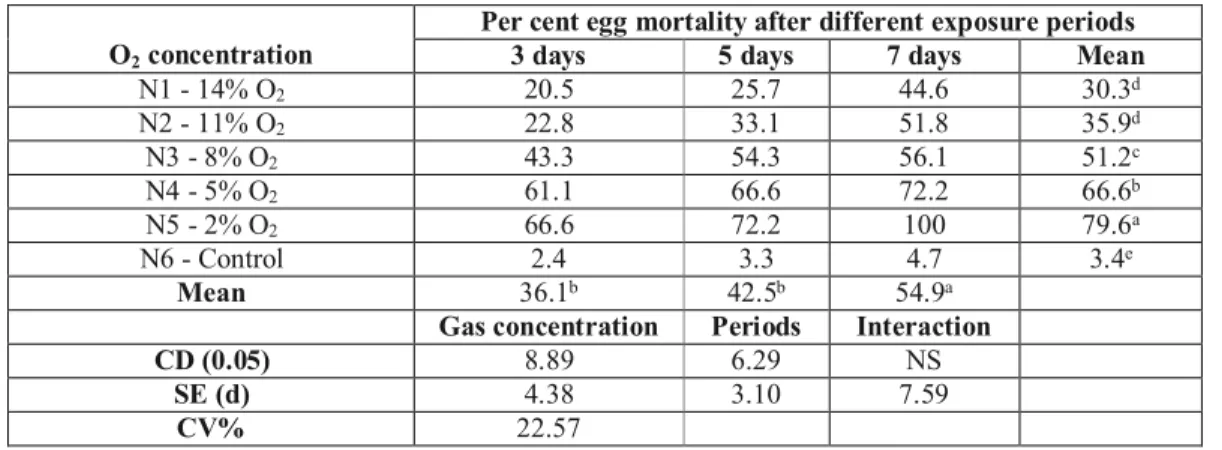
The effect of O2 level on egg mortality is given in the Table 4.
Table 4: Effect of N2 based modified atmosphere on egg mortality of C. maculatus
O2 concentration
Per cent egg mortality after different exposure periods
3 days 5 days 7 days Mean
N1 - 14% O2 20.5 25.7 44.6 30.3d
N2 - 11% O2 22.8 33.1 51.8 35.9d
N3 - 8% O2 43.3 54.3 56.1 51.2c
N4 - 5% O2 61.1 66.6 72.2 66.6b
N5 - 2% O2 66.6 72.2 100 79.6a
N6 - Control 2.4 3.3 4.7 3.4e
Mean 36.1b 42.5b 54.9a
Gas concentration Periods Interaction
CD (0.05) 8.89 6.29 NS
SE (d) 4.38 3.10 7.59
CV% 22.57
NS - Not significant
Means followed by the same letters are not significantly different at P=0.05 (LSD)
The results indicated that there was significant (P<0.05) difference in egg mortality considering the O2 concentration and exposure
period. For the influence of O2 concentration, it was found that at
2% O2 concentration the mean per cent egg mortality was 79.6
while in the control egg mortality was low with 3.46 %. For the exposure period, the mean per cent egg mortality was high at 7th
day and low at 3rd day with 54.91 and 36.15 respectively.
Adult population decreased drastically with decrease in O2
concentration. This may be due to the low number of survived eggs and the effect of N2 on egg hatching. Spratt (1979) [12] also reported
that the numbers of F1 adults were reduced when either oviposition
or development or both took place in modified atmosphere with O2,
CO2 or in the gas mixture.
Laboratory tests by Conyers (2006) [13] showed that under O
2 level
of 3-5 %, no population increase was observed for S. granarius, S. oryzae and T. castaneum. In addition the the adults were more susceptible to reduced O2 level than the eggs by comparing the %
mortalities achieved. This finding is in agreement with Campbell and Sinha, (1978)14 who found that the egg stage of stored product
insects is the most resistant stage to fumigants since they respire at low rate than larvae or adults
4. Conclusion
Nitrogen based atmosphere storage with low oxygen concentration (2%) showed an impact on progeny development. The number of eggs laid was low compared to control (normal atmosphere) and there was no adults emerged after 7 days of exposure. Nitrogen based modified atmosphere could be one of the promising and un-risky methods for pulse beetle management.
5. Acknowledgement
The authors are much thankful to the Government of Rwanda for financial support of the study. To all my workmates who read the earlier version of the manuscript.
6. Reference
1. Bailey SW. Airtight storage of grain; its effects on insect pests. II. Calandra oryzae (small strain). Aust. J Agr Res 1956; 7:7-19.
2. Calderon M, Barkai-Golan R. Food preservation by modified atmospheres. Edn 1, CRC Press, Boca Raton, FL, 1990, 416.
3. Navarro S. Modified atmospheres for the control of stored product insects and mites. In: Insect Management for Food Storage and Processing. Ed., Heaps J. W. AACC International, St. Paul, Minnesota USA 2006; 105-145. 4. Navarro S. Gaseous fumigant mixtures with special
reference to mixture of carbon dioxide with phosphine or methyl bromide. In: Proceedings of the GASGA Seminar on Fumigation Technology in Developing Countries. TDRI, Slough, UK, March 18-21, 1986; 150-158.
5. Banks HJ, Annis PC. Comparative advantages of high CO2 and low O2 types of controlled atmospheres for grain
storage. In: Food preservation by modified atmospheres. Eds., Calderon M, Barkai-Golan R. CRS-Press, Inc., Boca Raton, Florida, USA 1990; 93–122.
6. 6. Navarro S, Lider O, Gerson U. Response of adults of the grain mite, Acarussiro L. to modified atmospheres. J Agric Entomol 1985; 2(1):61-68.
7. Longstaff BC. The management of stored product pests by non-chemical means: an Australian perspective. J Stored Prod Res 1994; 30:179-185.
8. Abbott WS. A method of computing the effectiveness of an insecticide. J Econ Entomol 1925; 18:265–267. 9. Howe RW. A parameter for expressing the suitability of
an environment for insect development. J Stored Prod Res 1971; 7:63-65.
11. Babu TR, Hussein SH, Sayanarayna B. Effect of pre-storage seed treatment on adult mortality, oviposition and development of Callosobruchus chinensis (L.) (Bruchidae: Coleoptera) and the viability of mung bean Vignaradiata
(L.) in India. Trop Pest Mgt 1989; 34:397-398.
12. Spratt EC. The effect of a mixture of oxygen, carbon dioxide and nitrogen in the ratio1:1:8 on the oviposition
and development of Sitophilus zeamais
(Coleoptera:Curculionidae). J Stored Prod Res 1979; 15:73-80.
13. Conyers ST, Bell CH. A novel use of modified atmospheres: storage insect’s population control. J Stored Prod Res 2006; 43:367-374.