Vojnosanit Pregl 2017; 74(2): 189–192. VOJNOSANITETSKI PREGLED Page 189
Correspondence to: Jagoda Bajevska, Department of Prosthodontics, Faculty of Denstistry, Ho Ši Min 183 A Skopje, Former Yugoslav Republic of Macedonica. E-mail: [email protected]
C A S E R E P O R T UDC: 616.315-007.254-08::616.314-76/-77
DOI: 10.2298/VSP141114161B
Fixed prosthetic treatment in patients with cleft lip and palate
Fiksnoproteski tretman pacijenata sa heilognatopalatoshizom
Jagoda Bajevska*†, Jana Bajevska‡, Biljana Bajevska Stefanovska‡
*Department of Prosthodontics, Faculty of Dentistry, Skopje, Former Yugoslav Republic of Macedonia; †Clinic for Fixed Dental Prosthetics, University Dental Clinical
Centre “St Pantelejmon”, Skopje, Former Yugoslav Republic of Macedonia; ‡Private Healthcare Institution, Skopje, Former Yugoslav Republic of Macedonia
Abstract
Introduction. The prosthetic treatment of patients with cleft palate includes various treatment options such as fixed partial dentures, removable partial prosthesis, etc. The type of prosthetic appliance is determined by the oral health of each individual and the circumstances. We presented three adult patients with the cleft lip and palate subjected to pros-thetic treatment. Case report. From the possible prosthetic solutions according to the conditions in the oral cavity and the circumstances, fixed partial dentures veneered with composite or ceramic were chosen. A proper relationship between the teeth was reached with the fixed partial den-tures, and function established, the phonetics improved and satisfying aesthetics effect accomplished improving the pro-file appearance of the patient’s face. Plastic surgery of the nose was performed after that. Conclusion. Multidisclipi-nary treatment is necessary for favourable long-term out-come in cleft lip and palate patients.
Key words:
cleft lip; cleft palate; prosthodontics; dental prosthesis; denture, partial, fixed; treatment outcome.
Apstrakt
Uvod. Protetsko lečenje pacijenata sa rascepom nepca uključuje različite opcije kao što su fiksne parcijalne proteze, parcijalne pokretne proteze i tako dalje. Tip protetskog apa-rata zavisi od oralnog zdravlja svake osobe pojedinačno, kao i od okolnosti. Prikazana su tri odrasla pacijenta sa heilog-natopalatoshizom koji su zbrinuti protetski. Prikaz bole-snika. Od mogućih protetskih rešenja, u zavisnosti od us-lova u usnoj duplji, izabrano je da se urade mostovne kon-strukcije, fasetirane sa kompozitom ili keramikom. Sa mo-stovnom konstrukcijom uspostavljeni su međusobni odnosi zuba, postignuta je pravilna funkcija, poboljašala se fonetika, omogućena je zadovoljavajuća estetika i postignut je zado-voljavajući profilni izgled lica pacijenata. Usledila je plastična operacija nosa. Zaključak. Za povoljan dugoročni ishod
le-čenja bolesnika sa rascepom nepca i usne neophodan je multidisciplinarni pristup.
Ključne reči:
usna, rascep; nepce, rascep; protetika; zubna proteza; zubna proteza, parcijalna, fiksna; lečenje, ishod.
Introduction
The occurrence of congenital cleft lip and palate has seve-ral possible etiological factors. As possible causes stated in the literature are deficient diet and psychological stress during pregnancy, chemical teratogenic agents, infectious diseases (vi-ral origin), radiation during pregnancy and hereditary factors, gene mutation or chromosome aberration. The increased inci-dence of cleft lip and palate was observed during the periods of war as compared with peaceful times 1. For the treatment of pa-tients with cleft lip and palate a multidisciplinary approach is required including maxillofacial and oral surgeon, orthodontist, prosthodontist, speech therapist, sociologist, pediatrician, and psychologist.
The prosthetic treatment in patients who had cleft palate includes various treatment options such as fixed partial den-tures, removable partial prosthesis, overdenden-tures, complete dentures and implant-supported prosthetic dentures 2.
We presented three cases of managing cleft lip and pa-late in adult patients with fixed partial dentures.
Case report
Page 190 VOJNOSANITETSKI PREGLED Vol. 74, No. 2
Bajevska J, et al. Vojnosanit Pregl 2017; 74(2): 189–192.
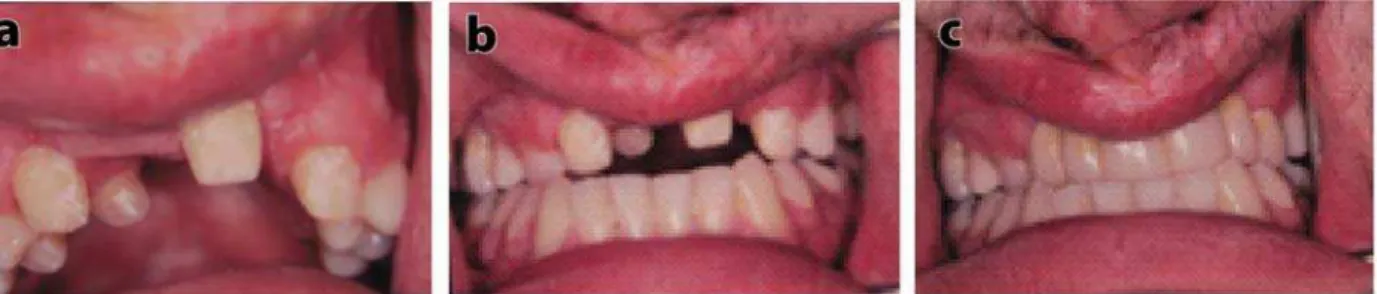
Fig. 1 – a) Dental status in the oral cavity and the maxilla; b) The dental arches in maximal intercuspation; c) Mounted fixed partial denture.
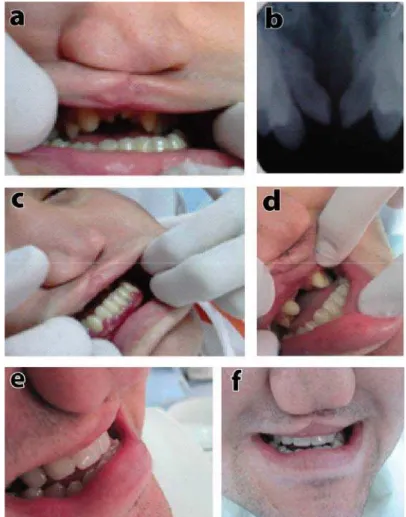
Fig. 2 – a) and b) Condition in the patient's oral cavity; c) Patient with completed prosthodontic restoration; d) Patient appearance.
and the parents of the other two declined the other suggested treatment modalities and requested fixed prosthetics therapy. The patients had visible scar tissue on the lip and in the cleft area, concave face profile and collapsed nose.
For proper analysis and treatment planning a complete history was taken from the patients and clinical examination was carried out assessing the overall state of the oral cavity (missing teeth, alignment of the present teeth, intraoral de-formities, relationship of the alveolar arches in occlusion and the occlusion itself, vertical dimension, oral hygiene, gingi-val inflammation, length of the clinical crowns, and their ability to serve as abutment teeth for fixed partial dentures). Paraclinical tests were also conducted (pulp testing, x-ray). After performing periodontal treatment in order to obtain healthy supportive tissues, impressions were taken and diag-nostic models were poured in dental stone, and were moun-ted in semiadjustable articulator in order to complete the analysis and information gathered previously. We evaluated the relationship of the alveolar arches and the occlusogingi-val relation, and diagnostic preparation and modeling in wax was made to determine the size and shape of the future pro-sthetic restoration. The present malpositioned teeth with in-sufficient length of radixes and peg-shaped crowns were extracted.
The remaining teeth in the frontal region which were properly aligned and shaped were prepared according to the biomechanical principles and impressions were made using putty/wash silicon impression materials in order to fabricate fixed partial dentures made from metal framework veneered with composite or ceramic.
Case 1
A 18-year-old patient had missing teeth in the frontal region and ectopic teeth scattered on the palate (Figures 1 a and b). The ectopic teeth were extracted. After careful plan-ning a fixed partial dentures were made using precious alloy veneered with composite (Figure 1 c).
Case 2
Vol. 74, No. 2 VOJNOSANITETSKI PREGLED Page 191
Bajevska J, et al. Vojnosanit Pregl 2017; 74(2): 189–192.
Fig. 3 –a) Micromaxilla; b) X-ray showing the malpositioned teeth; c) Gingival inflammation; d) Abutment teeth after preparation; e) Metal-ceramic fixed partial denture seated in the patient mouth; f) Appearance after
prosthodontic rehabilitation. Case 3
A 18-year-old patient with no orthodontic treatment had scars on the outer and inner part of the lip after the oral surgery. The intraoral status showed micromaxilla and pseu-doprogenia, missing and malpositioned teeth, central incisors that were rotated and rudimentary, gingival inflammation and crossed bite in the posterior region (Figures 3 a–c). Be-cause of the skeletal mismatch of the maxilla and mandible there was discrepancy between the alveolar arches. After ca-reful planning, the improperly aligned and rudimentary teeth were extracted and periodontal treatment carried out. The existing vertical dimension was used for fabrication of fixed partial denture from metal-ceramic. The teeth were prepared, and an impression was taken for the dental laboratory. With the finished fixed partial denture, mounted in the patient mo-uth, the function improved, the upper lip lifted taking teeth-supported position and the aesthetics of the patients face was improved (Figures 3 d–f). Prosthetic treatment was followed with plastic surgery on the nose. Since the patient had low smile line and the gingival third of the fixed partial denture was not visible the aesthetic appearance of the restoration was improved.
Discussion
In the treatment of patients with cleft lip and palate signifi-cant attention is given to the analysis of success of so far used protocols of treatment which cover several treatment stages: pre-surgical orthodontic therapy, plastic surgery of the cleft lip and palate followed with orthodontic therapy and plastic surgery on the nose and scar tissue after completed growth 3.
Restoring the teeth in such cases is demanding and complex task having the pseudoprogenia, crossed bite, hipo-dontia or hyperhipo-dontia in the cleft area with ectopical place-ment of the teeth, open bite, crowded teeth or teeth with dias-temas and lost middle line, and normal or reduced vertical dimension 4.
Several authors presented prosthetic treatment of such cases 2, 5–7. According to the oral health of each individual and the circumstances, the type of prosthetic appliance is de-termined 8. Fixed partial dentures provide comfort, improve speech, mastication and aesthetics influencing positively the overall psychological state of the patient 2.
Page 192 VOJNOSANITETSKI PREGLED Vol. 74, No. 2
Bajevska J, et al. Vojnosanit Pregl 2017; 74(2): 189–192. case reports on cleft lip and palate patients using root
co-pings, modified Dolder bar attachment, conus crown system, modified crowns and removable partial dentures 5, overlay den-tures retained with microextracoronar resilient attachments 10 and after obtaining stabile occlusion with orthodontic treat-ment a fixed partial dentures veneered with composite 11.
Patients with no bone grafting and orthodontic treat-ment present greatest challenge 12. Since patients with cleft palate require long time follow-up and maintenance, in case of failure of restoration review of the treatment is still needed
and incorporation of superior materials and methods in order to minimize further complications 11.
Conclusion
We presented solutions with fixed prosthetic treatment in patients with cleft lip and palate. With the fixed partial dentures a proper relation between the teeth was reached, function enab-led, phonetics significantly improved and satisfying aesthetic overall appearance of the patient accomplished.
R E F E R E N C E S
1. Meštrovic MM, Bagatin M, Poje Z. The incidence of orofacial clepts in Croatia in 1988−1998. Acta Stomatol Croat 2005; 39(1): 53−60. (Croatian)
2. Lopes JF, Pinto JH, de Almeida AL, Lopes MM, da Silva Dalben G. Cleft palate obturation with Brånemark protocol implant-supported fixed denture and removable obturator. Cleft Palate Craniofac J 2010; 47(2): 211−5.
3. Vukić-Čulafić B, Vučinić P, Ivić S, PetrovićĐ. The relationship of the parameters of jaw and cranial bases in cheilognathopalato-schisis. Proceedings of the XLVI International Congress of Anthropological Society of Yugoslavia; 2007 May 29 − June 2; Apatin, Serbia. Novi Sad: Glasnik Antropološkog društva Srbi-je 2008; 43: 140−7. (Serbian)
4. Suvin M, Kosovel Z. Fixed prosthodontics. Zagreb: Školska knji-ga; 1975. (Croatian)
5. Vojvodić D, Jerolimov V, Jokić DV, Lončar A. Oral Rehabilitation of the Patient with Cheilognathopalatoschisis. Acta Stomatol Croat 2000; 34(3): 329−30. (Croatian)
6. Ayna E, Başaran EG, Beydemir K. Prosthodontic Rehabilitation Alternative of Patients with Cleft Lip and Palate (CLP): Two Cases Report. Int J Dent 2009; 2009: 515790.
7. Watanabe I, Kurtz KS, Watanabe E, Yamada M, Yoshida N, Miller AW. Multi-unit fixed partial denture for a bilateral cleft palate patient: a clinical report. J Oral Rehabil 2005; 32(8): 620−2.
8. Freitas JA, Almeida AL, Soares S, Neves LT, Garib DG, Trindade-Suedam IK, et al. Rehabilitative treatment of cleft lip and palate: experience of the Hospital for Rehabilitation of Craniofacial Anomalies/USP (HRAC/USP) - Part 4: oral rehabilitation. J Appl Oral Sci 2013; 21(3): 284−92.
9. Kranjčić J, Žabarović D, Čelebić A, Mehulić K, Komar D, Vojvodić D. Prosthetic Modalities Used to Treat Cleft Palate Patients in a University Clinic. Year Review. Coll Antropol 2013; 37(2): 423−9.
10.Acharya V, Brecht LE. Conventional prosthodontic manage-ment of partial edentulism with a resilient attachmanage-ment-retained overdenture in a patient with a cleft lip and palate: a clinical report. J Prosthet Dent 2014; 112(2): 117−21.
11.Bidra AS. Esthetic and functional rehabilitation of a bilateral cleft palate patient with fixed prosthodontic therapy. J Esthet Restor Dent 2012; 24(4): 236−44.
12.Moore D, McCord JF. Prosthetic dentistry and the unilateral cleft lip and palate patient. The last 30 years. A review of the prost-hodontic literature in respect of treatment options. Eur J Pro-sthodont Restor Dent 2004; 12(2): 70−4.