Research and Politics October-December 2016: 1 –5 © The Author(s) 2016 DOI: 10.1177/2053168016681908 rap.sagepub.com
Creative Commons CC-BY: This article is distributed under the terms of the Creative Commons Attribution 3.0 License (http://www.creativecommons.org/licenses/by/3.0/) which permits any use, reproduction and distribution of
the work without further permission provided the original work is attributed as specified on the SAGE and Open Access pages (https://us.sagepub.com/en-us/nam/open-access-at-sage).
Introduction
At first, the idea that coups might be “good for democracy” sounds paradoxical. Yet recent transitions in Ecuador in 2003, Bangladesh in 2009 and Niger in 2011 all quickly fol-lowed military coups, matching an earlier pattern in Panama, Portugal, Bolivia, Thailand, and elsewhere. Indeed, recent empirical work argues that coups within autocracy raise the ensuing likelihood of democratization (Miller, 2012, 2016; Thyne and Powell, 2016; Varol, 2012). In particular, Thyne and Powell (2016) find that both coups and coup attempts predict democratization from 1950–2008.
In a recent reconsideration of the evidence, Derpanop-oulos et al. (2016) (hereafter, DFGW) dispute the idea that coups predict democratization. Applying a new model to Thyne and Powell’s (2016) coup data, they find that “the association between coups and democratization is statisti-cally insignificant” both during and after the Cold War (Derpanopoulos et al., 2016: 2). DFGW should be com-mended for an innovative analysis of the varied effects of coups; in particular, I do not challenge their well-defended conclusions that coups are often followed by autocratic regime changes and increased repression.
This paper instead critiques DFGW’s findings regarding coups and democratization. I show that their modeling approach, which adds fixed effects for each autocratic regime spell, severely biases their estimate and effectively removes most recent coups from the sample. I then reana-lyze DFGW’s data with similar models that do not suffer
from this bias. In every case, I recover a significantly posi-tive effect of coups and coup attempts on democratization. Besides contributing to an important substantive debate, this paper identifies an instructive and surprising source of bias. Researchers frequently overlook the possibility that add-ing too many controls can produce bias. Yet methodologists recognize that controls can cause “post-treatment bias” and “collider bias” (Pearl, 2009). Recent scholarship also cautions that unit fixed effects may exacerbate rather than reduce omit-ted variable bias (Middleton et al., 2016). DFGW’s model is another example of over-fitting producing bias, which can serve as a useful caution for empirical scholars.
Background
Although they differ on the underlying mechanisms, both Miller (2012) and Thyne and Powell (2016) find that coups raise the likelihood of later democratization.1 Miller (2012)
focuses on the five years after violent executive turnovers, demonstrating a stronger effect at higher average income.
Reanalysis: Are coups good for
democracy?
Michael K. Miller
Abstract
Several recent studies find that coups in autocracy raise the ensuing likelihood of democratization. In a recent critique (“Are coups good for democracy?”), Derpanopoulos et al. dispute this link. This paper shows that their modeling approach, which includes fixed effects for each autocratic regime spell, suffers from severe bias. A reanalysis that applies similar models to the data without this bias recovers significant effects of coups and coup attempts on democratization, although only during the post-Cold War era.
Keywords
Coups, democratization, quantitative methods, fixed effects
George Washington University, Washington, DC, USA
Corresponding author:
Michael K. Miller, Assistant Professor of Political Science and International Affairs, George Washington University, Monroe Hall 440, 2115 G St. NW, Washington, DC 20052, USA.
Email: [email protected]
681908RAP0010.1177/2053168016681908Research & PoliticsMiller
research-article2016
In related work, Miller (2016) examines all democratic transitions from 1800–2010 and finds that 52 had a suc-cessful coup as a primary causal factor.
Thyne and Powell (2016) find that experiencing a coup or coup attempt predicts democratization in a window from the current year through the following two years. To cri-tique this finding, DFGW retain the same coup data (from Powell and Thyne, 2011) and post-coup window, but use a different measure of democratization (from Geddes et al., 2014) and model (discussed below). Following Marinov and Goemans (2014), DFGW also distinguish between coups during and after the Cold War.
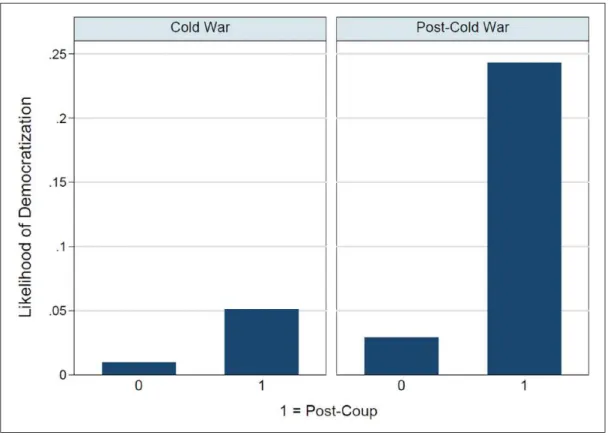
Figure 1 presents a simple descriptive breakdown using DFGW’s data, graphing the annual likelihood of democra-tization by post-coup status and period. The results are remarkably strong – experiencing a coup shifts the chances for democratization from 1.0% to 5.1% during the Cold War and from 2.9% to 24.3% during the post-Cold War era. Surprisingly, DFGW claim to find no effect of coups in either period. The next section explains how their model biases their results.
Problems with DFGW’s model
In a sample of autocracies from 1950–2015, DFGW use a linear model to predict democratization based on whether a
coup occurred in the current or previous two years.2
Separate models test coup attempts. Each model controls for year fixed effects, a cubic polynomial of regime dura-tion and the log of leader duradura-tion.
The most consequential and unusual choice, however, is DFGW’s addition of “regime-case fixed effects.” Rather than a fixed effect for each country, they include one for each of 285 autocratic regime spells. For instance, there are separate fixed effects for Cuba 1952–1959 and Cuba post-1959. The authors claim this leads to “a within-regime comparison of what follows a coup, while conditioning-out all differences between autocratic regimes” (Derpanopoulos et al., 2016: 3). Although this choice stems from a good motivation, it unfortunately produces severe bias and effec-tively restricts the sample to a specific type of coup.
The core problem with regime-case fixed effects is that coups typically produce a new autocratic regime. In DFGW’s sample, of 149 regimes facing a coup, only 52 (34.9%) sur-vive to the following year. Another 17 (11.4%) democratize the same year. Thus, the majority of coups (53.7%) produce a new autocratic regime with its own fixed effect.
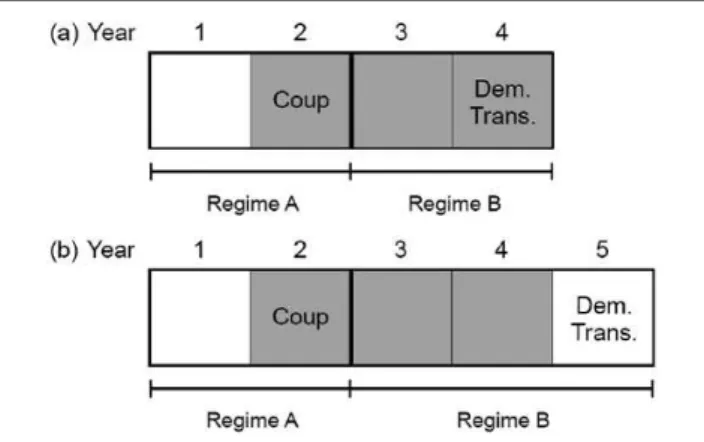
To see how this produces bias, consider Figure 2. If coups predict democratization, then we should see several cases where a coup is followed quickly by democratization. This is pictured in panel (a): A coup occurs in Year 2 and the
post-coup variable (pictured in grey) covers Years 2 to 4,
Miller 3
when democratization occurs. However, the democratiza-tion will be ignored if we include regime-case fixed effects and the coup produces a new autocratic regime. With these fixed effects, variables are tested relative to the regime aver-age. For Regime B, however, there is no variation in post-coup status. Thus, the post-coup variable is measured as 0 and Regime B’s observations have no leverage on its coef-ficient. This follows from the same reason that independent variables that are constant within country cannot be tested in the presence of country fixed effects. Further, the effect of coups will be biased towards 0 because post-coup in Year 2 does not lead to democratization that year.
The problem is worse for cases that democratize just after the two-year window, as shown in panel (b). Here, when Regime B democratizes in Year 5, this spuriously counts as a negative effect of coups on democratization. This is because a lower-than-regime-average value of post-coup in Year 5 coincides with democratization, generating a negative correlation. In fact, every case in which a coup pro-duces a new autocratic regime will generate either no effect or a negatively biased effect of coups on democratization.
What could generate a positive effect in DFGW’s model? There are two possibilities. First, a coup could precede democratization in the same year, which occurs in 17 cases. However, five of these cases are ignored because every earlier year in the regime is also post-coup. Second, a coup in autocracy could lead to democratization without first generating a new autocratic regime, which occurs in only four cases. All are coups that shuffled leadership within a military junta. In total, 37 cases of democratiza-tion occurred within two years of a coup, but the regime-case fixed effects effectively remove 21 of them. In sum, DFGW’s estimates combine negatively biased results for
regime-changing coups with results for a specific sub-sample of coups. Clearly, this cannot accurately represent whether coups predict democratization.
A reanalysis
I now reanalyze DFGW’s data, using models that hew closely to DFGW’s design but are not susceptible to the same bias. Specifically, I keep all elements of DFGW’s model, but alter the regime-case fixed effects. As in DFGW, I separately test coups during and post-Cold War era and cluster standard errors by the regime spell or its equivalent.
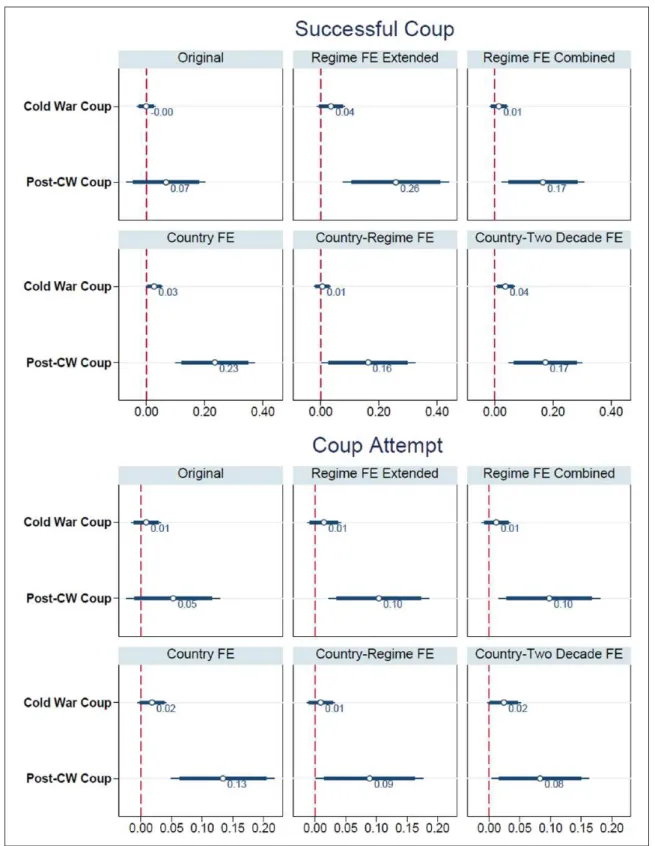
Figure 3 displays the results for successful coups (top) and attempted coups (bottom). I consider six total models. The first model replicates DFGW, confirming a null effect on democratization.3 The second model is
closest in spirit to DFGW’s original: It includes regime-case fixed effects, but extends the regime by two years following a coup. Thus, if a coup originally ended a regime in Year t, the regime is redefined to end in Year
t + 2. By including the post-coup period in the same
regime, this negates the source of bias. Further, it directly compares the post-coup likelihood of democratization to the preceding autocratic regime. At the same time, this design still finely controls for differences across regimes. In fact, the regime fixed effect is identical to DFGW’s original for 94.8% of the sample.
In the third model, regimes are considered continuing unless they fail without a coup. Again, this avoids the bias from coups producing regime failures. The fourth model uses country fixed effects, replicating a result that DFGW show in their online appendix. However, DFGW argue this is unsatisfactory as different regime types within the same country may have different propensities for liberalization. The fifth model therefore includes a distinct fixed effect for each autocratic regime type in each country (192 in total). The regime types are broken down into monarchies, military, party-based, and person-alist dictatorships, using Geddes et al. (2014). For instance, El Salvador gets separate fixed effects for its period as a military dictatorship and as a party-based dic-tatorship. Finally, the sixth model includes a separate country fixed effect for each 20-year period.
As seen in Figure 3, post-Cold War era coups and coup attempts are significantly positive (p < 0.05) for democrati-zation in every altered model. Further, the effect sizes are quite large. Since this is a linear model, the coefficients rep-resent shifts in probability. Thus, a post-Cold War era coup raises the likelihood of transition by 16–26%, consistent with Figure 1. Cold War results are less robust, but two of five coup models are significant at the 0.1 level.
In further analysis, I extended the post-coup window from two previous years up to four and found similar results for successful coups, although coup attempts are Figure 2. The pictures illustrate how the Derpanopoulos et al.
no longer significant. I also ran the models removing coups and attempts within democracies from the
post-coup definition and found even stronger results4 (see
Figures A1 and A2 in the online appendix).
Miller 5
Conclusion
This paper diagnoses a surprising source of bias in DFGW that results from over-fitting. The findings provide an instruc-tive example of why researchers should carefully consider how controls and other modeling elements alter the effective sample and the tested variation in their independent varia-bles. This especially applies to fixed effects models and stud-ies of regime change and other relatively rare events.
Although I do not challenge DFGW’s justified con-clusions regarding coups and increased repression, this paper adds to the substantial evidence that coups increase the likelihood of democratization. As Thyne and Powell (2016: 18) argue, one takeaway from this is that while coups against democracies should be condemned, we can view coups within autocracies as “windows of opportunities to foster democratization.” This does not necessarily imply that coups are “good,” but they may have unintended positive consequences that democratic actors can exploit.
Acknowledgements
Thanks to the reviewers and Editor Gleditsch for helpful com-ments on the manuscript.
Declaration of conflicting interest
The authors declare that there is no conflict of interest.
Funding
This research received no specific grant from any funding agency in the public, commercial, or not-for-profit sectors.
Supplementary material
The online appendix is available at: http://rap.sagepub.com/ content/3/4
Notes
1. This connects to a larger literature on how turnovers can destabilize autocratic regimes and produce liberalization (e.g., Jones and Olken, 2009; Treisman, 2015). Marinov and Goemans (2014) examine liberalization after coups, but limit themselves to a post-coup sample and thus cannot test whether coups raise the likelihood of liberalization.
2. Derpanopoulos et al. (2016) remove country-years with a transition to a new dictatorship so the comparison is to auto-cratic stability.
3. Derpanopoulos et al.’s (2016) replication materials were suf-ficient to reconstruct their findings, with the lone exception of the omission of leader duration data. As a substitute, I use Goemans et al. (2016). The results are virtually identical. 4. Again, all post-Cold War era coups and attempts are
signifi-cant (p < 0.05). In addition, three of five Cold War coup mod-els are significant.
Carnegie Corporation of New York Grant
This publication was made possible (in part) by a grant from Carnegie Corporation of New York. The statements made and views expressed are solely the responsibility of the author.
References
Derpanopoulos G, Frantz E, Geddes B, et al. (2016) Are coups good for democracy? Research & Politics 3(1): 1–7. Geddes B, Wright B and Frantz E (2014) Autocratic breakdown
and regime transitions: A new data set. Perspectives on
Politics 12(2): 313–331.
Goemans HE, Gleditsch KS and Chiozza G (2016) Archigos: A Data Set on Leaders, 1875–2015, Version 4.1. Available at: http://privatewww.essex.ac.uk/~ksg/papers/Archigos-27-Feb-2016.pdf (accessed 9 September 2016).
Jones BF and Olken BA (2009) Hit or miss? The effect of assassi-nations on institutions and war. American Economic Journal:
Macroeconomics 1(2): 55–87.
Marinov N and Goemans HE (2014) Coups and democracy.
British Journal of Political Science 44(4): 799–825.
Middleton JA, Scott MA, Diakow R, et al. (2016) Bias amplifica-tion and bias unmasking. Political Analysis 24(3): 307–323. Miller MK (2012) Economic development, violent leader removal,
and democratization. American Journal of Political Science
56(4): 1002–1020.
Miller MK (2016) Elections and elite violence on the road to democratization, 1800–2010. Working paper. Available at: http://sites.google.com/site/mkmtwo/Miller-Demz.pdf (accessed 9 September 2016).
Pearl J (2009) Causal inference in statistics: An overview.
Statistics Surveys 3: 96–146.
Powell JM and Thyne CL (2011) Global instances of coups from 1950 to 2010: A new dataset. Journal of Peace Research
48(2): 249–259.
Thyne CL and Powell JM (2016) Coup d’état or coup d’autocracy? How coups impact democratization, 1950–2008. Foreign
Policy Analysis 12(2): 192–213.
Treisman D (2015) Income, democracy, and leader turnover.
American Journal of Political Science 59(4): 927–942.
Varol OO (2012) The democratic coup d’état. Harvard International