Submitted 26 August 2015 Accepted 4 November 2015 Published24 November 2015
Corresponding author
Luke P. Miller, [email protected]
Academic editor
Robert Toonen
Additional Information and Declarations can be found on page 9
DOI10.7717/peerj.1442
Copyright
2015 Miller and Long
Distributed under
Creative Commons CC-BY 4.0
OPEN ACCESS
A tide prediction and tide height control
system for laboratory mesocosms
Luke P. Miller1,2and Jeremy D. Long3
1Hopkins Marine Station, Stanford University, Pacific Grove, CA, United States
2Department of Biological Sciences, San Jose State University, San Jose, CA, United States 3Coastal and Marine Institute Laboratory, San Diego State University, San Diego, CA,
United States
ABSTRACT
Experimental mesocosm studies of rocky shore and estuarine intertidal systems may benefit from the application of natural tide cycles to better replicate variation in immersion time, water depth, and attendant fluctuations in abiotic and edaphic conditions. Here we describe a stand-alone microcontroller tide prediction open-source software program, coupled with a mechanical tidal elevation control system, which allows continuous adjustment of aquarium water depths in synchrony with local tide cycles. We used this system to monitor the growth ofSpartina foliosa
marsh cordgrass and scale insect herbivores at three simulated shore elevations in laboratory mesocosms. Plant growth decreased with increasing shore elevation, while scale insect population growth on the plants was not strongly affected by immersion time. This system shows promise for a range of laboratory mesocosm studies where natural tide cycling could impact organism performance or behavior, while the tide prediction system could additionally be utilized in field experiments where treatments need to be applied at certain stages of the tide cycle.
Subjects Aquaculture, Fisheries and Fish Science, Ecology, Marine Biology
Keywords Intertidal, Estuary, Shore height, Mesocosm,Spartina foliosa
INTRODUCTION
Because of the abiotic and biotic heterogeneity found in intertidal communities, controlled laboratory mesocosm experiments often provide important insight into how these communities function (Dethier, Williams & Freeman, 2005;Matassa & Trussell, 2011;
Stachowicz et al., 2008). Traditional methods of manipulating water level in these mesocosms ranged from completely submerging intertidal organisms to creating tides with fixed submergence depths and rapid tidal changes. Given that tidal conditions (e.g., frequency and length of emersion) drive abiotic conditions in the intertidal zone (Denny et al., 2009), and influence the behavior, performance, and survival of intertidal seaweeds, plants, and invertebrates, there is a pressing need to develop mesoscosm systems that create more ecologically realistic tidal conditions.
survivorship (Woo & Takekawa, 2012). Tidal conditions can also affect animals, including their habitat selection (Davies, Edwards & Williams, 2006;Koch, 1989;Richardson, Ibarrola & Ingham, 1993), parasite release (Curtis, 1993), egg hatching (Kellmeyer & Salmon, 2001), feeding rates (Charles & Newell, 1997;No¨el et al., 2009), and movement (Ng & Williams, 2006;Silva et al., 2010;Williams & Morritt, 1995). Thus, a broad array of organisms is impacted by tidal conditions.
Traditional methods of manipulating water level in aquarium tanks have included simple high to low transitions created by removing a drain standpipe to drop the water level, by opening a low-mounted drain valve to drain the tank, or by turning on electric pumps to flood the tank during high tide. These systems often run on a simple fixed daily cycle (i.e., 12 h high, 12 h low), or they may be timed to only submerge soil and plants for a few hours during the day (Adams & Bate, 1995;Boorman, Hazelden & Boorman, 2001;
Paganini, Miller & Stillman, 2014). Water levels are normally changed in a binary fashion, with a quick transition from high to low set by the flow rate of the drain pipe. In some cases the transition from high to low water may be prolonged by actively pumping water from the tank at intervals, or carefully sizing the drain pipe to slow the outflow of water (Li et al., 2011;Woo & Takekawa, 2012). In a small number of studies, the timing of tidal inundation has been designed to also recreate the natural progression of high and low tide times from day to day, with each maximum or minimum coming later than the preceding day’s tide (Li et al., 2011;Miller, Matassa & Trussell, 2014;Pincebourde, Sanford & Helmuth, 2009). Studies using alternating water levels with estuarine systems have explored the role of tidal submersion on soil salinity, soil water potential, drainage, and the resulting effects on plant growth rates (Adams & Bate, 1995;Boorman, Hazelden & Boorman, 2001;Li et al., 2011;
Woo & Takekawa, 2012). With rocky intertidal systems, these systems have been employed to recreate temperature and desiccation stresses at low tide that could impact animal per-formance (feeding rate, metabolic rate, and growth rate) under present (Pincebourde, San-ford & Helmuth, 2009) or future climate conditions (Miller, Matassa & Trussell, 2014) and in concert with additional variables such as water pH (Paganini, Miller & Stillman, 2014).
We implemented a tide height control system (THC hereafter) for an aquarium system using a microcontroller to calculate the predicted tide height and control a motor-driven drain height adjustment system for continuous depth control. Our goal was to smoothly vary water depth in deep containers holding estuary plants potted in natural soil, creating high and low tide conditions that followed the natural progression of tide heights and timing from day to day while creating drainage in the potted soil similar to what occurs in natural soil in the field. In addition, the goal was to produce a low-cost system that could operate beyond the reach of a persistent network connection and does not require a full laptop or computer to run. Using the THC system, we were able to match the rise and fall of the mixed semidiurnal tides at our nearby field site within our laboratory containers, including accounting for the natural 24 h 50 min lunar tidal day length that shifts each high and low tide later on each subsequent day. We used this system to examine the effects of tidal submersion duration at different shore heights on the growth rate of the cordgrass
METHODS
Tide height predictions for the THC were generated continuously using a stand-alone microcontroller (Arduino Uno,http://arduino.cc) with attached real-time clock that stored the date and time in local standard time. The microcontroller was programmed to make tide height predictions for the current date and time for the local National Atmospheric and Oceanic Administration (NOAA) tide reference station (San Diego Bay, San Diego, California, USA, mean tide range 1.75 m) using tidal harmonic data generated by the NOAA tide station and extracted from the open-source XTide tide prediction application (http://flaterco.com). NOAA tide monitoring stations measure water levels over many years and use these data to generate a set of 37 or more tidal harmonic constituent values that account for the influence of celestial cycles and local topographic features (Hicks & Szabados, 2006). By combining the specific harmonic constants for a tidal reference station with a date and time (used to estimate position of the moon and sun), it is possible to generate current (and past or future) tide height predictions relative to the zero tide datum (Mean Lower Low Water, MLLW). We provide an online archive for the R code (R Development Core Team, 2015) used to extract the relevant site data and to generate the Arduino code (C+ +code) that runs the Arduino tide prediction routine, along with data for 140 NOAA sites around the mainland US, Hawaii, Alaska, and the Caribbean.
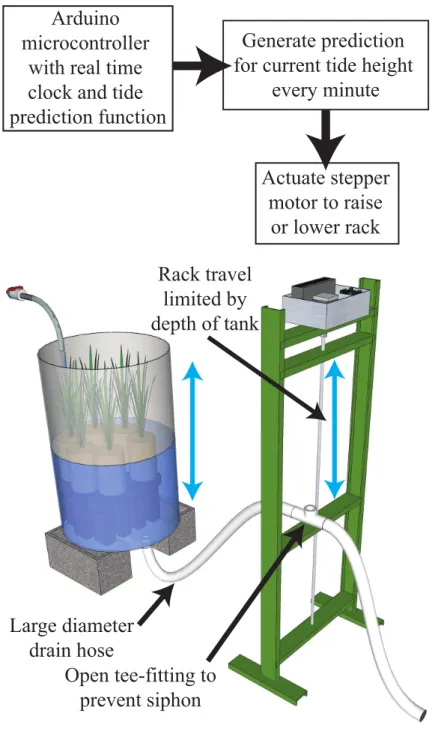
We used the microcontroller to predict the current tide height every minute, and then actuated a motor-driven rack to raise and lower the drain height of several tanks (Fig. 1). The microcontroller interfaced with a stepper motor via a stepper motor controller (see online archive for specific parts lists). The stepper motor drove an acme-thread lead screw (Roton, Kirkwood, Missouri, USA), which moved a traveling nut 0.1 inches per rotation of the lead screw. The controller, motor, and lead screw were mounted in a rack standing 1.2 m tall. A “carriage” was mounted to the traveling nut on the lead screw, allowing the entire carriage to be driven up and down in the rack frame via the lead screw.
The aquaria for this experiment were 200 L plastic barrels (88 cm height, 59 cm diameter), with a 3.8 cm bulkhead fit in the bottom to serve as a drain. PVC pipe (3.8 cm) ran from the barrels to the base of the THC rack, where a section of large-diameter hose (1.6 cm ID) connected to the moving carriage on the tide rack. At the carriage, the hose was attached to a PVC tee fitting with the third leg open and oriented straight up. An additional section of large-diameter hose was attached to the opposite leg of the tee fitting and ran to a floor drain. The open leg of the tee fitting prevented the formation of a siphon during operation.
carriage. During an ascending tide, the barrel water level would fill and rise to meet the new higher position of the carriage on the tide rack until the two heights equalized.
We used this system to examine the influence of shore elevation onSpartina foliosa
(Pacific cordgrass). Elevation has previously been shown to strongly affect growth of a congener (S. alterniflora) in a field transplant experiment (Bertness, 1991). We collected
S. foliosaand soil from Sweetwater Marsh (San Diego, CA) and brought them to San Diego State University’s Coastal and Marine Institute Laboratory. All plants were infested with herbivorous scale insects,Haliaspis spartina. Because scale insect density was variable at the time of collection, we counted the density ofH. spartinaon each plant, assigned them to one of five rankings of density, randomly selected one plant from each ranking, and placed plants into replicate barrels. We compared the growth ofS. foliosain mesocosms at three shore elevations (2.0, 1.8, and 1.6 m above MLLW) which would be submerged for different lengths of time depending on the tidal cycle. These elevations represent the upper end ofS. foliosa’s elevational range—the highest densities ofS. foliosaare typically found ∼1.0 m above MLLW. We chose the higher elevations because these areas typically have the
highest densities of scale insects.
Three replicate barrels were positioned at each elevation, with each barrel containing five pottedS. foliosa. Barrels at different elevations were randomly interspersed amongst each other. The plants were potted in 2.8 L pots (depth=17 cm) filled with estuary soil. The pots were elevated inside each barrel so that the surface of the soil in the pot was at a height that would leave it submerged during predicted tide heights above the chosen shore elevation. As the tide dropped, the plant stems and soil would gradually be exposed, and water was able to drain from the soil in each pot. The three shore elevations were established by adjusting the height of the barrels relative to the tide rack.
The upper travel limit of the THC carriage was defined as 2.07 m above MLLW. The total travel of the rack was limited to 0.84 m, so that the lower travel limit was at a tide height of 1.23 m above MLLW. When the natural tide cycle exceeded the lower (or upper) limit of the THC travel, the carriage halted at that limit until the tide was predicted to rise (or fall) above (or below) that limit again. During these time periods, the water level in the barrel remained equal to the carriage height. During a pilot experiment, we measured the water height difference at the PVC tee on the tide rack and water level in a barrel over a tide range of 0.21 m to ensure that the water level was following the rack movement within the travel range of the THC system. The exact height of the upper limit of the rack could be specified in software on the microcontroller, allowing the re-creation of different tidal ranges depending on the needs of the experiment. The experiment was run for 60 d from July 11 to September 9 2013, during which the maximum predicted tide height was 2.27 m and the minimum tide height was−0.42 m, though the tidal excursion in the barrels was limited to the values given above (Fig. 2). The plant height, measured as the distance from the soil surface to the tip of the longest leaf of eachS. foliosa, was measured at the start of the experiment and every 7–9 days subsequently.
Figure 2 Predicted tide cycles for San Diego Bay during the 60 day experiment from July 11 to September 9 2013.The dark region represents the tide range that the tide control rack was capable of traveling through. Water height was held static at the upper or lower limits of the dark region when the natural tide exceeded the travel limits of the tide rack. The heights of theSpartinapots are shown at the right.
growth as the difference between the maximum leaf length and starting leaf length. Additionally, because we did not observe an effect of starting insect density on plant growth, we pooled all plants within each barrel to account for the nesting of five plants in each barrel (thus, we had a single growth value for each of our three replicate barrels for each elevation). Upon examination of the data, we observed heterogeneous variances between our elevation treatments and so analyzed our data with a Kruskal–Wallis test.
We also calculated scale insect population growth by dividing the maximum number of scales per stem by the starting number of scales per stem. This provided us with insight into the performance of scales at each elevation. Although scale dispersal primarily occurs on the natal plant (J Long, pers. obs., 2012), we pooled all plants within each barrel to account for the lack of independence. As with plant growth, we analyzed the data with a Kruskal–Wallis test. Analyses were carried with R 3.1.3.
RESULTS
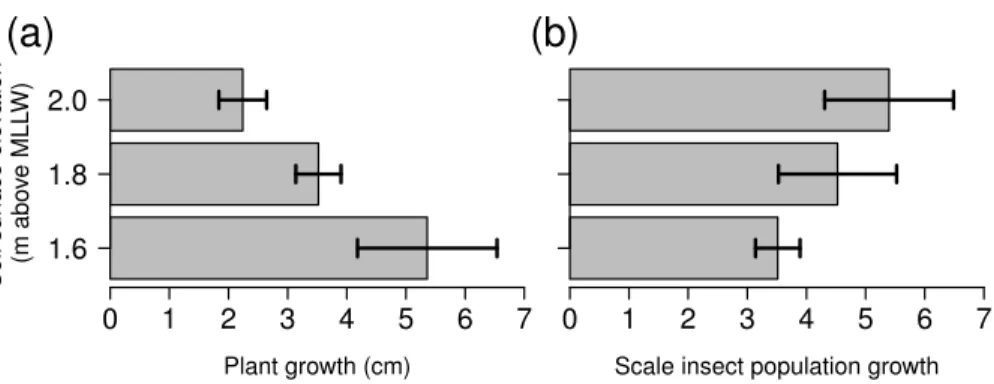
Figure 3 Growth ofSpartina foliosaplants (A) and proportional growth of scale insect populations (B) in mesocosms connected to the tide controller at three elevations.Values are mean±1 SE,n=3 replicate barrels per tide height.
Table 1 Summary of the number and duration of events where the soil surface of plant pots was submerged by a high tide event.The experiment ran for 60 days (1440 h).
Shore height (m)
Number of days with soil surface
submergence event
Total hours with soil surface submerged
Percentage of time with soil surface submerged
1.6 49 161 11.2
1.8 23 58 4.1
2.0 11 22 1.5
1.8 m elevation) during the 60 day experiment, while the soil in the highest elevation treatment was only covered on 11 days (Table 1).
The growth ofSpartina foliosadepended upon tidal height, with lower plants growing more than twice the amount of higher plants (Fig. 3A, Kruskal–Wallis test,H =6.489, p=0.039). In contrast, the population growth rates of scale insects did not depend upon tidal height (Fig. 3B, Kruskal–Wallis test,H=2.222,p=0.329).
DISCUSSION
The ability to recreate natural cycling of tide height and timing allows researchers to better control what may be an important aspect of laboratory mesocosm experiments for estuary or rocky shore systems. We present a simple, standalone microcontroller system that generates real tide predictions, without the need for an external network interface, and that will automatically resume function following loss of power. Because the THC system’s real time clock carries a backup battery to retain the date and time, an interruption of power will result in the system rebooting and returning to the current predicted tide height when mains power is restored. These predictions are coupled with a novel motor-driven rack system to continuously manipulate the standing height of water in an aquarium, allowing smooth changes in tide levels.
Members of the genusSpartinahave differing tolerances for the amount of time they spend submerged, and many estuaries exhibit a marked zonation in marsh plants with increasing tide height. The transition between different marsh plant species across shore elevation gradients is driven in part by competition and herbivory, but can also be a result of edaphic conditions influenced by the tide (Bertness, 1991). In this mesocosm experiment, reduced leaf elongation was associated with the prolonged aerial emersion produced by our higher shore elevation treatments.
In this experiment we simulated the tide cycling at a high shore height (1.23–2.07 m above MLLW), leaving theS. foliosaexposed for much of the time. The THC system can easily be adapted to simulate lower-shore submersion and emersion regimes by changing the reference shore height in the controller software. For example, if the goal was to recreate conditions in the 0–0.84 m shore height range (or any other range), changing a single value in the software could set the rack upper limit to be 0.84 m above MLLW. In this scenario, the THC rack would then alter the water level in the barrel whenever the predicted tide moved between 0.84 and 0 m, and the barrel would remain full whenever the predicted tide was above 0.84 m. If the researcher desired a larger range of movement, then deeper aquaria and a taller THC rack could be built, and only two values in software (upper limit and available rack travel) would need to be adjusted. The motor driven rack in this experiment was set up to drain nine separate aquaria, and additional aquaria could be included by modifying the system to use a more powerful motor to lift the weight of additional drain hoses.
Outside of the application described here for controlling water height in an estuarine mesocosm experiment, the THC tide prediction function could be used in a number of other scenarios. The system can be adapted to control aquarium flow in simpler high/low tide regimes that may still require a natural progression of the timing of high and low tide from day to day. The microcontroller tide calculations described here have been used to actuate an electric drain valve mounted on the bottom of a tank, so that a closed valve forces the water level to rise and exit via a high mounted drain at high tide, while an open valve causes the water level to drop to simulate low tide. Alternatively, the controller has been used to regulate the delivery of water spray so that it only occurs during high tide periods, simulating the periodic inundation created by wave action. This implementation has been used to successfully maintain rocky intertidal grazers such as high shoreLottia
original configuration (not including the motor driven rack), but this power draw could be reduced to 0.3 mA or less with alternate Arduino-compatible microcontroller hardware and software changes. The microcontroller could also be easily modified to track and manipulate other environmental variables in addition to tide height, such as temperature or light, and to serve as a datalogger, using inexpensive commercially-available modules developed by the open source community.
The software libraries provided in the online materials are presently limited to sites for which NOAA freely provides data under its mandate that United States government products be made available to non-commercial and commercial users. Many other countries make their tide harmonic data available only as a commercial product, but if the user can gain access to the tidal harmonic constituents for their site elsewhere in the world, the underlying open-source tide prediction software used here can be updated to substitute those values, as described in the Arduino C+ +source code provided in the online archive.
ACKNOWLEDGEMENTS
We thank the Center for Operational Oceanic Products and Services (CO-OPS), a section of the National Ocean Service within the National Oceanic and Atmospheric Administration for making the underlying tide measurements and data, and Dave Flater (http://flaterco.com) for making available public domain tidal harmonic data and open source tide prediction software that served as the basis for recreating the calculations on a microcontroller. This is Contribution No. 45 of the Coastal and Marine Institute Laboratory, San Diego State University.
ADDITIONAL INFORMATION AND DECLARATIONS
Funding
This work was funded by California Sea Grant NA10OAR4170060 to JD Long. LP Miller was supported by National Science Foundation BIO-OCE grant #1130095 to MW Denny. The funders had no role in study design, data collection and analysis, decision to publish, or preparation of the manuscript.
Grant Disclosures
The following grant information was disclosed by the authors: California Sea Grant: NA10OAR4170060.
National Science Foundation BIO-OCE grant: #1130095.
Competing Interests
The authors declare there are no competing interests.
Author Contributions
• Luke P. Miller and Jeremy D. Long conceived and designed the experiments, performed
Data Availability
The following information was supplied regarding data availability:
The software and hardware designs described in this manuscript have been made freely available in a permanent digital archive at Stanford University,http://purl.stanford.edu/ rb471wt3944.
Github.com:https://github.com/millerlp/Tide calculatorand
https://github.com/millerlp/Tide controller.
REFERENCES
Adams JB, Bate GC. 1995.Ecological implications of tolerance of salinity and inundation by
Spartina maritima.Aquatic Botany52:183–191DOI 10.1016/0304-3770(95)00496-3.
Bertness MD. 1991.Zonation ofSpartina patensandSpartina alterniflorain New England salt marsh.Ecology72:138–148DOI 10.2307/1938909.
Bonin C, Zedler J. 2008.Southern California salt marsh dominance relates to plant traits and plasticity.Estuaries and Coasts31:682–693DOI 10.1007/s12237-008-9057-4.
Boorman LA, Hazelden J, Boorman M. 2001. The effect of rates of sedimentation and tidal submersion regimes on the growth of salt marsh plants.Continental Shelf Research
21:2155–2165DOI 10.1016/S0278-4343(01)00049-8.
Charles F, Newell RIE. 1997.Digestive physiology of the ribbed musselGeukensia demissa
(Dillwyn) held at different tidal heights.Journal of Experimental Marine Biology and Ecology
209:201–213DOI 10.1016/S0022-0981(96)02694-9.
Curtis LA. 1993.Parasite transmission in the intertidal zone: vertical migrations, infective stages, and snail trails.Journal of Experimental Marine Biology and Ecology173:197–209
DOI 10.1016/0022-0981(93)90053-Q.
Davies MS, Edwards M, Williams GA. 2006.Movement patterns of the limpetCellana grata
(Gould) observed over a continuous period through a changing tidal regime.Marine Biology
149:775–787DOI 10.1007/s00227-006-0258-8.
Denny MW, Hunt LJH, Miller LP, Harley CDG. 2009.On the prediction of extreme ecological events.Ecological Monographs79:397–421DOI 10.1890/08-0579.1.
Dethier MN, Williams SL, Freeman A. 2005.Seaweeds under stress: manipulated stress and herbivory affect critical life-history functions.Ecological Monographs75:403–418
DOI 10.1890/03-4108.
Hicks SD, Szabados MW. 2006.Understanding tides. US Department of Commerce, National Oceanic and Atmospheric Administration, National Ocean Service, 83 pgs.Available athttp:// tidesandcurrents.noaa.gov/publications/Understanding Tides by Steacy finalFINAL11 30.pdf.
Kellmeyer K, Salmon M. 2001.Hatching rhythms ofUca thayeriRathbun: timing in semidiurnal and mixed tidal regimes.Journal of Experimental Marine Biology and Ecology260:169–183
DOI 10.1016/S0022-0981(01)00259-3.
Koch H. 1989.Desiccation resistance of the supralittoral amphipodTraskorchestia traskiana
(Stimpson, 1857).Crustaceana56:162–175DOI 10.1163/156854089X00059.
Li H, Lei G, Zhi Y, Bridgewater P, Zhao L, Wang Y, Deng Z, Liu Y, Liu F, An S. 2011.Phenotypic responses ofSpartina anglicato duration of tidal immersion.Ecological Research26:395–402
DOI 10.1007/s11284-010-0794-z.
Matassa CM, Trussell GC. 2011.Landscape of fear influences the relative importance of consumptive and nonconsumptive predator effects.Ecology92:2258–2266
DOI 10.1890/11-0424.1.
Miller LP, Allen BJ, King FA, Chilin DR, Reynoso VM, Denny MW. 2015.Warm microhabitats drive both increased respiration and growth rates of intertidal consumers.Marine Ecology Progress Series522:127–143DOI 10.3354/meps11117.
Miller LP, Matassa CM, Trussell GC. 2014.Climate change enhances the negative effects of predation risk on an intermediate consumer.Global Change Biology20:3834–3844
DOI 10.1111/gcb.12639.
Ng JSS, Williams GA. 2006.Intraspecific variation in foraging behaviour: influence of shore height on temporal organization of activity in the chitonAcanthopleura japonica.Marine Ecology Progress Series321:183–192DOI 10.3354/meps321183.
No¨el LM-L, Hakwins SJ, Jenkins SR, Thompson RC. 2009.Grazing dynamics in intertidal rockpools: connectivity of microhabitats.Journal of Experimental Marine Biology and Ecology
370:9–17DOI 10.1016/j.jembe.2008.11.005.
Padgett DE, Brown JL. 1999.Effects of drainage and soil organic content on growth ofSpartina alterniflora(Poaceae) in an artificial salt marsh mesocosm.American Journal of Botany
86:697–702DOI 10.2307/2656579.
Paganini AW, Miller NA, Stillman JH. 2014.Temperature and acidification variability reduce physiological performance in the intertidal zone porcelain crabPetrolisthes cinctipes.The Journal of Experimental Biology217:3974–3980DOI 10.1242/jeb.109801.
Pearson GA, Brawley SH. 1996.Reproductive ecology ofFucus distichus(Phaeophyceae): an intertidal alga with successful external fertilization.Marine Ecology Progress Series143:211–223
DOI 10.3354/meps143211.
Pincebourde S, Sanford E, Helmuth B. 2009.An intertidal sea star adjusts thermal inertia to avoid extreme body temperatures.The American Naturalist174:890–897DOI 10.1086/648065.
R Development Core Team. 2015.R: a language and environment for statistical computing. Vienna: R Foundation for Statistical Computing.Available athttps://www.r-project.org/.
Ravit B, Ehrenfeld J, H¨aggblom M, Bartels M. 2007.The effects of drainage and nitrogen enrichment onPhragmites australis, Spartina alterniflora,and their root-associated microbial communities.Wetlands27:915–927DOI 10.1672/0277-5212(2007)27[915:TEODAN]2.0.CO;2.
Richardson C, Ibarrola I, Ingham R. 1993.Emergence pattern and spatial distribution of the common cockleCerastoderma edule.Marine Ecology Progress Series99:71–81
DOI 10.3354/meps099071.
Silva ACF, Hawkins SJ, Boaventura DM, Brewster E, Thompson RC. 2010.Use of the intertidal zone by mobile predators: influence of wave exposure, tidal phase and elevation on abundance and diet.Marine Ecology Progress Series406:197–210DOI 10.3354/meps08543.
Stachowicz JJ, Best RJ, Bracken MES, Graham MH. 2008. Complementarity in marine biodiversity manipulations: reconciling divergent evidence from field and mesocosm experiments.Proceedings of the National Academy of Sciences of the United States of America
105:18842–18847DOI 10.1073/pnas.0806425105.
Williams GA, Morritt D. 1995.Habitat partitioning and thermal tolerance in a tropical limpet,
Cellana grata.Marine Ecology Progress Series124:89–103DOI 10.3354/meps124089.
Woo I, Takekawa JY. 2012.Will inundation and salinity levels associated with projected sea level rise reduce the survival, growth, and reproductive capacity ofSarcocornia pacifica