ABSTRACT
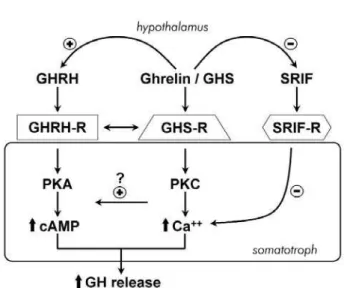
Growth hormone (GH)-releasing hormone and somatostatin modulate GH secretion. A third mechanism has been discovered in the last decade, involving the action of GH secretagogues. Ghrelin is a new acy-lated peptide produced mainly by the stomach, but also synthesized in the hypothalamus. This compound increases both GH release and food intake. The relative roles of hypothalamic and circulating ghrelin on GH secretion are still unknown. Endogenous ghrelin might amplify the basic pattern of GH secretion, optimizing somatotroph responsiveness to GH-releasing hormone. This peptide activates multiple interdependent intra-cellular pathways at the somatotroph, involving protein kinase C, protein kinase A and extracellular calcium systems. However, as ghrelin induces a greater release of GH in vivo, its main site of action is the hypothala-mus. In this paper we review the available data on the discovery of ghre-lin, the mechanisms of action and possible physiological roles of GH sec-retagogues and ghrelin on GH secretion, and, finally, the regulation of GH release in man after intravenous administration of these peptides. (Arq Bras Endocrinol Metab 2006;50/1:17-24)
Keywords:Ghrelin; GH; Growth hormone secretagogues; GHS
RESUMO
Dos Peptídeos Liberadores do Hormônio de Crescimento (HC) à Ghreli-na: Descoberta de Novos Moduladores da Secreção de HC
A secreção de hormônio de crescimento (HC) é modulada pelo hor-mônio liberador de HC e pela somatostatina. Na ultima década foi descoberto um terceiro mecanismo de controle, envolvendo os secre-tagogos de HC. A ghrelina é um peptídeo acilado, descoberto recen-temente, que é produzido no estômago, porém também é sintetizado no hipotálamo. Este peptídeo é capaz de liberar HC, além de aumentar a ingestão alimentar. A ghrelina endógena parece amplificar o padrão básico de secreção de HC, ampliando a resposta do somatotrófo ao hormônio liberador de HC. Este peptídeo estimula múltiplas vias intracelulares interdependentes no somatotrófo, envolvendo a proteína quinase C, proteína quinase A e sistemas moduladores de cálcio extracelular. Entretanto, como a liberação de HC induzida pela ghrelina in vivo é mais acentuada que in vitro, seu local de atuação predomi-nante é no hipotálamo. Nesse artigo apresentamos uma revisão sobre a descoberta da ghrelina, os dados existentes sobre os mecanismos de ação e possível papel fisiológico dos secretagogos de HC e da ghrelina na secreção de HC e, finalmente, os efeitos da administração endovenosa destes peptídeos sobre a secreção de HC no homem. (Arq Bras Endocrinol Metab 2006;50/1:17-24)
Descritores:Ghrelina; GH; Secretagogos de hormônio de crescimento; GHS
GH Secretion
Ana Maria J. Lengyel
Division of Endocrinology, Federal University of São Paulo
(UNIFESP/EPM), São Paulo, Brazil.
Historical review
B
EFORE THE IDENTIFICATION of the growthhor-mone-releasing hormone (GHRH), Bowers et al. (1) discovered a group of synthetic compounds with growth hormone (GH)-releasing properties (for review see ref. 2). These substances were developed from the met-enkephalin molecule, through theoreti-cal theoreti-calculations, computer modeling, chemitheoreti-cal alter-ations and studies of biological activity. These small peptides were able to induce a weak GH release ini-tially. Further chemical changes led to the synthesis of more potent compounds, including peptides such as GH releasing peptide-6 (GHRP-6), GHRP-2, hexare-lin, and non-peptides, as MK-0677, which could be administered orally (2). In the last decade several stud-ies were performed with these growth hormone secre-tagogues (GHS), especially with GHRP-6, and the obtained data have suggested that these compounds are modulators of GH release (3). It was shown that GHS enhance GH secretion by different mechanisms than those activated by GHRH (for reviews see ref. 2,3), and these substances act through different recep-tors than those of GHRH, somatostatin or opioid pep-tides. In 1996 Howard et al. cloned the GHS receptor (GHS-R), which was mainly found in the anterior pituitary and in the hypothalamus, and also in other areas of the central nervous system (4). In 1999 Koji-ma et al. discovered the endogenous ligand for these orphan receptors in the stomach, and this new hor-mone was denominated ghrelin (from ghre, the Indo-European root of the word grow) (5). Ghrelin is also present in small amounts in the hypothalamus and is able to stimulate GH release in a potent manner (5,6). This peptide is a new member of the brain-gut peptide family, and it acts in the control of appetite, an effect that is independent of GH release (for review see ref. 7,8). Ghrelin might have other actions, which are cur-rently being investigated (7,8). The discovery of ghre-lin is an example of reverse pharmacology: the chemi-cal synthesis of compounds, such as GHS, led to the discovery of the endogenous orphan receptor and, finally, to the isolation of its natural ligand.
GHS receptor
Howard et al. cloned the GHS receptor in 1996 and found that it belongs to the G-protein family. The GHS receptor has seven transmembrane spanning seg-ments and three intracellular and extracellular loops (4). Two subtypes of receptors were discovered, GHS-R1a, which is active, and GHS-R1b, a shorter isoform, which apparently does not have biological activity (4). It is likely that other subtypes might exist. The human
GHS-R1a has 366 aminoacids and is highly conserved in evolution. The active receptor was found in the ante-rior pituitary and in the hypothalamus, as well as in other regions of the central nervous system (4). GHS-R1a is present in several hypothalamic areas, including the arcuate, ventromedial and paraventricular nuclei (2,4). GHS-R might modulate biological rhythms, memory, mood, learning and appetite (2). In the pitu-itary GHS-R was found exclusively in somatotrophs (2). In knockout mice for GHS-R1a ghrelin fails to increase both GH release and food intake, indicating that both actions of ghrelin are dependent on this type of receptor. (9). GHS-R1a was also found in other tis-sues such as pancreas, heart, adrenal gland and the thy-roid (10). It is interesting that GHS-R1b, the inactive form, has a widespread distribution in peripheral tissues but its function has not been elucidated (10).
Ghrelin
the ghrelin precursor while the other encodes des-Gln14 ghrelin precursor, which has no glutamine on
position 14 (5). This latter peptide has 27 aminoacids and is biologically active, but is present in small amounts. Therefore, the main active form is ghrelin. Ghrelin is found in the submucosal layer of the stom-ach fundus, in endocrine oxyntic cells (X/A), and also, in lower concentrations, in the gastrointestinal tract (7). Both ghrelin and its mRNA are present in the arcuate nucleus of the hypothalamus and in the pitu-itary gland (5,10). At pitupitu-itary level it might act in autocrine or paracrine manner. It has been recently shown that ghrelin is expressed in lactotrophs, soma-totrophs and thyrotrophs, cells that are dependent, for differentiation, on Pit 1 gene expression (8). Ghrelin is also able to modulate Pit-1 transcription. Ghrelin has a widespread distribution and has been found in the lung, kidney, ovary, testis, placenta, among others, but its physiological role in these tissues remains to be elu-cidated (10). Because the localization of the biological active receptor (GHS-R1a) is not the same as the pep-tide, it is likely that other receptor subtypes might exist (10). Ghrelin is found in considerable amounts in cir-culation and this peptide has several actions apart from its modulatory role on GH release (7,8). Ghrelin enhances food intake, by activation of NPY/AGRP (agouti-related protein) neurons in the hypothalamus, while leptin has the opposite effect (7,8). Ghrelin is able to increase GH release both in animals and in men, and it also induces PRL, ACTH, cortisol and aldosterone secretion in vivo (5,6,13,14). Ghrelin causes a slight increase in glucose levels and a reduc-tion of circulating insulin (14). The discovery of ghre-lin reinforced the concept of a third pathway of GH regulation (2,3,7,8). However, the physiological role of this potent endogenous GH-releasing peptide remains to be elucidated.
GHS and Ghrelin: mechanism of action and possible physiological role on GH release
GHS and ghrelin act both at hypothalamic and pitu-itary levels to modulate GH secretion (for reviews see ref. 3,7,8). These peptides stimulate the GHS-R in pituitary cells in vitroto induce GH release (5). When GHRH is associated to GHS or ghrelin in vitro, an additive response is observed in most studies. Howev-er, when these peptides are administered together with GHRH in vivo, a synergistic effect on GH release is observed. This indicates that GHS and GHRH act through different mechanisms and suggests a main hypothalamic site of action of GHS (6,14-16). This is confirmed by the lack of GH release after GHRP-6 or
most GHS, but similar to that described for GHRP-2 in this species (27). These results reinforce the possi-bility of cross-talk between these transduction path-ways. However, the physiological role of these potent GH stimulators is still unclear. Controversial issues are how the hypothalamic peptide participates in GH modulation and whether circulating ghrelin has a role on pituitary GH secretion. In the rat ghrelin secretion occurs in a pulsatile manner, but has no correlation with GH pulses and is associated to food and sleep cycles (28). Circulating ghrelin levels are similar dur-ing GH peak and trough periods in the rat (29). Ghre-lin immunoneutralization does not interfere with GH pulsatility, while GHRH antibodies block endogenous pulsatile GH release (30). In humans GHRH antago-nist admiantago-nistration strongly inhibits 24h GH secre-tion, but fails to affect circulating ghrelin levels (31). However, in rats, intracerebroventricular or peripheral administration of GHSR-1A antagonists attenuates spontaneous GH secretion, due to a decrease in pulse amplitude and mean GH levels (32-34). Interestingly, a missense mutation in the GHS receptor, which severely impaired ghrelin binding, was associated with a case of familial short stature (35). It has also been shown in healthy volunteers that circulating ghrelin is related to GH pulses, suggesting that ghrelin partici-pates in the pulsatile regulation of GH secretion or that the two hormones are regulated in parallel (36). Therefore, endogenous ghrelin might amplify the basic pattern of GH secretion (32-34). This peptide may also have a physiological role in GH release by optimizing somatotroph responsiveness to GHRH
(37). Nevertheless, recent studies with ghrelin knock-out animals failed to show a major effect on GH reg-ulation (38). In contrast to predictions, these animals were not anorexic dwarfs (38). However, in transgenic models with decreased GHS-R mRNA expression in the arcuate nucleus, reduced GH and IGF-I levels were observed (39). Also, GHS-R knockout mouse had lower body weight and IGF-I values (40). These effects were only moderate, which is intriguing, as these peptides are quite potent GH stimulators. It has been previously suggested that the role of ghrelin on GH secretion might become more relevant during states of negative energy balance (30). However, fur-ther studies will be necessary to elucidate the physio-logical role of these peptides on GH secretion.
Modulation of GH release by GHRP-6 and Ghrelin in man
GHRP-6 and ghrelin increase GH release in a dose dependent manner, bothin vivo and in vitro in several species, including man (1,5,6,13,16). The GH relea-sing activity of ghrelin is similar to that of GHRHin vitro (5). However, ivghrelin administration at a dose of 1 µg/kg increases GH release potently in man, and this response is higher than that obtained with GHRH, hexarelin and GHRP-6 (13,14,41). This effect is not specific as an increase in PRL, ACTH, cor-tisol and aldosterone levels is also observed (14). Glu-cose levels increase and insulin values decrease after iv
administration of this peptide (14). These latter effects and the aldosterone stimulation are not seen with other GHS. When ghrelin or GHRP-6 are adminis-tered together with GHRH a synergistic effect is seen, but this is better observed with injections of ghrelin at low doses (0,08 and 0,2 µg/kg) (14,16). The admin-istration of GHRP-6 together with GHRH is an excel-lent test to diagnose GH deficiency in adults, but its usefulness in children is less clear (42). There is a high-ly reproducible response for GHS in normal subjects, studied in different occasions, differently than that observed for GHRH. There are no gender differences in the GH response to GHRP-6 and ghrelin (3,15,43), but an age related decrease of responsive-ness has been reported for both peptides (3,15,43). It has been shown that obese subjects have blunted GH responses to GHRP-6 and ghrelin (44,45). Ghrelin-induced GH release is decreased by 55% in women with visceral adiposity and BMI of 362 kg/m2 (45).
Hyperglycemia, free fatty acids and somatostatin decrease GHRP-6 and ghrelin-induced GH response (46,47). Arginine was not able to alter GH respon-siveness to ghrelin (48). The effect of cholinergic
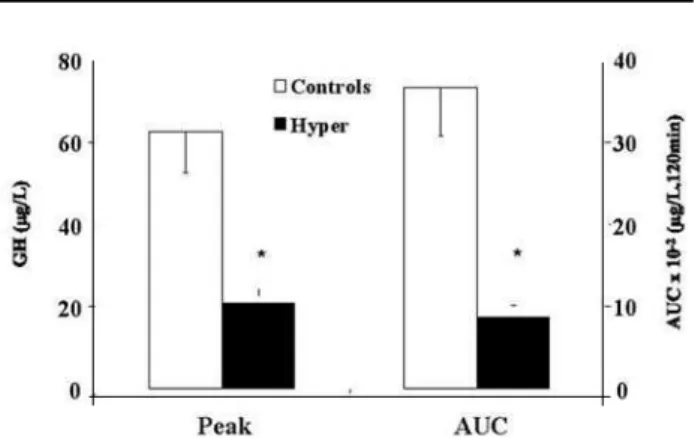
nists and antagonists on ghrelin-induced GH release is controversial. Piridostigmine failed to modify GH responsiveness to both ghrelin and GHRP-6 (15,48). However, atropine blunted this response, but piren-zepine, a muscarinic receptor antagonist, was unable to alter GH release after ghrelin (49). These latter compounds only blunt GH response to GHRP-6, while they completely abolish GH response to GHRH (15). GH response to GHS was only attenuated by glucocorticoids and GH administration, which proba-bly enhance hypothalamic somatostatin release (50,51). In patients with Cushing’s disease a blunted GH response to both GHRP-6 and ghrelin has been reported by us and by others (52-55). In these patients GHS and ghrelin-induced ACTH and cortisol release is increased (54,55). These latter effects could be due to a direct action of these peptides at GHS-R in the corticotroph adenoma or, alternatively, activation of hypothalamic AVP and probably, to a lesser extent, of CRH pathways (7). Interestingly, chronic glucocorti-coid administration does not interfere with GHRP-6 induced GH release (53). It has been previously sug-gested that the time of exposure to hypercortisolism is important for the GH response to these peptides. In patients with adrenal insufficiency a 72 h withdrawal of glucocorticoid replacement therapy does not influence the GH responsiveness to GHRP-6 (57). We have shown that in hyperthyroidism there is a decrease in GH responsiveness to GHRH while GHRP-6-induced GH release is maintained, which could suggest that thyroid hormones interfere mainly with GHRH-releasing mechanisms (58). However, we have recent-ly shown that there is a decrease in the GH response to ghrelin in these patients, suggesting that thyroid hormones might interfere with additional pathways of GH release activated by ghrelin (figure 2) (59). In type 1 diabetes mellitus GH response to GHRP-6 and
hexarelin is either normal or enhanced, demonstrating that hyperglycemia is unable to decrease GH release induced by these peptides, differently than in normal subjects (60). It has recently been shown that ghrelin-induced GH release is decreased in anorexia nervosa, which is an unexpected finding as these patients have high GH levels and enhanced responses to GHRH and GHS (61). GH-releasing compounds could repre-sent an alternative treatment in GH deficient states. However, these substances have failed to show benefit over GH therapy, despite the fact that they are more physiological, as they induce endogenous pulsatile GH release.
CONCLUSION
Ghrelin is a novel hormone secreted from the stomach to the circulation. This peptide is also produced in the hypothalamus and other tissues, with both endocrine and paracrine effects. The acyl modification of its mol-ecule is essential for enhancement of GH release and stimulation of food intake. Several questions remain to be answered concerning the roles of circulating and hypothalamic ghrelin on GH release. Ghrelin might have a physiological role on pulsatile GH secretion, but further studies are necessary to clarify its precise role on GH modulation.
ACKNOWLEDGEMENTS
I am grateful to the postgraduate students who con-tributed to this work, to Prof. Dr. José G.H. Vieira for the constant laboratory support and to Aparecida Filo-mena Machado and Walkiria Miranda for assistance with the assays. Ana Maria J. Lengyel is a Senior Scientist of Conselho Nacional de Pesquisa (CNPq). This work was supported by FAPESP (97/07689-0, 02/03508-0, 02/14118-9) and CNPq (300550/87-1).
REFERENCES
1. Bowers CY, Momany FA, Reynolds GA, Hong A. On the
in vitroand in vivoactivity of a new synthetic hexapep-tide that acts on the pituitary to specifically release growth hormone. Endocrinology 1984;114:1537-45.
2. Smith RG, Van der Ploeg LHT, Howard AD, et al. Pep-tidomimetic regulation of growth hormone secretion.
Endocr Rev 1997;18:621-45.
3. Korbonits M, Grossman A. Growth hormone-releasing peptide and its analogues – novel stimuli to growth hor-mone release. Trends Endocrinol Metab 1995;6:43-9.
4. Howard AD, Feighner SD, Cully DF, et al. A receptor in pituitary and hypothalamus that functions in growth hor-mone release. Science 1996;273:947-77.
5. Kojima M, Hosoda H, Date Y, Nakazato M, Matsuo H, Kangawa K. Ghrelin is a growth-hormone-releasing acy-lated peptide from stomach. Nature 1999;402:656-60.
6. Arvat E, DiVito L, Broglio F, Papotti M, Muccioli G, Dieguez C, et al. Preliminary evidence that ghrelin, the natural GH secretagogue (GHS)-receptor ligand, strongly stimulates GH secretion in humans. J Endocrinol Invest 2000;23:493-5.
7. Korbonits M, Goldstone A P, Gueorguiev M, Grossman AB. Ghrelin – a hormone with multiple functions. Front Neuroendocrinol 2004;25:27-68.
8. van der Lely AJ, Tschop M, Heiman ML, Ghigo E. Biolog-ical, physiologBiolog-ical, pathophysiologBiolog-ical, and pharmaco-logical aspects of ghrelin. Endocr Rev 2004;25:426-57.
9. Sun Y, Wang P, Zheng H, Smith RG. Ghrelin stimulation of growth hormone release and appetite is mediated through the growth hormone secretagogue receptor.
Proc Natl Acad Sci USA 2004;101:4679-84.
10. Gnanapavan S, Kola B, Bustin SA, Morris DG, McGee P, Fairclough P, et al. The tissue distribution of the mRNA of ghrelin and subtypes of its receptor, GHS-R, in humans. J Clin Endocrinol Metab 2002;87:2988-91.
11. Cummings DE, Weigle DS, Frayo RS, Breen PA, Ma MK, Dellinger EP, et al. Plasma ghrelin levels after diet-induced weight loss or gastric bypass surgery. N Engl J Med 2002;346:1623-30.
12. Banks WA, Tschop M, Robinson SM, Heiman ML. Extent and direction of ghrelin transport across the blood-brain barrier is determined by its unique primary structure. J Pharmacol Exp Ther 2002;302:822-7.
13. Takaya K, Ariyasu H, Kanamoto N, Iwakura H, Yoshimoto A, Harada M, et al. Ghrelin strongly stimulates growth hormone release in humans. J Clin Endocrinol Metab 2000;85:4908-11.
14. Arvat E, Maccario M, DiVito L, Broglio F, Benso A, Gottero C, et al. Endocrine activities of ghrelin, a natural growth hormone secretagogue (GHS), in humans: comparison and interactions with hexarelin, a nonnatural peptidyl GHS, and GH-releasing hormone. J Clin Endocrinol Metab 2001;86:1169-74.
15. Peñalva A, Carballo A, Pombo M, Casanueva F, Dieguez C. Effect of growth hormone (GH)-releasing hormone (GHRH), atropine, pyridostigmine, or hypo-glycemia on GHRP-6-induced GH secretion in man.J Clin Endocrinol Metab 1993;76:168-71.
16. Hataya Y, Akamizu T, Takaya K, Kanamoto N, Ariyasu H, Saijo M, et al. A low dose of ghrelin stimulates growth hormone (GH) release synergistically with GH-releasing hormone in humans. J Clin Endocrinol Metab 2001;86:4552-5.
17. Popovic V, Damjanovic S, Micic D, Djurovic M, Dieguez C, Casanueva FF. Blocked growth hormone-releasing peptide (GHRP-6)-induced GH secretion and absence of the synergic action of GHRP-6 plus GH-releasing hor-mone in patients with hypothalamopituitary disconnec-tion: evidence that GHRP-6 main action is exerted at the hypothalamic level. J Clin Endocrinol Metab 1995;80:942-7.
18. Popovic V, Miljic D, Micic D, Damjanovic S, Arvat E, Ghigo E, et al. Ghrelin main action on the regulation of growth hormone release is exerted at hypothalamic level. J Clin Endocrinol Metab 2003;88:3450-3.
19. Tannenbaum GS, Bowers CY. Interactions of growth hor-mone secretagogues and growth horhor-mone-releasing hormone/somatostatin. Endocrine 2001;14:21-7.
20. Pandya N, Mott-Friberg R, Bowers CY, Barkan AL, Jaffe CA. Growth hormone (GH)-releasing peptide-6 requires endogenous hypothalamic GH-releasing hormone for maximal GH stimulation. J Clin Endocrinol Metab 1998;83:1186-9.
21. Dickson SL, Doutrelant-Viltart O, Leng G. GH-deficient
dw/dwrats and lit/litmice show increased Fos expres-sion in the hypothalamic arcuate nucleus following sys-temic injection of GH-releasing peptide-6. J Endocrinol 1995;146:519-26.
22. Maheshwari H, Rahim A, Rahim A, Shalet S, Baumann G. Selective lack of growth hormone (GH) response to the releasing peptide hexarelin in patients with GH-releasing hormone receptor deficiency. J Clin Endocrinol Metab 1999;84:956-9.
23. Wren AM, Small CJ, Fribbens CV, Neary NM, Ward HL, Seal LJ, et al. The hypothalamic mechanisms of the hypophysiotropic action of ghrelin. Neuroendocrinology 2002;76:316-24.
24. Korbonits M, Little JA, Forsling ML, Tringali G, Costa A, Navarra P, et al. The effect of growth hormone secreta-gogues and neuropeptide Y on hypothalamic hormone release from acute rat hypothalamic explants. J Neu-roendocrinol 1999;11:521-8.
25. Guillaume V, Magnan E, Cataldi M, Dutour A, Sauze N, Renard M, et al. Growth hormone (GH)-releasing hor-mone secretion is stimulated by a new GH-releasing hexapeptide in sheep. Endocrinology 1994;135:1073-6.
26. Goth MI, Lyons CE, Canny BJ, Thorner MO. Pituitary adenylate cyclase activating polypeptide, growth mone (GH)-releasing peptide and GH-releasing hor-mone stimulate GH release through distinct pituitary receptor.Endocrinology 1992;130:939-44.
27. Malagon MM, Luque RM, Ruiz-Guerrero E, Rodriguez-Pacheco F, Garcia-Navarro S, Casanueva FF, et al. Intracellular signaling mechanisms mediating ghrelin-stimulated growth hormone release in somatotropes.
Endocrinology 2003;144:5372-80.
28. Tolle V, Bassant MH, Zizzari P, Poindessous-Jazat F, Tomasetto C, Epelbaum J, et al. Ultradian rhythmicity of ghrelin secretion in relation with GH, feeding behavior, and sleep-wake patterns in rats. Endocrinology 2002;143:1353-61.
29. Okimura Y, Ukai K, Hosoda H, Murata M, Iguchi G, Iida K, et al. The role of circulating ghrelin in growth hormone (GH) secretion in freely moving male rats. Life Sci 2003;72:2517-24.
30. Tannenbaum GS, Epelbaum J, Bowers CY. Interrelation-ship between the novel peptide ghrelin and somato-statin/growth hormone-releasing hormone in regulation of pulsatile growth hormone secretion. Endocrinology 2003;144:967-74.
sexually dimorphic, suppressed by somatostatin, and not affected by the ambient growth hormone levels. J Clin Endocrinol Metab 2003;88:2180-4.
32. Halem HA, Taylor JE, Dong JZ, Shen Y, Datta R, Abizaid A, et al. Novel analogs of ghrelin: physiological and clinical implications. Eur J Endocrinol 2004;151 (suppl. 1):S71-5.
33. Zizzari P, Halem H, Taylor J, Dong JZ, DattaR, Culler MD, et al. Endogenous ghrelin regulates episodic growth hor-mone (GH) secretion by amplifying GH pulse amplitude: evidence from antagonism of the GH secretagogue-R1a receptor. Endocrinology 2005;146:3836-42.
34. Tannenbaum GS, Samia M, Chen Q, Bowers CY. Antag-onism of the growth hormone secretagogue receptor unmasks a role for ghrelin in maintaining high GH pulse amplitude under physiological conditions. Endo Soc 87th Ann Meet 2005; San Diego, USA, June 4-7.
35. Pantel J, Cabrol S, Nivot S. Familial short stature associ-ated with a mutation in the growth hormone secreta-gogue receptor (GHSR). Endo Soc 86th Ann Meet 2004; New Orleans, USA, June 16-19.
36. Koutkia P, Canavan B, Breu J, Johnson ML, Grinspoon SK. Nocturnal ghrelin pulsatility and response to growth hor-mone secretagogues in healthy men. Am J Physiol Endocrinol Metab 2004;287:E506-12.
37. Kamegai J, Tamura H, Shimizu T, Ishii S, Tatsuguchi A, Sug-ihara H, et al. The role of pituitary ghrelin in growth hor-mone (GH) secretion: GH-releasing horhor-mone-depen- hormone-depen-dent regulation of pituitary ghrelin gene expression and peptide content.Endocrinology 2004;145:3731-8.
38. Sun Y, Ahmed S, Smith RG. Deletion of ghrelin impairs neither growth nor appetite. Mol Cell Biol 2003; 23:7973-81.
39. Shuto Y, Shibasaki T, Otagiri A, Kuriyama H, Ohata H, Tamura H, et al. Hypothalamic growth hormone secret-agogue receptor regulates growth hormone secretion, feeding, and adiposity. J Clin Invest 2002;109:1429-36.
40. Sun Y, Wang P, Zheng H, Smith RG. Ghrelin stimulation of growth hormone release and appetite is mediated through the growth hormone secretagogue receptor.
Proc Natl Acad Sci USA 2004;101:4679-84.
41. Peino R, Baldelli R, Garcia J, Rodriguez-Segade S, Kojima M, et al. Ghrelin-induced growth hor-mone secretion in humans. Eur J Endocrinol 2000; 143:R11-4.
42. Popovic V, Leal A, Micic D, Koppeschaar HPF, Torres E, Paramo C, et al. GH-releasing hormone and GH-releas-ing peptide-6 for diagnostic testGH-releas-ing in GH-deficient adults. Lancet 2000;356:1137-42.
43. Broglio F, Benso A, Castiglioni C, Gottero C, Prodam F, Destefanis S, et al. The endocrine response to ghrelin as a function of gender in humans in young and elderly subjects. J Clin Endocrinol Metab 2003;88:1537-42.
44. Cordido F, Peñalva A, Dieguez C, Casanueva FF. Mas-sive growth hormone (GH) discharge in obese subjects after the combined administration of GH-releasing hor-mone and GHRP-6: evidence for a marked somatotroph secretory capability in obesity.J Clin Endocrinol Metab 1993;76:819-23.
45. Tassone F, Broglio F, Destefanis S, Rovere S, Benso A, Got-tero C, et al. Neuroendocrine and metabolic effects of
acute ghrelin administration in human obesity. J Clin Endocrinol Metab 2003;88:5478-83.
46. Maccario M, Arvat E, Procopio M, Gianotti L, Grottoli S, Imbimbo BP, et al. Metabolic modulation of the growth hormone-releasing activity of hexarelin in man. Metabo-lism 1995;44:134-8.
47. DiVito L, Broglio F, Benso A, Gottero C, Prodam F, Papot-ti M, et al. The GH-releasing effect of ghrelin, a natural GH secretagogue, is only blunted by the infusion of exogenous somatostatin in humans. Clin Endocrinol 2002;56:643-8.
48. Broglio F, Benso A, Gottero C, Prodam F, Grottoli S, Tas-sone F, et al. Effects of glucose, free fatty acids or argi-nine load on the GH-releasing activity of ghrelin in humans. Clin Endocrinol 2002;57:265-71.
49. Maier C, Schaller G, Buranyi B, Nowotny P, Geyer G, Wolzt M, et al. The cholinergic system controls ghrelin release and ghrelin-induced growth hormone release in humans. J Clin Endocrinol Metab 2004;89:4729-33.
50. Gertz BJ, Sciberras DG, Yogendran L, Christie K, Bador K, Krupa D, et al. L-692,429, a nonpeptide growth hormone (GH) secretagogue, reverses glucocorticoid suppression of GH secretion. J Clin Endocrinol Metab 1994;79:745-9.
51. Arvat E, DiVito L, Gianotti L, et al. Mechanisms underly-ing the negative growth hormone (GH) autofeedback on the GH-releasing effect of hexarelin in man. Metabo-lism 1997;46:83-8.
52. Leal-Cerro A, Pumar A, Garcia-Garcia E, Dieguez C, Casanueva FF. Inhibition of growth hormone release after the combined administration of GHRH and GHRP-6 in patients with Cushing’s syndrome. Clin Endocrinol 1994;41:649-54.
53. Borges MH, DiNinno FB, Lengyel AM. Different effects of growth hormone releasing peptide (GHRP-6) and GH-releasing hormone on GH release in endogenous and exogenous hypercortisolism. Clin Endocrinol 1997; 46:713-8.
54. Leal-Cerro A, Torres E, Soto A, Dios E, Deghenghi R, Arvat E, et al. Ghrelin is no longer able to stimulate growth hor-mone secretion in patients with Cushing’s syndrome but instead induces exaggerated corticotropin and cortisol responses.Neuroendocrinology 2002;76:390-6.
55. Correa-Silva SR, Nascif SO, Silva MR, Senger MH, Miran-da WL, Machado AF, et al. Decreased GH secretion and enhanced ACTH and cortisol release after ghrelin administration in Cushing’s disease: comparison with GHRP-6.Proc 12th Intern Congr Endocrinol 2004. Lisbon, Portugal, August 31- September 4.
56. Arvat E, Giordano R, Ramunni J, Arnaldi G, Colao A, Deghenghi R, et al. Adrenocorticotropin and cortisol hyperresponsiveness to hexarelin in patients with Cush-ing’s disease bearing a pituitary microadenoma, but not in those with macroadenoma.J Clin Endocrinol Metab 1998;83:4207-11.
57. Pinto AC, Silva MR, Martins MR, Brunner E, Lengyel AM. Effects of short-term glucocorticoid deprivation on growth hormone (GH) response to GH-releasing pep-tide-6: studies in normal men and in patients with adrenal insufficiency. J Clin Endocrinol Metab 2000;85:1540-4.
GH-releas-ing peptide and GH-releasGH-releas-ing hormone in hyperthy-roidism. J Clin Endocrinol Metab 1996;81:1343-6.
59. Nascif SO, Correa-Silva S, Silva MR, Senger MH, Lengyel AM. The effects of ghrelin on GH, ACTH and cortisol release in thyrotoxicosis. Proc 12th Intern Congr Endocrinol 2004. Lisbon, Portugal, August 31-Septem-ber 4.
60. Weffort RFVB, Ramos-Dias JC, Chipoch C, Lengyel AM. Growth hormone (GH) response to GH-releasing pep-tide-6 in patients with insulin-dependent diabetes melli-tus. Metabolism 1997;46:706-10.
61. Broglio F, Gianotti L, Destefanis S, et al. The endocrine response to acute ghrelin administration is blunted in
patients with anorexia nervosa, a ghrelin hypersecretory state. Clin Endocrinol 2004;60:592-9.
Endereço para correspondência:
Ana Maria J. Lengyel
Div. Endocrinology, UNIFESP/EPM R. Pedro de Toledo 910
04039-002 São Paulo, Brazil Fax: (11) 5574-8432