Resilience does not explain the
dissociation between chronic pain and
physical activity in South Africans living
with HIV
Antonia L. Wadley, Duncan Mitchell and Peter R. Kamerman
Brain Function Research Group, School of Physiology, Faculty of Health Sciences, University of the Witwatersrand, Johannesburg, South Africa
ABSTRACT
Pain burden is high in people living with HIV (PLWH), but the effect of this pain on functionality is equivocal. Resilience, the ability to cope with adversity, may promote adaptation to pain, so we hypothesised that higher resilience would correlate with less pain-related impairment of activity. We recruited 197 black South African PLWH, 99 with chronic pain (CP) and 98 patients without. We measured pain intensity and interference using the Brief Pain Inventory, and resilience using the Resilience Scale. Participants were generally highly resilient. Greater resilience correlated with better health-related quality of life, but not with pain intensity or interference. We also measured physical activity objectively, by actigraphy, in a subset of patients (37 with chronic pain and 31 without chronic pain), who wore accelerometers for two weeks. There was no difference in duration or intensity of activity between those with and without pain, and activity was not associated with resilience. In this sample, pain was not associated with altered physical activity. Resilience did not explain differences in pain intensity or pain interference but was associated with improved quality of life. Financial stresses and the fear of HIV stigma may have driven patients to conceal pain and to suppress its expected impairment of activity.
Subjects Anaesthesiology and Pain Management, HIV, Psychiatry and Psychology Keywords HIV, Pain, Function, Activity, Resilience, Accelerometer, Actigraphy
INTRODUCTION
It seems self-evident, especially to the patients themselves (Riley, Ahern & Follick, 1988), that chronic pain, especially if it is moderate to severe, will interfere with activities of daily living. Pain is experienced by 50–75% (depending on cohort) of people living with HIV (PLWH), and for most of them the pain is moderate to severe in intensity
(Parker, Stein & Jelsma, 2014). As expected, PLWH in the US and Denmark reported significant pain-related functional impairment (Breitbart et al., 1996;Frich & Borgbjerg, 2000;Merlin et al., 2013), yet African PLWH with similar levels of pain reported little or no functional interference (Mphahlele, Mitchell & Kamerman, 2012;Voss et al., 2007; Wahab & Salami, 2011). Moderate to severe pain limits function in other populations including those with rheumatoid arthritis and dysmenorrhea (Chantler, Mitchell & Fuller, 2009;Prioreschi et al., 2013). The reasons for the apparent lack of functional interference
Submitted6 May 2016
Accepted19 August 2016
Published13 September 2016
Corresponding author
Antonia L. Wadley, [email protected]
Academic editor
Mark Boyes
Additional Information and Declarations can be found on page 18
DOI10.7717/peerj.2464
Copyright
2016 Wadley et al.
Distributed under
in African PLWH and HIV-related pain are unclear, but are likely to be informed by local psychological, social, cultural and economic factors. Reports of functional interference in PLWH have been based on subjective reports previously, rather than objective measurement, which limits interpretation.
Psychosocial factors (e.g., depression, anxiety and pain catastrophizing) are associated with greater pain intensity, disability and poorer outcomes in chronic pain populations (McWilliams, Goodwin & Cox, 2004;Wertli et al., 2014;Westman et al., 2011). However, the positive attribute of resilience, the ability to overcome and adapt to adversity (Windle, Bennett & Noyes, 2011), may temper these negative psychosocial factors and increase adaptation to chronic pain (Ruiz-Pa´rraga et al., 2015;Ruiz-Pa´rraga, Lo´pez-Martı´nez & Go´mez-Pe´rez, 2012). For example, resilience was associated with increased functioning and lower impairment in patients with chronic spinal pain (Ruiz-Pa´rraga et al., 2015). Whilst the construct of resilience has been well explored in some clinical conditions and populations, resilience and chronic pain has been less well covered (for review:Sturgeon & Zautra (2013)), and resilience and HIV even less so. Additionally, to our knowledge, there is no literature on resilience in chronic pain and HIV cohorts from Africa. Indeed, neither resilience alone, nor its impact on function, has ever been measured in individuals with HIV-related pain. Though we have suggested that resilience is high in South African PLWH (Mphahlele, Mitchell & Kamerman, 2012), we do not know for sure that this is the case and if it is resilience that accounts for the apparent lack of functional interference in the face of pain compared to cohorts in Denmark and the USA. We hypothesised that greater resilience in individuals with HIV-related pain would associate with lower pain intensity and better quality of life, and that these benefits would be reflected in greater levels of daily activity. Therefore, in the study we report here, we investigated whether resilience could account for the dissociation between chronic pain and functional impairment in South African PLWH. In addressing this question, we also report the first use of actigraphy to measure pain-related functional impairment in HIV-related individuals objectively, to determine to what extent pain interferes with function. We also validated two English-language resilience scales in isiZulu.
METHODS
with and without pain for a balanced design. We obtained relevant medical history from the patients’ medical records. Ethical approval was obtained from the Human Research Ethics Committee (Medical) of the University of the Witwatersrand
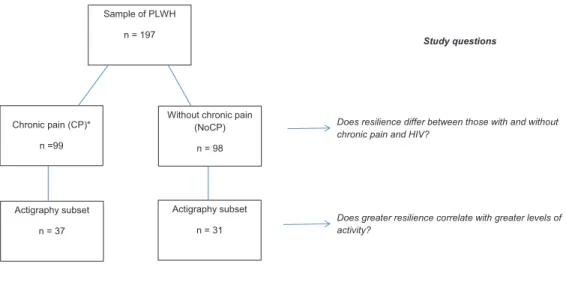
(clearance no: M140538). Two interpreters fluent in English and local African languages helped ensure that consent was properly informed and completed data collection with patients not wishing to speak English.Figure 1shows recruitment to each arm and sample sizes.
Part one: questionnaires
All participants completed the following questionnaires.
The Euroqol-5D-3L (EQ5D) measures health-related quality of life (Brooks, 1996; The EuroQol Group, 1990). First, participants rated five quality-of-life domains (mobility, self-care, usual activities, pain/discomfort and anxiety/depression) on an ordinal scale (“no problems,” “moderate problems,” or “severe problems”). Second, participants rated their overall perceived state of health on a 100-point visual analogue scale (VAS; anchored at 0: “the worst health imaginable,” and 100: “the best state of health imaginable”). The EQ5D has been used widely, including in South African HIV populations (for review: Robberstad & Olsen (2010)) and has good convergent and concurrent validity, and test-retest reliability (Brazier et al., 2004;Stavem, Frøland & Hellum, 2005;van Agt et al., 1994). Internal consistency of the score is acceptable: two recent studies have reported Cronbach alphas of 0.72 and 0.73 in US multiple sclerosis caregivers and Indian patients with acute respiratory distress syndrome (Joshi et al., 2016;Shah et al., 2016).
Resilience was measured using the Resilience Scale (Wagnild & Young, 1993) and the CD-RISC (Connor & Davidson, 2003), which both have good psychometric properties including good internal consistency (Cronbach alphas = 0.91 and 0.89, respectively) and construct and convergent validity (Wagnild & Young, 1993;Connor & Davidson, 2003; Ahern et al., 2006). The Resilience Scale is a 25-item questionnaire, with each item
Sample of PLWH
n = 197
Without chronic pain (NoCP)
n = 98 Chronic pain (CP)*
n =99
Actigraphy subset
n = 31 Actigraphy subset
n = 37
Does resilience differ between those with and without chronic pain and HIV?
Does greater resilience correlate with greater levels of activity?
*Does greater resilience correlate with lower pain intensity?
Study questions
measured on a seven-point Likert scale anchored at 1 (“strongly disagree”) and 7 (“strongly agree”). Maximum resilience scores 175. The CD-RISC also is a 25-item questionnaire, with each item measured on a five-point scale anchored at 0 (“not true at all”) and 4 (“true nearly all the time”). Maximum resilience scores 100. All
participants completed both questionnaires, with the questionnaires administered in random order.
Resilience scales have not been employed previously in populations with HIV-related pain, but the Resilience Scale has been validated in a chronic pain population
(Ruiz-Pa´rraga et al., 2015;Ruiz-Pa´rraga, Lo´pez-Martı´nez & Go´mez-Pe´rez, 2012), and the CD-RISC has been validated in South African cohorts, including patients with HIV infection (Jorgensen & Seedat, 2008;Spies & Seedat, 2014). We had no a priori reason to prefer one of the scales so decided to use both, and to compare their utility and outcomes. Patients were given the choice of answering the questionnaires in English or in isiZulu, the language spoken most widely by black South Africans. With the permission and input of the authors of both scales, we used a reputable national company to translate the questionnaires into isiZulu using two forward and back translations, followed by a consensus meeting. To assess the psychometric properties of the isiZulu translations, we investigated the internal consistency and factor structure of the translated questionnaires (Supplemental Material).
In addition to assessing quality of life and resilience, we also assessed resource prioritisation amongst participants (Uwimana & Struthers, 2007) by asking them how much they worried about specific life stressors: health, money, availability of food, and their family. We recorded how frequently they worried about these stressors using an ordinal scale (“not at all,” “rarely,” “sometimes,” “often,” “nearly all the time”). CP patients also were asked about any additional worries they had, and to whom they had revealed their pain; their unstructured responses were recorded.
Patients reporting chronic pain also completed The Brief Pain Inventory (BPI), an instrument used frequently to assess pain intensity and pain interference with life functions (Cleeland & Ryan, 1994). The pain intensity component of the instrument records pain intensity at its worst and at its least in the past week, as well as at the time of assessment, on an 11-point numerical rating scale anchored at 0 (“no pain”) and 10 (“the worst pain you can imagine”). The BPI also assesses average pain in the last week, but our experience with validating the Wisconsin Brief Pain Questionnaire (a precursor of the BPI) in a population of patients with similar demographics indicated that the concept of “average pain” did not translate validly amongst isiZulu speakers, so we omitted this question (Mphahlele, Mitchell & Kamerman, 2008). The pain interference component (BPI-I) assesses interference of pain on seven activities of daily living: general activity, mood, walking ability, normal work, relations with other people, sleep and enjoyment of life. Interference is scored on an 11-point numerical rating scale anchored at 0 (“does not interfere”) and 10 (“completely interferes”). The average of the seven individual
South African amaXhosa population, as has the closely-related Wisconsin Brief Pain Questionnaire in an amaZulu population (Mphahlele, Mitchell & Kamerman, 2008; Parker, Jelsma & Stein, 2016).
Part two: actigraphy
All patients who completed questionnaires were asked whether they would consent to wearing an accelerometer to measure their physical activity objectively by actigraphy. We aimed to achieve balanced cohorts, with half of those wearing actigraphs having chronic pain. Previous case-control studies of activity in cohorts with pain have recruited 12–20 people per cohort (Chantler, Mitchell & Fuller, 2009;Hasenbring et al., 2006; Raijmakers et al., 2015). We were unsure how much variability there might be in activity, and so aimed to recruit∼40 to each group. Exclusion criteria for wearing actigraphs
included: having a physical disability, neurological or respiratory complaint that impeded walking, or having an infant less than a year old, because of possible interrupted sleep and increased activity at night.
We used unidirectional accelerometers (Actical Step, Mini-Mitter, Respironics, Murrysville, PA, USA) to measure physical activity; the devices have been used previously to measure activity in other South African patients in pain (Chantler, Mitchell & Fuller, 2009;Prioreschi et al., 2013). As there is variation in individual accelerometer sensitivity, we referenced each accelerometer’s output to its maximum output (Bassett, Rowlands & Trost, 2012). Activity was recorded in one minute epochs. The accelerometers, which measured 293711 mm and weighed about 22 g, were fitted on a belt and worn over the right hip joint for two weeks. The accelerometers were removed for bathing,
showering or swimming only.
Analyses
Continuous parametric data are presented as mean (standard deviation, SD), and were analysed using unpaired t tests. Continuous, non-parametric data are presented as median (range), and were analysed using Wilcoxon rank sum tests. Categorical data are presented as percentages, and analysed using Fisher’s exact tests (2 2 tables) and Chi-square test for trend (> 2 2 tables). All univariate test statistics were generated using bootstrap methods using 10,000 resamples. The test statistic, 95% confidence interval and original p-value are reported. Permuted p-values (10,000 permutations) were also generated, and can be seen at the following url (Kamerman, Wadley & Mitchell, 2016).
Our validation process for the isiZulu translations of the resilience questionnaires resulted in us having to remove some questions because of poor factor loading (see below: ‘Validation of the resilience scales’). This curtailment meant that the number of
Activity analyses
To reduce irregularities in activity while the patients were getting used to wearing an actigraph, we analysed activity only from the last seven complete days. We measured: 1) time spent active, 2) intensity of activity, and 3) endurance (time spent at a particular level of activity).
1.Time spent active:We calculated average activity for each successive five-minute period. Periods with mean activity < 2.5% of the accelerometer maximum were classed as ‘inactive periods’ (e.g., sleeping or resting). The number of remaining five-minute ‘active periods’ was summed over 24 h and then averaged for the seven days.
Median minutes active per day were compared between the participants with and without pain using a Wilcoxon rank sum test.
2.Intensity of activity:Using data only from ‘active periods,’ we calculated median daily activity counts for the week, and compared the scores between participants with and without chronic pain using a Wilcoxon rank sum test. We used Spearman’s rank correlations to assess associations between median daily activity and subjective measures of pain, function and resilience.
3.Endurance:As the analysis of median activity would not differentiate between those who had consistent low levels of activity throughout the day from those who had short bursts of very intense activity, we added an analysis of endurance. Using data from both the active and inactive periods for the week, we calculated the time each
patient spent in quartiles of their maximum recorded activity during the week (0, 1–24, 25–49, 50–74,75% of maximum). We used a Wilcoxon rank sum test to compare time spent inactive and in each quartile between the participants with and without chronic pain, and correlated these measures of endurance with resilience scores using Spearman’s rank correlation.
Multivariate analysis
We identified variables predicting activity using random forest analysis (a nonparametric recursive partitioning technique) (Hothorn et al., 2006;Strobl et al., 2008; Strobl et al., 2007). This method was chosen as the data did not conform to the
We assessed for moderator effects of resilience on the associations between pain and activity using linear regression, and pain and quality of life using beta regression. Interactions were also examined in centred data using simple slope analysis.
Validation of the resilience scales
As the data arising from the resilience scales were ordinal integers, we used polychoric correlation matrices, rather than Pearson’s correlation matrices, in the assessment of internal consistency and parallel analysis for factor number estimates.
Factor analysis was used to determine the number of distinct factors in the isiZulu versions of each of the two resilience scales, and how well the questions loaded onto each of the factors. We determined the initial number of factors to include in the analyses using the parallel analysis method proposed byHorn (1965)(Revelle, 2015). Oblique Oblimin rotation was used in factor analyses because of the likelihood of correlation between factors (Beavers et al., 2013). The factor analysis was performed iteratively, with questions with factor loadings less than 0.3 being removed successively, until all loadings in re-runs exceeded 0.3 (Beavers et al., 2013).
Our data revealed good correlation between the scores of the Resilience Scale and the CD-RISC in our sample of patients (Spearman’s correlation: r = 0.54 and p < 0.0001). We therefore picked one, the resilience scale, to use in the univariate and multivariate analyses, on the grounds that it has been used previously to measure resilience in patients with CP (Ruiz-Pa´rraga et al., 2015;Ruiz-Pa´rraga, Lo´pez-Martı´nez & Go´mez-Pe´rez, 2012; Ramı´rez-Maestre & Esteve, 2014;Ramı´rez-Maestre, Esteve & Lo´pez, 2012).
We analysed our data using GraphPad Prism 4 (GraphPad, California), and R version 3.1.2 (Core R Team, 2015), using the ‘party’ package (Hothorn et al., 2006;Strobl et al., 2008;Strobl et al., 2007;Hothorn, Hornik & Zeileis, 2006) and ‘psych’ package (Revelle, 2015). Full data sets, analysis scripts, and analysis outputs for the factor, activity, and random forest analyses are available (Kamerman, Wadley & Mitchell, 2016). The site also contains the data and scripts used to generate the Supplemental Figures.
RESULTS
Table 1 Demographic characteristics of the participants.
Characteristic* Chronic
pain (n = 99)
No chronic pain (n = 98)
p-value
Age (years) 44 (10) 40 (10) 0.01†
Female (n (%)) 65 (66) 76 (78) 0.08‡
Highest level of education (n (%)) 0.01‡
No education 23 (23) 6 (6)
Primary 41 (41) 44 (45)
Secondary 28 (28) 38 (39)
Tertiary 7 (7) 7 (7)
Employment status (n (%))‖ 0.03‡
Full time 37 (37) 53 (54)
Part time/piece work 18 (18) 13 (13)
Unemployed 44 (44) 32 (33)
Years since diagnosis 6 (1–25) 6 (1–20) 0.92§
Years on antiretroviral therapy (ART)
4 (0–24) 4 (0–18) 0.57§
Nadir CD4 T-cell count (cells.mm-3)
130 (3–775) 145 (1–678) 0.98§
Number with undetectable viral load
77 (78) 76 (78) 0.56˚
Number receiving a social grant 22 (22) 17 (17) 0.48˚
Number receiving a disability grant
5 (5) 5 (5) 1.00˚
EQ5D subscales
Mobility
No problems 59 92 < 0.0001‡
Some problems 40 6
Unable 0 0
Self-care
No problems 94 98 0.02‡
Some problems 5 0
Unable 0 0
Usual activities
No problems 58 94 < 0.0001‡
Some problems 40 4
Unable 1 0
Pain/discomfort
No problems 6 93 < 0.0001‡
Moderate problems 71 4
undetectable viral load at the time of recruitment. Quality of life was significantly lower for those with pain. Indeed, patients in the CP group reported significantly greater dysfunction on each of the five EQ5D subscales. Apart from the pain subscale, the compromise for the CP group was most distinct in the mobility subscale, where 40% of the patients in the CP group, but only 6% of those in the NoCP group had some problem with mobility. The perceived overall health score for the CP group (mean 50/100) was significantly lower than that for the NoCP group (mean 80/100).
Characteristics of the pain in the CP group are shown inTable S1. Half the CP group had developed persistent pain following their HIV diagnosis, and the average duration of the pain for the CP group was four years. Pain was experienced most frequently in the feet, with 75% (36/48) of those with foot pain experiencing bilateral foot pain, compatible with the presence of HIV-associated neuropathy. Worst pain was on average 8/10. Even though we had assigned them to the NoCP group based on their reports of pain at the time of recruitment, one patient in the NoCP group reported extreme problems with pain and a further four patients reported moderate problems in the last week. They did not, however, fit our criteria for chronic pain. Overall, the degree to which pain interfered with the activities of daily living in the CP group was five, on the scale 0–10. Amongst the activities of daily living, pain interfered most with sleep and with general activity, but surprisingly little with enjoyment of life.
Table 2shows how much the CP and NoCP groups worried about their health and other stressors. A significantly greater proportion of patients in pain reported higher levels of worry for every stressor than those without pain. Worries about money were the most frequent for both CP and NoCP groups, with 84% of patients in the CP group and 55% in the NoCP group worried about money “nearly all the time.” Even though they had positive HIV diagnoses, 28% of patients in the NoCP group were not at all concerned about their health, while only 9% of patients with pain were not at all concerned. When we split the sample into employed and unemployed patients and then looked at the differences in worries between the CP and NoCP groups, the patients in pain worried
Table 1 (continued ).
Characteristic* Chronic
pain (n = 99)
No chronic pain (n = 98)
p-value
Anxiety/depression
None 74 89 0.002‡
Moderate 22 9
Extreme 3 0
EQ5D VAS 50 (0–90) 80 (30–100) < 0.0001§
Notes:
P values in bold are significant.
*Age: mean (SD). Female, Highest level of education, Employment status, Undetectable viral load, Number receiving a
social or disability grant and EQ5D subscales: count (percent group size). Time since diagnosis, Time on ART, Nadir CD4 T-cell count, EQ5D VAS: median (range). Social grants include child support, older person and disability grants.
†t-test.
‡Chi-square test for trend. §Wilcoxon rank sum test. ˚Fishers exact.
‖
about each of the life stressors more than their employment-matched pain-free
counterparts (Chi-square tests for trend; p0.02; for clarity, seeKamerman, Wadley & Mitchell, 2016). Demographic data shed further light on the economic stresses of the whole sample (n = 197): 21 patients (11%) came from households where nobody was earning an income, and of the remaining households, there were on average two dependents for each earner (range 0–11). When additional dependents living outside the home were taken into account, the average was three dependents per earner (range 0–11). Patients in the CP group also were asked an open question about other worries they were facing. Patients indicated that one of their other greatest worries was being
“gossiped about,” that is, their HIV status being revealed and discussed by others. Indeed, 44% (44/99) had not told their friends and 9% (9/99) had not told their families about their chronic pain for fear that it would reveal their HIV status.
Univariate analysis
The validation of the resilience scales is shown in theSupplemental Materialand in Kamerman, Wadley & Mitchell (2016).
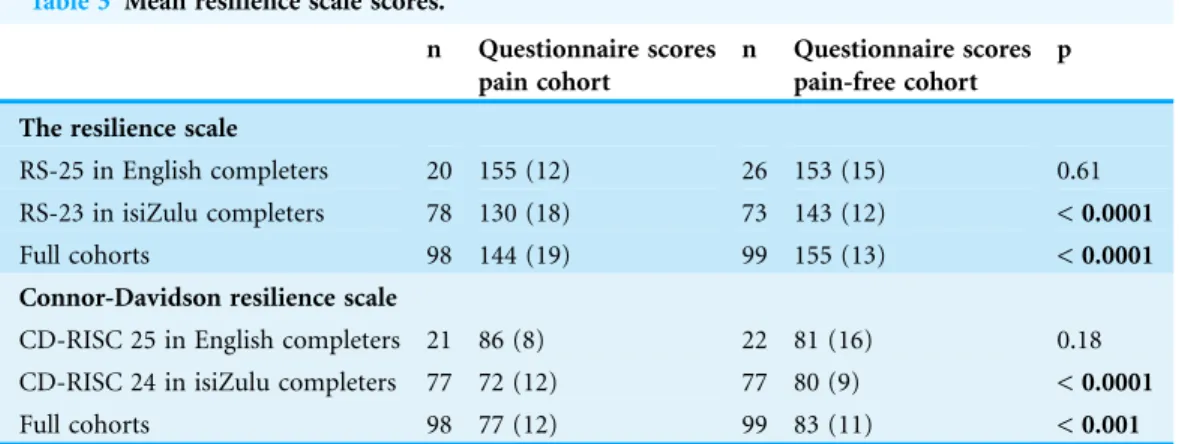
Mean scores for the resilience scales and comparisons between the CP and NoCP groups are shown inTable 3. Resilience scores were high. Participants in pain had lower resilience scale scores than did those not in pain, but even in the sub-group with least resilience, namely patients in pain who completed the questionnaires in isiZulu, the mean resilience score was not below 72% of the maximum for either scale. For all the patients without pain, resilience score exceeded 83% of maximum on both scales.
In a cohort analysis, we assessed the association between resilience scores and pain intensity, nadir CD4 T-cell count (as an index of disease severity) and subjective ratings of functional interference in the group CP (n = 99). Resilience did not correlate with either worst (Spearman’s correlation; r = 0.183, 95% CI-0.01–0.38, p = 0.07) or least
pain in the last week (Spearman’s correlation; r =-0.027, 95% CI-0.25–0.19, p = 0.79).
Neither did resilience correlate with nadir CD4 T-cell count (Spearman’s correlation; r =
-0.110, 95% CI-0.30–0.06, p = 0.30). Furthermore, resilience did not correlate with BPI-I
scores, the subjective measure of functional interference (Spearman’s r = 0.099, 95% CI
-0.11–0.31, p = 0.33). When comparing pain intensity with quality-of-life scores, we
Table 2 Frequency of worries about life stressors in the cohorts with and without chronic pain.
Health concerns Money Food Family concerns
CP NoCP p CP NoCP p CP NoCP p CP NoCP p
Not at all 9 (9) 26 (27) < 0.0001 0 (0) 7 (7) < 0.0001 14 (14) 40 (40) < 0.0001 7 (7) 23 (23) < 0.0001
Rarely 2 (2) 10 (10) 1 (1) 4 (4) 5 (5) 6 (6) 2 (2) 3 (3)
Sometimes 29 (29) 33 (34) 11 (11) 27 (28) 31 (31) 23 (23) 15 (15) 22 (22)
Often 6 (6) 8 (8) 5 (5) 6 (6) 3 (3) 8 (8) 5 (5) 8 (8)
Nearly all the time 53 (54) 21 (21) 82 (83) 54 (55) 46 (46) 22 (22) 70 (70) 42 (43)
Notes:
Data presented as count (%).
CP, chronic pain; NoCP, group without chronic pain.
found worst pain did not correlate with perceived state of health (using the EQ5D VAS scale) (Spearman’s; r =-0.170, 95% CI-0.36–0.02, p = 0.09). Scores correlated well for
the two subjective measures of functional limitation with mobility, that is, the mobility questions on the EQ5D and BPI interference scale (Wilcoxon rank sum; p = 0.02).
For the whole sample (n = 197), resilience was correlated with ratings of overall perception of health status (EQ5D VAS scale), with higher resilience scores associated with greater perceived health (Spearman’s; r = 0.407, 95% CI 0.29–0.54, p = < 0.0001). We looked for moderator effects of resilience on the association between pain and quality of life in the pain group (n = 99) but saw no evidence of interaction (r2= 0.12, p = 0.24; for clarity, seeKamerman, Wadley & Mitchell, 2016).
Actigraphy results
Of the 197 patients recruited to the study, 77 volunteered to wear accelerometers. Nine patients’ data were excluded from the analyses: seven because they wore the accelerometers inconsistently, one patient was lost to follow-up, and one patient’s accelerometer battery failed. Of the 68 patients included in the analysis, 37 had chronic pain and 31 did not. Demographic characteristics of the actigraphy subsets versus the remaining sample demonstrated that the subsets were representative of the larger groups with and without pain (Table S1). In particular, there was no difference in BMI between the two groups (Mean (SD): pain cohort 28 (6) kg m-2vs 26 (6) kg m-2pain-free cohort; t test; p = 0.09).
Differences between the CP and NoCP groups included education and employment, with the CP group having completed a lower level of education and less likely to be employed (p < 0.05; for clarity, seeKamerman, Wadley & Mitchell, 2016).
We compared duration of time spent active and intensity of activity between the CP and NoCP groups. There was no difference for either component: mean time spent active each week (Wilcoxon rank sum; test statistic 0.265, 95% CI-1.69–2.23, p = 0.89) or
median daily activity counts (as a percentage of the accelerometer’s calibrated maximum) (Wilcoxon rank sum; test statistic-0.895, 95% CI-2.85–0.10, p = 0.38) (Fig. S1).
Table 3 Mean resilience scale scores.
n Questionnaire scores pain cohort
n Questionnaire scores pain-free cohort
p
The resilience scale
RS-25 in English completers 20 155 (12) 26 153 (15) 0.61 RS-23 in isiZulu completers 78 130 (18) 73 143 (12) < 0.0001
Full cohorts 98 144 (19) 99 155 (13) < 0.0001
Connor-Davidson resilience scale
CD-RISC 25 in English completers 21 86 (8) 22 81 (16) 0.18 CD-RISC 24 in isiZulu completers 77 72 (12) 77 80 (9) < 0.0001
Full cohorts 98 77 (12) 99 83 (11) < 0.001
Notes:
P values in bold are significant.
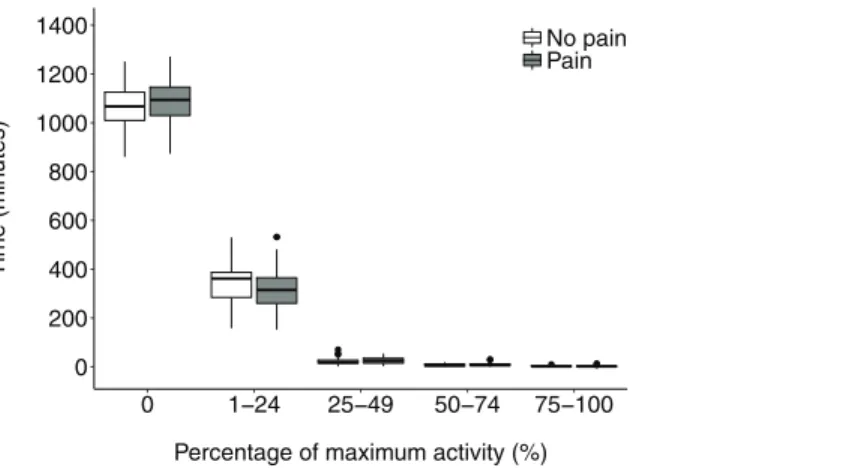
Having calculated each patient’s maximum activity count, we assessed time spent at 0, 0–24, 25–49, 50–74, and > 75% of maximum activity. There was no difference in time spent at 0% and in each of the quartiles between those with CP and those not (Wilcoxon rank sum; p values for each quartile > 0.05) (Fig. 2).
Univariate analysis
Figure S2 shows correlations between resilience and activity. Resilience scores did not correlate with median activity in the CP (Spearman’s r = -0.182, 95% CI-0.54–0.14,
p = 0.42) or NoCP groups (Spearman’s r = 0.024, 95% CI -0.35–0.40, p = 0.94).
However, for patients CP, resilience correlated inversely with time spent active, within the 25–49 and 50–74% quartiles of activity intensity (Spearman’s r = -0.460; 95%
CI-0.78 to-0.21, p = 0.005 and Spearman’s r =-0.397, 95% CI-0.73 to-0.15, p = 0.01
respectively), but the association was weak. There was no correlation between resilience and time spent at zero activity or with time spent active within the > 75% activity quartile, and no relationship between resilience and time spent active, within any quartiles of activity intensity, for those not in chronic pain (Spearman’s correlations; p > 0.05). We assessed for moderator effects of resilience on pain and activity and saw no evidence of interaction (r2= 0.11, p = 0.27 ; for clarity see url (Kamerman, Wadley & Mitchell, 2016)).
Figure S3shows associations between factors associated with activity levels in the chronic pain group only (n = 37). Neither intensity nor duration of activity correlated with subjective measures of functional interference including the walking scale of the BPI -I (Intensity of activity: Spearman’s r = 0.071, 95% CI-0.39–0.23, p = 0.58; Duration of
activity: Spearman’s r = 0.042, 95% CI-0.36–0.26), p = 0.76) or the mobility scale of the
EQ5D (Intensity of activity: Mann Whitney, p = 0.34; Duration of activity: Mann Whitney, p = 0.79). Furthermore, neither worst nor least pain intensity associated significantly with activity (Spearman’s correlation; r =-0.088, 95% CI-0.44–0.25,
p = 0.61 and r =-0.058, 95% CI-0.40–0.28, p = 0.73, respectively). 0
200 400 600 800 1000 1200 1400
0 1 24 25 49 50 74 75 100
Percentage of maximum activity (%)
Time (min
utes)
No pain Pain
Multivariate analysis
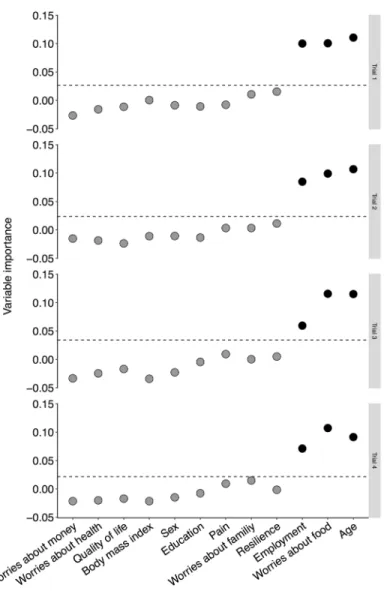
We used a random forest analysis to explore independent predictors of activity. As pain did not associate with any of the measures of activity, we collapsed the groups and completed the analysis on the full sample of actigraphy patients (n = 68). Lower age, being unemployed and more frequent worries about food consistently had variable importance rating greater than the threshold (Fig. 3). Neither pain nor any of the other remaining factors was associated with level of activity. We assessed for moderator effects of resilience on association between pain and activity but saw no evidence of interaction (r2= 0.11, p = 0.27).
DISCUSSION
Previously we have reported low pain-related functional interference in black South Africans living with HIV and who had moderate-to-severe pain (Mphahlele, Mitchell & Kamerman, 2012). What we then called “stoicism” also was evident in other populations
of PLWH in sub-Saharan Africa (Voss et al., 2007;Wahab & Salami, 2011). The phenomenon not only contradicted the usual association between chronic pain and functional impairment (Chantler, Mitchell & Fuller, 2009;Dansie et al., 2014;van den Berg-Emons et al., 2007) but was in stark contrast with data from PLWH in the US and Denmark (Breitbart et al., 1996;Frich & Borgbjerg, 2000;Merlin et al., 2013), and even India (Nair et al., 2009), in which there was significant impairment in the face of similar levels of pain. What was absent, though, was any formal assessment of stoicism, or what is better called “resilience,” in PLWH in pain, or investigation of whether such resilience could account for the dissociation between pain and function. Although physical activity has been measured by actigraphy in PLWH patients previously (Fillipas et al., 2010), no-one has measured objectively the impact of pain on physical activity in PLWH. So we measured resilience, pain and quality of life in black South Africans with chronic related pain. Second, we investigated the degree to which chronic HIV-related pain was associated with functional impairment, including impairment measured objectively by actigraphy in a subset of patients, and whether resilience modulated the relationship between pain and activity levels. During the process, we also validated isiZulu versions of the resilience scale and CD-RISC, and came to some conclusions about the psyche of the patients that might help explain their behaviour under adversity. Ours is the first study to assess resilience in a cohort with HIV-related pain, and also the first to report objective activity data in such a cohort. Higher resilience was associated positively with better quality of life, but we found no association between resilience and pain.
of sensitivity with the scales as scores all fell near the upper end of the scale, demonstrating possible ceiling effects. Nevertheless, black South African PLWH exhibited high
resilience, whether or not they were in pain.
High resilience was beneficial for patients. We found higher resilience to be associated with better quality of life, as has been found for another cohort of South African PLWH (Dageid & Grønlie, 2015). Resilience, however, did not explain the lack of association between pain and functional impairment in the patients here, and neither was it a moderator of the relationship. There was no association between resilience and pain intensity, or between resilience and subjective functional interference (measured using the BPI). However, we did find an association between pain intensity and subjective interference, as reported in other cohorts with HIV-related pain (Mphahlele, Mitchell & Kamerman, 2012;Hitchcock, Meyer & Gwyther, 2008). Though functional impairment was not as low as the impairment that we reported previously in patients with HIV-related pain from the same community (Mphahlele, Mitchell & Kamerman, 2012), it still was low for patients in moderate to severe pain, with mean interference scored 5/10 (Table 2).
Resilience previously has been defined as low functional interference in the face of high pain severity (Karoly & Ruehlman, 2006). Based on this definition, resilience has been associated with better adaptation to chronic pain including lower catastrophizing and better coping skills. We used a similar definition of resilience (‘the ability to cope with adversity’), which uses the construct of resilience as a trait, and we used scales that measured it as such. There is no agreed-upon definition of resilience, however, and the term can also refer to an outcome or process (Ahern et al., 2006). Our study was cross-sectional so we cannot comment on whether resilience leads to better pain coping (resilience being an adaptive trait) or whether pain led to better resilience (resilience being an outcome). Longitudinal studies are required to determine whether resilience should be interpreted as an outcome or trait in the context of chronic pain.
For the first time in patients with HIV-related pain, we assessed impairment with physical activity objectively by actigraphy in a subset of participants. Activity measured objectively in these participants did not correlate significantly with impairment
It was a limitation of our study that only 35% of the sample wore accelerometers, but not all patients were willing or able to wear an accelerometer for two weeks and then come back to the clinic to return the device. A logistically easier and less expensive way of collecting activity data would be to ask patients to wear a basic pedometer; however, we would only have been able to glean step counts rather than data on duration and intensity of activity, while still encountering the issue of patients’ willingness to wear and return the device. Future studies may consider collecting actigraphy data from participants
attending community clinics close to their homes (rather than a more distant tertiary hospital), so that return visits are more possible.
There were five individuals in the NoCP group who reported acute pain on the day of assessment. The presence of acute pain is typical in a general population (Ohayon & Stingl, 2012) and we feel this made the NoCP group representative of a general population. The mean resilience scores and median EQ5D VAS scores did not differ when these five participants were omitted (Resilience scale: unpaired t test, p = 0.96; EQ5D VAS: Wilcoxon rank sum, p = 0.84). Only one of these individuals was recruited to the actigraphy arm. Median activity and median time spent active (our measures of intensity and duration of activity) did not differ when this individual was omitted (Wilcoxon rank sum tests: Median activity, p = 0.84; Median time spent active, p = 1.0).
The lack of impact of pain on physical activity was confirmed by multivariate analysis: pain was not one of the factors predicting activity (Fig. 3). Even the patients without CP seldom engaged in activity exceeding 25% of their maximum (Fig. 2), and, on average, spent 18 h out of every 24 h inactive. In some cohorts CP of other aetiology, higher levels of activity are seen as helpful (Lin et al., 2011;Patel, Dansie & Turk, 2013), but in others endurance behaviour (persistence with activity despite pain (Hasenbring & Verbunt, 2010)) increases risk of disability and chronicity (Hasenbring & Verbunt, 2010; Huijnenl et al., 2011). Because we did not have a control cohort of HIV-negative patients from the same community, we cannot judge whether being HIV-positive reduced activity, irrespective of pain, though activity in the overall sample seemed similar to that of healthy cohorts and controls in other studies in South Africa (Prioreschi et al., 2013; Cook, Alberts & Lambert, 2012).
patients and their dependents, in poor South African households (Collins & Leibbrandt, 2007). As more of the patients in pain were unemployed we stratified the worries data by employment. Having taken employment out of the question, patients in pain still worried about each of the life stressors more than the pain-free patients. As our study was cross-sectional, we do not know whether having pain increased the worries, or the increased worries predisposed patients to developing pain although a recent study supports the latter (Chou, Parmar & Galinsky, 2016). Others have suggested that it is worries about money that compel African PLWH to continue with activities of daily living, in the face of pain (Uwimana & Struthers, 2007;Phaladze et al., 2005). Their worries tended to be private, though; nearly half of our patients in pain had not told their friends about the pain, for fear of their HIV status being revealed and the patient “gossiped about.” HIV stigma remains highly prevalent in South Africa (South African National AIDS Council, 2012). The inclusion of an appropriate stigma scale in future studies would help to determine the impact of HIV stigma on pain and activity in HIV populations. It is possible that the high levels of activity maintained by our patients in pain may have been used as a strategy to conceal HIV disease.
It cannot be assumed that the lack of functional interference is positive. Endurance behaviour (continuing with activity despite pain) has been associated with increased risk of chronicity and disability (Hasenbring & Verbunt, 2010) and future studies are needed to determine whether the high level of activity in PLWH with pain is adaptive or maladaptive. Like studies of other painful conditions and in an HIV cohort where pain was not measured, we also found discrepancies between subjective and objective measures of functional impairment (Fillipas et al., 2010;Huijnenl et al., 2011;Segura-Jime´nez et al., 2013;van Weering, Vollenbroek-Hutten & Hermens, 2011). Such discrepancies between subjective measures of functional interference lead us to believe that future investigations of functional interference in HIV-related pain (and pain of other aetiologies) should include objective measures of activity (Lo et al., 2015).
So, contrary to our hypothesis, it was not individual resilience that accounted for the dissociation between pain and ability to cope with daily living, in these South African PLWH. That does not mean, though, that we should abandon resilience as a trait relevant to the management of patients with HIV-related pain. In these patients, resilience was a significant determinant of quality of life. In them, as in other patients living with HIV , there were many psychological and social factors that influenced quality of life more than did pain intensity (Keltner et al., 2012). HIV-related pain is notoriously difficult to treat pharmacologically (Finnerup et al., 2015;Kamerman & Mitchell, 2011), and we may not be able to offer patients with HIV-related pain guaranteed pain relief for the foreseeable future. For those with low quality of life, though, we may be able to offer guaranteed improvement to quality of life, using strategies to improve
resilience.
ACKNOWLEDGEMENTS
for acting as interpreters, and for more commitments to the study. We also thank Guillaume Trusz for his assistance with preparing the manuscript and Kate Cherry for proof reading.
ADDITIONAL INFORMATION AND DECLARATIONS
Funding
Project funding was received from the Medical Faculty Research Endowment Fund of the University of the Witwatersrand and the Medical Research Council of South Africa. The Hillel Friedland Trust provided fellowship funding (AW). The funders had no role in study design, data collection and analysis, decision to publish, or preparation of the manuscript.
Grant Disclosures
The following grant information was disclosed by the authors:
University of the Witwatersrand and the Medical Research Council of South Africa. The Hillel Friedland Trust.
Competing Interests
DM is a director of Partners in Research who conduct healthcare market research. The other authors declare no conflicts of interest.
Author Contributions
Antonia L. Wadley conceived and designed the experiments, performed the experiments, analyzed the data, wrote the paper, prepared figures and/or tables, reviewed drafts of the paper.
Duncan Mitchell conceived and designed the experiments, analyzed the data, reviewed drafts of the paper.
Peter R. Kamerman conceived and designed the experiments, analyzed the data, contributed reagents/materials/analysis tools, prepared figures and/or tables, reviewed drafts of the paper.
Human Ethics
The following information was supplied relating to ethical approvals (i.e., approving body and any reference numbers):
Ethical approval was obtained from the Human Research Ethics Committee (Medical) of the University of the Witwatersrand (clearance no: M140538).
Data Deposition
The following information was supplied regarding data availability: Kamerman P, Wadley A, Mitchell D. Resilience 2016. HIVPain v0.1.1. doi:10.5281/zenodo.47321.
Supplemental Information
Supplemental information for this article can be found online athttp://dx.doi.org/ 10.7717/peerj.2464#supplemental-information.
REFERENCES
Ahern NR, Kiehl EM, Sole ML, Byers J. 2006.A review of instruments measuring resilience.Issues in Comprehensive Pediatric Nursing29(2):103–125DOI 10.1080/01460860600677643.
Bassett DR Jr, Rowlands A, Trost SG. 2012.Calibration and validation of wearable monitors.
Medicine and Science in Sports and Exercise44(1 Suppl 1):S32–S38
DOI 10.1249/MSS.0b013e3182399cf7.
Beavers AS, Lounsbury JW, Richards JK, Huck SW, Skolits GJ, Esquivel SL. 2013.Practical considerations for using exploratory factor analysis in educational research.Practical Assessment, Research and Evaluation18(6):1–13.
Brazier J, Roberts J, Tsuchiya A, Busschbach J. 2004.A comparison of the EQ-5D and SF-6D across seven patient groups.Health Economics13(9):873–884DOI 10.1002/hec.866.
Breitbart W, McDonald MV, Rosenfeld B, Passik SD, Hewitt D, Thaler H, Portenoy RK. 1996.
Pain in ambulatory AIDS patients. I: pain characteristics and medical correlates.Pain 68(2–3):315–321DOI 10.1016/S0304-3959(96)03215-0.
Brooks R, EuroQol Group. 1996.EuroQol: the current state of play.Health Policy37(1):53–72
DOI 10.1016/0168-8510(96)00822-6.
Chantler I, Mitchell D, Fuller A. 2009.Actigraphy quantifies reduced voluntary physical activity in women with primary dysmenorrhea.Journal of Pain10(1):38–46
DOI 10.1016/j.jpain.2008.07.002.
Chou EY, Parmar BL, Galinsky AD. 2016.Economic insecurity increases physical pain.
Psychological Science27(4):443–454DOI 10.1177/0956797615625640.
Cleeland CS, Ryan KM. 1994.Pain assessment: global use of the brief pain inventory.Annals of the Academy of Medicine23(2):129–138.
Collins DL, Leibbrandt M. 2007.The financial impact of HIV/AIDS on poor households in South Africa.AIDS21(Suppl 7):S75–S81DOI 10.1097/01.aids.0000300538.28096.1c.
Connor KM, Davidson JRT. 2003.Development of a new resilience scale: the Connor-Davidson resilience scale (CD-RISC).Depression and Anxiety18(2):76–82DOI 10.1002/da.10113.
Cook I, Alberts M, Lambert EV. 2012.Influence of cut-points on patterns of accelerometry-measured free-living physical activity in rural and urban black South African women.Journal of Physical Activity and Health9(2):300–310DOI 10.1123/jpah.9.2.300.
Core R Team. 2015.R: a language and environment for statistical computing. Vienna: R Foundation for Statistical Computing.Available athttp://www.R-project.org/.
Dageid W, Grønlie AA. 2015.The associations between resilience, social capital and self-rated health among HIV-positive South Africans.Journal of Health Psychology20(11):1463–1473
DOI 10.1177/1359105313513623.
Dansie EJ, Turk DC, Martin KR, Van Domelen DR, Patel KV. 2014.Association of chronic widespread pain with objectively measured physical activity in adults: findings from the National Health and Nutrition Examination survey.Journal of Pain15(5):507–515
DOI 10.1016/j.jpain.2014.01.489.
individuals compared with accelerometry.Journal of the Association of Nurses in AIDS Care 21(2):173–181DOI 10.1016/j.jana.2009.11.003.
Finnerup NB, Attal N, Haroutounian S, McNicol E, Baron R, Dworkin RH, Gilron I,
Haanpa¨a¨ M, Hansson P, Jensen TS, Kamerman PR, Lund K, Moore A, Raja SN, Rice ASC, Rowbotham M, Sena E, Siddall P, Smith BH, Wallace M. 2015.Pharmacotherapy for neuropathic pain in adults: a systematic review and meta-analysis.The Lancet Neurology 14(2):162–173DOI 10.1016/S1474-4422(14)70251-0.
Frich LM, Borgbjerg FM. 2000.Pain and pain treatment in AIDS patients: a longitudinal study. Journal of Pain and Symptom Management 19(5):339–347
DOI 10.1016/S0885-3924(00)00140-8.
Hasenbring MI, Plaas H, Fischbein B, Willburger R. 2006.The relationship between activity and pain in patients 6 months after lumbar disc surgery: do pain-related coping modes act as moderator variables?European Journal of Pain10(8):701–709DOI 10.1016/j.ejpain.2005.11.004.
Hasenbring MI, Verbunt JA. 2010.Fear-avoidance and endurance-related responses to pain: new models of behavior and their consequences for clinical practice.The Clinical Journal of Pain 26(9):747–753DOI 10.1097/AJP.0b013e3181e104f2.
Hitchcock SA, Meyer HP, Gwyther E. 2008.Neuropathic pain in AIDS patients prior to antiretroviral therapy.South African Medical Journal98(11):889–892.
Horn JL. 1965.A rationale and test for the number of factors in factor analysis.Psychometrika 30(2):179–185DOI 10.1007/BF02289447.
Hothorn T, Bu¨hlmann P, Dudoit S, Molinaro A, Van Der Laan MJ. 2006.Survival ensembles.
Biostatistics7(3):355–373DOI 10.1093/biostatistics/kxj011.
Hothorn T, Hornik K, Zeileis A. 2006.Unbiased recursive partitioning: a conditional inference framework.Journal of Computational and Graphical Statistics15(3):651–674
DOI 10.1198/106186006X133933.
Huijnen IPJ, Verbunt JA, Peters ML, Delespaul P, Kindermans HPJ, Roelofs J, Goossens M, Seelen HAM. 2010.Do depression and pain intensity interfere with physical activity in daily life in patients with Chronic Low Back Pain?Pain150(1):161–166DOI 10.1016/j.pain.2010.04.021.
Huijnenl IPJ, Verbuntl JA, Petersl ML, Smeetsl RJEM, Kindermansl HPJ, Roelofsl J, Goossensl M, Seelenl HAM. 2011.Differences in activity-related behaviour among patients with chronic low back pain.European Journal of Pain15(7):748–755
DOI 10.1016/j.ejpain.2010.11.015.
Jensen MP, Smith AE, Alschuler KN, Gillanders DT, Amtmann D, Molton IR. 2016.The role of pain acceptance on function in individuals with disabilities: a longitudinal study.Pain 157(1):247–254DOI 10.1097/j.pain.0000000000000361.
Jorgensen IE, Seedat S. 2008.Factor structure of the Connor-Davidson resilience scale in South African adolescents.International Journal of Adolescent Medicine and Health20(1):23–32
DOI 10.1515/IJAMH.2008.20.1.23.
Joshi N, Khanna R, Bentley JP, West-Strum D, Philips G, Strum MW, Barnard M. 2016.
Psychometric properties of the Euroqol-5-Dimensions questionnaire (EQ-5D-3L) among multiple sclerosis caregivers. In:ISPOR 21st Annual International Meeting. Washington, D.C.
Available athttp://www.ispor.org/ScientificPresentationsDatabase/Presentation/64036.
Kamerman P, Wadley A, Mitchell D. 2016.Resilience.HIVPain.Available athttps://github.com/ kamermanpr/Resilience.HIVPain.
Karoly P, Ruehlman LS. 2006.Psychological “resilience” and its correlates in chronic pain: findings from a national community sample.Pain123(1–2):90–97
DOI 10.1016/j.pain.2006.02.014.
Keltner JR, Vaida F, Ellis RJ, Moeller-Bertram T, Fitzsimmons C, Duarte NA, Robinson-Papp J, Dworkin RH, Clifford DB, McArthur JC, Simpson DM, Collier AC, Marra CM, Atkinson JH, Grant I, Charcter Group. 2012.Health-related quality of life ‘well-being’ in HIV distal neuropathic pain is more strongly associated with depression severity than with pain intensity.
Psychosomatics53(4):380–386DOI 10.1016/j.psym.2012.05.002.
Lin CWC, McAuley JH, Macedo L, Barnett DC, Smeets RJ, Verbunt JA. 2011.Relationship between physical activity and disability in low back pain: a systematic review and meta-analysis.
Pain152(3):607–613DOI 10.1016/j.pain.2010.11.034.
Lo GH, McAlindon TE, Hawker GA, Driban JB, Price LL, Song J, Eaton CB, Hochberg MC, Jackson RD, Kwoh CK, Nevitt MC, Dunlop DD. 2015.Symptom assessment in knee osteoarthritis needs to account for physical activity level.Arthritis & Rheumatology 67(11):2897–2904DOI 10.1002/art.39271.
McWilliams LA, Goodwin RD, Cox BJ. 2004.Depression and anxiety associated with three pain conditions: results from a nationally representative sample.Pain111(1–2):77–83
DOI 10.1016/j.pain.2004.06.002.
Merlin JS, Westfall AO, Chamot E, Overton ET, Willig JH, Ritchie C, Saag MS, Mugavero MJ. 2013.Pain is independently associated with impaired physical function in HIV-infected patients.Pain Medicine14(12):1985–1993DOI 10.1111/pme.12255.
Merskey H, Bogduk N. 2002.Classification of Chronic Pain: Descriptions of Chronic Pain Syndromes and Definitions of Pain Terms. Second edition. Seattle: IASP Press.
Mphahlele N, Mitchell D, Kamerman P. 2008.Validation of the Wisconsin brief pain questionnaire in a multilingual South African population.Journal of Pain and Symptom Management36(4):396–412DOI 10.1016/j.jpainsymman.2007.10.020.
Mphahlele NR, Mitchell D, Kamerman PR. 2012.Pain in ambulatory HIV-positive South Africans.European Journal of Pain16(3):447–458DOI 10.1002/j.1532-2149.2011.00031.x.
Nair SN, Mary TR, Prarthana S, Harrison P. 2009.Prevalence of pain in patients with HIV/AIDS: a cross-sectional survey in a South Indian state.Indian Journal of Palliative Care 15(1):67–70DOI 10.4103/0973-1075.53550.
Ohayon MM, Stingl JC. 2012.Prevalence and comorbidity of chronic pain in the German general population.Journal of Psychiatric Research46(4):444–450
DOI 10.1016/j.jpsychires.2012.01.001.
Parker R, Jelsma J, Stein DJ. 2016.Pain in amaXhosa women living with HIV/AIDS: translation and validation of the brief pain inventory-Xhosa.Journal of Pain and Symptom Management 51(1):126–132.e2DOI 10.1016/j.jpainsymman.2015.08.004.
Parker R, Stein DJ, Jelsma J. 2014.Pain in people living with HIV/AIDS: a systematic review.
Journal of the International AIDS Society17:18719DOI 10.7448/IAS.17.1.18719.
Patel KV, Dansie EJ, Turk DC. 2013.Impact of chronic musculoskeletal pain on objectively measured daily physical activity: a review of current findings.Pain Management3(6):467–474
DOI 10.2217/pmt.13.46.
Peng L, Zhang J, Li M, Li P, Zhang Y, Zuo X, Miao Y, Xu Y. 2012.Negative life events and mental health of Chinese medical students: the effect of resilience, personality and social support.
Psychiatry Research196(1):138–141DOI 10.1016/j.psychres.2011.12.006.
HIV/AIDS in sub-Saharan Africa.Journal of Nursing Scholarship37(2):120–126
DOI 10.1111/j.1547-5069.2005.00023.x.
Prioreschi A, Hodkinson B, Avidon I, Tikly M, McVeigh JA. 2013.The clinical utility of accelerometry in patients with rheumatoid arthritis.Rheumatology52(9):1721–1727
DOI 10.1093/rheumatology/ket216.
Raijmakers BG, Nieuwenhuizen MG, Beckerman H, de Groot S. 2015.Differences in the course of daily activity level between persons with and without chronic pain.
American Journal of Physical Medicine & Rehabilitation94(2):101–113
DOI 10.1097/PHM.0000000000000206.
Ramı´rez-Maestre C, Esteve R. 2014.The role of sex/gender in the experience of pain: resilience, fear, and acceptance as central variables in the adjustment of men and women with chronic pain.Journal of Pain15(6):608–618.e1DOI 10.1016/j.jpain.2014.02.006.
Ramı´rez-Maestre C, Esteve R, Lo´pez AE. 2012.The path to capacity: resilience and spinal chronic pain.Spine37(4):E251–E258DOI 10.1097/BRS.0b013e31822e93ab.
Revelle W. 2015.psych: procedures for personality and psychological research. Evanston, IL: Northwestern University.Available athttp://cran.r-project.org/web/packages/psych/.
Riley JF, Ahern DK, Follick MJ. 1988.Chronic pain and functional impairment: assessing beliefs about their relationship.Archives of Physical Medicine and Rehabilitation69(8):579–582.
Robberstad B, Olsen JA. 2010.The health related quality of life of people living with HIV/AIDS in sub-Saharan Africa–a literature review and focus group study.Cost Effectiveness and Resource Allocation8(1):5DOI 10.1186/1478-7547-8-5.
Ruiz-Pa´rraga GT, Lo´pez-Martı´nez AE, Esteve R, Ramı´rez-Maestre C, Wagnild G. 2015.A confirmatory factor analysis of the Resilience Scale adapted to chronic pain (RS-18): new empirical evidence of the protective role of resilience on pain adjustment.Quality of Life Research24(5):1245–1253DOI 10.1007/s11136-014-0852-z.
Ruiz-Pa´rraga GT, Lo´pez-Martı´nez AE, Go´mez-Pe´rez L. 2012.Factor structure and psychometric properties of the resilience scale in a spanish chronic musculoskeletal pain sample.Journal of Pain13(11):1090–1098DOI 10.1016/j.jpain.2012.08.005.
South African National AIDS Council (SANAC). 2012.The people living with HIV stigma index.
Available athttp://www.stigmaindex.org/sites/default/files/reports/South%20Africa%20People% 20Living%20with%20HIV%20Stigma%20Index%20%20Report%202012.pdf(accessed 31 August 2015).
Segura-Jime´nez V, Munguı´a-Izquierdo D, Camiletti-Moiro´n D, A´lvarez-Gallardo IC,
Ortega FB, Ruiz JR, Delgado-Ferna´ndez M. 2013.Comparison of the International Physical Activity Questionnaire (IPAQ) with a multi-sensor armband accelerometer in women with fibromyalgia: the al-Andalus project.Clinical and Experimental Rheumatology31(6 Suppl 79):
S94–S101.
Shah HA, Dritsaki M, Pink J, Petrou S. 2016.Psychometric properties of Patient Reported Outcome Measures (PROMs) in patients diagnosed with Acute Respiratory Distress Syndrome (ARDS).Health and Quality of Life Outcomes14(1):15DOI 10.1186/s12955-016-0417-7.
Song C-Y, Lin S-F, Huang C-Y, Wu H-C, Chen C-H, Hsieh C-L. 2016.Validation of the brief pain inventory in patients with low back pain.Spine41(15):E937–E942
DOI 10.1097/BRS.0000000000001478.
Spies G, Seedat S. 2014.Depression and resilience in women with HIV and early life stress: does trauma play a mediating role? A cross-sectional study.BMJ Open4(2):e4200
Stavem K, Frøland SS, Hellum KB. 2005.Comparison of preference-based utilities of the 15D, EQ-5D and SF-6D in patients with HIV/AIDS.Quality of Life Research14(4):971–980
DOI 10.1007/s11136-004-3211-7.
Strobl C, Boulesteix A-L, Kneib T, Augustin T, Zeileis A. 2008.Conditional variable importance for random forests.BMC Bioinformatics9(1):307DOI 10.1186/1471-2105-9-307.
Strobl C, Boulesteix A-L, Zeileis A, Hothorn T. 2007.Bias in random forest variable importance measures: illustrations, sources and a solution.BMC Bioinformatics8(1):25
DOI 10.1186/1471-2105-8-25.
Sturgeon JA, Zautra AJ. 2013.Psychological resilience, pain catastrophizing, and positive emotions: perspectives on comprehensive modeling of individual pain adaptation.Current Pain and Headache Reports17(3):317DOI 10.1007/s11916-012-0317-4.
The EuroQol Group. 1990.EuroQol–a new facility for the measurement of health-related quality of life.Health Policy16(3):199–208DOI 10.1016/0168-8510(90)90421-9.
Uwimana J, Struthers P. 2007.Met and unmet palliative care needs of people living with HIV/ AIDS in Rwanda.SAHARA-J: Journal of Social Aspects of HIV/AIDS4(1):575–585
DOI 10.1080/17290376.2007.9724819.
van Agt HME, Essink-Bot M-L, Krabbe PFM, Bonsel GJ. 1994.Test-retest reliability of health state valuations collected with the EuroQol questionnaire.Social Science & Medicine 39(11):1537–1544DOI 10.1016/0277-9536(94)90005-1.
van den Berg-Emons RJ, Schasfoort FC, de Vos LA, Bussmann JB, Stam HJ. 2007.Impact of chronic pain on everyday physical activity.European Journal of Pain11(5):587–593
DOI 10.1016/j.ejpain.2006.09.003.
van Weering MGH, Vollenbroek-Hutten MMR, Hermens HJ. 2011.The relationship between objectively and subjectively measured activity levels in people with chronic low back pain.
Clinical Rehabilitation25(3):256–263DOI 10.1177/0269215510380828.
Voss JG, Sukati NA, Seboni NM, Makoae LN, Moleko M, Human S, Molosiwa K, Holzemer WL. 2007.Symptom burden of fatigue in men and women living with
HIV/AIDS in Southern Africa.Journal of the Association of Nurses in AIDS Care18(4):22–31
DOI 10.1016/j.jana.2007.05.001.
Wagnild GM, Young HM. 1993.Development and psychometric evaluation of the Resilience Scale.Journal of Nursing Measurement1(2):165–178.
Wahab KW, Salami AK. 2011.Pain as a symptom in patients living with HIV/AIDS seen at the outpatient clinic of a Nigerian tertiary hospital.Journal of the International Association of Physicians in AIDS Care10(1):35–39DOI 10.1177/1545109710368863.
Wertli MM, Eugster R, Held U, Steurer J, Kofmehl R, Weiser S. 2014.Catastrophizing—a prognostic factor for outcome in patients with low back pain: a systematic review.The Spine Journal14(11):2639–2657DOI 10.1016/j.spinee.2014.03.003.
West C, Buettner P, Stewart L, Foster K, Usher K. 2012.Resilience in families with a member with chronic pain: a mixed methods study.Journal of Clinical Nursing21(23–24):3532–3545
DOI 10.1111/j.1365-2702.2012.04271.x.
Westman AE, Boersma K, Leppert J, Linton SJ. 2011.Fear-avoidance beliefs, catastrophizing, and distress: a longitudinal subgroup analysis on patients with musculoskeletal pain.The Clinical Journal of Pain27(7):567–577DOI 10.1097/AJP.0b013e318219ab6c.
Windle G, Bennett KM, Noyes J. 2011.A methodological review of resilience measurement scales.