Spatio-Temporal Simulation of First Pass Drug Perfusion
in the Liver
Lars Ole Schwen1*, Markus Krauss2,3, Christoph Niederalt2, Felix Gremse4, Fabian Kiessling4, Andrea Schenk1, Tobias Preusser1,5, Lars Kuepfer2,6
1Fraunhofer MEVIS, Bremen, Germany,2Computational Systems Biology, Bayer Technology Services, Leverkusen, Germany,3Aachen Institute for Advanced Study in Computational Engineering Sciences, RWTH Aachen University, Aachen, Germany,4Experimental Molecular Imaging, RWTH Aachen University, Aachen, Germany, 5School of Engineering and Science, Jacobs University, Bremen, Germany,6Institute of Applied Microbiology, RWTH Aachen University, Aachen, Germany
Abstract
The liver is the central organ for detoxification of xenobiotics in the body. In pharmacokinetic modeling, hepatic metabolization capacity is typically quantified as hepatic clearance computed as degradation in well-stirred compartments. This is an accurate mechanistic description once a quasi-equilibrium between blood and surrounding tissue is established. However, this model structure cannot be used to simulate spatio-temporal distribution during the first instants after drug injection. In this paper, we introduce a new spatially resolved model to simulate first pass perfusion of compounds within the naive liver. The model is based on vascular structures obtained from computed tomography as well as physiologically based mass transfer descriptions obtained from pharmacokinetic modeling. The physiological architecture of hepatic tissue in our model is governed by both vascular geometry and the composition of the connecting hepatic tissue. In particular, we here consider locally distributed mass flow in liver tissue instead of considering well-stirred compartments. Experimentally, the model structure corresponds to an isolated perfused liver and provides an ideal platform to address first pass effects and questions of hepatic heterogeneity. The model was evaluated for three exemplary compounds covering key aspects of perfusion, distribution and metabolization within the liver. As pathophysiological states we considered the influence of steatosis and carbon tetrachloride-induced liver necrosis on total hepatic distribution and metabolic capacity. Notably, we found that our computational predictions are in qualitative agreement with previously published experimental data. The simulation results provide an unprecedented level of detail in compound concentration profiles during first pass perfusion, both spatio-temporally in liver tissue itself and temporally in the outflowing blood. We expect our model to be the foundation of further spatially resolved models of the liver in the future.
Citation:Schwen LO, Krauss M, Niederalt C, Gremse F, Kiessling F, et al. (2014) Spatio-Temporal Simulation of First Pass Drug Perfusion in the Liver. PLoS Comput Biol 10(3): e1003499. doi:10.1371/journal.pcbi.1003499
Editor:Avner Schlessinger, Icahn School of Medicine at Mount Sinai, United States of America ReceivedSeptember 13, 2013;AcceptedJanuary 21, 2014;PublishedMarch 13, 2014
Copyright:ß2014 Schwen et al. This is an open-access article distributed under the terms of the Creative Commons Attribution License, which permits unrestricted use, distribution, and reproduction in any medium, provided the original author and source are credited.
Funding:This work was funded by the German Ministry of Education and Research (BMBF) via the systems biology network Virtual Liver (http://www.virtual-liver. de/), grant numbers 0315743, 0315747, and 0315769. The funders had no role in study design, data collection and analysis, decision to publish, or preparation of the manuscript.
Competing Interests:I have read the journal’s policy and have the following conflicts: MK, CN, and LK are employed by Bayer Technology Services GmbH, the company developing PK-Sim and MoBi.
* E-mail: [email protected]
Introduction
The liver is the main site of metabolization and detoxification of xenobiotics in the body of mammals. Compounds delivered by blood flow through the portal vein and the hepatic artery are continuously processed within hepatic cells, such that foreign and potentially harmful compounds can be cleared from the blood. Metabolization by enzyme-catalyzed biotransformation produces chemical alterations of the original compounds, thereby enabling their elimination. A second, complementary process is the active secretion to the bile duct from which the compound is further transported to the gastrointestinal tract. In pharmacology and medicine, plasma clearance is used to quantify the rate by which a compound is eliminated from the body [1]. Plasma clearance describes the overall detoxification capacity of the organism and summarizes individual clearance rates from all eliminating organs with the largest contribution coming from the kidney and the liver. While renal clearance can be measured by urinary secretion, a quantification of liver detoxification capacity is difficult since the
different physiological functions cannot be assessed directly. In particular, the relative contributions of the different underlying physiological functions such as metabolization or biliary secretion cannot be adequately differentiated since the liver is frequently rather considered as a net systemic sink. While hepatic turnover can be indirectly quantified with drugs following a known pharmacokinetic profile, the local, time-resolved distribution of compounds within the whole organ can generally not be analyzed even with distinguished measurement techniques. This holds in particular for the first pass of drug perfusion in a liver directly after drug administration, when hepatic tissue is exposed to a novel xenobiotic for the first time.
transition times [10]. For a more detailed overview, we refer to [11].
Generally, PK models are well suited to investigate distribution and clearance of compounds in the body. In compartmental PK modeling, a limited number of rather generic compartments is usually used to simulate plasma concentration and drug clearance. Following a complementary approach, physiologically based pharmacokinetic (PBPK) models describe biological processes at a large level of detail based on prior physiological knowledge [12]. This involves amongst others organ volumes and blood flow rates, such that physiological mechanisms underlying absorption, distribution, metabolization and excretion of compounds can be explicitly described. While most approaches consider intravenous or oral application of therapeutic compounds, PK models describing further uptake routes such as inhalation have also been developed [13,14]. Organs in PBPK models are divided in several subcompartments. So-called distribution models are used to describe the mass transfer between these subcompartments which are quantified based on physicochemical compound information such as lipophilicity or the molecular weight. Basic PBPK models can be extended to include enzyme-mediated metabolization or active transport across membranes [15].
Coming from the field of toxicology [16], PBPK models are nowadays routinely used in drug discovery and development [17]. They are for example applied in pediatric scaling [18], model-based risk assessment [19], as well as for multiscale modeling by integrating detailed models of intracellular signaling [20] or metabolic networks [21] into the cellular subcompartment, thus allowing for the analysis of cellular behavior within a whole-body context [22]. Notably, each organ in PBPK modeling is generally represented by few well-stirred subcompartments, thus allowing a quantitative description of drug pharmacokinetics once an equilibrium between the vascular system and the surrounding tissue has been reached. However, a spatially resolved description of drug perfusion in the whole organ covering particularly the first
instants after drug administration is impossible due to the inherent well-stirred assumption.
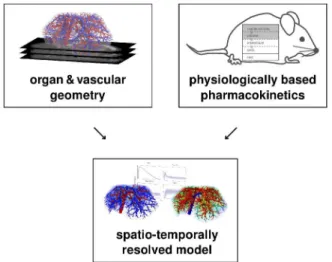
To mechanistically describe first pass perfusion, we here present a spatio-temporal model of drug distribution and metabolization in a mouse liver. The model represents liver lobes at the spatial length scale of lobuli such that physiological and molecular processes can be simulated in great detail. Our combined spatially resolved model (cf. overview in Figure 1) involves three main building blocks. These comprise physiological vascular structures, an organ-scale perfusion model describing blood flow and advection of compounds, and finally pharmacokinetic models translated to the spatially resolved tissue. Geometrically accurate models of murine hepatic vascular structures were obtained by using in vivo micro-CT imaging [23]. The mass balance within the tissue was quantified based on equations coming from PBPK modeling. Our combined model was inspired by [24], where a lobule-scale perfusion model in more physical detail and also allowing for deformation of the porous medium is introduced. A model for cardiac perfusion using very similar modeling techniques is presented in [25]. It considers multiple geometric scales, but no draining vascular system and no metabolization.
Our spatially resolved model covers several scales of biological organization displayed at varying levels of resolution. The scales range from the organ level to the cellular space where metabolization and molecular transport take place. The vascular systems form the scaffolds which links the hepatic in-flow to the sinusoidal space and thereby to the lobulus level. The model considers one supplying and one draining vascular system (denoted by SVS and DVS, respectively), with a homogenized hepatic space (denoted by HHS) in between as a tissue representation. The HHS includes in particular the sinusoids which are not explicitly resolved as vascular structures. In the latter, blood flow is represented by a fluid transport model [26]. Microcirculation and microanatomy [27] are only considered in effective form. While more detailed perfusion and metabolization models on the lobular scale [28,29] or the tissue-level [2] have been developed before, the representation of the HHS as a porous medium [30] is sufficient for our needs.
Figure 1. Conceptual model overview. Our spatially resolved model is based on mass balance equations from physiologically based pharmacokinetic modeling as well as organ and vascular geometry obtained by in vivo imaging. The combined model allows a detailed simulation of hepatic distribution and metabolization to accurately describe spatio-temporal effects underlying first-pass perfusion in the liver.
doi:10.1371/journal.pcbi.1003499.g001 Author Summary
Experimentally, the combined model corresponds to an isolated perfused liver [31,32], since recirculation of blood is not considered. The resolution of the model allows calculating local concentration profiles within the tissue which can for example be used to address heterogeneous phenomena such as spatially varying distributions of lipid droplets in steatotic livers. Spatial heterogeneity of pharmacokinetic parameters such as metabolic capacity can be taken into account. Likewise local exposure profiles of toxic compounds can be simulated such that off-target effects of drug therapy can be analyzed at a high level of resolution. Applications of spatially resolved perfusion and metabolization modeling include optimized design of therapeutic treatment where spatio-temporal perfusion effects are of relevance, e.g. hypothermic machine perfusion [33] or islet cell transplan-tations [34]. Moreover, such models can be used for planning drug delivery for which spatially heterogeneous distribution is an important property and crucial for administration design itself. Two major examples are intrahepatic injection of chemothera-peutics or radionuclides (see e.g. [35]), in particular in combina-tion with optimizacombina-tion of catheter placement [36], and targeted drug delivery [37] where drugs are injected in bound form and released at the desired location by mild hyperthermia. Likewise, our model may support data processing and interpretation in imaging or diagnostics. We expect the spatially resolved model presented here to be the foundation stone of further mechanistic models describing the spatial organization of the liver in an unprecedented level of physiological detail.
Materials and Methods
Ethics Statement
The animal experiment was reviewed and approved by the local authorities (NRW LANUV, permit number 10576G1) according to German animal protection laws.
Constructing a Combined Model
In the methods to be presented, we follow a geometric view from coarse to fine, i.e. from (1) the body scale (providing organ input and output) via (2) the vascular structures on the organ scale (perfusion only) to (3) the tissue scale (perfusion and metaboliza-tion). Models for steatosis and CCl4-induced liver necrosis are
subsequently presented to demonstrate how our spatially resolved simulations can be used for the analysis of pathological states influencing drug distribution in the liver. Finally, some aspects of computational resolution are addressed.
Overall Model Structure
Our spatially resolved model distinguishes between the supply-ing vascular tree, the HHS and a drainsupply-ing vascular tree which are considered in series (Figure 2). For reasons of simplicity, the supplying vascular system comprises both the portal vein and the hepatic artery. Since an isolated perfused liver was considered here which explicitly excludes recirculation through the body, the respective contributions of the portal vein and the hepatic artery were not distinguished and only the total blood inflow was taken into account. The draining vascular system represents the hepatic vein. Bile ducts were not considered in our model, since their geometric structure could not be resolved experimentally.
In our combined model, the HHS is composed of several subspaces in analogy to the liver compartment in PBPK models. The latter is divided in four subcompartments, i.e. red blood cells (rbc), plasma (pls), interstitium (int), and liver cells (cell). Those four subcompartments are also considered as subspaces of the HHS, in addition a fifth remaining subspace (rest) is taken into account.
This remaining subspace comprises all those parts inside the liver that are not considered for perfusion, metabolization and active transport, in particular the larger and explicitly resolved vascular structures and the bile ducts. The plasma subspace only refers to the blood plasma. For notational convenience, the sinusoidal subspace (sin) is defined as the combination of red blood cells and plasma subspace, thus representing a whole-blood compartment. The sinusoidal subspace is subject to advection, thereby reflecting blood flow through the tissue. The actual metabolization takes place only in the cellular subspace and is part of the PBPK equations that also model the exchange between the HHS subspaces. The vascular trees are resolved separately and considered for pure advection.
The volume fractions of the subspaces relative to the overall liver volume, also needed for the mass balance in the compartment models, are denoted by Qi,i[frbc,pls,sin,int,cell,restg. For our
simulations in a mouse liver, we use the values
Qrbc~0:0468, Qpls~0:0572, Qint~0:1470, Qcell~0:6500, Qrest~0:0990:
ð1Þ
Volume fractions were obtained by setting Qrest to cover the fraction of the vascular volume inside the segmented liver volume, both determined from the experimental image data as described below. The values for the other subspaces from [38] were then scaled accordingly by(1{Qrest) so that all five volume fractions sum up to 1. From Equation 1, we immediately obtain Qsin~QrbczQpls~0:1040.
For the perfusion part in our model, we address how molar concentrationscof compounds change due to advection through the vascular systems and the sinusoidal HHS subspace. The exchange with the remaining HHS subspaces and cellular metabolization are considered as a separate contribution to our combined model.
The body scale determines the total perfusionQtot~35ml=sof the liver in mice [38]. The blood flow into and out of the root edges of the supplying and draining vascular system, respectively, is the connection of the HHS to the surrounding organism. More precisely, inflowing and outflowing molar concentrations of the compounds of interest are the main model input and output quantities.
Organ Scale—Modeling the Vascular Systems
Obtaining physiological vascular geometries. The geom-etry of vascular systems and the organ shape used in our model was obtained from in vivo 3D images as illustrated in Figure 3.
To assess the vascular systems in vivo, a contrast enhanced micro-CT scan was acquired [23] for a nude mouse. The two tubes of the micro-CT (CT-Imaging, Erlangen, Germany) were operated at40 kV/1:0 mAand 65 kV/0:5 mA. For each micro-CT sub-scan, 2880 projections containing 1032|1012 pixels, were acquired over 4 full gantry rotations with a duration of 6minutes per sub-scan. To cover the whole body, three sub-scans were acquired, each covering3 cmin the axial direction. Before scanning, the mouse received an intravenous injection (5 mlper kg body weight) of an iodine-based radiopaque blood pool contrast agent [39]. During imaging, the mouse was anesthetized using a 2% mixture of isoflurane/air. After scanning, a Feldkamp-type reconstruction was performed at isotropic voxel size 35|35
From the CT image data, a liver segmentation (including decomposition in liver lobes) and a graph representation of the vascular structures (portal vein and hepatic vein) was determined using segmentation and skeletonization by a semi-automatic and clinically evaluated [40] procedure described in [41]. The graph was transformed into a strictly bifurcative tree with cylindrical edges (vascular pieces between two points, bifurcation to next bifurcation, or end point to next bifurcation, see Figure 2) of constant radius following the methods in [42]. The resulting liver has a volume of 1:077 ml. The obtained vascular graphs containing 443 and 299 leaf nodes (end points) for the portal and hepatic vein, respectively, are insufficiently detailed for robust simulations, so they need to be refined algorithmically.
For this purpose, an implementation [42] of a constrained constructive optimization method [43] for non-convex organ shapes was used. In summary, the algorithm determines a set of leaf nodes, each representing one lobule or a group of lobuli. It then starts with an initial tree, here obtained from an in vivo CT scan, and connects the additional leaf nodes by one. Each time, the algorithm introduces a new bifurcation which is optimal in the sense of minimal intravascular volume while providing constant blood supply for each leaf node. In finely resolved hepatic vascular
trees of mice, there are many edges with radius less than150mm, so it is particularly important to take the decrease of effective blood viscosity due to the Fhrus-Lindqvist effect [44] into account for the constructive algorithm. The methods of [42] were extended by more strictly avoiding vascular connections outside the organ. Note that this algorithm yields physiologically realistic vascular structures but is not meant to model the vascular development during organogenesis as studied e.g.in [45]. The algorithmic procedure is illustrated in Video S1.
Perfusion simulation in the vascular structures. We assume the same outflow from each leaf edge of the supplying vascular system and the same inflow to each leaf edge of the draining vascular system matching the assumptions in the constrained constructive optimization framework [42] used for vascular refinement. In particular, homogeneous perfusion is an assumption currently put into the model and no result.
In the vascular systems, we have essentially one-dimensional (1D) advection with velocities determined by flow splitting satisfying mass conservation and the underlying geometry, namely cross-section areas of edges. There is no diffusion term in the model, we can, however, not avoid artificial numerical diffusion [46] introduced by the discretization as discussed in Section 1 in the Text S1. Figure 2. Conceptual two-dimensional sketch of our liver perfusion model.The homogenized hepatic space HHS is supplied and drained by the supplying vascular systems SVS and the draining vascular system DVS, respectively. The blood flow through the SVS summarizes the contributions of both supplying systems (hepatic artery and portal vein). The blood is hereafter transferred to the HHS along the terminal edges of the supplying vascular tree (dashed lines). After blood has passed through the HHS, flow into the draining vascular tree (hepatic vein) occurs again along its terminal edges (dashed lines). The HHS itself locally consists of several subspaces, the sinusoidal subspace (combining red blood cells and the plasma subspace), the interstitial subspace, the cellular subspace, and the remaining subspace. An actual 3D vascular geometry is shown in Figure 3. The SVS and DVS roots are connected to the rest of the body by the total blood flow in the liver. In the vascular structures, only 1D advection with given velocities per edge take place. In the HHS, 3D advection (according to a 3D flow velocity vector field) as well as exchange between the HHS subspaces and metabolization (according to PBPK model parameters) are considered simultaneously.
doi:10.1371/journal.pcbi.1003499.g002
Figure 3. From in vivo scans to vascular geometry.Based on an in vivo micro-CT scan (a) of a mouse, vascular structures (b) in the liver are segmented and skeletonized. The supplying and draining vascular systems (SVS and DVS) are shown in red and blue, respectively. Furthermore, the liver is segmented and decomposed in lobes shown in different colors in (c). An algorithmic procedure is used to determine physiological vascular structures (d) with the desired level of detail, in our case800leaf nodes (end points) for each of the two trees are used.
Advection of a molar concentration profilecvasc(x,t)of a single compound through the vascular systems can be described by 1D advection as we assume a constant mean velocity ve for each
vascular edge e. As there are no sources inside the vascular structures, this is described by the partial differential equation (PDE)
Ltcvasc(x,t)zveLxcvasc(x,t)~0 ð2Þ
with appropriate initial conditions, boundary conditions at inflows, or coupling to connected edges. In the combined model, two advection problems of this form per compound are considered, one for the plasma and one for the red blood cells (see Figure 2). These are independent of one another and the same flow velocity is assumed for both.
At branching points in the supplying vascular system, mass conservation implies a splitting of the blood volume, but the molar concentrations do not change. In contrast, at branching points in the draining vascular system we assume instant mixing of the molar concentrations. These are obtained as the average of the inflowing molar concentrations weighted with the respective volume flow fractions. Mass conservation in the 1D model is ensured by the flow velocities. For discretizing the advection problem in Equation 2 for vascular trees, we use a 1D Eulerian-Lagrangian Locally Adjoint Method (ELLAM) [47] scheme adapted to the case of branchings. ELLAM allow for flexibly integrating other phenomena than advection in the discretization and avoids numerical artifacts occurring in other discretization schemes for advection problems [48]. Details about the discretiza-tion are explained in Secdiscretiza-tion 1 in Text S1, the implementadiscretiza-tion is an extension of own earlier work [49]. Alternative techniques for discretizing and simulating flow have been developed before, see e.g. [50].
The inflow in the root of the supplying vascular system from the body scale is given by a time-dependent molar concentration
cSVS
in (t). Outflow from terminal edges of the supplying vascular
system is treated by applying an appropriate molar concentration sink term. Mass conservation is ensured by vascular sink terms being HHS source terms as discussed below.
In the draining vascular system, the flow of information is different. Terminal edges drain whatever molar concentration is present in their vicinity, and the molar concentration obtained at the root is given back to the body scale as a time-dependent molar concentration. For this purpose, the inflow at each leaf node is computed as the average molar concentration near the corre-sponding draining terminal edge. Again, mass conservation is ensured by a corresponding sink for the HHS, see below. The outflow from the root edge of the draining vascular system does not require special treatment in the advection simulation, it merely needs to be evaluated for each time step.
Tissue Scale—Modeling the Homogenized Hepatic Space The HHS is modeled as a porous medium representing the effective behavior of the whole liver volume, with the sinusoidal subspace being perfused according to Darcy’s law [51]. The perfusion is split between the red blood cells and plasma subspaces (see Figure 2) proportional to their respective volumes.
Using appropriate flow source and sink terms in the HHS corresponding to the exchange with the vascular systems, flow velocities for 3D advection in the HHS are obtained. The advection of concentrations can then be calculated from the given flow velocities using appropriate discretizations described in this section. Technical details about the discretization and implementation in the model are presented in Section 2 in Text
S1. Finally, the pointwise exchange in the spatially resolved model between different HHS subspaces and the actual metabolization are modeled by equations coming from PBPK modeling.
Obtaining flow velocities. While the flow velocities in the vascular systems are easily obtained from the flow splitting described above and the respective cross-section areas, this is more complicated in the HHS. Flow in the HHS is determined by radial outflow and inflow for the terminal edges (see Figure 2) of the SVS and DVS, respectively. This outflow and inflow is assumed to be constant along each edge and assumed to happen along the one-dimensional line segments being the center lines of the terminal edges where we define source and sink termsgused in Equation 4.
The Darcy velocity vector field for the blood flow in the sinusoidal subspace of the HHS is obtained as
vsin(x)~a(x)
Qsin
+p(x) ð3Þ
where Qsin is the appropriate porosity of the HHS (sinusoidal volume fraction), a(x) is the effective permeability defined as permeability divided by dynamic viscosity, and p(x) is obtained from
{div(a(x)+p(x)) ~g xin HHSsin
L
np(x) ~0 xonLHHS
sin ð4Þ
wheregare the one-dimensional flow sources and sinks due to the terminal edges as discussed above. Rather than using the two quantities permeability and dynamic viscosity separately (as in [51] and commonly done in the literature), we here only need their ratioa.
For constant effective permeability (a(x)~const), its absolute value in this setting does not matter for the velocities obtained, sincepscales linearly inafor given flow sourcesf, and the velocity
vscales linearly in1
afor given pressurep. We hence assume the effective permeability to bea(x)~1. This means that the quantity
pcannot be interpreted as the actual physical pressure present in the HHS, but merely as a relative pressure. However,pis just an internal quantity of the computation described above and only the resulting velocityvwill be used later on.
Equation 4 was discretized using standard trilinear finite elements for computing the pressurep, using the appropriate line integrals for computing the right hand side source terms. The hexahedral finite element grid for this purpose was chosen to be the voxel midpoints of the binary image segmentation of the liver as obtained from the image processing. A piecewise constant velocity profilevwas obtained from the pressurepusing difference quotients corresponding to the given grid when discretizing the gradient in Equation 3. Due to the discretization and the lower-dimensional sources, the resulting velocity field will not have exactly vanishing divergence. This needs to be taken into account when simulating advection in the next step.
Perfusion simulation in the Homogenized Hepatic Space. Using the velocity profile vsin(x) of blood in the
sinusoidal subspace from Equation 3, we can now simulate the advection of molar concentrations crbc(x,t) and cpls(x,t) of
compounds. For simplicity, we will restrict the presentation to a single compound. As vsin(x) is constant in time, advection is
described by the PDEs
where the gvasc,i(x,t) are lower-dimensional sources and sinks
describing the inflow and outflow of compounds through the terminal edges of supplying and draining vascular system, respectively. Again, the velocity is the blood flow velocity and thus the same for any compound. In our simulations, constant initial conditions for Equation 5 were used. An explicit treatment of boundary conditions is not necessary since the velocity vanishes in normal direction to the liver boundary.
The molar concentration transfer from the supplying vascular system to the HHS is modeled as follows. In each terminal edge of the supplying vascular system, compounds are transported along the whole length to the end point and out of the edge. As we assume the cross-section area to decrease linearly to zero, this corresponds to a constant outflow of mass along the terminal edge. This mass outflow is used as a one-dimensional source term in the HHS, satisfying mass conservation. This models a flow to connected smaller vessels or sinusoids from the last resolved vascular edges.
Terminal edges of the draining vascular system are assigned an inflow value, in the same manner as for the root edge of the supplying vascular system. This inflow value is determined as an average molar concentration in a neighborhood of the terminal edge. Mass conservation is ensured by considering a corre-sponding one-dimensional source term with negative sign in the HHS. Note that this is only an approximation of an inflow from sinusoids or smaller vessels into the first resolved vascular edges.
In the supplying vascular system, we assume inflow concentra-tions to be such that an equilibrium between red blood cells and plasma concentrations has been obtained before the injected compound reaches our liver model.
The discretization of Equation 5 using a 3D ELLAM scheme is described in Section 2 in Text S1.
Metabolization simulation using Physiologically Based Pharmacokinetic Models. The exchange between the differ-ent HHS subspaces and the metabolization in the cellular HHS subspace are described by PBPK model equations. In the simulations performed, we ignore enzymatic formation of meta-bolic by-products, i.e. we consider the metabolization as a sink, and thus need one inflowing and one outflowing molar concen-tration only.
As mentioned above, PBPK models divide the liver in four subcompartments, i.e. red blood cells, plasma, interstitium, and cells. The PBPK models were written in terms of molar concentrations, so that a pointwise exchange E between the different subspaces and the contribution of metabolizationmcan be written in the form
Lt crbc cpls cint ccell 2 6 6 6 6 6 4 3 7 7 7 7 7 5 ~E crbc cpls cint ccell 2 6 6 6 6 6 4 3 7 7 7 7 7 5 z 0 0 0
m(ccell) 2 6 6 6 6 6 4 3 7 7 7 7 7 5
withci~ci(x,t) fori[frbc, pls, int, cellg
ð6Þ
withEandmdefined in Equations 7 and 8a/8b. We here omitted the dependency of concentrations on space and time to simplify notation. Note that perfusion and compound inflow are consid-ered separate from Equation 6.
In all our PBPK models, only passive, gradient-driven exchange of compounds takes place. We thus write Equation 6 using a4|4 matrix to quantify exchangeEof compounds as
E~
{Prbc,pls
krbc,plsQrbc
zPrbc,pls
Qrbc
0 0
zPrbc,pls krbc,plsQpls
{Prbc,pls Qpls z
{Ppls,int Qpls
zPpls,int
kpls,intQpls 0
0 zPpls,int
Qint
{Ppls,int kpls,intQintz
{Pint,cellkint Qint
zPcell,intkcell Qint
0 0 zPint,cellk
int
Qcell
{Pcell,intkcell Qcell 2 6 6 6 6 6 6 6 6 6 6 6 6 4 3 7 7 7 7 7 7 7 7 7 7 7 7 5
ð7Þ
whereQiare the volume fractions from Equation 1;krbc,pls,kpls,int,
kint, andkcell are dimensionless partition coefficients describing the equilibrium state of molar concentrations for which the exchange vanishes; andPrbc,pls,Ppls,int,Pint,cell, andPcell,intare the local effective permeabilities [1=s] between the different subspaces of the HHS [12].
The actual metabolization m within the cellular subspace is captured by linear mass action or Michaelis–Menten kinetics [52]
m(ccell)~{kdecaykcellccell(linear mass action) ð8aÞ
m(ccell)~{ Vmaxcellkcellccell Kcell
m zkcellccell
(Michaelis{Menten) ð8bÞ
with a first order rate constantkdecay [1=s] or Michaelis–Menten parametersVcell
max andKmcell.
Our PBPK models were built using the software tool PK-Sim (version 5.1; Bayer Technology Services GmbH, Leverkusen, Germany). The PBPK models generated in PK-Sim were exported and modified in MoBi (version 3.1; Bayer Technology Services GmbH). All PBPK models consider the pharmacokinetic charac-teristics of absorption, metabolization, and excretion of the simulated drug. Physiological parameters describing basic model structure such as organ volumes, blood flow rates, or surface permeabilities are provided by the software tool [12,53]. Mass transfer in PBPK models is described by so-called distribution models which are parametrized based upon the physicochemical properties of the compound under investigation. Notably, all physiological parameters are either explicitly provided in the PBPK software, e.g. organ volumes or blood perfusion rates, or they can be calculated by means of the underlying distribution model. In the latter case, physicochemical properties of the substance such as lipophilicity (logP) or molecular weight (MW) are used to quantify corresponding model parameters. The overall number of independent parameters in PBPK models is hence low (usually in the order of3to10).
For each of the three exemplary compounds considered here, PBPK models were developed, i.e. the respective model param-eters involving local effective permeabilities or partition coeffi-cients were adjusted with respect to plasma concentration data. Metabolization parameters (kdecay or Vcell
max and Kmcell) were
obtained by comparing simulation results of a whole-body PBPK model to experimentally measured plasma concentrations of the respective compounds. In contrast, permeabilities and partition coefficients are derived from physicochemical properties of the compounds. In order to quantify the model quality, we computed concordance correlation coefficients [54] for experimentally measured concentrations and simulated concentrations at the same time points. Once the PBPK models were established and found to describe the experimental data with sufficient accuracy, parameters describing the mass transfer in between the four
subcompartments were used to quantify the corresponding processes in the spatially resolved model of the isolated liver, see Table 1 for the resulting parameters.
Combined perfusion and metabolization model. Ex-change of compounds between the different subspaces of the HHS (see Figure 2) and cellular metabolization is modeled as the PBPK term from Equation 6 combined with the advection term from Equation 5. More precisely, advection applies to crbc(x,t)
and cpls(x,t), the PBPK term additionally involves cint(x,t), and ccell(x,t). Again omitting the dependency of the parameters and
concentrations on space and time to simplify notation, we can write the combined advection-PBPK problem as an extension of Equation 6, Lt crbc cpls cint ccell 2 6 6 6 4 3 7 7 7 5 z
vsin:+ xcrbc vsin:+
xcpls
0 0 2 6 6 6 4 3 7 7 7 5 ~ gvasc,rbc gvasc,pls 0 0 2 6 6 6 4 3 7 7 7 5 zE crbc cpls cint ccell 2 6 6 6 4 3 7 7 7 5 z 0 0 0 m(ccell) 2 6 6 6 4 3 7 7 7 5 ð9Þ
withEandmas explained in Equations 7 and 8a/8b, respectively. Let us sum up the dependency of parameters on space and time. For our purposes, the velocityvsin(x)in Equation 9 only depends
on space, the source termsgvasc,i(x,t)depend on space and time.
Effective permeabilities and partition coefficients as well as the metabolization parameters are constant in space and time except forkcell(x)in a spatially heterogeneous steatosis model described below.
Exchange and metabolization could be integrated in the ELLAM scheme used for discretizing the HHS perfusion, even if they are nonlinear [55]. Implementing such a combined ELLAM scheme, however, is quite complex and requires a timestep appropriate for both phenomena. Instead, we consider the two phenomena separately and use alternating time steps (see below for the choice of time step sizes). The advection part is discretized in space and time by a 3D ELLAM scheme as described above and in Section 2 in Text S1. For the PBPK part as in Equation 6, time stepping is necessary for each grid node, and we use standard Runge-Kutta-Fehlberg 4th/5th order (RKF45) time stepping [56] which automatically adapts the internal time step size. This amounts to solving the advection equation 5 involving all of the grid points in each step and the PBPK part of Equation 9 separately for each grid point.
The simulations, including determining the 3D velocity vector field in the HHS were implemented in custom C++code using the QuocMesh software library (version 1.3; AG Rumpf, Institute for Numerical Simulation, University of Bonn, Germany).
Steatosis and Necrosis as Examples for Heterogeneous Pathophysiological States
The final spatially resolved model can also be used for analysis of pathophysiological states of the liver which have not been taken into account during model establishment itself. We here consid-ered the case of steatosis leading to changes in intracellular lipid content as well as carbon tetrachloride (CCl4)-induced liver
necrosis affecting the spatial composition of the organ. Describing pathophysiological changes in spatially heterogeneous patterns is a key strength of our approach. A comparison of the simulation results with experimental data allows to evaluate model validity, thereby providing targeted suggestions for model extensions and modifications.
Steatosis is a common liver disease often caused by obesity or alcohol abuse [57]. It is characterized by lipid accumulations in
the cellular subspace [58], the influence of which can be structurally represented in the model. We here analyzed to what extent steatosis affects hepatic clearance following changes in intrahepatic drug distribution. For our simulations we consider data reported from rats in [59, Table 8], namely steatosis extents of about21:2+4:6% and 11:0+5:3%(mean + SD) in the left lateral and median liver lobe, respectively, obtained after two weeks of a specific diet. We proceed assuming that similar steatosis patterns can also exist in mice.
Lets(x)be the ratio of lipid accumulation per liver volume at positionx, corresponding to the steatosis percentages in [59, Table 8]. Using the lobe decomposition of our mouse liver dataset (cf. Figure 3), we consider two states of steatosis. First, we use a homogeneous lipid accumulation s(x)~0:14468 throughout the liver. This value is obtained as the averagesfors(x)~0:212in the left lateral lobe ands(x)~0:110in the remaining lobes as the left lateral lobe in our case has34%of the total volume. Second, we assign a pseudo-randomly varying values(x)uniformly distributed in½0:143,0:281(left lateral lobe) and½0:0305,0:1895(remaining lobes) to obtain a spatially heterogeneous steatosis pattern. To avoid unphysiologically large local variations, we generated random numbers [60] on a grid four times coarser than the computational resolution and interpolated multilinearly at the nodes actually used. The two steatotic cases are visualized in
Table 1.PBPK parameters for the compounds considered.
CFDA SE Midazolam Spiramycin
MW [g=mol] 557:469 325:767 843:06
fu[–] 0:5* 0:06[91]1
0:4[92]
logP[–] 2:8{
2:2986[91]1
3:4[92]
krbc,pls[–] 4:179` 0:186` 12:502`I
kpls,int[–] 0:666` 0:406` 0:607`
kint[–] 0:751` 0:148` 0:659`
kcell[–] 21:333:10{3`
65:327:10{3`
5:426:10{3`
Prbc,pls[1=s] 3:767:10{3`
7:709:10{3`
1:006:10{3`I
Ppls,int[1=s] 109:892`
13:187`
87:914`
Pint,cell[1=s] 1:657`
28:255`
0:553`
**
Pcell,int[1=s] 1:657`
28:255`
0:553`
**
kdecay[1=s] n/a n/a 0:054"
Vcell
max[mM=s] n/a 2:845" n/a
Kcell
m [mM] n/a 2:57 "
n/a
The table lists the PBPK model parameters for CFDA SE, midazolam, and spiramycin used in our simulations, including literature sources. Molecular weight MW, fraction unboundfuand lipophilicitylogPare used to calculate the partition coefficientskand permeabilitiesPused in the PBPK models. The physicochemical compound parameters were fine-tuned with respect to initial literature values by comparing PBPK simulation results to experimental PK data. Likewise, parameterskdecay,Vcell
max, andKmcellquantifying turnover in the metabolization terms were fitted to experimental PK data during model establishment.
* estimated.
{chemformatic prediction.
`
computed from the PBPK distribution model [38] based on MW,fu, andlogP. 1
fine-tuned from literature values during model establishment with respect to experimental PK data.
"
fitted during model establishment with respect to experimental PK data.
I
unused in the experimental setting [32] without RBC. ** adjusted later for the experimental setting [32]. doi:10.1371/journal.pcbi.1003499.t001
Figure 4. In this setting, s(x)~shealthy~0:04485corresponds to the healthy state [12].
We quantify the impact of steatosis (an increased intracellular volume fraction s(x) of lipids) by changing in cellular partition coefficientkcell in the PBPK model. Any other effects of steatosis are explicitly omitted here for the sake of simplicity of this proof of concept for a spatial heterogeneity. The cellular partition coefficient is calculated according to the formula [12]
kcell(s)~ 1 kcellhealthy
z10
logP{1
Qcell
: s{shealthy
" #{1
ð10Þ
with a constantlogP specific for the respective compound and kcellhealthy~kcell(Table 1).
The valueskcell(s(x))are substituted in Equations 7 and 8a/8b. As s(x) varies spatially, also kcell(s(x)) and thus intracomparte-mental exchange and metabolization vary accordingly. This is in contrast to commonly used PBPK models that, due to their compartmental organ representation, cannot distinguish between the homogeneous and heterogeneous case as they only use one constant value ofkcell.
As a second example for pathophysiological changes in the liver, we consider the case ofCCl4-induced hepatic injury.
Administra-tion ofCCl4 in animal models is a frequently used experimental
protocol to investigate the processes underlying toxic liver damage [61]. Inducing hepatic injury byCCl4leads to necrotic cell death
in the pericentral zone, similar to acetaminophen overdoses [62]. We analyzed the impact of pericentral necrosis on hepatic metabolization capacity. In our spatially resolved model, CCl4
-induced necrosis was represented by replacing the cellular space by interstitial space in the necrotic volume. The latter was set to be the27:5%of the liver volume closest to the DVS terminal edges (see Figure 4), where the percentage is based on the area analysis in [63, Table 1], observed one day afterCCl4administration.
Computational Resolution
Our basis for choosing computational resolutions is the actual size of lobuli in mice. From a cross-section area ofA~0:21 mm2, a
radius ofr~284:3mm(assuming a regular hexagonal shape), both from [63, Table 1], and assuming the same elongation (length divided by diameter) of 1:52 as for human lobuli [64, Chapter 2.5], a mouse lobulus has a volume of approximately181:9 nl, the total liver volume ofð1{QrestÞ1:077 mlthus corresponds to5333 lobuli. By definition, a lobule is the volume drained by one terminal edge of the hepatic vein, so a fully resolved vascular tree has approximately that many leaf nodes.
Computational resolution for the Homogenized Hepatic Space. The grid spacing for discretizing the HHS was chosen to be280mm, or one eighth of the image resolution of the CT image data, or approximately the lobulus radius. This choice leads to 49114 grid points inside the liver used in our simulations. Furthermore, anisotropy due to the internal arrangement of lobuli does not need to be taken into account at this resolution. Investigating the influence of discretizations other than hexahedral meshes considered here and their computational resolution requires a more elaborate investigation and is beyond the scope of this study.
Level of detail in the vascular tree. For the simulations presented later,800leaf nodes in both the supplying and draining vascular system were chosen as a trade-off between model accuracy (a fully resolved vascular system would have5333 leaf nodes) and computational efficiency (i.e. using a small number of
leaf nodes). Less than800 leaf nodes in the vascular trees was observed in Section 3 in Text S1 to lead to notable changes in the results while more details only lead to increasing computational costs. The vascular systems used for our simulations are visualized in Figure 3d and Video S2.
Since we do not fully resolve the vascular trees down to the lobular scale, the flow distance between the two vascular trees does not coincide with the real size of liver lobuli. Zonation effects [65], e.g. as observed in the simulations for the steatotic cases below, are qualitatively correct nonetheless. This is because the time available for metabolization is constant regardless of the vascular resolution, as we verify in Table 1 in Text S1, and because we do not consider individual cells (hepatocytes or other) and in particular do not see their length scale in our model. Consequently, also the overall clearance is represented correctly even though the vascular trees are not fully resolved.
To avoid excessively small time steps in the vascular advection simulation due to very short edges, a minimum edge length of0:5 times the computational resolution in the HHS is enforced. Shorter terminal edges are pruned from the tree, shorter non-terminal edges are contracted to multifurcations. There is no further coupling between the discretization grids of the HHS and vascular structures as illustrated in Figure 5 in Text S1.
Choice of the time step. A fixed time step k~0:05 swas chosen for the overall simulation (unless specified otherwise), and we alternatingly compute (1) advection time steps for the two vascular systems, (2) advection time steps in the HHS, and (3) metabolization time steps in the HHS. For (1), the time sub-step is chosen to be an integer fraction ofk such that the condition in Equation 1 in Text S1 is satisfied. Similarly, a 3D analog as discussed in Section 2 in Text S1 needs to be satisfied for (2). As for (3), the RKF45 time stepping automatically and adaptively chooses appropriate sub-steps. The relation between the different time steps is illustrated in Figure 6 in Text S1.
Results
To apply our model to pharmacological scenarios, we considered the distribution of three exemplary compounds covering typical aspects of drug distribution and metabolization: (1) the tracer carboxyfluorescein diacetate succinimidyl ester (CFDA SE), (2) the sedative midazolam, and (3) the antibiotic spiramycin. CFDA SE is a dye used to track proliferation in animal cells and is used here as a first proof of principle to describe the general behavior of our spatially resolved model only involving passive mass transfer. The model for CFDA SE was exemplarily used to investigate the computational performance and the influence of the level of detail in the vascular trees with regard to the number of leaf nodes (see Section 3 in Text S1). Also, we used the CFDA SE model to verify that the overall mass balance is satisfied in the combined model.
model structure of each of the PBPK models. All remaining parameters are either directly provided by the PBPK software such as organ volumes or they are calculated from the underlying distribution models based on the physicochemistry of the compounds.
We then used the PBPK model to parametrize the spatially resolved model. A comparison of the outflow concentrations of the spatially resolved model with experimental data from an isolated perfused liver [32] shows a good agreement with the experimental results. For all three compounds, we compared simulation results for the healthy reference state to homogeneous and heterogeneous steatotic states.
CFDA SE—Distribution of a Tracer
As a first application example without metabolization, we considered the distribution of the tracer CFDA SE within the liver. Since adequate pharmacokinetic data for CFDA SE were not available for mice, a PBPK model could not be validated in detail. Instead, only the basic physicochemical parameters (fuandlogP) were estimated and subsequently used to calculate the parameters quantifying passive mass transfer in the PBPK model (Table 1). The pharmacokinetic behavior of CFDA SE was described by
passive exchange as given in Equation 7. We considered an intravenous dose of10 mgper kg body mass [68] corresponding to an inflowing concentration of5:122 mMfor a duration of2 sfor a 20 gmouse. Note that the concentration of the compound in the inflowing blood encompasses the corresponding equilibrium concentrations in the red blood cells and the plasma, respectively. The model for CFDA SE was in particular used as a proof of concept for the general performance of the spatially resolved model. We could show with this model that overall mass conservation is satisfied, see Table 1 in Text S1. Since metabolization of CFDA SE was not considered here, concentra-tions of CFDA SE in the in- and the outflow alone could be used for this essential step in model validation.
The outflow curves for the spatially resolved model (Figure 6) show two effects, a temporal delay and a more smeared-out form of the peak from the spatially resolved simulation compared to the PBPK compartment simulation. The reasons for these observa-tions become clearer when considering the temporal development of the concentrations in the four hepatic subspaces. The spatially resolved model no longer considers mean concentrations in well-stirred compartments but rather calculates heterogeneous distri-butions of these compounds. Likewise, the transition times needed Figure 4. Visualization of pathophysiological states (steatosis,CCl4-induced necrosis) in the spatially resolved liver model.The images show the distribution of lipid in our steatotic model with homogeneous lipid accumulation throughout the whole liver (a, b) and different heterogeneous distributions (c, d) in the left lateral lobe and the remaining lobes. The average lipid accumulation over the whole liver is the same in both steatosis cases. The lipid accumulation is assumed to change the distribution and metabolization behavior according to Equation 9. The liver volume affected byCCl4-induced necrosis is shown in dark at the bottom (e, f). In each case, a volume rendering (a, c, e) and one coronal slice through the model liver (b, d, f) is shown along with the vascular structures.
to flow from the supplying to the draining vascular geometry are heterogeneous due to the different routes taken.
We next visualized the total CFDA SE concentration in the HHS (Figure 7) obtained as the weighted average of the concentrations in the different subspaces,
ctotal~QrbccrbczQplscplszQintcintzQcellccell: ð11Þ Note that this is the quantity one observes in general for CT or MRI contrast agents by 3D imaging. In Figure 7 and in a Video S3, the different phases of the first pass of drug perfusion and distribution are shown. Also, the subsequent wash-out of the compound can be observed once the incoming pulse has passed through the liver. Notably, our spatially resolved model describes drug passage as a continuous process which may be used to complement experimental image data at discrete time points.
Finally, we simulated steatotic cases where lipid accumulation in the cellular space of the liver influences the distribution behavior of compounds. In particular, we considered whether our spatially resolved simulations may be useful to support diagnostics and
imaging. Concentration changes of CFDA SE due to spatially homogeneous and spatially heterogeneous states of steatosis are shown in Figure 8.
Midazolam—Distribution and Metabolization of a Drug As a pharmacokinetic application including intracellular metabolization, we next considered the distribution and metabo-lization of the sedative midazolam. For model establishment and parameter identification, we used previously published PK data [66] for mice obtaining an intravenous dose of2:5 mgper kg body weight. Metabolization of midazolam by CYP3A was quantified by using gene expression data as a proxy for tissue-specific protein abundance within a whole-body context [15]. This also involves a specific quantification of the hepatic metabolization capacity which is an essential prerequisite for the consecutive parametri-zation of mass transfer in the HHS. The PBPK model of midazolam was pre-parametrized with the physicochemical compound parameters molecular weight, fraction unbound and lipophilicity. Subsequently, the compound parameters as well as the metabolization parameters were fine-tuned with respect to the Figure 5. PBPK model establishment and parameter identification.Pharmacokinetic simulations of an intravenous dose of midazolam of
2:5 mgper kg body weight(left)and an oral dose of spiramycin of400 mgper kg body weight(right)are shown. The PBPK simulations (red lines) were compared to experimental data (green asterisks) for midazolam [66] and spiramycin [67] in mice.
doi:10.1371/journal.pcbi.1003499.g005
Figure 6. Results of the single pass perfusion of CFDA SE (outflow concentrations).For perfusion by CFDA SE, the large plot(left)shows the outflowing CFDA SE concentration in the healthy state of the isolated mouse liver model and the two steatotic states for a CFDA SE inflow during
2seconds. For comparison, results for a PBPK simulation are shown as well. The four small plots(right)show the mean CFDA SE concentrations in the four subspaces of the homogenized hepatic space as well as the ranges between 5th/95th and 25th/75th percentiles, respectively, to illustrate the ranges of the concentrations in the spatially resolved model. The PBPK simulation results, shown for comparison, in contrast yield one value for each compartment at any given time point, representing only mean values.
experimental PK data [66] (Table 1). The simulated plasma time curves obtained with the thus established PBPK model are in good agreement with the experimental PK data in mice (Figure 5). For the midazolam PBPK model in Figure 5, a concordance correlation coefficientrc~0:899was found, see also Figure 3 in
Text S1.
We next used the model parameters identified in the midazolam PBPK model for the spatially resolved model. As before, mass transfer of midazolam within the liver was described by passive exchange between the sinusoidal and interstitial subspace as well as the interstitial and cellular subspace as given in Equation 7. In addition, a nonlinear cellular metabolization according to Equation 8b was considered in this model. Values for the parameters in the equations are listed in Table 1. We considered a dose of2 mgper kg body mass, corresponding to an inflowing concentration of1:654 mMfor a duration of2 s.
Outflow concentration time curves from the draining vascular system for the healthy state are shown in Figure 9. The total molar amounts (concentrations integrated over the whole liver) of compounds contained in the red blood cells, plasma, interstitial and cellular subspaces are plotted in Figure 9. In the simulations, we again observe a delayed and more smeared-out peak in the spatially resolved model. After 120 s simulated time, our model predicts a metabolization of approximately 45%of the injected midazolam (healthy state), the rest having flown out from the model or still being present in the HHS and vascular systems. For midazolam metabolization, we also considered steatosis andCCl4
-induced liver necrosis. In the homogeneous and heterogeneous steatotic state, an increase of the metabolization compared to the healthy state by 18% and 16%, respectively, can be observed, again after120 ssimulated time. For liver necrosis followingCCl4
intoxication [61] our simulation predicts a decrease of20:2%of the metabolized midazolam amount after120 s.
Spiramycin—Comparison to Experimental Data from an Isolated Perfused Liver
Finally we considered a model for the antibiotic spiramycin for which experimental data for an isolated liver were available in the literature [32]. For model establishment and parameter identifi-cation, we again used previously published PK data [67] for mice obtaining an oral dose of 500 mg per kg body weight of spiramycin. Intravenous PK data are generally necessary for PBPK model development in order to identify systemic clearance capacity and distribution behavior without overlaying processes in the gastro-intestinal tract during oral absorption. Since intrave-nous PK data, however, were not available for mice, intraveintrave-nous monkey PK data [69] were used for establishment of the fundamental model structure (Figure 1 in Text S1). We considered a linear metabolization term and pre-parametrized the distribution model with the physicochemical compound parameters (MW,fu, logP). Based on the structure of the intravenous PBPK model, we then established a model for oral administration of spiramycin in mice [32]. Subsequently the model parameters were adjusted with respect to the experimental data [67] (Table 1). As before for midazolam, the spiramycin PBPK model provides a quantitative description of hepatic clearance capacity. The simulation time curves with the mouse PBPK model for intravenous spiramycin administration are in good agreement with the experimental plasma concentrations (Figure 5). For the PBPK model for spiramycin, we obtained a concordance correlation coefficient rc~0:845, see also Figure 3 in Text S1.
Based on the validated mouse PBPK model for spiramycin we parametrized the spatially resolved model which is structurally identical to that of midazolam, except for the (now linear)
metabolization kinetics. The spatially resolved model was then used to simulate experimental data for administration of spiramy-cin in an isolated liver [32]. The model structure of our spatially resolved model corresponds entirely to the experimental setup of the ex vivo assay, the availability of such highly specific data provided the opportunity to further validate our model. In the experiments [32], perfusion was performed using a buffer not containing red blood cells. The volume fractions from Equation 1 were hence changed to~QQrbc~0:0andQQ~pls~0:104. Moreover, a total perfusion ofQQtot~ ~5 ml=minwas used, which changes the flow velocities in our model and requires using a smaller time step (~kk~0:02 s). Passive exchange between plasma, interstitial, and cellular subspaces was again modeled as in Equation 7, mass transfer involving red blood cells, however, was set to zero to take into account the specific experimental setup [32]. Due to the unphysiologically high flow rate, the local effective permeability parameters between interstitial and cellular space were adapted to
~
P
Pint,cell~0:040:1=s and Pcell,intP~ ~0:627:1=s. An inflowing spira-mycin concentration of1mM for a duration of15minutes was used as inflow condition reproducing the inflowing concentration profile in the experimental setup [32].
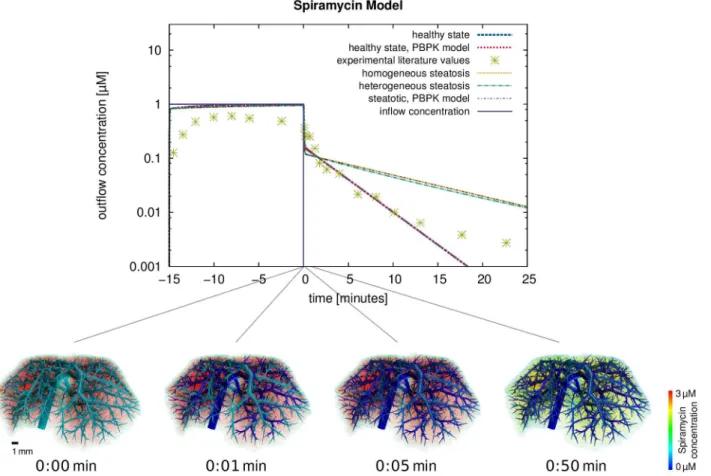
For a comparison to the experimental data reported in Figure 2 (wild-type) in [32], the outflowing rate of spiramycin was computed and plotted in Figure 10, again for the healthy state and the two steatotic states described above. Comparing experimental outflow concentrations and those simulated using the spatio-temporal model for the healthy reference case, a concordance correlation coefficientrc~0:624 is obtained. Com-plementarily, volume renderings were generated at different time points after the end of the inflow for15minutes (Figure 10) and show the spatial distribution of the spiramycin concentration immediately. This comparison illustrates very nicely how our spatially resolved model can be used to relate macroscopic observations in the plasma to distribution processes at the tissue scale.
Discussion
Simulation Results
We here present a spatially resolved model which describes the perfusion, distribution, and metabolization of compounds within the liver. The model structure is based on mass transfer equations obtained from PBPK modeling and vascular structures generated from micro-CT imaging. Our model excludes in particular any recirculation through the body such that metabolization and distribution of compounds can be considered without any overlaying effects. After the end of the initial administrations, a bi-phasic behavior can be observed which is initially governed by the distribution within the tissue and a slow release afterwards. Note that wash-out after the end of injection is additionally determined by advection in the blood flow.
Figure 7. Results of the spatio-temporal perfusion simulations of CFDA SE in the liver.The volume renderings show the distribution of CFDA SE in the mouse liver for the healthy state at different time points, showing the first pass of perfusion (tƒ2 s), the distribution phase (1 sƒtƒ5 s) and the wash out (t§3 s).
doi:10.1371/journal.pcbi.1003499.g007
concentrations. Likewise, the transition times needed for the compounds to flow from the supplying to the draining vascular systems are heterogeneous due to the different routes taken. This shows the general performance of the spatially resolved model where mass flows follows the physiological architecture of hepatic tissue governed both by vascular geometry and the composition of the connecting hepatic tissue. While this temporal delay only plays a role during first pass perfusion or similar sudden incidents, results from the spatially resolved model can nevertheless be used to revise PBPK model parameters by comparison with targeted experimental data [32].
Previous approaches already described macroscopic effects such as transit time distribution [10,11], this can also be reproduced using our model. In addition, our approach provides a mechanistic interpretation and visualization of the underlying processes. Our model allows for example a physiology-based description of the liver, thus providing more insight into drug distribution and underlying clearance processes. Likewise, in contrast to fractal models [11] translating the vascular branching to effective pharmacokinetics parameters, we consider the actual anatomical geometry of the organ and its vascular structures. A highly resolved representation is indispensable for models that can also describe individual, potentially heterogeneous, pathologies of the liver. One major drawback, however, of the spatially resolved model is the highly increased computational effort required to run the simulations, see Table 1 in Text S1.
To initially validate our spatially resolved model, we compared simulation results for spiramycin to experimental data obtained ex vivo with an isolated liver. The outflow concentrations simulated using the spatially resolved model and the experimental measure-ments in [32] are not in full agreement. Note, however, that the simulations of the isolated perfused liver are actually a prediction, since the original equations in the PBPK model were initially adjusted with respect to in vivo PK data [67]. In the light of this workflow it should be noted that the PBPK model represents only an intermediate step before the final spatially resolved model is ultimately established. It is only in this subsequent step that the liver model is integrated in the spatially resolved model, in this case to simulate ex vivo data from an isolated perfused liver [32]. Our
approach hence extrapolates in vivo results obtained in a whole-body context to ex vivo data generated in an isolated liver as such supporting a structural transfer of knowledge. Hence, the setup of an isolated perfused liver is a suitable test case. The drawback of this prediction approach is the necessity of integrating experimen-tal data coming from different sources which may partly explain the deviations in the stationary phase during the first 15 minutes during the onset of perfusion.
While deviations between experimental data and simulated concentrations can be attributed to large experimental standard deviations or limitations of in silico to ex vivo transferability, a general agreement between the spatially resolved model and experimental data can be observed (Figure 6). In particular, the clearance rate after the interruption of the spiramycin inflow is in good agreement with the experimental data. This illustrates how our spatially resolved model can be used to relate macroscopic observations in the plasma to distribution processes at the lobulus scale.
When applying the combined model to the case of steatosis it was found that already a spatially homogeneous change in the tissue composition leads to spatially heterogeneous differences in the distribution (Figure 8). The observed behavior showing the effect of an increased intracellular lipid content is actually a zonation effect on the length scale between terminal edges of the supplying and the draining vascular system. As discussed above, the qualitative result and the overall clearance are correct even though the flow distance between the two vascular trees is not the real hepatic lobule size. It was also found that the increased lipid content of the cells leads to longer intracellular retention times since the bound and thus immobile drug fraction increases. In turn, this leads to higher metabolization rates since lipid binding protects the compound from a fast wash-out due to increased retention times in steatotic livers.
spatially resolved modeling (Figure 9). The model thus provides a mechanistic description of pathophysiological states of the liver and can moreover distinguish between different spatial patterns of the pathology.
Let us point out that both the temporal delay of the outflowing peak and differences between different steatotic states are inherent properties of the spatio-temporal model that the original compartmental PBPK model cannot describe. In contrast, the spatially resolved model can capture these effects in a qualitatively plausible way.
Our model predicts increased metabolization in steatotic livers, but decreased metabolization followingCCl4-induced liver
necro-sis. The simulations hence provide testable predictions which can be compared to previously published experimental data [70,71]. For steatotic livers, drug lipophilicity has been related to intrinsic elimination clearance in rats with nonalcoholic steatohepatitis (NASH) and control rats, respectively [70]. From this study, an increased clearance of approximately 70%can be estimated for midazolam (logP~2:3) in steatotic animals. Even though this relationship has been established in rat livers perfused in situ and cannot be translated directly to our model, it nevertheless confirms qualitative validity of our simulations, since our model predicts an increased metabolization between 16% and 18%. For more detailed comparisons, simulations and experimental measure-ments would need to be performed for the same experimental setup and in particular in the same species. However, the
significantly increased clearance found experimentally in steatotic animals already points to the necessity of a more refined diseased model of steatosis since lipid accumulation alone is obviously not sufficient to explain the observed decrease in metabolic capacity. Possible model extension include, amongst others, previously discussed changes in microcirculation [72] and intracompart-mental permeability [70]. For CCl4-induced necrosis, our
computational findings are also qualitatively validated by exper-imental observations, where a decreased metabolization of midazolam afterCCl4pretreatment has been found in rats [71].
Comparing the experimental findings with our current model structure indicates that decreased cytochrome levels in CCl4
-treated animals need to be considered as future model extensions. Here, our spatially resolved model could in particular be used to differentiate the contributions of enzymatic depletion and volu-metric extension of necrosis on the decrease of metabolic capacity.
Model Extensions
Despite the performance of the newly developed spatially resolved model, several limitations need to be addressed, which represent excellent opportunities for future model refinement. On the technical side, a more detailed geometric vascular model and flow simulation [73], not only using constant velocity in each cylinder could be considered. However, all this will drastically increase computational costs with little benefit as the intravascular flow patterns are largely irrelevant for what happens in the HHS. Figure 10. Results for the metabolization of spiramycin and comparison to experimental data from an isolated perfused liver.The plot shows the outflow rates of spiramycin from our single pass perfusion model for a spiramycin inflow during 15minutes compared to experimental data from an isolated perfused liver [32]. While the experimental values were measured in a healthy liver, we also show simulation results for the steatotic states. The volume renderings show the total spiramycin concentration for four time points after the end of the inflow (t~0minutes).