Exemplar-based inference in multi-attribute decision making:
Contingent, not automatic, strategy shifts?
Linnea Karlsson
∗Department of Psychology
Umeå University
Peter Juslin
Department of Psychology
Uppsala University
Henrik Olsson
Center for Adaptive Behavior and Cognition
Max Planck Institute for Human Development
Abstract
Several studies propose that exemplar retrieval contributes to multi-attribute decisions. The authors have proposed a process theory enabling a priori predictions of what cognitive representations people use as input to their judgment process (Sigma, for “summation”; P. Juslin, L. Karlsson, & H. Olsson, 2008). According to Sigma, exemplar retrieval is a back-up system when the task does not allow for additive and linear abstraction and integration of cue-criterion knowledge (e.g., when the task is non-additive). An important question is to what extent such shifts occur spontaneously as part of automatic procedures, such as error-minimization with the Delta rule, or if they are controlledstrategyshifts contingent on the ability to identify a sufficiently successful judgment strategy. In this article data are reviewed that demonstrate a shift between exemplar memory and cue abstraction, as well as data where the expected shift doesnot
occur. In contrast to a common assumption of previous models, these results suggest a controlled and contingent strategy shift.
Keywords: exemplar memory, cue abstraction, strategy shifts, multi-attribute decisions, Sigma.
1
Introduction
Exemplar models have proven particularly successful for describing categorization learning and categorical deci-sions (Nosofsky & Johansen, 2000; cf. Medin & Schaf-fer, 1978). In the last years, researchers have shown in-terest in studying exemplar-based reasoning as a basis for other sorts of judgments and decisions (e.g., DeLosh, Busemeyer, & McDaniel, 1997; Dougherty, Gettys, & Ogden, 1999; Enkvist, Newell, Juslin, & Olsson, 2006; Juslin & Persson, 2002; Juslin, Olsson, & Olsson, 2003; Juslin, Jones, Olsson, & Winman, 2003; Juslin, Karlsson, & Olsson, 2008; Karlsson, Juslin, & Olsson, 2007; Nils-son, OlsNils-son, & Juslin, 2005; OlsNils-son, Enkvist, & Juslin, 2006; Olsson, Juslin, & Olsson, 2006; Sieck & Yates, 2001; Smith & Zarate, 1992).
It has thus been increasingly acknowledged that many
∗Linnea Karlsson is now at the Max Planck Institute for Human
De-velopment, Berlin. This research was supported by Bank of Sweden Tercentenary Foundation and the Swedish research council. Correspon-dence concerning this paper should be addressed to: Linnea Karlsson, Max Planck Institute for Human Development, Center for Adaptive Be-havior and Cognition, Lentzeallee 94, 141 95 Berlin, Germany, or to the e-mail address: [email protected].
everyday judgments, like, for example, a diagnosis of a patient, or the decision to hire a job candidate or to pur-chase a car may, at least in part, be driven by the retrieval of concrete, similar previous examples. Despite this inter-est, thenatureof the interaction between exemplar mem-ory and other processes, such as rule-based processes, has received relatively little empirical scrutiny.
As an illustration, imagine a teacher predicting the fi-nal grades of students in an Economy class on the ba-sis of four different test results. When looking at Robin, the teacher might infer that his high score on the Win-ter Exam should be associated with a high final grade. His medium score on the National High School Economy Exam should also be associated with a high grade, since that exam is very difficult. The teacher considers the different individual test results and integrates their com-bined impact on the grade. This exemplifies a judgment process based on abstracted knowledge of the relations between individual cues (the tests and their difficulty) and the criterion (the final grade).
For Lisa, on the other hand, the teacher might realize that her test results are very similar to Robin’s. Since the teacher gave Robin a final grade of 8 out of 10, she
cides to give Lisa an 8 as well. This illustrates a judgment based on a similar concrete exemplar. Although these ex-amples are highly simplified, we can probably all agree that we have at times engaged in both sorts of processes. What is less clear, and has received relatively little at-tention in judgment and decision research, are what task properties invite the one or the other process, and what processes that instigate shifts between the processes.
The possibility that exemplar memory interacts with rule-based processes has been modeled in the context of, for example, classification learning (e.g. Bourne et al., 1999; Erickson & Kruschke, 1998; Palmeri, 1997), and arithmetic learning (Rickard, 1997, 2004; Logan, 1988). Without claiming identity, these models share the assumption that a transition from one process to an-other occurs automatically at an item-based level, either as a side-effect of obligatory, accumulative encoding (Lo-gan, 1988) or as implemented by an error-driven learning rule typical of connectionist models (e.g., Erickson & Kr-uschke, 1998).
A viable alternative, however, is that the shifts are hypothesis-driven, involving controlled and sequential tests of strategies, sustained over a period of trials (Brehmer, 1994; Haider, Frensch, & Jarom, 2005; Meeter, Myers, Shohamy, Hopkins, & Gluck, 2006). Ac-cording to this view, the choice of the one rather than the other strategy is the result of an active and effortful pro-cess of problem solving and contingent on the perceived success of the strategy.
The aim of this article is to review data onmultiple-cue judgment(Cooksey, 1996; Hammond & Stewart, 2001) that demonstrate abilities to shift between the processes, as well as striking and stubborn inabilities to make appro-priate shifts. These data, in turn, serve to shed light on the nature of the mechanisms controlling the shifts between processes.
2
Exemplar memory
That experience is partly structured in the form of episodic memories is an acknowledged part of cogni-tive psychology (Tulving, 1972). You can recall a cer-tain event that has occurred to you and you can state that you have met a certain brilliant scientist once before. The concept ofsimilarityis likewise a classic and important phenomenon in cognitive psychology (Shepard, 1987). You may have a belief that your grandmother’s painting is similar to one you have seen at Guggenheim and that your new patient makes similar complaints as the patient you met yesterday. The concepts of episodes and similar-ity unite in the exemplar-based framework (Estes, 1994; Medin & Schaffer, 1978; Nosofsky & Johansen, 2000). An exemplar-based process involves a comparison
be-tween a judgment probe and similar instances stored in memory. Exemplar-based reasoning allows flexible infer-ences in the sense that minimal commitments to the un-derlying task structure is made at the original time of en-coding (Juslin & Persson, 2002, see Aha, 1997 on “Lazy Algorithms”).
Medin and Schaffer (1978) provided one of the most influential mathematical formulations of exemplar the-ory; thecontext model(see also Nosofsky, 1984, 1986, for the further development into the Generalized Context Model). With the context model it is assumed that when a judgment is made about a probe, the judge considers the similarity of the probe to all or some of the previ-ously encountered exemplars. Similarity acts as a weight on the stored criterion values. When applied to a continu-ous criterion in a multiple-cue judgment task (e.g., Juslin, Olsson et al., 2003), a similar exemplar suggests a similar criterion value, whereas a dissimilar receives less weight in the judgment. The weighted criterion values are then added and divided by the sum similarity of all exemplars considered. The similarity between a probe and an exem-plar is determined by feature overlap. An exemexem-plar with large feature overlap receives a relatively dominant im-pact on the judgment (for details, see below).
As already noted, exemplar memory has proven suc-cessful in accounting for a wide range of judgment phe-nomena, includingcategorization(e.g., Nosofsky & Jo-hansen, 2000),function learning(DeLosh et al., 1997), implicit learning (Pothos & Bailey, 2000), likelihood judgment(Dougherty et al., 1999),multiple-cue judgment (Enkvist et al., 2006; Juslin, Olsson et al., 2003; Juslin, Jones et al., 2003; Juslin et al., 2008; Karlsson et al., 2007; Olsson, Enkvist et al., 2006; Olsson, Juslin et al., 2006),confidence(Juslin & Persson, 2002; Nilsson et al., 2005; Sieck & Yates, 2001) andsocial judgment(Smith & Zarate, 1992).
3
Exemplar memory and its
inter-play with other processes
3.1
Obligatory encoding and automatic
competitive retrieval
One proposal is that rule-based processes compete with the retrieval of individual instances, where further train-ing leads to gradual accumulation of individual instances that ultimately come to dominate the response output. In the theory of automatization, Logan (1988) proposes that the key to skilled performance is memory:
“The theory makes three main assumptions: First, it assumes that encoding into memory is an obligatory, un-avoidable consequence of attention. Attending to a stim-ulus is sufficient to commit it to memory. It may be re-membered well or poorly, depending on the conditions of attention, but it will be encoded. Second, the theory assumes that retrieval from memory is an obligatory, un-avoidable consequence of attention. Attending to a stim-ulus is sufficient to retrieve from memory whatever has been associated with it in the past. Retrieval may not al-ways be successful, but it occurs nevertheless. Encoding and retrieval are linked through attention; the same act of attention that causes encoding also causes retrieval. Third, the theory assumes that each encounter with a stimulus is encoded, stored, and retrieved separately.” (p. 493).
This implies that as experience with a task increases there will be more and more available instances stored. Logan (1988) proposed that the transition from what he called “algorithm-based processing” to instance retrieval occurs as a competition and the process that can produce the fastest output “wins”. Rickard (1997) makes similar proposes of a competition between algorithm-based and instance-based processes that race to produce the output in every trial. He modified Logan’s account somewhat and assumed that in every trial one or the other process will be strengthened, and the process that is most stable at the moment will be responsible for the response. In a model calledEBRW (Exemplar-Based Random Walk) Nosofsky & Palmeri (1997) proposed that learning in a perceptual judgment task proceed as a gradual accumula-tion of exemplars as suggested by Logan.
3.2
Procedures for error minimization
Another influential idea is that there is an adaptive mech-anism that, after each consecutive judgment, adapts the weight given to different processes in a manner that should minimize the judgment error on the next judgment trial, much in the spirit of conditioning and reinforcement learning. This mechanism often involves some version of the Delta-rule, or its derivative Back-propagation (Ellis & Humphreys, 1999). In categorization learning, a com-mon assumption has thus been that category learning is an error-driven competition between processes (e.g., Ashby
et al., 1998; Erickson & Kruschke, 1998; Palmeri, 1997). Erickson and Kruschke (1998) propose a sophisticated connectionist model (ATRIUM) constructed as two sepa-rate modules; onerule-moduleand oneexemplar-module. Both modules process the incoming stimuli, in parallel, but the module with the highest activation will give rise to the output. After each judgment, the activation of the modules is adjusted to allow better future performance. Ashby et al. (1998) likewise suggests a competitive in-terplay between an explicit verbal system and animplicit procedural system (and thus not exemplar-based in the episodic sense) that is driven by the rate of categorization error.
3.3
Controlled and contingent strategy
shifts
Another possibility is that learning to perform well in a judgment task is primarily governed by explicit and con-trolled attempts on behalf of the learner. Haider and col-leagues (e.g., 2005) initiated a series of experiments aim-ing at identifyaim-ing voluntary components to strategy shifts. The task paradigm they used — the Alphabet Verification Task (AVT) — demands a judgment of whether strings of letters are alphabetically correct or not. A typical string could look like CDEFG[4]L, where the digit in brackets is to be interpreted as “is there four letters between G and L” (this rule was not told to the participants beforehand). Participants started with a strategy where they focused on all elements in the string but shifted to a strategy where they only considered the triplets involving the digit (i.e. G[4]L).
Haider and colleagues interpreted the data as support for an abrupt adoption of the later strategy, not a gradual transition from one to the other. They suggest that a factor inducing the abrupt shift was that the participants became aware that during some trials the responses were faster than during others: “The abruptly occurring violations of expectation, we presently assume, might serve as triggers for explicit inferential processes” (2005, p. 517). Recent data from probabilistic category learning likewise appear to provide additional empirical support for voluntary shift components (Meeter et al., 2006). These authors assume that participants do discrete switches between different strategies as they try to solve the task. The individual data are modelled in order to try to identify the hypothesized “switch points”. Similar discrete switching results have been reported by Rehder & Hoffman (2005).
judg-ment performance; if the initial performance is too poor, another strategy is selected. While one strategy is at-tempted, little or no learning with respect to the other strategies occurs (e.g., as long as the judge pursues the strategy of cue abstraction, little information relevant to the alternative strategy of exemplar memory is accumu-lated). While little is known about such a hypotheti-cal lexicographic ordering of processes or strategies, the common observation of a preference for explicit rule-based processes (a “rule bias”, cf. Ashby et al., 1998) suggest that rule-based strategies of cue abstraction are attempted before exemplar memory.
There are, at least, two differences between this hy-pothesis of a controlled and contingent mechanism and the previous more automatic mechanisms for a shift be-tween the processes. First: as noted, the knowledge gained is primarily related to the strategy that is actively pursued. Second: the continued application of a strategy is contingent on its ability to deliver acceptable perfor-mance early in learning; otherwise the judge will shift to reliance on some other strategy. Together these properties suggest that learning is not an inevitable consequence of experience, but the outcome ofactive problem solvingby the judge.
Berndt Brehmer formulated a well-known similar “hy-pothesis testing” model in the context of learning the functional relations between continuous cues and crite-ria; participants evaluate different hypotheses regarding the function relating the cues to the criteria in a lexico-graphic order. A positive, linear function relating the cues to a criterion has been argued to be the first hypothesis that is tested by a function learner (Brehmer, 1994). The present proposal extends such a cognitive approach to the choice of judgment strategy.
Next, we will describe the judgment task used in the studies we review, followed by an overview of Sigma, the framework in terms of which we derive and test predic-tions concerning representational shifts in multiple-cue judgment. Thereafter, we will review data on peoples’ abilities to shift between representations in variations of this task and discuss the implications for a putative mech-anism underlying adaptive shifts between different cogni-tive strategies.
4
A multiple-cue judgment task
In order to distinguish between exemplar memory and cue abstraction we have employed a specific task design (see e.g., Juslin, Olsson et al., 2003). The idea is to pro-vide a learning task in which some exemplars are with-held, only later to be introduced in a test phase. In this way, we can study the judgment performance for the new exemplars which depends on the cognitive processes used
to make the judgments.
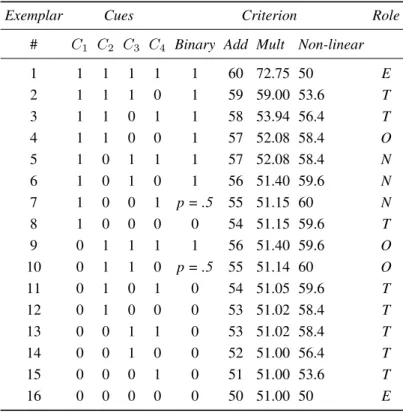
All the experiments reviewed in this article involve judgments of the toxicity of subspecies of a fictitious poi-sonous Death Bug (in the case modifications are made to the task, they are described in connection with the experi-ment in question). The bugs come in different species that vary on four binary cues (e.g., length of the legs, pattern on the back). The cues either have a value of 0, imply-ing no change on the criterion, or a value of 1 implyimply-ing a change (see Table 1). In one version of the task the bugs are displayed as drawings, and in one version the cue val-ues are presented as four written propositions.
The task structure is summarized in Table 1. In a bi-nary version of the task, half of the bugs are assigned to a harmless category (criterion = 0) and the other half are assigned to a dangerous category (criterion = 1). In an ad-ditive continuous version of the task, the cue-combination rule is strictly a weighted linear function of the four cues,
c= 50 + 4·C1+ 3·C2+ 2·C3+ 1·C4 (1)
C1is the most important cue with acoefficientof 4 (i.e., a relative weight .4),C2is the second most important cue with a coefficient of 3, and so forth. In Table 1, a sub-species with feature vector [0, 0, 0, 0] therefore has a tox-icity of 50%; a subspecies with feature vector [1, 1, 1, 1] has 60%. The other variations of the task displayed in Ta-ble 1 will be further explained below. For some of the ex-periments reported below a normally distributed random error was added to the error-free criterion, transforming the discrete 11 values in Table 1 into a truly continuous andprobabilisticvariable (correlation r = .9 with the error-free criterion).
In a learning phase, the participants learn to make judg-ments from outcome feedback. The learning phase con-sists of 11 of the subspecies in Table 1 (denoted “O” in Table 1). After the learning phase there is a test phase where all the 16 exemplars from Table 1 are included. Judgments on the 5 new exemplars (denoted “E” and “N” in Table 1) are important for identifying what cognitive process that might have been at play.
5
Sigma: predictions for cue
ab-straction and exemplar memory
Table 1: The 16 Exemplars with their Cues and Criteria Prior to Addition of Random Error for the tasks in Experiment 1, 2 and 3 (Juslin, Olsson et al., 2003), from Experiments 1 & 2 (Juslin et al., 2008) and Experiments 1 and 2 (Olsson, Enkvist et al., 2006).
Exemplar Cues Criterion Role
# C1 C2 C3 C4 Binary Add Mult Non-linear
1 1 1 1 1 1 60 72.75 50 E
2 1 1 1 0 1 59 59.00 53.6 T
3 1 1 0 1 1 58 53.94 56.4 T
4 1 1 0 0 1 57 52.08 58.4 O
5 1 0 1 1 1 57 52.08 58.4 N
6 1 0 1 0 1 56 51.40 59.6 N
7 1 0 0 1 p = .5 55 51.15 60 N
8 1 0 0 0 0 54 51.15 59.6 T
9 0 1 1 1 1 56 51.40 59.6 O
10 0 1 1 0 p = .5 55 51.14 60 O
11 0 1 0 1 0 54 51.05 59.6 T
12 0 1 0 0 0 53 51.02 58.4 T
13 0 0 1 1 0 53 51.02 58.4 T
14 0 0 1 0 0 52 51.00 56.4 T
15 0 0 0 1 0 51 51.00 53.6 T
16 0 0 0 0 0 50 51.00 50 E
a good approximation. In other tasks, exemplar memory is suggested to act as a back-up system that is more in-dependent of the specific task structure (e.g., the manner in which the cues combine). This knowledge, however, comes at the cost; the task structure is not explicitly ana-lyzed and ready for verbalization.
For a complete and detailed proposal of Sigma readers are referred to Juslin et al. (2008). There are three main assumptions of the theory:
Assumption 1. The judgment process is inherently constrained to successive consideration of two real or po-tential estimates of the criterion. At the time of learning, this constraint implies that the problem solving involved in estimating the weight of individual cues (i.e., cue ab-straction) is restricted to the comparison of two exemplars with different criteria and different cues. For example, observing exemplars [0, 1, 1, 1] with criterion 56 in close sequel to exemplar [1, 1, 1, 1] with criterion 60 may sug-gest that the first cue has the effect of adding four units to the criterion.
This constraint thereby imposes a severe difficulty to infer non-linear cue-criterion relations, since for such in-ferences at least three data points are needed (e.g., at least
three data-points are needed in a bi-variate plot in order to discover a nonlinear function).
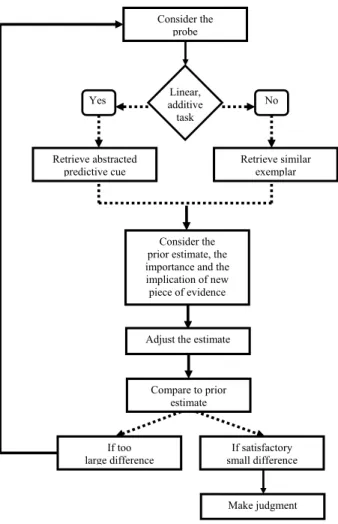
At the time of judgment, the constraint to only consider two estimates implies a judgment process where the es-timate at one time is adjusted into a new eses-timate on the basis of the consideration of additional evidence (i.e., a cue or a similar exemplar). This constraint thus implies a sequential adjustment of a tentative estimate that im-plements anadditivecombination of the impact of each cue (i.e., each cycle involves the adjustment of a previous estimateˆcn−1into a new estimateˆcn).
Assumption 2. The judgment process may be driven by different representations, for example, either by abstract knowledge of cue-criterion relations or by memory for concrete previous exemplars.
Consider the prior estimate, the importance and the implication of new piece of evidence
Consider the probe
Retrieve abstracted predictive cue
Adjust the estimate
Compare to prior estimate
If too large difference
If satisfactory small difference
Make judgment Linear,
additive task
Retrieve similar exemplar
Yes No
Figure 1: A flow-chart exemplifying the iterative and sequential judgment cycle hypothesized by Sigma (for the complete mathematical formulation, see Juslin et al., 2008). When making a judgment about a probe, the in-formation input to the process at a certain time point is either an abstracted predictive cue or a similar exemplar, depending on the structure of the task. An adjustment of a prior estimate of the probe is made (if such exists, otherwise of a default estimate), by considering the im-portance of the retrieved piece of evidence, as well as the estimate it implies. This procedure of sampling pieces of evidence from memory continues until the judge per-ceives the estimate to be good enough, and a judgment can be made.
By considering cognitive limitations in relation to the task we can predicttask-dependentshifts in the process. Sigma adheres to the growing body of evidence indicat-ing that controlled cognitive processindicat-ing is constrained to additive and serial consideration of information (Ander-son, 1981; Chapman & John(Ander-son, 2002; Cooksey, 1996; Denrell, 2005; Fischbein, Deri, Nello, & Marino, 1985; Hammond & Stewart, 2001; Hogarth & Einhorn, 1992; Roussel, Fayol, & Barrouillet, 2002; Shiffrin &
Schnei-der, 1977).
This implies that human judgment isbounded(Simon, 1990), not only in the time and knowledge available, or with regard to computational ability in some unspecified sense, but with regard to theinformation integrationthat can be performed (see Anderson, 1981). Sigma thus em-phasizes that the abstraction and integration of cues in multiple-cue judgment must conform to this constraint. The task structure is crucial; to abstract and integrate the additive impact of cues on a criterion will not produce accurate judgment in tasks where the cues combine in a highly non-additive or non-linear manner. Because we are able to learn also in such tasks, we have to resort to exemplar memory instead (Juslin et al., 2008). Interest-ingly, the claim that additive and non-additive tasks in-duce different cognitive processes has recently been im-plied also by brain imaging results (Karlsson, Nyberg, Juslin & Olsson, 2007).
The framework of Sigma can also be used to predict time-dependentshifts. On the assumption that there ex-ists a rule-bias (e.g.. Ashby et al., 1998) the participants will start with cue abstraction as they approach a task. If the task is well approximated by linear, additive inte-gration of the cues, cue abstraction will continue to be a viable alternative. If not, there is a shift to exemplar memory. Sigma therefore serves as a framework for un-derstanding the role of different cognitive processes in multiple-cue judgment. As with many models of cate-gory learning (e.g., Ashby et al., 1998; Erickson & Kr-uschke, 1998) it assumes that people shift adaptively be-tween processes, but Sigma emphasizes that both cue ab-straction and exemplar memory involve controlled cogni-tive processing components.
We now consider the quantitative predictions that can be derived from Sigma for the judgment tasks in Table 1, when it is fed either with representations of cue-criterion relations (cue abstraction) or with exemplars (exemplar memory). (Again, the reader is referred to Juslin et al., 2008, for details about the derivation of the predictions). These quantitative models allow us to test the key pre-diction by Sigma: in tasks where the criterion is not well predicted by a linear, additive model, we should observe a shift from cue abstraction to exemplar memory.
5.1
Cue abstraction
The estimate of the criterion by cue abstraction is equiv-alent to a linear additive model,
ˆ
c=a+bI·CI+. . .+bI ·CI (2)
wherea= 50 +.5·(10−Pbi),Iis the total number of
cues, and the linear weightsbi(i = 1. . .i)are estimated
criterion case, the estimate of the criterion by the cue ab-straction model is equivalent to logistic regression,
p(b= 1) = e− .5P
Iwi+ P
Iwici
1 +e−.5
P
Iwi+PIwici (3) wherep(b= 1)is the probability of responding 1 (in our case “dangerous”) andwi are logistic cue weights. We
assume that crossover between binary judgment 0 to 1 occurs at toxicity 55, hence the term−.5PIwi. In this
task, the binary cue abstraction model is formally identi-cal to a prototype model with a multiplicative similarity rule (Olsson & Poom, 2005).
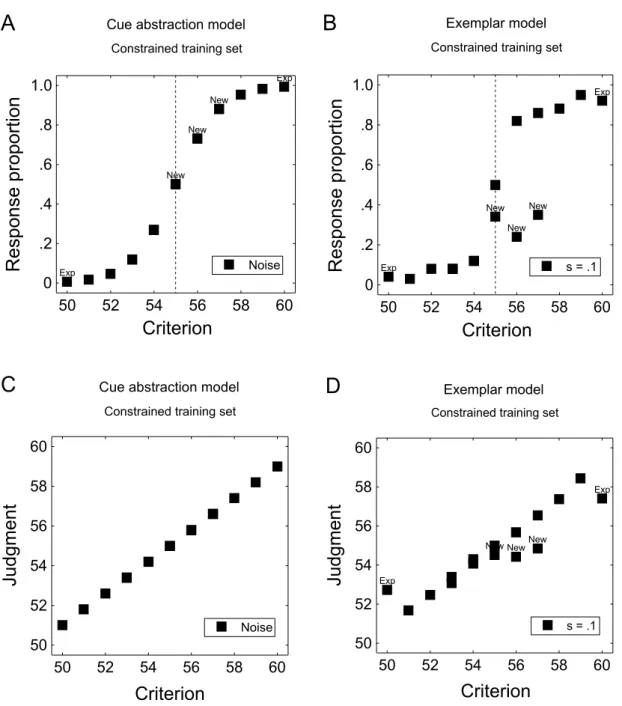
Because the process is the same, cue-abstraction pre-dicts that judgments for new exemplars will not devi-ate systematically from judgments for the old exemplars, and implies the ability to extrapolate beyond the training range of the criterion, even if these extreme exemplars have never been encountered in training (see Figure 2 A, C).
5.2
Exemplar memory
The estimate of the criterion by exemplar memory is a weighted average of the criteria of the retrieved exem-plars (Juslin, Olsson et al., 2003),
ˆ c=
P
NSn·cn
P
NSn
(4)
whereNrefers to the number of exemplars,Snrefers
to the probe-exemplar similarity andcn to the criterion
of exemplarn(n= 1. . .N). The similarity between the probe and exemplarxn is computed with the similarity
rule of the original context model (Medin & Schaffer, 1978):
Sn=
Y
i=1:I
di (5)
diis an index that takes value 1 if the cue values on cue
dimensioni(i= 1. . .i)coincide (i.e., both are 0 or both are 1), andsi if they deviate (i.e., one is 0, the other is
1). siare four parameters in the interval [0, 1] that
cap-ture the impact of deviating cues on the similaritySn.
Equations 4 and 5 can be used both when the criterion is continuous and when it is binary.
With exemplar memory the prediction is that judg-ments for new exemplars will be poorer than for old ex-emplars, because old exemplars can benefit from retrieval of identical previous exemplars with the correct criterion. There will also be an inability to extrapolate outside of the training criterion range for the new extreme exem-plars, because the judgment is a weighted average of the criterion values in training (Figure 2 B, D).
In sum, one account of multiple cue judgment iscue abstraction; the judge attends to individual cues in se-quence, each with a known relationship to the criterion,
and mentally integrates them into an overall judgment (Einhorn, Kleinmutz, & Kleinmutz, 1979).1 Another
ac-count isexemplar memory, where the judge retrieves sim-ilar exemplars from memory and integrates the criterion values that are stored together with the exemplars (Medin & Schaffer, 1978; Nosofsky & Johansen, 2000). Note that with exemplar-memory there has been no abstraction on the level of the individual cues and their relation to the criterion. Rather, it is the pattern of cues in relation to the criterion that is driving the judgments. Sigma predicts that people shift between cue abstraction and exemplar memory depending on the task.
As we shall see, however, there are limitations to this account. Recent results suggest that, despite the assumed flexibility of exemplar memory in relation to the task structure, participants do not always shift to exemplar memory in the predicted manner in tasks where cue ab-straction is not a viable alternative. The scope of this article is to explore the theoretical implications of those results. We will argue that there are limitations to an “in-evitable consequence of task experience” (Haider et al., 2005) account of the interplay and suggest that it is bet-ter described as a controlledstrategy shiftcontingent on early learning performance.
6
The empirical studies
Sigma predicts that the task structure is one factor shap-ing the cognitive process that dominates in a judgment task. Four types of tasks were used to derive predictions that were tested in the experiments reviewed below:1)a binary task, where the feedback is assumed to be too poor to encourage abstraction of the underlying cue-criterion relations, and which hence should invite exemplar mem-ory (see Juslin, Olsson et al., 2003);2)anadditive task with a continuous criterion, which should allow, and in-vite, the abstraction and integration of multiple cues in a linear and additive manner (Juslin, Olsson et al., 2003; Juslin et al., 2008; Olsson, Enkvist et al., 2006);3)a mul-tiplicative task, where the cue-criterion relations are not well predicted by a linear, additive model and the pro-cess therefore should be exemplar memory (Juslin et al., 2008), 4) anon-linear task, which similarly should not in-vite additive, linear integration of cues, and hence should induce use of exemplar memory (Olsson, Enkvist et al., 2006).
1Note that cue abstraction does not necessarily involve integration of
Exp New
New
New
Exp 0 .2 .4 .6 .8 1.0
50 52 54 56 58 60
Noise
Cue abstraction model
Constrained training set
Criterion
R
e
s
p
o
n
s
e
p
ro
p
o
rt
io
n
A
Exp
New New New
Exp 0 .2 .4 .6 .8 1.0
50 52 54 56 58 60
s = .1
Exemplar model
Constrained training set
Criterion
R
e
s
p
o
n
s
e
p
ro
p
o
rt
io
n
B
50 52 54 56 58 60
50 52 54 56 58 60
Noise Constrained training set
Cue abstraction model
C
J
u
d
g
m
e
n
t
Criterion
Exp
New New New
Exp
50 52 54 56 58 60
50 52 54 56 58 60
s = .1 Constrained training set
Exemplar model
D
J
u
dg
m
en
t
Criterion
Figure 2: Predicted judgments for a binary (A, B) and a continuous (C, D) criterion with the constrained training set. Panel A and C: Cue abstraction model with noise for the constrained training set. Panel B and D: Exemplar model with similarity parameters=.1.
6.1
General Method
Participants in all experiments reviewed were undergrad-uate students at Umeå University, Sweden. Stimuli and procedures were basically the same for all the experi-ments. The participants learned to make judgments of the toxicity of fictitious bugs, varying on four binary di-mensions (i.e., length of their legs, spots or no spots on their fore back). The experiments consisted of a learning phase and a test phase. In the learning phase, participants
We will discuss three dependent measures: perfor-mance, exemplar indexandmodel fit. Performance was measured in terms of root mean squared error (RMSE) between judgment and criterion. The exemplar index measures to what extent exemplar memory has domi-nated the judgments, and is a combination of an extrap-olation indexand aninterpolation index. The deviation between the judgments for the new extreme exemplars introduced at test (i.e. those with cue values [0,0,0,0] and [1,1,1,1]) and the predicted linear extrapolation for those items, based on the old exemplars at test defines the ex-trapolation index. The interpolation indexis the differ-ence between absolute deviations between judgment and criterion for the new exemplars in the middle of the crite-rion range (i.e. exemplar nr 5, 6, & 7) and the matching old exemplars. The sum of the extra- and interpolation in-dices is the exemplar index. A negative exemplar index is indicative of exemplar memory, because it captures sys-tematic deviations from the correct criterion value for the new exemplars, as predicted by the exemplar model. An exemplar index of 0 is indicative of cue abstraction, since this suggests no systematic difference in judgment error between the new and the old exemplars.
The models described above were used to predict the judgments from the test phase. The parameters were es-timated for the judgments in the last part of the learning phase and used to predict data in the test phase (a method we callprojective fit). The model fit is reported in terms of thecoefficient of determination(r2
) and theroot mean square deviation (RMSD)between the predictions and the data. The reader is referred to the original publications for additional details on the methods of the experiments.
7
Successful representational shifts
7.1
Binary vs. continuous criterion (Juslin,
Olsson et al., 2003)
The first two experiments involve variations of the lin-ear, additive version of the task (Eq. 1), with either a bi-nary criterion or a continuous criterion (Experiments 1 & 2 in Juslin, Olsson et al., 2003). According to Sigma, the feedback is crucial for the ability to abstract explicit knowledge of cue-criterion relations. If one assumes a linear additive model (as people often do, e.g., Brehmer, 1994) and if the additive task described by Eq. 1 is de-terministic, in principle observation of only five exem-plars is sufficient to uniquely determine the five coeffi-cients. By contrast, when the feedback is binary or nomi-nal, often the relevant structure cannot be identified from a few observations, even if the correct model is assumed (Juslin, Olsson et al., 2003). Therefore, we predicted re-liance on exemplar memory in the binary version of the
additive task and a shift towards cue abstraction when the criterion is continuous.
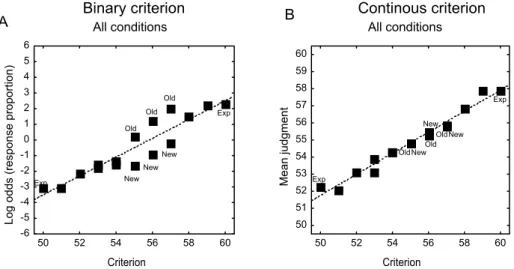
Experiment 1 involved judgments of a deterministic bi-nary criterion and Experiment 2 judgments of a determin-istic continuous criterion. Figure 3 shows the mean judg-ments plotted against the criterion (log odds transformed for the judgments in Experiment 1). Clearly, there are larger differences between new and old exemplars when the criterion is binary than when it is continuous. The proportion of participants for which the 95% confidence interval for the exemplar index includes 0, as predicted by cue abstraction (i.e., the judgments for new and old exemplars do not deviate in a systematic manner), was 28% with the binary criterion and 50 % with the contin-uous criterion. The shift towards more cue abstraction was also verified by the model fit indices. The fit was better for the exemplar model when the criterion was bi-nary (r2 =.93
withRM SD= 0.089vs.r2 =.80 with RM SD = 0.18) with a tendency toward the opposite pattern when the criterion was continuous (r2=.89
with RMSD=0.63 vs.r2 =.92withRM SD = 0.58). These results suggest that when the criterion was changed from a binary into a continuous criterion the processes shifted from exemplar memory to cue abstraction.
7.2
Deterministic vs. probabilistic criterion
(Juslin, Olsson et al., 2003)
The third experiment in Juslin, Olsson et al. (2003) in-vestigated the effect of a probabilistic relation between the cues and the criterion. A deterministic task allows for perfect accuracy by retrieving exemplars that have been observed previously and the reoccurring presentation of a few unique exemplars (i.e., the same cues and criterion) may promote exemplar memory. In a probabilistic task, on the other hand, the same cues and criteria do not reoc-cur, and exemplar memory does not allow perfect accu-racy. This suggests that exemplar memory may become less prevalent in a probabilistic task and that people shift to cue abstraction.
Experiment 3 involved the same stimuli and task struc-ture as Experiment 2 in Juslin, Olsson et al. (2003), but contrasted a deterministic condition with a probabilis-tic condition where the multiple correlation between the cues and the criterion was .9. The proportion of partic-ipants for which the 95% confidence interval for the ex-emplar index includes 0 was 44% with the deterministic criterion and 84 % with the probabilistic criterion. The shift towards more cue-abstraction was also verified by the model fit indices. The fit for the exemplar model was almost as good as the cue abstraction model in the de-terministic condition (r2 = .90
Binary criterion All conditions
Criterion
L
o
g
o
d
d
s
(
re
s
p
o
n
s
e
p
ro
p
o
rt
io
n
)
-6 -5 -4 -3 -2 -1 0 1 2 3 4 5 6
50 52 54 56 58 60
Exp
Exp
New New Old
Old Old
New
Continous criterion All conditions
Criterion
M
e
a
n
j
u
d
g
m
e
n
t
50 51 52 53 54 55 56 57 58 59 60
50 52 54 56 58 60
Exp
Exp
Old Old New
New Old New
A B
Figure 3: Mean judgments in a task with binary criterion (log odds transformed, Experiment 1) and a task with con-tinuous deterministic criterion (Experiment 2). Adapted from “Exemplar Effects in Categorization and Multiple-Cue Judgment” by P. Juslin, H. Olsson, & A-C., Olsson, 2003.Journal of Experimental Psychology: General. Copyright by the American Psychological Association.
model became better at accounting for the data in the probabilistic condition (r2
= .90withRM SD = 0.56 vs.r2
= .95withRM SD = 0.42). The results of Ex-periment 3 suggest that cue abstraction increases in a task where the criterion is probabilistic.
More generally, the shift in processing observed across all experiments in Juslin, Olsson et al. (2003) indicates that changing a binary task into an additive task with a continuous criterion induces adaptive shifts from exem-plar memory to cue abstraction. This is consistent with the success of exemplar models in categorization studies (e.g., Nosofsky & Johansen, 2000) and the assumption that multiple-cue judgment often involves cue abstraction (Einhorn et al., 1979), but also with a bias to abstract rules whenever possible (Ashby et al., 1998).
7.3
Additive
vs.
multiplicative
cue-combination rules (Juslin et al., 2008)
Experiments 1 and 2 in Juslin et al. (2008) were de-signed to address a shift depending on whether the cue-combination rule is additive or multiplicative. As pre-dicted by Sigma, cue-abstraction is a viable alternative when the task at hand is additive and linear. On the other hand, if the cues combine non-additively the abstraction of linear slopes between the cues and the criteria is not possible and, hence, we predict a dominance of exemplar memory in a distinctly non-additive task. The two ex-periments compared an additive version of the task (Eq. 1) with a multiplicative version of the task. In the mul-tiplicative version the cue-combination rule was a
non-additive combination of the four cues,
c= 51 + 0.0009875·e4C1+3C2+2C3+C4
= 51 + 0.0009875·e4C1
·e3C2
·e2C3
·eC4 (6)
with the same coefficients as in the additive task (Eq. 1). A cue with value 0 leaves the expression in Eq. 6 unchanged, while a cue with value 1 multiplies the rest of the expression with a constant that is specific to each cue. For example, the multiplicative criterion for sub-species [1, 1, 1, 0] is51 + 0.0009875·(54.60·20.09·
7.39 ·1)≈59.00, and for subspecies [0, 0, 0, 1] it is
51 + 0.0009875·(1·1·1·2.72)≈51.00(see Table 1).
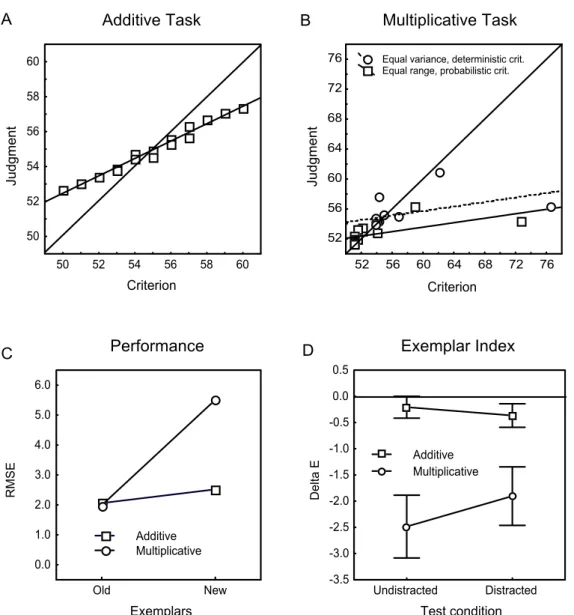
The idea with Experiment 1 was to investigate whether we could observe a task dependent shift in the cognitive processes and the hypothesis was that we would observe more reliance on exemplar memory in the multiplicative task.2 The judgments plotted against the criterion
val-ues are shown in Figure 4. There was better performance in the additive than in the multiplicative task. There was also a significant interaction between performance for the old as compared to the new exemplars in the additive and in the multiplicative tasks: the judgments for the old ex-emplars were about equally good in both tasks, while the judgments for the new exemplars were much worse in the multiplicative task (Figure 4C).
2The original experiment involved a dual–task manipulation of
Additive Task
Criterion
J
u
d
g
m
e
n
t
50 52 54 56 58 60
50 52 54 56 58 60
Performance
Exemplars
R
M
S
E
0.0 1.0 2.0 3.0 4.0 5.0 6.0
Old New Additive Multiplicative
Exemplar Index
Test condition
D
e
lt
a
E
-3.5 -3.0 -2.5 -2.0 -1.5 -1.0 -0.5 0.0 0.5
Undistracted Distracted Additive
Multiplicative
A
B
C
D
Multiplicative Task
Criterion
J
u
d
g
m
e
n
t
52 56 60 64 68 72 76
52 56 60 64 68 72 76
Equal variance, deterministic crit. Equal range, probabilistic crit.
B
Figure 4: Panel A: Mean judgments in the additive task. Panel B: Mean judgments in the multiplicative task. Panel C: Performance measured as RMSE for old and new exemplars respectively compared between the additive and the mul-tiplicative task. Panel D: Exemplar index in the additive and the mulmul-tiplicative task in the undistracted and distracted test phase. Adapter from “Information Integration in Multiple Cue Judgment: A Division of Labor Hypothesis” by P. Juslin, L. Karlsson & H. Olsson, 2008.Cognition.Copyright by Elsevier.
In the additive task the exemplar index included 0, sug-gestive of cue abstraction. In the multiplicative task ex-emplar index was well below 0, indicating that exem-plar memory had been the dominating process (Figure 4D).3Consistent with the results suggested by the
exem-plar index, in the additive task, the additive cue abstrac-tion model fitted the data better than the exemplar model
3There was a significant interaction between environment and
undis-tracted or disundis-tracted test phase, in terms of exemplar index. However, since a priori the exemplar model only predicts a negative exemplar index, not its magnitude, this effect is not to be interpreted as a shift towards cue abstraction in the distracted test phase in the multiplicative task.
(r2
= .95withRM SD = .32versus r2
= .89with RM SD= 0.45), while the reverse was true in the mul-tiplicative task (r2 = .46
withRM SD = 2.94versus r2=.92
withRM SD= 0.49).
7.4
Controlled vs. confounded training
se-quence (Juslin et al., 2008)
bug where only one cue has changed from the trial be-fore, this should facilitate learning with cue abstraction. If you, for example, first observe a bug with cues [1, 1, 1, 0] and criterion 59 and then immediately thereafter ob-serve a bug with cues [1, 1, 0, 0] and criterion 57, this invites the inference that the third cue, which is the only difference between the two exemplars, accounts for the difference of two units on the criterion, allowing you to abstract the weight of Cue 3. We administered two differ-ent learning sequences, one where there was always only one cue that changed from trial to trial and one sequence in which several cues always changed from trial to trial.
The hypothesis was that a controlled sequence, where only one cue changes between the successive trials, should improve learning in the additive task where people primarily rely on cue abstraction. By contrast, in the mul-tiplicative task a controlled sequence should provide no benefit if people rely on exemplar memory. If anything, it should lead to poorer performance by inviting people to attempt futile attempts at cue abstraction, which, as im-plied by the constraints in Sigma, is virtually impossible in a multiplicative task.
The training phase was divided into blocks of 11 ments. Judgment performance (RMSE between judg-ment and criterion) for the first two training blocks was taken to index the speed of learning and was entered into a factorial ANOVA that yielded a statistically significant interaction. Learning in the additive task was thus fa-cilitated by the controlled sequence, while learning in the multiplicative task wasimpairedby the controlled se-quence. This dissociation strongly suggests different cog-nitive processes in the two conditions. The 95% confi-dence intervals for the mean exemplar index∆Ein each cell included 0 only in the additive task with controlled sequence. As in Experiment 1, the cue abstraction model fitted data best in the additive task, while the reverse was true in the multiplicative task. The results from both Ex-periments 1 and 2 in Juslin et al. (2008) therefore clearly suggest that participants adapted to the multiplicative task by a shift to exemplar memory.
8
Stubborn resistance to shifts
8.1
Linear vs. non-linear cue-combination
rule (Olsson, Enkvist et al., 2006)
Olsson, Enkvist et al. (2006) tested if a task with non-linear cue-criterion relations would induce a shift from cue abstraction to exemplar memory. The criterion in the nonlinear task involved a non-linear transformation of the linear criterioncLin Eq. 1:
cN L= ((−2·(cL)2)/5) + 44·cL−1150 (7)
In Experiment 1 the idea was to compare judgments in an additive task with judgments in1) a probabilistic non-linear task, 2) a probabilistic non-linear task with frequency manipulation and3)a deterministic non-linear task with frequency manipulation. The frequency manip-ulation increased the presentation frequency of the ex-treme training exemplars that most clearly reveal the non-linear function in Eq. 7.
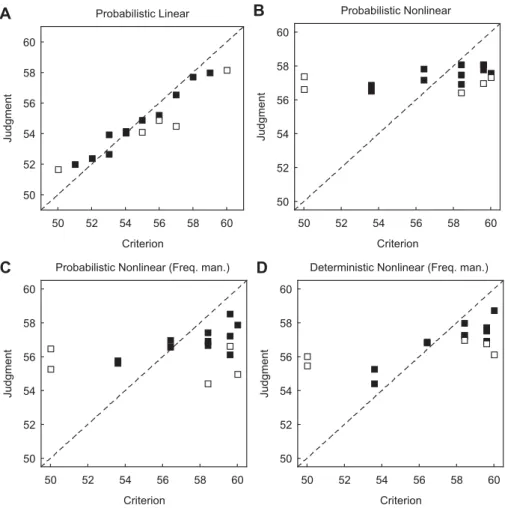
The hypothesis was that cue abstraction would be the dominating process only in the linear task. Inspecting Figure 5, plotting the mean judgments as a function of the criterion, reveals that performance is good in the lin-ear condition but extremely poor in all three non-linlin-ear conditions. Although the task should be facilitated by making it deterministic and allowing the extreme exem-plars to be shown especially often, only 60 % of the participants with the deterministic non-linear task with frequency manipulation had a significant correlation be-tween their judgments and the criterion for the old exem-plars.
The Exemplar Index was significantly separated from 0 in all three of the non-linear conditions, but includes 0 in the linear condition, suggesting that cue abstraction was the dominating process in the linear task. In the lin-ear condition, the cue abstraction model provides the best quantitative fit. In all non-linear conditions the fit of both models was poor (r2between .13 and .26), basically be-cause the judgment performance was very poor.
Given the complexity of the nonlinear task it may not appear surprising that the participants failed to abstract the underlying cue criterion relations. But the learning phase in the condition with a deterministic criterion in-volved no less than 20 presentations of the same 11 ex-emplars (i.e., the same four binary cues with the same criterion). This would seem to make exemplar memory both a viable and useful process to make accurate judg-ments, but evidently the participants were unable to shift to reliance on exemplar memory.
8.2
Prolonged training and explicit
instruc-tions (Olsson, Enkvist et al., 2006)
50 52 54 56 58 60 Criterion
Probabilistic Linear
50 52 54 56 58 60
J
u
d
g
m
e
n
t
A
50 52 54 56 58 60 Criterion
Probabilistic Nonlinear
50 52 54 56 58 60
J
u
d
g
m
e
n
t
B
50 52 54 56 58 60 Criterion
Probabilistic Nonlinear (Freq. man.)
50 52 54 56 58 60
J
u
d
g
m
e
n
t
C
50 52 54 56 58 60 Criterion
Deterministic Nonlinear (Freq. man.)
50 52 54 56 58 60
J
u
d
g
m
e
n
t
D
Figure 5: Mean judgment from the test phase of Experiment 1 plotted against the criterion. Filled squares are old exemplars, and open squares are new exemplars only presented in the test phase. Panel A: The probabilistic linear condition. Panel B: Probabilistic nonlinear condition. Panel C: Probabilistic nonlinear condition with frequency manipulation. Panel D: Deterministic nonlinear condition with frequency manipulation. Adapted from “Go with the flow: how to master a non-linear multiple-cue judgment task” by A-C. Olsson, T., Enkvist & P. Juslin, 2006.Journal of Experimental Psychology: Learning, Memory and Cognition. Copyright by the American Psychological Association.
relations can be abstracted and the only way to master the task is by memorizing the concrete exemplars. We call the conditions the neutral condition and the exem-plar condition, respectively. One outcome could be that already with the neutral instruction 440 trials of learning would be sufficient for the shift to exemplar memory to materialize. The other possibility could be that the partic-ipants are unable to spontaneously perform this process shift also after 440 trials, and that we will only observe a shift to exemplar memory after providing explicit exem-plar instructions.
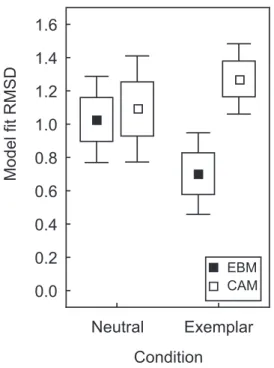
The performance in terms ofRM SEwas significantly better in the exemplar instruction condition than in the neutral instruction condition, but performance in the neu-tral condition of Experiment 2 was not significantly im-proved from the corresponding deterministic condition in Experiment 1 with 220 trials, suggesting that despite 440
learning trials the participants were still unable to shift to exemplar memory (Figure 6). There was no difference in terms of Exemplar Index between the neutral and the exemplar conditions. The exemplar model provides the best fit in the exemplar condition (see Figure 7). This result not only validates the modeling, but also suggests that the participants were stubbornly resisting a shift to exemplar memory, unless they were explicitly told by in-structions to perform a strategy shift.
9
Summary of the results
50 52 54 56 58 60
Criterion
Neutral Instruction Condition
50 52 54 56 58 60
J
u
d
g
m
e
n
t
50 52 54 56 58 60
Criterion
Exemplar Instruction Condition
50 52 54 56 58 60
J
u
d
g
m
e
n
t
Figure 6: Mean judgment from test phase of Experiment 2 plotted against the criterion. Filled squares are old exem-plars presented both under training and at test, and open squares are new exemexem-plars only presented in the test phase. Left panel: The neutral instruction condition. Right panel: The exemplar instruction condition. Adapted from “Go with the flow: how to master a non-linear multiple-cue judgment task” by A-C. Olsson, T., Enkvist & P. Juslin, 2006. Journal of Experimental Psychology: Learning, Memory, and Cognition. Copyright by the American Psychological Association.
Neutral
Exemplar
Condition
0.0
0.2
0.4
0.6
0.8
1.0
1.2
1.4
1.6
M
o
d
e
l f
it
R
M
S
D
EBM CAM
Figure 7: Model fit in terms of RMSD for each condi-tion and model. (EBM = exemplar-based model, CAM = cue-abstraction model) Adapted from “Go with the flow: how to master a non-linear multiple-cue judgment task” by A-C. Olsson, T., Enkvist & P. Juslin, 2006.Journal of Experimental Psychology: Learning, Memory, and Cog-nition. Copyright by the American Psychological Asso-ciation.
cue-criterion relations the participants favor cue abstrac-tion. Moreover, when changing the cue-combination rule from an additive to a multiplicative function the partic-ipants are no longer able to add the impact of separate cues into accurate judgments, and therefore they seem to shift rapidly to exemplar memory (Juslin et al., 2008; see also Karlsson, Nyberg et al., 2007 for implications at the neural level).
The results in Olsson, Enkvist et al. (2006), however, provide clear evidence for a situation where such an adap-tive shift apparently fails to materialize. Even though in the deterministic non-linear conditions there were a very limited number of unique exemplars (11) and the learn-ing was extended to 440 trials the data reveal extremely poor learning in the non-linear task. In the contrast to the assumption of an automatic shift, only when the partici-pants were told what strategy could be a viable alternative did they perform reasonably well.
10
General discussion
At a first glance, the poor learning observed in the non-linear tasks might seem rather surprising. Abilities to abstract statistical regularities in our environments or to learn mere stimulus-response associations have appar-ently not been important in the non-linear tasks reported above.
captured bycue abstraction(a rule-bias, see Ashby et al., 1998; Juslin, Olsson et al., 2003). There are obvious ad-vantages of having knowledge that is general enough to allow generalization also to other situations and which provides a readily communicated summary of the under-lying task structure. 2) However, when attempts at cue abstraction are futile and participants do not manage to create stable representations of the linear slopes between cues and criterion, they will try the strategy of using ex-emplar memoryinstead. Exemplar memory allows a flex-ible adaptation to judgment tasks, since storing instances in memory should be less dependent on the task structure than cue abstraction.3)However, if the initial attempt at using a strategy of exemplar memory leads to poor per-formance, the judge reverts back to the default strategy of cue abstraction and become stuck in impasse with ex-tremely poor performance.
This interpretation implies that what happens early in the application of a specific strategy is crucial for de-termining the development of a stable strategy. (Addi-tive) cue abstraction is obviously not appropriate for good performance in the non-linear task, as hypothesized by Sigma (Olsson, Enkvist et al., 2006; Juslin et al., 2008). But, why is the exemplar strategy rejected early in its ap-plication to this nonlinear judgment task?
At asymptotic training, exemplar memory allows per-fect performance for the old exemplars in the determin-istic nonlinear task. But when actually scrutinizing the nonlinear task (see Table 1) it becomes evident that early during learning, exemplar memory may not be encour-aged by the non-linear task structure. After the first tri-als, having only a few exemplars stored in memory, per-haps with very dissimilar cue profiles but similar criterion values, might make integration of similar exemplars diffi-cult while still aiming at good performance. For example, consider that Exemplar #2 and Exemplar #15 in Table 1 have cue profiles [1, 1, 1, 0] and [0, 0, 0, 1]. These two ex-emplars have diametrically opposed cue profiles (all four cues differ) but the same criterion (53.6). On the other hand, Exemplar #2 and Exemplar #6 in Table 1 have cue profiles [1, 1, 1, 0] and [1, 0, 1, 0] that are highly similar (only one cue differs), but rather large difference in the criterion (53.6 & 59.6, respectively). This complex sim-ilarity structure may dissuade early attempts at applying an exemplar strategy.
We conclude that the results reviewed in this article speak strongly against the assumption of parallel and obligatory encoding of exemplars, as envisioned by Lo-gan (1988), at least in the context of multiple-cue judg-ments. We also believe that the results speak less in favor of a mechanism that is a parallel and automatic side ef-fect of experience (e.g., Bourne et al., 1999; Erickson & Kruschke, 1998; Logan, 1988; Palmeri, 1997; Rickard, 1997, 2004), but more in favor of a mechanism where
memory traces for later recollection and usage as a ba-sis for judgment demands a strategic choice on behalf of the participant. This alternative explanation of the na-ture of the interplay between exemplar memory and other processes may thus be best understood asstrategy shifts, contingent on the structure of the task.
There are other lines of research that appear to sup-port our way of reasoning. To date there are a number of empirical studies demonstrating how explicit processes can hinder effective learning with implicit processes (e.g. Fletcher et al., 2005; Reber, 1976). With the first words of the title intriguingly chosen as “On the benefits of not try-ing. . . ” Fletcher et al. state that explicit processes might actuallysuppressimplicit learning. They report findings where explicit intention to learn a difficult sequence im-paired implicit learning of the same sequence.
Moreover, Sloutsky and Fischer (2004) suggests that children have better memory performance than adults after learning inductive categorization tasks, since they have not yet reached the developmental criteria for in-ducing category-specific information, and are hence con-strained to use a memory-based strategy. This invites the counterintuitive hypothesis that children might perform better than adults in the non-linear task reported in this article.
10.1
Conclusions
Conceiving exemplar memory as a strategy to be chosen rather than as an automatic side effect of learning is an important step towards understanding the cognitive basis of multiple-cue judgment. Further research endeavors are necessary to get firmer support for this view. There are not that many published multiple-cue judgment (or cat-egorization) studies withhealthy participantsthat report a task where virtually no learning was observed (but see Smith, Redford, Gent & Washburn, 2005). Nonetheless, the results reviewed in this article suggests that learning in multiple-cue judgment, including shifts of the repre-sentation that is input to the process, may have more to do with active and controlled problem solving, than with automatic side effects of experience as captured by asso-ciative mechanisms.
References
Aha, D. W. (1997). Lazy learning.Artificial Intelligence Review, 11,7–10.
Anderson, N. H. (1981). Foundations of information in-tegration theory.New York: Academic Press.
Ashby, F. G., Alfonso-Reese, L. A., Turken, A. U., & Waldron, E. M. (1998). A neuropsychological theory of multiple systems in category learning. Psychologi-cal Review,105,442–481.
Bourne, L. E., Healy, A. F., Parker, J. T., Rickard, T. C. (1999). The strategic basis of performance in binary classification tasks: strategy choices and strategy tran-sitions. Journal of Memory and Language, 41,223– 252.
Brehmer, B. (1994). The psychology of linear judgment models. Acta Psychologica,87,137–154.
Chapman, G. B., & Johnson, E. J. (2002). Incorporat-ing the irrelevant: Anchors in judgments of belief and value. In T. Gilovich, D. Griffin, & D. Kahneman, (Eds.) Heuristics and biases: The psychology of intu-itive judgement,pp. 120–138. New York: Cambridge University Press.
Cooksey, R. W. (1996). Judgment analysis: Theory, methods, and applications. San Diego: Academic Press, Inc.
DeLosh, E. L., Busemeyer, J. R., & McDaniel, M. A. (1997). Extrapolation: The sine qua non for abstrac-tion in funcabstrac-tion learning. Journal of Experimental Psy-chology: Learning, Memory, and Cognition, 23, 968– 986.
Denrell, J. (2005). Why most people disapprove of me: Experience sampling in impression formation. Psy-chological Review, 112, 951–978.
Einhorn, J. H., Kleinmuntz, D. N., & Kleinmuntz, B. (1979). Regression models and process tracing anal-ysis.Psychological Review, 86, 465–485.
Ellis, R., & Humphreys, G. W. (1999). Connectionist Psychology: A Text with Readings. London: Psychol-ogy Press.
Enkvist, T., Newell, R. B., Juslin, P., & Olsson, H. (2006). On the role of casual intervention in multiple-cue judg-ment: Positive and negative effects on learning. Jour-nal of Experimental Psychology: Learning, Memory, and Cognition, 32, 163–179.
Erickson, M. A., & Kruschke, J. K. (1998). Rules and ex-emplars in category learning.Journal of Experimental Psychology: General, 127,107–140.
Estes, W. K. (1994). Classification and cognition. New York: Oxford University Press.
Fischbein, E., Deri, M., Nello, M., & Marino, M. (1985). The role of implicit models in solving verbal problems in multiplication and division.Journal for Research in Mathematics Education, 16, 3–17.
Fletcher, P. C., Zafiris, O., Frith, C. D., Honey, R. A. E., Corlett, P. R., Zilles, K., & Fink, G. R. (2005). On the benefits of not trying: brain activity and connec-tivity reflecting the interactions of explicit and implicit
sequence learning.Cerebral Cortex, 15, 1002–1015. Gigerenzer, G., Todd, P. M., & the ABC Research Group
(1999). Simple heuristics that make us smart. New York: Oxford University Press.
Haider, H., Frensch, P. A., & Joram, D. (2005). Are strat-egy shifts caused by data-driven processes or by vol-untary processes? Consciousness and Cognition, 14, 495–519.
Hammond, K. R., & Stewart, T. R. (Eds.) (2001). The essential Brunswik: Beginnings, explications, applica-tions. Oxford: Oxford University Press.
Hintzman, D. L. (1986). ”Schema abstraction” in a multiple-trace memory model. Psychological Review, 93, 411–428.
Hogarth, R. M., & Einhorn, H. J. (1992). Order effects in belief updating: The belief-adjustment model. Cogni-tive Psychology,24, 1–55.
Juslin, P., Jones, S., Olsson, H., & Winman, A. (2003). Cue abstraction and exemplar memory in categoriza-tion. Journal of Experimental Psychology: Learning, Memory, and Cognition, 29,924–941.
Juslin, P., Karlsson, L., & Olsson, H. (2008). Informa-tion integraInforma-tion in multiple-cue judgment: A division of labor hypothesis.Cognition, 106, 259–298. Juslin, P., Olsson, H., & Olsson, A-C. (2003).
Exem-plar effects in categorization and multiple-cue judg-ment. Journal of Experimental Psychology: General, 132, 133–156.
Juslin, P., & Persson, M. (2002). PROBabilities from Exemplars (PROBEX): A “lazy” algorithm for prob-abilistic inference from generic knowledge.Cognitive Science,26, 563–607.
Karlsson, L., Juslin, P., & Olsson, H. (2007). Adaptive changes between cue abstraction and exemplar mem-ory in a multiple-cue judgment task with continuous cues. Psychonomic Bulletin and Review, 14, 1140– 1146.
Karlsson, L., Nyberg, L., Juslin, P., & Olsson, H. (2007). Distinct neural correlates underlie multiple-cue judgment depending on the multiple-cue-combination rule. Manuscript submitted for publication.
Logan, D. G. (1988). Towards an instance theory of au-tomatization.Psychological Review,95, 492–527. Medin, D. L., & Schaffer, M. M. (1978). Context
the-ory of classification learning, Psychological Review, 85, 207–238.
Meeter, M., Myers, C. E., Shohamy, D., Hopkins, R.O., & Gluck, M. A. (2006). Strategies in probabilistic cat-egorization: Results from a new way of analyzing per-formance.Learning and Memory, 13,230–239. Mellers, B. A. (1980). Configurality in multiple-cue
Nilsson, H., Olsson, H., & Juslin, P. (2005). The cogni-tive substrate of subjeccogni-tive probability.Journal of Ex-perimental Psychology: Learning, Memory, and Cog-nition, 31, 600–620.
Nosofsky, R. M. (1984). Choice, similarity, and the con-text theory of classification. Journal of Experimental Psychology: Learning, Memory, and Cognition, 10, 104–114.
Nosofsky, R. M. (1986). Attention, similarity, and the identification-categorization relationship. Journal of Experimental Psychology: General, 115,39–57. Nosofsky, R. M., & Johansen, M. K. (2000).
Exemplar-based accounts of “multiple-system” phenomena in perceptual categorization. Psychonomic Bulletin and Review, 7,375–402.
Nosofsky, R. M., & Palmeri, T. J. (1997). An exemplar-based random walk model of speeded classification. Psychological Review, 104,266–300.
Olsson, A-C., Enkvist, T., & Juslin, P. (2006). Go with the flow! How to master a non-linear multiple cue judgment task. Journal of Experimental Psychology: Learning, Memory, and Cognition, 32,1371–1384. Olsson, A-C., Juslin, P., & Olsson, H. (2006). Multiple
cue judgment in individual and dyadic learning. Jour-nal of Experimental Social Psychology,42, 40–56. Olsson, H., & Poom, L. (2005). The noisy cue
abstrac-tion model is equivalent to the multiplicative prototype model.Perceptual and Motor Skills, 100,819–820. Palmeri, T. J. (1997). Exemplar similarity and the
devel-opment of automaticity.Journal of Experimental Psy-chology: Learning, Memory, and Cognition, 23,324– 354.
Pothos, E. M., & Bailey, T. M. (2000). The role of sim-ilarity in artificial grammar learning. Journal of Ex-perimental Psychology: Learning, Memory, and Cog-nition, 26,847–862.
Reber A. S. (1976). Implicit learning of synthetic lan-guages: the role of instructional set.Journal of Exper-imental Psychology: Human Learning and Memory, 2, 88–94.
Rehder, B., & Hoffman, A. B. (2005). Eyetracking and selective attention in category learning.Cognitive Psy-chology, 51, 1–41.
Rickard, T. C. (1997). Bending the power law: a CMPL theory of strategy shifts and the automatization of cog-nitive skills. Journal of Experimental Psychology: General, 126,288–311.
Rickard, T. C. (2004). Strategy execution in cognitive skill learning: an item-level test of candidate models. Journal of Experimental Psychology: Learning, Mem-ory, and Cognition, 30,65–82.
Roussel, J-L., Fayol, M., & Barrouillet, P. (2002). Pro-cedural vs. direct retrieval strategies in arithmetic: A comparison between additive and multiplicative prob-lem solving. European Journal of Cognitive Psychol-ogy, 14, 61–104.
Shepard, R. N. (1987). Toward a universal law of general-ization for psychological science.Science, 237, 1317– 1323.
Shiffrin, R. M., & Schneider, W. (1977). Controlled and automatic human information processing: II. Percep-tual learning, automatic attending, and a general the-ory.Psychological Review, 84, 127–190.
Sieck, W. R., & Yates, J. F. (2001). Overconfidence ef-fects in category learning: A comparison of connec-tionist and exemplar memory models. Journal of Ex-perimental Psychology: Learning, Memory, and Cog-nition, 27,1003–1021.
Simon, H. A. (1990). Invariants of human behavior. An-nual Review of Psychology, 41,1–19.
Sloutsky, V. M., & Fisher, A. V. (2004). When devel-opment and learning decrease memory — evidence against category-based induction in children. Psycho-logical Science, 15, 553–558.
Smith, J. D., Redford, J.S., Gent, L. C. & Washburn, D.A. (2005). Visual search and the collapse of categoriza-tion. Journal of Experimental Psychology: General, 134,443–460.
Smith, E. R., & Zarate, M. A. (1992). Exemplar-based model of social judgment. Psychological Review, 99, 3–21.