review of the literature of the last 10 years
Envelhecimento normal e tomada de decisão: uma revisão
sistemática da literatura dos 10 últimos anos
Carine Carolina Wiesiolek
1, Maria Paula Foss
2, Paula Rejane Beserra Diniz
1,3ABSTRACT
Objective: Conduct a systematic review to investigate whether healthy elderly have deicits
in the decision-making process when compared to the young. Methods: We performed a
systematic search on SciELO, Lilacs, PsycINFO, Scopus and PubMed database with keywords
decision making and aging (according to the description of Mesh terms) at least 10 years.
Re-sults: We found nine studies from diferent countries, who investigated 441 young and 377 elderly. All studies used the IOWA Gambling Task as a way of benchmarking the process of de-cision making. The analysis showed that 78% of the articles did not have signiicant diferences between groups. However, 100% of the studies that assessed learning did ind relevant dife-rences. Furthermore, studies that observed the behavior of individuals in the face of losses and gains, 60% of articles showed that the elderly has more disadvantageous choices throughout
the task. Conclusion: The consulted literature showed no consensus on the existence of
di-ferences in performance of the decision-making process between old and young, but it is ob-served that the elderly has deicits in learning and a tendency to fewer advantageous choices.
RESUMO
Objetivo: Realizar uma revisão sistemática para investigar se idosos saudáveis apresentam
disfunções no processo de tomada de decisão quando comparados a jovens. Métodos:
Foi realizada uma busca sistemática nas bases de dados SciELO, Lilacs, PsycINFO, Scopus e
PubMed, com as palavras-chave decision making and aging (de acordo com a descrição dos
ter-mos Mesh) dos últiter-mos 10 anos. Resultados: Foram encontrados nove estudos de diferentes
países, que investigaram 441 jovens e377 idosos. Como resultado, observou-se que 78% dos
artigos não encontram diferenças signiicativas entre os grupos. Porém, 100% dos estudos que avaliaram o aprendizado encontram diferenças signiicativas. Além disso, dos estudos que ob-servaram o comportamento dos indivíduos perante as perdas e ganhos, 60% mostraram que
os idosos apresentam mais escolhas desvantajosas ao longo do teste. Conclusão: Os artigos
avaliados não apresentaram um consenso em relação à existência de diferenças no processo de tomada de decisão entre idosos e jovens, porém observa-se que os idosos apresentam diiculdade no aprendizado e tendência a escolhas menos vantajosas.
1 Federal University of Pernambuco (UFPE), Neuropsychiatric and Cognitive Neuroscience Post-Graduation Program. 2 University of São Paulo (USP), Clinical Hospital, Ribeirão Preto.
3 UFPE, Internal Medicine, Telehealth Center.
Address for correspondence: Carine Carolina Wiesiolek Departamento de Fisioterapia,
Universidade Federal de Pernambuco Av. Prof. Moraes Rego, 1235 Cidade Universitária 50670-90 – Recife, PE, Brazil E-mail: [email protected]
Received in 3/25/2014 Approved in
8/31/2014
Keywords
Decision-making, aging, IOWA Gambling Task.
Palavras-chave
Tomada de decisão,
envelhecimento, IOWA
Gambling Task.
INTRODUCTION
As the world’s population is aging, the cognitive decline im-pacts the quality of life and feeling of well-being in this age range so that behavioral and cognitive changes should be
better understood1,2. Making decisions is part of everyday life
and is an important aspect in the aging because of pro blems associated with the lifetime, such as retirement, health pro-blems, loss of loved ones and others. In aging it has been increasingly common the maintenance of a productive li-festyle, so that they continue facing complex decisions such as selection of inancial options, managing their lifetimes, treatment of multiple diseases and the decision of how to live the following year in the best way. Understanding the decision-making process in the later stages of life, therefore,
becomes extremely important3-5.
The neural mechanisms involved in the decision-making process are a major target of research in the ield of
cogni-tive and behavioral neuroscience6,7. It is known that the best
decision is related to the ability to choose strategies that are part of a particular context, from the anatomical point of view, involves the prefrontal cortical region, especially the ventromedial portion, essential for reasoning and decision-making. However, this is not an only region involved that is vulnerable to aging the neuroanatomical circuitry also in-clude the cingulate cortex, amygdala, striatum, supplemen-tary motor area and dopaminergic circuits, the latter being also related to the reward and learning. With increasing age, these brain circuits become less eicient and can provoke
changes in decision-making and reward-related learning8-16.
Functionally, the process of decision-making has been assessed by neuropsychological tests, being IOWA Gam-bling Task (IGT) the most used to evaluation of possible cognitive deicits in healthy, neurological, and/or psychiatric
populations17-22. The IOWA Gambling Task was developed
by Bechara et al.23 to evaluate this process in patients with
lesion of ventromedial prefrontal cortex. The internationally most-used score is the performance overall value by blocks of cards. In the comprehensive assessment, the performance of a participant is judged by the choices of advantageous decisions quantiied by the number of cards chosen from “good” blocks (blocks C and D) minus the number of cards chosen from “bad” blocks (blocks A and B) or [(C + D) - (A + B)]24,25. At the beginning of the task, individuals choose of-ten cards with higher gains and also with higher losses and, subsequently with experience. Individuals without cognitive impairment learn to choose the best cards and so they
maxi-mize gains19. The calculation by blocks indicates the learning
capacity during testing24. The IOWA allows classifying the
behavior of individual in terms of skill in adaptive or impaired
decision-making25.
In this way, the aim of this review is to understand the inluence of aging in the decision-making process in healthy
elderly through studies that used the IOWA Gambling Task as evaluation method, since this is the most used.
METHODS
We performed a systematic search in the database SciELO, Lilacs, PsycINFO, Scopus and PubMed with the keywords
decision-making and aging (according to the description of the Mesh terms). The keywords were combined using the Boolean operator AND, without language restriction. The inclusion criteria were: clinical trials in healthy humans (screening for neurological and psychiatric diseases), comparison of results between young and old subjects, and the last 10 years that used the IGT to analyze the decision-making. We excluded studies involving elderly subjects with neurological patholo-gies or without comparison with younger individuals. It was considered as the primary outcome the decision-making in healthy elderly. The method used to accomplish this revision followed the model Preferred Reporting Items for Systematic
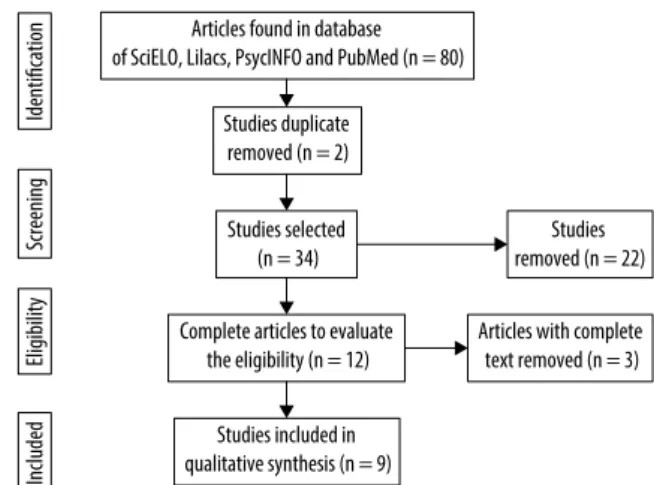
Reviews and Meta-Analyses (PRISMA)26. The search result and
the selection process are shown in igure 1.
Figure 1. Flowchart illustrating the process of selection and analysis of articles.
Identification
Articles found in database of SciELO, Lilacs, PsycINFO and PubMed (n = 80)
Studies duplicate removed (n = 2)
Studies selected (n = 34)
Complete articles to evaluate the eligibility (n = 12)
Studies included in qualitative synthesis (n = 9)
Screening Studies
removed (n = 22)
Articles with complete text removed (n = 3)
Eligibility
Included
RESULTS
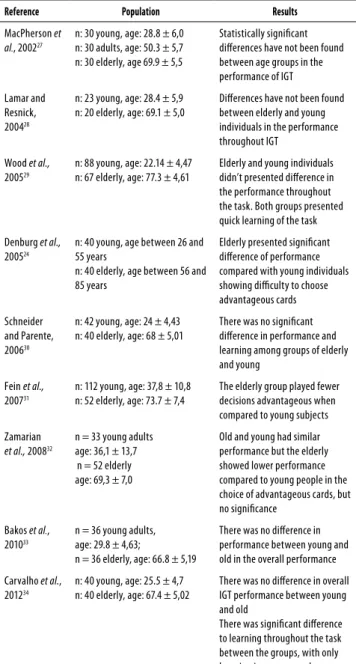
We found nine studies from diferent countries, who inves-tigated 441 young and 377 elderly, and played the IGT as a way of benchmarking the decision-making process. Only two articles showed signiicant diference in the experiment between young and elderly groups according to the evalua-tion of the overall performance index. Two studies evaluate the learning during the task proposed by IGT, and these sho-wed diferences, with young group presenting better perfor-mance (Table 1).
studies performed exclusion for neurological and/or neuro-psychiatric changes to ensure that the indings relate to the healthy elderly. No studies included in this review conducted an evaluation with neuroimaging techniques, which reinfor-ces the need for studies with structural analysis on this sub-ject.
two studies carried out this evaluation and showed diferen-ces in the learning prodiferen-cess, which is faster and more eicient in young individuals.
Denburg et al.24 proposed an additional classiication
based on behavior acquired during decision-making, it was about monetary choices in the short and long-term, and thus evaluated the participant with advantageous, border-line or impaired behavior. Using this same classiication, four articles evaluated the volunteers’ behavior and three of them found elderly patients with signiicantly impaired
performance compared to young subjects24,31,32. According
to Peters et al.35, changes in the decision-making process
re-lated to age favor a poorer quality decision, so that the adap-tive processes include greater emotional selectivity and life experience to predict better or worse decisions depending on the situation.
Wood et al.29 also conducted a modiied analysis of the
IGT proposed by Busemeyer and Strout36 which evaluated
the decision-making with mathematical calculations based on the model of expectancy valence. These authors found a higher valuation gains and expected reward in the elder-ly group. They also showed that the groups used diferent strategies: young people used more memory and learning whereas elderly gave more importance to losses and gains. Furthermore, it was also observed that younger individuals showed greater negativity bias at neural and behavioral level whereas elderly did not increase the level of attention be-fore a negative information. It is known that the age-related changes in cognitive abilities such as memory and process-ing speed as well as increased reliance on automatic and adaptive motivational processes in older adults focus more on afective information (especially positive), what can ex-plain why older and younger adults respond diferently to
information about risk3,37.
Regarding knowledge acquired during the task, only two studies conducted this analysis in which was found a signiicant diference between young and old, with young
people showing better learning. Brand et al.38 showed that
a poor performance during the IGT can be caused by the deicit in implicit learning, as people can train these skills during the experience gained in the test. Since in IGT, there is no information regarding the likelihood, participants need to learn about the value of the options selected and feed-back throughout their choices. The decreased of cognitive stability and lexibility in reaction to advantageous decisions
facing negative feedback in the elderly,can lead in learning
diiculties in this group associated to these ambiguous con-ditions37.
This review has some limitations as the divergence of tests used in neuropsychological assessment, the small num-ber of databases consulted and a possible low sensitivity of IGT as a parameter for comparison, suggesting the investiga-tion of other tests to elderly evaluainvestiga-tion.
Table 1. Study characteristics and results
Reference Population Results
MacPherson et al., 200227
n: 30 young,age: 28.8 ± 6,0 n: 30 adults,age: 50.3 ± 5,7 n: 30 elderly,age 69.9 ± 5,5
Statistically signiicant diferences have not been found between age groups in the performance of IGT
Lamar and Resnick, 200428
n: 23 young,age: 28.4 ± 5,9 n: 20 elderly,age: 69.1 ± 5,0
Diferences have not been found between elderly and young individuals in the performance throughout IGT
Wood et al., 200529
n: 88 young,age: 22.14 ± 4,47 n: 67 elderly,age: 77.3 ± 4,61
Elderly and young individuals didn’t presented diference in the performance throughout the task. Both groups presented quick learning of the task
Denburg et al., 200524
n: 40 young, age between 26 and 55 years
n: 40 elderly,age between 56 and 85 years
Elderly presented signiicant diference of performance compared with young individuals showing diiculty to choose advantageous cards
Schneider and Parente, 200630
n: 42 young,age: 24 ± 4,43 n: 40 elderly,age: 68 ± 5,01
There was no signiicant diference in performance and learning among groups of elderly and young
Fein et al., 200731
n: 112 young, age: 37,8 ± 10,8 n: 52 elderly,age: 73.7 ± 7,4
The elderly group played fewer decisions advantageous when compared to young subjects
Zamarian et al., 200832
n = 33 young adults age: 36,1 ± 13,7 n = 52 elderly age: 69,3 ± 7,0
Old and young had similar performance but the elderly showed lower performance compared to young people in the choice of advantageous cards, but no signiicance
Bakos et al., 201033
n = 36 young adults, age: 29.8 ± 4,63;
n = 36 elderly, age: 66.8 ± 5,19
There was no diference in performance between young and old in the overall performance
Carvalho et al., 201234
n: 40 young,age: 25.5 ± 4,7 n: 40 elderly,age: 67.4 ± 5,02
There was no diference in overall IGT performance between young and old
There was signiicant diference to learning throughout the task between the groups, with only learning in young people
DISCUSSION
In fact, our results suggest there is no diference in the decision-making process in the elderly. Still, it is necessary further studies to investigate the performance between young and old, as well as evaluation of the analytical and emotional performance. Furthermore, it is important to have a greater understanding of the strategies used in the process of decision-making and the anatomical areas involved in per-forming this task, since authors point out that the similarities regarding performance can exist thanks to the involvement of diferent brain structures and networks (compensatory) in the elderly.
The dorsolateral dysfunction is more sensitive than the ventromedial to the efects of aging, so that changes in exe-cutive functioning and working memory are more sensitive to changes at this life stage. By this reason the efects of ag-ing and emotional processag-ing in decision-makag-ing are less apparent because they are more speciic to the ventrome-dial area27.
Rogalsky et al.21 states that elderly without neurological
disorders shows impared decision making, like IGT. Through behavioral analysis of include studies, it was observed that ive studies classiied the behavior of decision-making, and between them three showed that olders have less
advanta-geous decision compared to the young individuals. Beitz et
al.39 states that older adults were more likely to forget about
recent outcomes and this fact could inluence of cogni-tive ability at IGT with lowered performance in older adults.
Bechara et al.40 points out that besides the cognitive deicit,
impulsivity can also generate deicit in performance of IGT.
Denburg et al.24 showed that diferences in
decision-making between young and elderly may be due to dispro-portionate aging of ventromedial cortex that could explain the slowness in learning and the presence of impulsivity.
MacPherson et al.27 asserted that, by the frontal lobe aging
theory, the alterations are more evident was in the dorso-lateral and therefore, the diferences are not observable in the IGT, since this test involves the more ventromedial area.
More recently, Lamar and Resnick28 observed the existence
of this disproportionate susceptibility, where the tasks relat-ed to the orbitofrontal cortex function has greater sensitiv-ity to the aging efects when compared to the one related with dorsolateral prefrontal cortex function. So, the lack of diference may be due to low sensitivity of IOWA for healthy aging33,34.
CONCLUSION
Articles evaluated showed there is no consensus on the exis-tence of diferences in performance of the decision-making process between old and young. Those who observed the behavior of individuals in the face of losses and gains, 60% of articles showed that the elderly has more disadvantageous
choices throughout the task. These indings may be attribu-ted to the use of diferent cognitive strategies on the part of the elderly and the low sensitivity of IOWA Gambling Task in detecting changes in this population.
INDIVIDUAL CONTRIBUTIONS
Carine Wiesiolek – Substantially contributed to concep-tion, analysis and interpretation of data.
Maria Paula Foss and Paula R. Beserra Diniz – Sub-stantially contributed to drafting the article and revising it critically for important intellectual content. They had given the inal approval of the version to be published.
CONFLICTS OF INTEREST AND FINANCIAL
DISCLOSURES
There were no conlicts of interest and inancial support.
REFERENCES
1. Kennedy KM, Erickson KI, Rodrigue KM, Voss MW, Kramer AF, Acker JD, et al. Age-related diferences in regional brain volumes: a comparison of optimized voxel-based morphom-etry to manual volummorphom-etry. Neurobiol Aging. 2009;30(10):1657-76.
2. Ferreira LK, Busatto GF. Resting-state functional connectivity in normal brain aging. Neu-rosci Biobehav Rev. 2013;37(3):384-400.
3. Finucane ML. Emotion, afect, and risk communication with older adults: challenges and opportunities. J Risk Res. 2008;11(8):983-97.
4. Hosseini AMH, Rostami M, Yomogida Y, Takahashi M, Tsukiura T, Kawashima R. Aging and decision making under uncertainty: behavioral and neural evidence for the preservation of decision making in the absence of learning in old age. Neuroimage. 2010;52(4):1514-20.
5. Worthy DA, Gorlick MA, Pacheco JL, Schnyer DN, Maddox TW. With age comes wisdom: decision making in younger and older adults. Psychol Sci. 2011;22(111):1375-80.
6. Wang Y, Ruhe G. The cognitive process of decision making. IJCINI. 2007(1):73-85.
7. Funahashi S. Neural mechanisms of decision making. Brain Nerve. 2008;60(9):1017-27.
8. Jack CR, Petersen RC, Xu YC, Waring SC, O’brien PC, Tangalos EG, et al. Medial temporal atro-phy on MRI in normal aging and very mild Alzheimer’s disease. Neurology. 1997;49(3):786-94.
9. Raz N, Lindenberger U, Rodrigue KM, Kennedy KM, Head D, Williamsons A, et al. Regional brain changes in aging healthy adults: general trends, individual diferences and modiiers cerebral cortex. 2005;15(11):1676-89.
10. Beste C, Willemssen R, Saft C, Falkenstein M. Error processing in normal aging and in basal ganglia disorders. Neuroscience. 2009;159(1):143-9.
11. Brabec J, Rulseh A, Hoyt B, Vizek M, Hornek D, Hort J, et al. Volumetry of the human amyg-dala – An anatomical study. Psychiatry Res. 2010;182(1):67-72.
12. Guitart-Masip M, Barnes GR, Horner A, Bauer M, Dolan RJ, Duzel M. Synchronization of medial temporal lobe and prefrontal rhythms in human decision making. J Neurosci. 2013;33(2):442-51.
13. Floresco SB, Ghods-Sharii S. Amygdala-prefrontal cortical circuitry regulates efort-based decision making. Cereb Cortex. 2007;17(2):251-60.
14. Rushworth MFS, Behrens ETJ. Choice, uncertainty and value in prefrontal and cingulate cortex. Nat Neurosci. 2008;11:389-97.
16. Eppinger B, Hammerer D, Li SC. Neuromodulation of reward-based learning and decision-making in human aging. Ann N Y Acad Sci. 2011;1235:1-17.
17. Bechara A, Tranel D, Damasio H. Characterization of the decision-making deicit of patients with ventromedial prefrontal cortex lesions. Brain. 2000;123(Pt 11):2189-202.
18. Bechara A. Disturbances of emotion regulation after focal brain lesions. Int Rev Neurobiol. 2004;62:159-93.
19. Lamar M, Resnick SM. Aging and prefrontal functions: dissociating orbitofrontal and dor-solateral abilities. Neurobiol Aging. 2004;25(4):553-8.
20. Cheng CP, Sheu CF, Yen NS. A mixed-efects expectancy-valence model for the Iowa gam-bling task. Behav Res Methods. 2009;41(3):657-63.
21. Rogalsky C, Vidal C, Li X, Damasio H. Risky decision-making in older adults without cognitive deicits: an fMRI study of VMPFC using the Iowa Gambling Task. Soc Neurosci. 2012;7(2):178-90.
22. Cardoso CO, Cotrena C. Tomada de decisão examinada pelo Iowa Gambling Task: análise das variáveis de desempenho. Neuropsicol Lat Am. 2012;5(1):24-30.
23. Bechara A, Damasio H, Tranel D, Damasio AR. Deciding advantageously before knowing the advantageous strategy. Science. 1997;275(5304):1293-5.
24. Denburg NL, Tranel D, Bechara A. The ability to decide advantageously declines prema-turely in some normal older persons. Neuropsychologia. 2005;43(7):1099-106.
25. Bechara A. Risky business: emotion, decision-making, and addiction. J Gambl Stud. 2008;19(1):20-7.
26. Liberati A, Altman DG, Tetzlaf J, Mulrow C, Gotzsche PC, Ioannidis JP, et al. The PRISMA statement for reporting systematic reviews and meta-analyses of studies that evaluate health care interventions: explanation and elaboration. J Clin Epidemiol. 2009;62(10):e1-34.
27. MacPherson SE, Phillips LH, Della Sala S. Age, executive function, and social decision mak-ing: a dorsolateral prefrontal theory of cognitive aging. Psychol Aging. 2002;17(4):598-609.
28. Lamar M, Resnick SM. Aging and prefrontal functions: dissociating orbitofrontal and dor-solateral abilities. Neurobiol Aging. 2004;25(4):553-8.
29. Wood S, Busemeyer J, Koling A, Cox CR, Davis H. Older adults as adaptive decision makers: evidence from the Iowa Gambling Task. Psychol Aging. 2005;20(2):220-5.
30. Schneider DDG, Parente MAMP. O desempenho de adultos jovens e idosos na Iowa Gam-bling Task (IGT): um estudo sobre a tomada de decisão. Psicol Relex Crit. 2006;19(3):442-50.
31. Fein G, McGillivray S, Finn P. Older adults make less advantageous decisions than younger adults: cognitive and psychological correlates. J Int Neuropsychol Soc. 2007;13(3):480-9.
32. Zamarian L, Sinz H, Bonatti E, Gamboz N, Delazer M. Normal aging afects decisions under ambiguity, but not decisions under risk. Neuropsychology. 2008;22(5):645-5.
33. Bakos DS, Parente MAMP, Bertagnolli AC. A tomada de decisão em adultos jovens e em adultos idosos: um estudo comparativo. Psicol Cienc Prof. 2010;30(1):162-73.
34. Carvalho JC, Cardoso CO, Shneider-Bakos D, Kristensen CH, Fonseca RP. The efect of age on decision making according to the Iowa Gambling Task. Span J Psychol. 2012;15(2):480-6.
35. Peters E, Hess TM, Vastja D, Auman C. Adult age diferences in dual information processes implications for the role of afective and deliberative processes in older adults’ decision-making. Perspect Psychol Sci. 2007;2:1-2.
36. Busemeyer JC, Stout JR. A contribution of cognitive decision models to clinical as-sessment: decomposing performance on the Bechara gambling task. Psychol Assess. 2002;14(3):253-62.
37. Ska B, Fonseca RP, Scherer SC, Oliveira CR, Parente MAMP. Mudanças no processamento cognitivo em adultos idosos: déicits ou estratégias adaptativas? Estudo Interdisciplinar sobre o Envelhecimento. 2009;14(1):13-24.
38. Brand M, Markowitsch HJ. Aging and decision-making: a neurocognitive perspective. Ger-ontology. 2010;56(3):319-24.
39. Beitz KM, Salthouse TA, Davis HP. Performance on the Iowa Gambling Task: From 5 to 89 years of age. J Exp Psychol Gen. 2014;143(4):1677-89.