www.atmos-chem-phys.net/8/4095/2008/ © Author(s) 2008. This work is distributed under the Creative Commons Attribution 3.0 License.
Chemistry
and Physics
Amines are likely to enhance neutral and ion-induced sulfuric
acid-water nucleation in the atmosphere more effectively than
ammonia
T. Kurt´en, V. Loukonen, H. Vehkam¨aki, and M. Kulmala
Division of Atmospheric Sciences and Geophysics, Dept. of Physics, P.O.Box 64, 00014 University of Helsinki, Finland Received: 12 February 2008 – Published in Atmos. Chem. Phys. Discuss.: 16 April 2008
Revised: 17 June 2008 – Accepted: 17 June 2008 – Published: 30 July 2008
Abstract. We have studied the structure and formation
ther-modynamics of dimer clusters containing H2SO4or HSO−4 together with ammonia and seven different amines possi-bly present in the atmosphere, using the high-level ab ini-tio methods RI-MP2 and RI-CC2. As expected from e.g. proton affinity data, the binding of all studied amine-H2SO4 complexes is significantly stronger than that of NH3•H2SO4, while most amine-HSO−4 complexes are only somewhat more strongly bound than NH3•HSO−4. Further calculations on larger cluster structures containing dimethylamine or am-monia together with two H2SO4 molecules or one H2SO4 molecule and one HSO−4 ion demonstrate that amines, unlike ammonia, significantly assist the growth of not only neutral but also ionic clusters along the H2SO4co-ordinate. A sen-sitivity analysis indicates that the difference in complexation free energies for amine- and ammonia-containing clusters is large enough to overcome the mass-balance effect caused by the fact that the concentration of amines in the atmosphere is probably 2 or 3 orders of magnitude lower than that of ammonia. This implies that amines might be more impor-tant than ammonia in enhancing neutral and especially ion-induced sulfuric acid-water nucleation in the atmosphere.
1 Introduction
Based on experimental and modeling results, particle for-mation by nucleation in the lower atmosphere is thought to involve water and sulfuric acid, with possible contributions from ions, ammonia or various organic molecules (Korho-nen et al., 1999; Kulmala et al., 2000; Anttila et al., 2005).
Correspondence to: T. Kurt´en ([email protected])
Recent experimental results (Kulmala et al., 2007) indicate that neutral mechanisms are likely to dominate nucleation at least in boreal forest areas, with ion-induced nucleation playing only a small role. The effect of ammonia in the sul-furic acid-water nucleation process has been studied exten-sively. Experimental results (Ball et al., 1999) suggest that ammonia enhances nucleation by 1–2 orders of magnitude, whereas theoretical studies have previously given varying predictions. Recent quantum chemical calculations demon-strate that when appropriate methods are applied to suffi-ciently large cluster structures (containing two or more sulfu-ric acid molecules), also molecular-level simulations repro-duce the experimentally observed nucleation-enhancing ef-fect (Kurt´en et al., 2007a; Torpo et al., 2007; Nadykto and Yu, 2007). Experiments (Ball et al., 1999), updated and cor-rected classical nucleation theory simulations (Anttila et al., 2005) and quantum chemical calculations are now all in qual-itative agreement, and indicate a modest enhancement of sul-furic acid-water nucleation by ammonia in most atmospheric conditions.
4096 T. Kurt´en et al.: Amines enhance atmospheric sulfuric acid nucleation compounds are involved in stabilizing the clusters. Kurt´en et
al. (2007b) recently computed formation energies for small neutral and ionic sulfuric acid-water and sulfuric acid-water-ammonia clusters, and found that the HSO−4 ion is very weakly bound to ammonia. This result was confirmed by Ortega et al. (2008), who also computed formation energies of charged clusters containing HSO−4, NH3 and up to three H2SO4molecules, and found that ammonia does not enhance ion-induced sulfuric acid-water nucleation. Some other com-pound or family of comcom-pounds are thus needed to explain the experimental observations of Laakso et al. (2007).
Like ammonia, amines are able to form e.g. nitrate or sulfate salts in atmospheric conditions. Indeed, chemical intuition and proton affinity data (Hunter and Lias, 1998) indicates that proton transfer should occur more easily for amine-acid clusters than for ammonia-acid clusters, leading to stronger binding. Based on laboratory chamber experi-ments and quantum chemical calculations on crystal struc-tures, Murphy et al. (2007) recently reported that for nu-cleation processes involving nitric acid, amines such as di-ethylamine may be more effective than ammonia in form-ing new particles. Based on a combination of smog chamber experiments and field measurements, Angelino et al. (2001) suggested that amine chemistry “may play a significant role in particle formation in regions with high amine concentra-tions” due to both acid-base and oxidation reactions. Also, in an experimental study by M¨akel¨a et al. (2001) dimethylam-monium, the ionic form of dimethylamine, was found to be present in aerosol particles during particle formation events and/or the immediately following particle growth processes in Hyyti¨al¨a, Southern Finland. The relative difference be-tween event and non-event dimethylamine concentrations in the aerosol phase were approximately 50-fold, indicating that dimethylamine is involved in particle formation. In view of these results, it is possible that amines, instead of ammonia, are the primary enhancers of sulfuric acid-water nucleation, or may at least significantly contribute to particle formation in the atmosphere.
As a first step in the investigation of the atmospheric relevance of sulfuric acid-amine clusters, we have calcu-lated the structure and binding energies of clusters com-prising one sulfuric acid and either ammonia, methylamine, dimethylamine, trimethylamine, ethylamine, diethylamine, triethylamine or ethylmethylamine, using high-level ab ini-tio methods. The same calculaini-tions were then performed with the hydrogensulfate ion instead of sulfuric acid. Based on the results of these calculations, as well as the results of M¨akel¨a et al. (2001), further calculations were then car-ried out on clusters containing dimethylamine or ammonia together with either two sulfuric acid molecules or one sul-furic acid molecule and one hydrogensulfate ion. Qualitative estimates for the formation enthalpies, entropies and Gibbs free energies were then computed for all clusters using the harmonic oscillator and rigid rotor approximations.
2 Computational details
All calculations were performed using the Turbomole v.5.8. program suite (Ahlrichs et al., 1989; H¨aser and Ahlrichs, 1989). For structure optimizations and vibrational frequency calculations, we used the RI-MP2 method (Weigend and H¨aser, 1997; Weigend et al., 1998) with the frozen-core ap-proximation and the aug-cc-pV(D+d)Z basis set (Dunning et al., 2001), though some test optimizations were also per-formed using the larger aug-cc-pV(T+d)Z basis set (Dunning et al., 2001) (see the supporting information for details). The auxiliary basis sets needed for the RI expansion are given by Weigend et al. (2002). Final electronic energies were com-puted using the RI-MP2 and RI-CC2 methods (Christiansen et al., 1995) and the aug-cc-pV(T+d)Z basis set. Though the correlation energy computed by the RI-CC2 method is more accurate than that given by RI-MP2, the RI-CC2 method is primarily designed to compute molecular properties rather than energies, and it should therefore be noted that the results are thus not as accurate as those computed using, for exam-ple, the more demanding coupled cluster methods CCSD or CCSD(T). In a recent high-level study on small neutral and charged sulfuric acid - water clusters (Kurt´en et al., 2007b), we have shown that at the RI-MP2 level, increasing the ba-sis set size beyond aug-cc-pV(T+d)Z has only a small ef-fect on the intermolecular binding (complexation) energies. The commonly used counterpoise (CP) correction seems to significantly exaggerate basis-set related errors for large ba-sis sets containing multiple diffuse baba-sis functions (Kurt´en et al., 2007b; Feller, 1992), and is therefore not computed here. The convergence with respect to the electronic energy in the self-consistent field (SCF) step was 10−7a.u. (atomic units), and the convergence with respect to the gradient was 10−4a.u. For the numerical frequency calculations, a step-size of 0.01 a.u. and a SCF convergence limit of 10−8a.u. were used, based on test calculations carried out as part of an earlier study on sulfuric acid-ammonia clusters (Kurt´en et al., 2007c). As the emphasis of this study is on compar-ing complex formation free energies of amine- and ammonia-containing clusters rather than on computing accurate abso-lute free energies, no scaling factors were used to account for vibrational anharmonicity. For details on the effect of anharmonicity on this type of cluster structures, and on the difficulties in constructing reliable scaling factor approaches for free energy calculations, see Kurt´en et al. (2007b).
3 Results and discussion
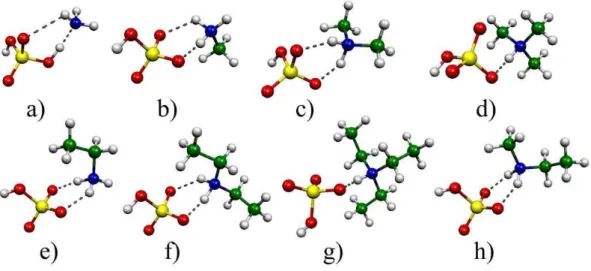
Fig. 1. The structures of dimer clusters containing sulfuric acid and ammonia or various amines: a) H2SO4•NH3, b) H2SO4•CH3NH2, c) H2SO4•(CH3)2NH, d) H2SO4•(CH3)3N, e) H2SO4•CH3CH2NH2, f) H2SO4•(CH3CH2)2NH, g) H2SO4•(CH3CH2)3N, h) H2SO4•(CH3CH2)NH(CH3). Hydrogen bonds are indicated by dashed lines. Color coding: yellow = sulfur, red = oxygen, blue = nitrogen, green = carbon and white = hydrogen.
Table 1. Electronic energies computed for the dimer formation reactions at different levels of theory. DZ and TZ correspond to aug-cc-pV(D+d)Z and aug-cc-pV(T+d)Z, respectively. All values correspond to geometries optimized at the RI-MP2/aug-cc-aug-cc-pV(D+d)Z level.
Reaction 1E0, 1E0, 1E0,
RI-MP2/DZ RI-MP2/TZ RI-CC2/TZ kcal/mol kcal/mol kcal/mol
H2SO4+ NH3↔H2SO4•NH3 −16.99 −17.08 −17.37
H2SO4+ CH3NH2↔H2SO4•CH3NH2 −21.91 −21.90 −22.84 H2SO4+ CH3CH2NH2↔H2SO4•CH3CH2NH2 −23.78 −23.40 −24.53 H2SO4+ (CH3)2NH↔H2SO4•(CH3)2NH −26.73 −26.06 −27.22 H2SO4+ (CH3CH2)2NH↔H2SO4•(CH3CH2)2NH −30.05 −29.09 −30.19 H2SO4+ (CH3)3N↔H2SO4•(CH3)3N −28.71 −27.51 −28.47 H2SO4+ (CH3CH2)3N↔H2SO4•(CH3CH2)3N −33.09 −31.05 −32.16 H2SO4+ (CH3CH2)NH(CH3)↔H2SO4•(CH3CH2)NH(CH3) −28.14 −27.34 −28.48
HSO−4 + NH3↔HSO−4•NH3 −10.79 −10.60 −10.85
HSO−4 + CH3NH2↔HSO−4•CH3NH2 −10.66 −9.79 −10.12 HSO−4 + CH3CH2NH2↔HSO−4•CH3CH2NH2 −12.07 −10.92 −11.36 HSO−4 + (CH3)2NH↔HSO−4•(CH3)2NH −14.06 −13.65 −14.25 HSO−4 + (CH3CH2)2NH↔HSO−4 •(CH3CH2)2NH −15.47 −14.56 −15.33 HSO−4 + (CH3)3N↔HSO−4 •(CH3)3N −13.12 −12.09 −12.80 HSO−4 + (CH3CH2)3N↔HSO−4 •(CH3CH2)3N −15.61 −13.81 −14.78 HSO−4 + (CH3CH2)NH(CH3)↔HSO−4 •(CH3CH2)NH(CH3) −15.03 −14.31 −15.03
enthalpies and entropies are presented in the supporting information along with the coordinates for all studied cluster structures (http://www.atmos-chem-phys.net/8/4095/ 2008/acp-8-4095-2008-supplement.pdf).
The electronic energies for the formation of the various dimer clusters from their constituent molecules are shown in Table 1. The values have been computed at three lev-els of theory: pV(D+d)Z,
4098 T. Kurt´en et al.: Amines enhance atmospheric sulfuric acid nucleation
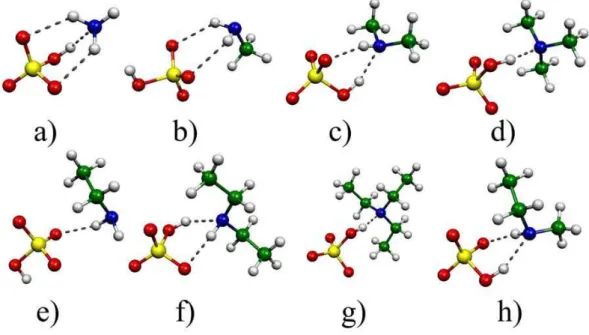
Fig. 2. The structures of ionic dimer clusters containing a hydrogensulfate ion and ammonia or various amines: a) HSO−4•NH3, b) HSO−4•CH3NH2, c) HSO−4•(CH3)2NH, d) HSO−4•(CH3)3N, e) HSO−4•CH3CH2NH2, f) HSO−4•(CH3CH2)2NH, g) HSO−4•(CH3CH2)3N, h) HSO−4•(CH3CH2)NH(CH3). Hydrogen bonds are indicated by dashed lines. Color coding as in Fig. 1.
Table 2. Enthalpies, entropies and Gibbs free energies computed for the dimer formation reactions at 298 K and 1 atm reference pressure for all reactants. All values correspond to RI-MP2/aug-cc-pV(D+d)Z geometries and harmonic vibrational frequencies and RI-CC2/aug-cc-pV(T+d)Z electronic energies.
Reaction 1H(298 K) 1S(298 K) 1G(298 K)
kcal/mol cal/Kmol kcal/mol
H2SO4+ NH3↔H2SO4•NH3 −16.06 −31.60 −6.64
H2SO4+ CH3NH2↔H2SO4•CH3NH2 −20.87 −36.62 −9.95 H2SO4+ CH3CH2NH2↔H2SO4•CH3CH2NH2 −22.45 −38.22 −11.06 H2SO4+ (CH3)2NH↔H2SO4•(CH3)2NH −24.73 −37.14 −13.66 H2SO4+ (CH3CH2)2NH↔H2SO4•(CH3CH2)2NH −27.73 −37.65 −16.53 H2SO4+ (CH3)3N↔H2SO4•(CH3)3N −26.01 −36.08 −15.26 H2SO4+ (CH3CH2)3N↔H2SO4•(CH3CH2)3N −29.54 −41.04 −17.30 H2SO4+ (CH3CH2)NH(CH3)↔H2SO4•(CH3CH2)NH(CH3) −25.94 −36.78 −14.97
HSO−4 + NH3↔HSO4−•NH3 −9.07 −40.57 1.75
HSO−4 + CH3NH2↔HSO4−•CH3NH2 −8.68 −33.14 1.20
HSO−4 + CH3CH2NH2↔HSO4−•CH3CH2NH2 −10.00 −33.82 0.09 HSO−4 + (CH3)2NH↔HSO−4•(CH3)2NH −12.73 −40.15 −0.76 HSO−4+ (CH3CH2)2NH↔HSO−4 •(CH3CH2)2NH −14.37 −43.76 −0.94 HSO−4 + (CH3)3N↔HSO4−•(CH3)3N −11.27 −39.46 0.50 HSO−4+ (CH3CH2)3N↔HSO4−•(CH3CH2)3N −13.35 −44.80 0.01 HSO−4+ (CH3CH2)NH(CH3)↔HSO−4•(CH3CH2)NH(CH3) −13.49 −38.20 −1.71
clusters, as the free ion is likely to possess an internal rota-tion degree of freedom (Kurt´en et al., 2007b). However, the contribution of this error source is essentially constant, so the relative energetics (e.g. differences in formation free energies between HSO−4-ammonia and HSO−4-amine complexes) are still relatively reliable.
not the free energy.) For the neutral dimers, the stabiliza-tion effect associated with the substitustabiliza-tion of one or more hydrogens of ammonia with alkyl groups is very large, on the order of 5–15 kcal/mol. The magnitude of this effect sys-tematically increases both with the number and size of the alkyl substituents. As expected, the ordering of the complex-ation free energies for the neutral dimers follows that of the proton affinites reported by Hunter and Lias (1998). How-ever, for the charged dimers, this is not the case. Overall, the stabilization effect is much smaller for the charged clus-ters, on the order of 0–3 kcal/mol, and while increasing the substituent size still systematically increases the stability of the complex, the dimers containing disubstituted amines are more stable than the dimers containing mono- or trisubsti-tuted amines.
For the neutral complexes, the main reason for the large effect on the formation energies is apparent from Fig. 1: the alkyl groups on the amines are better able to stabilize the positive charge associated with proton transfer from an SOH group to the nitrogen atom, which leads to the formation of a strongly bound ion pair. For H2SO4-NH3clusters, in con-trast, the presence of two sulfuric acids are required for pro-ton transfer to occur (Kurt´en et al., 2007a; Nadykto and Yu, 2007). This also explains, on a microscopic level, the growth in stability (and increase in proton affinity) as a function of substituent size and number: larger and more numerous sub-stituents are able to stabilize the positive charge better.
In the case of the HSO−4 ion, there is no weakly bound proton to transfer, and the change in stability is correspond-ingly smaller, as it involves only the strengthening of existing hydrogen bonds instead of the formation of new ion pairs. The decrease in stability in going from di- to trisubstituted amines is probably explained by the fact that while the dis-ubstituted amines can form two hydrogen bonds with HSO−4, the trisubstituted amines can form only one, as they lack the additional hydrogen atom needed for the bond (see Fig. 2). For the neutral complexes, the increased ion pair stabilization in going from di- to trisubstituted amines seems to outweigh the absence of the second, weaker hydrogen bond. However, the difference in stability between dimers containing di- and trisubstituted amines is much smaller than the difference be-tween dimers containing mono- and disubstitude amines, es-pecially in the case of the neutral complexes. While it is very unlikely that the addition of water molecules will change the central conclusion that amines are much more strongly bound to sulfuric acid than ammonia is, hydration may change the bonding patterns seen in Figs. 1–3, and affect the relative stability of different amine-acid clusters. For example, the more highly substituted amines are less hydrophilic than am-monia or the less substituted amines. Thus, accounting for hydration of the clusters is likely to somewhat decrease the differences in stability observed in Tables 1 and 2.
In order to assess the importance of amines for sulfu-ric acid-related nucleation processes, it is not enough to know how strongly they are bound to a single sulfuric acid
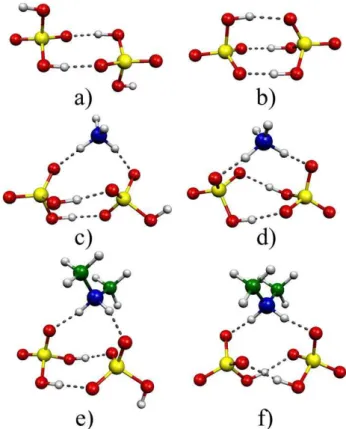
Fig. 3. The structures of most stable cluster struc-tures containing two sulfuric acid molecules or one sul-furic acid and one hydrogensulfate ion: a) (H2SO4)2, b) H2SO4•HSO−4, c) (H2SO4)2•NH3, d) H2SO4•HSO−4•NH3, e) (H2SO4)2•(CH3)2NH, f) H2SO4•HSO−4•(CH3)2NH. Hy-drogen bonds are indicated by dashed lines. Color coding as in Fig. 1.
4100 T. Kurt´en et al.: Amines enhance atmospheric sulfuric acid nucleation
Table 3. Electronic energies computed for the addition of sulfuric acid to various clusters, at different levels of theory. DZ and TZ correspond to aug-cc-pV(D+d)Z and aug-cc-pV(T+d)Z, respectively. All values correspond to geometries optimized at the RI-MP2/aug-cc-pV(D+d)Z level.
Reaction 1E0, 1E0, 1E0,
RI-MP2/DZ RI-MP2/TZ RI-CC2/TZ kcal/mol kcal/mol kcal/mol
H2SO4+ H2SO4↔(H2SO4)2 −17.99 −18.97 −19.04 H2SO4•NH3+ H2SO4↔(H2SO4)2•NH3 −29.51 −30.53 −31.21 H2SO4•(CH3)2NH + H2SO4↔(H2SO4)2•(CH3)2NH −33.66 −34.38 −34.41 HSO−4 + H2SO4↔HSO−4•H2SO4 −47.11 −48.87 −49.05 HSO−4•NH3+ H2SO4↔HSO−4•H2SO4•NH3 −49.68 −50.27 −51.23 HSO−4•(CH3)2NH + H2SO4↔HSO−4•H2SO4•(CH3)2NH −59.01 −58.39 −59.40
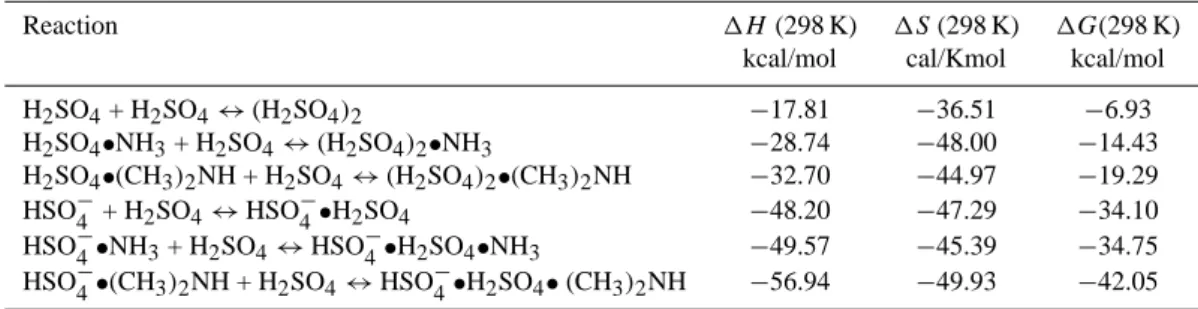
Table 4. Enthalpies, entropies and Gibbs free energies computed for the addition of sulfuric acid to various ammonia or dimethylamine-containing clusters, at 298 K and 1 atm reference pressure for all reactants. All values correspond to RI-MP2/aug-cc-pV(D+d)Z geometries and harmonic vibrational frequencies and RI-CC2/aug-cc-pV(T+d)Z electronic energies.
Reaction 1H(298 K) 1S(298 K) 1G(298 K)
kcal/mol cal/Kmol kcal/mol
H2SO4+ H2SO4↔(H2SO4)2 −17.81 −36.51 −6.93 H2SO4•NH3+ H2SO4↔(H2SO4)2•NH3 −28.74 −48.00 −14.43 H2SO4•(CH3)2NH + H2SO4↔(H2SO4)2•(CH3)2NH −32.70 −44.97 −19.29 HSO−4 + H2SO4↔HSO−4•H2SO4 −48.20 −47.29 −34.10 HSO−4•NH3+ H2SO4↔HSO−4•H2SO4•NH3 −49.57 −45.39 −34.75 HSO−4•(CH3)2NH + H2SO4↔HSO−4•H2SO4•(CH3)2NH −56.94 −49.93 −42.05
effectively than ammonia, with the difference in reaction free energies being approximately 5 kcal/mol for the neutral clus-ters and 7 kcal/mol for the charged clusclus-ters. Especially the latter results is significant, as it implies that, despite the low attraction between the various amines and the HSO−4 ion, amines, unlike ammonia, might still enhance ion-induced sulfuric acid nucleation. This is especially relevant given the suggestion by Laakso et al. (2007) that some third compound besides sulfuric acid and water is needed to explain the ob-served ion-induced contribution to nucleation events in the boreal forest.
Beside thermodynamic data at standard conditions, infor-mation on the concentrations of the reactant species is also required to determine the atmospheric role of sulfuric acid-amine cluster formation. From the law of mass balance, the ratio of the concentrations of e.g. dimethylamine - containing clusters to ammonia - containing clusters can be expressed as:
[X•(CH3)2NH] [X•NH3] =
[(CH3)2NH] [NH3]
e−
11G0
RT (1)
where X indicates some cluster composition (e.g. H2SO4•H2SO4 or H2SO4•HSO−4), T is the tempera-ture in Kelvin,Ris the molar gas constant and11G0is the
difference in the standard free energies of formation for the X•(CH3)2NH and X•NH3clusters. Thus, if the gas-phase concentration of dimethylamine is e.g. 100–1000 times smaller than the concentration of ammonia, the formation free energies for the dimethylamine-containing clusters must be more than 3–4 kcal/mol lower than that of the ammonia-containing clusters for their concentrations to be equal.
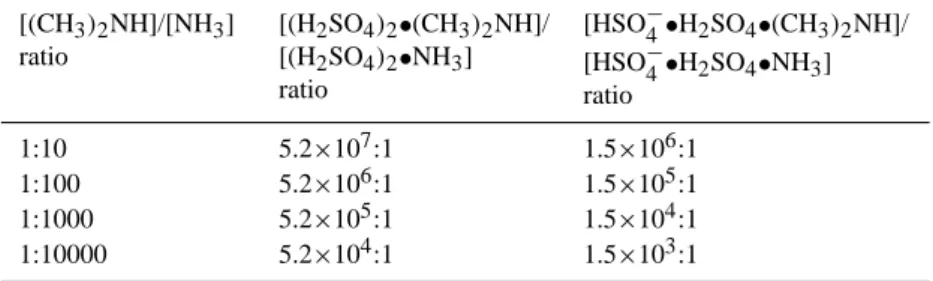
Table 5. Ratio of the concentrations of dimethylamine-containing to ammonia-containing neutral and ionic trimer clusters, as a function of the gas-phase concentration ratio of dimethylamine to ammonia in a hypothetical steady-state situation, based on the free energies of complex formation given in Tables 2 and 4.
[(CH3)2NH]/[NH3] ratio
[(H2SO4)2•(CH3)2NH]/ [(H2SO4)2•NH3] ratio
[HSO−4•H2SO4•(CH3)2NH]/ [HSO−4•H2SO4•NH3] ratio
1:10 5.2×10⁷:1 1.5×10⁶:1
1:100 5.2×10⁶:1 1.5×10⁵:1
1:1000 5.2×10⁵:1 1.5×10⁴:1
1:10000 5.2×10⁴:1 1.5×10³:1
even smaller. However, at a boreal forest site in Hyyti¨al¨a, Finland, trimethylamine concentrations during a spring mea-surement campaign (Sellegri et al., 2005) varied between 34 and 80 ppt, indicating that the order-of-magnitude esti-mate above may be roughly correct. Close to amine emis-sion sources, concentrations may be much higher, e.g. di-ethylamine and butylamine concentrations of over 100 ppb have been reported in the vicinity of a dairy farm in Califor-nia (Rabaud et al., 2003).
These measurements and estimates show that the number concentration of amine molecules may well be equal to or greater than that of sulfuric acid, which typically has concen-trations of 107molecules cm−3 (corresponding to 0.4 ppt at 298 K) or less in non-polluted areas (Spracklen et al., 2006). Even for amine concentrations as low as 1 ppt, the collision rate of amine and sulfuric acid molecules would thus still be on the order of 104–105collisions cm−3s−1, indicating that the formation of atmospherically significant amounts of amine-sulfuric acid clusters is at least not ruled out by col-lision kinetics. Still, in these conditions each sulfuric acid molecule or small cluster collides with an amine molecule only every 100 s or so, implying that while amines are likely to play a significant role in the initial steps of nucleation, their role in subsequent particle growth is likely to be minor. This is in line with atmospheric observations which indicate that the vapors responsible for the formation of 1 nm – scale particles are not the same as those responsible for the growth of particles (Kulmala et al., 2007).
Using the Eq. (1) together with free energies for com-plexation given in Tables 2 and 4, we have computed the ratio of the concentrations of (H2SO4)2•(CH3)2NH to (H2SO4)2•NH3 and HSO4−•H2SO4•(CH3)2NH to HSO−4•H2SO4•NH3 clusters as a function of the ratio of ammonia and dimethylamine concentrations. As the con-centration ratios do not depend strongly on the temperature, results are shown only for 298 K. The results are presented in Table 5. It can be seen from Table 5 that even if the concen-tration of gas-phase dimethylamine is only one thousandth of the ammonia concentration, amine-containing clusters are still likely to dominate the cluster distribution. However,
the application of Eq. (1) presumes a pseudo-steady-state situation, where the formation of complexes does not signifi-cantly deplete the gas-phase reservoir of reactant molecules. For very low absolute amine concentrations, this is almost certainly not the case: the formation of sulfuric acid-amine clusters will then quickly deplete the amine reservoir, and steady-state conditions will not apply. The results presented here should therefore be considered as qualitative order-of-magnitude assessments. A quantitatively reliable determination of the relative atmospheric importance of amine- and ammonia-containing clusters would require both much more reliable concentration data as well as fully kinetic nucleation simulations, which are beyond the scope of this study.
Previously, it has been thought that vegetation influences new-particle formation mainly via the emission of various types of terpenes, which are oxidized in the atmosphere to form condensable vapors (Kulmala et al., 2004b). These vapors may then participate in nucleation (O’Dowd et al., 2002), e.g. via reacting or clustering with sulfuric acid molecules. As vegetation is a also source of amines, a nu-cleation mechanism involving enhancement of sulfuric acid-water nucleation by biogenic amines would provide another link between biogenic vapor emissions from forests and par-ticle formation. The results presented here indicate that the stable pool of 1.5–1.8 nm neutral clusters observed by Kul-mala et al. (2007) in boreal forest conditions are likely to con-tain contributions from amine-sulfuric acid clustering rather than ammonia-sulfuric acid clustering reactions.
4 Conclusions
4102 T. Kurt´en et al.: Amines enhance atmospheric sulfuric acid nucleation more effective than ammonia in enhancing the addition of
sulfuric acid molecules to both neutral and ionic sulfuric acid clusters. This is especially relevant for the ionic clusters, as previous experimental and theoretical studies indicate that in addition to sulfuric acid and water, the participation of some third compound, other than ammonia, is needed to explain the ion-induced contribution to observed nucleation rates. Our results indicate that both neutral and ion-induced nucle-ation mechanisms involving sulfuric acid are likely to be en-hanced much more effectively by amines than by ammonia, even after the differences in their atmospheric concentrations are accounted for. Quantitative determination of the effect of amines on sulfuric acid-water nucleation, and especially the relative effect of different amines, will require the explicit modeling of amine-sulfuric acid cluster hydration, which is beyond the scope of the present paper.
Acknowledgements. We acknowledge the Scientific Computing
Center (CSC) in Espoo, Finland for computing time and the Academy of Finland for financial support. Furthermore, we wish to thank Martta Salonen for useful assistance.
Edited by: A. Wiedensohler
References
Ahlrichs, R., B¨ar, M., H¨aser, M., Horn, H., and K¨olmel, C.: Elec-tronic structure calculations on workstation computers: The pro-gram system Turbomole, Chem. Phys. Lett., 162, 165–169, 1989. Angelino, A., Suess, D. T., and Prather, K.: Formation of Aerosol Particles from Reactions of Secondary and Tertiary Alkylamines: Characterization by Aerosol Time-of-Flight Mass Spectrometry, Environ. Sci. Technol. 35, 3130–3138, 2001.
Anttila, T., Vehkam¨aki, H., Napari, I., and Kulmala, M.: Effect of ammonium bisulphate formation on atmospheric water-sulphuric acid-ammonia nucleation, Boreal Env. Res., 10, 511–523, 2005. Ball, S. M., Hanson, D. R., Eisele, F. L. ,and McMurry, P. H.: Lab-oratory studies of particle nucleation: Initial results for H2SO4, H2O, and NH3vapors, J. Geophys. Res. D, 104, 23 709–23 718, 1999.
Christiansen, O., Koch, H., and Jørgensen, P.: The second-order approximate coupled cluster singles and doubles model CC2, Chem. Phys. Lett., 243, 409–418, 1995.
Dunning Jr., T. H., Peterson, K. A., and Wilson, A. K.: Gaussian basis sets for use in correlated molecular calculations. X. The atoms aluminum through argon revisited, J. Chem. Phys., 114, 9244–9253, 2001.
Feller, A. D.: Application of systematic sequences of wave func-tions to the water dimer, J. Chem. Phys., 96, 6104–6114, 1992. Hunter, E. P. and Lias, S. G.: Evaluated Gas Phase Basicities and
Proton Affinities of Molecules: An Update, J. Phys. Chem. Ref. Data, 27, 413–656 (data available online via the NIST Chemistry WebBook), 1998.
H¨aser, M. and Ahlrichs, R: Improvements on the direct SCF method, J. Comput. Chem., 10, 104–111, 1989.
Korhonen, P., Kulmala, M., Laaksonen, A., Viisanen, Y., McGraw, R., and Seinfeld, J. H.: Ternary nucleation of H2SO4, NH3, and
H2O in the atmosphere, J. Geophys. Res., 104, 26 349–26 353, 1999.
Kulmala, M., Pirjola, L., and M¨akel¨a, J. M.: Stable sulphate clusters as a source of new atmospheric particles, Nature, 404, 66–69, 2000.
Kulmala, M., Vehkam¨aki, H., Pet¨aj¨a, T., Dal Maso, M., Lauri, A., Kerminen, V.-M., Birmili, W., and McMurry, P. H.: Formation and growth rates of ultrafine atmospheric particles: a review of observations, J. Aerosol Sci., 35, 143–176, 2004a.
Kulmala, M., Suni, T., Lehtinen, K. E. J., Dal Maso, M., Boy, M., Reissell, A., Rannik, ¨U., Aalto, P., Keronen, P., Hakola, H., B¨ack, J., Hoffmann, T., Vesala, T., and Hari, P.: A new feedback mechanism linking forests, aerosols, and climate, Atmos. Chem. Phys., 4, 557–562, 2004b,
http://www.atmos-chem-phys.net/4/557/2004/.
Kulmala, M., Riipinen, I., Sipil¨a, M., Manninen, H. E., Pet¨aj¨a, T., Junninen, H., Dal Maso, M., Mordas, G., Mirme, A., Vana, M., Hirsikko, A., Laakso, L., Harrison, R. M., Hanson, I., Leung, C., Lehtinen, K. E. J., and Kerminen, V.-M.: Towards Direct Measurement of Atmospheric Nucleation, Science, 318, 89–92, 2007.
Kurt´en, T., Torpo, L., Ding, C.-G., Vehkam¨aki, H., Sundberg, M. R., Laasonen, K., and Kulmala, M.: A density functional study on water-sulfuric acid-ammonia clusters and implications for atmospheric cluster formation, Geophys. Res., 112, D04210, doi:10.1029/2006JD007391, 2007a.
Kurt´en, T., Noppel, M., Vehkam¨aki, H., Salonen, M., and Kulmala, M.: Quantum chemical studies of hydrate formation of H2SO4 and HSO−4, Boreal Env. Res., 12, 431–453, 2007b.
Kurt´en, T., Torpo, L., Sundberg, M. R., Vehkam¨aki, H., and Kul-mala, M: Estimation of the NH3:H2SO4ratio of nucleating clus-ters in atmospheric conditions using quantum chemical methods, Atmos. Chem. Phys., 7, 2765–2773, 2007c,
http://www.atmos-chem-phys.net/7/2765/2007/.
Laakso, L., Gr¨onholm, T., Kulmala, L., Haapanala, S., Hirsikko, A., Lovejoy, E. R., Kazil, J., Kurt´en, T., Boy, M., Nilsson, E. D., Sogachev, A., Riipinen, I., Strattman, F., and Kulmala, M.: Hot-air balloon measurements of vertical variation of boundary layer new particle formation, Boreal Env. Res., 12, 279–294, 2007. Lovejoy, E. R., Curtius, J., and Froyd, K. D.: Atmospheric
ion-induced nucleation of sulfuric acid and water, J. Geophys. Res., 109, D08204, doi:10.1029/2003JD004460, 2004.
M¨akel¨a, J. M., Yli-Koivisto, S., Hiltunen, V., Seidl, W., Swietlicki, E., Teinil¨a, K., Sillanp¨a¨a, M., Koponen, I. K., Paatero, J., Ros-man, K., and H¨ameri, K.: Chemical composition of aerosol dur-ing particle formation events in boreal forest, Tellus, 53B, 380– 393, 2001.
Murphy, S. M., Sorooshian, A., Kroll, J. H., Ng, N. L., Chhabra, P., Tong, C., Surratt, J. D., Knipping, E., Flagan, R. C., and Seinfeld, J. H: Secondary aerosol formation from atmospheric reactions of aliphatic amines, Atmos. Chem. Phys., 7, 2313–2337, 2007, http://www.atmos-chem-phys.net/7/2313/2007/.
Nadykto, A. B. and Yu, F.: Strong hydrogen bonding between at-mospheric nucleation precursors and common organics, Chem. Phys. Lett., 435, 14–18, 2007.
O’Dowd, C. D., Aalto, P., H¨ameri, K., Kulmala, M., and Hoffmann, T.: Atmospheric particles from organic vapours, Nature, 416, 497–498, 2002.
of Ammonia in Sulfuric Acid Ion-Induced Nucleation, Atmos. Chem. Phys., 8, 2859–2867, 2008,
http://www.atmos-chem-phys.net/8/2859/2008/.
Portmann, S.: MOLEKEL, Version 4.3.win32. Swiss Center for Scientific Computing (CSCS)/ETHZ, Switzerland, 2002. Rabaud, N. E., Ebeler, S. E., Ashbaugh, L. L., and Flocchini, R. G.:
Characterization and quantification of odorous and non-odorous volatile organic compounds near a commercial dairy in Califor-nia, Atmos. Environ., 37, 933–940, 2003.
Schade, G. W. and Crutzen, P. J.: Emission of aliphatic amines from animal husbandry and their reactions: Potential source of N2O and HCN, J. Atmos. Chem. 22, 319–346, 1995.
Seinfeld, J. H. and Pandis, S. N.: Atmospheric Chemistry and Physics: From Air Pollution to Climate Change, Wiley & Sons, New York, USA, 1998.
Sellegri, K., Hankel, M, Umann, B., Arnold, F., and Kulmala, M.: Measurements of organic gases during aerosol formation events in the boreal forest atmosphere during QUEST, Atmos. Chem. Phys., 5, 373–384, 2005,
http://www.atmos-chem-phys.net/5/373/2005/.
Spracklen, D. V., Carslaw, K. S., Kulmala, M., Kerminen, V.-M., Mann, G. W., and Sihto, S.-L.: The contribution of boundary layer nucleation events to total particle concentrations on re-gional and global scales, Atmos. Chem. Phys., 6, 5631–5648, 2006,
http://www.atmos-chem-phys.net/6/5631/2006/.
Torpo, L., Kurt´en, T., Vehkam¨aki, H., Sundberg, M. R., Laasonen, K., and Kulmala, M.: The significant role of ammonia in at-mospheric nanoclusters, J. Phys. Chem. A, 111, 10 671–10 674, 2007.
Weigend, F. and H¨aser, M: RI-MP2: first derivatives and global consistency, Theor. Chem. Acc., 97, 331–340, 1997.
Weigend, F., H¨aser, M., Patzelt, H., and Ahlrichs, R.: RI-MP2: Optimized auxiliary basis sets and demonstration of efficiency, Chem. Phys. Lett., 294, 143–152, 1998.