Nongyrotropic particle distributions in space plasmas
U. Motschmann1;2, K. H. Glassmeier3, A. L. Brinca4
1German Aerospace Center (DLR), Institute for Planetary Exploration, D-12484 Berlin, Germany 2Now at Institute for Theoretical Physics, Technical University, D-38106 Braunschweig, Germany E-mail: [email protected]
3Institute for Geophysics and Meteorology, Technical University, D-38106 Braunschweig, Germany 4Centro de Fisica de Plasmas, Instituto Superior Tecnico, P-1096 Lisboa Codex, Portugal
Received: 16 July 1998=Revised: 10 November 1998=Accepted: 20 November 1998
Abstract. In nonstationary, strong inhomogeneous or open plasmas particle orbits are rather complicated. If the nonstationary time scale is smaller than the gyration period, if the inhomogeneity scale is smaller than the gyration radius, i.e. at magnetic plasma boundaries, or if the plasma has sources and sinks in phase space, then nongyrotropic distribution functions occur. The stabil-ity of such plasma con®gurations is studied in the framework of linear dispersion theory. In an open plasma nongyrotropy drives unstable waves parallel and perpendicular to the background magnetic ®eld, where-as in the gyrotropic limit the plwhere-asma is stable. In nonstationary plasmas nongyrotropy drives perpendic-ular unstable waves only. Temporal modulation couples a seed mode with its side lobes and thus it renders unstable wave growth more dicult. As an example of an inhomogeneous plasma a magnetic halfspace is discussed. In a layer with thickness of the thermal proton gyroradius a nongyrotropic distribution is formed which may excite unstable parallel and perpen-dicular propagating waves.
Key words. Interplanetary physics (plasma waves
and turbulence) áIonosphere (plasma waves and
instabilities)á Magnetospheric physics (plasma waves
and instabilities)
1 Introduction
The study of symmetries is an important tool to describe physical phenomena including the equations which are used to model them. This is also true for distribution functions of plasmas where symmetry is mainly
discus-sed in the phase space, especially in the velocity space. The state of highest symmetry is isotropy; the distribu-tion funcdistribu-tion depends only on the value of the velocity vector and surfaces of equal phase space density are spheres. Such distributions usually occur in the absence of any background magnetic ®elds. In case of a preferred orientation, normally due to an ambient magnetic ®eld, the plasma becomes anisotropic. There is still a symmetry in the plane perpendicular to the magnetic ®eld but in the parallel direction symmetry is broken. Anisotropic plasma distributions are gyrotropic as they are independent of the gyrophase angle. The transition from an isotropic to an anisotropic plasma increases the number of internal degrees of freedom. Consequently the number of possible eigenstates is also increased and expressed by the various wave modes which may exist in such a plasma. If symmetry in the plane perpendicular to the magnetic ®eld is also broken, the distribution function has lost all symmetry proper-ties in the velocity space. It is called nongyrotropic because of the gyrophase dependence is supplemented. The number of degrees of freedom is further increased and new eigenstates are to be expected.
Whereas isotropic and anisotropic plasmas were studied intensively in the last decades widespread interest for nongyrotropic ones has been manifested only since the beginning of the 1990s. These distribu-tions were observed at pickup processes in space plasmas especially when the pickup is burst-like. Evi-dence for nongyrotropy was found at comets (Neubauer
et al., 1993; Glassmeier and Neubauer, 1993; Coates
et al., 1993; Cao et al., 1998), at collisionless shocks (Gosling et al., 1982; Anderson et al., 1985; Thomsen
et al., 1985; Sckopkeet al., 1990; Fuselieret al., 1990), in the plasma environment of the shuttle (Cairns, 1990), at tangential discontinuities in the solar wind (Astudillo
et al., 1996), in the plasma sheet boundary layer (BuÈchner and Kuska, 1996), and in the geomagnetotail (Ashour-Abdallaet al., 1996).
of the particles in any way. This synchronization may be realized in three dierent ways. One possibility is the existence of sources and sinks which are phase-depen-dent in velocity space. Inevitably the distribution becomes gyrophase-dependent. Sources and sinks are e.g. ionization and recombination processes. Distribu-tions in such an open phase space may be stationary and homogeneous in space. Another possibility to generate nongyrotropy consists of a temporal modulation of the distribution. An ensemble of particles once bunched in the gyrophase rotates with the gyroperiod and thus forms a nongyrotropic nonstationary distribution. Such a time-dependent nongyrotropy occurs after a burst-like injection of charged particles into the phasespace, e.g. at a pickup process. Groups of particles which are accel-erated at a shock or another discontinuity with respect to the plasma background and which are repicked up by the background magnetic ®eld also generate such rotating nongyrotropies. A third way for the generation of a nongyrotropic distribution is provided by inhomo-geneous plasmas. Any spatial variation of the magnetic ®eld deforms the circular particle orbits known for homogeneous magnetic ®elds. In general the orbits may become very complicated or even chaotic (BuÈchner and Zelenyi, 1989). Thus, a magnetic gradient may bunch the gyrophases and provide a nongyrotropic distribu-tion. A noticable eect, however, is provided only if the inhomogeneity scale is not very large compared with the particle gyroradius. This is especially realized if the plasma inhomogeneity has the structure of a boundary layer.
Nongyrotropic plasmas are not in thermal equilibri-um. They carry excess energy and may excite unstable waves. Studies of the stability of rotating nongyrotropic distribution functions and of nongyrotropies maintained by sources and sinks in the phase space were performed by Brinca et al. (1992, 1993), Motschmann and Glass-meier (1993, 1998a) and Cao et al. (1995, 1998). The stability of an inhomogeneous nongyrotropy was dis-cussed for a magnetic reversal by Motschmann and Glassmeier (1998b). In broad ranges of the parameters nongyrotropy contributes to the destabilization of a plasma and to the excitation of unstable wave modes. In many observations the nongyrotropy is superimposed by other sources of free energy such as ring distribu-tions, anisotropy distributions or beams. In these observations it is not always easy to separate the contribution of these dierent sources. In theoretical studies, however, it is very easy to perform this separation. Pure nongyrotropies without any other source of excess energy were studied by Brinca and Romeiras (1998) and Motschmann and Glassmeier (1998a). In an open phase space and for propagation parallel to the ambient magnetic ®eld they found a destabilization of the right handed mode. For propaga-tion perpendicular to the ambient magnetic ®eld non-gyrotropy may excite the extraordinary mode. In a rotating nongyrotropy the temporal modulation of any undisturbed distribution may couple wave modes at frequencies which dier from each other by the gyro-frequency of the nongyrotropic plasma component or its
harmonics. Analogous wave mixing at dierent frequen-cies is well known in nonlinear optics and high frequency technologies (Schubert and Wilhelmi, 1971). In the excitation process this coupling eects several waves at the same time. Thus, the excess energy is distributed in a broader spectral range and any thresh-old of the instability is more dicult to hit, as in a
quasi-monochromatic excitation process. Therefore no
instability for parallel propagation was found and for perpendicular propagation unstable wave growth is restricted to narrow parameter ranges.
Nongyrotropic distributions in an inhomogeneous plasma are very dicult to handle. The eigenvalue problem of the stability analysis is not analytically solvable. Even for such intensively studied examples like the Harris sheet (Harris, 1962) only approximate solu-tions were found (Pritchett et al., 1991; Motschmann and Glassmeier, 1998b). In this study we will discuss a magnetic halfspace which is one of the simplest but nontrivial inhomogeneous con®gurations. In the transi-tion layer from the ®eld-free halfspace to the magnetic halfspace the ions penetrate into a sheet with a thickness of the order of the thermal gyroradius. In this sheet the ions are phase-bunched and thus they form a nongyro-tropic distribution function. This inhomogeneous
non-gyrotropy may be approached by the open
nongyrotropy with sources and sinks in velocity space. Although for the original open nongyrotropy sources and sinks are homogeneously distributed in real space, now sources and sinks are located at the ®eld-free edge of the layer. Thus, as known from open nongyrotropies, unstable waves may be excited parallel and perpendic-ular to the magnetic ®eld.
The present work is organized in the following way. In Sect. 2 the basic equations are given and the basic types of nongyrotropic distribution functions are dis-cussed. In Sect. 3 an overview of the results of the stability analysis for the dierent types is given, and in Sect. 4 the results are summarized and conclusions are drawn.
2 Basic equations
We consider a plasma consisting of electrons and
protons (indices e and p) with stable distribution
functions and an abundance of a nongyrotropic com-ponent (index 0) which can be either ions or electrons. The undisturbed nongyrotropic distribution functionF0
depends on the velocity coordinates mk;m?, and espe-cially on the gyrophase angleu.mk andm? are velocity components parallel and perpendicular to the stationary background magnetic ®eld B0 0;0;B0. The Vlasov equation has the form:
@tm@xq0
m0
mB0@m
F0 QÿL : 1
The Lorenz force term may be simpli®ed and so that
@tm@xÿX0 @u
ÿ
where the gyrofrequency X0q0B0=m0 (q0: charge,m0:
mass of the nongyrotropic particles) is introduced. Q
and L are source and loss terms, respectively, for the nongyrotropic component. Equation (2) is the starting point for our classi®cation of nongyrotropic plasmas. As
the term @uF0 must not vanish by de®nition of
nongyrotropy it has to be balanced by one of the other terms (or a combination of them). Thus we can distinguish the following basic types.
2.1 Open nongyrotropy
The gyrophase dependence is generated by the source Q and loss L terms which open the velocity space. Therefore this type is abbreviated to open nongyrot-ropy. This type is of major importance when new plasma ions are generated by ionization processes and when these particles are inserted in the basic plasma by mass-loading. It yields
ÿX0@u F0QÿL : 3
Integration of Eq. (3) is trivial resulting in
F0 u ÿ 1
X0
Z u
0
Q u0 ÿL u0
du0 : 4
The arbitrary dependence on mk andm? is not indicated here. An example of an open nongyrotropy with source
and sink at ®xed gyrophases in velocity space
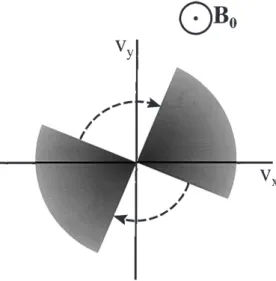
Q/d uQ;L/d uLis sketched in Fig. 1.
2.2 Rotating nongyrotropy
When the gyrophase dependence in Eq. (2) is balanced by the time derivative the result is
@tÿX0 @uF00 : 5
The solution of Eq. (5) is
F0F0 uX0t : 6 Thus, the distribution rotates with the gyrofrequency
X0. An example of such a distribution is sketched in
Fig. 2. This type is of importance when ionization processes are ®nished but the distribution of the inserted particles is still dierent from the basic plasma distri-bution.
2.3 Inhomogeneous nongyrotropy
When the gyrophase dependence is balanced by the spatial derivative, Eq. (2) provides
mx@xÿX0 @uF00 : 7
Now it is useful to consider an inhomogeneous back-ground magnetic ®eld, that is X0 x. The solution of Eq. (7) depends on the spatial pro®le of the magnetic ®eld. For a one-dimensional con®guration the general solution has the form:
F0F0 mk;m?;m?sinu
q0
m0
Ay x
; 8
where the vector potentialAyis introduced viaB0z@xAy.
This type is useful to describe magnetic boundary layers as sketched in Fig. 3 and magnetic reconnection regions (Motschmann and Glassmeier, 1998b).
3 Stability of nongyrotropic distributions
Nongyrotropic plasmas are not in thermal equilibrium. They contain excess energy which may drive unstable
waves. The excited wave ¯uctuations provide a
Fig. 1. Sketch of an open nongyrotropic distribution function.
Positively charged ions (shaded region) enter the velocity space atuQ
and leave it atuL
gyrophase diusion analogous to the pitch angle diusion. These processes were studied by a particle simulation in earlier work (Kafemann and Motschm-ann, 1995; Motschmann et al., 1997). A diusion along the gyrophase angleuexclusively conservingm? andmk, however, does not force an instability, as the particle energy Em0=2 m2
km2? is independent of u. The
gyrophase diusion has to be accompanied e.g. by a decrease ofmkto allow transformation of particle energy to wave energy. This synchronous diusion alonguand
m? may occur if, in the distribution function, underpop-ulated gyrophase sections exist into which the particles may move with a simultaneous decrease ofm?. A sketch of this diusion is depicted in Fig. 4.
The stability is studied in the framework of a normal mode analysis. In part we follow a previous paper (Motschmann and Glassmeier, 1998a). The analysis is performed separately for the dierent types of nongy-rotropic distributions where the treatment of the open and the rotating nongyrotropies is similar and both types are presented in one section.
3.1 Open nongyrotropy and rotating nongyrotropy
The undisturbed distribution functions (Eq. 4 and 6, respectively) may be uni®ed formally by the expression
F0 uHX0t where H0 represents the open nongy-rotropy andH1 the rotating one. The 2p periodicity
of F0 allows the Fourier expansion into
F0 mk;m?;uHX0t
X
1
nÿ1
F0 n mk;m?eÿin uHX0t : 9
The Vlasov equation for the disturbance F1 of this
distributionF0 has the form "
@ui xÿkkmk
X0 ÿ
k?m?
X0 cosu
#
F1 x;k
q0
m0X0
X
n
("
E xÿHnX0;k
mkE xÿHnX0;k
xÿHnX0
#
@m F0 n mk;m?eÿinu
)
10
wherek k?;0;kkandm m?cosu;m?sinu;m
k. The
wave equation for the (disturbed) electric ®eldEis given by
1ÿk 2c2
x2
Iÿkokc
2
x2
E x;k ÿ i
0xj
x;k ; 11
with the disturbed current density
j x;k n0q0
Z
mF1 x;k;mk;m?;um?dm? dmk du :
12 In the following this system of Eqs. (10±12) is solved by standard methods and the conductivity tensorras well
as the dispersion relation are derived. To do this we set
H0 in the case of an open nongyrotropy andH1 in
the case of a rotating nongyrotropy.
3.1.1. Open nongyrotropy. The conductivity tensor r
singled out from Eqs. (10) and (12) is presented in detail in the Appendix. As a standard example a three component plasma consisting of electrons, protons, and alpha particles is discussed. Electrons and protons have stable distribution functions; the nongyrotropic component of alpha particles of densityn0is added. The plasma ful®lls the neutrality conditionnenp2n0.
Fig. 3. Sketch of nongyrotropic distribution function in the magnetic boundary layer of a magnetic halfspace
For the propagation of waves parallel to the ambient magnetic ®eld kkB0dispersion relation is used:
det "
1ÿk 2
kc2
x2
!
dij
k2kc2
x2 diz
i 0x
X
e;p;0
rij
#
0;
i;j2 f;ÿ;zg : 13 In this case it is convenient to use the circularly polarized ®eld amplitudes
E1
2 Ex i Ey
ÿ
: 14
First let us remember the equivalent gyrotropic plasma con®guration. There are stable right hand polarized R, left hand polarized L, and longitudinal polarized P
modes. The L mode is split near the alpha particle
gyroresonance X0. Now, in cases where the alpha
particles are organized in a nongyrotropic way the
R;L, andP modes are no longer independent modes but they are coupled with each other. This coupling is expressed by nonvanishing o-diagonal elements of the
conductivity tensor r. If we restrict to symmetric
nongyrotropies, that is F0 u F0 up, only L and
Rmodes are coupled (Brincaet al., 1992). The coupling
occurs for small x and small kk where the phase
velocities of both modes are comparable. In the result
the R mode becomes unstable and it is excited.
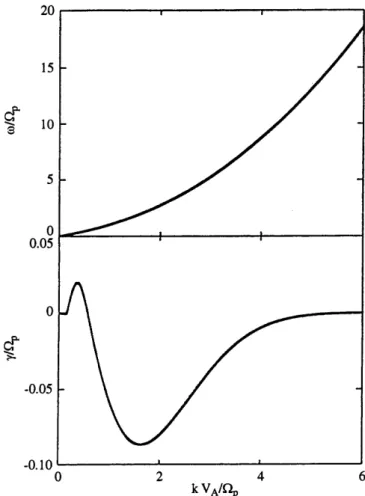
Frequency and growth rate are displayed in Fig. 5. For arbitrary (non-symmetric) nongyrotropies Brinca and Romeiras (1998) found an unstable coupling with the P
mode too. However, it seems that this instability exists only in a plasma without gyrotropic background as
otherwise the damping of the P mode keeps this
coupling region stable.
For propagation perpendicular to the magnetic ®eld k?B0the ordinary mode is not in¯uenced essentially by the nongyrotropic alpha particles and we focus to the extraordinary mode. Its dispersion relation has the form
det dijÿ
k2?c2
x2
diy
i 0x
X
e;p;0
rij
" #
0;
i;j2 fx;yg : 15 In Eq. (15) the dispersion branches of the higher
harmonics of X0 and Xp are coupled with the
funda-mental branch complicating its analysis. Therefore we restrict to the limit of long wavelengths kcm=X0 <1 where the higher harmonics are truncated. Then non-gyrotropic alpha particles destabilize the extraordinary mode. Figure 6 shows the maximum growth rate just at the gyroresonance of the alpha particles.
3.1.2. Rotating nongyrotropy. For this basic type the undisturbed distribution function is nonstationary. Thus it is not a standard situation for the stability analysis in the framework of dispersion theory. However, a non-stationary solution of zeroth order may be studied with respect to their stability in the same way as a stationary state; any deviations of the distribution function and the
®elds from the zeroth order have to be checked to see if they are increasing or decreasing.
The rotating nongyrotropy describes a temporal modulation of the undisturbed plasma. From nonlinear optics, high-frequency technology and other ®elds it is well known that any modulation of a carrier medium forces a frequency mixing of transmitted waves. A wave is scattered by generating side lobes of ®rst and higher orders. The sidelobe distance is just the modulation frequency. In our standard example this is the gyrofre-quency of the alpha particles. Thus, any seed ®eld amplitude atxis coupled with the seed ®eld amplitudes at xnX0;n1;2;. . . This coupling is expressed in
Ohm's law for the disturbed current j taking now the
form
j x;k
X1
nÿ1
r n x;kE xÿnX0;k 16
The partial conductivity tensors r n are given in the
Appendix. It is obvious that, in general, the dispersion relation leads us to an in®nity dimensional linear system for theE xÿnX0;n0;1;2;. . . In practice it is to
be expected that the side lobes are restricted to a few orders. Thus higher orders can be truncated dependent on the respective example.
Fig. 5. Parallel propagating unstable mode byL-Rcoupling forced
In the special case of parallel propagation kkB0the coupling truncates exactly at the second order. All partial conductivity tensorsr nwithjnj>2 vanish. We found that for this case nongyrotropy does not excite any unstable waves (Motschmann and Glassmeier, 1998a). The coupling takes place, but the available excess energy is distributed over a broad spectral range and the threshold for an instability is not reached. We mention that an additional energy contribution, e.g. by an anisotropy, will indeed excite unstable waves as discussed by Brincaet al. (1992) and Motschmann and Glassmeier (1993). In this plasma the instability is mainly driven by the anisotropy; the coupling of wave amplitudes up to the side lobes of the second order caused by the nongyrotropy is maintained.
At perpendicular propagation k?B0 the coupling does not truncate automatically at higher orders. We consider the long wavelength approximation analogous to the open nongyrotropy where coupling is restricted to ®rst order side lobes (Motschmann and Glassmeier, 1998a) . Thus, the excess energy is bundled in narrow spectral region. In this case a strong instability is excited. Frequency and growth rate are shown in Fig. 7. Max-imum growth rate is reached at frequencies in between the gyrofrequencyX0of the alpha particles and the side
lobe at 2X0. Studies of short wavelengths k?X0=mA1
do not exist yet. We speculate that no instability or only a weak version will be excited as the excess energy would be distributed over a broader spectral range.
3.2 Inhomogeneous nongyrotropy
In an inhomogeneous magnetic ®eld the particle orbits deviate from circular ones. In general they may become rather complicated and even chaotic (Ashour-Abdalla
et al., 1991). Then the distribution functions are gyro-phase-dependent too, that is nongyrotropic. The de-tailed shape depends on the spatial pro®le of the background magnetic ®eld. Strong gyrophase-depen-dence is provided in cases where the spatial scale of the inhomogeneity is at least of the same order as the thermal gyroradius. Because of the smallness of this scale it is more convenient to speak of a boundary layer than of a inhomogeneous space.
An analytic handling of an inhomogeneous nongy-rotropy is not trivial. Therefore we discuss as a fairly simple example a magnetic halfspace as sketched in Fig. 3 and we regard this example as a prototype of real magnetic boundaries. However, even this example is not solvable in a fully exact way and thus we perform some approximations. The transition from the ®eld-free
Fig. 6. Perpendicular propagating unstable extraordinary mode
forced by an open nongyrotropy of alpha particles embedded in a gyrotropic electron-proton plasma (Motschmann and Glassmeier, 1998a)
Fig. 7. Perpendicular propagating unstable extra ordinary mode
region to the magnetic region is assumed to be sharp such that the characteristic gradient scale is small compared with the gyroradii of the particles. An electron-proton plasma as discussed here forms a nongyrotropic sheet just at the edge of the magnetic halfspace. The thickness of the sheet is of the order of the proton gyroradius. As the electron gyroradius is much smaller we do not take their nongyrotropy into account.
For the magnetic halfspace the vector potential Ay
yields
Ay
0 for x<0
Bzx for x>0
: 17
For the construction of the undisturbed nongyrotropic distribution function we refer to the general solution (8) of a one-dimensional inhomogeneity and choose the shape of the form
F0 mk;m?;u;x
0 for x<0
1 p
p
mtp 3e
ÿ
m2
km
2
?
m2
tp e
m?sinu mtp eÿ
x
rtp for x>0 8
> <
> :
9
> =
> ;
: 18
This u dependent distribution F0 is restricted to the transition layer from the ®eld-free halfspace to the magnetic halfspace. The protons which form this distribution we regard as a third component embedded in a gyrotropic electron-proton plasma. mtp is thermal
proton velocity and rtpmtp=Xp is the corresponding
gyroradius. To keep the further analysis tractable we will approach expression (18) by a rectangular shape of the form
F0 mk;m?;u;x
0 for x<0 andx>rtp
1 p
p
mtp 3e
ÿ
m2
km2?
m2
tp eÿ
m?sinu
mtp for 0<x<r
tp
8
> <
> :
9
> =
> ;
:
19
This distribution (19) may be expanded in a Fourier series analogous to expression (9) for an open
nongy-rotropy H0. However, there is not only a formal
equivalence of the open and the inhomogeneous non-gyrotropies. In Sect. 3.1 we assumed sources and sinks in the velocity space to produce a gyrophase depen-dence. Now we replace this by sources and sinks in real space. Indeed the sources and sinks for the
nongyrot-ropy are located at x0. Thus we can take over the
results of Sect. 3.1 for an open nongyrotropy. In particular, we conclude that the distribution (19) is unstable with respect to parallel and perpendicular wave propagation where perpendicular propagation is now
taken along y. To avoid a con¯ict when applying the
results of the open nongyrotropy in free space to the layer we restrict our discussion to wavelengths shorter than the thicknessrptof the layer. Unstable waves ful®ll
kmA=XpI as is seen in Fig. 5. This corresponds to a
wavelength of k2prptmA=mtp 2prpipbpt. Thus for a
high proton plasma beta bpI the result is krtp
and our model is consistent.
4 Summary and conclusions
The gyrophase-dependence of a distribution function introduces new degrees of freedom in the wave-particle system of a collisionless plasma. A classi®cation of the various types of nongyrotropic distribution functions is performed. Three basic types may be discriminated: the nongyrotropy caused by sources and sinks in velocity space, the rotating nongyrotropy, and nongyrotropy because of an inhomogeneity of the ambient magnetic ®eld. These nongyrotropic distributions are not in thermal equilibrium. They carry excess energy which may excite unstable waves. The stability of the basic types were discussed in the framework of linear dispersion analysis. All types are unstable for convenient ranges of the plasma parameters.
Open nongyrotropies may drive waves parallel as well as perpendicular to the background magnetic ®eld. At parallel propagation and at symmetric nongyrotro-pies theR-mode and theL-mode are coupled where the
R-mode is destabilized. At perpendicular propagation the extraordinary mode is destabilized where the growth rate becomes maximum at the gyrofrequency of the nongyrotropic plasma component.
The rotating nongyrotropy couples a seed wave with its side lobes caused by the temporal modulation of the undisturbed plasma. This coupling has the tendency to stabilize the system as the excess energy is smeared out by means of the side lobes over broad spectral range but not transformed to a wave quasimonochromatically. Therefore at parallel propagation any instability is suppressed. At perpendicular propagation a strong instability is excited in the long wavelength limit where the coupling is restricted to side lobes of the ®rst order. The inhomogeneous nongyrotropy has been studied for the case of the magnetic halfspace. In the transition layer from the ®eld-free region to the magnetic region a nongyrotropic distribution is generated because of incomplete circular particle orbits. The distribution in the layer has the thickness of the order of the thermal ion gyration radius. It may be approached by the open nongyrotropic type, where spatially distributed sources and sinks are replaced now by sources and sinks spatially localized at the edge of the layer. In general this nongyrotropic distribution in the layer is unstable and it may excite parallel and perpendicular waves. We speculate that this process in its nonlinear stage may reorganize the original layer structure.
The Editor-in-chief thanks N. Watkins and another referee for their help in evaluating this paper.
Appendix
In case of the open nongyrotropy H0 where the
undisturbed plasma is assumed to be stationary and homogeneous Ohm's law has the conventional form
j x;k r x;kE x;k
From Eqs. (10) and (12) the conductivity tensorrcan be
singled out. It yields
ripn0q
2 0
m0 X
n;l
Z
m2?dm?dmk
"
JnlJl
kkmkÿx nl1X0g
n
Jnlÿ1Jl
kkmkÿx nlX0c
n
#
rÿipn0q 2 0
m0 X
n;l
Z
m2?dm?dmk
"
Jnlÿ1Jl
kkmkÿx nlX0c
n ÿ
Jnlÿ2Jl
kkmkÿx nlÿ1X0g
n ÿ
#
rz
ipn0q20
m0 X
n;l
Z
m2?dm?dmk
"
JnlJl
kkmkÿx nl1X0h
n
Jnlÿ1Jl
kkmkÿx nlX0f
n
Jnlÿ2Jl
kkmkÿx nlÿ1X0h
n ÿ
#
rÿipn0q 2 0
m0 X
n;l
Z
m2?dm?dmk
Jnl2Jl
kkmkÿx nl1X0g
n
Jnl1Jl
kkmkÿx nlX0c
n
rÿÿipn0q
2 0
m0 X
n;l
Z
m2?dm?dmk
Jnl1Jl
kkmkÿx nlX0c
n ÿ
JnlJl
kkmkÿx nlÿ1X0g
n ÿ
rÿz
ipn0q20
m0 X
n;l
Z
m2?dm?dmk
"
Jnl2Jl
kkmkÿx nl1X0h
n
Jnl1Jl
kkmkÿx nlX0f
n
JnlJl
kkmkÿx nlÿ1X0h
n ÿ
#
rz
ipn0q20
m0 X
n;l
Z
m?dm?mkdmk
Jnl1Jl
kkmkÿx nl1X0g
n
JnlJl
kkmkÿx nlX0c
n
rzÿ
ipn0q20
m0 X
n;l
Z
m?dm?mkdmk
JnlJl
kkmkÿx nlX0c
n ÿ
Jnlÿ1Jl
kkmkÿx nlÿ1X0g
n ÿ
rzz
ipn0q20
m0 X
n;l
Z
m?dm?mkdmk
"
Jnl1Jl
kkmkÿx nl1X0h
n :
JnlJl
kkmkÿx nlX0f
n
Jnlÿ1Jl
kkmkÿx nlÿ1X0h
n ÿ
#
where
c n k?
xnF
n
0 ; f n@mkF0 n
g n kkm?
x @mk 1ÿ
kkmk x
@m?
n m?
F0 n
h n1
2 ÿ
k?m? x @mk
k?mk x @m?
n m?
F0 n :
The argument of the Bessel functionsJl isk?m=X0.
For the rotating nongyrotropy H1) Ohm's law
has the form given by Eqn. (16). The partial conductiv-ity tensors r n analogous to the open nongyrotropy is
produced from Eqs. (10) and (12). It follows:
r n ipn0q 2 0 m0 X l Z
m2?dm?dmk
JnlJl
kkmkÿx nl1X0g
n
Jnlÿ1Jl
kkmkÿx nlX0c
n
r ÿn ipn0q
2 0 m0 X l Z
m2?dm?dmk
Jnlÿ1Jl
kkmkÿx nlX0c
n ÿ
Jnlÿ2Jl
kkmkÿx nlÿ1X0g
n ÿ
r nzipn0q
2 0 m0 X l Z
m2?dm?dmk
"
JnlJl
kkmkÿx nl1X0h
n
Jnlÿ1Jl
kkmkÿx nlX0f
n
Jnlÿ2Jl
kkmkÿx nlÿ1X0h
n ÿ
#
r ÿn ipn0q 2 0 m0 X l Z
m2?dm?dmk
Jnl2Jl
kkmkÿx nl1X0g
n
Jnl1Jl
kkmkÿx nlX0c
n
r ÿÿn ipn0q 2 0 m0 X l Z
m2?dm?dmk
Jnl1Jl
kkmkÿx nlX0c
n ÿ
JnlJl
kkmkÿx nlÿ1X0g
n ÿ
r ÿnzipn0q 2 0 m0 X l Z
m2?dm?dmk
"
Jnl2Jl
kkmkÿx nl1X0h
n
Jnl1Jl
kkmkÿx nlX0f
n
JnlJl
kkmkÿx nlÿ1X0h
n ÿ
#
r znipn0q
2 0 m0 X l Z
m?dm?mkdmk
Jnl1Jl
kkmkÿx nl1X0g
n
JnlJl
kkmkÿx nlX0c
n
r znÿipn0q
2 0 m0 X l Z
m?dm?mkdmk
JnlJl
kkmkÿx nlX0c
n ÿ
Jnlÿ1Jl
kkmkÿx nlÿ1X0g
n ÿ
r zznipn0q 2 0 m0 X l Z
m?dm?mkdmk
"
Jnl1Jl
kkmkÿx nl1X0h
n
JnlJl
kkmkÿx nlX0f
n
Jnlÿ1Jl
kkmkÿx nlÿ1X0h
n ÿ
#
where now,
c n k?
xÿnX0nF
n
0 ; f n@mkF0 n
g n kkm?
xÿnX0@mk 1ÿ
kkmk xÿnX0
@m?
n m?
F0 n
h n1
2 ÿ
k?m? xÿnX0@mk
k?mk
xÿnX0 @m?
n m?
F0 n :
References
Anderson, K. A., R. P. Lin, C. Gurgiolo, G. K. Parks, D. W. Potter,
S. Werden, and H. Reme, A component of nongyrotropic
(phase-bunched) electrons upstream from the Earth's bow shock,J. Geophys. Res.,90,10 809±10 814, 1985.
Ashour-Abdalla, M., L. M. Zelenyi, V. Peroomian, L. A. Frank, and
W. R. Paterson,Coarse-grained texture of ion distributions in
the magnetotail: a fractal-like approach,J. Geophys. Res.,101, 15 287±15 296, 1996.
Ashour-Abdalla, M., J. BuÈchner, and L. M. Zelenyi, The
quasi-adiabatic ion distribution in the central plasma sheet and its boundary layer,J. Geophys. Res.,96,1601±1609, 1991.
Astudillo, H. F., S. Livi, E. Marsch and H. Rosenbauer, Evidence
for nongyrotropic alpha particle and proton distribution functions: TAUS solar wind measurements,J. Geophys. Res., 101,24 423±24 432, 1996.
Brinca, A. L., and F. J. Romeiras,On the stability of stationary
nongyrotropic distribution functions: coupling and purely growing waves,J. Geophys. Res.,103,9275±9283, 1998.
Brinca, A. L., L. Borda de AÂgua, and D. Winske,Nongyrotropy as a
source of instability and mode coupling,Geophys. Res. Lett.,12, 2445±2448, 1992.
Brinca, A. L., Y. Omura, and H. Matsumoto, Linear coupling
eects originated in electron nongyrotropy, J. Geophys. Res., 98,21 071±21 076, 1993.
BuÈchner, J., and J. P. Kuska, On the formation of cup-like ion
beam distributions in the plasma sheet boundary layer, J. Geomagn. Geoelectr.,48,781±797, 1996.
BuÈchner, J., and L. M. Zelenyi, Regular and chaotic charged
particle motion in magnetotaillike ®eld reversals, 1. Basic theory of trapped motion,J. Geophys. Res.,94,11 821±11 842, 1989. Cairns, I. H., Transition from ring to beam arc distributions of
water ions near the space shuttle orbiter,J. Geophys. Res.,95, 15 167±15 173, 1990.
Cao, J. B., C. Mazelle, G. Belmont, and H. Reme,The
corresponding instability,J. Geophys. Res.,100,23 379±23 388, 1995.
Cao, J. B., C. Mazelle, G. Belmont, and H. Reme, Oblique ring
instability driven by nongyrotropic ions: application to obser-vations at comet Grigg-Skjellerup,J. Geophys. Res.,103,2055, 1998.
Coates, A. J., A. D. Johnstone, B. Wilken, and F. M. Neubauer, Velocity space diusion and nongyrotropy of pickup water group ions at comet Grigg-Skjellerup, J. Geophys. Res., 98, 20 985±20 994, 1993.
Fuselier, S. A., O. W. Lennartsson, M. F. Thomsen, C. T. Russell, Specularly re¯ected He2at high Mach number quasi-parallel
shocks,J. Geophys. Res.,95,4319±4325, 1990.
Glassmeier, K. H., and F. M. Neubauer, Low-frequency
electro-magnetic plasma waves at comet P/Grigg-Skjellerup: overview and spectral characteristics,J. Geophys. Res.,98,20 921, 1993. Gosling, J. T., M. F. Thomsen, S. J. Bame, W. C. Feldman, G.
Paschmann, and N. Sckopke, Evidence for specularly re¯ected
ions upstream from the quasi-parallel bow shock,Geophys. Res. Lett.,9,1333±1336, 1982.
Harris, E. G.,On a plasma sheath sparating regions of oppositely
directed magnetic ®eld, Il Nuovo Cimento, XXIII, 115±121, 1962.
Kafemann, H., and U. Motschmann,Studies on nongyrotropic ion
distributions in magneto plasmas by 2-d hybrid code simula-tion,Simpo Newsl.5,14±19, 1995.
Motschmann, U., and K. H. Glassmeier,Nongyrotropic distribution
of pickup ions at comet P/Grigg-Skjellerup: a possible source of wave activity,J. Geophys. Res.,98,20 977±20 983, 1993.
Motschmann, U., H. Kafemann, and M. Scholer,Nongyrotropy in
magnetoplasmas: Simulation of wave excitation and phase space diusion,Ann. Geophysicae,15,603±613, 1997.
Motschmann U., and K. H. Glassmeier, Dispersion and wave
excitation in nongyrotropic plasmas,J. Plasma Phys.,60,111± 132, 1998a.
Motschmann U., and K. U. Glassmeier,Relation of magnetic ®eld
line reconnection and unstable nongyrotropic particle distribu-tions,Proc. Int. Conf. on Substorms-4, Lake Hamana, Japan, in press, 1998b
Neubauer, F. M., K. H. Glassmeier, A. J. Coates, and A. D.
Johnston,Low frequency elctromagnetic plasma waves at comet
P/Grigg-Skjellerup: analysis and interpretation, J. Geophys. Res.,98,20 937±20 953, 1993.
Pritchett, P. L., F. V. Coroniti, and R. Pellat, Collisionless
reconnection in two-dimensional magnetotail equilibria,J. Geo-phys. Res.,96,11 523±11 538, 1991.
Schubert, M., and B. Wilhelmi, EinfuÈhrung in die nichtlineare
Optik, Teubner Verlagsgesellschaft, Leipzig, 1971.
Sckopke, N., G. Paschmann, A. L. Brinca, C. W. Carlson, and H.
LuÈhr,Ion thermalisation in quasi-perpendicular shocks
involv-ing re¯ected ions,J. Geophys. Res.,95,6337±6352, 1990. Thomsen, M. F., J. T. Gosling, S. J. Bame, and C. T. Russell,