Vanaja Ramaswamy
1, Abinaya Sivarasu
2, Bharghavi Sridharan
3and Hamsalekha
Venkatesh
41, 2, 3, 4Department Of Computer Science and Engineering,
Sri Venkateswara College Of Engineering, Sriperumpudur taluk, Tamilnadu, India
A
BSTRACTIEEE 802.11n mainly aims to provide high throughput, reliability and good security over its other previous standards. The performance of 802.11n is very effective on the saturated traffic through the use of frame aggregation. But this frame aggregation will not effectively function in all scenarios. The main objective of this paper is to improve the throughput of the wireless LAN through effective frame aggregation using scheduler mechanism. The Bi-Scheduler algorithm proposed in this article aims to segregate frames based on their access categories. The outer scheduler separates delay sensitive applications from the incoming burst of multi-part data and also decides whether to apply Aggregated - MAC Service Data Unit (A-MSDU) aggregation technique or to send the data without any aggregation. The inner scheduler schedules the remaining (delay-insensitive, background and best-effort) packets using Aggregated-MAC Protocol Data unit (A-MPDU) aggregation technique.
K
EYWORDSIEEE 802.11n, Frame Aggregation, Scheduler, A-MPDU, A-MSDU.
1.
INTRODUCTION
IEEE 802.11n is the most popularly used wireless Local Area Network (LAN) technology today.
2.1.1 Multiple Input Multiple Output (MIMO)
IEEE 802.11n uses MIMO technology to improve the data rate up to 600 Mbps [10]. MIMO uses multiple antennas for transmission and reception for transmission of the same data at phases. It
defines different M X N configurations from 1 X 1 to 4 X 4 [5]. As the number of antennas for
transmission and reception increases, the performance of the channel increases significantly. MIMO operates in two different modes: SDM and STBC.
• In Spatial Division Multiplexing (SDM), the output stream is divided into multiple sub
streams which are then spatially multiplexed and transmitted from multiple antennas. At the receiving side, these streams are demultiplexed and recovered.
• In Space Time Block Coding (STBC), the same output stream is transmitted over
multiple antennas simultaneously. At the receiving side, the multiple streams with different strength are compared to recover the original stream.
802.11 Freq
(Hz)
Through put (Mb/s)
Max Bit rate (Mb/s)
Modulation rin
(m)
A 5 23 54 OFDM ~35
B 2.4 4.3 11 DSSS ~38
G 2.4 19 54 OFDM ~38
N 2.4, 5 74 248 OFDM ~70
Table 2.1- 802.11n standard specification [2]
2.1.2 Channel bonding
It uses a 40MHz channel which means greater bandwidth which ultimately leads to better performance in WLAN. The 40MHz channel [5] behaves like a combination of two 20 MHz channel. It can also operate in two modes: 20MHz mode and 40MHz mode. The 20MHz [5] mode is used if the bandwidth availability is limited. The 40MHz channel provides two times more desirability than 20MHz channel.
2.2 MAC layer enhancement
Fig 2.1-Frame Aggregation method [9]
There are three types of frame aggregation techniques- MSDU, MPDU and Two Level Frame Aggregation.
2.2.1 MAC Service Data Unit (MSDU)
This is the unit of transmission used at the MAC layer for data which is received from the upper layer. The data received from the logical link control (LLC). This LLC sub layer is present above
the medium access control (MAC) sub layer in a protocol stack.
2.2.2 Aggregated MAC Service Data Unit (A-MSDU)
Multiple MAC service data unit are combined to form the payload of a MPDU packet. The entire aggregate packet will have a single frame header and these packets are destined to the same client and should have same access category. The main motivation of A-MSDU technique is the smaller size of Ethernet header when compared to 802.11 header. Hence multiple Ethernet frames can be combined to form A-MSDU. Since individual sub frames don’t have frame checksum, selective retransmission of corrupted sub frames will not be possible. Sub frames will have same traffic identifier (TID) and sequence number [2]. For constructing an A-MSDU there is some limitations to follow such as, every MSDUs should have the same traffic identifier value. The sustained time of A-MSDU should be equal to the maximum sustained time of its constituent elements. In the sub frame header the values of destination address and sender address should match with the values of receiver address and the transmitter address in the MAC header.
individually and if error occurred it is retransmitted.
2.2.4 Aggregated MAC Protocol Data Unit (A-MPDU)
Multiple MAC protocol data unit with common PHY header are aggregated as a single A-MPDU. The size of sub frames should be multiple of 4 bytes otherwise length is adjusted by adding padding bytes [9]. Each PDU in the frame has its known header and cyclic redundancy check so in case of transmission error it is sufficient to send only the lost PDU thereby improving the throughput [3]. A-MPDU functions after the encapsulation process of MAC header here the matching traffic identifier is not considered but all the MPDUs present within an A-MPDU should be addressed to the same receiver address. Since there is no holding time to form A-MPDU the number of A-MPDUs to be aggregated depends on the packets that are already present in the transmission queue.
Fig 2.3- Format of A-MPDU [10]
Before MPDU a set of delimiters are added and in its tail padding bits varied from 0 – 3 bytes are added to define the length and position inside the aggregated frame the delimiter header is used. For determining the structure of A-MPDU the usage of MPDU delimiters and PAD bytes are must. After the A-MPDU is received it checks for the MPDU delimiter for any errors in cyclic redundancy check. If the value is correct then the MPDU is extracted else it continues until it reaches the end of physical layer service data unit
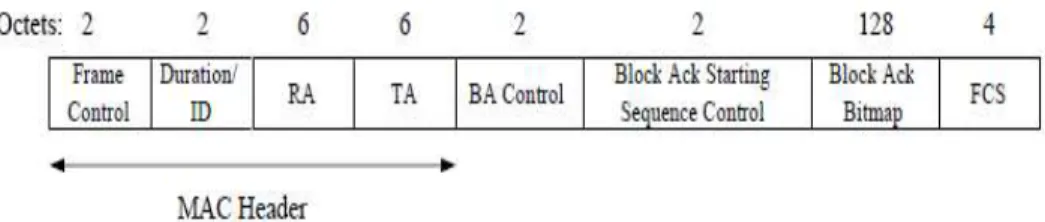
2.3 Block acknowledgement
Fig 2.4 - Block acknowledgement format
To confirm the frame delivery block acknowledgment minimizes the number of ACKs that a receiver must send to a transmitter.
Access Category Frame Aggregation Reasons
Voice NA
Voice packets are delay- sensitive. These packets need
strict latency, jitter and bandwidth requirement [8] use of aggregation degrade the performance of voice packets since these has to wait
for other packets.
Video A-MPDU
Video packets have strict bandwidth demand but loser
latency in jitter demand [8]. Video packets have high data
rate so waiting for other packets exceed the maximum
tolerable delay [7].
Best effort and Background A-MPDU
Delay insensitive and no bandwidth requirements [8]
making the packets of this access category will not have
any impact on their performance.
Table 2.2 -Selecting required Aggregation Scheme
3. MOTIVATION FOR THE PROPOSED WORK (Issues in frame
aggregation)
Fig 4.1- Bi-Scheduler Implementation Using Queues
4.1 Working of Bi-Scheduler Technique for Throughput improvement in Frame Aggregation
The idea is based on the fact that since Audio packets are delay sensitive and have low data rate, so making them wait in the queue will introduce lot of delay in network and degrades its performance. Thus, A-MSDU technique must be applied to such packets in order to increase their throughput. Hence frame aggregation (A-MSDU) can be effectively applied only to improve the throughput of high data rate packets. Therefore, making such types of packets wait in the queue (to attain the desired size for aggregation) does not significantly affect the throughput of the network. While Background and Best Effort packets are delay insensitive and making them wait will not have any impact in the through put of the network.
1. Initially, the Outer Scheduler (S1) separates the delay sensitive frames i.e. Voice/ Audio
2. The remaining frames i.e. Video and Background/ Best-Efforts are stored temporarily in
Buffer B1 of Inner Scheduler (S2). S2 then separates Video frames from Best-Efforts frames
and enques them in queue Q2, where they are aggregated to form A-MPDU packets. The rest of the frames are enqued in Q3. A common timer is also maintained for Q2 and Q3.
a. When Q2 has reached the aggregated size before the timer expires, it’s
transferred to the respective destination.
b. If Q2 has not reached the aggregated size before the timer expires, then that many
remaining packets from Q3 are taken to attain the desired size and sent to the destination.
3. If, simultaneously both Q1 and Q2 have reached the desired size before the timer expires,
then our algorithm gives preference to Audio packets i.e. contents of Q1 will be sent first, since they are highly delay sensitive packets. After, resetting Q1’s timer, Q2 contents will be sent to the respective destination.
in order to efficiently transmit the frames to the destination. The future work will be to simulate and experimentally verify the proposed scheduler mechanism effectively.
ACKNOWLEDGEMENTS
We would like to acknowledge and thank the Defence Research Development Organisation (DRDO), New Delhi, India for granting us extra mural research funds for carrying out the research work is a part of the research project titled “Network Throughput Enhancement in distributed using Cross layer optimisation”.
We would also like to thank the Head of the Department of Department of CSE and other faculty members who gave us necessary support to implement this project.
REFERENCES
[1] Nasreddine Hajlaoui, Issam Jabri and Maher Ben Jemaa, “Experimental Performance Evaluation and Frame Aggregation Enhancement in IEEE 802.11n WLANs”.
[2] J.Kolap, S.Krishnan, N.Shala,”Frame Aggregation Mechanism for High Throughputin 802.11n WLANS”.
[3] Selvam T, Srikanth.S, “A Frame Aggregation Scheduler for IEEE 802.11n”. [4] WI-FI Certified TM 802.11n Draft2.0.
[5] L.Kriara, M.K. Marina, A.Farshad, “Characterization of 802.11n Wireless LAN performance via Test bed measurement and statistical Analysis”.
[6] A.Saif, M.othman, S.Subramaniam and N.A.A. Hamid “Frame Aggregation in Wireless Techniques and Issues”.
[7] S.Gubner and C. Luidemann, “Evaluating the Impact of Frame Aggregation on Video Streaming over IEEE802.11n Multi hop Network”.
[8] B.Selvig, A.Bai, T.Skeie, P. Engelstad, “Differentiated Service in 802.11e WLANS”
[9] T.Nakajima, Y.Utsuomiya, Y. Nishibayashi, T.Tandai, T.Adachi and M. Takagi “Compressed Block Acknowledgment – an efficient selective repeat mechanism for IEEE 802.11n”
[10] Sources are also taken from Google and Wikipedia.
Authors
Ms Vanaja Ramaswamy
Assistant professor, Department of Computer Science and Engineering, Sri Venkateswa ra college of Engineering, Sriperumpudur Taluk, Tamilnadu,IndiaCo-Principal Investigator of DRDO Extra mural Research Project.Area of Interest : Operating System , Data structures and Computer Networks
Hamsalekha Venkatesh
Bhargavi Sridharan
Final Year Student (B.E.), Department of Computer Science and Engineering S ri Venkateswara College Of Engineering. Sriperumpudur Taluk, Tamilnadu, India,Area of Interest: Computer Networks and object oriented programming.
Abinaya sivarasu
![Fig 2.2- Format of A-MSDU [10]](https://thumb-eu.123doks.com/thumbv2/123dok_br/16369248.190934/3.918.166.656.733.917/fig-format-of-a-msdu.webp)