www.biogeosciences.net/12/4979/2015/ doi:10.5194/bg-12-4979-2015
© Author(s) 2015. CC Attribution 3.0 License.
Assessing the potential of amino acid
13
C patterns as a carbon
source tracer in marine sediments: effects of algal growth
conditions and sedimentary diagenesis
T. Larsen1, L. T. Bach2, R. Salvatteci3, Y. V. Wang3, N. Andersen1, M. Ventura4, and M. D. McCarthy5
1Leibniz Laboratory for Radiometric Dating and Stable Isotope Research, Christian-Albrechts-Universität zu Kiel,
24118 Kiel, Germany
2Helmholtz-Zentrum für Ozeanforschung Kiel (GEOMAR), Düsternbrooker Weg 20, 24105 Kiel, Germany 3Institute of Geoscience, Department of Geology, Kiel University, Ludewig-Meyn-Str. 10, 24118 Kiel, Germany 4Biogeodynamics and Biodiversity Group, Centre for Advanced Studies of Blanes (CEAB), Spanish Research Council
(CSIC), 17300-Blanes, Catalonia, Spain
5Ocean Sciences Department, UC Santa Cruz, Santa Cruz, CA 95064, USA
Correspondence to:T. Larsen ([email protected])
Received: 19 December 2014 – Published in Biogeosciences Discuss.: 23 January 2015 Revised: 13 July 2015 – Accepted: 5 August 2015 – Published: 21 August 2015
Abstract.Burial of organic carbon in marine sediments has
a profound influence in marine biogeochemical cycles and provides a sink for greenhouse gases such as CO2and CH4.
However, tracing organic carbon from primary production sources as well as its transformations in the sediment record remains challenging. Here we examine a novel but grow-ing tool for tracgrow-ing the biosynthetic origin of amino acid carbon skeletons, based on naturally occurring stable car-bon isotope patterns in individual amino acids (δ13CAA). We
focus on two important aspects for δ13CAA utility in
sedi-mentary paleoarchives: first, the fidelity of source diagnos-tic of algalδ13CAA patterns across different oceanographic
growth conditions, and second, the ability of δ13CAA
pat-terns to record the degree of subsequent microbial amino acid synthesis after sedimentary burial. Using the marine di-atom Thalassiosira weissflogii, we tested under controlled conditions how δ13CAA patterns respond to changing
en-vironmental conditions, including light, salinity, tempera-ture, and pH. Our findings show that while differing oceanic growth conditions can change macromolecular cellular com-position,δ13CAA isotopic patterns remain largely invariant.
These results emphasize that δ13CAA patterns should
accu-rately record biosynthetic sources across widely disparate oceanographic conditions. We also explored how δ13CAA
patterns change as a function of age, total nitrogen and
or-ganic carbon content after burial, in a marine sediment core from a coastal upwelling area off Peru. Based on the four most informative amino acids for distinguishing between di-atom and bacterial sources (i.e., isoleucine, lysine, leucine and tyrosine), bacterially derived amino acids ranged from 10 to 15 % in the sediment layers from the last 5000 years, and up to 35 % during the last glacial period. The greater bacterial contributions in older sediments indicate that bac-terial activity and amino acid resynthesis progressed, ap-proximately as a function of sediment age, to a substantially larger degree than suggested by changes in total organic ni-trogen and carbon content. It is uncertain whether archaea may have contributed to sedimentary δ13CAA patterns we
observe, and controlled culturing studies will be needed to investigate whetherδ13CAA patterns can differentiate
bacte-rial from archeal sources. Further research efforts are also needed to understand how closelyδ13CAA patterns derived
from hydrolyzable amino acids represent total sedimentary proteineincous material, and more broadly sedimentary or-ganic nitrogen. Overall, however, both our culturing and sed-iment studies suggest thatδ13CAApatterns in sediments will
1 Introduction
Marine phytoplankton are responsible for nearly half the world’s carbon net primary production (Field et al., 1998). While most of this production is rapidly decomposed or transferred to consumers within the shallow euphotic zone, a small fraction escapes from surface waters to the seafloor. While the fraction that is eventually buried in the sediment is small (on a global scale it has been estimated to be < 0.5 %; Hedges and Keil, 1995), marine sedimentary burial has a pro-found influence on the global carbon cycling over geological timescales (Burdige, 2007), representing the main preserva-tion mechanism for reduced carbon in active biochemical cy-cles. Much progress in understanding the factors affecting or-ganic matter preservation has been made in the last decades using trace metals and stable isotope ratios of oxygen, car-bon and nitrogen in sediments (Cowie and Hedges, 1994; Henderson, 2002; Meyers, 2003; Tribovillard et al., 2006). However, the importance of different primary producers and the role of microbes in sedimentary organic matter preserva-tion remain key open quespreserva-tions, for which informapreserva-tion must be derived from specific organic tracers.
Amino acids are one of the most studied biochemical classes in organic geochemistry, because they are major con-stituents of phytoplankton (Nguyen and Harvey, 1997; Wake-ham et al., 1997), and also sensitive tracers for diagenetic processes (Dauwe et al., 1999; Lomstein et al., 2006). In the open ocean, the majority of organic carbon in both plank-ton and sinking particular organic matter (POM) is in the form of amino acids (Lee et al., 2000; Hedges et al., 2001). However, because amino acids are also more labile than bulk organic matter (Cowie and Hedges, 1994), degradation also changes the composition of protein amino acids in particles and sediments, in part by introducing new bacterially derived biosynthate (Grutters et al., 2002; Lomstein et al., 2006). This means that amino acids preserved in sediments repre-sent a mixture of those derived from original autotrophic sources and those that have been subjected to subsequent diagenetic alteration. In degraded organic matter mixtures (including sediments), amino acid origins can be complex, with the potential for selective degradation or de novo syn-thesis via heterotrophic bacterial metabolism (McCarthy et al., 2007).
Tracing original autotrophic sources has long been one of the most important biomarker applications in many areas of organic geochemistry. Recent research has demonstrated that naturally occurringδ13C variations among amino acids (i.e.,
δ13CAA patterns) can be directly linked to biosynthetic
ori-gin (Larsen et al., 2009, 2013). These δ13CAA patterns, or
fingerprints, are generated during biosynthesis, and can po-tentially be used as high-fidelity markers or fingerprints of al-gal, bacterial, fungal and plant origins of amino acids, and by extension a large fraction of total organic matter. In contrast to bulk isotope approaches, where often uncertain “baseline” values for a given environment are essential for correctly
in-ferring provenance of carbon, recent results have suggested thatδ13CAAfingerprints are largely independent of variation
in baseline isotope values. For example, Larsen et al. (2013) found that variations in bulkδ13C values were between 5 and 10 times greater than variation inδ13C values between in-dividual amino acids for seagrass (Posidonia oceanica) and giant kelp (Macrocystis pyrifera), collected at different times or location in the natural environment. These findings sug-gest that sedimentary δ13CAA patterns may lead to a new
approach to assess major primary or secondary production contributions to sediments. However, controlled physiologi-cal studies have never been conducted to test whetherδ13CAA
patterns from algae remain constant under varying environ-mental conditions.
A second key issue is the degree to which δ13CAA
pat-terns preserved in sediments reflect original exported pro-duction, as opposed to secondary bacterial production oc-curring after deposition. Understanding the balance between major sources of preserved organic carbon is central to un-derstanding how changes in productivity of marine ecosys-tems may ultimately affect global carbon cycles. Highly pro-ductive coastal ecosystems, such as the Peruvian upwelling area, have a particularly large impact on global carbon se-questration, because of the high fluxes and preservation of particulate organic matter. Particulate organic matter in such systems is often deposited under oxygen-deficient to anoxic conditions, allowing a much larger proportion of primary production to be ultimately preserved than is typical of open-ocean regions (Hartnett et al., 1998). Sediments from the Pe-ruvian upwelling region represent one endmember of sed-imentary depositional conditions and therefore an ideal first environment in which to examine the extent to whichδ13CAA
patterns reflect original phytoplankton sources, compared to subsequent bacteria resynthesis.
Here we report for the first time experiments that directly explore these two main issues forδ13CAAsedimentary
appli-cations, focusing on understanding bothδ13CAA source
pat-terns across large variation in growth conditions, and then quantifying evidence for bacterial influence in ultimate sed-imentary preservation. To address the question of whether
δ13CAA patterns of phytoplankton remain constant under
varying environmental conditions, we culturedThalassiosira weissflogiiunder controlled conditions.Thalassiosira weiss-flogiiis an abundant, nitrate-storing, bloom-forming diatom with high phenotypic plasticity, i.e., the ability to change macromolecular composition (Diekmann et al., 2009; Kamp et al., 2013). Diatoms are a diverse and ecologically impor-tant group contributing up to 40 % of the ocean’s primary production (Nelson et al., 1995). To investigate howδ13CAA
proportions of algal vs. heterotrophic microbial amino acids with age.
2 Material and methods
2.1 Culture experiment
The marine diatomThalassiosira weissflogiiGrunow (strain CCMP 1010) was cultured in sterile filtered North Sea water (Schleswig-Holstein, Germany) or Baltic Sea water (Schleswig-Holstein, Germany). The medium was enriched with f/4 concentrations of macro- and micronutrients (ni-trate, phosphate, silicic acid, trace metal mixture, and vita-min mixture) as described by Guillard and Ryther (1962). All experiments were performed in sterile 2 L Schott Duran glass bottles. These bottles were made of borosilicate glass (filters UV radiation < 310 nm) except for the quartz glass bottles (pure silica without UV radiation filter) used in the UV experiment (Table 1). The cultures were either incubated in climate chambers with 400–700 nm radiation or 10 cm be-low water level at be-low tide in Kiel Fjord in May 2011. Wa-ter temperature and light irradiance data were obtained from the weather station maintained by the GEOMAR institute in Kiel, Germany. Growth conditions for the various treatments, i.e., salinity, pH, temperature and irradiance are given in Ta-ble 1. pH values were measured with separate glass and refer-ence electrodes (Metrohm) and calculated with Eq. (3) from DOE 2007 Chap. 6b in Dickson et al. (2007) and corrected as described in Bach et al. (2012). Cultures were inoculated with densities of 20 cells mL−1. Cell densities and equivalent
spherical diameters were determined with a Coulter counter (Beckman Coulter) at the beginning and the end of the ex-periment, respectively. Growth rates and cell diameters are reported in Table 2. When incubations ended, cells were fil-tered on 47 mm diameter, 5 m mesh size Nucleopore track-etched membrane filters (Whatman) and frozen at −18◦C immediately after filtration.
2.2 Sediment samples
Sediment samples were retrieved from a 14.97 m long piston core (M772-003-2) collected on 2008 by theMeteorcruise at 271 m water depth within the main upwelling area off Peru (15◦06.21′S, 75◦41.28′W). At the time of sampling, the O2concentration at the seafloor was 1.1 g L−1, i.e., nearly
anoxic conditions. We obtained count and species assem-blage of diatoms from Mollier-Vogel (2012). The site can, ac-cording to the algal abundance and nitrogen content, be char-acterized as highly productive; for the sediment layers ana-lyzed in this study, the percentage of algal upwelling species was larger than 60 % (Table 3).
The age for core M772-003-2 is based on 16 radiocarbon dates measured at the AMS facility of the Leibniz Laboratory for Radiometric Dating and Isotope Research at Kiel Univer-sity (Grootes et al., 2004). Radiocarbon measurements were
carried out on organic matter instead of foraminifera due to extensive periods of dissolution of foraminifera in Peruvian marine sediments (e.g., Makou et al., 2010). Prior to deter-mination of organic matter content, sediment samples were pre-treated with an acid-alkali-acid cleaning with HCl and NaOH (Grootes et al., 2004). For the age model and sed-imentation rates, see Schönfeld et al. (2015) and Mollier-Vogel (2012). In brief, the radiocarbon dates were performed on the humic acid fraction, which contains organic matter mainly from marine origin. Radiocarbon dates were cali-brated for the global ocean reservoir age using the MA-RINE09 calibration curve (Reimer et al., 2009). Addition-ally, the radiocarbon dates were calibrated for regional reser-voir effect (1R) using a value of 511±278 years (Ortlieb et al., 2011). The age model of the core is based on linearly interpolated ages between the calibrated radiocarbon ages. A temporal gap of 20 000 years (from 17.4 to 37.8 kyr BP) was found at 10.3 m depth, which is a common feature on sedi-ments retrieved from the Peruvian continental shelf (Skilbeck and Fink, 2006; Salvatteci et al., 2014).
2.3 Stable isotope analyses
Both diatom and bulk sediment samples were freeze-dried prior to isotopic analysis. To prepare aliquots for derivatiza-tion of amino acids, we used 3–4 mg of diatoms and 100– 150 mg of sediments. The samples were transferred to Pyrex culture tubes (13×100 mm), flushed with N2 gas, sealed,
and hydrolyzed in 1 mL of 6N HCl at 110◦C for 20 h. Af-ter hydrolysis, lipophilic compounds were removed by vor-texing with 2 mL ofn-hexane/DCM (6 : 5,v/v) for 30 s. The aqueous phase was subsequently transferred through dispos-able glass pipettes lined with glass wool into 4 mL dram vials. Samples were evaporated until dry under a stream of N2 gas for 30 min at 110◦C before being stored at−18◦C.
Before derivatization, sediment samples were purified with Dowex 50WX8 cation exchange 100–200 mesh resin accord-ing to Amelung and Zhang (2001) and He et al. (2011). The purification removes interfering organic substances, with the result that coelution of unwanted compounds is minimized during chromatographic separation (see Fig. S1 in the Sup-plement for a sediment sample GC trace). The purification also ensures that isotope fractionation associated with acety-lation and methyacety-lation of amino acids are comparable across sample types. Since it was unknown whether the purifica-tion process would affect δ13C values of amino acids, we performed a test on freeze-dried yeast samples and a mix-ture of amino acid standards. For both sample types, as-paragine/aspartate (Asx) was significantly enriched by ap-proximately 1.5 ‰ compared to the controls (see Fig. S2). For the remaining amino acids, we found no consistent iso-tope effects of purification indicating that δ13CAA values
Table 1.Treatment description and growth parameters for theThalassiosira weissflogiitreatments.
Treatment ID Temp Light Light cycle Salinity pH at 17◦C
◦C µmol m−2s−1 D / L (h) psu Init. Term
Control Ctrl 17.0 120 12.00/12.00 30.2 8.08 8.35±0.00
Low pH pH.L 17.0 120 12.00/12.00 30.2 7.65 8.15±0.01
High pH pH.H 17.0 120 12.00/12.00 30.2 8.75 8.89±0.01
Low irradiance Irr.L 17.0 50 12.00/12.00 30.2 8.08 8.36±0.06
High irradiance Irr.H 17.0 490 12.00/12.00 30.2 8.08 8.40±0.04
Low salinity Psu.L 17.0 100 12.00/12.00 12.3 7.99 8.60±0.05
18◦C T.18 18.0 100 12.00/12.00 30.9 8.02 8.68±0.01
27◦C T.27 27.0 100 12.00/12.00 30.9 7.90 8.55±0.04
UV filter outdoor UV.ct 10.61 7152 15.35/8.25 30.9 8.13 8.60±0.00
No UV filter outdoor UV.tr 10.61 7152 15.35/8.25 30.9 8.13 8.59±0.04
1Temperature and2irradiance values are means of outdoor conditions; the 25 and 75 % quartiles for temperature were 9.8 and 11.3◦
C, and
the 25 and 75 % quartiles for irradiance levels were 269 and 1274 µmol m−2s−1.
modified from Corr et al. (2007) as described by Larsen et al. (2013). Briefly, the dried samples were methylated with acidified methanol and subsequently acetylated with a mix-ture of acetic anhydride, triethylamine, and acetone, forming N-acetyl methyl ester derivatives. As a precautionary mea-sure to reduce the oxidation of amino acids, we flushed and sealed reaction vials with N2 gas prior to methylation and
acetylation. Another modification from Corr et al. (2007) was that ice baths in that protocol were substituted here with solid aluminum blocks at room temperature. We used known
δ13C values of pure amino acids prepared and analyzed un-der the same conditions as the samples to calculate correc-tion factors specific to each amino acid to account for carbon addition and fractionation during derivatization. The deriva-tized amino acids were dissolved in ethyl acetate and stored at 18◦C until required for analysis.
Amino acid δ13CAA values were obtained from Leibniz
Laboratory for Radiometric Dating and Stable Isotope Re-search in Kiel. We injected the amino acid derivatives into a PTV injector held at 250◦C for 4 min before GC separation on an Agilent 6890N GC. Diatom samples were separated on an Rtx-200 column (60 m×0.32 mm×0.25 µm) and sed-iment samples on a Thermo TraceGOLD TG-200MS GC column (60 m×0.32 mm×0.25 µm). For both GC columns, the oven temperature of the GC was started at 50◦C and heated at 15◦C min−1to 140◦C, followed by 3◦C min−1to 152◦C and held for 4 min, then 10◦C min−1to 245◦C and held for 10 min, and finally 5◦C min−1to 290◦C and held for 5 min. The GC was connected with a MAT 253 isotope ratio mass spectrometer (IRMS) via a GC-III combustion (C) interface (Thermo-Finnigan Corporation). We obtained consistently good chromatography for alanine (Ala), valine (Val), leucine (Leu), isoleucine (Ile), Asx, threonine (Thr), methionine (Met), glutamine/glutamate (Glx), phenylalanine (Phe), tyrosine (Tyr), lysine (Lys), and arginine (Arg), with the exception that Asx and Thr partially coeluted on the
Rtx-200 column. Serine (Ser) and proline (Pro) coeluted on both columns. The average reproducibility for the norleucine in-ternal standard was±0.4 ‰ (n=3 for each sample), and the reproducibility of amino acid standards ranged from±0.1 ‰ for Phe to±0.6 ‰ for Thr (n=3). See Tables S1 and S2 in the Supplement forδ13CAA values of diatom and sediment
samples, respectively.
Amino acid molar composition was determined with the derivative samples used for δ13CAA analysis. The
amino acids were separated on an Rxi-35SIL MS column (30 m×0.32 mm×0.25 m) with an Agilent 6890N GC with a flame ionization detector. With this column we obtained good chromatography for Ala, Asx, Glx, Gly, Ser, Tyr, Arg, Ile, Leu, Lys, Met, Phe, Thr, and Val. For quantification, we used internal references consisting of pure amino acids (Alfa Aesar, Karlsruhe, Germany). For comparison between mo-lar composition and isotope values, amino acids were sub-divided into the following biosynthetic families: pyruvate (Ala, Leu, Val), oxaloacetate (Asx, Ile, Lys, Met, Thr),α -ketoglutarate (Arg, Glx), 3-phosphoglycerate (Gly, Ser), and shikimate (Phe, Tyr).
sam-T able 2. Gro wth rates, b ulk isotope v alues, elemental composition (e xpres sed as percentage by mass), and relati v e composition (mole-based) of amino acids according to biosynthetic precursors for Thalassiosir a weissflo gii (mean ± SD, n = 3). See T able 1 for treatment identities. ID Gro wth rate Cell density Cell size Bulk isotopes Elemental composition Relati v e amino acid composition ∗ d − 1 cells mL − 1 µm diam. δ 13C (‰) δ 15N (‰) %C %N C :N (atomic) p yruv ate (%) oxalo (%) α -k eto (%) 3-PGA (%) shikimate (%) Ctrl 0.735 ± 0.016 6560 ± 773 12.6 ± 0.2 − 22.9 ± 0.3 4.8 ± 0.6 24.3 ± 2.6 1.93 ± 0.18 10.8 ± 0.3 22.0 ± 0.3 30.4 ± 0.4 18.3 ± 0.3 15.0 ± 0.4 14.2 ± 0.4 Irr .L 0.483 ± 0.016 6283 ± 1270 13.6 ± 0.5 − 22.5 ± 0.4 2.4 ± 0.6 23.3 ± 2.3 2.42 ± 0.19 8.3 ± 1.3 22.3 ± 1.2 30.7 ± 0.3 19.5 ± 0.6 13.9 ± 1.0 13.6 ± 0.7 Irr .H 0.769 ± 0.010 8287 ± 741 12.5 ± 0.1 − 23.2 ± 0.3 3.4 ± 0.2 23.1 ± 0.7 1.97 ± 0.08 10.1 ± 0.2 21.1 ± 2.7 30.1 ± 0.6 18.7 ± 0.5 15.6 ± 1.2 14.5 ± 0.8 pH.L 0.732 ± 0.002 6865 ± 90 12.9 ± 0.1 − 23.4 ± 0.1 4.7 ± 0.0 24.8 ± 0.6 1.93 ± 0.03 11.0 ± 0.3 21.3 ± 1.0 30.4 ± 0.2 18.7 ± 0.3 15.2 ± 0.3 14.4 ± 0.6 pH.H 0.721 ± 0.008 6799 ± 421 12.9 ± 0.0 − 19.1 ± 0.3 4.0 ± 0.5 20.1 ± 1.3 1.59 ± 0.28 10.7 ± 0.2 20.3 ± 0.0 29.9 ± 0.2 18.2 ± 0.2 16.7 ± 0.3 14.8 ± 0.0 Psu.L 0.946 ± 0.022 15190 ± 2467 15.3 ± 0.0 − 29.1 ± 0.6 1.9 ± 0.4 31.4 ± 0.5 4.55 ± 0.20 5.9 ± 0.2 28.2 ± 0.3 28.2 ± 0.1 19.5 ± 0.2 11.4 ± 0.3 12.7 ± 0.3 T .18 0.878 ± 0.015 9388 ± 924 14.4 ± 0.4 − 19.3 ± 0.2 0.8 ± 0.3 25.9 ± 1.5 2.96 ± 0.40 7.6 ± 0.6 26.1 ± 1.0 28.6 ± 1.0 19.5 ± 0.9 12.8 ± 0.8 12.8 ± 0.4 T .27 1.343 ± 0.015 16962 ± 1274 14.9 ± 0.5 − 18.3 ± 0.4 − 0.9 ± 0.2 24.2 ± 2.2 4.59 ± 0.27 4.5 ± 0.1 27.7 ± 0.2 28.8 ± 0.8 19.4 ± 0.7 12.0 ± 0.4 12.2 ± 0.8 UV .ct 0.510 ± 0.003 5501 ± 156 14.4 ± 0.3 − 23.0 ± 0.3 3.1 ± 0.6 28.2 ± 2.3 3.07 ± 0.20 7.9 ± 0.6 22.3 ± 1.8 30.0 ± 1.2 21.8 ± 0.7 12.5 ± 0.7 13.3 ± 0.8 UV .tr 0.505 ± 0.012 5248 ± 665 14.6 ± 0.1 − 23.4 ± 0.4 3.0 ± 1.0 30.6 ± 0.8 3.54 ± 0.15 7.2 ± 0.3 22.1 ± 1.2 30.5 ± 1.5 21.8 ± 0.3 12.6 ± 0.5 13.0 ± 1.2 ∗Pyruv ate: Ala, Leu, V al; oxalo (oxaloacetate): Asx, Ile, L ys, Met, Thr; α -k eto ( α -k etoglutarate): Ar g, Glx; 3-PGA (3-phosphoglycerate): Gly , Ser; shikimate: Phe, T yr .
ple. These preliminary values were finalized by correcting the values for the entire batch based on the known values of the included laboratory standards. The long-term standard deviation is 0.2 ‰ forδ13C and 0.3 ‰ forδ15N. See Mollier-Vogel (2012) forδ15N and total nitrogen content determi-nation of the sediment samples. Briefly, the sediment sam-ples were measured at the University of Bordeaux 1 (EPOC, UMR CNRS 5805, France) on 5 to 60 mg of homogenized and freeze-dried bulk sediment. Samples were encapsulated in tin cups and then injected into a Carlo Erba CN 2500 an-alyzer coupled directly to a Micromass Isoprime mass spec-trometer.
2.4 Calculations and statistical analyses
All statistical analyses were performed in R version 3.0.2 using the RStudio interface version 0.98.493. Prior to test-ing differences between diatom treatments with analysis of variance (ANOVA) and Tukey HSD post hoc tests,δ13CAA
values were normalized to the mean of all the amino acids (δ13CAAnor; Thr, Met and Arg were excluded due to their
large treatment variations) and tested for univariate nor-mality by visually checking whether there were departures from normality onQ–Qplots. We denoted δ13CAA values
that were not normalized to the mean as absolute values (δ13CAAabs). To examine combinations of independent
vari-ables (i.e., δ13CAA values) that best explained differences
between the categorical variables and to construct models for predicting membership of unknown samples, we per-formed linear discriminant function analysis (LDA, R pack-age “MASS”) (Venables and Ripley, 2002) withδ13CAA
val-ues. To test the null hypothesis that there was no differ-ence in classification between the groups, we applied Pil-lai’s trace (MANOVA). To identify significant correlation be-tween sedimentδ13CAAvalues and explanatory variables we
performed multiple scatterplot matrices. For model simpli-fication of multiple linear regression we performed a penal-ized log likelihood. We estimated the proportion of amino acid biosynthetic origins using the Bayesian mixing model FRUITS version 2.0 (Fernandes et al., 2014b). We also per-formed principal component analysis (PCA, R package “ve-gan”) withδ13CAAnorvalues and amino acid molar
composi-tion.
To estimate the changes of molar composition of protein amino acids as a result of diagenesis, we also determined the degradation index (DI) of sediment amino acids according to Dauwe and Middelburg (1998):
DI=X
i
[(vari−AVGvari)/SDvari] ×fac.coefi, (1)
where variis the nonstandardized mole percentage of amino
acidiin our data set, AVGvariand SDvari are the mean and
standard deviation, and fac.coefiis the first PCA factor
Table 3.Characteristics of sediment core M772-003-2 with depth, estimated age, total nitrogen (TN),δ15N values, organic carbon, alkenones, algal abundance and percentage of upwelling species (based onChaetocerosresting spores,Pseudo-nitzschiaspp.,Thalassionema nitzs-chioides). The degradation index (DI) was calculated based on Dauwe et al. (1999).
ID Depth Age TN δ15N Corg Alkenone conc. Algal abundance Upwelling species DI
cm ka % ‰ wt % ng g−1 106cm−3 %
sed8 8 0.47 0.74 5.9 5.56 10504 77.2 60.8 −0.47
sed13 13 0.60 0.46 6.6 4.11 7477 77.2 60.8 −0.28
sed268 268 4.29 0.41 8.5 5.82 2764 178.9 67.9 0.49
sed278 278 4.40 0.63 5.0 5.82 5077 208.1 81.0 −0.17
sed353 353 5.20 0.31 8.4 2.90 1322 213.2 79.4 0.82
sed638 638 8.96 0.52 6.8 5.07 5925 69.9 75.6 0.10
sed689 698 9.66 0.48 6.5 3.57 4492 39.5 70.3 0.82
sed998 998 16.96 0.26 9.23 2.41 4214 26.6 50.0 1.10
sed1023 1023 17.33 0.33 8.8 3.15 5360 92.3 71.7 0.11
sed1283 1283 44.29 0.31 6.4 3.32 6487 251.3 66.4 0.76
sed1413 1413 45.01 0.45 5.8 4.75 8744 145.0 72.5 0.31
3 Results
3.1 Culture experiment with diatoms
The range in δ13C values between the most depleted and most enriched treatments was 11 ‰, in part owing to dif-ferences in carbonate chemistry speciation (Tables 1 and 2). When omitting the low-salinity and high-pH treatments, which both had markedly different buffering capacity, bulk
δ13C values were linearly correlated with cell densities (p< 0.001,R2=0.732), reflecting that CO2as a source for
carbon fixation became limiting as cell densities became high. Temperature was by far the most important parameter controlling growth rates (p< 0.001,R2=0.877).
The δ13CAA patterns ofT. weissflogiiacross all 10
treat-ments were quite similar in spite of the large span in δ13C baseline (i.e., bulk δ13C values; Fig. 1). The mean range in δ13CAAnor values for the 11 amino acids (Thr omitted
due to large variability between replicates) was 1.4±0.7 ‰, compared to 6.1±0.9 ‰ forδ13CAAabsvalues (Fig. 2). The
maximum range was 2.6±0.9 ‰ forδ13CAAnor values and
11.1±0.8 ‰ forδ13CAAabsvalues. Thus, bothδ13Cbulkand
δ13CAAabsvalues were about 4 times greater thanδ13CAAnor
values. The amino acids with the smallestδ13CAAnorvalues
(< 2 ‰) were Met, Leu, Phe, Glx and Ile. The amino acids with the least variability tended to be the ones with long and complicated biosynthetic pathways, i.e., the amino acids considered essential for animals. However, certain essential amino acids such as Lys and Val had greaterδ13CAAnor
val-ues than nonessential amino acids such as Glx and Ala. We also plotted the offsets in δ13CAAnor values between
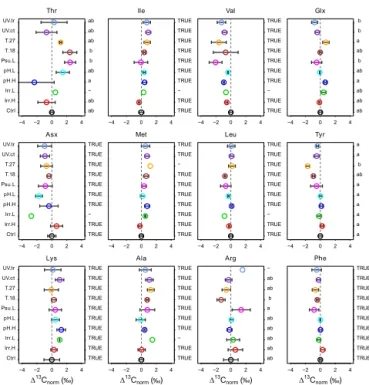
the control and the remaining treatments (Fig. 3). Almost all offset values were within 1 ‰, except for amino acids with high variability between replicates, such as Thr, Asx and Arg. We found the largest offsets relative to the con-trol among treatments with high cell densities (27◦C, low
−30
−20
−10
Thr Asx Lys Ile Met Ala Val Leu Arg Glx Tyr Phe bulk
δ
13C
(
)
‰
Tr.ID
Ctrl
Irr.H
Irr.L
pH.H
pH.L
Psu.L
T.18
T.27
UV.ct
UV.tr
Figure 1.Average δ13CAA andδ13Cbulk values (n=3) of
Tha-lassiosira weissflogiiacross 10 treatments (Tr.ID). See Table 1 for treatment descriptions and Supplement Table S1 for standard devi-ation values.
salinity, 18◦C; Table 2). Finally, to confirm thatδ13CAA
pat-terns ofT. weissflogiiwould remain diagnostic of their au-totrophic source, regardless of these relatively small changes inδ13CAAnorvalues associated with different growth
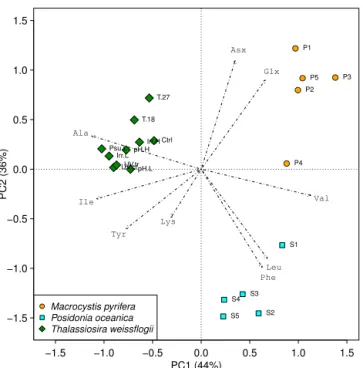
condi-tions, we compared our T. weissflogii data with published data sets for two other main marine taxa, seagrass and kelp, collected from a range of different natural marine habitats (Larsen et al., 2013). The PCA showed that the three taxa clustered apart, and almost all of the amino acids were im-portant for explaining variation in the multivariate data set (Fig. 4). This result suggests that the magnitude of change in
δ13CAApatterns associated with changing growth conditions
Oxaloacetate Pyruvate Glutamate Aromatic
0 5 10
Thr Asx Lys Ile Met Ala Val Leu Arg Glx Tyr Phe bulk
δ 13 C v ) normalizedi non-normalizedi ‰
Figure 2.Distribution of relative differences in individualδ13CAA
and δ13Cbulk values of Thalassiosira weissflogii (28 samples) across 10 different treatments. The “non-normalized” box plots rep-resent absolute differences inδ13C values (as shown in Fig. 1) and the “normalized” box plots represent differences forδ13C values normalized to the amino acid mean for each treatment. The upper and lower whiskers indicate maximum and minimum values, the boxes show the 25th and 75th percentile range, and the line inside the boxes shows the median. The small dots show outlier values, and the large dots average values.
−4 −2 0 2 4
Thr Ctrl Irr.H Irr.L pH.H pH.L Psu.L T.18 T.27 UV.ct UV.tr ab ab − a( ab (b (b ab ab ab
−4 −2 0 2 4
Asx Ctrl Irr.H Irr.L pH.H pH.L Psu.L T.18 T.27 UV.ct UV.tr TRUE TRUE − TRUE TRUE TRUE TRUE TRUE TRUE TRUE
−4 −2 0 2 4
Lys Ctrl Irr.H Irr.L pH.H pH.L Psu.L T.18 T.27 UV.ct UV.tr
∆13C
normg G
TRUE TRUE TRUE TRUE TRUE TRUE TRUE TRUE TRUE TRUE
−4 −2 0 2 4
Ile TRUE TRUE − TRUE TRUE TRUE TRUE TRUE TRUE TRUE
−4 −2 0 2 4
Met TRUE TRUE TRUE TRUE TRUE TRUE TRUE − TRUE TRUE
−4 −2 0 2 4
Ala
∆13C
normg G
TRUE TRUE − TRUE TRUE TRUE TRUE TRUE TRUE TRUE
−4 −2 0 2 4
Val TRUE TRUE − TRUE TRUE TRUE TRUE TRUE TRUE TRUE
−4 −2 0 2 4
Leu TRUE TRUE − TRUE TRUE TRUE TRUE TRUE TRUE TRUE
−4 −2 0 2 4
Arg
∆13C
normg G
ab ab ab ab ab a( b ab ab −
−4 −2 0 2 4
Glx ab ab ab a( ab (b ab a( b (b
−4 −2 0 2 4
Tyr a( a( a( a( a( a( ab (b a( a(
−4 −2 0 2 4
Phe
∆13C
normg G
TRUE TRUE TRUE TRUE TRUE TRUE TRUE TRUE TRUE TRUE ‰ ‰ ‰ ‰
Figure 3.δ13CAAnorvalues of 10 treatments relative to the control
treatment (Ctrl; vertical broken line) forThalassiosira weissflogii
(the symbols and the horizontal bars represent the means and stan-dard deviations including analytical errors). Different letters to the right of each figure indicate significant differences between treat-ments at≤5 % significance levels (one-way ANOVA); the “–” sym-bol signifies that the given sample was omitted from the test due to missing replicates. See Table 1 for description of treatments.
We investigated how growth conditions affected stoichio-metric composition of the diatom cells (Table 2). The results show that amino acid molar composition correlated with both cell size and C : N ratio. The C : N ratios broadly correlated with amino acid composition across biosynthetic families; proportions of Gly, Tyr, Lys, Met and Arg increased signifi-cantly with higher C : N ratios (R2values ranged from 0.657 to 0.846,P< 0.001), while the proportions of Leu, Asx, Ile, Val, Glx and Phe decreased (R2 values ranged from 0.661 to 0.760,P< 0.001). We also found similar relationships be-tween cell size and amino acid composition, presumably ow-ing to the positive correlation between C : N ratios and cell size (P< 0.001,R2=0.831).
To explore the possibility that variations inδ13CAA
pat-terns were connected with the stoichiometric composition of the cells, we correlatedδ13CAAnor with the relative
mo-lar composition of amino acid biosynthetic families and car-bon (%C), nitrogen (%N) and the ratio of both elements (C : N). For all amino acids except Ala, Tyr and Phe, corre-lations betweenδ13CAAnorvalues and C : N ratios were weak
(R2≤0.37), and in most cases insignificant (P> 0.05). In the pyruvate family, Ala was the amino acid with the strongest correlations to the 3-PGA and shikimate families, and C : N ratios, respectively, with R2 values ranging from 0.569 to 0.650 (P< 0.001). While δ13CAAnor values of Ala became
more enriched with increasing proportions of pyruvate amino acids, the relationship was opposite for the 3-PGA and shiki-mate families, and also for C : N ratios. Correlations between Ala and the oxalo andα-ketoglutarate families were non-significant (P > 0.05). Finally, the trends for Tyr and Phe in the shikimate families were the opposite of those observed for Ala. The linear correlations between Tyr or Phe to biosyn-thetic families and C : N ratios were significant but much weaker (P< 0.001,R2≤0.462) compared to Ala. We did not find that any of the remaining environmental and physiolog-ical parameters correlated tightly withδ13CAAnorvalues.
3.2 Sediment samples
To investigate the degree of bacterial-likeδ13CAA patterns
in the sediment samples, we first performed LDA to iden-tify which set of amino acids would best distinguish be-tween diatoms and bacteria, using a training data set based on laboratory-cultured diatoms and bacteria by Larsen et al. (2013). In the training data set, we also included the diatoms Stauroneis constricta and T. weissflogii cultured specifically for this study under conditions similar to the control treatment described previously (Table 1). To avoid single-species bias in the training data set, we did not in-clude the 28T. weissflogiisamples from the culture experi-ment. The LDA results, which was based onδ13C values of nine amino acids, showed that bacteria and diatom each have distinctδ13CAA patterns, with Ile, Lys, Leu and Tyr
−1.5 −1.0 −0.5 0.0 0.5 1.0 1.5 −1.5
−1.0 −0.5 0.0 0.5 1.0 1.5
PC1 (44%)
PC2 (36%)
● ●
● ●
●
S1
S2 S3 S4
S5
P5 P1
P2 P3
P4 pH.H
pH.L Ctrl Irr.H
Irr.L Psu.L
T.18 T.27
UV.ctUV.tr
Asx
Lys Ile
Ala
Val
Leu Glx
Tyr
Phe
●Macrocystis pyrifera
Posidonia oceanica Thalassiosira weissflogii
Figure 4. Principal component analysis of δ13CAAnor values of
giant kelp (Macrocystis pyrifera), seagrass (Posidonia oceanica) and diatoms (Thalassiosira weissflogii) showing that variation in
δ13CAApattern induced by varying growth conditions does not al-ter diagnostic tracer information. The two first axes accounting for 80 % of the variation separated the three marine taxa into distinct groups. All amino acids were important for the variations displayed by the two first ordination components. Thr was omitted owing to its large intraspecies variability.
with 100 % probability as either bacteria or diatoms via the LDA; however, the linear discriminant scores were generally intermediate between bacteria and diatoms, indicating that the original primary production sources were reworked by bacteria. Since LDA is intrinsically nonquantitative, a classi-fication method indicating probable associations, it is poorly suited for estimating the proportion of bacteria- vs. diatom-derived amino acids. For this reason we explored two other statistical approaches.
The first statistical approach for estimating the relative proportion of bacteria was based on a Bayesian mixing model FRUITS using δ13CAAnor values. We selected Leu,
Lys, Ile and Tyr because they have the largest discriminant scores for separating diatoms and bacteria (Fig. 5). Based on the Bayesian model, the sedimentary contribution of bacteri-ally derived amino acids ranged from 10 to 15 % in the upper layers, and to up to 35 % in deeper layers, with standard de-viation values ranging between 8 and 20 % (Fig. 6; for more information see Fig. S1 and Table S3). The larger bacterial fractions in deeper layers indicate that accumulation of bac-terial biosynthate continued to increase as a function of age throughout this core.
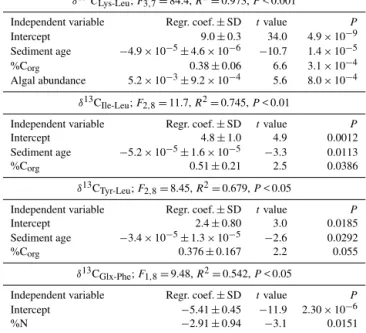
In the second statistical approach, we used multiple lin-ear regression analyses correlatingδ13C differences between
Linear discr
iminant
−10 −5 0 5 10
Training dataset Sediment samples Coefficients
13 cm (0.60) 268 cm (4.3)
278 cm (4.4)
353 cm (5.2)
689 cm (9.7) 1023 cm (17.3)
1283 cm (44.3) 1413 cm (45.0) 8 cm (0.47)
638 cm (9.0)
Thr
Asx
Lys Ile
Val
Leu Glx Tyr
Phe Thr
−1.5 −1.0 −0.5 0.0 0.5 1.0 1.5
LD
A coefficients
Figure 5.A linear function discriminant analysis based onδ13CAA
values identifying which set of amino acids best distinguishes be-tween diatoms (filled squares) and bacteria (filled circles). The two categorical variables are used to predict group membership of amino acids derived from sediment core M772-003-2 (open circles). The coefficients for each independent variable (crosses) are shown to the right; amino acids with the greatest absolute values are the most informative, i.e., Leu, Ile, Lys and Tyr. Amino acid abbrevia-tions are as defined in text.
pairs of amino acids with other sediment parameters. By analyzing all possible pairwise combinations of sediment
δ13CAA values, we found that Leu relative to Lys, Ile and
Tyr was highly significant as a function of sediment age. For theδ13CLys-Leucombination, age, % organic C, and algal
abundance explained 97.3 % of the variation (Table 4). The offsets between δ13CLys andδ13CLeu became smaller with
age (P< 0.001, R2=0.572), in contrast to organic C con-tent (P < 0.05,R2=0.525). Algal abundance was not signif-icant as a single explanatory variable (P> 0.05). The trends inδ13CLys-Leu values as a function of age were similar to
the trend of the bacterial amino acid fraction calculated with FRUITS (Fig. 6). We also comparedδ13CLys-Leuvalues with
another diagenetic parameter, DI (Table 3), and found that the correlation between these two parameters was weak but significant with anR2value of 0.40 (P≤0.05) in contrast to the correlation between age and DI (P> 0.05). In regard to the remaining pairwise combinations with Leu,δ13CIle-Leu,
2 2.5 3 3.5 4 4.5 5 5.5 6
10 15 20 25 30 35 40
-12.5 -12 -11.5 -11 -10.5 -10 -9.5 -9
0 500 1000 1500
Depth (cm)
Bacterial
AA
fraction (%)
δ
13C L
ys-Leu (
o/
oo
)
Organic carbon (wt.%)
A
B
C
Higher productivity
Higher degradation
Lower degradation Lower
productivity
Holocene Last DeglaciaL Last Glacial
250 750 1250
Figure 6. Estimated proportions of bacterial amino acids across
sediment depths of core M772-003-2 using laboratory-grown di-atoms and bacteria as endmembers(b) compared toδ13CLys-Leu values (c)and organic carbon content (a). The Bayesian mixing modeling based onδ13C values of Leu, Lys, Ile and Tyr(b)and pairwise differences between Lys and Leu show a similar trend of increasing values as a function of sediment depth (or age). While organic carbon content can explain some of the covariation of
δ13CLys-Leu(Table 4), sediment depth is the most influential pa-rameter for explaining the increasing values.
Table 4.Linear regression tables with one or more explanatory
vari-ables that explainδ13CAAvalues from sediment core M772-003-2. We applied penalized log likelihood to simplify the model, and fitted main effects without interactions. The following explanatory variables were tested: sediment age, algal abundance, bulkδ15N, organic C content (%Corg), %N (pr.N), C/N ratio, algal cell num-bers and % upwelling species. To focus on the most important re-sults we only display significant rere-sults withR2values greater than 50 %. “Regr. coef.” signifies regression coefficient, and “SD” signi-fies standard deviation. Non-significant regressions are not shown.
δ13CLys-Leu;F3,7=84.4,R2=0.973,P< 0.001
Independent variable Regr. coef.±SD tvalue P
Intercept 9.0±0.3 34.0 4.9×10⁻⁹
Sediment age −4.9×10⁻⁵±4.6×10⁻⁶ −10.7 1.4×10⁻⁵
%Corg 0.38±0.06 6.6 3.1×10⁻⁴
Algal abundance 5.2×10⁻³±9.2×10⁻⁴ 5.6 8.0×10⁻⁴
δ13CIle-Leu;F2,8=11.7,R2=0.745,P< 0.01
Independent variable Regr. coef.±SD tvalue P
Intercept 4.8±1.0 4.9 0.0012
Sediment age −5.2×10⁻⁵±1.6×10⁻⁵ −3.3 0.0113
%Corg 0.51±0.21 2.5 0.0386
δ13CTyr-Leu;F2,8=8.45,R2=0.679,P< 0.05
Independent variable Regr. coef.±SD tvalue P
Intercept 2.4±0.80 3.0 0.0185
Sediment age −3.4×10⁻⁵±1.3×10⁻⁵ −2.6 0.0292
%Corg 0.376±0.167 2.2 0.055
δ13CGlx-Phe;F1,8=9.48,R2=0.542,P< 0.05
Independent variable Regr. coef.±SD tvalue P
Intercept −5.41±0.45 −11.9 2.30×10⁻⁶
%N −2.91±0.94 −3.1 0.0151
δ13CTyr-Leu, age and % organic C explained 64.8 % of the
variation (Table 4). None of the other sediment parameters were as important as age:δ13CGlx-Phe as a function of %N
had anR2value of 0.542, and δ13CThr-Ala as a function of
algal abundance had anR2value of 0.744. DI values did not correlate with any of the pairwise combination of sediment
δ13CAAvalues.
4 Discussion
4.1 Sensitivity ofδ13CAApatterns to algal growth
conditions
To investigate whetherδ13CAApatterns remain diagnostic of
source across different growth conditions, we exposed the cosmopolitan diatomT. weissflogiito different treatments in the laboratory. We found thatδ13CAA patterns ofT. weiss-flogiiacross all 10 different treatments remained consistent (Fig. 1), and so we retained the ability to trace primary pro-ducer carbon source. This finding was underscored by our comparison to literature data from two other dominant ma-rine taxa, seagrass and kelp, collected from different natural habitats. The range in baselineδ13C values (i.e., bulkδ13C) of the diatoms was about 11 ‰, compared to about 2–3 ‰ for δ13CAAnor values. No specific treatment induced larger
than average variation inδ13CAApatterns. In terms of
macro-molecular composition, the finding that C : N ratios varied 2-fold across treatments indicates that, as has been observed previously, lipid-to-protein ratios vary widely with growth conditions (Tsuzuki et al., 1990; Dohler and Biermann, 1994; Rousch et al., 2003; Torstensson et al., 2013). Changes in amino acid molar composition were relatively modest in comparison; the largest differences in relative composition were in the pyruvate and 3-PGA families, with 30–40 % off-set between treatments, and the smallest in the oxaloacetate family, with < 10 % offset.
Overall, our findings indicate that while differing oceanic growth conditions may change macromolecular composition,
δ13CAAisotopic patterns remain largely invariant. This
con-clusion is strongly supported by previously published results for both giant kelp and seagrass (Larsen et al., 2013), and is also consistent with the results from two recent natural food-web studies (Arthur et al., 2014; Vokhshoori et al., 2014). Together, these results represent the first controlled experi-mental confirmation thatδ13CAA patterns represent reliable
carbon source tracers for primary production, irrespective of growth environment.
amino acid composition. As noted above, from the pyruvate family, Alaδ13C values correlated with the molar composi-tion of most amino acid families (R2=0.60). Isotope values of two amino acids from the shikimate family, Tyr and Phe, also had similar correlations as Ala but with opposite rela-tionships (R2=0.45). Since pyruvate and shikimate both use phosphoenolpyruvate as a precursor, it is possible that part of the variability inδ13CAA patterns between different growth
conditions can be explained by routing at branching points in the central metabolism.
Three remaining amino acids, Thr, Asx, and Arg, had higher than averageδ13C variability (Fig. 3) but did not cor-relate with any of the environmental and physiological pa-rameters tested. A previous study comparingδ13CAAvalues
between leaf and seed protein amino acids also found Thr and Asx to be the most variable of all the amino acids (Lynch et al., 2011). The authors suggested that these two amino acids may be synthesized within the seeds rather than transported from the leaves, potentially resulting in a different isotopic composition from that in leaves. A similar compartmental-ization does not exist for the unicellular diatoms, except for storage of protein amino acids in vacuoles (see discussion below); however, one possibility is that the variability in Thr isotope values can be attributed to the carbon flux distributed between the biosynthesis of Lys and the biosynthesis of Met and Thr (Bromke, 2013). A two-way downstream flux also exists for oxaloacetate, the immediate precursor for Asx, as is the case for Ala. Finally, the highδ13CAAnorvariability for
Arg may be analytical in nature, attributable to typical high signal-to-noise ratios during isotope analysis.
Changes in amino acid composition could also be related to changes in the diatom’s protein content and intracellular storage nitrogen pool. The fact that C : N ratios and cell size were correlated indicates that there is a preferential storage of certain amino acids in the diatom’s intracellular storage pool. These pools (or vacuoles) contain mostly nitrate and play an important role for cell division and dissimilatory ni-trate reduction under dark and anoxic conditions (Kamp et al., 2013). Changes in molar amino acid composition can also be related to the diatoms’ requirements for different amino acids under different growth conditions. Several stud-ies have reported that diatoms change their protein content in response to higher temperatures, nutrient availability and salinity (Rousch et al., 2003; Araujo and Garcia, 2005; Diek-mann et al., 2009). Given the large ecological role of marine diatoms, it is evident from such data that the high macro-molecular plasticity of individual diatom species such asT. weissflogiihas the potential to alter nutrient and energy fluxes in marine ecosystems (Sackett et al., 2013).
4.2 Sedimentaryδ13C
AApatterns
A central question for preservation of sedimentary OM (SOM) generally is the degree to which primary production source patterns are preserved, as opposed to microbially
al-tered, during early diagenesis. We used heterotrophic bac-teria as the microbial endmember because bacbac-terialδ13CAA
patterns are well established in contrast to those of archaea. Archaea are likely to play an important role for degradation in subsurface waters and sediments, but additional studies are needed for studying this topic in terms of source diagnos-tic isotope patterns. In the first step of estimating the rela-tive proportion of bacterial amino acids in sediments from the Peru margin, we identified the amino acids that were most informative of diatom and bacterial origins using the
δ13CAAfingerprinting method. We relied on a broad
assem-blage of laboratory-cultured diatoms and bacteria as train-ing data. Larsen et al. (2009, 2013) have previously shown that heterotrophic bacterialδ13CAApatterns are broadly
sim-ilar and clearly distinct from eukaryotic autotrophic sources. Hence, we used heterotrophic bacterialδ13CAA patterns as
one endmember of our predictive classification model. We used diatoms as another source endmember because of their importance as dominant primary producers in nutrient-rich upwelling environments worldwide. While the species as-semblage of the 10 diatom samples may not be identical to the deposited algae at the sampling site, we contend that the laboratory-cultured diatoms represent a reasonableδ13CAA
endmember for coastal plankton sources since diatoms com-prised between 50 and 80 % of the total algal remains in the sediment (Table 3). Previousδ13CAAwork has indicated that
δ13CAApatterns of different eukaryotic phytoplankton,
espe-cially diatoms, have relatively minor differences (Vokhshoori et al., 2014). Moreover, we demonstrated in the diatom cul-ture experiment thatδ13CAApatterns remain source
diagnos-tics across varying environmental conditions. Therefore, we hypothesize that bacterial resynthesis of original algal pro-duction should clearly shiftδ13CAApatterns, thus offering a
novel approach for directly evaluating the importance of bac-terial source in preserved SOM.
We explored two independent approaches for character-izing microbial contribution during sedimentary diagenesis: Bayesian mixing modeling with normalized δ13CAA
val-ues and pairwiseδ13CAAdifferences. Results from both
ap-proaches showed that Ile, Lys, Leu and Tyr (in that order) were the most informative amino acids for distinguishing be-tween bacterial and algal sources, which is in good agree-ment with Larsen et al. (2013). It is particularly striking that the Bayesian model for directly estimating fraction of bac-terial source (based on values of these four amino acids) showed essentially identical trends with time toδ13CLys-Leu
alone (Fig. 6). This similarity gives added confidence to the estimated bacterial fractions, despite the rather high uncer-tainties in estimated mean values (Table S4). These findings are encouraging in suggestingδ13CAA as a new, direct
tradi-tional proxies, including redox-sensitive elements and diage-netic or bacterial markers such as D-amino acids and mu-ramic acid (Grutters et al., 2002; Lomstein et al., 2009; Fer-nandes et al., 2014a). In terms of the methodological issues of analyzing sedimentaryδ13CAA, we found that purification
did not alter 13CAA values except that Asx showed an
en-richment of approximately 2 ‰. In our case, Asx was not informative of degradation processes and the 2 ‰ fraction-ation was therefore of no concern for this study. That said, it will be important to continue the method development of purifying complex samples to ensure that isotope effects are completely eliminated.
We compared our results with the DI, a commonly used degradation proxy based on molar amino acid composi-tion (Dauwe and Middelburg, 1998; Dauwe et al., 1999). The finding of weak correlation between the DI and the
δ13CAA-based proxy seems somewhat surprising. However,
the range in DI values in this core is relatively modest, and there is no consistent trend of increasing DI with sediment depth throughout the core (Table 3). This may be consistent with a low-oxygen, high-preservation environment, suggest-ing that DI values could be mainly related to the sources and deposition of individual sediment horizons, as opposed to further change downcore. Ultimately, however, the appar-ent decoupling of these two parameters likely points to our currently limited mechanistic understanding of many com-monly applied diagenetic parameters. The DI is an opera-tional parameter, developed based on multivariate analysis of changes in amino acid molar composition between dif-ferent samples with a priori assumed differences in degra-dation state (Dauwe and Middelburg, 1998). However, such molar changes could arise equally from selective degradation of autotrophic amino acids or from addition of new bacterial biosynthate, or even from changes in amino acid pool that can be liberated by acid hydrolysis. The δ13CAA estimates
of bacterial contribution, in contrast, reflect mostly essential amino acids synthesized by heterotrophic bacteria. Overall, coupling such parameters in future work may offer major new opportunities to more fully understand the mechanis-tic basis of sedimentary organic matter preservation. We also note that future research is needed in terms of understand-ing the resistance of proteinaceous sediment material to acid hydrolysis. To answer this question, it will be particularly important to quantify proteinaceous vs. non-proteinaceous fractions of organic nitrogen in the sediment (Keil et al., 2000). The single study to date that directly compares sta-ble isotope values of bulk sedimentary nitrogen vs. the hy-drolyzable proteinaceous amino acid pool suggests that the non-proteinaceous fraction of organic nitrogen is substantial (Batista et al., 2014).
It is also possible that degradation and resynthesis of amino acids in the water column could have shaped the
δ13CAA patterns we observed in sediments. The proportion
of amino acids degraded in the water column is usually large; for example, Lee and Cronin (1982) found that, in
the Peruvian upwelling region, amino acid nitrogen declined from 75–90 % in fresh plankton to 10–30 % in the surface sediment. However, whether such degradation is predomi-nantly due to amino acid removal, or whether water col-umn degradation also introduces significant bacterially syn-thesized amino acids, is not as clear. Lomstein et al. (2006) found for Chilean coastal upwelling areas that a large frac-tion of their measured D-amino acids in the sediment derived from diatom empty cell sacs and cell wall fragments, includ-ing peptidoglycan. The fact that these remains persisted in the sediment after cell death indicates that microbial degra-dation of diatom remains that reached the sea floor was rela-tively modest. Sinking particles caught in sediment traps usu-ally have overall “fresh” biochemical signatures, relatively unaltered isotopic signatures (e.g., Cowie and Hedges, 1994; Hedges et al., 2001). Subsurface suspended POM, in con-trast, often undergoes dramatic shifts in bulk N isotope signa-tures with depth consistent with microbial alteration (Zhang and Altabet, 2008) and also has typically older114C ages (Druffel et al., 1996). However, a recent paper examining
δ13CAA in suspended POM (which had undergone an 8 ‰
shift in bulk isotope values with depth) did not find evi-dence that bacteria represented a significant source of or-ganic material (Hannides et al., 2013). This finding is con-sistent with very low dark / light amino acid ratios in sim-ilar particles (Kaiser and Benner, 2008). In sinking POM, the only compound-specific isotope amino acid paper to date has found variable results. McCarthy et al. (2004) reported a strong imprint of heterotrophic resynthesis from surface wa-ters in an equatorial upwelling region, corresponding with multiple other parameters indicating extensive heterotrophic organic matter alteration. In contrast, in an adjacent region, sinking POM showed little change inδ13CAA patterns with
depth, even in deep-ocean (3600 m) traps. Overall, it seems possible that some portion of the surface sediment bacterial contributions can be attributed to processes during water col-umn transit; however, not enough is known aboutδ15N and
δ13C patterns in sinking particles to clearly constrain this possible source.
Taken together, these first sedimentδ13CAA results
indi-cate that, even in a relatively high deposition and low oxy-gen environment such as the Peru margin, microbial resyn-thesis has contributed substantially to amino acids preserved in the oldest sediments. The correlation in our study between sediment age and bacterial amino acid contribution supports the idea of progressive accumulation of bacterial SOM, even in extremely well preserved sediments (Fig. 6). While the multivariate analysis showed that high total organic carbon content was also associated with less bacterial-likeδ13CAA
content, is the most important driver of increasing bacte-rial contribution. It is possible that bactebacte-rial transformation could also have been linked to specific depositional condi-tions of specific sediment horizons (Grutters et al., 2002), but further cross-site studies are warranted to better understand what controls transformation from algae- to bacteria-derived SOM.
5 Conclusions and outlook
In this study we have presented a first assessment of the po-tential of δ13CAA patterns as new paleoproxies, first from
the perspective of assessing the fidelity of δ13CAA sources
in the face of variation in ocean growth conditions of pri-mary producer sources, and second in terms of assessing possible post-depositional bacterial contributions to sedi-mentary organic matter. Our algal growth experiments have clearly demonstrated that, at least in one cosmopolitan ma-rine species, δ13CAA patterns are good tracers of
phyloge-netic source, irrespective of wide variation in bulk isotope values, or biochemical cellular makeup linked to growth con-ditions. These results strongly support the potential to use nowδ13CAAas a novel proxy for reconstructing detailed
car-bon sources and budgets in sediments, as well as potential in other paleoarchives. Finally, our results from sediments may be also be quite important for future studies of the role of bacteria in preservation of SOM, because they suggest that
δ13CAAcan also be used as a new tool to directly assess the
extent of microbial contribution. Because amino acids are by far the most important form of preserved organic nitrogen in modern sediments, these data suggest that direct contribution of bacterially sourced biosynthetic to sedimentary organic ni-trogen may be extensive.
Future research will need to explore in more detail the de-gree to which the extent of bacterial sedimentary amino acid resynthesis is linked to sedimentary regimes, and should also move to combine the information potential from both amino acidδ15N andδ13C values, in assessing the role of bacteria in sedimentary organic preservation. Specifically, these re-sults pose a number of mechanistic questions, which we sug-gest should be important topics for future work. First, the re-sults here are derived from the hydrolyzable amino acid pool, which is usually a fairly low proportion of total organic ni-trogen in most sedimentary systems (e.g., Cowie and Hedges, 1994).
Since bacterial growth and resynthesis should, by defini-tion, produce “fresh” proteinaceous material, it will be im-portant to devise ways to understand whether the trends in bacterial source indicated here are representative of the en-tire sediment amino acid pool, or rather mainly the “fresh-est” fraction, amenable to acid hydrolysis. Second, it will be important to determine whether results indicating substan-tial bacterial source and resynthesis are general, or are spe-cific to different sedimentary regimes. For example, Batista
et al. (2014) recently examinedδ15NAA patterns from
lam-inated anoxic sediments in the Santa Barbara Basin. The authors found no evidence for bacterial modification in
δ15NAA patterns past the sediment–water interface, a
con-clusion supported byδ15NAA-based resynthesis parameters
such as total heterotrophic amino acid resynthesis (6V )
(McCarthy et al., 2007). While δ15NAA was not measured
in this study, the apparent contrast between these two high-productivity/deposition environments suggests that bacterial sources of resynthesized organic matter could be more vari-able than might initially be assumed. Finally, the apparent variability in bacterial contributions in this single core poses the fundamental question of what controlling mechanisms regulate the percentage of post-deposition bacterial resynthe-sis. We suggest thatδ13CAApatterns can represent a key new
tool for understanding the direct role of bacterial resynthesis in SOM preservation.
The Supplement related to this article is available online at doi:10.5194/bg-12-4979-2015-supplement.
Acknowledgements. The study was funded by the Deutsche Forschungsgemeinschaft through the Cluster of Excellence “The Future Ocean” (EXC 80/1, CP0937). L. T. Bach was funded by the BMBF in the framework of the BIOACID II project, and M. Ventura was funded by the Spanish government project Invasivefish (427/2011). This work is a contribution to the DFG-supported Sonderforschungsbereich 754 “Climate–Biogeochemistry In-teractions in the Tropical Ocean” (www.sfb754.de). We thank Philippe Martinez and Elfi Mollier for providing the sediment samples.
Edited by: V. Garçon
References
Amelung, W. and Zhang, X.: Determination of amino acid enantiomers in soils, Soil Biol. Biochem., 33, 553–562, doi:10.1016/S0038-0717(00)00195-4, 2001.
Araujo, S. D. and Garcia, V. M. T.: Growth and biochemical com-position of the diatomChaetoceroscf.wighamiibrightwell un-der different temperature, salinity and carbon dioxide levels. I. Protein, carbohydrates and lipids, Aquaculture, 246, 405–412, doi:10.1016/j.aquaculture.2005.02.051, 2005.
Arthur, K. E., Kelez, S., Larsen, T., Choy, C. A., and Popp, B. N.: Tracing the biosynthetic source of essential amino acids in marine turtles usingδ13C fingerprints, Ecology, 95, 1285–1293, doi:10.1890/13-0263.1, 2014.
Batista, F. C., Ravelo, A. C., Crusius, J., Casso, M. A., and McCarthy, M. D.: Compound specific amino acid δ15N in marine sediments: A new approach for studies of the ma-rine nitrogen cycle, Geochim. Cosmochim. Ac., 142, 553–569, doi:10.1016/j.gca.2014.08.002, 2014.
Bromke, M.: Amino Acid Biosynthesis Pathways in Diatoms, Metabolites, 3, 294–311, 2013.
Burdige, D. J.: Preservation of organic matter in marine sed-iments: Controls, mechanisms, and an imbalance in sedi-ment organic carbon budgets?, Chem. Rev., 107, 467–485, doi:10.1021/cr050347q, 2007.
Corr, L. T., Berstan, R., and Evershed, R. P.: Development ofN -acetyl methyl ester derivatives for the determination of δ13C values of amino acids using gas chromatography-combustion-isotope ratio mass spectrometry, Anal. Chem., 79, 9082–9090, doi:10.1021/ac071223b, 2007.
Cowie, G. L. and Hedges, J. I.: Biochemical indicators of diagenetic alteration in natural organic matter mixtures, Nature, 369, 304– 307, doi:10.1038/369304a0, 1994.
Dauwe, B. and Middelburg, J. J.: Amino acids and hex-osamines as indicators of organic matter degradation state in North Sea sediments, Limnol. Oceanogr., 43, 782–798, doi:10.4319/lo.1998.43.5.0782, 1998.
Dauwe, B., Middelburg, J. J., Herman, P. M. J., and Heip, C. H. R.: Linking diagenetic alteration of amino acids and bulk organic matter reactivity, Limnol. Oceanogr., 44, 1809–1814, doi:10.4319/lo.1999.44.7.1809, 1999.
Dickson, A. G., Sabine, C. L., and Christian, J. R.: Guide to best practices for ocean CO measurements, PICES Special Publica-tion, 191 pp., 2007.
Diekmann, A. B. S., Peck, M. A., Holste, L., St John, M. A., and Campbell, R. W.: Variation in diatom biochemical composition during a simulated bloom and its effect on copepod production, J. Plankton Res., 31, 1391–1405, doi:10.1093/plankt/fbp073, 2009. Dohler, G. and Biermann, T.: Impact of UV-B radiation on the lipid and fatty acid composition of synchronizedDitylum brightwellii
(West) Grunow, Z. Naturforschung C, 49, 607–614, 1994. Druffel, E. R. M., Bauer, J. E., Williams, P. M., Griffin, S., and
Wol-gast, D.: Seasonal variability of particulate organic radiocarbon in the northeast Pacific Ocean, J. Geophys. Res.-Oceans, 101, 20543–20552, doi:10.1029/96JC01850, 1996.
Fernandes, L., Garg, A., and Borole, D. V.: Amino acid biogeo-chemistry and bacterial contribution to sediment organic matter along the western margin of the Bay of Bengal, Deep-Sea Res. Pt. I, 83, 81–92, doi:10.1016/j.dsr.2013.09.006, 2014a.
Fernandes, R., Millard, A. R., Brabec, M., Nadeau, M.-J., and Grootes, P.: Food Reconstruction Using Isotopic Transferred Sig-nals (FRUITS): A Bayesian Model for Diet Reconstruction, Plos One, 9, e87436, doi:10.1371/journal.pone.0087436, 2014b. Field, C. B., Behrenfeld, M. J., Randerson, J. T., and Falkowski,
P.: Primary production of the biosphere: Integrating ter-restrial and oceanic components, Science, 281, 237–240, doi:10.1126/science.281.5374.237, 1998.
Grootes, P. M., Nadeau, M.-J., and Rieck, A.: 14C-AMS at the Leibniz-Labor: radiometric dating and isotope research, Nucl. Instrum. Meth. B, 223–224, 55–61, doi:10.1016/j.nimb.2004.04.015, 2004.
Grutters, M., van Raaphorst, W., Epping, E., Helder, W., de Leeuw, J. W., Glavin, D. P., and Bada, J.: Preservation of amino
acids from in situ-produced bacterial cell wall peptidoglycans in northeastern Atlantic continental margin sediments, Lim-nol. Oceanogr., 47, 1521–1524, doi:10.4319/lo.2002.47.5.1521, 2002.
Guillard, R. R. and Ryther, J. H.: Studies of marine planktonic di-atoms. I. Cyclotella nanaHustedt, and Detonula confervacea
(cleve) Gran, Can. J. Microbiol., 8, 229–239, 1962.
Hannides, C. C. S., Popp, B. N., Choy, C. A., and Drazen, J. C.: Midwater zooplankton and suspended particle dy-namics in the North Pacific Subtropical Gyre: A sta-ble isotope perspective, Limnol. Oceanogr., 58, 1931–1946, doi:10.4319/lo.2013.58.6.1931, 2013.
Hartnett, H. E., Keil, R. G., Hedges, J. I., and Devol, A. H.: In-fluence of oxygen exposure time on organic carbon preserva-tion in continental margin sediments, Nature, 391, 572–574, doi:10.1038/35351, 1998.
He, H. B., Lu, H. J., Zhang, W., Hou, S. M., and Zhang, X. D.: A liq-uid chromatographic/mass spectrometric method to evaluate13C and15N incorporation into soil amino acids, J. Soil. Sediment., 11, 731–740, doi:10.1007/s11368-011-0360-5, 2011.
Hedges, J. I. and Keil, R. G.: Sedimentary organic matter preserva-tion: an assessment and speculative synthesis, Mar. Chem., 49, 81–115, doi:10.1016/0304-4203(95)00008-F, 1995.
Hedges, J. I., Baldock, J. A., Gelinas, Y., Lee, C., Peterson, M., and Wakeham, S. G.: Evidence for non-selective preservation of organic matter in sinking marine particles, Nature, 409, 801–804, doi:10.1038/35057247, 2001.
Henderson, G. M.: New oceanic proxies for paleoclimate, Earth Planet. Sc. Lett., 203, 1–13, doi:10.1016/S0012-821x(02)00809-9, 2002.
Kaiser, K. and Benner, R.: Major bacterial contribution to the ocean reservoir of detrital organic carbon and nitrogen, Limnol. Oceanogr., 53, 99–112, doi:10.4319/lo.2008.53.1.0099, 2008. Kamp, A., Stief, P., Knappe, J., and de Beer, D.:
Re-sponse of the Ubiquitous Pelagic Diatom Thalassiosira weissflogii to Darkness and Anoxia, Plos One, 8, e82605, doi:10.1371/journal.pone.0082605, 2013.
Keil, R. G., Tsamakis, E., and Hedges, J. I.: Early diagenesis of particulate amino acids in marine systems, in: Perspectives in amino acid and protein geochemistry, edited by: Goodfriend, G. A., Collins, M. J., Fogel, M. L., Macko, S. A., and Wehmiller, J. F., Oxford University Press, Oxford, New York, 69–82, 2000. Larsen, T., Ventura, M., Damgaard, C., Hobbie, E. A., and Krogh,
P. H.: Nutrient allocations and metabolism in two collembolans with contrasting reproduction and growth strategies, Funct. Ecol., 23, 745–755, doi:10.1111/j.1365-2435.2009.01564.x, 2009.
Larsen, T., Ventura, M., Andersen, N., O’Brien, D. M., Pi-atkowski, U., and McCarthy, M. D.: Tracing Carbon Sources through Aquatic and Terrestrial Food Webs Using Amino Acid Stable Isotope Fingerprinting, Plos One, 8, e73441, doi:10.1371/journal.pone.0073441, 2013.
Lee, C. and Cronin, C.: The Vertical Flux of Particulate Organic Nitrogen in the Sea – Decomposition of Amino Acids in the Peru Upwelling Area and the Equatorial Atlantic, J. Mar. Res., 40, 227–251, 1982.
seawater and sediments, Deep-Sea Res. Pt. I, 47, 1535–1568, doi:10.1016/s0967-0637(99)00116-8, 2000.
Lomstein, B. A., Jorgensen, B. B., Schubert, C. J., and Nigge-mann, J.: Amino acid biogeo- and stereochemistry in coastal Chilean sediments, Geochim. Cosmochim. Ac., 70, 2970–2989, doi:10.1016/j.gca.2006.03.015, 2006.
Lomstein, B. A., Niggemann, J., Jørgensen, B. B., and Langerhuus, A. T.: Accumulation of prokaryotic remains during organic mat-ter diagenesis in surface sediments off Peru, Limnol. Oceanogr., 54, 1139–1151, doi:10.4319/lo.2009.54.4.1139, 2009.
Lynch, A. H., McCullagh, J. S. O., and Hedges, R. E. M.: Liquid chromatography/isotope ratio mass spectrometry measurement of delta13C of amino acids in plant proteins, Rapid Commun. Mass Sp., 25, 2981–2988, doi:10.1002/rcm.5142, 2011. Makou, M. C., Eglinton, T. I., Oppo, D. W., and Hughen, K. A.:
Postglacial changes in El Niño and La Niña behavior, Geology, 38, 43–46, doi:10.1130/G30366.1, 2010.
McCarthy, M. D., Benner, R., Lee, C., Hedges, J. I., and Fogel, M. L.: Amino acid carbon isotopic fractionation patterns in oceanic dissolved organic matter: an unaltered photoautotrophic source for dissolved organic nitrogen in the ocean?, Mar. Chem., 92, 123–134, doi:10.1016/j.marchem.2004.06.021, 2004.
McCarthy, M. D., Benner, R., Lee, C., and Fogel, M. L.: Amino acid nitrogen isotopic fractionation patterns as indi-cators of heterotrophy in plankton, particulate, and dissolved organic matter, Geochim. Cosmochim. Ac., 71, 4727–4744, doi:10.1016/j.gca.2007.06.061, 2007.
Meyers, P. A.: Applications of organic geochemistry to pale-olimnological reconstructions: a summary of examples from the Laurentian Great Lakes, Org. Geochem., 34, 261–289, doi:10.1016/S0146-6380(02)00168-7, 2003.
Mollier-Vogel, E.: Peruvian Oxygen Minimum Zone Dynamics During the Last 18 000 Years, PhD dissertation, Mathematisch-Naturwissenschaftliche Fakultät der Christian-Albrechts Univer-sität zu Kiel, Kiel, 2012.
Nelson, D. M., Treguer, P., Brzezinski, M. A., Leynaert, A., and Queguiner, B.: Production and dissolution of biogenic silica in the ocean: Revised global estimates, comparison with regional data and relationship to biogenic sedimentation, Global Bio-geochem. Cy., 9, 359–372, doi:10.1029/95gb01070, 1995. Nguyen, R. T. and Harvey, H. R.: Protein and amino acid
cy-cling during phytoplankton decomposition in oxic and anoxic waters, Org. Geochem., 27, 115–128, doi:10.1016/S0146-6380(97)00076-4, 1997.
Ortlieb, L., Vargas, G., and Saliege, J. F.: Marine radiocarbon reser-voir effect along the northern Chile-southern Peru coast (14– 24 S) throughout the Holocene, Quaternary Res., 75, 91–103, doi:10.1016/j.yqres.2010.07.018, 2011.
Reimer, P. J., Baillie, M. G. L., Bard, E., Bayliss, A., Beck, J. W., Blackwell, P. G., Ramsey, C. B., Buck, C. E., Burr, G. S., Ed-wards, R. L., Friedrich, M., Grootes, P. M., Guilderson, T. P., Hajdas, I., Heaton, T. J., Hogg, A. G., Hughen, K. A., Kaiser, K. F., Kromer, B., McCormac, F. G., Manning, S. W., Reimer, R. W., Richards, D. A., Southon, J. R., Talamo, S., Turney, C. S. M., van der Plicht, J., and Weyhenmeye, C. E.: Intcal09 and Marine09 Radiocarbon Age Calibration Curves, 0–50 000 Years Cal Bp, Radiocarbon, 51, 1111–1150, 2009.
Rousch, J. M., Bingham, S. E., and Sommerfeld, M. R.: Changes in fatty acid profiles of thermo-intolerant and thermo-tolerant ma-rine diatoms during temperature stress, J. Exp. Mar. Biol. Ecol., 295, 145–156, doi:10.1016/S0022-0981(03)00293-4, 2003. Sackett, O., Petrou, K., Reedy, B., De Grazia, A., Hill, R., Doblin,
M., Beardall, J., Ralph, P., and Heraud, P.: Phenotypic Plasticity of Southern Ocean Diatoms: Key to Success in the Sea Ice Habi-tat?, Plos One, 8, e81185, doi:10.1371/journal.pone.0081185, 2013.
Salvatteci, R., Field, D., Sifeddine, A., Ortlieb, L., Ferreira, V., Baumgartner, T., Caquineau, S., Velazco, F., Reyss, J.-L., Sanchez-Cabeza, J.-A., and Gutierrez, D.: Cross-stratigraphies from a seismically active mud lens off Peru indicate horizontal extensions of laminae, missing sequences, and a need for mul-tiple cores for high resolution records, Mar. Geol., 357, 72–89, doi:10.1016/j.margeo.2014.07.008, 2014.
Schönfeld, J., Kuhnt, W., Erdem, Z., Flögel, S., Glock, N., Aquit, M., Frank, M., and Holbourn, A.: Records of past mid-depth ven-tilation: Cretaceous ocean anoxic event 2 vs. Recent oxygen min-imum zones, Biogeosciences, 12, 1169–1189, doi:10.5194/bg-12-1169-2015, 2015.
Skilbeck, C. G. and Fink, D.: Radiocarbon dating and sedimenta-tion rates for Holocene – upper Pleistocene sediments, eastern equatorial Pacific and Peru continental margin, Data report ODP Leg-181, in: Proc. ODP, Sci. Results, 201, edited by: Jørgensen, B. B., D’Hondt, S. L., and Miller, D. J., 2006.
Torstensson, A., Hedblom, M., Andersson, J., Andersson, M. X., and Wulff, A.: Synergism between elevatedpCO2and tempera-ture on the Antarctic sea ice diatom Nitzschia lecointei, Biogeo-sciences, 10, 6391–6401, doi:10.5194/bg-10-6391-2013, 2013. Tribovillard, N., Algeo, T. J., Lyons, T., and Riboulleau, A.: Trace
metals as paleoredox and paleoproductivity proxies: An update, Chem. Geol., 232, 12–32, doi:10.1016/j.chemgeo.2006.02.012, 2006.
Tsuzuki, M., Ohnuma, E., Sato, N., Takaku, T., and Kawaguchi, A.: Effects of CO2 concentration during growth on fatty-acid composition in microalgae, Plant Physiol., 93, 851–856, doi:10.1104/Pp.93.3.851, 1990.
Venables, W. N. and Ripley, B. D.: Modern applied statistics with S, 4th Edn., Statistics and computing, Springer, New York, 495 pp., 2002.
Vokhshoori, N., Larsen, T., and McCarthy, M.: Reconstructingδ13C isoscapes of phytoplankton production in a coastal upwelling system with amino acid isotope values of littoral mussels, Mar. Ecol.-Prog. Ser., 504, 59–72, doi:10.3354/meps10746, 2014. Wakeham, S. G., Lee, C., Hedges, J. I., Hernes, P. J., and
Pe-terson, M. J.: Molecular indicators of diagenetic status in ma-rine organic matter, Geochim. Cosmochim. Ac., 61, 5363–5369, doi:10.1016/s0016-7037(97)00312-8, 1997.