BGD
10, 10399–10428, 2013
The bacterial role in benthic carbon
cycling
L. Pozzato et al.
Title Page
Abstract Introduction
Conclusions References
Tables Figures
◭ ◮
◭ ◮
Back Close
Full Screen / Esc
Printer-friendly Version Interactive Discussion
Discussion
P
a
per
|
D
iscussion
P
a
per
|
Discussion
P
a
per
|
Discuss
ion
P
a
per
|
Biogeosciences Discuss., 10, 10399–10428, 2013 www.biogeosciences-discuss.net/10/10399/2013/ doi:10.5194/bgd-10-10399-2013
© Author(s) 2013. CC Attribution 3.0 License.
Open Access
Biogeosciences Discussions
Geoscientiic Geoscientiic
Geoscientiic Geoscientiic
This discussion paper is/has been under review for the journal Biogeosciences (BG). Please refer to the corresponding final paper in BG if available.
Sink or link? The bacterial role in benthic
carbon cycling in the Arabian sea oxygen
minimum zone
L. Pozzato1, D. Van Oevelen1, L. Moodley1, K. Soetaert1, and J. J. Middelburg2
1
Department of Ecosystem Studies, Royal Netherlands Institute for Sea Research NIOZ-Yerseke Korringaweg 7, 4401 CT Yerseke, the Netherlands
2
Department of Earth Sciences-Geochemistry Faculty of Geosciences, Utrecht University Budapestlaan 4, 3584 CD Utrecht, the Netherlands
Received: 6 May 2013 – Accepted: 5 June 2013 – Published: 26 June 2013
Correspondence to: L. Pozzato ([email protected], [email protected])
BGD
10, 10399–10428, 2013
The bacterial role in benthic carbon
cycling
L. Pozzato et al.
Title Page
Abstract Introduction
Conclusions References
Tables Figures
◭ ◮
◭ ◮
Back Close
Full Screen / Esc
Printer-friendly Version Interactive Discussion
Discussion
P
a
per
|
D
iscussion
P
a
per
|
Discussion
P
a
per
|
Discuss
ion
P
a
per
|
Abstract
The bacterial loop, the consumption of dissolved organic matter (DOM) by bacteria and subsequent transfer of bacterial carbon to higher trophic levels, plays a prominent role in pelagic aquatic food webs. However, its role in sedimentary ecosystems is not well documented. Here we present the results of isotope tracer experiments performed 5
under in situ oxygen conditions in sediments from inside and outside the Arabian Sea Oxygen Minimum Zone (OMZ) to study the importance of the microbial loop in this setting. Particulate organic matter, added as phytodetritus, was processed by bacteria, protozoa and metazoans, while dissolved organic matter was processed only by bac-teria and there was very little, if any, transfer to higher trophic levels within the experi-10
mental period. This lack of significant transfer of bacterial-derived carbon to metazoan consumers indicates that the bacterial loop is rather inefficient in these sediments. Moreover, metazoans directly consume labile particulate organic matter resources and thus compete with bacteria for phytodetritus.
1 Introduction
15
Isotope tracer experiments have been conducted in various settings to assess the pro-cessing of particulate labile organic matter (OM) by the benthic community (Moodley et al., 2002, 2005b; Witte et al., 2003a, b; Andersson et al., 2008; Woulds et al., 2009). These studies have revealed that all benthic size classes (bacteria, meiofauna, and macrofauna) were involved and took up some of the labeled OM. These results, al-20
though very informative, left one question unanswered: is organic matter assimilated directly by meio- and macrofauna feeding on phytodetritus, or indirectly via ingestion of bacteria that in turn hydrolyzed particulate organic matter (POM) into dissolved or-ganic matter (DOM) and subsequently incorporated it? In other words, are sedimentary bacteria a link or a sink in the benthic food web?
BGD
10, 10399–10428, 2013
The bacterial role in benthic carbon
cycling
L. Pozzato et al.
Title Page
Abstract Introduction
Conclusions References
Tables Figures
◭ ◮
◭ ◮
Back Close
Full Screen / Esc
Printer-friendly Version Interactive Discussion
Discussion
P
a
per
|
D
iscussion
P
a
per
|
Discussion
P
a
per
|
Discuss
ion
P
a
per
|
Pomeroy (1974) suggested that bacteria and protozoa form an important link between dissolved organic matter produced by primary producers and metazoans higher up in the food web. Following studies confirmed this hypothesis and Azam et al. (1983) named this pathway the “microbial loop” in pelagic ecosystems. Later, Ju-mars et al. (1989) presented a provocative paper in which this theory was further elabo-5
rated: they showed that heterotrophic bacteria were feeding not only on phytoplankton-derived dissolved organic carbon but also on DOM phytoplankton-derived from sloppy feeding by zooplankton.
Lee (1980) and Kemp (1988) were among the first to hypothesize that the microbial loop might also be occurring in the sediment, although possibly in a more complex form. 10
According to these authors, sediment bacteria would incorporate DOM via their mem-branes directly from the pore water or from polymeric materials and particles, after breaking them down to more simple compounds using exoenzymes. Bacteria would then become food for protozoans and metazoans and thereby play a key role in the transfer of carbon and nutrients. Lee (1992) conducted14C incubation experiments us-15
ing water samples from an enclosed marine glacial basin, to study carbon preservation under oxic and anoxic condition. She found that biomass and biodiversity of bacterial grazers may explain part of the differences in carbon preservation, supporting the idea of a benthic microbial loop and offering some insights in the relationships between bacteria and their grazers.
20
Recent observations on the trophic role of bacteria and bacterial-derived carbon in sediments based on isotope tracer experiments revealed however that bacteria are not a major carbon source for intertidal benthos (Van Oevelen et al., 2006b). Consistently, for deep-sea sediments Nomaki et al. (2006) and Guilini et al. (2010) found limited to no bacterivory by meiofauna, previously thought to be major consumers of bacterial 25
BGD
10, 10399–10428, 2013
The bacterial role in benthic carbon
cycling
L. Pozzato et al.
Title Page
Abstract Introduction
Conclusions References
Tables Figures
◭ ◮
◭ ◮
Back Close
Full Screen / Esc
Printer-friendly Version Interactive Discussion
Discussion
P
a
per
|
D
iscussion
P
a
per
|
Discussion
P
a
per
|
Discuss
ion
P
a
per
|
responsible for nearly all prokaryotic mortality, transforming bacteria in detritus. The viral shunt hypotheses and the results obtained in bacterivory studies suggest that the microbial loop in sediments is a sink rather than a link in the benthic food web.
The importance of the microbial loop in deep-sea benthic food webs has however been exclusively studied in oxic sediments. Oxygen minimum zones (OMZ) are known 5
for a different biogeochemistry as compared to regular oxic settings. The naturally oc-curring OMZ in the Arabian Sea is an archetypical example: here OM accumulates in the sediment (Cowie et al., 1999; Middelburg and Levin, 2009). Several explanations have been given for this accumulation: low faunal biomass (Demaison and Moore, 1980; Levin et al., 1991; Jeffreys et al., 2009) and faunal activity (Woulds et al., 2007; 10
Levin et al., 2009), lack of oxidants and interaction of the OM with inorganic material (Hedges and Keil, 1995), incorporation of organic particles in geomacromolecules or humic substances (Mayer, 1994), and the refractory nature of the OM deposited at the bottom (Henrichs, 1992). Focusing on the functioning of this ecosystem, results by Moodley et al. (2011), Pozzato et al. (2013) and Koho et al. (2013) showed that faunal 15
limited activity, oxygen low concentration and low faunal biomass are not exclusively responsible for the OM accumulation. Instead, community functioning and efficiency are more likely to be key factors in determining such phenomenon.
OMZ sediments harboring benthic fauna could offer ample opportunity for an efficient microbial loop because of: high quantity of refractory OM (preferentially degraded by 20
bacteria) and low labile OM concentration (which force fauna to choose other food sources, such as bacteria). Thus, should the microbial loop key role in sediment OM cycling not be confirmed in such a setting, then such loop is unlikely to be important in any soft-sediment.
We investigated the specific role of bacteria in the sediments of the Arabian Sea 25
BGD
10, 10399–10428, 2013
The bacterial role in benthic carbon
cycling
L. Pozzato et al.
Title Page
Abstract Introduction
Conclusions References
Tables Figures
◭ ◮
◭ ◮
Back Close
Full Screen / Esc
Printer-friendly Version Interactive Discussion
Discussion
P
a
per
|
D
iscussion
P
a
per
|
Discussion
P
a
per
|
Discuss
ion
P
a
per
|
POM degradation by bacteria and metazoans, i.e. the detritivore pathway (Mayer, 1989; Chrost, 1991a, b), and DOM incorporation by bacteria subsequently grazed by fauna, i.e. the microbial loop. This simultaneous tracking of the two pathways allowed us to track the transfer of C up the food web to fauna via bacterivory.
2 Material and methods
5
2.1 Study area
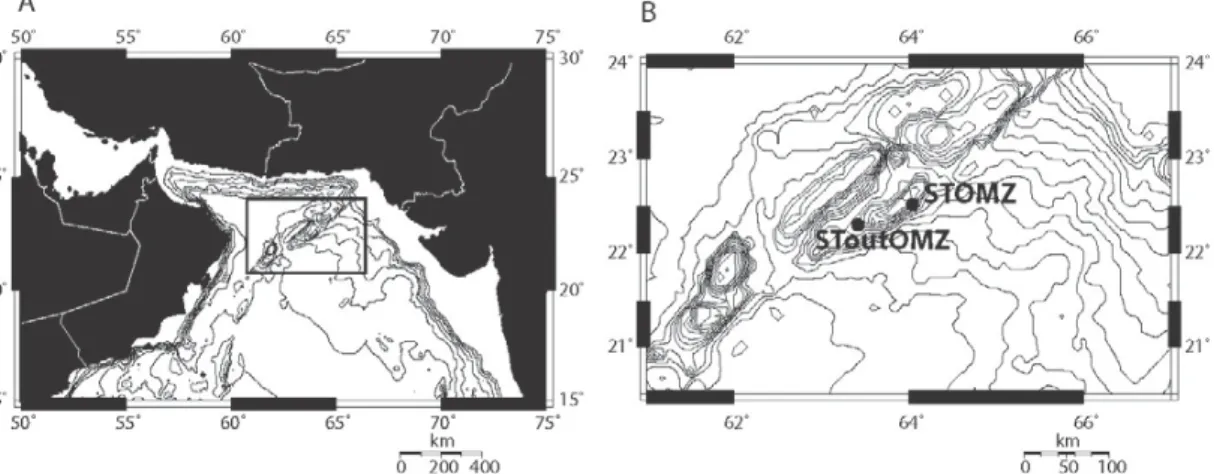
The study focused on two stations on the Murray Ridge, situated in the northern Ara-bian Sea between the Indus River delta and the city of Muscat (Fig. 1). Station STOMZ lies in the core of the OMZ and was shallower (22◦32.9′ 64◦02.4′, 885 m) than the deeper station SToutOMZ (22◦18.5′ 63◦24.5′, 1791 m) at the lower boundary of the 10
OMZ. The Murray Ridge is located south west of the Pakistan margin and it starts about 100 km from the coast into the Arabian Sea; it is approximately 20 km wide and 750 km long. The Ridge is composed of three different parts: the southern crest at wa-ter depth<1000 m, the northern zone is subdued with water depths of 2000 m and the >4400 m deep Dalymple Trough (Gaedicke et al., 2002). The sedimentary cover of the 15
Ridge increases in thickness towards the coast and it progressively widens. The Ridge is a perfect experimental setting to study marine OM processing because it is isolated and far away from shore (Shimmield et al., 1990), preventing confounding terrestrial input to this site. The OMZ starts approximately 150 m below the sea surface and coin-cides with the seasonal thermocline. At STOMZ a surface mixed layer was recorded by 20
our CTD at depth between 80 and 85 m, whereas SToutOMZ was a fully mixed water column that lacked layers and was thus not stratified.
Three different methods were used to analyze the oxygen concentration in the water column: the oxygen sensor on the CTD, Winkler titration of the water sampled by the rosette sampler and an optode fitted to the multicorer. The CTD was equipped with 25
cali-BGD
10, 10399–10428, 2013
The bacterial role in benthic carbon
cycling
L. Pozzato et al.
Title Page
Abstract Introduction
Conclusions References
Tables Figures
◭ ◮
◭ ◮
Back Close
Full Screen / Esc
Printer-friendly Version Interactive Discussion
Discussion
P
a
per
|
D
iscussion
P
a
per
|
Discussion
P
a
per
|
Discuss
ion
P
a
per
|
brated using Winkler titration of samples from outside the OMZ. One CTD cast was done per station. Sea surface temperature was 25.2◦C and below the mixed layer the temperature declined to a minimum of 2.1◦C at 2600 m. Salinity profiles showed a distinct maximum of 36.2 at 320 m, probably related to the Persian Gulf outflow. The salinity decreased below 400 m to a minimum of 34.7 at 3000 m.
5
2.2 Preparation of isotopically labeled substrates
POM and DOM were prepared in the laboratory from axenic cultures of the brown di-atom Thalassiosira pseudonanathat was grown in a 30 % 13C-NaHCO3 enriched F2 medium. Algae were harvested via centrifugation (2000 G), the pellet washed of any residual label with artificial seawater and centrifuged again. The pellets were frozen at 10
−80◦C and freeze-dried. We harvested∼0.8 g dry algae from 9 L of cultured Thalas-siosira pseudonana. Sterilized Milli-Q water was then added to the freeze-dried pallets to burst the algal cells and release the inner cytoplasm and exudates from the algal frustules. DOM was separated from POM by centrifugation (2000 G). This procedure was repeated three times. The remaining pellet was used as POM substrate. The su-15
pernatant was taken as DOM substrate and was filtered through a GF/F pre-combusted filter, filtered through a 0.2 µm syringe filter before being stored in glass vials. Both POM and DOM were portioned, frozen and freeze-dried again before usage in the experi-ments. The13C content of the POM was 20 % (equal to aδ13C value of 21 500 %) and 18 % of the DOM (equal to aδ13C of 18 500 %) as measured by a Thermo Electron 20
Flash EA 1112 analyzer (EA) coupled to a Delta V isotope ratio mass spectrometer (IRMS).
2.3 Sediment core sampling
Intact 10 cm i.d. multicorer cores were retrieved from both stations. Upon arrival on deck, the cores were transferred to a temperature-controlled laboratory and were al-25
BGD
10, 10399–10428, 2013
The bacterial role in benthic carbon
cycling
L. Pozzato et al.
Title Page
Abstract Introduction
Conclusions References
Tables Figures
◭ ◮
◭ ◮
Back Close
Full Screen / Esc
Printer-friendly Version Interactive Discussion
Discussion
P
a
per
|
D
iscussion
P
a
per
|
Discussion
P
a
per
|
Discuss
ion
P
a
per
|
the overlying water of the cores was gently bubbled with pre-made air mixtures (cer-tified O2, CO2 and N2 gas mixture by Hoekloos BV, the Netherlands) to give oxygen
concentrations of 125 µM O2for SToutOMZ and 6 µM O2for STOMZ.
2.4 Sediment characteristics
Two additional cores per station were sampled together with the incubation cores and 5
used to determine sediment characteristics. The upper 3 cm of each core was sliced off, homogenized and 10 cm3of each slice subsampled and used for analysis. The porosity was calculated on sediment wet/dry measurements using an average sediment density of 2.55 g cm−3. Grounded freeze-dried sediment samples were measured for organic carbon content, molar C : N ratio and backgroundδ13C values with a Thermo Electron 10
Flash EA 1112 analyzer (EA) coupled to a Delta V isotope ratio mass spectrometer (IRMS). Sediment grain size distribution was assessed with a MALVERN Mastersizer 2000 on freeze-dried sediment samples.
2.5 Experimental incubations
Eight cores were incubated in total: from STOMZ, 2 with the equivalent of 400 mg C m−2 15
POM, 2 with the equivalent of 400 mg C m−2 DOM and from SToutOMZ, 2 with the equivalent of 100 mg C m−2 POM and 2 with the equivalent 100 mg C m−2 DOM. The selected tracer quantities represent 0.31 and 0.19 % of the organic C present in the surface 3 cm of the sediment. The POM was resuspended in 0.2 µm filtered natural seawater and then gently delivered to the sediment surface of each core via a long 20
glass pipette, paying attention not to disturb the sediment. The DOM was dissolved in 0.2 µm filtered natural seawater and subsequently injected down to approximately 4 cm into the sediment with a micro-glass syringe via numerous injections of 10 µL each, equally distributed over the surface of the core. The cores were sealed on the bottom and on the top with O-ring lids and incubated for 7 days under suboxic conditions (6 µM 25
(cer-BGD
10, 10399–10428, 2013
The bacterial role in benthic carbon
cycling
L. Pozzato et al.
Title Page
Abstract Introduction
Conclusions References
Tables Figures
◭ ◮
◭ ◮
Back Close
Full Screen / Esc
Printer-friendly Version Interactive Discussion
Discussion
P
a
per
|
D
iscussion
P
a
per
|
Discussion
P
a
per
|
Discuss
ion
P
a
per
|
tified O2, CO2 and N2gas mixture by Hoekloos BV, the Netherlands) in the overlying water of each core. To verify that the oxygen concentration in the core water of the dif-ferent incubations was matching the desired ones, measurements were carried out with an oxygen-optode probe (Presens, Germany) following standard procedures manual of calibration, according to the optode manual, directly before and after the experiment. 5
The out-flowing air of each core entered into two successively placed CO2traps, which
were connected to each other and changed every 3.5 days to prevent oversaturation. The CO2traps were filled with a solution of Milli-Q water and NaOH (Kristensen et al.,
1992) and were prepared in 500 mL sealed-off glass bottles with a screw-on septum cap. At the end of the incubation time, the cores were opened sequentially, oxygen 10
concentration measurements done in the cores and water samples were taken.
2.6 Sample processing
At the end of the incubation, the overlying water of the cores and the content of the CO2 traps were filtered on GF/F pre-combusted filters. The filters were then analyzed for phospholipid fatty acids (PLFA) to estimate the water column bacterial contribution 15
to OM degradation (see below). The sediment cores where then frozen in their coring tube. While frozen, the upper 10 cm of each core was cut offwhen still inside the coring tube with a hand saw for later sub-sampling. This procedure was preferred over normal slicing due to the extremely soft nature of the sediment. The intact core sections were stored in a−20◦C freezer and transported to the laboratory at NIOZ-Yerseke.
20
After arrival in the laboratory, four weeks later, the background and incubation cores were sliced frozen in 2 cm intervals: 0–2 and 2–4 cm with a circular electric saw. While frozen, each slice was portioned as follows: one quarter (approx. 39 mL) was ana-lyzed of bacterial PLFA, two quarters were used for faunal extraction and the remaining quarter was used for total lipids extraction and archaeal biomarkers (Lengger, 2013a). 25
BGD
10, 10399–10428, 2013
The bacterial role in benthic carbon
cycling
L. Pozzato et al.
Title Page
Abstract Introduction
Conclusions References
Tables Figures
◭ ◮
◭ ◮
Back Close
Full Screen / Esc
Printer-friendly Version Interactive Discussion
Discussion
P
a
per
|
D
iscussion
P
a
per
|
Discussion
P
a
per
|
Discuss
ion
P
a
per
|
and allowed to thaw at room temperature. This was preferred over fixing and staining after defrosting to better preserve the fauna. The stained sediment was stored for 2 days at room temperature before sieving, to give the stain sufficient time to color the animals.
2.7 δ13C isotope measurements
5
2.7.1 Bacteria
The bacterial tracer incorporation was estimated through the isotope enrichment of bacterial-specific PLFAs (Boschker and Middelburg, 2002). Two main biomarkers were chosen for the analysis: iC15:0 and ai15:0 because of their specificity for bacteria and presence in all samples. Fatty acids were extracted using the Bligh and Dyer extraction 10
protocol and analyzed using GC-c-IRMS (Middelburg et al., 2000) and δ13C values were corrected for the C addition during derivatization and also per PLFA-C content differences. Incorporation of 13C into these bacterial PLFAs was converted to incorpo-ration into bacterial biomass by assuming that the specific PFLAs represent 11 % of all bacterial PLFAs, which in turn comprise 5.6 % of total bacterial carbon (following 15
Moodley et al., 2002). The conversion from PLFA gDW to bacterial biomass m−2was done using determined sediment porosity values.
2.7.2 Fauna
Following Rose Bengal staining, the sediment was sieved on stacked 500 and 38 µm sieves to separate macrofauna (retained on 500 µm sieve) and meiofauna (retained 20
BGD
10, 10399–10428, 2013
The bacterial role in benthic carbon
cycling
L. Pozzato et al.
Title Page
Abstract Introduction
Conclusions References
Tables Figures
◭ ◮
◭ ◮
Back Close
Full Screen / Esc
Printer-friendly Version Interactive Discussion
Discussion
P
a
per
|
D
iscussion
P
a
per
|
Discussion
P
a
per
|
Discuss
ion
P
a
per
|
sieve. Residues retained on both mesh sizes, containing the fauna and some sedi-ment particles, were then hand-picked under a binocular microscope and the fauna was divided in: branched and shelled Foraminifera, soft-bodied protists (both Gromiids and Allogromiids), Polychaetes,Linopherus sp., nematodes and “other” (mostly crus-taceans. The fauna was transferred into pre-weighed silver cups, oven-dried (50◦C), 5
decarbonated with 10 % HCl (slow addition for Foraminifera and checked under binoc-ular to ensure that bubbling had finished) and again oven-dried. The silver cups were then weighed to establish the dry-weight of the fauna and pinched closed. The sam-ples were then analyzed for carbon and nitrogen concentration and δ13C value with a Thermo Electron Flash EA 1112 analyzer (EA) coupled to a Delta V. Faunal biomass 10
was determined via dry weight and C content values from the IRMS, combined with measurements of faunal abundance through counting all specimens in the faunal sed-iment sample (78 mL) under the binocular.
2.8 Uptake calculations
The relative uptake of the isotope tracer is presented in the ∆δ13C notation, which 15
represents the enrichment inδ13C of the sample in excess of its natural background value (δ13Cbackground), and is calculated as
∆δ13Csample=δ13Csample−δ13Cbackground (1)
The13C enrichment in at % (E) is calculated as
E=Fsample−Fcontrol (2) 20
where
F =
13
C
13C+12C=
R
BGD
10, 10399–10428, 2013
The bacterial role in benthic carbon
cycling
L. Pozzato et al.
Title Page
Abstract Introduction
Conclusions References
Tables Figures
◭ ◮
◭ ◮
Back Close
Full Screen / Esc
Printer-friendly Version Interactive Discussion
Discussion
P
a
per
|
D
iscussion
P
a
per
|
Discussion
P
a
per
|
Discuss
ion
P
a
per
|
and
R= δ
13
C 1000+1
!
×Rref (4)
with Rref=0.01118. The uptake of 13C tracer (I, µg tracer13C m−2) is then calculated as the product ofE and biomass. The total uptake of the DOM and POM substrates (µg tracer C m−2) for both bacteria and fauna was then calculated according to Moodley 5
et al. (2005a), by dividing the total13C tracer uptake (I) with the fractional abundance of13C in the tracers (i.e. 0.2 for POM, 0.18 for DOM). Please note that the presented data on relative and total uptake are calculated for each individual experimental core and then averaged. Biomass values are however the average of all cores (i.e. all ex-perimental and background cores per station) since the larger area covered implies 10
a better biomass estimate.
2.9 Respiration measurements
Water samples of ∼2 mL for analysis of DIC (dissolved inorganic carbon) from the CO2-traps (changed every 3 days) and the overlying water of the incubated cores were
taken with a sterile plastic syringe, filtered on a GF/F filter attached to the syringe and 15
injected into helium pre-flushed 5 mL glass vials, were sealed with crimp-cap with rub-ber septum. DIC samples were immediately acidified with 99 % H3PO4(10 µL per mL
sample) to stop biological activity and vials were stored upside down at 4◦C until anal-ysis in the laboratory (∼four weeks after sampling). Shortly before analysis, each vial was further acidified to convert any residual bicarbonate into CO2, which then
accu-20
mulates in the vial headspace. The headspace was sampled using a glass syringe and CO2concentration and isotope ratio of the gas were measured on a Thermo Electron
Flash EA 1112 analyzer (EA) coupled to a Delta V isotope ratio mass spectrometer (IRMS). Total respired13C-DIC was determined by summing the values obtained from the overlying water and CO2 trap. The second CO2-trap in succession showed no to
BGD
10, 10399–10428, 2013
The bacterial role in benthic carbon
cycling
L. Pozzato et al.
Title Page
Abstract Introduction
Conclusions References
Tables Figures
◭ ◮
◭ ◮
Back Close
Full Screen / Esc
Printer-friendly Version Interactive Discussion
Discussion
P
a
per
|
D
iscussion
P
a
per
|
Discussion
P
a
per
|
Discuss
ion
P
a
per
|
very limited13C enrichment in the DIC, which indicated that all DIC had been trapped and that the data from the second trap could safely be ignored in the calculations.
3 Results 3.1 Sediment
The sediment was very different between the 2 stations. SToutOMZ was mainly com-5
posed of light gray and very compact clay, whereas at STOMZ it was dark brown-black, watery and fluffy, poor in clay but with a high content of foraminiferan shells and diatom frustules. The layering and burrows were still intact, indicating that no alteration of the sediment occurred during sampling and retrieval. The total organic carbon con-tent and C : N ratio were higher inside the OMZ, whereas the δ13C and δ15N of the 10
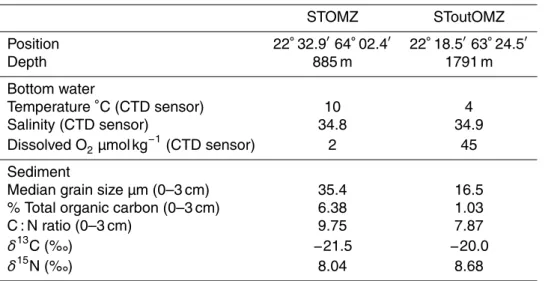
sediment inside and outside the OMZ were comparable (Table 1).
3.2 Benthic biomass
Biomass data per layer and station of both incubated and background cores are shown in Fig. 2 as averages among treatments to account for sediment patchi-ness. Bacterial biomass was 1000 and 1600 mg C m−2respectively in SToutOMZ and 15
STOMZ, meiofaunal nematode biomass was 19 and 13 mg C m−2, meiofaunal-sized shelled foraminiferan biomass was 42 and 38 mg C m−2. Macrofaunal-sized shelled foraminiferan biomass accounted for 118 and 183 mg C m−2
for STOUT OMZ and STOMZ respectively, polychaetes biomass was 87 and 897 mg C m−2withLinopherus sp. the most abundant species in STOMZ. Macrofaunal nematodes accounted for 20
17 mg C m−2
in SToutOMZ but were found only in background cores at low biomass in STOMZ, macrofaunal branched foraminifera and soft-bodied protists were found only in SToutOMZ where they accounted for 208 and 497 mg C m−2, respectively. Other eu-karyotes accounted for 0.2 mg C m−2
BGD
10, 10399–10428, 2013
The bacterial role in benthic carbon
cycling
L. Pozzato et al.
Title Page
Abstract Introduction
Conclusions References
Tables Figures
◭ ◮
◭ ◮
Back Close
Full Screen / Esc
Printer-friendly Version Interactive Discussion
Discussion
P
a
per
|
D
iscussion
P
a
per
|
Discussion
P
a
per
|
Discuss
ion
P
a
per
|
3.3 OM incorporation
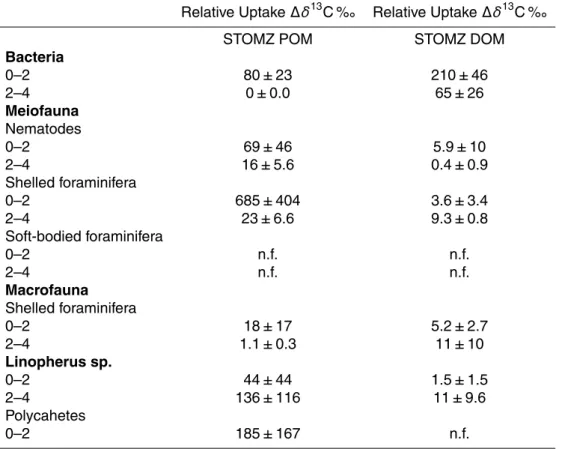
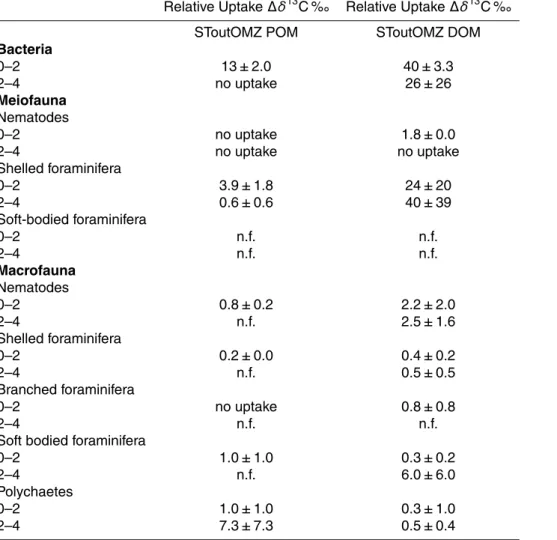
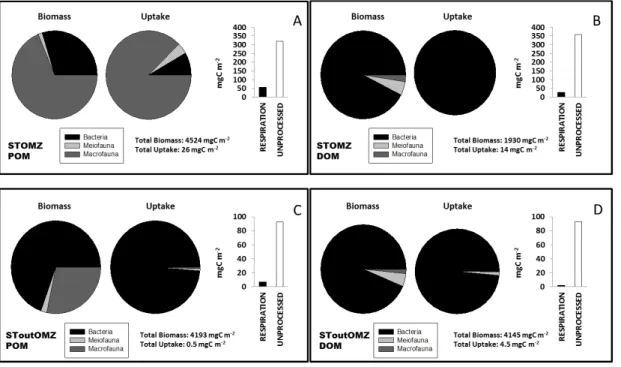
Incorporation into biota of the two13C labeled OM types was evident in both treatments, although the level of enrichment differed per station, benthic group and depth layer (Table 2 and Fig. 3).
At STOMZ, the biota in the upper layer (0–2 cm) accounted for only a small part 5
(3247 µg C m−2 or 12 % of the total uptake) of the POM uptake: bacteria incorporated 2181 µg C m−2, meiofaunal nematodes 36.8 and shelled foraminifera 1028 µg C m−2, macrofaunal shelled foraminifera incorporated 0.13 µg C m−2and Linopherus sp. ac-counted for 1.18 µg C m−2. Almost all the POM incorporation took place in the deeper 2–4 cm layer (23 000 µg C m−2or 87 % of the total uptake). Meiofaunal nematodes 10
accounted for 2.66 µg C m−2and shelled foraminifera for 6.55 µg C m−2, macrofaunal shelled foraminifera accounted for 4.83 µg C m−2, polychaetes for 6133 µg C m−2 and
Linopherus sp.for 16 807 µg C m−2. The bacterial contribution to POM uptake in this deeper layer was negligible. DOM incorporation was strongly dominated by bacte-ria and thereby clearly different from that of the POM substrate. In the upper layer, 15
most of the total uptake took place 12 314 µg C m−2 (87 %): bacteria incorporated 12 312 µg C m−2, followed by meiofaunal nematodes with 2.33 µg C m−2; macrofaunal shelled foraminiferans incorporated 0.02 µg C m−2 and Linopherus sp. 0.05 µg C m−2. Meiofaunal shelled foraminiferan contribution was negligible. In the deeper layer, 2– 4 cm, the uptake was much lower (1818 µg C m−2or 13 %): bacteria again clearly dom-20
inated uptake (1803 µg C m−2), while meiofaunal shelled foraminifera accounted only for 8.4 µg C m−2, meiofaunal and macrofaunal nematodes had negligible uptake and macrofaunaLinopherus sp.accounted for 6.1 µg C m−2.
At SToutOMZ, the largest part of the POM uptake was found in the upper layer: bac-teria incorporated 466 µg C m−2, meiofaunal shelled foraminifera 2.06 µg C m−2, macro-25
faunal nematodes 0.42 µg C m−2
BGD
10, 10399–10428, 2013
The bacterial role in benthic carbon
cycling
L. Pozzato et al.
Title Page
Abstract Introduction
Conclusions References
Tables Figures
◭ ◮
◭ ◮
Back Close
Full Screen / Esc
Printer-friendly Version Interactive Discussion
Discussion
P
a
per
|
D
iscussion
P
a
per
|
Discussion
P
a
per
|
Discuss
ion
P
a
per
|
layer was dominated by bacteria (3637 µg C m−2), with negligible uptake by the other groups (<0.01 µg C m−2). This pattern was different in the deeper layer: bacteria in-corporating 805 µg C m−2
, meiofaunal shelled foraminifera 63.7 µg C m−2
, macrofaunal shelled foraminifera 1.94 µg C m−2and polychaetes 2.63 µg C m−2.
3.4 Respiration
5
Respiration of POM at STOMZ was twice as high as compared to DOM respiration, 54.5 versus 26.9 mg C m−2
, respectively. The same pattern was seen at SToutOMZ, where respiration of POM and DOM were 6.82 and 2.07 mg C m−2, respectively. Most of the POM and DOM tracers was not processed within the 7 days incubation time, but respiration was the dominant fate of processed DOM and POM at both stations 10
(Fig. 4), accounting for up to 13.6 % and 6.73 % of the added tracer on average for STOMZ POM and DOM treatment and 6.80 % and 2.07 % for SToutOMZ (Fig. 4).
4 Discussion
In most environmental settings, the majority of the OM that reaches the ocean floor is used by the benthic community for biomass production and respiration (Burdige, 2006). 15
This processing is thought to occur essentially along two pathways in the benthic food web. The POM pathway involves metazoan ingesting of particulate detritus, while con-sortia of bacteria hydrolyze POM to DOM first, before taking it up. The DOM pathway involves the microbial incorporation of DOM directly, or after hydrolysis. Microbial car-bon, produced through either the POM or DOM pathway, can be transferred to higher 20
BGD
10, 10399–10428, 2013
The bacterial role in benthic carbon
cycling
L. Pozzato et al.
Title Page
Abstract Introduction
Conclusions References
Tables Figures
◭ ◮
◭ ◮
Back Close
Full Screen / Esc
Printer-friendly Version Interactive Discussion
Discussion
P
a
per
|
D
iscussion
P
a
per
|
Discussion
P
a
per
|
Discuss
ion
P
a
per
|
work (Pozzato et al., 2013), confirm that all size classes take up recently deposited phytodetritus in Arabian Sea sediments. The biomass values of bacteria, protists and fauna in our stations (Fig. 2) were comparable to other deep-sea settings (Moodley et al., 2002, 2005b; Witte et al., 2003b; Woulds et al., 2009; Hunter et al., 2012), which confirms that the benthic community in Arabian Sea sediments underlying oxic and 5
suboxic bottom water is well developed and active.
Although one decade of isotope tracer experiments has established that phytodetritus-derived carbon eventually ends up in all benthic size classes (Woulds et al., 2009), we have little understanding whether this represents direct access of con-sumers to POM and therefore direct incorporation of the tracer, or whether the POM 10
uptake by fauna is mediated by bacteria. Here we directly address the question by fo-cusing on the carbon flow in parallel incubations using complex13C enriched DOM and POM substrates and target both microbes and fauna.
In our experiments, the DOM tracer was quickly incorporated by bacteria but no appreciable uptake was seen by benthic fauna (Figs. 3 and 4). This indicates limited 15
bacterivory and the comparison of relative labeling (∆δ13C, Table 2) of bacteria versus their potential consumers in other ecosystems (Hall and Meyer, 1998; Van Oevelen et al., 2006b) supports this finding. Few studies (Lee et al., 1966; Delaca et al., 1981; Delaca, 1982) reported foraminifera feeding directly on dissolved organic carbon. Our StoutOMZ samples also showed some enrichment in foraminifera (Fig. 3), thus we 20
cannot exclude direct DOM assimilation or transfer through bacterivory to protists, the latter also suggested by Van Oevelen et al. (2006b) although in relative low amounts. We limited our analysis of the microbial community to bacteria because in a companion study conducted at the same stations, Lengger et al. (2013b) showed that only bacteria and not archaea utilized the13C enriched POM and DOM, indicating bacteria as domi-25
BGD
10, 10399–10428, 2013
The bacterial role in benthic carbon
cycling
L. Pozzato et al.
Title Page
Abstract Introduction
Conclusions References
Tables Figures
◭ ◮
◭ ◮
Back Close
Full Screen / Esc
Printer-friendly Version Interactive Discussion
Discussion
P
a
per
|
D
iscussion
P
a
per
|
Discussion
P
a
per
|
Discuss
ion
P
a
per
|
must also be due to direct ingestion of the POM substrate rather than ingestion of bac-terial biomass. In the POM treatment, the∆δ13C values of fauna are much higher than those of bacteria (Table 2), further supporting that tracer incorporation occurred via direct substrate ingestion.
Kemp (1990) reviewed the fate of benthic bacterial production in shallow/soft sed-5
iments and concluded that likely only a small fraction of bacterial production enters the macrofaunal food web (directly and indirectly) and that most bacterial production is remineralized and respired by a microbial food web. Later predation studies (Honde-veld et al., 1992; Starink et al., 1994; Hamels et al., 2001) further debunked the micro-bial loop theory and Pomeroy’s ideas by not finding evidence of bacterial ingestion by 10
their “thought to be” main grazers, protozoa, suggested as link between bacteria and fauna. The limited bacterial-derived carbon transfer was confirmed experimentally by Van Oevelen et al. (2006a, b) who used in situ stable isotope pulse-chase experiments and modeling in a tidal mudflat. They concluded that some bacterial production was lost to the sediment via exchange processes and grazing by meio- and macrobenthos, but 15
that its major fate was mortality (65 %), which inducing recycling of bacterial biomass in the sediment. The same studies reported also that only a small portion (up to 11 %) of the faunal carbon requirements was met by bacterivory, irrespective of dwelling depth and organism size. Hence, they concluded that intertidal meio- and macrofauna de-pend primarily on carbon sources other than bacteria. Nomaki et al. (2006) conducted 20
feeding experiments with deep-sea foraminifera using13C-labeled bacteria and algae and found that these protozoa selectively ingested algae or randomly ingested sedi-mentary organic matter. No selective feeding on bacteria was observed, because bac-teria were either not or to a very limited extent assimilated. Guilini et al. (2010) con-ducted similar experiments in the Arctic targeting nematode feeding habits and reached 25
BGD
10, 10399–10428, 2013
The bacterial role in benthic carbon
cycling
L. Pozzato et al.
Title Page
Abstract Introduction
Conclusions References
Tables Figures
◭ ◮
◭ ◮
Back Close
Full Screen / Esc
Printer-friendly Version Interactive Discussion
Discussion
P
a
per
|
D
iscussion
P
a
per
|
Discussion
P
a
per
|
Discuss
ion
P
a
per
|
macrofauna and that faunal carbon requirements are not met by bacterial production. These and our experimental results disagree with other studies (Vanreusel et al., 1995; Iken et al., 2001; Hoste et al., 2007) that suggested transfer of carbon from bacteria to nematodes via direct predation from positive correlations between bacterial density and nematodes abundance in the deep-sea. Along this line, Ingels et al. (2010) found 5
a preferential uptake of bacteria versus phytodetritus-derived carbon by nematodes, but the isotope enrichment of the nematodes was so low that the authors concluded that the contribution of nematodes to benthic mineralisation was limited in deep po-lar seas. Hence, even though nematodes might be bacterivorous, upwards transfer of bacterial derived carbon via nematodes appears to be minimal.
10
It has been shown that bacterial standing stocks along a depth gradient of 0–6000 m appears quite stable in sediments (Rex et al., 2006). Hence, if it’s not grazing controlling bacterial populations in sediments, then some other mechanism must be responsible. Recently Danovaro et al. (2008) suggested that viral infection controls bacterial pro-duction. In their recent review Rowe and Deming (2011) finally proposed a paradigm 15
shift that is in line with most isotope tracer studies. Free-living heterotrophic microbes in marine sediments would play only a minor role in metazoan food webs, providing only a small fraction of metazoans nourishment.
5 Conclusions
Accumulating evidence from the literature and our experimental results suggest 20
strongly that bacteria are a carbon sink in the benthic food web of the Arabian Sea OMZ sediments because no appreciable carbon transfer from bacteria up the food chain to meio- and macrofauna occurs via predation or grazing. This also implies that the POM and DOM processing pathways in this system are separated. The DOM path-way is limited to bacterial exploitation, since no other group showed any uptake of this 25
com-BGD
10, 10399–10428, 2013
The bacterial role in benthic carbon
cycling
L. Pozzato et al.
Title Page
Abstract Introduction
Conclusions References
Tables Figures
◭ ◮
◭ ◮
Back Close
Full Screen / Esc
Printer-friendly Version Interactive Discussion
Discussion
P
a
per
|
D
iscussion
P
a
per
|
Discussion
P
a
per
|
Discuss
ion
P
a
per
|
petition for food, since bacteria as well as various faunal groups take up this resource, as shown in many short-term experiments. Similarly to what happens with the DOM though, once POM is taken up by bacteria it is lost for faunal secondary production. Protists could have grazed upon bacteria to a minor extent but we could not investigate such predation, due to present lack of technical tools to do so in intact sediment cores. 5
Our results from StoutOMZ indicate that direct DOM uptake by foraminifera may occur, as also found by others, which when predated by bigger fauna, might be an alternative route for carbon transport along the food chain. Evidently, there is great need for future investigation for the role of protozoans and protists in sedimentary food webs to be able to further constrain the apparently weak link between bacteria and protozoan and 10
metazoan consumers in marine sediments.
Acknowledgements. This research was carried out as part of the PASOM project, which was funded by the NWO (Netherlands Organization for Scientific Research) under grant number 817.01.015 and the Darwin Center for Biogeosciences. We thank chief scientist GJ Reichart and the crew of the RV Pelagia for logistic support during the 64PE301 cruise, the NIOZ-15
Yerseke Analytical Laboratory for analytical support, Pieter van Rijswijk for technical support and K. Koho for her precious advice on the foraminifera.
References
Andersson, J. H., Woulds, C., Schwartz, M., Cowie, G. L., Levin, L. A., Soetaert, K., and Mid-delburg, J. J.: Short-term fate of phytodetritus in sediments across the Arabian Sea Oxygen 20
Minimum Zone, Biogeosciences, 5, 43–53, doi:10.5194/bg-5-43-2008, 2008.
Azam, F., Fenchel, T., Field, J. G., Gray, J. S., Meyerreil, L. A., and Thingstad, F.: The ecological role of water-column microbes in the sea, Mar. Ecol.-Prog. Ser., 10, 257–263, 1983.
Boschker, H. T. S. and Middelburg, J. J.: Stable isotopes and biomarkers in microbial ecology, Fems Microbiol. Ecol., 40, 85–95, 2002.
25
BGD
10, 10399–10428, 2013
The bacterial role in benthic carbon
cycling
L. Pozzato et al.
Title Page
Abstract Introduction
Conclusions References
Tables Figures
◭ ◮
◭ ◮
Back Close
Full Screen / Esc
Printer-friendly Version Interactive Discussion
Discussion
P
a
per
|
D
iscussion
P
a
per
|
Discussion
P
a
per
|
Discuss
ion
P
a
per
|
Burgess, B.: An improved protocol for separating meiofauna from sediments using colloidal silica sols, Mar. Ecol.-Prog. Ser., 214, 161–165, 2001.
Chrost, R. J.: Environmental control of the synthesis and activity of aquatic microbial ectoen-zymes in: Microbial Enectoen-zymes in Aquatic Environments, edited by: Chrost, R. J., Springer-Verlag, New York, 29–59, 1991a.
5
Chrost, R. J.: Ectoenzymes in aquatic environments: microbial strategy for substrate supply, Int. Ver. Theor. Angew. Limnol. Verh., 24, 2597–2600, 1991b.
Cowie, G. L., Calvert, S. E., Pedersen, T. F., Schulz, H., and von Rad, U.: Organic content and preservational controls in surficial shelf and slope sediments from the Arabian Sea (Pakistan margin), Mar. Geol., 161, 23–38, 1999.
10
Danovaro, R., Dell’Anno, A., Corinaldesi, C., Magagnini, M., Noble, R., Tamburini, C., and Wein-bauer, M.: Major viral impact on the functioning of benthic deep-sea ecosystems, Nature, 454, 1084–1088, 2008.
Delaca, T. E.: Use of dissolved amino acids by the foraminiferNotodendrodes antarctikos, Am. Zool., 22, 683–690, 1982.
15
Delaca, T. E., Karl, D. M., and Lipps, J. H.: Direct use of dissolved organic carbon by aggluti-nated benthic foraminifera, Nature, 289, 287–289, 1981.
Demaison, G. J. and Moore, G. T.: Anoxic environments and oil source bed genesis, Am. Assoc. Pet. Geol. Bull., 64, 1179–1209, 1980.
Gaedicke, C., Schluter, H. U., Roeser, H. A., Prexl, A., Schreckenberger, B., Meyer, H., Re-20
ichert, C., Clift, P., and Amjad, S.: Origin of the northern Indus Fan and Murray Ridge, North-ern Arabian Sea: interpretation from seismic and magnetic imaging, Tectonophysics, 355, 127–143, 2002.
Guilini, K., Van Oevelen, D., Soetaert, K., Middelburg, J. J., and Vanreusel, A.: Nutritional im-portance of benthic bacteria for deep-sea nematodes from the Arctic ice margin: results of 25
an isotope tracer experiment, Limnol. Oceanogr., 55, 1977–1989, 2010.
Hall, R. O. and Meyer, J. L.: The trophic significance of bacteria in a detritus-based stream food web, Ecology, 79, 1995–2012, 1998.
Hamels, I., Muylaert, K., Casteleyn, G., and Vyverman, W.: Uncoupling of bacterial production and flagellate grazing in aquatic sediments: a case study from an intertidal flat, Aquat. Microb. 30
Ecol., 25, 31–42, 2001.
BGD
10, 10399–10428, 2013
The bacterial role in benthic carbon
cycling
L. Pozzato et al.
Title Page
Abstract Introduction
Conclusions References
Tables Figures
◭ ◮
◭ ◮
Back Close
Full Screen / Esc
Printer-friendly Version Interactive Discussion
Discussion
P
a
per
|
D
iscussion
P
a
per
|
Discussion
P
a
per
|
Discuss
ion
P
a
per
|
Henrichs, S. M.: Early diagenesis of orcanic matter in marine sediments: progress and perplex-ity, Mar. Chem., 39, 119–149, 1992.
Hondeveld, B. J. M., Bak, R. P. M., and Vanduyl, F. C.: Bacterivory by heterotrophic nanoflagel-lates in marine sediments measured by uptake of fluorescently labelled bacteria, Mar. Ecol.-Prog. Ser., 89, 63–71, 1992.
5
Hoste, E., Vanhove, S., Schewe, I., Soltwedel, T., and Vanreusel, A.: Spatial and temporal variations in deep-sea meiofauna assemblages in the Marginal Ice Zone of the Arctic Ocean, Deep-Sea Res. Pt. I, 54, 109–129, 2007.
Hunter, C. J., Veuger, B., and Witte, U.: Macrofauna regulate heterotrophic bacterial carbon and nitrogen incorporation in low-oxygen sediments, ISME J., 6, 2140–2151, 2012.
10
Iken, K., Brey, T., Wand, U., Voigt, J., and Junghans, P.: Food web structure of the benthic community at the Porcupine Abyssal Plain (NE Atlantic): a stable isotope analysis, Prog. Oceanogr., 50, 383–405, 2001.
Ingels, J., Van den Driessche, P., De Mesel, I., Vanhove, S., Moens, T., and Vanreusel, A.: Preferred use of bacteria over phytoplankton by deep-sea nematodes in polar regions, Mar. 15
Ecol.-Prog. Ser., 406, 121–133, 2010.
Jeffreys, R. M., Wolff, G. A., and Cowie, G. L.: Influence of oxygen on heterotrophic reworking of sedimentary lipids at the Pakistan margin, Deep-Sea Res. Pt. II, 56, 358–375, 2009. Jumars, P. A., Penry, D. L., Baross, J. A., Perry, M. J., and Frost, B. W.: Closing the microbial
loop: dissolved organic carbon pathway to heterotrophic bacteria from incomplete ingestion, 20
digestion and absorption in animals, Deep-Sea Res. Pt. I, 36, 483–495, 1989.
Kemp, P. F.: Bacterivory by benthic ciliates: significance as a carbon source and impact on sediment bacteria, Mar. Ecol.-Prog. Ser., 49, 163–169, 1988.
Kemp, P. F.: The fate of benthic bacterial production, Rev. Aquat. Sci., 2, 109–124, 1990. Koho, K. A., Nierop, K. G. J., Moodley, L., Middelburg, J. J., Pozzato, L., Soetaert, K., 25
van der Plicht, J., and Reichart, G-J.: Microbial bioavailability regulates organic matter preservation in marine sediments, Biogeosciences, 10, 1131–1141, doi:10.5194/bg-10-1131-2013, 2013.
Kristensen, E., Andersen, F. O., and Blackburn, T. H.: Effects of benthic macrofauna and temperature on degradation of macroalgal detritus – the fate of organic-carbon, Limnol. 30
BGD
10, 10399–10428, 2013
The bacterial role in benthic carbon
cycling
L. Pozzato et al.
Title Page
Abstract Introduction
Conclusions References
Tables Figures
◭ ◮
◭ ◮
Back Close
Full Screen / Esc
Printer-friendly Version Interactive Discussion
Discussion
P
a
per
|
D
iscussion
P
a
per
|
Discussion
P
a
per
|
Discuss
ion
P
a
per
|
Lee, C.: Controls on organic carbon preservation: the use of stratified water bodies to compare intrinsic rates of decomposition in oxic and anoxic systems, Geochim. Cosmochim. Ac., 56, 3323–3335, 1992.
Lee, J.: A conceptual model of marine detrital decomposition and organisms associated with the process, in: Advances in Aquatic Microbiology, edited by: Droop, M. R. and Jannasch, H. 5
W., Academic Press, 257–291, 1980.
Lee, J. J., McEnery, M., Pierce, S., Freudenthal, H. D., and Muller, W. A.: Tracer experiments in feeding littoral foraminifera, J. Eukaryot. Microbiol., 13, 659–670, doi:10.1111/j.1550-7408.1966.tb01978.x, 1966.
Lengger, S. K.: Production and preservation of archaeal glycerol dibiphytanyl glycerol 10
tetraethers as intact polar lipids in marine sediments: implications for their use in microbial ecology and TEX86 paleothermometry, PhD dissertation, Utrecht, 2013a.
Lengger, S. K., Moeseneder, M., Pozzato, L., Thornton, B., Witte, U. F. M., Moodley, L., Mid-dleburg, J. J., Sinninghe Damsté, J. S., and Schouten, S.: Lack of uptake of carbon from phytodetritus into thaumarchaeal lipids: on the role of Archaea in deep sea benthic organic 15
carbon processing, PLoS ONE, n preparation, 2013b.
Levin, L. A., Huggett, C. L., and Wishner, K. F.: Control of deep-sea benthic community structure by oxygen and organic matter gradients in the eastern Pacific ocean, J. Mar. Res., 49, 763– 800, 1991.
Levin, L. A., Whitcraft, C. R., Mendoza, G. F., Gonzalez, J. P., and Cowie, G.: Oxygen and 20
organic matter thresholds for benthic faunal activity on the Pakistan margin oxygen minimum zone (700–1100 m), Deep-Sea Res. Pt. II, 56, 449–471, 2009.
Mayer, L. M.: Extracellular proteolytic enzyme activity in sediments of an intertidal mudflat, Limnol. Oceanogr., 34, 973–981, 1989.
Mayer, L. M.: Surface area control of organic carbon accumulation in continental shelf sedi-25
ments, Geochim. cosmochim. Ac., 58, 1271–1284, 1994.
Middelburg, J. J. and Levin, L. A.: Coastal hypoxia and sediment biogeochemistry, Biogeo-sciences, 6, 1273–1293, doi:10.5194/bg-6-1273-2009, 2009.
Middelburg, J. J., Barranguet, C., Boschker, H. T. S., Herman, P. M. J., Moens, T., and Heip, C. H. R.: The fate of intertidal microphytobenthos carbon: an in situ13C labeling study, 30
BGD
10, 10399–10428, 2013
The bacterial role in benthic carbon
cycling
L. Pozzato et al.
Title Page
Abstract Introduction
Conclusions References
Tables Figures
◭ ◮
◭ ◮
Back Close
Full Screen / Esc
Printer-friendly Version Interactive Discussion
Discussion
P
a
per
|
D
iscussion
P
a
per
|
Discussion
P
a
per
|
Discuss
ion
P
a
per
|
Moodley, L., Middelburg, J. J., Boschker, H. T. S., Duineveld, G. C. A., Pel, R., Herman, P. M. J., and Heip, C. H. R.: Bacteria and Foraminifera: key players in a short-term deep-sea benthic response to phytodetritus, Mar. Ecol.-Prog. Ser., 236, 23–29, 2002.
Moodley, L., Middelburg, J. J., Herman, P. M. J., Soetaert, K., and de Lange, G. J.: Oxygena-tion and organic-matter preservaOxygena-tion in marine sediments: direct experimental evidence from 5
ancient organic carbon-rich deposits, Geology, 33, 889–892, 2005a.
Moodley, L., Middelburg, J. J., Soetaert, K., Boschker, H. T. S., Herman, P. M. J., and Heip, C. H. R.: Similar rapid response to phytodetritus deposition in shallow and deep-sea sediments, J. Mar. Res., 63, 457–469, 2005b.
Moodley, L., Nigam, R., Ingole, B., Babu, C. P., Panchang, R., Nanajkar, M., Sivadas, S., van 10
Breugel, P., van Ijzerloo, L., Rutgers, R., Heip, C. H. R., Soetaert, K., and Middelburg, J. J.: Oxygen minimum seafloor ecological (mal) functioning, J. Exp. Mar. Biol. Ecol., 398, 91–100, 2011.
Nomaki, H., Heinz, P., Nakatsuka, T., Shimanaga, M., Ohkouchi, N., Ogawa, N. O., Kogure, K., Ikemoto, E., and Kitazato, H.: Different ingestion patterns of C-13-labeled bacteria and algae 15
by deep-sea benthic foraminifera, Mar. Ecol.-Prog. Ser., 310, 95–108, 2006.
Pomeroy, L.: The ocean’s food web, a changing paradigm, BioScience, 24, 499–504, 1974. Pozzato, L., Van Oevelen, D., Moodley, L., Soetaert, K., and Middelburg, J. J.: Carbon
process-ing at the deep-sea floor of the Arabian Sea oxygen minimum zone: a tracer approach, J. Sea Res., 78, 45–58, 2013.
20
Rex, M. A., Etter, R. J., Morris, J. S., Crouse, J., McClain, C. R., Johnson, N. A., Stuart, C. T., Deming, J. W., Thies, R., and Avery, R.: Global bathymetric patterns of standing stock and body size in the deep-sea benthos, Mar. Ecol.-Prog. Ser., 317, 1–8, 2006.
Rowe, G. T. and Deming, J. W.: An alternative view of the role of heterotrophic microbes in the cycling of organic matter in deep-sea sediments, Mar. Biol. Res., 7, 629–636, 2011.
25
Shimmield, G. B., Price, N. B., and Pedersen, T. F.: The influence of hydrography, bathymetry and productivity on sediment type and composition of the Oman Margin and in the Northwest Arabian Sea, Geol. Soc. Lond. Spec. Publ., 49, 759–769, 1990.
Starink, M., Krylova, I. N., Bargilissen, M. J., Bak, R. P. M., and Cappenberg, T. E.: Rates of benthic protozoan grazing on free and attached sediment bacteria measured with fluorescent 30
BGD
10, 10399–10428, 2013
The bacterial role in benthic carbon
cycling
L. Pozzato et al.
Title Page
Abstract Introduction
Conclusions References
Tables Figures
◭ ◮
◭ ◮
Back Close
Full Screen / Esc
Printer-friendly Version Interactive Discussion
Discussion
P
a
per
|
D
iscussion
P
a
per
|
Discussion
P
a
per
|
Discuss
ion
P
a
per
|
Van Oevelen, D., Middelburg, J. J., Soetaert, K., and Moodley, L.: The fate of bacterial carbon in an intertidal sediment: modeling an in situ isotope tracer experiment, Limnol. Oceanogr., 51, 1302–1314, 2006a.
Van Oevelen, D., Moodley, L., Soetaert, K., and Middelburg, J. J.: The trophic significance of bacterial carbon in a marine intertidal sediment: results of an in situ stable isotope labeling 5
study, Limnol. Oceanogr., 51, 2349–2359, 2006b.
Vanreusel, A., Vincx, M., Schram, D., and Vangansbeke, D.: On the vertical distribution of the metazoan meiofauna in shelf break and upper slope habitats of the NE Atlantic, Int. Rev. Ges. Hydrobio., 80, 313–326, 1995.
Witte, U., Aberle, N., Sand, M., and Wenzhofer, F.: Rapid response of a deep-sea benthic 10
community to POM enrichment: an in situ experimental study, Mar. Ecol.-Prog. Ser., 251, 27–36, 2003a.
Witte, U., Wenzhofer, F., Sommer, S., Boetius, A., Heinz, P., Aberle, N., Sand, M., Cremer, A., Abraham, W. R., Jorgensen, B. B., and Pfannkuche, O.: In situ experimental evidence of the fate of a phytodetritus pulse at the abyssal sea floor, Nature, 424, 763–766, 2003b.
15
Woulds, C., Cowie, G. L., Levin, L. A., Andersson, J. H., Middelburg, J. J., Vandewiele, S., Lamont, P. A., Larkin, K. E., Gooday, A. J., Schumacher, S., Whitcraft, C., Jeffreys, R. M., and Schwartz, M.: Oxygen as a control on seafloor biological communities and their roles in sedimentary carbon cycling, Limnol. Oceanogr., 52, 1698–1709, 2007.
Woulds, C., Andersson, J. H., Cowie, G. L., Middelburg, J. J., and Levin, L. A.: The short-term 20
BGD
10, 10399–10428, 2013
The bacterial role in benthic carbon
cycling
L. Pozzato et al.
Title Page
Abstract Introduction
Conclusions References
Tables Figures
◭ ◮
◭ ◮
Back Close
Full Screen / Esc
Printer-friendly Version Interactive Discussion
Discussion
P
a
per
|
D
iscussion
P
a
per
|
Discussion
P
a
per
|
Discuss
ion
P
a
per
|
Table 1.Station locations, environmental parameters, water and sediment characteristics of the two sampling stations STOMZ and SToutOMZ.
STOMZ SToutOMZ
Position 22◦32.9′64◦02.4′ 22◦18.5′ 63◦24.5′
Depth 885 m 1791 m
Bottom water
Temperature◦C (CTD sensor) 10 4 Salinity (CTD sensor) 34.8 34.9 Dissolved O2µmol kg−1(CTD sensor) 2 45
Sediment
BGD
10, 10399–10428, 2013
The bacterial role in benthic carbon
cycling
L. Pozzato et al.
Title Page
Abstract Introduction
Conclusions References
Tables Figures
◭ ◮
◭ ◮
Back Close
Full Screen / Esc
Printer-friendly Version Interactive Discussion
Discussion
P
a
per
|
D
iscussion
P
a
per
|
Discussion
P
a
per
|
Discuss
ion
P
a
per
|
Table 2.Relative uptake for POM and DOM treatment. “n.f.” means that no specimen of the group was found in the core layer. The terms “Soft bodied protists” represents Gromiids and Allogromiids.
Relative Uptake∆δ13C % Relative Uptake∆δ13C %
STOMZ POM STOMZ DOM Bacteria
0–2 80±23 210±46
2–4 0±0.0 65±26
Meiofauna Nematodes
0–2 69±46 5.9±10
2–4 16±5.6 0.4±0.9
Shelled foraminifera
0–2 685±404 3.6±3.4
2–4 23±6.6 9.3±0.8
Soft-bodied foraminifera
0–2 n.f. n.f.
2–4 n.f. n.f.
Macrofauna Shelled foraminifera
0–2 18±17 5.2±2.7
2–4 1.1±0.3 11±10
Linopherus sp.
0–2 44±44 1.5±1.5
2–4 136±116 11±9.6
Polycahetes
BGD
10, 10399–10428, 2013
The bacterial role in benthic carbon
cycling
L. Pozzato et al.
Title Page
Abstract Introduction
Conclusions References
Tables Figures
◭ ◮
◭ ◮
Back Close
Full Screen / Esc
Printer-friendly Version Interactive Discussion
Discussion
P
a
per
|
D
iscussion
P
a
per
|
Discussion
P
a
per
|
Discuss
ion
P
a
per
|
Table 2.Continued.
Relative Uptake∆δ13C % Relative Uptake∆δ13C %
SToutOMZ POM SToutOMZ DOM Bacteria
0–2 13±2.0 40±3.3
2–4 no uptake 26±26
Meiofauna Nematodes
0–2 no uptake 1.8±0.0
2–4 no uptake no uptake
Shelled foraminifera
0–2 3.9±1.8 24±20
2–4 0.6±0.6 40±39
Soft-bodied foraminifera
0–2 n.f. n.f.
2–4 n.f. n.f.
Macrofauna Nematodes
0–2 0.8±0.2 2.2±2.0
2–4 n.f. 2.5±1.6
Shelled foraminifera
0–2 0.2±0.0 0.4±0.2
2–4 n.f. 0.5±0.5
Branched foraminifera
0–2 no uptake 0.8±0.8
2–4 n.f. n.f.
Soft bodied foraminifera
0–2 1.0±1.0 0.3±0.2
2–4 n.f. 6.0±6.0
Polychaetes
0–2 1.0±1.0 0.3±1.0
BGD
10, 10399–10428, 2013
The bacterial role in benthic carbon
cycling
L. Pozzato et al.
Title Page
Abstract Introduction
Conclusions References
Tables Figures
◭ ◮
◭ ◮
Back Close
Full Screen / Esc
Printer-friendly Version Interactive Discussion
Discussion
P
a
per
|
D
iscussion
P
a
per
|
Discussion
P
a
per
|
Discuss
ion
P
a
per
|
BGD
10, 10399–10428, 2013
The bacterial role in benthic carbon
cycling
L. Pozzato et al.
Title Page
Abstract Introduction
Conclusions References
Tables Figures
◭ ◮
◭ ◮
Back Close
Full Screen / Esc
Printer-friendly Version Interactive Discussion
Discussion
P
a
per
|
D
iscussion
P
a
per
|
Discussion
P
a
per
|
Discuss
ion
P
a
per
|
BGD
10, 10399–10428, 2013
The bacterial role in benthic carbon
cycling
L. Pozzato et al.
Title Page
Abstract Introduction
Conclusions References
Tables Figures
◭ ◮
◭ ◮
Back Close
Full Screen / Esc
Printer-friendly Version Interactive Discussion
Discussion
P
a
per
|
D
iscussion
P
a
per
|
Discussion
P
a
per
|
Discuss
ion
P
a
per
|
BGD
10, 10399–10428, 2013
The bacterial role in benthic carbon
cycling
L. Pozzato et al.
Title Page
Abstract Introduction
Conclusions References
Tables Figures
◭ ◮
◭ ◮
Back Close
Full Screen / Esc
Printer-friendly Version Interactive Discussion
Discussion
P
a
per
|
D
iscussion
P
a
per
|
Discussion
P
a
per
|
Discuss
ion
P
a
per
|