www.epjournal.net – 2007. 5(4): 786-800
¯ ¯ ¯ ¯ ¯ ¯ ¯ ¯ ¯ ¯ ¯ ¯ ¯ ¯ ¯ ¯ ¯ ¯ ¯ ¯ ¯ ¯ ¯ ¯ ¯ ¯ ¯ ¯
Original Article
Sex Differences in Performance with the Hand and Arm in Near and Far
Space: A Possible Effect of Tool Use
Geoff Sanders, Department of Psychology, London Metropolitan University, Calcutta House, Old Castle
Street, London E1 7NT UK. Email: [email protected] (Corresponding author)
Marta Perez, Department of Psychology, London Metropolitan University, Calcutta House, Old Castle Street, London E1 7NT UK.
Abstract: Using novel tasks, we tested two predictions from the hunter-gatherer hypothesis concerning sex differences in the motor control of hand and arm and in the visual processing of near and far space. In Study 1 we replicated earlier findings by demonstrating that women scored higher with the hand while men scored higher with the arm. Study 2 tested the motor and visual predictions concurrently and showed that the Muscle*Sex interaction, seen in Study 1, occurs in far as well as near space. However, we failed to confirm that women perform better with visual information from near and men from far space. Instead the relative performance of women and men was the same in far as it was in near space. Drawing on evidence from studies of selective visual neglect we suggest that this outcome arose because tool use causes far space to be re-mapped as near space. Finally, the selective visual neglect literature indicates that the processing of far and near space is located in the ventral and dorsal cortical streams, previously described as two “what”/“where” visual systems. We draw attention to their additional “there”/“here” functions that are sex dimorphic and, as we have shown, modulated by tool use.
Keywords: hunter-gatherer hypothesis, sex differences, motor control, visual processing, near and far space, tool use.
¯ ¯ ¯ ¯ ¯ ¯ ¯ ¯ ¯ ¯ ¯ ¯ ¯ ¯ ¯ ¯ ¯ ¯ ¯ ¯ ¯ ¯ ¯ ¯ ¯ ¯ ¯ ¯ ¯ ¯ ¯ ¯ ¯ ¯ ¯ ¯ ¯ ¯ ¯ ¯ ¯ ¯ ¯ ¯ ¯ ¯ ¯ ¯ ¯ ¯ ¯ ¯ ¯ ¯ ¯ ¯ ¯ ¯ ¯ ¯ ¯ ¯ ¯ ¯ ¯ ¯ ¯ ¯ ¯ ¯ ¯ ¯ ¯ ¯ ¯ ¯ ¯ ¯ ¯ ¯ ¯ ¯ ¯ ¯ ¯ ¯ ¯ ¯
Introduction
performance in tasks directed at far space and using the large proximal muscles of the arm and shoulder. These skills would facilitate the location of a target followed by accurately aiming and throwing a weapon, at prey when hunting and at a threat when defending. On the contrary, women, as gatherers, should show better performance in tasks directed at near space and in using the small distal muscles of the wrist and fingers. Both abilities would facilitate caring and also gathering behaviors by promoting the detection of suitable items followed by precise reaching and grasping.
The potential existence of these predicted sex differences in motor control and visual processing would be strengthened if separate neural mechanisms existed for the constituent processes that may be sex dimorphic. Studies with monkeys (Lawrence and Kuypers, 1968a; 1968b) have demonstrated that the neural bases for proximal and distal muscle control are distinct. The distal (hand) muscles are controlled by the primary motor cortex via two dorsolateral corticospinal tracts whereas the proximal (arm) muscles are controlled by the primary motor cortex via two ventromedial corticospinal tracts.
A similar neural separation exists for the visual processing of near and far space, domains which were originally defined by Brain (1941) as “grasping distance” as opposed to “walking distance” and later by Brouchon, Joanette and Samson (1986) as “reaching field” and “pointing or throwing field”. Studies of selective visual neglect report a dissociation between far and near space in monkeys (Rizzolatti, Matelli, and Pavesi, 1983) and humans (Brouchon, Joanette, and Samson, 1986; Butler, Eskes, and Vandorpe, 2004; Guariglia and Antonucci, 1992; Halligan and Marshall, 1991; Vuilleumier Valenza, Mayer, Reverdin, and Landis, 1998). Three studies using normal human volunteers, one using transcranial magnetic stimulation (Bjoertomt, Cowey, and Walsh, 2002) and two using PET (Weiss, et al., 2000; Weiss, Marshall, Zilles, and Fink, 2003) have located the corresponding pathways in the cerebral cortex. The performance of tasks in far space is dependent on the ventral stream, from the primary visual cortex to the inferior temporal cortex, while the performance of tasks in near space is dependent on the dorsal stream, from the primary visual cortex to the posterior parietal cortex.
significantly better in near than far space and men were significantly better in far than near space.
Here we report two studies in which we attempted to replicate those predictions from the hunter-gatherer hypothesis. In Study 1 we investigated the sex difference in motor control of hand and arm using a novel task performed in near space. In Study 2 we investigated the sex differences in motor control and visual processing of near and far space concurrently. From the hunter-gatherer hypothesis we predicted that men would perform better when using their proximal arm muscles and when performing in far (extrapersonal) space while women would perform better when using their distal hand muscles and when performing in near (peripersonal) space. Data were subjected to appropriate analyses of variance and significant interactions were explored with t-tests using 1-tailed tests for directional predictions and 2-tailed tests for other comparisons.
Study 1
This study was designed to investigate the motor control prediction derived from the hunter-gatherer hypothesis. Using a novel task we attempted to replicate the finding that women perform better with the small distal muscles of their fingers and wrist while men do better with the large proximal muscles of their upper arm and shoulder (Sanders and Walsh, 2007). Participants were required to move colored tokens from a neutral starting area to appropriately colored target areas using the distal and proximal muscles in a counterbalanced order.
Materials and Methods
Participants
The study involved 48 right-handed participants, 24 men (mean age 27.08 +/- 5.93) and 24 women (mean age 27.67 +/- 5.62). None of the participants had suffered an upper limb injury in the previous six months, all could operationally distinguish the colors of the tokens and all had normal, or corrected to normal, vision. The study was approved by the London Metropolitan University Psychology Department Ethics Committee. All participants gave informed written consent and were aware that they could withdraw from the study at any time. None withdrew.
Tasks and procedure
Hand task The participants were presented with a horizontal board (127 x 178
with these instructions. The task began with a 5 second practice followed by a 20 second test from which the total number of tokens correctly place in the color matching target zones was recorded.
Arm task The participants were presented with a larger horizontal board (305 x
406 mm) divided as for the hand task into a neutral starting zone and five smaller target zones with the same five colors. This time, the participants were given a short (178 mm) hooked metal stylus, which they used to slide tokens as quickly as possible from the neutral starting zone to the target zone of the same color as the token. Throughout the task participants were required not to move their fingers and to keep their wrist locked so that movement was restricted to the proximal muscles of the upper arm and shoulder. Performance was monitored to ensure that participants complied with these instructions. In practice, participants readily adapted to this constraint. Trials began with a 5 second practice followed by a 20 second test from which the total number of tokens correctly place in the color matching target zones was recorded.
The far edge of the boards used for the hand and arm tasks was placed within 500 mm of the participants so that both tasks were performed in near (peripersonal) space. The sequence in which the tasks were completed was counterbalanced across participants with half of the women and half of the men doing the hand task first followed by the arm task while the other half completed the tasks in the reverse order.
Results and Discussion
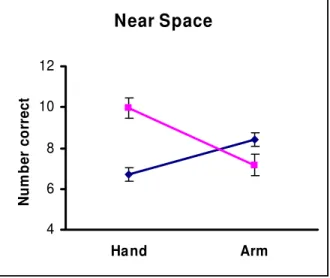
The number of tokens correctly moved to the target areas were subjected to a two-way ANOVA with Muscle as a within participants and Sex as a between participants factor. Neither of the main effects were significant (Muscle: F1,46= 2.88, p=0.096; Sex:
F1,46= 3.51, p=0.067) but the predicted Muscle*Sex interaction (Fig. 1) was significant
(F1,46= 49.70, p<0.001) and this was explored further with appropriate t-tests.
Within-sex comparisons reveal that women scored higher with the hand than with the arm (t23= 5.29, p<0.001, one-tailed, effect size d=0.98) while men scored higher with
the arm than with the hand (t23= 4.77, p<0.001, one-tailed, effect size d=0.89). In addition,
between-sex comparisons show that women scored higher than men with the hand (t46=
4.60, p<0.001, two-tailed, effect size d=1.11) while men scored higher than women with the arm (t46= 2.39, p=0.021, two-tailed, effect size d=0.66). Thus the predicted sex
differences were confirmed with large effect sizes.
Figure 1. Study 1: Means (+/- SEM) of the number of tokens correctly placed by women (pink/light grey lines and squares) and men (blue/dark grey lines and diamonds) using the distal muscles of the hand or the proximal muscles of the arm when the tasks were performed in near (peripersonal) space.
Near Space
4 6 8 10 12
Hand Arm
Nu
m
b
er
co
rr
ec
t
In Study 1 participants performed similar tasks, the sorting of colored tokens by moving them from a mixed pile to appropriately colored target zones, either by using the muscles of the wrist and fingers (hand condition) or by using the muscles of the upper arm and shoulder (arm condition) with both tasks performed in near space. Hence, the previous confounds of task demands and spatial location were controlled. The outcome from the within-sex comparisons are consistent with our motor control prediction based on the hunter-gatherer hypothesis and they confirm the findings reported by Sanders and Walsh (2007); women perform a motor task better when using their hand rather than their arm while men perform better with their arm rather than with their hand. Between-sex comparisons are not strictly relevant to our hypothesis because their nature will always depend on the relative difficulty that a task presents to women and men. If the task used is easy for women but difficult for men then it may happen that women out-perform men using both the hand and the arm. Therefore we made no predictions regarding these comparisons. As it happened, women scored only slightly higher than men and the difference was not significant. As a consequence, both of the between-sex comparisons were significant: women scored higher than men with the hand while men scored higher than women with the arm.
Study 2
In a second test of predictions from the hunter-gatherer hypothesis, Sanders, Sinclair and Walsh (2007) demonstrated that women perform tasks better when the visual information is presented in near rather than far space whereas men show the reverse pattern. We designed Study 2 as a concurrent investigation of the visual processing and the motor control predictions. Using a similar token sorting task we attempted to replicate two findings: [1] that women perform better with the distal muscles of their fingers and wrist while men do better with the proximal muscles of their upper arm and shoulder and [2] that women perform better with visual information from near space while men do better with visual information from far space. Participants were required to move colored tokens from a neutral starting area to appropriately colored target areas using the distal and proximal muscles and a short or long stylus that allowed manipulation of the tokens to occur in near or far space.
Materials and Methods
Participants
The study involved a new sample of 48 right-handed participants, 24 men (mean age 26.17 +/- 4.56) and 24 women (mean age 27.09 +/- 5.12). None of the participants had suffered an upper limb injury in the previous six months, all could operationally distinguish the colors of the tokens and all had normal, or corrected to normal, vision. The study was approved by the London Metropolitan University Psychology Department Ethics Committee. All participants gave informed written consent and were aware that they could withdraw from the study at any time. None withdrew.
Tasks and procedure
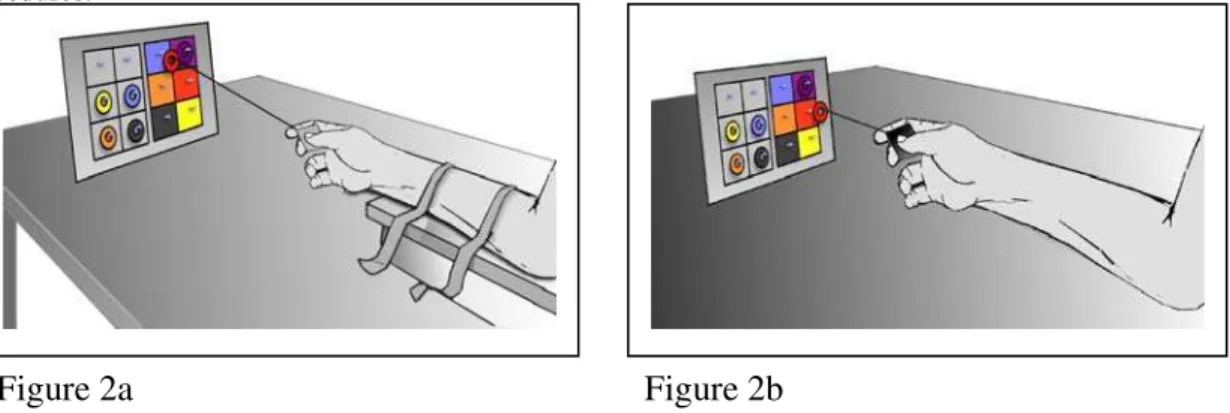
Participants were required to move six colored washers from their positions in a neutral starting array to color-matching squares in a 2x3 target array (Fig. 2). The six colors used were blue, purple, orange, red, black and yellow. Each of the six locations within the two arrays had a central peg on which a washer could be suspended. Participants used a slightly hooked wire stylus to lift and move the washers, one at a time, from their position in the starting array to their appropriate position in the target array. They performed this task in four ways characterized by the muscle (hand or arm) used and the spatial location (near or far) in which the task was performed, i.e. hand/near, hand/far, arm/near and arm/far.
Hand condition Participants used a slightly hooked wire stylus, held between their
thumb and first finger, to move the washers using the muscles of the fingers and wrist only. Throughout the task their arm was strapped to a board in order to prevent movement of the upper arm and shoulder muscles (Fig. 2a). The restraint was used because without it participants were inclined to move their arm as well as their hand.
Arm condition Participants used a slightly hooked wire stylus, held between their
action and participants were readily able to move their arm while keeping the wrist and fingers locked.
Figure 2. Schematic drawings, not to scale, showing the experimental set-up for two of the four condition used in Study 2. Figure 2a shows the far/hand condition in which the array is 1000 mm from the eyes of the participant whose arm is restrained. Figure 2b shows the near/arm condition in which the stimulus array is 300 mm from the eyes of the participant whose arm is unrestrained. See text for further explanation of the procedures.
Figure 2a Figure 2b
Near condition The stylus for this condition was 203 mm long, the circular
washers had an external diameter of 12 mm and a central circular hole with a diameter of 6 mm, and the vertical arrays were placed in near (peripersonal) space at a distance of 300 mm from the participant. Each of the cells in the arrays measured 38 x 38 mm.
Far condition
The stylus for this condition was 734 mm long, the circular washers
had an external diameter of 38 mm and a central circular hole with a diameter of 9 mm, and each of the cells in the arrays measured 85 x 85 mm. The vertical arrays were placed in far (extrapersonal) space at a distance of 1000 mm from the participant. The suitability of this distance as an operational definition of far space is addressed in the General Discussion.
The four tasks, arm/near, arm/far, hand/near and hand/far, were completed in a counter-balanced order. Each task began with a 10 second practice during which the experimenter ensured that the participant performed the task correctly using the appropriate set of muscles. Following this practice the participant had one attempt to move all of the washers from the neutral starting array to the color-matching positions in the target array. If a washer fell it was immediately retrieved by the experimenter and placed back in its original position on the starting array. The total time taken to complete the task was recorded in seconds.
Results and Discussion
The task completion time data were submitted to a 3-way ANOVA with sex (male/female) as a between participants factor plus muscle (hand/arm) and space (near/far) as within participants factors. On the basis of the hunter-gatherer hypothesis and results from previous studies we had predicted that women should perform better with the hand than arm and better in near than far space while men should be better with arm than hand and better in far than near space. Thus we expected a Muscle*Space*Sex interaction and were surprised to find that it was not significant (F1,46=2.11, p=0.15). However, following
with an interesting serendipitous finding concerning the impact of tool use on the perceptual division between near and far space.
Of the two predicted 2-way interactions, Muscle*Sex was significant (F1,46=15.61,
p=0.001) but Space*Sex (F1,46=0.34, p=0.711) was not. We shall explore these central
findings below. The remaining 2-way interaction, Space*Muscle, approached significance (F1,46=4.03, p=0.051) because the difference between near and far space performance was
greater for the hand than for the arm. Of the main effects, sex was not significant (F1,46=0.83, p=0.366), but space (F1,46=424.40, p<0.001), and muscle (F1,46=15.82,
p<0.001) were significant. Overall performance was better in near than far space, and better with the arm than with the hand. However, these space and muscle differences merely reflect the relative difficulty of the near/far and hand/arm tasks.
Figure 3. Study 2: Means (+/- SEM) of the time taken by participants to place the tokens correctly using the distal muscles of the hand and the proximal muscles of the arm when the task was performed in near (peripersonal) and far (extrapersonal) space. (Women – pink /lighter grey lines and squares; Men – blue /darker grey lines and diamonds.)
Near Space
2 0 3 0 4 0 5 0 6 0 7 0
Hand Arm
T
im
e t
aken
(
secs)
Far Space
2 0 3 0 4 0 5 0 6 0 7 0
Hand Ar m
Hand “v” arm
As seen in Figure 3, the significant 2-way interaction between Muscle and Sex, noted above, arose because men completed the task significantly faster with their arm than with their hand and this was true for both near (t23 = 5.76, p<0.001, one-tailed, effect size
d=1.18) and far (t23 = 4.47, p<0.001, one-tailed, effect size d=0.91) space. For women the
differences between performance with the hand and arm were not significant (near space:
t23 = 0.16, p = 0.44, one-tailed, effect size d=0.03; far space: t23 = 0.12, p = 0.45, effect size
p=0.004, two-tailed, effect size d=0.81) and in far space (t46= 2.23, p=0.031, two-tailed,
effect size d=0.62). Men were faster than women with the arm in near space (t46= 2.85,
p=0.007, two-tailed, effect size d=0.77) but not in far space (t46= 1.90, p=0.063, two-tailed,
effect size d=0.53) space. As shown, these sex differences displayed moderate to large effect sizes.
Near “v” far
Participants in both hand and arm conditions took longer to complete the tasks in far than in near space (Fig. 3) but there is no evidence to support our prediction that women would perform better in near than in far space and men better in far than in near space. Indeed, the relative pattern of male and female performance in near and far space is remarkably consistent. Combining the hand and arm data quantifies this consistency and reveals almost identical female to male ratios for near and far space (Table 1).
Table 1. Study 2: Mean (SEM) of the combined hand and arm scores (i.e. time to complete the token re-location task in seconds) recorded for women and men when operating in near (peripersonal) and far (extrapersonal) space.
Near Space Far Space
Women (n = 24)
32.835
(1.93)
51.44
(3.48)
Men (n = 24)
35.46
(2.03)
54.75
(3.49)
Female/Male Performance Ratio 0.93 0.94
discussion together with a consideration of whether or not the definition of near and far space as 300 mm and 1000 mm is sufficient to generate known near/far effects.
General Discussion
Studies 1 and 2 are extensions of two recent investigations that tested predictions from the hunter-gatherer hypothesis (Sanders and Walsh, 2007; Sanders, Sinclair and Walsh, 2007). The authors argued that selection for hunting skills would favor, among other things, two abilities: [1] visual processing of far space that would be essential for detecting and aiming at prey and [2] motor control employing the upper arm and shoulder muscles that would be used to direct missiles at the prey. Conversely, selection for gathering skills would favor [1] visual processing of near space that would be essential for detecting suitable items and for guiding appropriate reaching and grasping movements and [2] motor control employing the wrist and finger muscles that would be used to collect the chosen items. These predictions would apply to tasks that directly mirrored aspects of hunting and gathering behavior such as targeted throwing and manual dexterity tasks. However, as the authors noted, tasks of that kind usually confound task demands, the muscles used and the spatial location in which the task is performed. Hence, tasks chosen to test the hunter-gatherer predictions should avoided such confounds. Suitable tasks may be identified by deconstructing the activities of hunting and gathering to find abilities that should be differentially present in men as hunters and in women as gatherers. Whether or not the chosen tasks mirror an aspect of hunting or gathering behavior is then not important. As indicated above, this process led to the selection of [1] visual processing of near and far space and [2] motor control by hand and arm. As predicted women were better with near and men with far space (Sanders, Sinclair and Walsh, 2007) and women were better with the hand and men with the arm (Sanders and Walsh, 2007). The present Studies 1 and 2 attempted to confirm those findings using novel tasks and, in Study 2, to test the motor control and visual processing predictions concurrently.
The findings and potential limitations of Study 1: Hand “v” Arm
In Study 1, we used a novel token re-location task performed in near space and successfully replicated the findings reported by Sanders and Walsh (2007). As seen in Figure 1, women performed better when movement was restricted to the distal muscles of the wrist and fingers (hand task) while men were better when using the proximal muscles of the upper arm and shoulder (arm task). It is true that our hand and arm tasks differed in one aspect in addition to the muscle used; in the hand task the tokens were moved with forceps whereas in the arm task they were moved with a hooked stylus. However, it seems unlikely that the difference between the tools would of itself have generated the sex difference. While it has been suggested that the widely reported, female-favoring, sex difference in fine motor skill is the result of the different average finger size in men and women (Peters and Campagnaro, 1996) it seems unlikely that it could be a causal factor here. Our forceps and stylus were of a size and construction that could be equally well operated by both large and small fingers. In fact, in the light of our findings it is interesting to look more closely at the evidence presented by Peters and Campagnaro.
much of the evidence for female superiority on fine motor skills came from the Purdue pegboard task (Tiffin, 1968) and suggested that finger size rather than a sex difference per se could be responsible for the female advantage. As evidence to support their claim they reported using a pegboard task with fine (1.6 mm diameter) pegs for which the female advantage, recorded when participants used their fingers, disappeared when the participants used tweezers that could be equally well manipulated with large as well as small fingers. Further, with a grooved pegboard using somewhat thicker pegs (3.2 mm diameter plus a 1.6 mm longitudinal ridge) they found no sex difference, while, with another pegboard that used thicker (9.5 mm diameter) pegs that had to be moved 203 mm from one row to another they actually recorded a male advantage.
Peters and Campagnaro explained their findings in terms of average male and female finger size. Our results suggest that the direction of the sex difference recorded is dependent on the extent to which participants use hand or arm muscles to perform a task. The use of fingers with fine pegs may encourage finger and wrist movements while the free use of tweezers encourages arm movements. When our participants used forceps in Study 1, with arm movements prevented, we recorded a female advantage. In addition, for the pegboard task that revealed a male advantage, Peters and Campagnaro (1996, p. 1109) state that a “…larger arm movement [was] required to move pegs from one row to the other…”, a requirement and an outcome that is line with our explanation. Further, when those authors used a larger version of Kimura’s sequencing task (Kimura, 1977) they found a male rather than the original female advantage but themselves note that the discrepancy may have arisen because their participants had to move their hand over somewhat larger distances [up to 350 mm] than in the original female-favoring task designed by Kimura, i.e. a significant aiming movement, controlled by the arm and shoulder, was required.
The findings and potential limitations of Study 2: Hand “v” Arm and Near “v” Far
In addition to the motor prediction that we tested in Study 1, the hunter-gatherer hypothesis also generates a visual processing prediction: women should perform better with input from near space while men should be better with input from far space. This prediction was confirmed in three studies reported by Sanders, Sinclair and Walsh (2007). However, to our knowledge, the present Study 2 is the first to test both predictions concurrently. As seen in Figure 3, the motor prediction, a Muscle*Sex interaction generated because men perform better with their arm muscles and women with their hand muscles, was confirmed in both the near and far space conditions. Following the earlier report (Sanders and Walsh, 2007) the present findings are the third and fourth demonstrations of that Muscle*Sex interaction. Given that three studies (Sanders, Sinclair and Walsh, 2007) have already confirmed the predicted Space*Sex interaction and shown that it arises because women process visual input better from near, and men from far, space, we were initially surprised not to repeat that finding. As seen in Table 1, although the token re-location task was more difficult in far than near space, taking 55% more time to complete, there was no difference in the relative performance of men and women. Women were about 7% faster than men (a non-significant difference) but the female/male performance ratios for near and far space were essential the same, 0.93 and 0.94 respectively.
as within reaching or grasping distance (near space) or beyond that distance (far space). For the near condition, 300 mm was clearly within reaching and grasping distance for our participants, while, for the far condition, 1000 mm was clearly beyond that distance. In addition, we chose 1000 mm because it was close to the limit at which our tool could be readily used to complete the washer sorting task. The clinical and normal studies of near/far differences reviewed in our Introduction have used distances ranging from 1500 to 3000 mm for the far condition. However, two studies of pseudoneglect (a leftward error seen in line bisection by normal participants) found near/far differences between distances of 450 and 900 mm (McCourt and Garlinghouse, 2000) and increasingly greater differences between 300 mm and distances of 600, 900 and 1200 mm (Longo and Lourenco, 2006). In addition, as discussed in more detail below, a clinical study of a patient with radial visual neglect for near space showed a clear near/far effect with distances similar to those we used. When asked to bisect lines in near (500 mm) and far (1000 mm) space by pointing with a lightpen, as expected the patient’s error was greater for near than far space (Berti and Frassinetti, 2000). Finally, in a pilot study for a current project in our laboratory we found that men (t38=2.328, p=0.025) but not women (t38=0.180, p=0.858) performed a line
bisection task significantly more accurately in far (1000 mm) than near (500 mm) space (Sanders, unpublished data). Consequently, we do not think that our failure to find a near/far effect in Study 2 arose from the distances chosen to represent near and far space. Instead, we believe that studies of tool use in monkeys and humans provide a more likely explanation.
Iriki, Tanaka and Iwamura (1996) trained macaques to retrieve objects beyond their hand reaching distance using a rake and recorded the receptive fields for bimodal neurons in the postcentral gyrus of the parietal lobe where visual and somatosensory inputs converge. During normal reaching these receptive fields covered the monkeys’ hand and near space (i.e. peripersonal space within reaching distance). However, when the monkeys were raking, the receptive fields expanded to include the entire length of the rake and that portion of far space that could be reached with the rake. These findings imply that a tool is processed by the brain as part of the hand that holds it and also that the portion of far space which can be reached with the tool is temporarily re-mapped and processed as near space.
These findings regarding tool use provide an explanation for our failure to find a Space*Sex interaction in Study 2 where the relative performance of women and men was the same in our near and far space conditions. It would appear that when our participants performed the token location task in far space, the used of the tool caused the brain to re-map as near space that portion of far space which could be reached with the tool. Consequently, near and far space were not differentiated by the task that we used and, therefore, no Space*Sex interaction should be expected and this is exactly what we found. The relative performance of women and men in our far space condition was the same as that seen in the near condition; with tool use, far space had become near space. Of course, to demonstrate conclusively that tool use reverses the male advantage for the processing of visual information from far space it would be desirable to conduct a concurrent investigation of the relative performance of women and men in near and far space with and without tool use.
Implications of near/far space differences for future studies of the visual system
As noted in the Introduction, studies of radial visual neglect have revealed a separation between the neural mechanisms for the visual processing of near and far space. Of particular interest is that three studies of normal human volunteers (Bjoertomt, Cowey, and Walsh, 2002; Weiss, Marshall, Wunderlich, Tellmann, Halligan, Freund, et al. 2000; Weiss, Marshall, Zilles, and Fink, 2003) have located these near and far visual processing functions to pathways in the cerebral cortex. It appears that the performance of tasks in far space is dependent on the ventral stream, from the primary visual cortex to the inferior temporal cortex, while the performance of tasks in near space is dependent on the dorsal stream, from the primary visual cortex to the posterior parietal cortex. However, a large, and separately reported, body of evidence has identified these same cortical pathways as “what”/“where” (Ungerleider and Mishkin, 1982) or “what”/“how” (Goodale and Milner, 1992) visual systems. From the clinical and normal studies of the near/far dissociation mentioned above, we conclude that the ventral and dorsal cortical streams have the additional function of separately processing far and near space. Thus the two visual systems also have “there”/“here” functions. If so, the evidence for sex differences in the visual processing of near and far space indicates that, in this respect, the two visual systems are sexually dimorphic. A more detailed examination of this issue may be found in Sanders, Sinclair and Walsh (2007) where the authors suggest future studies of the two visual systems should consider the potential impact of sex differences and the location of stimulus presentations with respect to near and far space. To this caution we add that future studies should be aware of the powerful effect of tool use on the perception and cognitive processing of visual space.
Acknowledgements: We are grateful to our colleague, John Robinson, who produced the
drawings for Figure 2.
References
Berti, A. and Frassinetti, F. (2000). When far becomes near: Remapping of space by tool use. Journal of Cognitive Neuroscience, 12, 415-420.
Bjoertomt, O., Cowey, A., and Walsh, V. (2002). Spatial neglect in near and far space investigated by repetitive transcranial magnetic stimulation. Brain, 125, 2012-2022. Brain, W.R. (1941). Visual disorientation with special reference to lesions of the right
cerebral hemisphere. Brain, 64, 244-272.
Brouchon, M., Joanette, Y. and Samson, M. (1986). From movement to gesture: “Here” and “there” as determinants of visually guided pointing. In J.L. Nespoulos, P. Perron, and A.R. Lecours (Eds). The Biological Foundations of Gestures: Motor
and Semiotic Aspects (pp. 95-108). London: Erlbaum.
Butler, B.C., Eskes, G.A. and Vandorpe, R.A. (2004). Gradients of detection in neglect: Comparison of peripersonal and extrapersonal space. Neuropsychologia, 42, 346-358.
Farne, A. and Ladavas, E. (2000). Dynamic size-change of hand peripersonal space following tool use. Neuroreport, 11, 1645-1649.
Goodale, M.A. and Milner, A.D. (1992). Separate visual pathways for perception and action. Trends in Neuroscience,15, 20-25.
Guariglia, C. and Antonucci, G. (1992). Personal and extrapersonal space: a case of neglect dissociation. Neuropsychologia, 30, 1001-1009.
Hall, J.A.Y. and Kimura, D. (1995). Sexual orientation and performance on sexually dimorphic motor tasks. Archives of Sexual Behavior, 24, 395-407.
Halligan, P.W. and Marshall, J.C. (1991). Left neglect for near but not far space in man.
Nature, 350, 498-500.
Halpern, D.F. (2000). Sex Differences in Cognitive Abilities. Mahwah, NJ: Erlbaum.
Iriki, A., Tanaka, M. and Iwamura, Y. (1996). Coding of modified body schema during tool use by macaque postcentral gyrus neurones. Neuroreport, 7, 2325-2330.
Kimura, D. (1977). Acquisition of a motor skill after left-hemisphere damage. Brain, 100,
527-542.
Kimura, D. (1999). Sex and Cognition. Cambridge, MA: The MIT Press.
Lawrence, D.G. and Kuypers, H.G.J.M. (1968a). The functional organization of the motor system in the monkey: I. the effects of bilateral pyramidal lesions. Brain, 91, 1-14. Lawrence, D.G. and Kuypers, H.G.J.M. (1968b). The functional organization of the motor
system in the monkey: II. the effects of lesions of the descending brain-stem pathways. Brain, 91, 15-36.
Longo, M.R. and Lourenco, S.F. (2006). On the nature of near space: Effects of tool use and the transition to far space. Neuropsychologia, 44, 977-981.
Maravita, A., Clarke, K., Husain, M. and Driver, J. (2002). Active tool use with the contralesional hand can reduce cross-modal extinction of touch on that hand.
Neurocase, 8, 411-416.
Maravita, A., Husain, M., Clarke, K. and Driver, J. (2001). Reaching with a tool extends visual-tactile interactions into far space: evidence from cross-modal extinction.
Maravita, A., Spence, C., Kennett, S. and Driver, J. (2002). Tool-use changes multimodal spatial interactions between vision and touch in normal humans. Cognition, 83,
B25-B34.
McCourt, M. E. and Garlinghouse, M. (2000). Asymmetries of visuospatial attention are modulated by viewing distance and visual field elevation: Pseudoneglect in peripersonal and extrapersonal space. Cortex, 36, 715-731.
Nicholson, K.G. and Kimura, D. (1996). Sex differences for speech and manual skill.
Perceptual and Motor Skills, 82, 3-13.
Peters, M. and Campagnaro, P. (1996). Do women really excel over men in manual
dexterity? Journal of Experimental Psychology: Human Perception and
Performance, 22, 1107-1112.
Rizzolatti, G., Matelli, M. and Pavesi, G. (1983). Deficits in attention and movement following the removal of postarcuate (area 6) and prearcuate (area 8) cortex in macaque monkeys. Brain, 106, 655-673.
Sanders, G. and Kadam. A. (2001). Prepubescent children show the adult relationship between dematoglyphic asymmetry and performance on sexually dimorphic tasks.
Cortex, 37, 91-100.
Sanders, G., Sinclair, K. and Walsh, T. (2007). Testing predictions from the hunter-gatherer hypothesis – 2: Sex differences in the visual processing of far and near space.
Evolutionary Psychology, 5, 666-679.
Sanders, G. and Walsh, T. (2007). Testing predictions from the hunter-gatherer hypothesis – 1: Sex differences in the motor control of hand and arm. Evolutionary
Psychology. 5, 653-665.
Silverman, I., and Eals, M. (1992). Sex differences in spatial abilities: Evolutionary theory and data. In J.H. Barkow, L. Cosmides, and J. Tooby (Eds.), The Adapted Mind:
Evolutionary Psychology and the Generation of Culture (pp. 533-549). New York:
Oxford University Press.
Tiffin, J. (1968). Purdue Pegboard Examiner Manual. Chicago: Science Research Associates.
Ungerleider, L.G. and Mishkin, M. (1982). Two cortical visual systems. In D.J. Ingle, M. A. Goodale, and R.J.W. Mansfield (Eds.), Analysis of Visual Behavior (pp. 549-586). Cambridge, MA: MIT Press.
Vuilleumier, P., Valenza, N., Mayer, E., Reverdin, A. and Landis, T. (1998). Near and far visual space in unilateral neglect. Annals of Neurology, 43, 406-410.
Watson, N.V., and Kimura, D. (1991). Nontrivial sex differences in throwing and intercepting: Relation to psychometrically-defined spatial functions. Personality
and Individual Differences, 12, 375-385.
Weiss, P.H., Marshall, J.C., Wunderlich, G., Tellmann, L., Halligan, P.W., Freund, H-J., et al. (2000). Neural consequences of acting in near versus far space: A physiological basis for clinical dissociations. Brain,123, 2531-2541.