Submitted2 October 2015 Accepted 8 December 2015 Published21 January 2016
Corresponding author Peter Richman,
Academic editor Antonio Palazón-Bru
Additional Information and Declarations can be found on page 6
DOI10.7717/peerj.1544
Copyright 2016 Baum et al.
Distributed under
Creative Commons CC-BY 4.0
OPEN ACCESS
Potential impact of co-payment at
point of care to influence emergency
department utilization
Zachary Baum1, Michael R. Simmons1, Jose H. Guardiola2, Cynthia Smith1,
Lynn Carrasco3, Joann Ha1and Peter Richman1
1Department of Emergency Medicine, Christus Spohn/Texas A & M Health Science Center, Corpus Christi,
TX, United States
2Department of Mathematics, Texas A & M University—Corpus Christi, Corpus Christi, TX, United States 3Graduate Medical Education, Christus Spohn/Texas A & M Health Science Center, Corpus Christi, TX,
United States
ABSTRACT
Background.Many proponents for healthcare reform suggest increased cost-sharing
by patients as a method to reduce overall expenditures. Prior studies on the effects of co-payments for ED visits have generally not been directed toward understanding patient attitudes/behavior at point of care.
Objectives. We conducted a survey at point of care to test our hypothesis that a
significant number of patients with urgent chief complaints might have avoided the ED if asked to provide a co-payment.
Methods. Cross-sectional study design. Stable, oriented, consenting patients at an
inner-city, academic ED were consecutively enrolled at hours in which trained research associates were available to assist with data collection. Enrolled patients completed a written survey providing demographic/chief complaint information, and then were asked whether 13 interval amounts of co-payment ranging from 0 to>500 would have
impacted their decision to visit the ED. Categorical data are presented as frequency of occurrence and analyzed by chi-square; continuous data presented as means±standard
deviation, analyzed byt-tests. ORs and 95% confidence intervals provided. Primary outcome parameter was the % of patients who would have avoided the ED if asked to pay any co-payment for several urgent chief complaints: chest pain, SOB, and abdominal pain.
Results.A total of 581 patients were enrolled; 63.1% female, mean age 42.4±15.1 years,
65% Hispanic, 71.2% income less than 20,000, 28.6% less than high school graduate, 81.3% had primary care physician, 57.6% had 2 or more ED visits/past year. Overall, 30.2% of patients chose 0 as the maximum they would have been willing to pay if it was required to be seen in the ED. 16/58 (28%; 95% CI [18–40%]) of chest pain patients, 9/43 (20.9%; 95% CI [11–35%]) of SOB patients, and 24/127 (26.8%; 95% CI [13–27%]) of abdominal pain patients would have been unwilling to pay a co-pay. Patients with income>20,000 were more willing to pay a co-payment (OR=2.55;
95% CI [1.59–4.10]). No significant relationship was identified between willingness to pay for: gender, race, education, established primary care provider, and frequency of ED visits.
Conclusion.Overall, 30.2% of our patients would not have accepted a co-pay in order
SubjectsEmergency and Critical Care, Health Policy Keywords Emergency department, Co-payment, Utilization
INTRODUCTION
The cost of healthcare has been a growing concern for many decades in our country. Dur-ing 2011, CMS estimated health care expenditures in the US at $2.7 trillion overall and $8,680 per person (Centers for Disease Control Prevention, 2010). Emergency treatment is a growing component of health care spending with nearly 130 million annual emergency department (ED) visits. Prior investigation suggests that as many as half of these visits are ‘‘unnecessary,’’ representing $38 billion in annual spending that is potentially avoidable (National Health Expenditures, 2011).
Proponents for healthcare reform often suggest that patients should increasingly cost-share out-of-pocket as a method to reduce overall expenditures. There have been numerous studies in which investigators have attempted to evaluate the effect of cost sharing on the medical system, and they have found variable results in terms of its impact on patient health resource utilization (Becker et al., 2013;Chernew et al., 2008;DeVries, Li & Oza, 2013;Flores-Mateo et al., 2012;Hsu et al., 2006;Keeler & Rolph, 1983;Magid et al., 1997;
Newhouse et al., 1981;O’Grady et al., 1985;Reed et al., 2005;Selby, Fireman & Swain, 1996;
Shapiro et al., 1989;Shapiro, Ware & Sherbourne, 1986;Wharam et al., 2007;Wharam et al., 2013;Wong et al., 2001). Several investigations have found reductions in ED use following the introduction of a co-payment (Hsu et al., 2006;Keeler & Rolph, 1983;O’Grady et al., 1985;Reed et al., 2005;Selby, Fireman & Swain, 1996;Shapiro, Ware & Sherbourne, 1986;
Tzeel & Brown, 0000). Meanwhile, other studies have raised concerns that such payments cause risk of disparities for patients of lower socioeconomic status (Chernew et al., 2008;
Shapiro et al., 1989;Wharam et al., 2007;Wharam et al., 2013;Wong et al., 2001).
These prior studies are generally limited by the use of phone and medical records to retrospectively determine the urgency of an ED visit after the outcome for each patient was known. From many standpoints, it is important to understand how patients with potentially urgent chief complaints would respond to a co-payment without the benefit of hindsight. We conducted a survey at point-of-care to test our hypothesis that a significant number of patients with urgent chief complaints might avoid the ED if they were asked to provide a co-payment prior to evaluation.
METHODS
Study designWe conducted a cross-sectional study designed to evaluate patients’ willingness to pay a co-payment in order to receive ED care.
Setting
patients. The Christus Spohn institutional review board reviewed the study protocol and provided a status of exempt (IRB #2014-004).
Population
Our study included a convenience sample of medically stable, verbally consenting, adult patients age >18 years that presented to the emergency department during a two-month period. Patients were excluded for any of the following reasons: refusal to provide consent, pregnancy, and inability to complete the questionnaire due to clinical instability, severe pain, or disorientation as determined by a study physician. Patients who were initially unstable or in severe pain were eligible for inclusion once their condition was stabilized.
Study protocol
Patients were consecutively enrolled at hours in which trained research associates (college students) were available to assist with data collection. These hours were variable and included overnight as well as weekend days. Enrolled patients completed a written survey providing demographic information including sex, age, race, income and education as well as chief complaint information, and then, were asked whether 13 interval amounts of co-payment ranging from $0 to >$500 would have impacted their decision to visit the ED.
Statistical analysis
Categorical data are presented as frequency of occurrence and were analyzed by chi-square. Continuous data presented as means±standard deviation and were analyzed by t-tests. Odds ratios and 95% confidence intervals are also provided. The primary outcome parameter was the percentage of patients who would have avoided the emergency department if asked to pay any co-payment for several urgent chief complaints: chest pain, SOB, and abdominal pain.
RESULTS
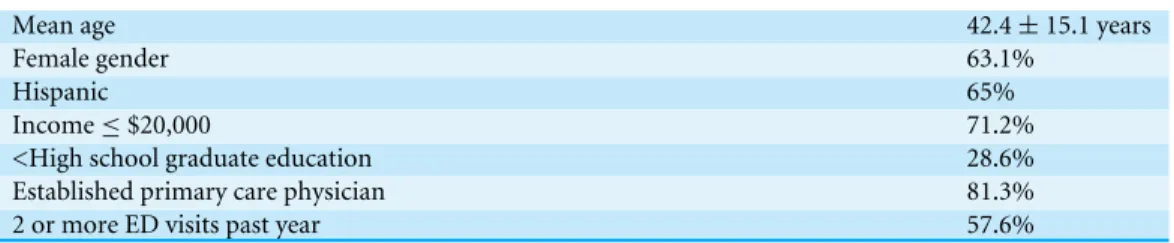
During the study period, 581 patients were enrolled.Table 1 summarizes the characteristics of the study group. The study group was relatively young (mean age 42.4±15.1 years) and 63.1% were female. Typical of inner-city populations in the Southwestern US, 65% of the patients were Hispanic and from a generally low socioeconomic status (71.2% with income less than $20,000).
Table 1 Study group characteristics (N=581).
Mean age 42.4±15.1 years
Female gender 63.1%
Hispanic 65%
Income≤$20,000 71.2%
<High school graduate education 28.6% Established primary care physician 81.3%
2 or more ED visits past year 57.6%
DISCUSSION
Numerous investigators have evaluated the effect of cost sharing on the medical system as well as specifically with regard to patient utilization of the emergency department (DeVries, Li & Oza, 2013;Hsu et al., 2006;Newhouse et al., 1981;O’Grady et al., 1985;Reed et al., 2005; Selby, Fireman & Swain, 1996; Shapiro et al., 1989;Shapiro, Ware & Sherbourne, 1986;Wharam et al., 2007;Wharam et al., 2013;Wong et al., 2001;Tzeel & Brown, 0000). In most cases, reports have shown evidence of reduced ED visits when co-payments are required for a wide range of respective cohorts (Hsu et al., 2006;Keeler & Rolph, 1983;
O’Grady et al., 1985; Reed et al., 2005; Selby, Fireman & Swain, 1996; Shapiro, Ware & Sherbourne, 1986;Tzeel & Brown, 0000).Hsu et al. (2006)performed a quasi-longitudinal study examining three years of patient records from a prepaid integrated health care delivery system when co-payments of $0–$100 were introduced (approximately 2.5 million patients). The authors found that ED visits were reduced throughout the range of co-payment groups. Further, they noted that co-co-payments did not increase ICU and hospital admissions, nor was there an increased number of patient deaths. These results confirmed the group’s preliminary findings in a smaller study during which they surveyed 932 patients by telephone within a large health care delivery system and found that patients tended to seek alternative sources of treatment rather than avoid the ED care altogether when confronted with co-payments (Reed et al., 2005).
visit and chief complaint, rather than by phone or examining medical records when the acuity/appropriateness of the visit is determined with the benefit of a retrospective viewpoint. Overall, within our study group, 30.2% of patients reported that they would not have been willing to pay a co-payment in order to be seen that day. This included more than 20% of each of the patient groups with the following urgent chief complaints: chest pain (28%), shortness of breath (20.9%), and abdominal pain (26.9%) respectively. Physicians, as much as patients, often struggle to identify when symptoms within these chief complaint groups represent emergent pathology. Thus, our findings suggest the potential for serious adverse events if a point-of-care co-payment was a requirement to be seen at our ED. This is especially true for our inner-city patient population with limited access to other venues for rapid health care evaluation.
LIMITATIONS AND FUTURE QUESTIONS
Our study has several limitations that warrant discussion. The opportunity to focus on patients at point of care and within the context of their current chief complaint holds several of the aforementioned advantages over previous investigations. However, our survey instrument has not been previously validated, and we asked patients a written question regarding their ED utilization in the setting of a hypothetical co-payment. Patients’ answers may not reflect how they would actually respond if a payment was truly required. Nonetheless, before implementing such a requirement, we would argue that it is worthwhile to examine the question a hypothetical manner first so as to identify the potential risk of patients not presenting with urgent complaints. Further, we did not collect data regarding the eventual outcome of those patients that reported that they would have avoided ED care. Thus, the actual risk of seriously ill patients leaving before treatment or deciding to not come to the ED is unknown. Future studies should follow patients who might refuse ED co-payments forward from their triage through their diagnostic work up and outcomes.
We did not track patient refusals to participate, so we do not know how those who refused might have responded to the same questions and/or if those patients matched the participants in demographic and other characteristics. Furthermore, with respect to external validity, our patient population is predominantly Hispanic and relatively poor. Thus, our results may not be generalizable to other settings and populations. However, as Latinos represent the fastest growing demographic group in the US, this population certainly warrants more study as cultural and language barriers may influence their decision-making to visit the ED.
CONCLUSIONS
ADDITIONAL INFORMATION AND DECLARATIONS
Funding
The authors received no funding for this work.
Competing Interests
The authors declare there are no competing interests.
Author Contributions
• Zachary Baum conceived and designed the experiments, performed the experiments, analyzed the data, wrote the paper, reviewed drafts of the paper.
• Michael R. Simmons conceived and designed the experiments, wrote the paper, reviewed drafts of the paper.
• Jose H. Guardiola and Peter Richman conceived and designed the experiments, analyzed the data, wrote the paper, prepared figures and/or tables, reviewed drafts of the paper.
• Cynthia Smith conceived and designed the experiments, performed the experiments, contributed reagents/materials/analysis tools, reviewed drafts of the paper.
• Lynn Carrasco performed the experiments, analyzed the data, contributed
reagents/materials/analysis tools, reviewed drafts of the paper.
• Joann Ha performed the experiments, analyzed the data, reviewed drafts of the paper.
Human Ethics
The following information was supplied relating to ethical approvals (i.e., approving body and any reference numbers):
Christus Spohn IRB study #2014-004.
Data Availability
The following information was supplied regarding data availability: The research in this article did not generate any raw data.
Supplemental Information
Supplemental information for this article can be found online athttp://dx.doi.org/10.7717/
peerj.1544#supplemental-information.
REFERENCES
Becker DJ, Blackburn J, Morrisey MA, Sen B, Kilgore ML, Caldwell C, Menachemi
N. 2013.Co-payments and the use of emergency department services in the
children’s health insurance program.Medical Care Research and Review70:514–530
DOI 10.1177/1077558713491501.
Centers for Disease Control Prevention. 2010.National Hospital Ambulatory Medical
Chernew M, Gibson TB, Yu-Isenberg K, Sokol MC, Rosen AB, Fendrick AM. 2008.Effects of increased patient cost sharing on socioeconomic dispari-ties in health care.Journal of General Internal Medicine23(8):1131–1136
DOI 10.1007/s11606-008-0614-0.
DeVries A, Li CH, Oza M. 2013.Strategies to reduce nonurgent emergency department
use: experience of a northern virginia employer group.Medical Care51(3):224–230
DOI 10.1097/MLR.0b013e3182726b83.
Flores-Mateo G, Violan-Fors C, Carrillo-Santisteve P, Peiró S, Argimon JM. 2012.
Ef-fectiveness of organizational interventions to reduce emergency department utiliza-tion: a systematic review.PLoS ONE 7(5):e35903DOI 10.1371/journal.pone.0035903.
Hsu J, Price M, Brand R, Thomas Ray G, Fireman B, Newhouse J, Selby J. 2006.
Cost-sharing for emergency care and unfavorable clinical events: findings from the safety and financial ramifications of ED copayments study.Health Services Research
41(5):1801–1820DOI 10.1111/j.1475-6773.2006.00562.x.
Keeler EB, Rolph JE. 1983.How cost sharing reduced medical spending of
par-ticipants in the health insurance experiment.JAMA249(16):2220–2222
DOI 10.1001/jama.1983.03330400066026.
Magid DJ, Koepsell TD, Every NR, Martin JS, Siscovick DS, Wagner EH, Weaver WD.
1997.Absence of association between insurance copayments and delays in seeking
emergency care among patients with myocardial infarction.New England Journal of Medicine336(24):1722–1729DOI 10.1056/NEJM199706123362406.
National Health Expenditures. 2011.Centers for Medicare & Medicaid Services.
Available atwww.cms.gov.
Newhouse JP, Manning WG, Morris CN, Orr LL, Duan N, Keeler EB, Leibowitz A,
Marquis KH, Marquis MS, Phelps CE, Brook RH. 1981.Some interim results from a
controlled trial of cost sharing in health insurance.New England Journal of Medicine
305(25):1501–1507DOI 10.1056/NEJM198112173052504.
O’Grady KF, Manning WG, Newhouse JP, Brook RH. 1985.The impact of cost
sharing on emergency department use.The New England Journal of Medicine
313(8):484–490DOI 10.1056/NEJM198508223130806.
Reed M, Fung V, Brand R, Fireman B, Newhouse JP, Selby JV, Hsu J. 2005.
Care-seeking behavior in response to emergency department copayments.Medical Care
43(8):810–816DOI 10.1097/01.mlr.0000170416.68260.78.
Selby JV, Fireman BH, Swain BE. 1996.Effect of a copayment on use of the emergency
department in a health maintenance organization.New England Journal of Medicine
334(10):635–642DOI 10.1056/NEJM199603073341006.
Shapiro MF, Hayward RA, Freeman HE, Sudman S, Corey CR. 1989.Out-of-pocket
payments and use of care for serious and minor symptoms: results of a national survey.Archives of Internal Medicine149(7):1645–1648
DOI 10.1001/archinte.1989.00390070153025.
Shapiro MF, Ware JE, Sherbourne CD. 1986.Effects of cost sharing on seeking care
Tzeel A, Brown J.Expect the unexpected: a role for behavioral economics in under-standing the impact of cost-sharing on emergency department utilization.American Health & Drug Benefits3(4):248–256.
Wharam JF, Landon BE, Galbraith AA, Kleinman KP, Soumerai SB, Ross-Degnan D.
2007.Emergency department use and subsequent hospitalizations among members
of a high-deductible health plan.JAMA297(10):1093–1102
DOI 10.1001/jama.297.10.1093.
Wharam JF, Zhang F, Landon BE, Soumerai SB, Ross-Degnan D. 2013.
Low-socioeconomic-status enrollees in high-deductible plans reduced high-severity emergency care.Health Affairs32(8):1398–1406DOI 10.1377/hlthaff.2012.1426.
Wong MD, Andersen R, Sherbourne CD, Hays RD, Shapiro MF. 2001.Effects of cost