http://www.uem.br/acta ISSN printed: 1679-9275 ISSN on-line: 1807-8621
Doi: 10.4025/actasciagron.v36i3.17466
Behavior of
Orius insidiosus
preying on
Aphis gossypii
reared on
transgenic and conventional cotton varieties
Ana Carolina Pires Veiga1, Valéria Lucas de Laurentis1, Alessandra Marieli Vacari1*, Haroldo
Xavier Linhares Volpe1, Dagmara Gomes Ramalho2 and Sergio Antonio De Bortoli1
1
Laboratório de Biologia e Criação de Insetos, Departamento de Fitossanidade, Faculdade de Ciências Agrárias e Veterinárias, Universidade Estadual Paulista “Julio de Mesquita Filho”, Via de Acesso Prof. Paulo Donato Castellane, s/n, 14884-900, Jaboticabal, São Paulo, Brazil. 2
Departamento de Biologia, Faculdade de Filosofia Ciências e Letras, Universidade de São Paulo, Ribeirão Preto, São Paulo, Brazil. *Author for correspondence. E-mail: [email protected]
ABSTRACT. The objective of this study was to evaluate the functional response of Orius insidiosus preying on the third and fourth instars of Aphis gossypii nymphs that were reared on transgenic NuOPAL (Bollgard I Event 531) and conventional Buriti cotton varieties. Fifty O. insidiosus female bugs aged 12–24h were distributed into five different Petri dishes with different densities of A. gossypii (2, 4, 8, 16, and 32 nymphs per plate) for each cotton variety. The number of prey consumed was evaluated over the course of 12h, with a final assessment at 24h. The handling times (Th) and attack rates (a) were 0.0697h and 1.1862h-1,
respectively, for the Buriti variety and 0.0713h and 0.3030h-1, respectively, for the NuOPAL variety.
The average number of prey consumed by O. insidiosus was similar for both varieties at 24h and at higher densities; the attack rate was higher for the Buriti-reared aphid prey than for the NuOPAL-reared aphids.
Keywords: cotton aphid, functional response, Gossypium hirsutum, minute pirate bug, transgenic plants.
Comportamento de
Orius insidiosus
predando
Aphis gossypii
criados em variedades de
algodão transgênico e convencional
RESUMO. O objetivo deste estudo foi avaliar a resposta funcional de Orius insidiosus que predaram ninfas de terceiro e quarto instar de Aphis gossypii criadas em variedades de algodão transgênico e convencional. Cinquenta fêmeas de O. insidiosus de 12–24h foram individualizadas por tratamento em placas de Petri. Diferentes densidades de A. gossypii (2, 4, 8, 16 e 32 ninfas por placa) foram testadas usando cada variedade de algodão. O número de presas consumidas foi avaliado durante 12h. Foi realizada uma avaliação final com 24h. O tempo de manipulação (Th) e a taxa de ataque (a) foram 0,0697h e 1,1862h-1, respectivamente,
para a variedade Buriti e 0,0713h e 0,3030h-1, respectivamente, para a variedade NuOPAL. O número
médio de presas consumidas por O. insidiosus foi similar para ambas variedades com 24h e com maiores densidades; a taxa de ataque foi maior com pulgões criados em Buriti do que criados em NuOPAL.
Palavras-chave: pulgão do algodoeiro, resposta funcional, Gossypium hirsutum, percevejo pirata, plantas transgênicas.
Introduction
Cotton plants attacked in their early developmental stages by the aphid Aphis gossypii Glover (Hemiptera: Aphididae) experience direct damage via suction, resulting in withering of leaves and deformation of new shoots, which affect plant growth and development. These changes may cause up to a 40% reduction in cotton production (BRIOSO, 1996). Moreover, A. gossypii can carry and transmit phytopathogenic viruses (MICHELOTTO; BUSOLI, 2007). This aphid is typically controlled via the use of chemicals.
The bug Orius insidiosus (Say) (Hemiptera: Anthocoridae) is an important biological control agent of plant pests owing to its widespread geographical
distribution, ability to feed on different prey types, capability to seek out prey, and ability to survive during food shortages (CALIXTO et al., 2013). Moreover, this bug is an important natural enemy of Frankliniella occidentalis (Pergande) (Thysanoptera: Thripidae) (WILSON et al., 1991), which attacks cotton plants. In Brazil, studies have been conducted on the behavior and biological characteristics of O. insidiosus to provide information that can enhance the use of this bug as a biological control agent against F. occidentalis,
Frankliniella insularis (Franklin), Caliothrips phaseoli
(Hood) (Thysanoptera: Thripidae), and the eggs of
The genetically modified cotton variety Bollgard I event 531, also called NuOPAL, expresses the toxin Cry1Ac that is found in Bacillus thuringiensis Berliner. This toxin is an excellent tool in the management of defoliating caterpillars (SHARMA; ORTIZ, 2000; WU, 2001). However, an increase in the aphid population in China has led to the emergence of aphids as key pests, despite the use of this genetically modified cotton variety (DENG et al., 2003). This phenomenon may have been caused by changes in tri-trophic interactions in the agro-ecosystem or by unanticipated pleiotropy in transgenic plant varieties (SUJII et al., 2013).
Several researchers have studied the relationship between B. thuringiensis and non-target insects; many of these researchers have observed that Cry proteins from
B. thuringiensis can be transferred to other trophic levels and may interfere with the insect component of the food chain (DOGAN et al., 1996; TORRES et al., 2006; ZHANG et al., 2006). Melatti et al. (2010) reported that B. thuringiensis can have toxic effects on
A. gossypii when used systemically in plants. One of the strategies used by the bugs that are generally found on cotton plants is to feed on herbivores devoid of Cry proteins, which could limit any adverse effects on the bugs (TORRES et al., 2006).
In addition, because of the range of prey and the mobility of O. insidiosus adults, it is difficult to quantify the contribution of these predators toward the mortality of target pests in an agro-ecosystem. In this context, studies must be conducted with different prey densities, so that instantaneous rates of predation can be measured via the functional response of predators. The objective of this study was to evaluate the predation behavior of O. insidiosus nymphs preying on
A. gossypii reared on transgenic NuOPAL (Bollgard I Event 531) and conventional Buriti cotton varieties.
Material and methods
The experiment was conducted at the Laboratory of Biology and Insect Rearing (LBIR), Department of Crop Protection, College of Agriculture and Veterinary Sciences, São Paulo State University, São Paulo, Brazil. The experimental conditions were controlled at a temperature of 25 ± 1°C, a relative humidity (RH) of 70% ± 10%, and a photo-phase of 12h.
Cotton planting and A. gossypii rearing
Transgenic cotton plants of the NuOPAL variety (Bollgard I Event 531) that express the Cry1Ac protein and plants of the conventional Buriti variety (BRS 269) were grown and maintained in polystyrene trays with the ‘Plantmax®’ substrate for
seedling production. These plants were placed in
screen cages (0.64 m high × 2.082 m wide × 1.52 m long) free of pests and natural enemies that were lit with fluorescent lighting (daylight) from Grolux lamps. Staggered planting was performed at intervals of 20 days. The trays were placed in metal containers containing water; the plants absorbed the required amount of water via osmosis. The plants were grown in a climatized greenhouse at a temperature of 25 ± 1°C, a RH of 70% ± 10%, and photo-phase of 14h (OLIVEIRA et al., 2010).
The aphids used in the experiments were obtained from the NuOPAL (Bollgard I Event 531) and Buriti varieties reared at the LBIR. Individual aphids were collected from cotton plants from commercial crops in Jaboticabal, São Paulo State; the aphids were then identified and transferred to healthy plants maintained under the conditions mentioned above and protected against migration and infestation by other species of aphids and natural enemies. Every 20 days, healthy plants were infested with aphids for maintenance of the laboratory rearing system (OLIVEIRA et al., 2010).
To protect A. gossypii from parasitoids in the greenhouse, the colonies were sprayed with household insecticides (SBP®: 0.1% allethrin or Protector®: 0.3%
tetramethrin and 0.1% permethrin) wherever the presence of these natural enemies was observed. These insecticides affect only the parasitoid population, with no significant effect on the A. gossypii population (OLIVEIRA et al., 2010).
Rearing of O. insidiosus
To initiate the rearing and maintenance of
O. insidiosus, specimens of O. insidiosus individuals were collected from corn (Zea mays L.) and beggar tick plants (Bidens pilosa L.) by the beat method (‘tapping method’) at São Paulo State University campus.
The adults were kept in glass cages (1.7 L) sealed with polyvinyl chloride (PVC) films. A paper towel was placed within each cage to serve as a shelter for the predators. To promote aeration, holes were made in the PVC film with the aid of a stylus. Every 2 days,
Anagasta kuehniella (Zeller) (Lepidoptera: Pyralidae) eggs were provided to the bugs as a food source. Inflorescences of beggar tick were disinfected in a solution of 0.12% sodium hypochlorite and offered as oviposition substrates (BUENO et al., 2006).
Food and water were replenished every 2 days. Soon after emergence, the adults were segregated into couples to start a new cycle of rearing.
Experimental procedure
Fifty O. insidiosus females aged 12–24h were isolated and placed into 5 Petri dishes (6 × 2 cm), each containing 10 females per treatment; the predators were starved for 12h. After this period, third/fourth instar aphid nymphs reared on transgenic NuOPAL and conventional Buriti varieties were transferred to the plates with the aid of a brush; there, they were placed on leaf disks at densities of 2, 4, 8, 16, and 32 aphids per plate. The prey and predators were obtained from the cattle stock at LBIR.
Ten replicates of each prey density were used, with the absence of the predator in 3 replicates to assess the natural mortality of the prey. The predation behavior ratings were noted every 15 min. during the first 12h, and a final evaluation was performed after 24h. Because no aphids died in the absence of the predators, correction for mortality was not required.
The type of functional response was determined by logistic regression of the proportion of A. gossypii
nymphs consumed according to the original density using the categorical modeling procedure (PROC CATMOD) of the Statistical Analysis System (SAS, 2002). A random predation equation was fitted to the results using the non-linear regression procedure (PROC NLIN) of the SAS (JULIANO, 2001). We used a functional response equation proposed by Rogers (1972) as the random equation because the prey was not replaced during the experiment. The estimated attack rates (a) and handling times (Th) were compared between the densities at a 95% confidence interval (CI); means were considered significantly different if the 95% CIs of different groups did not overlap (p < 0.05) (DI STEFANO, 2005).
Predation data at different densities were tested using the Kolmogorov test to verify the assumption of data normality and Bartlett’s test to test for homogeneity of variance. Mean values were compared by the Tukey test at 5% probability and by analysis of variance (ANOVA) to determine when a significant difference existed. All analyses were carried out using the SAS software (SAS, 2002).
Results and discussion
Observation of the predation behavior of
O. insidiosus at intervals of 15 min. for 12h in both the cotton varieties showed that the predator would walk with its rostrum extended to detect the prey, and, upon encountering the prey, would make several attempts to insert its stylet into the aphid
prey. Once the stylet was inserted, the predator fed, one prey at a time, until no more food reserves remained. Soon after the predation was completed, the predators cleaned their stylet and antennae with the aid of their prothoracic legs.
The average consumption of aphids by each
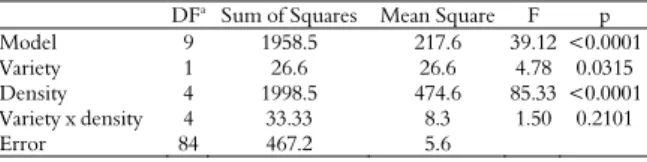
O. insidiosus female in both cultivars differed significantly among the different prey densities and between the varieties (Table 1).
Table 1. Analysis of variance of the average consumption of Aphis gossypii nymphs by Orius insidiosus females, depending on the different densities of the prey in the transgenic and conventional cotton varieties.
DFa
Sum of Squares Mean Square F p
Model 9 1958.5 217.6 39.12 <0.0001
Variety 1 26.6 26.6 4.78 0.0315
Density 4 1998.5 474.6 85.33 <0.0001
Variety x density 4 33.33 8.3 1.50 0.2101
Error 84 467.2 5.6
aDF, degree of freedom.
Predators that fed on A. gossypii aphids reared on both Buriti and NuOPAL varieties showed stabilization of consumption between the densities of 16 and 32 aphids per plate (Table 2). Experimental data were observed until the mean number of prey consumed at 24h was obtained for each prey density; the mean consumption ranged from 2.0 to 13.9 aphids for Buriti-reared aphids (F = 37.97, p < 0.0001) and from 2.0 to 13.1 for NuOPAL-reared aphids (F = 50.99, p < 0.0001) (Table 2).
Table 2. Average consumption of Aphis gossypii nymphs by Orius insidiosus female bugs at different prey densities.
Consumption Prey Density
n Buriti NuOPAL
2 10 2.0 ± 0.12c 2.0 ± 0.09b
4 10 3.9 ± 0.11c 3.4 ± 0.34b
8 10 8.0 ± 0.14b 4.5 ± 0.81b
16 10 12.0 ± 1.52a 11.3 ± 0.75a
32 10 13.9 ± 0.83a 13.1 ± 0.99a
dMean ± standard error values with the same letter, i.e., a, b, or c in the Buriti and NuOPAL
columns show no difference on comparison via the Tukey test (p > 0.05), n = number of replicates per density.
The attack rate (a) for the Buriti-fed aphids was higher than that for the NuOPAL-fed aphids; observed attack rates were 1.1862h-1 (95% CI 0.0521–2.4244)h-1
and 0.3030h-1 (95% CI 0.1367–0.4694)h-1, respectively
(Table 3). The attack rate parameter was related to the performance of the predator such that the efficiency of attack in the trials increased when the attack ratio increased. This parameter varied depending on the area (room) in which the predators and the prey were placed, the type of the host available for the prey, and the prey type.
NuOPAL-fed aphids (Table 3). To obtain the number of Buriti-reared aphids preyed upon per h, 0.0697 was multiplied by 24h, yielding a value of 1.6728 aphids preyed upon per h. To obtain the number of NuOPAL-reared aphids preyed on per h, 0.0713 was multiplied by 24h, yielding a value of 1.7112 per h. Thus, the predator’s average consumption of aphids reared on the Buriti and NuOPAL varieties ranged from 14.0 to 14.3 aphids per day (t Th-1).
Table 3. Attack rate (h-1
) and prey handling time (h) for Orius insidiosus preying on Aphis gossypii nymphs reared on transgenic (NuOPAL) and conventional (Buriti) varieties.
Variety Attack Rate (h-1) Handling Time (h)
Buriti 1.1862a
(0.0521 – 2.4244)
0.0697a (0.0642 – 0.0752)
NuOPAL 0.3030b
(0.1367 – 0.4694)
0.0713a (0.0623 – 0.0803)
cMean values with the same letter in the columns show no difference with Confidence
Intervals (CIs)of 95% probability
For both varieties, the predatory capacity of
O. insidiosus gave rise to a type II functional response curve (increased consumption attached to the stabilization) (Table 4 and Figure 1). The quotient of the linear equation was negative (Buriti y = 4.1312 - 0.1380x and NuOPAL y = 1.5848 - 0.0603x) (Table 4), and the type of the functional response curve was determined by the logistic regression equation of the proportion of aphids on the basis of live prey (TREXLER et al., 1988). The type of functional response was determined by the linear regression coefficient; a coefficient not significantly different from 0 indicated a type I functional response, and a coefficient significantly different from 0 indicated either a type II negative response curve or a type III positive response curve.
Biological pest control achieved using predators and parasitoids in agro-ecosystems is a key component of integrated pest management (IPM) systems (CROFT, 1990). Another key element of IPM is the resistance of the host plant.
However, before the advent of transgenic Bt crops, few plants were found to have resistance to the key species of Lepidoptera and Coleoptera that are usually found on most crops (SHELTON et al., 2008). A key question is whether host plant resistance involving Bt technology is compatible with biological pest control. Many laboratory and field studies have reported the potential effect of Bt proteins on the natural enemies of pests. The effects of Cry toxins on predators have been reviewed by Romeis et al. (2006) who suggested that the predators were not susceptible to the lepidopteran-active proteins. For example, Lawo et al. (2010) confirmed that the Cry1Ac protein does not produce
direct toxicity on the predator Chrysoperla carnea
(Stephens) (Neuroptera: Chrysopidae). The situation is more complex in the case of parasitoids. While an insect predator consumes many prey during its life cycle, a parasitoid’s complete development occurs in stages in a single host, and all its nutritional requirements are provided by the host tissues.
Table 4. Logistic regression estimates of the number of Aphis gossypii nymphs consumed by Orius insidiosus in transgenic (NuOPAL) cotton and conventional (Buriti) cotton, at densities of 2, 4, 8, 16, and 32 prey per plate.
Variety Parameters Estimates (± SE) DF χ2 P
Intercept 4.1312 ± 0.3902 1 112.10 < 0.0001 Linear -0.1380 ± 0.0133 1 106.89 < 0.0001
Quadratic - - - -
Buriti
Cubic - - - -
Intercept 1.5848 ± 0.2139 1 54.88 < 0.0001 Linear - 0.0603 ± 0.0083 1 52.37 < 0.0001
Quadratic - - - -
NuOPAL
Cubic - - - -
Figure 1. Predation of Aphis gossypii by Orius insidiosus on transgenic cotton (NuOPAL) and conventional cotton (Buriti) varieties, depending on the different densities of aphids.
plant-herbivore-predator (tri-trophic interactions) system. Deleterious effects on longevity, mortality, or development of the predators were only reported when they preyed on lepidopteran larvae that had ingested the toxin, thereby making the predators susceptible to the toxin (ROMEIS et al., 2006; BAHAR et al., 2011).
Romeis et al. (2006) reported that certain predators are exposed differently to the toxin on the basis of their feeding mode. Predators with masticatory mouthparts, such as beetles (Coccinellidae), ingested the toxin when feeding Bt-fed arthropods, due to the consumption of the intestines, where most of the toxin was located. Predators with sucking mouthparts, such as stink bugs, may feed on parts of the prey’s body tissues that do not contain the toxin; however, this possibility is not clear on the basis of available data.
Predators make use of chemical stimuli, such as odors and phagostimulants, and of physical stimuli in searching for and obtaining their prey (WALDBAUER; FRIEDMAN, 1991). Bugs belonging to the family Anthocoridae, which regulate the foraging behavior of plant pests, are guided by chemical stimuli that help locate their prey (LATTIN, 1999). Cocuzza et al. (1997) reported a similar behavior in predators such as
O. laevigatus (Fieber, 1860) and O. albidipennis
(Reuter, 1884) (Heteroptera: Anthocoridae) when preying on F. occidentalis (Pergande, 1895) (Thysanoptera: Thripidae). Mendes and Bueno (2001) and Bueno (2009) reported that the predator
O. insidiosus surveys an entire leaf in search of its prey by moving its head from side-to-side; when it detects a prey, its antennae move in the prey’s direction and it walks toward the prey with its rostrum extended. Moreover, Loureiro and Moino Júnior (2007) noted that O. insidiosus cleans its stylet and antennae after predation of the aphid A. gossypii.
One of the most important factors affecting the predation rate is the prey density in areas explored by the predator. At lower prey densities, the search efficiency is lower (O’NEIL, 1988) due to the energy cost of locating prey. At higher densities, De Clercq and Degheele (1994) reported that the predation rate may be increased due to the ease with which predators encounter prey, causing the predator to abandon its prey before it is fully consumed. One of the methods that O. insidiosus
uses to locate and capture its prey is to detect plant volatiles that are released when the herbivores feed (HATANO et al., 2008). When the toxin of
B. thuringiensis is used systemically in a plant, it may have toxic effects on a herbivore that feeds on the
plant (MELATTI et al., 2010). Thus, in our study, the presence of this toxin in the transgenic variety NuOPAL may have reduced the feeding activity of the aphid A. gossypii reared on plants of this cultivar.
The type II functional response is the most common functional response of the predators because of the increased number of trapped and damaged prey with the subsequent tendency for stabilization of consumption. Most predators of the genus Orius show the type II functional response, as observed by Oliveira et al. (2006), Brito et al. (2009), Gitonga et al. (2002), and Nagai and Yano (2000), who, in their studies, used imprisoned A. gossypii, eggs and larvae of Plutella xylostella (L.) (Lepidoptera: Plutellidae), Megalurothrips sjostedti (Trybom) (Thysanoptera: Thripidae), and Thrips palmi (Karny) (Thysanoptera: Thripidae), respectively, as prey.
Conclusion
In both cotton varieties, the predatory capacity of
O. insidiosus gave rise to a type II functional response curve and the attack rate of the predators was affected when they consumed aphids reared on cotton plants expressing the B. thuringiensis toxin. Other researchers have found that the toxins present in the plants move to the third trophic level and that 17% of the total concentration of the toxin present in a cotton plant moved to the predator O. insidiosus
through the herbivore F. occidentalis, further studies should be performed to verify that this toxin has no detrimental effect on predators.
Acknowledgements
We would like to thank the Coordenação de Aperfeiçoamento de Pessoal de Nível Superior (CAPES) for the scholarship and Dr. Jose Ednilson Miranda, Empresa Brasileira de Pesquisa Agropecuária (EMBRAPA), Centro Nacional de Pesquisado Algodão (CNPA), for sending us the seeds of the cotton varieties used in the study.
References
BAHAR, M. H.; STANLEY, J. N.; GREGG, P. C.; DEL SOCORRO, A. P.; KRISTIANSEN, P. Comparing the predatory performance of green lacewing on cotton bollworm on conventional and Bt cotton. Journal of Applied Entomology, v. 136, n. 4, p. 263-270, 2011. BRIOSO,P. S. T. Doenças causadas por vírus em pimentão.
Informe Agropecuário, v. 18, n. 184, p. 74-80, 1996. BRITO, J. P.; VACARI, A. M.; THULER, R. T.; DE BORTOLI, S. A. Aspectos Biológicos de Orius insidiosus
(Say, 1832) predando ovos de Plutella xylostella (L., 1758) e
BUENO, V. H. P. Desenvolvimento e criação massal de percevejos predadores Orius. In: BUENO, V. H. P. (Ed.). Controle Biológico de Pragas. Lavras: UFLA, 2009. p. 33-76.
BUENO, V. H. P.; MENDES, S. M.; CARVALHO, L. M. Evaluation of a rearing-method for the predator Orius insidiosus. Bulletin of Insectology, v. 59, n. 1, p. 1-6, 2006. CALIXTO, A. M.; BUENO, V. H. P.; MONTES, F. C.; SILVA, A. C.; VAN LENTEREN, J. C. Effect of diferente diets on reproduction, longevity and predation capacity of
Orius insidiosus (Say) (Hemiptera: Anthocoridae).
Biocontrol Science and Technology, v. 23, n. 11, p. 1245-1255, 2013.
COCUZZA, G. E.; CLERCQ, P. D.; LIZZIO, S.; VEIRE, M. V.; TIRRY, L.; DEGHEELE, D.; VACANTE, V. Life tables predation activity of Orius laevigatus and O. albidipennis at three constant temperatures. Entomologia Experimentalis et Applicata, v. 85, n. 3, p. 189-198, 1997.
CROFT, B. A. Arthropod biological control agents and pesticides. New York: Wiley, 1990.
DE CLERCQ, P.; DEGHEELE, D. Laboratory measurement of predation by Podisus maculiventris and
P. sagitta (Hemiptera: Pentatomidae) on beet armyworm (Lepidoptera: Noctuidae). Journal of Economic Entomology, v. 87, n. 1, p. 76-83, 1994.
DENG, S. D.; XU, J.; ZHANG, Q. W.; ZHOW, S. W.; XU, G. J. Effect of transgenic Bacillus thuringiensis cotton on population dynamics of non-target pest and natural enemies. Acta Entomologica Sinica, v. 46, n. 2, p. 1-5, 2003.
DI STEFANO, J. Effect size estimates and confidence intervals: an alternative focus for the presentation and interpretation of ecological data. In: BURK, A. R. (Ed.).
New trends in Ecology Research. New York: Nova Science Publishers, 2005. p. 71-102.
DOGAN, E. B.; BERRY, R. E.; REED, G. L.; ROSSIGNOL, P. A. Biological parameters of convergent lady beetle(Coleoptera: Coccinellidae) feeding on aphids (Homoptera: Aphididae) on transgenic potato. Journal of Economic Entomology, v. 89, n. 5, p. 1105-1108, 1996. GITONGA, L. M.; OVERHOLT, W. A.; LOHR, B.; MAGAMBO, J. K.; MUEKE, J. M. Functional response of
Orius albidipennis (Hemiptera: Anthocoridae) to Megalurothrips sjostedti (Thysanoptera: Thripidae). Biological Control, v. 24, n. 1, p. 1-6, 2002.
HATANO, E.; KUNERT, G.; MICHAUD, J. P.; WEISSER, W. W. Chemical cues mediating aphid location by natural enemies. European Journal of Entomology, v. 105, n. 5, p. 797-806, 2008.
JULIANO, S. A. Non-linear curve fitting: predation and functional response curves. In: SCHEINER, S. M.; GUREVITCH, J. (Ed.). Design and analysis of ecological experiments. Oxford: Oxford Universtiy Press, 2001. p. 178-196.
LATTIN, J. D. Bionomics of the Anthocoridae. Annual Review of Entomology, v. 44, n. 1, p. 207-231, 1999. LAWO, N. C.; WACKERS, F. L.; ROMEIS, J. Characterizing indirect prey quality mediated effects of
a Bt crop on predatory larvae of the green lacewing,
Chrysoperla carnea. Journal Insect Physiology, v. 56, n. 11, p. 1702-1710, 2010.
LOUREIRO, E. S.; MOINO JÚNIOR, A. Patogenicidade de fungos entomopatogênicos e Orius insidiosus (Say) (Hemiptera: Anthocoridae). BioAssay, v. 2, n. 10, p. 1-8, 2007.
MELATTI, V. M.; PRAÇA, L. B.; MARTINS, E. S.; SUJII, E.; BERRY, C.; MONNERAT, R. G. Selection of
Bacillus Thuringiensis strains toxic against cotton aphid
Aphis gossypii, Glover (Hemiptera: Aphididae). BioAssay, v. 5, n. 2, p. 1-4, 2010.
MENDES, S. M.; BUENO, V. H. P. Biologia de Orius insidiosus (Say) (Hemiptera: Anthocoridae) alimentado com Caliothrips phaseoli (Hood) (Thysanoptera: Thripidae).
Neotropical Entomology, v. 30, n. 3, p. 423-428, 2001. MENDES, S. M.; BUENO, V. H. P.; CARVALHO, L. M.; SILVEIRA, L. C. P. Efeito da densidade de ninfas de
Aphis gossypii Glover, 1877 (Hemiptera, Aphididae) no consumo alimentar e aspectos biológicos de Orius insidiosus
(Say, 1832) (Hemiptera, Anthocoridae). Revista Brasileira de Entomologia, v. 47, n. 1, p. 19-24, 2003. MICHELOTTO, M. D.; BUSOLI, A. C. Características de transmissão do vírus do Mosaico-das-nervuras do algodoeiro pelo pulgão Aphis gossypii com relação a persistência e ao tempo necessário para inoculação.
Bragantia, v. 66, n. 3, p. 445-4551, 2007.
NAGAI, K.; YANO, E. Predation by Orius sauteri
(Poppius) (Heteroptera: Anthocoridae) on Thrips palmi
Karny (Thisanoptera: Thriphidae): functional response and selective predation. Applied Entomology and Zoology, v. 35, n. 4, p. 565-574, 2000.
OLIVEIRA, J. E. M.; DE BORTOLI, A. S.; GUEDES, I. V. Resposta funcional de Orius insidiosus (Say, 1932) a diferentes densidades de Aphis gossypii (Glover, 1877).
Revista de Biologia e Ciências da Terra, v. 6, n. 1, p. 63-72, 2006.
OLIVEIRA, J. E. M.; DE BORTOLI, A. S.; SANTOS, R. F.; MOREIRA, N. A. Desenvolvimento de metodologia de criação e multiplicação de Aphis gossypii: avanços e sucessos.
Comunicata Scientiae, v. 1, n. 1, p. 65-68, 2010.
O’NEIL, R. J. A model of predation by Podisus maculiventris (Say) on Mexican bean beetle, Epilachna varivestis Mulsant, in soybeans. The Cannadian Entomologist, v. 120, n. 7, p. 601-608, 1988.
ROGERS, D. Random search and insect population models.
Journal of Animal Ecology, v. 41, n. 2, p. 369-383, 1972. ROMEIS, J.; MEISSLE, M.; BIGLER, F. Transgenic crops expressing Bacillus thuringiensis toxins and biological control.
Nature Biotechnology, v. 24, n. 1, p. 63-71, 2006.
SAS-Statistical Analysis System. SAS user’s: guide statistics. Cary: SAS, 2002.
SHARMA, H. C.; ORTIZ, R. Transgenics, pest management, and the environment. Current Science, v. 79, n. 4, p. 421-437, 2000.
G. G. (Ed.). Integration of insect-resistant, genetically modified crops within IPM programs. Dordrecht: Springer, 2008. p. 419-429.
SILVEIRA, L. C. P.; BUENO, V. H. P. Orius insidiosus
(Say, 1832) (Heteroptera, Anthocoridae): sensibilidade ao fotoperíodo e diapausa reprodutiva. Revista Brasileira de Entomologia, v. 47, n. 4, p. 631-635, 2003.
SUJII, E. R.; TOGNI, P. H. B.; RIBEIRO, P. A.; BERNARDES, T. A.; MILANE, P. V. G. N.; PAULA, D. P.; PIRES, C. S. S.; FONTES, E. M. G. Field evaluation of Bt cotton crop impact on nontarget pests: cotton aphid and boll weevil. Neotropical Entomology, v. 42, n. 1, p. 102-111, 2013.
TORRES, J. B.; RUBERSON, J. R.; ADANG, M. J. Expression of Bacillus thuringiensis Cry1Ac protein in cotton plants, acquisition by pests and predators: a tritrophic analysis.
Agricultural and Forest Entomology, v. 8, n. 3, p. 191-202, 2006.
TORRES, J. B.; RUBERSON, J. R. Interactions of
Bacillus thuringiensis Cry1Ac toxin in genetically engineered cotton with predatory heteropterans. Transgenic Research, v. 17, n. 3, p. 345-354, 2008.
TREXLER, J. C.; MCCULLOCH, C. E.; TRAVIS, J. How can the functional response best be determined?
Oecologia, v. 78, n. 4, p. 206-214, 1988.
WALDBAUER, G. P.; FRIEDMAN, S. Self-selection of optimal diets by insects. Annual Review of Entomology, v. 36, n. 1, p. 43-63, 1991.
WILSON, L. T.; TRICHILO, P. J.; GONZALEZ, D. Natural enemies of spider mites (Acari: Tetranychidae) on cotton: density regulation or casual association?
Environmental Entomology, v. 20, n. 3, p. 849-856, 1991.
WU, K. IPM cotton. In: JIA, S. (Ed.). Transgenic Cotton. Beijing: Science Press, 2001. p. 218-224. ZHANG, G.; WAN, F.; LÖVEI, G. L.; WAN-XUE, L.; GUO, J. Transmission of Bt Toxin to the Predador
Propylaea japonica (Coleoptera: Coccinellidae) through its aphid prey feeding on transgenic Bt cotton.
Environmental Entomology, v. 35, n. 1, p. 143-150, 2006.
Received on June 4, 2012. Accepted on October 2, 2012.