Near Rough and Near Exact Subgraphs in G
m
-Closure Spaces
A. E. Radwan1 and Y. Y. Yousif 2
1
Department of Mathematics, Faculty of Science, Ain Shams University, Cairo-Egypt
2
Department of Mathematics, Faculty of Education Ibn-Al-Haitham, Baghdad University, Baghdad-Iraq
Abstract
The basic concepts of some near open subgraphs, near rough, near exact and near fuzzy graphs are introduced and sufficiently illustrated. The Gm-closure space induced by closure operators is used to generalize the basic rough graph concepts. We introduce the near exactness and near roughness by applying the near concepts to make more accuracy for definability of graphs. We give a new definition for a membership function to find near interior, near boundary and near exterior vertices. Moreover, proved results, examples and counter examples are provided. The Gm-closure structure which suggested in this paper opens up the way for applying rich amount of topological facts and methods in the process of granular computing.
Key words: Graph Theory, Gm-closure space, Near rough
graphs, near exact graphs, Near fuzzy graphs, Near rough membership function.
(2000) Math. Subject Classification: 54C05
1. Introduction
The notions of closure operator and closure system are very useful tools in several sections of mathematics. As an example, in algebra [5, 7], topology [8, 13, 14] and computer science theory [23, 28]. Many works have appeared recently for example in structural analysis [24, 25], in chemistry [26], and physics [11]. The theory of rough sets, proposed by Pawlak [20], is an extension of set theory for the study of intelligent systems characterized by insufficient and incomplete information. Using the concepts of lower and upper approximation in rough set theory, knowledge hidden in information systems may be unraveled and expressed in the form of decision rules. This leaded several authors to investigate about the closure systems and the closure operators in the framework of fuzzy set theory. As an example, see [4, 10, 23, 28]. The purpose of the present work is to put a starting point for the application of abstract topological graph theory in the rough set analysis. Also, we shall integrate some ideas in terms of concept in topological graph theory. Topological graph theory is a branch of Mathematics, whose concepts exists not only in almost all branches
of Mathematics, but also in many real life application. We believe that topological graph structure will be an important base for modification of knowledge extraction and processing.
2. Preliminaries
This section presents a review of some fundamental notions of Gm-closure spaces [24, 25] and Pawlak's
rough sets [6, 20, 21].
2.1 Fundamental Notions of Gm-Closure Spaces In this section, we introduce the concepts of closure operators on digraphs, several known topological property on the obtained Gm-closure spaces are studies.
Definition 2.1.1. [24, 25] Let G = (V(G), E(G)) be a
digraph, P(V(G)) its power set of all subgraphs of G and ClG : P(V(G)) P(V(G)) is a mapping associating
with each subgraph H = (V(H), E(H)) a subgraph ClG(V(H)) V(G) called the closure subgraph of H
such that:
ClG(V(H)) = V(H){v V(G) – V(H) ;
hv E(G) for all hV(H)}.
The operation ClG is called graph closure operator and
the pair (G, FG) is called G-closure space, where FG is
the family of elements of ClG. Evidently ClG(V(H)) =
∩{V(F) ; V(F) FG and V(H) V(F)}. The dual of the
graph closure operator ClG is the graph interior
operator IntG : P(V(G)) P(V(G)) defined by
IntG(V(H)) = V(G) ClG(V(G) V(H)) for all
subgraph H G. A family of elements of IntG is called
interior subgraph of H and denoted by TG. Clear that
(G, TG) is a topological space. Evidently IntG(V(H)) =
{V(O) ; V(F) TG and V(O) V(H)}. Then the
domain of ClG is equal to the domain of IntG and also
ClG(V(H)) = V(G) IntG(V(G) V(H)). A subgraph H
ClG(V(H)) = V(H). It is called open subgraph if its
complement is closed subgraph, i.e., ClG(V(G) V(H))
= V(G) V(H), or equivalently IntG(V(H)) = V(H).
Example 2.1.1. Let G = (V(G), E(G)) be a digraph such that: V(G) = {v1, v2, v3, v4},
E(G) = {(v1, v2), (v1, v3), (v2, v1), (v2, v3), (v4, v3)}.
v1 v4
v2 v3
Fig. 1 Graph G given in Example 2.1.1.
Table 1: ClG for all subgraph H G.
V(H) ClG(V(H)) V(H) ClG(V(H))
V(G) V(G) {v1,v4} V(G)
{v2,v3} {v1,v2,v3}
{v1} {v1,v2,v3} {v2,v4} V(G)
{v2} {v1,v2,v3} {v3,v4} {v3,v4}
{v3} {v3} {v1,v2,v3} V(G)
{v4} {v3,v4} {v1,v2,v4} V(G)
{v1,v2} { v1,v2,v3} {v1,v3,v4} V(G) {v1,v3} {v1,v2, v3} {v2,v3,v4} V(G) FG = {V(G), , {v3}, {v3, v4}, {v1, v2, v3}},
TG = {V(G), , {v4}, {v1, v2}, {v1, v2, v4}}.
We obtain a new definition to construct topological closure spaces from G-closure spaces by redefine graph closure operator on the resultant subgraphs as a domain of the graph closure operator and stop when the operator transfers each subgraph to itself.
Definition 2.1.2. [24, 25] Let G = (V(G), E(G)) be a digraph and ClGm : P(V(G)) P(V(G)) an operator
such that:
(a)It is called Gm-closure operator if ClGm(V(H)) =
ClG(ClG(… ClG(V(H)))), m-times, for every
subgraph H G,
(b)it is called Gm-topological closure operator if
ClGm+1(V(H)) = ClGm(V(H)) for all subgraph H G.
The space (G, FGm) is called Gm-closure space.
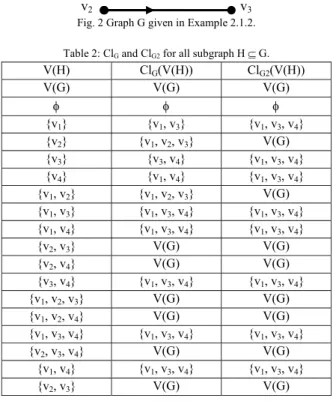
Example 2.1.2. Let G = (V(G), E(G)) be a digraph such that: V(G) = {v1, v2, v3, v4},
E(G) = {(v1, v3), (v2, v1), (v2, v3) , (v3, v4) , (v4, v1)}.
v1 v4
v2 v3
Fig. 2 Graph G given in Example 2.1.2.
Table 2: ClG and ClG2 for all subgraph H G.
V(H) ClG(V(H)) ClG2(V(H))
V(G) V(G) V(G)
{v1} {v1, v3} {v1, v3, v4}
{v2} {v1, v2, v3} V(G)
{v3} {v3, v4} {v1, v3, v4}
{v4} {v1, v4} {v1, v3, v4}
{v1, v2} {v1, v2, v3} V(G)
{v1, v3} {v1, v3, v4} {v1, v3, v4} {v1, v4} {v1, v3, v4} {v1, v3, v4}
{v2, v3} V(G) V(G)
{v2, v4} V(G) V(G)
{v3, v4} {v1, v3, v4} {v1, v3, v4}
{v1, v2, v3} V(G) V(G)
{v1, v2, v4} V(G) V(G)
{v1, v3, v4} {v1, v3, v4} {v1, v3, v4}
{v2, v3, v4} V(G) V(G)
{v1, v4} {v1, v3, v4} {v1, v3, v4}
{v2, v3} V(G) V(G)
FG2 = {V(G), , {v1, v3, v4}}, TG2 = {V(G), , {v2}}.
Proposition 2.1.1. [24] Let (G, FGm) be a Gm-closure
space. If H and K are two subgraphs of G such that H
K G, then
ClGm(V(H)) ClGm(V(K)) and IntGm(V(H))
IntGm(V(K)).
Proposition 2.1.2. [24] Let (G, FGm) be a Gm-closure
space. If H and K are two subgraphs of G, then (a) ClGm(V(H) V(K)) = ClGm(V(H)) ClGm(V(K)).
(b) IntGm(V(H) ∩ V(K)) = IntGm(V(H)) ∩ IntGm(V(K)).
Proposition 2.1.3. [24] Let (G, FGm) be a Gm-closure
space. If H and K are two subgraphs of G, then
(a) ClGm(V(H) ∩ V(K)) ClGm(V(H)) ∩ ClGm(V(K)),
and
(b) IntGm(V(H)) IntGm(V(K)) IntGm(V(H)
V(K)).
Remark 2.2.1. The converse of proposition (2.1.3) above need not be true in general, as the following example (2.3 in [24]).
Definition 2.1.3. [24] Let (G, FGm) be a Gm-closure
BdGm(V(H)) = ClGm(V(H)) IntGm(V(H)).
Proposition 2.1.4. [24] Let (G, FGm) be a Gm-closure
space and H G, then
(a)
BdGm(V(H)) = ClGm(V(H)) ∩ ClGm(V(G) V(P)).(b)
BdGm(V(P)) = BdGm(V(G) V(P)).(c)
ClGm(V(P)) = V(P) BdGm(V(P)).(d)
IntGm(V(P)) = V(P) BdGm(V(P)).By a similar way of definitions of regular open set [27], semi-open set [16], pre-open set [18], -open set [9] (b-open set [2]), -open set [15], and -open set [1] (=semi-pre-open set [3]). We introduce the following definitions which are essential for our present study. In
Gm-closure space (G, FGm) the subgraph H in (G, FGm) is
called
(a) Regular open subgraph [24] (briefly R-osg) if V(H)
= IntGm(ClGm(V(H))).(b) Semi-open subgraph [24] (briefly S-osg) if V(H)
ClGm(IntGm(V(H))).(c) Pre-open subgraph [24] (briefly P-osg) if V(H)
IntGm(ClGm(V(H))).(d)
-open subgraph (briefly -osg) if V(H) ClGm(IntGm(V(H)))IntGm(ClGm(V(H))).(e)
-open subgraph [24] (briefly -osg) if V(H) IntGm(ClGm(IntGm(V(H))).(f)
-open subgraph [24] (briefly -osg) if V(H) ClGm(IntGm(ClGmV(H))).The complement of an R-osg (resp. S-osg, P-osg, -osg, -osg and -osg) is called R-closed subgraph (briefly R-csg) (resp. S-csg, P-csg, -csg, -csg and -csg).
The family of all R-osgs (resp. S-osgs, P-osgs, -osgs,
-osgs and -osgs) of (G, FGm) is denoted by ROGm(G)
(resp. SOGm(G), POGm(G), OGm(G), OGm(G) and OGm(G) ). All of SOGm(G), POGm(G), OGm(G), OGm(G) and OGm(G) are larger than TGm and closed
under forming arbitrary union.
The family of all R-csgs (resp. S-csgs, P-csgs, -csgs,
-csgs and -csgs) of (G, FGm) is denoted by RCGm(G)
(resp. SCGm(G), PCGm(G), CGm(G), CGm(G) and CGm(G) ).
The near closure (resp. near interior and near boundary)of a subgraph H of G in a Gm-closure space
(G, FGm) is denoted by ClGmj (V(H)) (resp.
IntGmj (V(H)) and BdGmj (V(H)) ) and defined by
ClGmj (V(H)) = ∩{V(F) ; V(F) is j-csg and V(H)
V(F)}.
(resp. IntGmj (V(H)) = V(G) ClGmj (V(G) V(H)) and
BdGmj (V(H)) = ClGmj (V(H)) IntGmj (V(H)) ) where
j{R, S, P, , α, }.
Proposition 2.1.5. [24] Let (G, FGm) be Gm-closure
space, the implication TGm and the families of near open
and near closed graphs are given by following statements.
(a)ROGm(G) TGm OGm(G) SOGm(G) OGm(G) OGm(G),
(b)OGm(G) POGm(G) OGm(G),
(c)RCGm(G) FGmCGm(G) SCGm(G) CGm(G) CGm(G),
(d)CGm(G) PCGm(G) CGm(G).
2.2. Fundamental Notions of Uncertainty
Motivation for rough set theory has come from the need to represent subsets of a universe in terms of equivalence classes of a partition of that universe. The partition characterizes a topological space, called approximation space K = (X, R), where X is a set called the universe and R is an equivalence relation [17, 21]. The equivalence classes of R are also known as the granules, elementary sets or blocks, we shall use Rx X to denote the equivalence class containing x
X. In the approximation space, we consider two operators, the upper and lower approximations of subsets: Let A X, then the lower approximation (resp. the upper approximation) of A is given by
L(A) = {x X : Rx A}
(resp. U(A) = {x X : Rx∩ A })
Boundary, positive and negative regions are also defined:
BdR(A) = U(A) – L(A),
POSR(A) = L(A),
NEGR(A) = X – U(A).
These notions can be also expressed by rough membership functions [21], namely,
X x , R
A R ) x (
x x R
A
.
Different values defines boundary (0 < RA(x) < 1),
positive (RA(x) = 1) and negative (RA(x) = 0) regions.
Fuzzy set [29] is a way to represent populations that the set theory cannot describe definitely, fuzzy sets use a many (usually infinite) valued membership function, unlike classical set theory which uses a two valued membership function (i.e. an element is either in a set or it is not). Let X denotes a universal set and A X. Then a membership function on X, A, is a function;
A : X L for some partially order set L. L usually is a lattice [11]. Intuitively the membership function, A, gives the degree to which an element x X is in the fuzzy set A. In the case L is the closed interval [0, 1], we call it the Standard Fuzzy Set Theory.
2. Near Rough and Near Exact Subgraphs
in G
m-closure Spaces
The present section is devoted to introduce the near exactness and near roughness by applying the concepts of near open subgraphs to make more accuracy for definability of graphs. Let H be a subgraph of a graph G. Let IntGm(V(H)), ClGm(V(H)) and BdGm(V(H)) be
Gm-closure, Gm-interior and Gm-boundary region
respectively. H is Gm-exact if BdGm(V(H)) =
otherwise H is Gm-rough [14]. We shall express near
Gm-rough graph properties in terms of Gm-topological
closure concepts. Let ClGmj (V(H)), IntGmj (V(H)) and
BdGmj (V(H)) be near Gm-closure, near Gm-interior, and
near Gm-boundary vertices respectively, where j{R,
S, P, , α, }. H is a near Gm-exact (briefly jGm-exact)
graph if BdGmj (V(H)) = , otherwise H is a near Gm
-rough (briefly jGm-rough). It is clear H is jGm-exact iff
ClGmj (V(H)) = IntGmj (V(H)). In Pawlak space a subset
A X has two possibilities rough or exact. The following definition introduces new types of near definability for a subgraph H G in a Gm-closure
space (G, FGm).
Definition 3.1. Let (G, FGm) be a Gm-closure space and
H G, then H is called
(a) totally jGm-definable (jGm-exact) graph if
IntGmj (V(H)) = V(H) = ClGmj (V(H)),
(b) internally jGm-definable graph if IntGmj (V(H)) =
V(H), ClGmj (V(H)) V(H),
(c) externally jGm-definable graph if IntGmj (V(H))
V(H), ClGmj (V(H)) = V(H),
(d) jGm-indefinable (jGm-rough) graph if IntGmj (V(H))
V(H), ClGmj (V(H)) V(H), where j{R, S, P, , α, }.
Proposition 3.1. Let (G, FGm) be a Gm-closure space
and H be a subgraph of G. If H is Gm-exact graph, then
it is jGm-exact for all j{R, S, P, , α, }
Proof. The proofs of the six cases are similar; So, we will only prove the case when j = : Let H be Gm-exact
graph, then ClGm(V(H)) = V(H) =IntGm(V(H)). Now,
ClGm(V(H)) = ∩ {V(F) ; V(F) FGm and V(H) V(F)}
∩{V(F) ; V(F) CGm(G) and V(H) V(F)}
since FGm CGm(G)
= ClGm (V(H)) (3.1.1)
Also, IntGm(V(H)) = V(G) ClGm(V(G) V(H))
V(G) ClGm(V(G) V(H))
since TGmOGm(G)
= IntGm(V(H)) (3.1.2)
From (3.1.1) and (3.1.2) we get IntGm(V(H))
IntGm(V(H)) V(H) ClGm(V(H)) ClGm(V(H)).
Since H is exist we get IntGm (V(H)) = V(H) =
ClGm(V(H)). Hence H is Gm-exact.
The converse of the above proposition is not true in general as the following example illustrates.
Example 3.1. Let G = (V(G), E(G)) be a digraph such that: V(G) = {v1, v2, v3, v4},
E(G) = {(v2, v3), (v3, v4), (v4, v2)}.
v1. v4
v2 v3
Fig. 3 Graph G given in Example 3.1.
FG2 = {V(G), , {v1}, {v2, v3, v4}},
TG2 = {V(G), , {v1}, {v2, v3, v4}}.
Let H = (V(H), E(H)); V(H) = {v1, v2}, E(H) = . Then
IntG2(V(H)) = {v1} and ClG2(V(H)) = V(G), that is, H is
a G2-rough graph. But
IntG2(V(H)) = V(H) = ClG2(V(H)), that is, H is G2
In a Gm-topological closure space (G, TGm), we shall
use IntGmj (V(H))|TGm (resp. ClGmj (V(H))|TGm and
BdGmj (V(H))|TGm) for a subgraph H G to denote
IntGmj (V(H)) (resp. ClGmj (V(H)) and BdGmj (V(H)) )
with respect to the Gm-topology TGm for all j{R, S, P,
, α, }.
Proposition 3.2. Let (G, FGm) and (G', F 'Gm) be two
Gm-closure space such that the family of jGm-open
subgraphs in TGm subset of the family of jGm-open
subgraphs in T 'Gm for all j{R, S, P, , α, }. If H G,
G' is jGm-exact in (G, FGm) then H is jGm-exact in (G', F
'Gm).
Proof. Since BdGmj (V(H))|T 'Gm BdGmj (V(H))|TGm and
BdGmj (V(H))|TGm = for all j{R,S,P, ,α, }. Then
BdGmj (V(H))|T 'Gm = and H is jGm-exact with respect
to T 'Gm.
In Proposition (3.2), it is not necessary for TGm to be
coarser than T 'Gm, also the converse of this proposition
is not true in general as the following example illustrates.
Example 3.2. Let G = (V(G), E(G)) and G' = (V(G), E(G')) be two digraph such that V(G) = {v1, v2, v3, v4},
E(G) = {(v1, v2), (v1, v3), (v1, v4), (v2, v1), (v2, v3), (v4,
v3)} and E(G') = {(v2, v3), (v3, v4), (v4, v2)}.
v1 v4 v1 . v4
v2 v3 v2 v3
G G' Fig. 4 Graph G and G' given in Example 3.2.
FG1 = {V(G), , {v3}, {v3, v4}, {v1, v2, v3}}, TG1 = {V(G), , {v4}, {v1, v2}, {v1, v2, v4}}. F 'G2 = {V(G), , {v1}, {v2, v3, v4}}, T 'G2 = {V(G), , {v1}, {v2, v3, v4}}.
Then POG1(G)|TG1 POG2(G')|T 'G2.
If H = (V(H), E(H)); V(H)={v4}, E(H) = ,
BdGP1(V(H))|TG1 = {v3} and BdGP'2(V(H))|T 'G'2 = .
Thus H is is PG2-exact graph in T 'G'2 but it is not PG1
-exact in TG1.
Lemma 3.1. Let (G, FGm) and (G', F 'Gm) be two Gm
-closure space and H is a subgraph of G, G'. Then
ClGmj (V(H))|T 'Gm = ClGmj (V(H))|TGm if and only if
IntGmj (V(H))|T 'Gm = IntGmj (V(H))|TGm for all j{R, S,
P, , α, }.
Proof. The proofs of the six cases are similar; So, we will only prove the case when j = : Now,
ClGm(V(H))|T 'Gm = ClGm(V(H))|TGm if and only if
∩ {V(F) V(G); V(H) V(F), V(F) CGm(G') with
respect to T 'G'}
= ∩ {V(F) V(G); V(H) V(F), V(F) CGm(G)
with respect to TG}
if and only if
V(G) – ∩ {V(F) V(G); V(H) V(F), V(F)
CGm(G') with respect to T 'G'}
= V(G) – ∩ {V(F) V(G); V(H) V(F), V(F)
CGm(G) with respect to T G}
if and only if
{V(G)–V(F)V(G);V(G)–V(H)V(G)–V(F), V(G)–
V(F) OGm(G') w. r. t. T 'G'}
={V(G)–V(F)V(G);V(G)–V(H)V(G)–V(F),
V(G)–V(F)OGm(G) w. r. t. TG}
if and only if
IntGmj (V(H))|T 'Gm = Int j
Gm(V(H))|TGm.
Let us observe Lemma 3.1. The following proposition
gives the condition for jGm-exact graphs in (G', F 'Gm) to
be jGm-exact graphs in (G, FGm), where the family of
jGm-open graphs in (G, FGm) subset of the family of
jGm-open graphs in (G', F 'Gm) for all j{R,S,P, , α, }.
Proposition 3.3. Let (G, FGm) and (G', F 'Gm) be two
Gm-closure space such that the family of jGm-open
subgraphs in TGm subset of the family of jGm-open
subgraphs in T 'Gm for all j{R, S, P, , α, }. Then
Gm) if and only if Cl j
Gm(V(H))|TGm = ClGmj (V(H))|T 'G'm
for all subgraph H G, G'.
Proof. If H is jGm-exact graph in (G', F 'G'm) for all
j{R, S, P, , α, }, then ClGmj (V(H))|T 'G'm = V(H) and
ClGmj (V(H))|TGm = V(H), hence ClGmj (V(H))|TGm =
ClGmj (V(H))|T 'G'm . Conversely, if ClGmj (V(H))|TGm =
ClGmj (V(H))|T 'G'm and H is jGm-exact in (G', F 'G'm).
Then H is jGm-exact in (G, FGm).
3. Near Rough Membership Function in
G
m-closure Spaces
Original rough membership function is defined using equivalence classes. It was extended to topological
spaces [15], namely. If TGm is a Gm-topology on a finite
graph G, then the Gm-rough membership function for
subgraph H on G is
H
Gm(v) =
| } ) K ( V { | | )) H ( V )} K ( V { | v v
, v G (4.1)
where Kv is any suggraph of TGm containing v.
In equation (4.1), since it is not necessary for { ∩ Kv }
to be a j-open graph for all j{R, S, P, , α, }, then we cannot use this equation to express j-boundary region, j-interior and j-exterior of a subgraph H G in a Gm
-closure space (G, FGm) even thought Kv is a j-open
graph.
Example 4.1. Let (G, FGm) be a Gm-closure space
which is given in Example (2.1.1).
FG1 = {V(G), , {v3}, {v3, v4}, {v1, v2, v3}}, TG1 = {V(G), , {v4}, {v1, v2}, {v1, v2, v4}},
OG1(G) = {V(G), {v1}, {v2}, {v4}, {v1, v2}, {v1, v3}
{v1, v4}, {v2, v3}, {v2, v4}, {v3, v4}, {v1, v2, v3}, {v1, v2,
v4}, {v1, v3, v4}, {v2, v3, v4}}.
If H = (V(H), E(H)); V(H)={v1, v3, v4}, E(H)= {(v1,
v3), (v4, v3)}, in equation (4.1), then
H
Gm(v1) =
| } ) K ( V { | | } v , v , v { )} K ( V { | 1 1 v 4 3 1 v 2 1 | } v , v { | | } v , v , v { } v , v { | 2 1 4 3 1 2 1 ,
That is v1IntGm(V(H)); but IntGm(V(H)) = {v1, v3,
v4}.
Also, in the case of Kv OGm(G) and H = (V(H),
E(H)); V(H) = {v3}, E(H) = , then
H
Gm(v3) = 1
| } v { | | } v { } v { | | } ) K ( V { | | } v { )} K ( V { | 3 3 3 v 3 v 3
3
; but
IntGm(V(H)) = .
In a Gm-closure space (G, FGm), we use jGm-boundary
region "briefly jBdGm(V(H))" (resp. jGm-positive region
"briefly jPOSGm(V(H))" and jGm-negative region
"briefly jNEGGm(V(H))) to denote BdGmj (V(H)) (resp.
IntGmj (V(H)) and ExtGmj (V(H)) ) for a subgraph H
G, where j{R, S, P, , α, }.
we introduce the following definition for a jGm-rough
membership function to express jBdGm (V(H)),
jPOSGm(V(H))) and jNEGGm(V(H))) for a subgraph H
G, where j{R, S, P, , α, }.
Definition 4.1. Let (G, FGm) be a Gm-closure space and
H G. Then the near Gm-rough (briefly jGm-rough)
membership function on G is jHGm : G [0, 1] and it
is given by
jH Gm(v) =
otherwise )) H ( V ( K min )), H ( V ( K 1 if 1 v j v j
where jKv(V(H)) =
opengraph,v V(K) Gm a is K : | ) K ( V | | ) H ( V ) K ( V | j
for all j{R, S, P, , α, }.
Theorem 4.1. Let (G, FGm) be a Gm-closure space and
H G. Then
(a) v IntGmj (V(H)) if and only if jHGm(v) = 1,
(b) v BdGmj (V(H)) if and only if 0 < jHGm(v) < 1,
(c) v is a jGm-exterior vertex of H (briefly v
EXTGmj (V(H)) ) if and only if jHGm(v) = 0.
For all j{R, S, P, , α, }.
Proof. The proofs of the six cases are similar; So, we will only prove the case when j = :
(a) v IntGm(V(H)) iff K OGm(G) such that v
V(K) V(H)
iff K OGm(G), v V(K) such that
| ) K ( V | | ) H ( V ) K ( V | = 1
(b) v BdGm(V(H)) iff K OGm(G), v V(K),
we have V(K) ∩ V(H) and V(K) ∩ (V(G) – V(H))
iff K OGm(G), v V(K), we have 0 < | V(K)
∩ V(H) | < | V(K) |
iff K OGm(G), v V(K), we have 0 <
| ) K ( V |
| ) H ( V ) K ( V
|
< 1
iff 0 < jHGm(v) < 1.
(c) v EXTGm(V(H)) iff K OGm(G) such that v V(K) (V(G) – V(H))
iff K OGm(G), v V(K) such that V(K) ∩
V(H) =
iff K OGm(G), v V(K) such that
| ) K ( V |
| ) H ( V ) K ( V
|
= 0
iff HGm(v) = 0.
The jGm-rough membership function defines
jBdGm(V(H)) (resp. jPOSGm(V(H)) and jNEGGm(V(H))
if 0 < jHGm(v) < 1 (resp. jHGm(v) = 1 and jHGm(v) =
0) for all j{R, S, P, , α, } in a Gm-closure space (G, FGm) and H G. The following example illustrates
Theorem (4.1) for j{ , α, }.
Example 4.2. Let (G, FGm) be a Gm-closure space
which is given in Example (2.1.1).
FG1 = {V(G), , {v3}, {v3, v4}, {v1, v2, v3}}, TG1 = {V(G), , {v4}, {v1, v2}, {v1, v2, v4}},
OG1(G) = {V(G), , {v1}, {v2}, {v4}, {v1, v2}, {v1, v4},
{v2, v4}, {v3, v4}, {v1, v2, v3}, {v1, v2, v4}, {v1, v3, v4},
{v2, v3, v4}},
OG1(G) = {V(G), , {v4}, {v1, v2}, {v1, v2, v4}}, and OG1(G) = {V(G), , {v1}, {v2}, {v4}, {v1, v2}, {v1,
v3} {v1, v4}, {v2, v3}, {v2, v4}, {v3, v4}, {v1, v2, v3},
{v1, v2, v4}, {v1, v3, v4}, {v2, v3, v4}}.
If H = (V(H), E(H)); V(H)={v1, v3}, E(H)= {(v1, v3)},
we get:
GmH (v1) = 1/3, GmH (v2) = 1/3,HGm(v3) = 1/2,
GmH (v4) = 0,
GmH (v1) = 1, GmH (v2) = 0, HGm(v3) = 1/3,
GmH (v4) = 0,
HGm(v1) = 1, HGm(v2) = 0, HGm(v3) = 1, GmH (v4)
= 0, Therefore
IntGm(V(H)) = {v1}, BdGm(V(H)) = {v3},
EXTGm(V(H)) = {v2, v4},
IntGm(V(H)) = , BdGm(V(H)) = {v1, v2, v3},
EXTGm(V(H)) = {v4},
IntGm(V(H)) = {v1, v3}, BdGm(V(H)) = , EXT
Gm
(V(H)) = {v2, v4}.
4. Near Fuzzy Graphs in G
m-closure
spaces
Near membership functions allow us to express fuzzy theory in Gm-closure spaces. In the following definition
we define a near Gm-fuzzy (briefly jGm-fuzzy) graph by
using the jGm-rough membership function of Gm
-closure spaces for all j{R, S, P, , α, }.
Definition 5.1. Let (G, FGm) be a Gm-closure space and
H G. The jGm-fuzzy graph of H is denoted by jHf and
is given by
jH f
= {(v, jHGm(v)) : for all v G }, j{R,S,P, ,α, }.
Example 5.1. Let (G, FGm) be a Gm-closure space
which is given in Example (2.1.1).
If H = (V(H), E(H)); V(H)={v1, v3}, E(H)= {(v1, v3)},
then
Hf = {(v1, 1), (v2, 0), (v3, 1/3), (v4, 0)},
Hf = {(v1, 1/3), (v2, 1/3), (v3, 1/2), (v4, 0)}, and
Hf = {(v1, 1), (v2, 0), (v3, 1), (v4, 0)}.
Now, we introduce some simple operations on jGm
-fuzzy graphs for all j{R, S, P, , α, }.
Definition 5.2. Let H and K be two subgraphs of G in a Gm-closure space (G, FGm). We say that jHf is included
in jKf (briefly jHf jKf) for all j{R, S, P, , α, } if
and only if
jH
Gm(v) jKGm(v) for all v G.
Definition 5.3. Let H and K be two subgraphs of G in a Gm-closure space (G, FGm). We say that jH
f
and jK f
are
equal (briefly jHf = jKf) for all j{R, S, P, , α, } if
and only if
jH
Gm(v) = j K
Gm(v) for all v G.
If at least one v of G is such that the equality jHGm(v)
= jGmK (v) is not satisfied, we say that jH f
and jK f
are
Definition 5.4. Let H and K be two subgraphs of G in a Gm-closure space (G, FGm). We say that jH
f
and jK f
are
complementary (briefly jK f
= jH fc
) for all j{R, S, P, , α, } if and only if
jK
Gm(v) = 1 – j H
Gm(v) for all v G.
One obviously has (jH fc
)c = jH f
for all j{R,S,P, ,α, }.
Example 5.2. Let (G, FGm) be a Gm-closure space
which is given in Example (2.1.1).
If H = (V(H), E(H)); V(H)={v1, v3}, E(H)= {(v1, v3)},
then
Hf = {(v1, 1), (v2, 0), (v3, 1/3), (v4, 0)},
Hfc = {(v1, 0), (v2, 1), (v3, 2/3), (v4, 1)}.
Definition 5.5. Let H, K and M be subgraphs of G in a Gm-closure space (G, FGm). We define the intersection
jHf∩jKf for all j{R, S, P, , α, } as the largest jGm
-fuzzy graph contained at the same time in jHf and jKf.
that is, if jM f
= jH f∩
jK f
, then
jM
Gm(v) = min { j H Gm(v), j
K
Gm(v) } for all v G.
Definition 5.6. Let H, K and M be subgraphs of G in a Gm-closure space (G, FGm). We define the union jH
f
jK f
for all j{R, S, P, , α, } as the smallest jGm-fuzzy
graph contains both jH f
and jK f
. that is, if jM f
= jH f
jK f
, then
jM
Gm(v) = max { j H Gm(v), j
K
Gm(v) } for all v G.
Example 5.3. Let (G, FGm) be a Gm-closure space
which is given in Example (2.1.1).
If H = (V(H), E(H)); V(H) ={v1, v3}, E(H) = {(v1, v3)},
and If K = (V(K), E(K)); V(K) = {v1, v2, v3}, E(H) =
{(v1, v2), (v1, v3), (v2, v1), (v2, v3)}, then
v1 v1
v2 v3 v3
H K
Fig. 5 Subgraph H and K given in Example 5.3.
Hf = {(v1, 1/3), (v2, 1/3), (v3, 1/2), (v4, 0)},
Kf = {(v1, 1), (v2, 1), (v3, 3/4), (v4, 0)},
Hf∩Kf = {(v1, 1/3), (v2, 1/3), (v3, 1/2), (v4, 0)},
HfKf = {(v1, 1), (v2, 1), (v3, 3/4), (v4, 0)}.
Definition 5.7. Let H and K be two subgraphs of G in a Gm-closure space (G, FGm). The disjunction sum of two
jGm-fuzzy graph for all j{R, S, P, , α, } is define in
terms of union and intersections in the following fashion
jHfjKf = (jHf∩jKfc) (jHfc∩jKf).
Example 5.3. In Example (4.3)., we get
Hf = {(v1, 1/3), (v2, 1/3), (v3, 1/2), (v4, 0)},
Kf = {(v1, 1), (v2, 1), (v3, 3/4), (v4, 0)}. Hence
Hfc = {(v1, 2/3), (v2, 2/3), (v3, 1/2), (v4, 1)},
Kfc = {(v1, 0), (v2, 0), (v3, 1/4), (v4, 1)},
Hf∩Kfc= {(v1, 0), (v2, 0), (v3, 1/4), (v4, 0)},
Hfc ∩ Kf= {(v1, 2/3), (v2, 2/3), (v3, 1/2), (v4, 0)}.
Thus
HfKf = (Hf∩Kfc) (Hfc∩Kf) = {(v1, 2/3),
(v2, 2/3), (v3, 1/2), (v4, 0)}.
Definition 5.8. Let H and K be two subgraphs of G in a Gm-closure space (G, FGm). The difference jH
f
– jK f
for
all j{R, S, P, , α, } is define by
jH f
– jK f
= jH f∩
jK fc
.
Of course, except in particular cases, jHf – jKf = jKf –
jHf for all j{R, S, P, , α, }.
Example 5.5. In Example (4.3)., we get
Hf = {(v1, 1/3), (v2, 1/3), (v3, 1/2), (v4, 0)},
Kf = {(v1, 1), (v2, 1), (v3, 3/4), (v4, 0)}. Then
Hf –Kf = Hf∩Kfc= {(v1, 0), (v2, 0), (v3, 1/4), (v4,
0)}, since
Kfc= {(v1, 0), (v2, 0), (v3, 1/4), (v4, 1)}.
Definition 5.9. Let H and K be two subgraphs of G in a finite Gm-closure space (G, FGm). The j-Hamming
distance between H and K for all j{R, S, P, , α, } is define by
jd(H, K) =
n
1 i
i K Gm j i H Gm
j (v) (v)|
| .
Example 5.6. In Example (4.3)., we get
Hf = {(v1, 1/3), (v2, 1/3), (v3, 1/2), (v4, 0)}, and
Kf = {(v1, 1), (v2, 1), (v3, 3/4), (v4, 0)}. Then
d(H, K) = | 1/3 – 1 | + | 1/3 – 1 | +| 1/2 – 3/4 | +| 0 – 0 |
= 2/3 + 2/3 + 1/4 +0 = 1.583 .
Definition 5.10. Let H and K be two subgraphs of G in a finite Gm-closure space (G, FGm). The j-Euclidean
je(H, K) =
n 1 i 2 i K Gm j i H Gmj (v) (v))
( .
Definition 5.11. Let H and K be two subgraphs of G in a finite Gm-closure space (G, FGm). The j-Euclidean
norm between H and K for all j{R, S, P, , α, } is define by
je 2
(H, K) =
n 1 i 2 i K Gm j i H Gm
j (v) (v))
( .
Example 5.7. In Example (4.3)., we get
Hf = {(v1, 1/3), (v2, 1/3), (v3, 1/2), (v4, 0)}, and
Kf = {(v1, 1), (v2, 1), (v3, 3/4), (v4, 0)}. Then
je(H, K) = 4/94/91/160 0.9510.975, and
je 2
(H, K) = 4/9 +4/9 +1/16 +0 = 0.951.
Definition 5.12. Let H and K be two subgraphs of G in a finite Gm-closure space (G, FGm). The generalized
relative j-Euclidean between H and K for all j{R, S, P, , α, } is define by
j(H, K) = n ) K , H ( d j =
n 1 i i K Gm j i H Gmj (v) (v)|
| n 1
.
Example 5.8. In Example (4.3)., we get
Hf = {(v1, 1/3), (v2, 1/3), (v3, 1/2), (v4, 0)}, and
Kf = {(v1, 1), (v2, 1), (v3, 3/4), (v4, 0)}. Then
(H, K) =
4 583 . 1
= 0.396 .
Definition 5.13. Let H and K be two subgraphs of G in a finite Gm-closure space (G, FGm). The relative
j-Euclidean between H and K for all j{R, S, P, , α, } is define by
j(H, K) =
n ) K , H ( e j =
n 1 i 2 i K Gm j i H Gmj (v) (v))
( n 1
.
Definition 5.14. Let H and K be two subgraphs of G in a finite Gm-closure space (G, FGm). The relative
j-Euclidean norm between H and K for all j{R, S, P, , α, } is define by
j2(H, K) =
n ) K , H ( e2 j =
n 1 i 2 i K Gm j i H Gmj (v) (v))
( n 1
.
Example 5.9. In Example (4.3)., we get
Hf = {(v1, 1/3), (v2, 1/3), (v3, 1/2), (v4, 0)}, and
Kf = {(v1, 1), (v2, 1), (v3, 3/4), (v4, 0)}. Then
(H, K) = 2 975 . 0
= 0.488 , and
2(H, K) =
4 ) 975 . 0 ( 2
= 0.238 .
6. Conclusions
In this paper, we used Gm-closure space concepts to
introduce definitions to near rough, near exact and near fuzzy graphs. We generalize near rough graphs in the frameworks of topological spaces. We believe such generalization will be useful in digital topology [22] as well as biomathematics [26]. The topological applications which introduced help for measuring near exactness and near roughness of graphs. Our approach is to topologize information systems. We connect near rough graphs, topological spaces, near rough membership function, and near fuzzy graphs.
References
[1] M. E. Abd El-Monsef, S. N. El-Deeb, R. A. Mohmoud, -open sets, -continuous mappings, Bull. Fac. Sc. Assuit Univ., 12(1983), 77-90. [2] D. Andrijevic, On b-open sets, Mat. Vesnik, 48
(1996),59-64.
[3] D. Andrijevic, Semi-preopen sets, ibid. 38(1986), 24-32.
[4] R. Belohlavek, Fuzzy Closure Operators, J. of math. Analysis and Application, 262 (2001), 473-491.
[5] G. Birkhoff, Lattice Theory, AMS Colloq Publications, Providence, 6 RI, 1940, (3 rd edition, 1967).
[7] W. Buszkowski, A representation Theorem for Co-diangonalizable Al-gebras, Reports on Mathematical Logic, 38 (2004),13-22.
[8] D. Dikranjan, W. Tholen, Catergorical Structure of Closure Operators, Klumer Academic Publishers, Dordrecht, 1995.
[9] A. A. El-Atik, A study of Some Types of Mappings on Topological Spaces, M. Sc. Thesis, Tanta Univ. (1997).
[10] G. Elsalamony, On Two Types of Fuzzy Closed Sets, J. Egypt. Math. Soc. Vol.15(1) (2007) pp.69-78.
[11] A. Galton, A generalized Topological View of Motion in Discrete Space, Theory. Comput. Sci. (2002).
[12] M. Goldstern, Lattices, Interpolation and set Theory, In Contr. General Algebra 12 (2000), 23-36.
[13] C. Kuratowski, Topolgie, Warsaw,1952.
[14] C. Largeron, S. Bonneray, A pre-topological Approach For Structural Analysis, Information Scienecs, 144, (2002), 169-185.
[15] E. Lashin, A. Kozae, A. Abo Khardra and T. Medhat, Rough Set Theory for Topological spaces, International Journal of Approximate Reasoning 40 (2005) 35-43.
[16] N. Levine, Semi-open Sets and Semi-continuity in Topological Spaces, Amer Math. Monthly, 70 (1963), 36-41.
[17] T.Y. Lin, Topological and Fuzzy Rough Sets, in: R. Slowinski (Ed.), Decision Supportby Experience-Application of the Rough Sets Theory, Kluwer Academic Publishers, 1992, pp. 287–304. [18] A. S. Mashhour, M. E. Abd Monsef, S. N.
El-Deeb, On pre continuous and weak pre continuous mappings, Proc. Math. Phys. Soc. Egypt, 53 (1982), 47-53.
[19] O. Njastad, On Some Classes of Nearly Open Sets, Pacific J. Math., 15(1956), 961-970.
[20] Z. Pawlak, Rough Sets, Int. J. Information Comput. Sci. 11(5) (1982) 341-356.
[21] Z. Pawlak, Rough Sets, Theoretical Aspects of Reasoning about Data, Kluwer Academic, Boston, 1991.
[22] A. Rosenfeld, Digital Topology, American Mathematical Monthly 86 (1979), 621-630.
[23] W. Shi, K. Liu, A fuzzy Topology for Computing the Interior, Boundary, and Exterior of Spatial Objects Quantitatively in GIS, Computer & Geosciences, 33 (2007), 898-915.
[24] M. Shokry, Y. Y. Yousif, Closure Operators on Graphs, Australian J. of Basic and Applied Sciences (preprint 2011).
[25] M. Shokry, Y. Y. Yousif, Connectedness in Graphs and Gm-closure spaces. Int. J. Math. &
Computer Sciences, Vol.22 No.3 (preprint 2011). [26] B.M.R. Stadler, P.F. Stadler, Generalized
Topological Spaces in Evolutionary Theory and
Combina-torial Chemistry, J.Chem.Inf.Comput.Sci.42(2002) 577-585.
[27] M. Stone, Application of the Theory of Boolian Rings to General Topology, Trans. Amer, Math. Soc., 41(1937), 374-481.
[28] W-Z Wu, W-X Zharg, Constructive and Axiomatic Approaches of Fuzzy Approximation Operators, Information Sciences, 159 (2004), 233-254.
[29] L. A. Zadeh, Fuzzy Sets, Information and Control 8 (1965) 338-352.
A. R. Radwan, PhD. He was born in Cairo, Egypt in 1958. He received the PhD in pure Mathematics from Ain Shams University in 1991. He received the M. Sc. in pure Mathematics from Ain Shams University, Faculty of Science, Department of Mathematics in 1986. Moreover, he is currently Professor and head of Department of Mathematics, Faculty of Science, Ain Shams University, Cairo-Egypt.
Y. Y. Yousif. is Ph.D student in pure Mathematics (New studies for topological generalizations and uncertainty in graph theory) in department of Mathematics, Faculty of Science, Ain Shams University, Cairo-Egypt. He was born in Baghdad, Iraq in 1971. He completed his M.Sc in Mathematics Science, Faculty of Graduate Study, University of Jordan, Amman, 2001. He is a permanent lecturer in department of Mathematics, Faculty of Education Ibn-Al-Haitham, Baghdad University, Baghdad-Iraq.