ESDD
6, 1163–1200, 2015Oil, conflict, and climate change vulnerability of pastoral communities
in Northwest Kenya
J. Schilling et al.
Title Page
Abstract Introduction
Conclusions References
Tables Figures
◭ ◮
◭ ◮
Back Close
Full Screen / Esc
Printer-friendly Version
Interactive Discussion
Discussion
P
a
per
|
Discussion
P
a
per
|
Discussion
P
a
per
|
Discussion
P
a
per
|
Earth Syst. Dynam. Discuss., 6, 1163–1200, 2015 www.earth-syst-dynam-discuss.net/6/1163/2015/ doi:10.5194/esdd-6-1163-2015
© Author(s) 2015. CC Attribution 3.0 License.
This discussion paper is/has been under review for the journal Earth System Dynamics (ESD). Please refer to the corresponding final paper in ESD if available.
The nexus of oil, conflict, and climate
change vulnerability of pastoral
communities in Northwest Kenya
J. Schilling1,2, R. Locham3, T. Weinzierl1, J. Vivekananda2, and J. Scheffran1
1
University of Hamburg, Institute of Geography, CLISEC, Hamburg, Germany
2
International Alert, London, UK
3
Danish Demining Group, Lodwar, Kenya
Received: 22 May 2015 – Accepted: 02 June 2015 – Published: 16 July 2015 Correspondence to: J. Schilling ([email protected])
ESDD
6, 1163–1200, 2015Oil, conflict, and climate change vulnerability of pastoral communities
in Northwest Kenya
J. Schilling et al.
Title Page
Abstract Introduction
Conclusions References
Tables Figures
◭ ◮
◭ ◮
Back Close
Full Screen / Esc
Printer-friendly Version
Interactive Discussion
Discussion
P
a
per
|
Discussion
P
a
per
|
Discussion
P
a
per
|
Discussion
P
a
per
|
Abstract
Turkana, in northwest Kenya, is the country’s poorest and least developed county. Pastoralism in Turkana is well adapted to the harsh climatic conditions but an increase in drought frequency associated with global climate change and intensifying violent conflicts between pastoral groups, poses significant challenges for local communities.
5
The conflicts are especially violent in the border region between the Turkana and the Pokot communities. In this very region significant oil reserves have been found
recently. The first aim of this paper is to analyse how the oil exploration affects the
communities’ vulnerability to climate change. Secondly, the paper explores the risk of the oil explorations to create new conflicts or aggravate existing ones. The primary
10
method of the study is qualitative field research supplemented with a geo-spatial analysis of conflict data. The field research was conducted in October 2013 and April 2014 in three villages with different levels of engagement with the oil exploration. At the time of the research, oil exploration was expected close to Lokwamosing while it had recently started in the vicinity of Lopii and had been ongoing for a longer time close
15
to Nakukulas. The findings suggest that the oil exploration increases the community’s vulnerability to climate change. Further, unmet community expectations for water, employment and development pose a significant risk for violent conflict between local communities and the operating oil company. Intercommunal conflict over water and land could increase as well.
20
1 Introduction
Agriculture and pastoralism are the dominant sources for food production and income generation in Africa (World Bank, 2014). Especially in arid and semi-arid regions such as Turkana in northwest Kenya, pastoralism is a well-suited livelihood and
production system that makes efficient use of the highly limited water and pasture
25
ESDD
6, 1163–1200, 2015Oil, conflict, and climate change vulnerability of pastoral communities
in Northwest Kenya
J. Schilling et al.
Title Page
Abstract Introduction
Conclusions References
Tables Figures
◭ ◮
◭ ◮
Back Close
Full Screen / Esc
Printer-friendly Version
Interactive Discussion
Discussion
P
a
per
|
Discussion
P
a
per
|
Discussion
P
a
per
|
Discussion
P
a
per
|
African continent is often viewed by national governments as being “backward” and partly even “primitive” (see Pavanello, 2009; Devereux, 2010). Views like these have resulted in political, economic and social marginalisation and discrimination of pastoral communities (GoK, 2007). Turkana is no exception. Here, the limitation of pastoral mobility by the government of Kenya and the neighbouring governments (mainly
5
Uganda, Ethiopia and partly South Sudan) has decreased the adaptive capability of pastoralists (Schilling et al., 2014). This is particularly critical as an increase in rainfall variability and higher drought frequency, associated with global climate change, pose significant challenges for pastoral communities (Schilling et al., 2014; Opiyo et al., 2014). However, most detrimental to the resilience of Turkana pastoralists and their
10
livelihood in general, are the violent conflicts between pastoral groups. Each year hundreds, some sources suggest thousands of people loose their lives in violent attacks, called raids, executed to acquire livestock or gain control over water points and pasture resources (Schilling et al., 2012b; CEWARN, 2010). Within Turkana the conflicts are particularly violent in southern Turkana where the Pokot of Kenya and
15
Uganda raid the Turkana and vice versa (Mkutu, 2006, 2010; Schilling et al., 2012b).
In this conflict-affected, underdeveloped (in the formal sense) and water scarce area,
significant oil reserves have been discovered recently (see also Anderson and Browne, 2011). The dimensions are immense. The main basin in Turkana alone contains more than 600 million barrels of oil according to the UK-based operating company Tullow Oil
20
(Tullow, 2014b). The commercial viability has been confirmed and Tullow’s exploration director concludes that “northern Kenya has the potential to become a significant new hydrocarbon province” (Tullow, 2014b). For the government of Kenya the discovery of oil is “very good news” (Daily Monitor, 2012) as former President Kibaki stated after first oil explorations in 2012.
25
For the pastoral communities the effects of the oil exploration are likely to be more
ESDD
6, 1163–1200, 2015Oil, conflict, and climate change vulnerability of pastoral communities
in Northwest Kenya
J. Schilling et al.
Title Page
Abstract Introduction
Conclusions References
Tables Figures
◭ ◮
◭ ◮
Back Close
Full Screen / Esc
Printer-friendly Version
Interactive Discussion
Discussion
P
a
per
|
Discussion
P
a
per
|
Discussion
P
a
per
|
Discussion
P
a
per
|
only one study but Johannes et al. (2014) do not specifically focus on vulnerability to climate change. The authors conclude that oil is part of “a tinderbox of risk and opportunism for violent conflict, lawlessness, and potential armed rebellion” (Johannes et al., 2014).
Most other studies on the topic have focused on (South) Sudan. For pastoralists in
5
Sudan already confronted with militarisation of inter-ethnic conflicts and displacement, oil is an additional worry (Chavunduka and Bromley, 2011). Chavunduka and Bromley (2011) conclude that “oil has not engendered peace and prosperity but the exact opposite”. Similarly, Pantuliano (2010) finds that oil exploitation in Sudan has contributed to environmental degradation, for example through tree-cutting for oil
10
extraction sites, which in turn has exacerbated conflict over land (see also Switzer, 2002). Further, disappointed expectations of pastoralists for employment in the oil sector have led to attacks on oil sites and contributed to insecurity. But Pantuliano (2010) also points to positive aspects of the oil exploitation. The road infrastructure and hence the mobility has improved as a result of the presence of the oil industry. Along
15
the oil roads new settlements and markets have emerged, opening new opportunities for trade and development.
Beyond (South) Sudan, there are several studies exploring the effects of oil
exploitation on communities, although not on pastoralists. Particularly in Nigeria the
detrimental effects of oil exploitation on the environment and the communities is
20
well studied (for example Aghalino, 2009; Anifowose et al., 2012; Ikelegbe, 2001; Obioha, 2009; Osuji et al., 2004). Given the significant revenues earned with oil and the persistent high levels of insecurity and urban poverty, oil has mostly become a “resource curse” for communities in rural Nigeria (Sala-i-Martin and Subramanian, 2013; Obi, 2012; Idemudia, 2012). For example, unfair distribution of oil revenues
25
ESDD
6, 1163–1200, 2015Oil, conflict, and climate change vulnerability of pastoral communities
in Northwest Kenya
J. Schilling et al.
Title Page
Abstract Introduction
Conclusions References
Tables Figures
◭ ◮
◭ ◮
Back Close
Full Screen / Esc
Printer-friendly Version
Interactive Discussion
Discussion
P
a
per
|
Discussion
P
a
per
|
Discussion
P
a
per
|
Discussion
P
a
per
|
peacebuilding organisation also stresses the opportunities of “harnessing oil for peace and development” (International Alert, 2009; see also Vokes, 2012).
The overall aim of this paper is to explore the interactions between oil exploration, conflict and vulnerability of pastoral communities to climate change. This aim is divided
into two specific research questions. First, how does the oil exploration affect the
5
communities’ vulnerability to climate change? Second, what is the risk of the oil exploration to create new conflicts or aggravate existing ones? To address these questions, field research was conducted in October 2013 and April 2014 in Turkana South. Specifically, the three villages Lokwamosing, Lopii and Nakukulas were chosen
to be able to compare communities with different levels of engagement with the oil
10
exploration. The qualitative research was supplemented with a geo-spatial analysis of conflict data in Turkana. More details on the methods are described in the following section before the results are presented and conclusions are drawn.
2 Methods
2.1 Research area
15
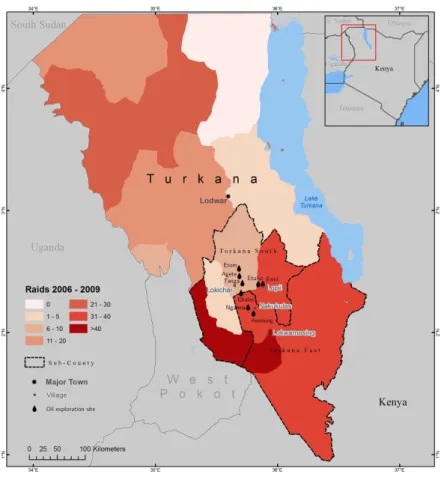
The study was carried out in the county Turkana, located in north-west Kenya (Fig. 1). Nomadic pastoralism is the main livelihood in Turkana. Water, pasture, land and livestock (mainly cattle, goats, sheep and camels) are the key resources for the population. The lack of formal education, poor health and road infrastructure, and
the limited existence of businesses (mostly concentrated in Lodwar) offer the Turkana
20
population very few opportunities in the formal job market (UNDP, 2010, 2006). Turkana has a poverty rate of 94 %. About 76 % of the population never attended a school (Kenya Open Data, 2011a, b). In their “National policy for the sustainable development of arid and semi-arid lands”, the government of Kenya (2007) acknowledges the marginalisation of Turkana and the government’s failure to integrate Turkana into the
ESDD
6, 1163–1200, 2015Oil, conflict, and climate change vulnerability of pastoral communities
in Northwest Kenya
J. Schilling et al.
Title Page
Abstract Introduction
Conclusions References
Tables Figures
◭ ◮
◭ ◮
Back Close
Full Screen / Esc
Printer-friendly Version
Interactive Discussion
Discussion
P
a
per
|
Discussion
P
a
per
|
Discussion
P
a
per
|
Discussion
P
a
per
|
national economy. Insecurity related to pastoral conflicts and violent livestock raids is widespread in Turkana (see Schilling et al., 2012b, Fig. 1 and Sect. 3.2).
The climate in Turkana is semi-arid to arid and characterised by a bi-modal rainfall pattern with “long rains” between October and December and “short rains” between March and May” (McSweeney et al., 2012). Reliable climate date is mostly available
5
for Lodwar, the county capital of Turkana. In Lodwar the annual rainfall ranges from 500 mm in particularly wet years to less than 50 mm in drought years (Schilling et al., 2014).
The average annual temperature in Lodwar is usually above 30◦C. Global climate
change is likely to lead to temperature increases and a more variable and less
10
predictable rainfall pattern in Turkana (Schilling et al., 2014; McSweeney et al., 2012). Both trends are likely to increase the drought risk. Droughts, a historically common phenomenon in Turkana have already been occurring more often in the past decades (Mude et al., 2009; Opiyo et al., 2015). In general, water is a scarce resource in Turkana. Lake Turkana is the only permanent source of water, although with a high
15
salt concentration. Apart from several smaller ephemeral rivers (called laghas), the
semi-permanent rivers Turkwel and Kerio are the only source of freshwater (see also Kenya Open Data, 2014a).
Within Turkana, the study was conducted in the Sub-Counties Turkana South and
Turkana East (Fig. 1). The counties cover an area of about 18 670 km2 and have
20
a population of about 226 000 people (Kenya Open Data, 2014b). The villages of Lopii, Nakukulas and Lokwamosing were chosen for the field research to be able to compare different levels of engagement with the oil exploration.
Lokwamosing is furthest away from any oil exploration site. At the time of the research, members of the community in Lokwamosing had only heard about oil
25
ESDD
6, 1163–1200, 2015Oil, conflict, and climate change vulnerability of pastoral communities
in Northwest Kenya
J. Schilling et al.
Title Page
Abstract Introduction
Conclusions References
Tables Figures
◭ ◮
◭ ◮
Back Close
Full Screen / Esc
Printer-friendly Version
Interactive Discussion
Discussion
P
a
per
|
Discussion
P
a
per
|
Discussion
P
a
per
|
Discussion
P
a
per
|
net oil pay were found (Tullow, 2014b). Net oil pay refers to the thickness of rock that can deliver oil to the well at a profitable rate (Tiab and Donaldson, 2012). Ngamia is located in the Lokichar Basin containing more than 600 million barrels of oil (Tullow, 2014b). All three villages fall in the oil exploration block 10BB which is held by Tullow (50 %), Africa Oil (10 %) and Lion (10 %). Tullow is the only operator while the others hold a
5
“non-operated interest” (Tullow, 2014b). Ngamia and Amosing are already in the phase
of appraisal drillings (for the different phases see Cairn, 2015; for recent updates see
Africa Oil, 2015). The recent period of low oil prices has forced Tullow to cut its global exploration and appraisal budget from USD 300 million to USD 200 million (Financial Times, 2014). Estimates of when production of oil could start in Kenya range from as
10
early as 2015 to later than 2020 (Daily Nation, 2015; Standard, 2015; Financial Times, 2015). The commercial production of oil in Kenya could reach 100 000 barrels per day (Standard, 2015). How fast Kenya will become an oil exporter will also depend on the oil pipeline, proposed to run over a distance of 850 km cutting through the country from Turkana to a maritime terminal, located at the coast of south-east Kenya (Tullow,
15
2014a).
2.2 Data collection
Data collection for this study was carried out in October 2013 and April 2014. The main research method applied was a qualitative approach based on individual interviews, small group interviews, focus group discussion and observations. In total 124 persons
20
participated in the study. Most of them were community members including women,
pastoralists, elder, youth and village chiefs. To pick up on potential gender differences,
men and women were interviewed in separate as well as in mixed groups. Each interview or focus group discussion was conducted by at least two researchers to increase objectivity. Interviews and focus group discussions were audio recorded,
25
ESDD
6, 1163–1200, 2015Oil, conflict, and climate change vulnerability of pastoral communities
in Northwest Kenya
J. Schilling et al.
Title Page
Abstract Introduction
Conclusions References
Tables Figures
◭ ◮
◭ ◮
Back Close
Full Screen / Esc
Printer-friendly Version
Interactive Discussion
Discussion
P
a
per
|
Discussion
P
a
per
|
Discussion
P
a
per
|
Discussion
P
a
per
|
of non-governmental organisations (NGO) working in the research area. For example a discussion was held with a group consisting of local NGO representatives and local businessmen working on natural resources in Turkana South.
All efforts were made to get interviews with or statements from Tullow Oil
representatives but the requests were denied. The research team spoke to a few
5
Tullow Community Liaison Officers (CLO) but these were not formal interviews from
which direct quotes could be used. The atmosphere was partly tense, especially in Nakukulas where the purpose of the research had to be explained extensively prior to the survey.
The individual and small group interviews were based on an interview guideline
10
structured along the themes of “general changes”, “worries” and “expectations/hopes”. To avoid biasing responses, terms such as “oil”, “conflict” and “climate” were only used by the researchers after respondents used them first. Further, participating and non-participating observations were conducted. These were particularly useful to assess sensitive issues such as interactions between Tullow representatives and communities
15
as well as the operations of the oil exploration itself.
The secondary research method of this study is quantitative. Data on livestock raids in Turkana, collected by the local NGO Turkana Pastoralist Development Organisation (TUPADO) was analysed using Excel (for a more detailed description of the conflict data see Schilling et al., 2012b). The data was then geo-referenced using ArcGIS, to
20
show the distribution of raids and the location of oil exploration sites within Turkana (see Fig. 1 and Sect. 3.2.2). The analysis is limited to 2006 to 2009 as the reporting was only consistent in this period.
In addition, an in-depth review of the literature on pastoralism, conflict, oil and climate change was conducted and newspaper articles and press releases by oil companies
25
ESDD
6, 1163–1200, 2015Oil, conflict, and climate change vulnerability of pastoral communities
in Northwest Kenya
J. Schilling et al.
Title Page
Abstract Introduction
Conclusions References
Tables Figures
◭ ◮
◭ ◮
Back Close
Full Screen / Esc
Printer-friendly Version
Interactive Discussion
Discussion
P
a
per
|
Discussion
P
a
per
|
Discussion
P
a
per
|
Discussion
P
a
per
|
Like every study, the present one has its limitations. The sample size is limited to three villages and the perspective of Tullow could not been captured directly. The latter could in parts be compensated by informal conversations with Tullow representatives and a review of Tullow press releases. And while three villages are not representative for Turkana as a whole, this is to the authors’ knowledge one of the first studies that
5
explores the oil-conflict-pastoralism-climate-nexus in Kenya.
2.3 Conceptual framework
The study applies a conceptual framework based on agents who each have a certain capability and motivation to pursue certain goals. This approach has been developed
by Scheffran et al. (2012) and previously applied to the Turkana-Pokot conflict (see
10
Schilling et al., 2012b). Motivation is commonly understood as the process that initiates, guides, and maintains goal-oriented behaviours. Capability is the ability to execute
a certain course of action (Scheffran et al., 2012). This relates to skills, knowledge,
experience and networks on the one hand and financial resources and physical means such as men, weapons and ammunition on the other. Each actor has the choice
15
between investing resources into a cooperative path which implies to try to work with other actors or into a conflicting path which implies pursuing aims in a forceful manner (Fig. 2).
Figure 2 shows that if one actor chooses the conflict path the other actor almost has to take this path as well to avoid disadvantages. In theory, mutual cooperation has
20
the potential to generate the highest overall benefit for all actors as no resources are wasted for destructive purposes.
To be able to apply the described framework, key terms need to be defined. Violent conflict is defined as the forceful settlement of opposing views. In contrast,
cooperation is the peaceful sharing of resources and a state in which differences are
25
ESDD
6, 1163–1200, 2015Oil, conflict, and climate change vulnerability of pastoral communities
in Northwest Kenya
J. Schilling et al.
Title Page
Abstract Introduction
Conclusions References
Tables Figures
◭ ◮
◭ ◮
Back Close
Full Screen / Esc
Printer-friendly Version
Interactive Discussion
Discussion
P
a
per
|
Discussion
P
a
per
|
Discussion
P
a
per
|
Discussion
P
a
per
|
Vulnerability, specifically the vulnerability of the communities in Lokwamosing, Lopii and Nakukulas, is commonly divided into the three elements of sensitivity, exposure
and adaptive capacity (IPCC, 2014). Sensitivity is determined by the effect of climate
change on a particular resource (for instance water), its availability and how important the resource is for a certain actor (Schilling et al., 2012a). Climate exposure is the
5
rate and extent of temperature and precipitation changes that a region is exposed to. The exposure to climate change interacts with exposure to environmental changes, for instance water pollution. It is hence important to consider the climate exposure in conjunction with the environmental exposure (see for example Schilling et al., 2013). Adaptive capacity relates to the actor’s knowledge, skills, options and assets to adapt to
10
climatic changes (IPCC, 2014). Since risk is a central term of this study, it is important to define it as well. Risk is understood as a product of the likelihood of an event to
happen and its (potential) impact (Scheffran et al., 2012).
3 Results and discussion
The result section is structured along the two research questions. In the first section
15
the effects of the oil exploration on the communities’ vulnerability to climate change are
presented. The second section addresses the risk of the oil explorations to create new conflicts or aggravate existing ones.
3.1 Oil exploration and community vulnerability
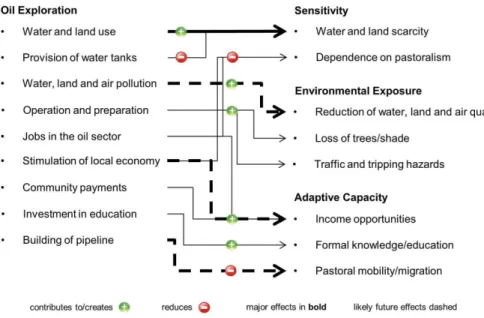
Figure 3 summarises the effects of oil exploration on the communities’ vulnerability
20
to climate and environmental change. Each element of sensitivity, environmental exposure and adaptive capacity is worded to have the same sign as the respective category. For instance, the higher the water scarcity and dependence on pastoralism,
the higher is the sensitivity. Major current and future effects are shown in bold. Land
and especially water use are the issues contributing most to community vulnerability.
ESDD
6, 1163–1200, 2015Oil, conflict, and climate change vulnerability of pastoral communities
in Northwest Kenya
J. Schilling et al.
Title Page
Abstract Introduction
Conclusions References
Tables Figures
◭ ◮
◭ ◮
Back Close
Full Screen / Esc
Printer-friendly Version
Interactive Discussion
Discussion
P
a
per
|
Discussion
P
a
per
|
Discussion
P
a
per
|
Discussion
P
a
per
|
In the future, the issues of water extraction, pollution and soil degradation are likely to become more prominent. Elements of the adaptive capacity of the communities are likely to have improved due to Tullow’s payments to the communities and investments into education. In the future, there is a risk that the pipeline between the extraction site and the refinery will disrupt migration routes of the Turkana and other pastoral groups
5
in the area. Overall, the oil exploration and particularly the oil exploitation are likely to make the communities more vulnerable to climate change. The following sections describe each element of vulnerability in more detail.
3.1.1 Sensitivity
Water and land (including pasture) are already scarce resources in Turkana. Oil
10
exploration and exploitation aggravates water scarcity as significant amounts of groundwater are needed in every step (including drilling, injection, completion, and fracturing) (Allen et al., 2011). Studies for Canada for instance show that about three barrels of water are needed to extract one barrel of oil (Ptacek et al., 2004). Tullow aims to produce 100 000 barrels of oil per day in Kenya and mainly in Turkana (Standard,
15
2015). This will likely be felt in the mid to long run while in the short run Tullow has improved the communal access to water through the installation of water tanks along the main road and in Nakukulas and Lopii. Community members reported that these tanks are filled by Tullow with water trucks.
Further, the extraction of oil in Turkana has the potential to offer some direct
20
employment opportunities with Tullow and stimulation for the local economy, for example in the nearby town Lokichar. Both could to a certain extent decrease the communities’ dependence on pastoralism and hence make it less sensitive to climatic
and environmental changes (Fig. 3). However, given that the effect of oil extraction
on local employment is limited (see Sect. 3.2.1), the importance of water for pastoral
25
ESDD
6, 1163–1200, 2015Oil, conflict, and climate change vulnerability of pastoral communities
in Northwest Kenya
J. Schilling et al.
Title Page
Abstract Introduction
Conclusions References
Tables Figures
◭ ◮
◭ ◮
Back Close
Full Screen / Esc
Printer-friendly Version
Interactive Discussion
Discussion
P
a
per
|
Discussion
P
a
per
|
Discussion
P
a
per
|
Discussion
P
a
per
|
3.1.2 Exposure
Globally the burning of fossil fuels, including oil, is a major driver of climate change (Armaroli and Balzani, 2011). But the oil exploration in Turkana, at least so far, increases the climate exposure for the pastoral communities to a negligible extent. However, the oil exploration in Turkana exposes the communities to environmental
5
changes which in turn interact with changes in temperature and rainfall. Exposure to pollution of water, land and air is a major concern (Fig. 3). It has been known for a long time that oil spills on land can “pose long term threats to groundwater
quality” (Duffy et al., 1980). Studies conducted in Nigeria show that oil extraction can
have detrimental effects on the environment and local populations, especially where
10
environmental regulations are lacking or are not enforced, like in Kenya (for Nigeria see Linden and Palsson, 2013; Iwegbue, 2007; Orisakwe, 2009). Apart from the risk of contamination of drinking water (Owamah et al., 2013), for example by so called non-aqueous phase liquids (NAPL), there is the possibility of inter-aquifer leakage. This term describes the process in which pumping causes (contaminated) ground water
15
from another aquifer to enter the one being pumped (EPA, 1993). While the pollution of aquifers by oil is an environmental risk, it is beyond this study to assess this issue in detail. The respondents did not mention the pollution of water, possibly because they are not noticeable yet as the exploration in Turkana has only started in 2012. In addition to water, land could be polluted for instance by the dumping of oil wastes
20
without proper sealing and treatment (Khaitan et al., 2006; da Silva et al., 2013). But again, the pollution of land did not feature strongly in the responses of the communities. The community members reported several smaller changes in their environment related to the oil operation and preparation for it. Pastoralists from Lopii and Nakukulas mentioned that the noise and vibrations caused by the drilling disturb and scare the
25
ESDD
6, 1163–1200, 2015Oil, conflict, and climate change vulnerability of pastoral communities
in Northwest Kenya
J. Schilling et al.
Title Page
Abstract Introduction
Conclusions References
Tables Figures
◭ ◮
◭ ◮
Back Close
Full Screen / Esc
Printer-friendly Version
Interactive Discussion
Discussion
P
a
per
|
Discussion
P
a
per
|
Discussion
P
a
per
|
Discussion
P
a
per
|
As they are often hidden by bushes, it is plausible that pastoralists see the wires as a tripping hazard for them and their livestock. Another reported change in the environment is black smoke coming from the oil extraction sites. Several community members in Nakukulas stated that they were afraid of the smoke since they were not used to it. And while the Turkana are used to cars, a few pastoralist reported that more
5
livestock is injured or killed in road accidents. Indeed, the increased traffic with jeeps, trucks and movement of heavy machinery related to the oil exploration was noticeable. Several pastoralists from Nakukulas complained that Tullow had cut down several trees and therefore shade was lacking to protect livestock from the heat.
3.1.3 Adaptive capacity
10
The adaptive capacity is mainly determined by the knowledge, skills, resources and options the pastoralists have. A key adaptation strategy to lack of water and pasture is migration (Schilling et al., 2014). Some pastoralists claimed that the oil exploration sites have altered their migration routes but the extent seems to be limited. This is likely to change when the extraction sites are connected to the refinery through a pipeline
15
(see Tullow, 2014a for the route of the pipeline). The degree of disruption caused by the pipeline will depend on how much of the pipeline will run underground. According to Tullow (2014a) this will “mostly” be the case.
The research team observed envelopes being handed out by Tullow representatives to several community members in Lopii who reported that Tullow has been handing
20
out cash to the community. While this has other implications (see Sect. 3.2), the availability of financial resources generally increases the adaptive capacity of community members. Employment and stimulation of the local economy related to
the oil extraction in Turkana offer further income opportunities. However, the low level
of formal education is a disadvantage of the communities. Tullow has made efforts
25
ESDD
6, 1163–1200, 2015Oil, conflict, and climate change vulnerability of pastoral communities
in Northwest Kenya
J. Schilling et al.
Title Page
Abstract Introduction
Conclusions References
Tables Figures
◭ ◮
◭ ◮
Back Close
Full Screen / Esc
Printer-friendly Version
Interactive Discussion
Discussion
P
a
per
|
Discussion
P
a
per
|
Discussion
P
a
per
|
Discussion
P
a
per
|
local primary school. In addition, the company has given scholarships to a few students to attend secondary school.
Improvements of infrastructure can also be related to Tullow’s presence and it has brought better transport links. Existing roads have been improved, new ones have been built, and the local airstrip has been rehabilitated. However, most roads only
5
connect Tullow sites to the major road. And the airstrip is only used by the oil company
and government officials. Despite this, the assistant chief of Nakukulas acknowledged
that this provision of services was never the less more than the government was offering, and better than nothing: “If it was left to me, I couldn’t have brought this much development to my village”.
10
3.2 Oil and conflict risk
This section discusses the conflict risk associated with the oil exploration. Both dimensions of community–company and intercommunal conflict are addressed.
3.2.1 Community–company conflict
The communal perceptions of oil extraction and Tullow range from cautiously hopeful to
15
hostile. In Lokwamosing and Lopii community members have hopes and fears when it comes to and the impacts of oil. Some hope for jobs, water and education while others, like the chief of Lokwamosing, have heard “where there is oil, there are conflicts”. In Nakukulas, this is already the case. Tullow is increasingly viewed as a stressor or even an enemy. One woman describes the situation as being caught between two enemies:
20
“on one side is the enemy [Pokot] and on the other is the oil company.” The conflict between the community in Nakukulas and Tullow has resulted in community road
blocks which disrupted the traffic from and to Tullow sites. The road blocks are usually
resolved in exchange for water to the community and under heavy presence of security personal. The security personal consists of Kenya’s administration police, KPRs (Kenya
25
ESDD
6, 1163–1200, 2015Oil, conflict, and climate change vulnerability of pastoral communities
in Northwest Kenya
J. Schilling et al.
Title Page
Abstract Introduction
Conclusions References
Tables Figures
◭ ◮
◭ ◮
Back Close
Full Screen / Esc
Printer-friendly Version
Interactive Discussion
Discussion
P
a
per
|
Discussion
P
a
per
|
Discussion
P
a
per
|
Discussion
P
a
per
|
team of this study was also held up in a community road block which was resolved without violence after about half an hour. Community members in Nakukulas also
reported that “some Turkana” had “chased away” workers who were trying to fence off
an area. Several participants of a gender-mixed focus group discussion in Nakukulas mentioned that they have “seen people” destroying the wires that Tullow installed. The
5
majority of participants in the focus group discussion supported this action. Especially in comparison to the other two research location, the atmosphere at the time of the research visits was tense. During the first research phase in October 2013 it took
the local research assistants some efforts to explain the purpose of the research and
that the visitors are not associated with Tullow before the community would speak to
10
the research team. Without being asked for it the community members in Nakukulas started talking about Tullow and oil which were the dominant topics. During the second research phase, the research team only interviewed the chief of Nakukulas because the aggravation of the community had reached a level which did not allow further interviews on this heated topic. Between the two research trips the level of violence
15
between Nakukulas and Tullow had escalated. Newspapers reported of community demonstrations and storming of an oil site, including lootings and destruction of property (Nation, 2013). Tullow had to hold operations for several weeks because of the fragile security situation (Standard, 2013).
The causes of the community anger towards Tullow are less driven by the
20
externalities of the oil exploitation but rather by the unmet expectations that the communities have for Tullow.
The expectations have to be understood against a wider background. There is a strong perception within the three communities and among pastoral groups in Turkana in general that they have been “forgotten” by the central government who does
25
ESDD
6, 1163–1200, 2015Oil, conflict, and climate change vulnerability of pastoral communities
in Northwest Kenya
J. Schilling et al.
Title Page
Abstract Introduction
Conclusions References
Tables Figures
◭ ◮
◭ ◮
Back Close
Full Screen / Esc
Printer-friendly Version
Interactive Discussion
Discussion
P
a
per
|
Discussion
P
a
per
|
Discussion
P
a
per
|
Discussion
P
a
per
|
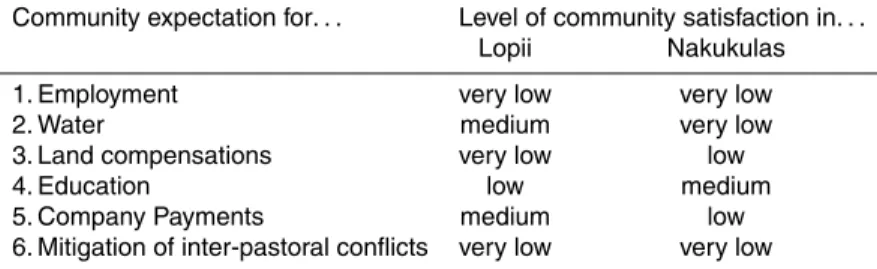
building roads and drilling for water that the communities were unable to access. Table 1 shows the expectations of the communities in Lopii and Nakukulas (ranked by their importance) and how well they are met according to the communities.
By far, the most important issue was employment. “We want Tullow to give us jobs”, was a recurring expectation articulated by community members in both Lopii and
5
Lokwamosing. In Nakukulas this expectation has already been disappointed.
According to the county government act, 70 % jobs from Tullow are meant for local Turkana and 30 % for others. However this allocation is not being met. Community members themselves acknowledge that the locals are not qualified. They suggested
that Tullow could offer apprenticeships to train them. Several respondents felt they
10
are stereotyped as a community as being illiterate and ignorant pastoralists. The
highest position a Turkana has at Tullow is Community Liaison Officer, there are no
Turkana in management positions, and the best job a young Turkana man can get is a security guard (earning about KES 18 000 (Kenyan Shilling) or USD 190 per month). According to villagers, Tullow even flies in drivers from Nairobi. This is a source of
15
major resentment: “Employment from Tullow goes to people from Kitale. Leadership is not proactive to help us get work. They say we are not learned to get jobs, that we have not been to school. We don’t know what kind of school these people in Kitale have! If we are not learned, can we not be given causal jobs?” If things do not change, community members saw that conflict was inevitable. “We can only see a tense future
20
with Tullow unless the government can do something good for us that will let us forget our precious treasure that have been taken from us.”
Tullow has not released any recent numbers on employment and the company was not available for any interviews. In October 2013, a press release by Tullow claimed that “Tullow employs over 800 people from the Turkana region out of the 1400
25
people currently employed on Tullow’s Kenyan operations” (2013b). There are several newspaper reports and websites citing a more recent Tullow statement that “as at the
end of August 2014, 2187 out of the 3619 staffemployed by Tullow and its contractors
ESDD
6, 1163–1200, 2015Oil, conflict, and climate change vulnerability of pastoral communities
in Northwest Kenya
J. Schilling et al.
Title Page
Abstract Introduction
Conclusions References
Tables Figures
◭ ◮
◭ ◮
Back Close
Full Screen / Esc
Printer-friendly Version
Interactive Discussion
Discussion
P
a
per
|
Discussion
P
a
per
|
Discussion
P
a
per
|
Discussion
P
a
per
|
not available (anymore) on the Tullow website and it needs to be questioned whether the numbers are realistic, at least for the research area. According to the chiefs and community members in Nakukulas and Lopii, the direct employment of Turkana in the oil sector has been minimal. Numbers between four and fifteen were given. Community members stated that the highest position a Turkana has at Tullow is Community Liaison
5
Officer (CLO). The CLOs are the main communication channel between Tullow and the
communities. On the one hand the CLOs are supposed to listen to the communities’ needs, concerns and complaints and to feed them back to Tullow. On the other hand CLOs should inform the communities about the company’s actions and plans. Another position mentioned was security guard. In the capital rather than labour intensive oil
10
industry the demand for unskilled labour is low.
Water is the next critical conflict issue. The three communities expect Tullow to give them water. To a limited extent, Tullow is doing this; drilling boreholes, setting up water tanks and filling them, according to an informal interview with a CLO, “on a regular basis”. In addition, water points with pumps are set up in communities. However, the
15
members of the Nakukulas community reported that Tullow only started to share the pumped water after on-going and vocal complaints from the community. Further, Tullow is unlikely to meet the communities’ expectations for water. One elder in Nakukulas stated that “we have only very small positive changes from Tullow since 2011. The water pump they gave us is not enough as it serves both livestock and community – one
20
water source can not support everyone.” Asked about the reasons for the community road blocks and attacks on Tullow, most interviewees responded “jobs” and “water”. The latter is likely to become more prominent in the future when almost inevitable high usage and pollution of groundwater will become noticeable.
Land is the third critical conflict driver. Traditionally Turkana is communal land which
25
ESDD
6, 1163–1200, 2015Oil, conflict, and climate change vulnerability of pastoral communities
in Northwest Kenya
J. Schilling et al.
Title Page
Abstract Introduction
Conclusions References
Tables Figures
◭ ◮
◭ ◮
Back Close
Full Screen / Esc
Printer-friendly Version
Interactive Discussion
Discussion
P
a
per
|
Discussion
P
a
per
|
Discussion
P
a
per
|
Discussion
P
a
per
|
of taken land. One woman from Nakukulas states “of our two enemies [Pokot and Tullow], we fear the Pokot the most. Tullow will only take our land, but the Pokot will take everything and kill us.” Several community members mentioned that Nakukulas has received some compensation from Tullow. One elder named an amount of KES 2.2
million (USD 24 000). In Lopii the research team observed Tullow distributing one-off
5
cash payments to households. The immediate response in the community was very positive. “Today is like a festival” stated one woman. But the payments are likely to further increase community expectations for more payments, especially because the
compensations for the lost resources are seen as insufficient. The following statement
from Nakukulas summarises the view on compensations. “[These] are good but too
10
small to address the negative impacts of the companies. They are not enough for us. We cannot consider the small gestures as compensation for the amount of land and animals they have taken from us.” Another elder added, “our main concern is the land they [Tullow] have taken from us.” The communities have not received any compensation from the Kenyan government. Once the actual exploitation of the oil
15
reserves starts (see Sect. 2.1), the Kenyan constitution demands that the profits are shared between the national government receiving 70 %, the county government receiving 20 and 10 % are meant to directly go to the local communities (Republic of Kenya, 2010). The issue of revenue sharing is already causing disagreements between the different levels of government (Star, 2012).
20
The demand for education was less of a conflict driver in Lopii and Nakukulas,
although still present. Tullow has made efforts to improve the level of education in
Turkana. According to Tullow 100 (out of 11 000) applicants were selected for the 2013/14 scholarship program which supports postgraduate degrees, technical trainings and vocational studies (Tullow, 2013a, b). In Nakukulas the company has built two new
25
classrooms, bought textbooks and gave a few students scholarship.
ESDD
6, 1163–1200, 2015Oil, conflict, and climate change vulnerability of pastoral communities
in Northwest Kenya
J. Schilling et al.
Title Page
Abstract Introduction
Conclusions References
Tables Figures
◭ ◮
◭ ◮
Back Close
Full Screen / Esc
Printer-friendly Version
Interactive Discussion
Discussion
P
a
per
|
Discussion
P
a
per
|
Discussion
P
a
per
|
Discussion
P
a
per
|
conflict between Turkana and Pokot. Pokot always come and raid us. Tullow does not even want to mitigate or to respond” (see also Sect. 3.2.2).
The conceptual framework, developed under Sect. 2.3, is useful in understanding the interactions between the communities and Tullow. The communities in Lopii and especially Lokwamosing had not interacted with Tullow much. But in Nakukulas
5
a motivation to choose a conflicting path with Tullow could be observed. In the first research phase the assistant chief of Nakukulas explained that if community members have a complaint, for example over the cutting of trees, an animal hit by a Tullow vehicle, or about a water issue, the elders come together to talk to the village chief, who then takes the issue to the district commissioner and finally to Tullow. The majority
10
of respondents expressed dissatisfaction with this very indirect way and the response
to some of the complaints. CLOs offer a more direct way of communication but Tullow
had stopped sending CLOs to Nakukulas, likely because of the tense security situation associated with a series of community road blocks and an attack on an oil site. This shows that after the Nakukulas community had chosen a conflicting path, Tullow
15
refrained from investing into a cooperative path (Fig. 2). This in turn is negatively perceived by the community. The assistant chief states; “the CLOs used to come to talk to and even stay with community to try to understand their views before extraction started but [they] stopped coming last year [2013]”. “Tullow is like a rock. It does not listen”, stated one elder. The broken communication with Tullow is likely to increase the
20
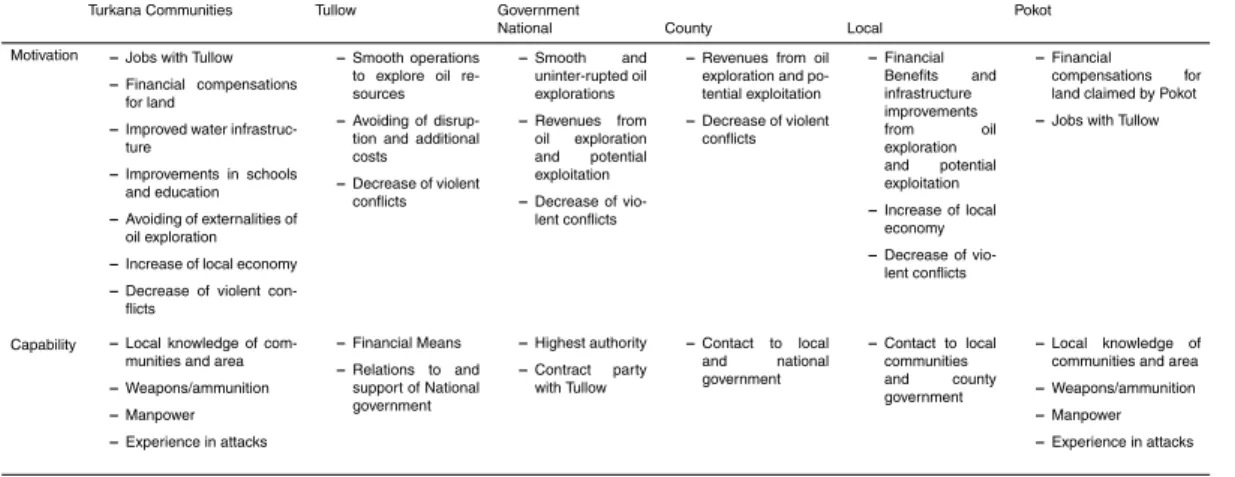
risk of community members resorting to force to achieve their aims. Table 2 lists the main actors and their motivation and capability.
A long history of violent conflicts with other groups has provided the Turkana communities in the research area with the skills, knowledge and arms to execute violent attacks. Tullow is motivated to ensure smooth operations. The company has
25
the financial means to set up its own security forces but these imply costs, especially when conflicts are escalating.
ESDD
6, 1163–1200, 2015Oil, conflict, and climate change vulnerability of pastoral communities
in Northwest Kenya
J. Schilling et al.
Title Page
Abstract Introduction
Conclusions References
Tables Figures
◭ ◮
◭ ◮
Back Close
Full Screen / Esc
Printer-friendly Version
Interactive Discussion
Discussion
P
a
per
|
Discussion
P
a
per
|
Discussion
P
a
per
|
Discussion
P
a
per
|
the oil profits do not trickle down through the different levels of government to the local communities, especially because corruption (rank 145 of 175 countries) and patronage along political and ethnic lines is already a widespread problem in Kenya (Transparency International, 2014; Carrier and Kochore, 2014). The member of parliament, Lomenen notes: “Oil is not the problem – it is how it is done that is the issue.” The local
5
government, mainly represented by the village chiefs, is in a difficult position. On the
one hand, the chiefs have to follow the national direction and support the oil exploration.
On the other hand, they understand their communities’ frustration with the effects
caused by oil exploration.
The assistant chief of Nakukulas warns that “if Tullow will not work hand in hand with
10
the community and administration, the direction will be very, very hard for them.” An elder concluded “we do not see a positive future relationship with Tullow”. Against this background, the risk of an escalation of conflict between the community of Nakukulas and Tullow is significant. Lopii and Lokwamosing could follow that path. In addition, the exploration of oil has implications for intercommunal conflicts in the region.
15
3.2.2 Intercommunal conflict and oil
The research area is heavily affected by intercommunal conflicts and raids (see Fig. 1
in Sect. 2.1). Between 2006 and 2009 the average number of 71 raids per year (six raids per month) reflects the high level of insecurity expressed by the interviewees. On average two people died per raid over the four years considered (TUPADO, 2011).
20
The highest intensity of raiding is found in the border region between the Turkana and Pokot (Fig. 1). Lokwamosing is part of this raiding hotspot while Nakukulas and Lopii fall within the second highest raid category. The distribution of raids across Turkana shows a similar pattern to the one identified by Ember et al. (2012), with two differences. First, according to the TUPADO conflict records no raids occurred in the northeast part of
25
ESDD
6, 1163–1200, 2015Oil, conflict, and climate change vulnerability of pastoral communities
in Northwest Kenya
J. Schilling et al.
Title Page
Abstract Introduction
Conclusions References
Tables Figures
◭ ◮
◭ ◮
Back Close
Full Screen / Esc
Printer-friendly Version
Interactive Discussion
Discussion
P
a
per
|
Discussion
P
a
per
|
Discussion
P
a
per
|
Discussion
P
a
per
|
than 40 raids while Ember et al. (2012) find none to a maximum of ten raids in the same areas.
Tullow has dealt with this high level of insecurity by recruiting KPR, from the wider region to protect their oil sites and transportation routes. KPRs are community members who are a given a gun, some ammunition, a uniform and some allowance by
5
the government of Kenya to protect their community (Schilling et al., 2012b). A member
of parliament stated in an interview that 1000 KPR officers have been assigned to guard
oil operations. Tullow informally gave a much smaller figure of 200. Regardless of the exact number, members of all three research locations have indicated that on the one hand, the increased presence of KPRs has improved the security situation where the oil
10
exploitation is taking place. Several community members, for example in Lokwamosing reported that the raiding of the Pokot has decreased. “The home guards are patrolling” notes one community member. On the other hand, security in other areas such as the raiding hotspots along the Turkana–Pokot border was reported to have increased due to a lack of KPRs.
15
In addition, to affecting the distribution of security forces in the region, there is
a concern that oil is increasing the value of land and hence the Pokot’s interest in it (Table 2). Disputed territory is already a driver of the Turkana–Pokot conflict (Schilling et al., 2012b). To what extent oil exploration will affect land rights and prices is however too early to say. But the oil exploration could further weaken the already weak
20
social contract between the pastoral communities and the central government. A few community members in Nakukulas blamed the government in Nairobi for the situation with Tullow. One woman summarised “we don’t know fully of the oil company’s benefits to us. Maybe it will be of benefit to our children. But now we have no power to change anything. This is something that the government has brought to us.”
25
ESDD
6, 1163–1200, 2015Oil, conflict, and climate change vulnerability of pastoral communities
in Northwest Kenya
J. Schilling et al.
Title Page
Abstract Introduction
Conclusions References
Tables Figures
◭ ◮
◭ ◮
Back Close
Full Screen / Esc
Printer-friendly Version
Interactive Discussion
Discussion
P
a
per
|
Discussion
P
a
per
|
Discussion
P
a
per
|
Discussion
P
a
per
|
versa. However, the community interviews in Nakukulas, Lopii and Lokwamosing gave little evidence for strong grievances over employment among communities in Turkana.
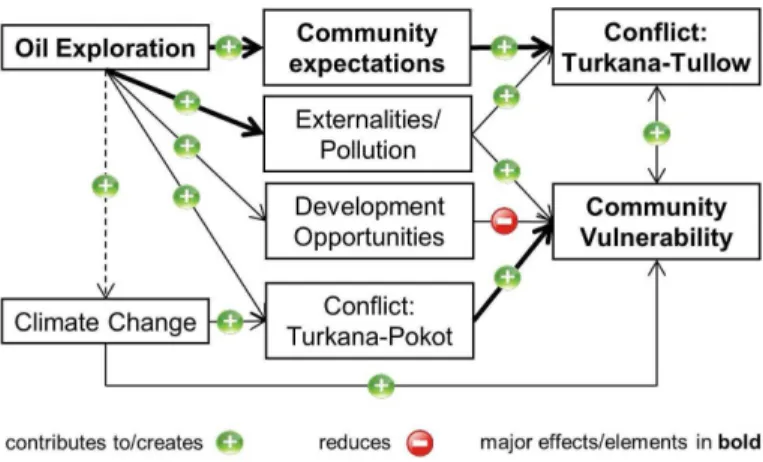
3.3 Synthesis of oil, conflict, vulnerability, and climate change
Figure 4 combines the results of Sects. 3.1 and 3.2 to place them into context of the big picture. The oil exploration creates high expectations among the communities
5
for employment, water provision and general development (education, infrastructure, financial benefits). In the communities’ perception the expectations are not met which in turn can be seen as the major driver for the conflicts between the communities and Tullow. It is possible that the longer the community expectations are not met, the stronger this conflict driver will be come.
10
Oil exploration (and later exploitation) needs significant amounts of groundwater which the communities depend on. Other externalities (loss of land, disturbance of livestock, and disruption of migration routes) and pollution of water and soil will likely become a source of conflict but at the time of the research these externalities were less noticeable (hence a thinner line between externalities and conflict). The pollution
15
and externalities associated with oil contribute to the communities’ vulnerability through an increase of their exposure to environmental changes (reduction and degradation of water and land resources, loss of trees) and a potential reduction of their adaptive capacity through limitation of mobility (especially once the pipeline is built).
But the oil exploration can also improve the communities’ adaptive capacity and
20
hence reduce vulnerability through offering of development opportunities (Fig. 4). Direct
employment with Tullow and indirect income opportunities related to the growth of local hubs such as Lokichar (Fig. 1) can strengthen the adaptive capacity of communities while reducing their dependence on pastoralism and therefore their sensitivity to climatic changes.
25
There were indications that oil exploration affects the Turkana–Pokot conflict through
ESDD
6, 1163–1200, 2015Oil, conflict, and climate change vulnerability of pastoral communities
in Northwest Kenya
J. Schilling et al.
Title Page
Abstract Introduction
Conclusions References
Tables Figures
◭ ◮
◭ ◮
Back Close
Full Screen / Esc
Printer-friendly Version
Interactive Discussion
Discussion
P
a
per
|
Discussion
P
a
per
|
Discussion
P
a
per
|
Discussion
P
a
per
|
The oil exploration and especially the exploitation later on will produce greenhouse gases which in turn drive climate change (left side of Fig. 4). But in the context of global emissions this has a marginal effect for the local situation (hence a dashed line). However, previous studies have shown that climate change aggravates the existing
conflicts between the Turkana and Pokot (Scheffran et al., 2014; Omolo, 2010; Schilling
5
et al., 2014; Ide et al., 2014). The conflicts in turn contribute strongly to community vulnerability because they lead to loss of human lives and livestock, spread insecurity and result in inefficient use of pasture (Schilling et al., 2012b). Positive mutual feedback between community–company conflict and vulnerability indicates that a vicious cycle
or a “spiral of violence” (Scheffran et al., 2014) could start or escalate. Vulnerability
10
increases the risk that communities resort to violence and conflicts while these in turn contribute to vulnerability.
Overall, the identified conflict risk is in line with a previous study. However Johannes et al. (2014) place a stronger emphasis on land as a key conflict driver while the present study suggest that the conflicts between the communities and Tullow are mostly driven
15
by disappointed community expectation for water and employment.
4 Conclusions
The communities in Turkana South face significant challenges of violent intercommunal conflict, climate change and political and economic marginalisation. Now oil enters the scene. The current extraction and later exploitation of oil brings new economic
20
opportunities and infrastructure improvements to Turkana. Both are likely to reduce the vulnerability of communities to climate change. However, significant water usage and pollution of soil and water related to the oil extraction are likely to exceed these
effects. So far the externalities of the oil exploration are much less of a driver of
the conflicts between the community in Nakukulas and Tullow as compared to the
25
ESDD
6, 1163–1200, 2015Oil, conflict, and climate change vulnerability of pastoral communities
in Northwest Kenya
J. Schilling et al.
Title Page
Abstract Introduction
Conclusions References
Tables Figures
◭ ◮
◭ ◮
Back Close
Full Screen / Esc
Printer-friendly Version
Interactive Discussion
Discussion
P
a
per
|
Discussion
P
a
per
|
Discussion
P
a
per
|
Discussion
P
a
per
|
Now the communities see a new potent actor entering the region who has the capability to drill for water, build roads and accumulate security personal. This has let the communities to transfer their expectations for development and security away from the government of Kenya onto Tullow. It is however not the company’s responsibility to compensate government failure. However, Tullow is facing these expectations whether
5
they are justified or not. Tullow has responded with some provision of water, financial compensations and education resources but there is still a strong feeling among the communities that they only experience the externalities of the “oil rush” while others, outside of Turkana get the jobs, revenues and prosperity. Unmet community expectations, especially for employment and provision of water have resulted in
10
community road blocks, destruction of company property and attacks on oil sites. To prevent a further escalation of violence which will be detrimental to all parties involved,
significant changes are needed driven by different actors.
The national government has to use the revenues generated through the selling of oil exploration licences and taxes from exploitation to finally compensate its failure
15
in Turkana. This implies significant investments into education, health services and transport infrastructure. But most importantly the issue of insecurity and violent conflict needs to be addressed through intercommunal peace meetings, especially between the Turkana and Pokot. Further the governments need to ensure that the expected oil revenues are shared as stated in the constitution. Particularly the local
20
communities need to benefit based on a transparent process. The issue of land has to be addressed to prevent the communities from losing their land without proper compensation. Strong environmental regulations and especially their enforcement are needed to prevent oil pollution of water and soil. The county and local government need
to offer communication channels for local communities to enable them to express their
25
concerns and requests in a more effective and direct way.
Tullow and any oil company operating in Turkana are well advised to closely communicate with the local communities to inform them about the operations, get
ESDD
6, 1163–1200, 2015Oil, conflict, and climate change vulnerability of pastoral communities
in Northwest Kenya
J. Schilling et al.
Title Page
Abstract Introduction
Conclusions References
Tables Figures
◭ ◮
◭ ◮
Back Close
Full Screen / Esc
Printer-friendly Version
Interactive Discussion
Discussion
P
a
per
|
Discussion
P
a
per
|
Discussion
P
a
per
|
Discussion
P
a
per
|
(CLOs) are a promising approach. While it has to be acknowledged that the demand for unskilled labour in the oil industry is limited, integration of Turkana into the company’s workforce will be a positive sign for the communities. To be able to increase the
share of Turkana employees, it is important to offer trainings in which community
members can acquire skills needed in the oil industry. Tullow should ensure that risks of
5
environmental pollution are minimised. Water needs to be shared with the community in a way that is reliable and transparent but also sustainable.
The communities need to reduce their expectations for employment at Tullow and redirect their legitimate demands for development and security back to the government of Kenya. Frustration with Tullow should be expressed in a non-violent manner, for
10
example through the chiefs or CLOs. If every actor, particularly the government of Kenya and Tullow, takes these recommendations seriously, then there is a real chance that Turkana and Kenya overall can benefit from the oil. Unfortunately, the more likely scenario is that oil will exacerbate the existing marginalised and discrimination of pastoral communities which in return is likely to fuel more conflict.
15
Acknowledgements. The authors dedicate this publication to their dear friend Beth Njeri Njiru who has passed away so early and unexpectedly. The authors thank the communities of Lokwamosing, Lopii and Nakukulas, and every person who volunteered information for this study. The authors appreciate the helpful comments of the reviewers. The field research was made possible by International Alert. The overall work is supported through the Cluster
20
of Excellence “Integrated Climate System Analysis and Prediction – CliSAP”, Universität Hamburg, funded by the German Science Foundation (DFG).
References
Aghalino, S. O.: Oil exploitation and the accentuation of intergroup conflicts in the Niger Delta, Nigeria, Journal of Human Ecology, 28, 153–159, 2009.
25
ESDD
6, 1163–1200, 2015Oil, conflict, and climate change vulnerability of pastoral communities
in Northwest Kenya
J. Schilling et al.
Title Page
Abstract Introduction
Conclusions References
Tables Figures
◭ ◮
◭ ◮
Back Close
Full Screen / Esc
Printer-friendly Version
Interactive Discussion
Discussion
P
a
per
|
Discussion
P
a
per
|
Discussion
P
a
per
|
Discussion
P
a
per
|
Amundsen, I.: Drowning in oil Angola’s institutions and the “resource curse”, Comp. Polit., 46, 169–189, 2014.
Anderson, D. M. and Browne, A. J.: The politics of oil in Eastern Africa, J. East. Afr. Stud., 5, 369–410, doi:10.1080/17531055.2011.573187, 2011.
Anifowose, B., Lawler, D. M., van der Horst, D., and Chapman, L.: Attacks on oil transport
5
pipelines in Nigeria: a quantitative exploration and possible explanation of observed patterns, Appl. Geogr., 32, 636–651, doi:10.1016/j.apgeog.2011.07.012, 2012.
Armaroli, N., and Balzani, V.: The legacy of fossil fuels, Chem.-Asian J., 6, 768–784, doi:10.1002/asia.201000797, 2011.
Business Daily: Turkana Locals Take Lion’s Share of Tullow Jobs, available at:
10
http://www.businessdailyafrica.com/Turkana-locals-take-lion-s-share-of-Tullow-jobs/-/ 539552/2469114/-/4fynp0/-/index.html, last access: 29 June 2015, 2014.
Cairn: Oil and gas exploration and production life cycle, available at: http://www.cairnenergy. com/index.asp?pageid=554, (last access: 1 April 2015), 2015.
Carrier, N. and Kochore, H. H.: Navigating ethnicity and electoral politics in
north-15
ern Kenya: the case of the 2013 election, J. East. Afr. Stud., 8, 135–152, doi:10.1080/17531055.2013.871181, 2014.
CEWARN: CEWARN Country Updates: September–December 2009, CEWARN (Conflict Early Warning and Response Mechanism), Addis Ababa, 2010.
Chavunduka, C. and Bromley, D.: Climate, carbon, civil war and flexible boundaries: Sudan’s
20
contested landscape, Land Use Policy, 28, 907–916, 2011.
da Silva, L. Jordao, Oliveira, F. J. S., and Pessoa de Franca, F.: Oil waste management through large scale landfarming: a case study, International Journal of Environment and Waste Management, 11, 233–243, 2013.
Daily Monitor: President Kibaki says country discovers oil in remote northern region, available
25
at: http://www.monitor.co.ug/News/National/-/688334/1373938/-/awqni5z/-/index.html, last access: 29 June 2015, 2012.
Daily Nation: Tullow to slash budget for oil search in Kenya, available at: http: //www.nation.co.ke/business/Tullow-to-slash-budget-for-oil-search-in-Kenya/-/996/
2620918/-/b13udqz/-/index.html, (last access: 1 April 2015), 2015.
30