Development of an Accelerometer-Linked
Online Intervention System to Promote
Physical Activity in Adolescents
Nicole Guthrie1, Andrew Bradlyn2, Sharon K. Thompson3, Sophia Yen4, Jana Haritatos1, Fred Dillon1, Steve W. Cole1*
1HopeLab Foundation, Redwood City, California, United States of America,2West Virginia University, Morgantown, West Virginia, United States of America,3Santech Inc., La Jolla, California, United States of America,4Department of Pediatrics, Division of Adolescent Medicine, Stanford Medical School, Stanford, California, United States of America
Abstract
Most adolescents do not achieve the recommended levels of moderate-to-vigorous physical activity (MVPA), placing them at increased risk for a diverse array of chronic diseases in adulthood. There is a great need for scalable and effective interventions that can increase MVPA in adolescents. Here we report the results of a measurement validation study and a preliminary proof-of-concept experiment testing the impact of Zamzee, an accelerometer-linked online intervention system that combines proximal performance feedback and incen-tive motivation features to promote MVPA. In a calibration study that parametrically varied levels of physical activity in 31 12-14 year-old children, the Zamzee activity meter was shown to provide a valid measure of MVPA (sensitivity in detecting MVPA = 85.9%, speci-ficity = 97.5%, and r = .94 correspondence with the benchmark RT3 accelerometer system; all p<.0001). In a subsequent randomized controlled multi-site experiment involving 182
middle school-aged children assessed for MVPA over 6 wks, intent-to-treat analyses found that those who received access to the Zamzee intervention had average MVPA levels 54% greater than those of a passive control group (p<0.0001) and 68% greater than those of an active control group that received access to a commercially available active videogame (p<.0001). Zamzee’s effects on MVPA did not diminish significantly over the course of the 6-wk study period, and were statistically significant in both females and males, and in nor-mal- vs. high-BMI subgroups. These results provide promising initial indications that com-bining the Zamzee activity meter with online proximal performance feedback and incentive motivation features can positively impact MVPA levels in adolescents.
Introduction
Sub-optimal physical activity in youth has been identified as a major public health challenge [1–3]. Recent estimates indicate that only 6–8% of U.S. adolescents achieve the
CDC-a11111
OPEN ACCESS
Citation:Guthrie N, Bradlyn A, Thompson SK, Yen S, Haritatos J, Dillon F, et al. (2015) Development of an Accelerometer-Linked Online Intervention System to Promote Physical Activity in Adolescents. PLoS ONE 10(5): e0128639. doi:10.1371/journal. pone.0128639
Academic Editor:Marc A Adams, Arizona State University, UNITED STATES
Received:February 4, 2014
Accepted:April 30, 2015
Published:May 26, 2015
Copyright:© 2015 Guthrie et al. This is an open access article distributed under the terms of the
Creative Commons Attribution License, which permits unrestricted use, distribution, and reproduction in any medium, provided the original author and source are credited.
recommended 60 min of moderate to vigorous physical activity (MVPA) per day [4]. U.S.
chil-dren’s MVPA levels decline with age, showing a particularly steep drop during middle school
years [5,6]. Given the association between low MVPA in adolescents and subsequent low
MVPA in adulthood [7–9] and associated elevations in risk for a diverse array of adult chronic
illnesses [10–12], there is a great need for effective and efficiently scalable interventions to
in-crease MVPA in middle-school aged children.
Existing interventions to increase physical activity in adolescents range from curriculum-based programs to the use of active video games (i.e., games in which physical movement is part of the gameplay mechanism). Recent literature reviews suggest that no current interven-tion strategies have been able to consistently induce the sustained changes in MVPA needed to have health benefits in general population samples [13]. However, there is considerable interest in the possibility of improving the physical activity impact of active videogames due to their in-trinsic appeal [14], relative ease of distribution, and the potential for such interactive technolo-gies to engage basic positive motivational processes [15,16] that have been identified as key drivers of sustained behavior change [17,18]. Small fixed and intermittent incentives in particu-lar have been shown to promote positive health behaviors in adults [19,20] and may warrant further investigation in the context of adolescent physical activity. In addition, proximal feed-back regarding physical activity levels has also been shown to enhance motivation [21,22] and promote sustained behavior change [23,24].
In the present studies, we evaluated a new metrics-driven incentive motivation program
called“Zamzee”which seeks to increase MVPA in adolescents by combining proximal
feed-back on physical activity levels with frequent small scale incentives [25,26]. These two basic principles of behavior change were implemented through the combination of a small wearable 3-axis accelerometer system to assess MVPA (the Zamzee activity meter) and an online feed-back and rewards program that seeks to harness basic principles of incentive motivation and intrinsic motivation [17,27]. To maximize efficiency and scaling potential, both components were engineered to be autonomous of program administration staff and as inexpensive as pos-sible while providing accurate MVPA measurement and minimal sufficient external incentives to enhance MVPA over time. This report presents data assessing the performance of the Zam-zee activity meter as an accurate measure of MVPA and presents results from a pilot multi-site randomized controlled proof-of-concept experiment testing whether the Zamzee system (ac-tivity meter and website) might significantly increase MVPA in middle school-aged children.
Materials and Methods
Ethics statement
All study procedures were reviewed and approved by institutional review boards (Ethical & In-dependent Review Services, Corte Madera, CA, and West Virginia University). Prior to study enrollment, all study participants provided written informed assent in conjunction with paren-tal written informed consent.
Zamzee activity meter
The Zamzee activity meter is a small, lightweight 3-axis accelerometer system developed by Firefly Design LLC (http://fireflydesign.com/) that implements standard procedures for accel-erometer-based activity measurement [28,29] with 10-s data acquisition epochs to ensure
detection of the short activity bursts often seen in young people’s spontaneous movement
pat-terns [30,31]. The Zamzee activity meter compiles raw accelerometer output (20 Hz-sampled g values) over 10-s intervals and converts the 3 axial accelerometer measures into a single
vec-tor magnitude value (VMa = [(ax)2+ (ay)2+ (az)2].5, where ax,ay,and azrepresent output from
other conflicting interest in the scientific results of this study. Santech Inc. provided support in the form of a salary for author SKT, but did not have any additional role in the study design, data collection and analysis, decision to publish, or preparation of the manuscript. The specific role of this author is articulated in the author contributions section.
each of the 3 orthogonal accelerometers) [28,29]. Based on empirical results from the
calibra-tion studies described below, Zamzee VMa values4.04 indicate MVPA. VMa values are
stored in a flash memory chip with capacity for 12 wks of data, and stored data are automatical-ly uploaded to a web-based data repository whenever the meter is connected to the USB port of
a computer running the Zamzee“upload center”software. Separate Zamzee upload centers
were developed for computers running Windows (XP, Vista, and 7) and Apple (OSX 10.5 and newer) operating systems.
Zamzee website
The Zamzee website (previously named gDitty.com) activates automatically when users plug the Zamzee activity meter into the USB port of an internet-connected computer. After the user supplies a login ID and password, their personal website page opens to display two general
types of information: 1.) feedback regarding the user’s physical activity history (with a
particu-lar focus on the amount of MVPA achieved per day), and 2.) information about the user’s
cur-rent status within the Zamzee reward system and the nature of the specific rewards available when physical activity performance goals are met. Physical activity feedback is delivered in both a proximal mode, in the form of a graphical time series histogram displaying minute-by-minute activity intensity data over the course of the current calendar day, and in a cumulative
summary mode within a separate“Detailed Stats”page presenting numerical measures of total
min of MVPA achieved over the past week, total achieved“ever”(i.e., since program initiation),
average min of MVPA per day, maximum min of MVPA per day ever achieved, and duration of participation in the Zamzee program, all of which are presented adjacent to a graphical time series histogram displaying daily minutes of MVPA achieved over the past week. Physical ac-tivity performance feedback is closely integrated with information about user status within the Zamzee rewards system. The primary Zamee reward system is based on the accumulation of
points (MVPA“Zone Activity Minutes”, or ZAMs) that are accrued based on the duration of
MVPA achieved per calendar day. ZAMs accrue at the rate of 2 per min of MVPA for the first 20 cumulative min of MVPA per day (a basal incentive level for basic good performance), 8 per
min of MVPA for MVPA mins 21–120 (to maximize reward salience for optimal
perfor-mance), and 0 per min for MVPA mins 121 and above (to avoid incentivizing unhealthy over-activity). Overall reward levels were optimized by balancing 3 competing interests: 1) to ensure that a typical study participant would be able to accrue at least one $5 gift card per week during the course of the study, 2.) to provide sufficient incentive to motivate behavior change in this age group, and, 3) to maximize intervention sustainability by minimizing the financial cost of rewards per unit time. Incentive reward rates were targeted to yield US $5 per wk for a realistic change in MVPA, which was selected to be commensurate with the modal weekly cash allow-ance provided by parents to middle school-aged children in the US (http://www.kidsmoney. org/allstats.htm). The user’s current accumulated total ZAM balance is displayed numerically adjacent to each activity feedback graph, and daily accrual values are displayed numerically above daily MVPA sums in both daily and weekly performance histograms. Accumulated ZAMs can be redeemed for a variety of tangible monetary rewards (e.g., Amazon.com or Apple iTune gift cards, at $5 value per 1000 ZAMs), or for pro-social rewards such as contributions to
a selected charity (e.g., the participant’s school, Save the Children, KABOOM!, or ASPCA,
again at $5 per 1000 ZAMs) or self- / value-expressive graphical“badges”that appear on the
user’s home page (valued at 250 ZAMs). Reward information and selection buttons are
pre-sented adjacent to performance feedback graphs to maximize contingent reward association. In addition to ZAM accumulation based on the continuously accruing sum of MVPA, the
achievement of 30 min / d of MVPA (the CDC-recommended level at the time of Zamzee’s ini-tial development) [32,33]. Users progress from one level to another based on the cumulative number of days in which they meet the 30 min /d goal, with gradually increasing numbers of
success days required to progress to higher levels. Success in“leveling up”is noted in both text
congratulation, display of new achievement level, and presentation of a graphical badge to
sym-bolize each specific level’s accomplishment. To enhance focus on future achievement, text
adja-cent to the activity performance graphs also indicates the number of additional days of MVPA goal achievement required to reach the next performance level. In addition to activity feedback
and reward system information, each user’s home page also displays a user-selected graphical
“avatar”character to help promote a sense of self-expression and identity. To harness the
per-formance-motivating effects of social comparison and social facilitation, users also have access
to a“People”page that displays the avatar, user ID, and general physical activity performance
data (e.g., cumulative sum of MVPA min and current reward system level) for all other active Zamzee system participants in a matrix below the comparable statistics for the user. The overall portfolio of website features was selected to implement basic principles of proximal feedback and performance-contingent reward under a regime that also maximizes intrinsic motivation by enhancing feelings of competence, autonomy, purpose, relatedness, and mastery [17,27]. Access to the intervention website was controlled by an electronic ID programmed into the Zamzee activity meter (i.e., participants in control groups received Zamzee meters that were programmed not to access the Zamzee website, but to instead connect users to a control condi-tion website that simply acknowledged their provision of data to the study).
Activity meter validation
The Zamzee activity meter was tested for accurate detection of MVPA in a controlled valida-tion experiment in which physical activity levels were experimentally varied across a range from low intensity (e.g., sitting still; 1.1 METs) to high intensity (e.g., sprinting; 10.0 METs)
[34] for defined periods of time. 31 middle school-aged children (age 12–14, 17 female and 14
male) were recruited from California middle schools with written parental consent and child assent. Each participant was affixed with a pouch containing the Zamzee accelerometer system (meter) and an established benchmark accelerometer system (RT3; Stayhealthy Inc., Monrovia,
CA) [35–39]. Participants were then asked to perform a series of physical activities including
sitting at rest (1.1 METs), slow walking (2 mph; 2.0 METs), standing stretches (2.3 METs), normal walking (3 mph; 2.5 METs), brisk walking (4 mph; 3.5 METs), shooting baskets (4.5
METs), jogging (6.0 METs), soccer (7.0 METs), and maximal sprinting (8.0–10.5 METs
de-pending on clocked speed) for experimenter-specified periods of time ranging from 30 s to 10 min. Activities were selected based on 1.) coverage over the range of normal variation in physi-cal activity intensity, and 2.) availability of established metabolic intensity values from pre-vious studies [34].
To validate the technical performance of the Zamzee meter as a measure of physical activity intensity, analyses first quantified relationship between benchmark RT3 activity counts and
Zamzee VMa values (VMa = [(ax)2+ (ay)2+ (az)2].5, where ax,ay,and azrepresent output from
measurements. Agreement between METs values estimated by Zamzee vs. RT3 was assessed by
Bland-Altman plots and related linear regression of agreement (log10Zamzee METs—log10
RT3 METs) on average estimated activity intensity ([log10Zamzee METs + log10RT3 METs]/
2) as previously described [40]. All analyses were conducted in SAS v9.3 (SAS Institute Inc.,
Cary, NC), with 2-tailed p<.05 serving as the criterion for statistical significance and a
Spear-man r>.80 serving as the threshold of acceptable cross-validation.
To identify optimal VMa cut points for identifying MVPA and vigorous physical activity (VPA), receiver operating characteristic (ROC) analyses were conducted in the context of logis-tic regression analyses relating VMa values to METs values for each activity bout [41,42]. Anal-yses were conducted using SAS PROC LOGISTIC to identify a threshold VMa value below which the Zamzee meter was assumed to be perfectly stationary (i.e., not actually worn by a person), 2) a threshold VMa value corresponding to the 4.0 MET threshold of MVPA conven-tionally used in studies of energy expenditure in children [3,41,42] a threshold VMa value cor-responding to the conventional 6.0 MET threshold of VPA. Ancillary Spearman correlation and mixed effect linear model analyses were also performed to gauge the magnitude of mono-tonic relationship between VMa values and METs over the entire range of activity intensities examined.
Pilot study of effects on physical activity
To test for potential impact of the Zamzee meter/website system on MVPA levels in 11–14
year-old children, we conducted a 6-week multi-site randomized controlled pilot experiment (ClinicalTrials.gov Identifier: NCT02425384) involving 3 study arms: 1) a passive control group that received Zamzee activity meters but no other intervention (i.e., had no access to the Zamzee website), 2) an active control group that received Zamzee activity meters and the Dance Dance Revolution (DDR) active video game (Konami Inc., El Segundo CA), which has previously been shown to increase MVPA [43,44], reduce sedentary time [45] and improve health risk factors [46] in youth, and 3) a Zamzee intervention group that received Zamzee ac-tivity meters that were programmed to access the Zamzee feedback and incentive motivation website. Participants were a convenience sample recruited by community flyers and in-person presentations at middle schools in Morgantown WV, Mountain View CA, and Vista CA.
En-rollment criteria were 11–14 yrs of age, ability to read English, and ability to participate in
nor-mal physical activity. Criteria were ascertained by self-report and signature on the informed consent form. Participants were enrolled following parental written informed consent, dis-pensed a Zamzee activity meter, and randomized to experimental conditions using a random number generator with 1/3 probability of assignment to each condition.
In all study arms, participants were asked to wear their Zamzee activity meters close to the trunk of their bodies (e.g. clipped to their waistband or in their pants pocket) during all waking hours (except when in water). Participants were asked to charge the meter periodically (every couple of days) using a provided AC charger or by connecting it to a computer USB port. To fa-cilitate activity data collection, participants were asked to periodically connect their Zamzee activity meters to the USB port of an internet-enabled computer (e.g., at home or school) on which Zamzee upload center software had been installed.
DDR-compatible computer or videogame console were loaned a Play Station console (Sony Computer Entertainment America LLC, Foster City CA) to support DDR use for the length of the study. The DDR dance mats were equipped with tracking software to record the date, time, and duration of each DDR game play session. Participants were asked to use the assigned pro-gram (Zamzee website or DDR game) as little or as much as they wanted to over the course of the 6-wk study.
The primary outcome analyzed was average daily MVPA levels aggregated weekly over the 6-wk study. Daily MVPA was quantified as both absolute duration of MVPA per day (i.e., sum of 10 s VMa values per day) and as the MVPA rate, or the ratio of MVPA duration to the total duration of time monitored per day (i.e., sum of 10 s VMa values exceeding the MVPA
thresh-old divided by the sum of 10 s VMa values exceeding the“meter worn”threshold of .007). Data
were analyzed by mixed effect linear models (SAS PROC MIXED) using a 3 (Group) x 6 (Time) factorial design. In the event of a significant omnibus test statistic for the overall Group main effect or the Group X Time interaction, follow-up contrast analyses assessed the statistical significance of pairwise differences among groups. Analyses were conducted on an intent-to-treat basis, with all available data analyzed for any day in which VMa values exceeded the
“meter worn”threshold for>10 min. Days in which VMa exceeded the“meter worn”
thresh-old for<10 min were treated as missing data (i.e., assumed to represent spurious readings
rather than valid assessment of daily activity). To ensure that individual differences in meter wear times did not bias results, analyses of MVPA duration controlled for individual differ-ences in meter wear time as a covariate, and analyses of MVPA rates (i.e., MVPA duration / total wear duration) were weighted by daily meter wear duration. All analyses also controlled for study site to address potential clustering. In addition to primary analyses of general experi-mental group effects, ancillary analyses tested for potential differences in the magnitude of ex-perimental effects as a function of participant sex (self-reported at study entry) and adiposity (determined by research staff measurement of height and weight at study entry). BMI was computed based on measured height and weight, converted to age- and sex-specific percentile
values, and classified as normal BMI for values<95% or high BMI for percentiles95% (the
CDC-recommended cut-off for youth BMI classification) [47]. In the absence of any prior
in-formation regarding the Zamzee system’s likely effect on MVPA levels, this study was powered
to detect a moderate effect size (.5 SD) with>90% power in a planned contrast comparing the
6-wk average MVPA level in the Zamzee group with the pooled 6-wk average observed in the active and passive control groups.
At study completion, all participants received compensation deemed appropriate by institu-tional review boards in consultation with local site administrators (Site 1, Morgantown WV: $50 gift card to participants and $25 gas card to parents to compensate for transportation re-quirements within the broader WV region from which participants were drawn; Site 2, Moun-tain View CA: $60 cash; Site 3, Vista CA: $30 cash). On average, Zamzee participants received an additional $7.55 in non-cash activity rewards (gift cards, charitable donations made in their name, etc.).
Results
Activity meter calibration
Fig 1shows the correspondence of measurements from the Zamzee activity meter compared to the benchmark RT3 activity meter over 1,774 10 s epochs of experimentally manipulated phys-ical activities that included seated rest, performing standing stretches, slow walking, normal walking, fast walking, jogging, shooting baskets, playing soccer, and sprinting. Data were
Fig 1. Correspondence between Zamzee and RT3 activity meters.Physical activity was experimentally varied by asking 31 middle school-aged adolescents (12–14 years of age) to sit at rest, perform standing stretches, walk slowly, walk normally, walk rapidly, shoot baskets, jog, play soccer, and sprint for .5–10 min intervals while wearing both RT3 and Zamzee activity monitors. (A) Zamzee activity measurement (3-d accelerometer vector magnitude; VMa) and RT3 activity counts were accumulated over 10 s intervals, and the magnitude of their monotonic relationship was assessed by Spearman r correlation coefficients. Solid line indicates linear regression function. Similar results emerged from analyzes of data that averaged over repeated measurements within individuals to form a single summary mean for each activity (n = 96, r = .97, p
<.0001). (B) Bland-Altman plot of agreement between MET values estimated by Zamzee vs. RT3 (difference: log10Zamzee—log10RT3) as a function of MET intensity (average: [log10Zamzee + log10RT3] / 2). Solid line
indicates linear regression function.
close monotonic correspondence between Zamzee VMa values and RT3 activity counts, with a
Spearman correlation of r = .94 (p<0.001;Fig 1a). Similar results emerged when analyses
av-eraged over repeated 10 s epochs to form a single average VMa value for each person during
each activity (n = 96, Spearman r = .97, p<.0001). MET values estimated by Zamzee showed
close agreement with those estimated by RT3, as shown by Bland-Altman plot (Fig 1b) indicat-ing absence of systematic bias (mean difference between Zamzee- and RT3-estimated
METs = 0.7% of their average value) and no trend toward greater % disagreement at greater
METs intensity (minimal/negative slope of regression line inFig 1b).
Fig 2shows results from receiver operating characteristic (ROC) analyses applied to the same set of parametric calibration data to identify optimal cut points for distinguishing MVPA and VPA. Results identified a VMa value of 4.04 as the optimal threshold for detecting MVPA
(METs4), yielding a sensitivity of 85.9%, a specificity of 97.5%, and a 97.5% total
concor-dance between VMa and METs (p<.0001). A VMa value of 6.60 was identified as the optimal
threshold for detecting VPA (METs6; sensitivity = 98.0%, specificity = 98.8%,
concor-dance = 99.8%; p<.0001). These results compared favorably with results for the benchmark
RT3 accelerometers (MVPA: sensitivity = 86.7%, specificity = 95.7%, concordance = 97.5%; VPA: sensitivity = 77.7%, specificity = 95.0%, concordance = 95.5%). MVPA duration was thus estimated in subsequent studies as the sum of 10 s monitoring epochs in which the Zamzee VMa value exceeded 4.04.
Pilot study: effect of Zamzee on physical activity
To assess the Zamzee system’s potential impact on MVPA in adolescents, 182 middle
school-aged children were recruited from 3 study sites and randomized into a passive control condi-tion (no intervencondi-tion; n = 59), an active control condicondi-tion (DDR active videogame; n = 61), or an intervention group that received access to the Zamzee online incentive rewards system
(n = 62). Total and site-specific sample characteristics are presented inTable 1.
Adherence and intervention utilization. Study protocol adherence was high, with 96% (175/182) of participants providing physical activity data over the course of the 6-wk study. On average, participants provided valid activity data on 63% of the study days (mean = 26.4 ± SE 13.2 days) and wore their activity meters for 8.9 ± 0.1 hrs / day. Measurement non-adherence rates were similar across study groups: participants who provided no activity data included n = 3 in the intervention group, n = 3 in the passive control group, and n = 1 in the active con-trol group. In the Zamzee intervention group, 82% of participants visited the intervention web-site at least once. In the active control group, electronic tracking of DDR dance pad activity indicated that 51% of participants used the assigned game at least once. Intervention group
participants earned a median US $5.00 / wk in incentive rewards (25thpercentile = $1.60; 75th
percentile = $8.30).
Primary outcome: moderate-to-vigorous physical activity. Weekly average MVPA dura-tion (min/day) and MVPA rate (min/monitored duradura-tion) were analyzed in a 3 (Group) x 6 (Week) mixed effect linear model, with planned contrasts assessing pair-wise differences
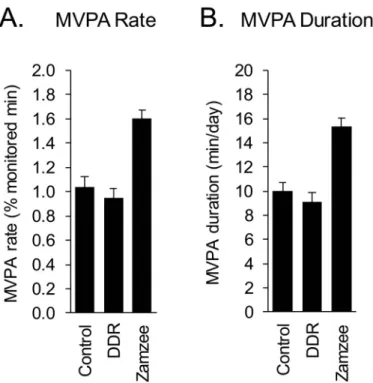
be-tween groups in average MVPA over the entire 6-wk period. As shown inFig 3, average MVPA
duration differed significantly across groups (p<.0001). Participants in the passive control
group showed an average 10.27 min of MVPA per day over the course of the 6-wk study and participants in the active control group (DDR) showed an average 9.12 min MVPA per day. Average MVPA duration did not differ between active and passive control conditions (p = .2732). Participants in the Zamzee intervention group showed an average 15.26 min of MVPA
per day—a level 49% greater than that of the passive control group (p<.0001) and 67% greater
Fig 2. Correspondence between Zamzee VMa values and experimentally manipulated activity intensity (in METs).(A) Receiver operating characteristic analyses were applied to the parametric physical activity calibration data (described inFig 1) to identify optimal accelerometer VMa cut points for distinguishing moderate-to-vigorous physical activity (MVPA = activity4 MET intensity) and vigorous physical activity (VPA = activity6 MET intensity). r and p values derive from ancillary Spearman rank correlation analyses to assess monotonic relationship between VMa and METs over the entire range of activity intensities examined.
did not differ significantly over the course of the 6-week study (i.e., no significant Group x
Week interaction; p = .6048). (Fig 3ashows observed differences in directly measured MVPA
rates and3bexpresses the same data normalized to a standard 16 h waking day.)
Sex differences in intervention impact. To determine whether Zamzee intervention ef-fects might differ for females vs. males, ancillary analyses were conducted in a 2 (Sex) x 3 (Group) x 6 (Week) factorial design. Forty-eight percent of participants were female, and the prevalence of female participants was similar across experimental conditions (n = 23 in passive control, n = 31 in active control, and n = 34 in Zamzee intervention group; difference p = .1952
byX2). Results showed 38% greater MVPA levels in general for males vs. females (p<.0001),
Table 1. Sample Characteristics.
ALL Passive Control Active Control (DDR) Zamzee
n 182 59 61 62
Age,mean (SD) 12.7 (0.9) 12.5 (0.8) 12.7 (0.9) 12.7 (0.9)
BMI,mean (SD) 21.2 (4.6) 22.2 (5.1) 20.7 (3.9) 20.7 (4.5)
Female,n (%) 88 (48) 23 (39) 31 (51) 34 (55)
Ethnicity,n (%)
Caucasian 97 (53) 30 (51) 32 (52) 35 (56)
Black or African American 21 (12) 4 (7) 9 (15) 8 (13)
Asian 10 (5) 3 (5) 2 (3) 5 (8)
Hispanic 37 (20) 16 (27) 12 (20) 9 (15)
Other/ Decline to answer 17 (9) 6 (10) 6 (10) 5 (8)
doi:10.1371/journal.pone.0128639.t001
Fig 3. Moderate-to-vigorous physical activity (MVPA) across experimental conditions.Average (±SE) daily MVPA rate (MVPA duration as a fraction of total time monitored) (A) and standardized MVPA duration (i.e., standardized to a 16 h waking day) (B) in passive control condition participants, active control participants who received a DDR active video game, and intervention group participants who received access to the Zamzee online feedback and rewards system.
as well as a continued significant effect of Zamzee in promoting overall MVPA rates (p< .0001). Results also identified a statistically significant sex difference in the magnitude of Zam-zee intervention effects (p = .0384), with female ZamZam-zee participants showing an average 39% increase in MVPA (p = .0049), and male Zamzee participants showing an average 76% increase
in MVPA (p<.0001).
Effect of adiposity on intervention impact. To determine whether Zamzee intervention effects might differ for individuals who were overweight at study entry, additional ancillary analyses were conducted in a 2 (BMI: normal vs. high) x 3 (Group) x 6 (Week) factorial design.
Sixty-four percent of participants had normal BMI-for-age/gender percentiles (i.e.,<95th
per-centile of CDC reference norm), and the prevalence of high-BMI participants was similar across experimental conditions (n = 15 in passive control, n = 11 in active control, and n = 10
in Zamzee intervention group; difference, p = .4020 byX2). Results identified no significant
BMI x Group interaction for MVPA (p = .9146), and Zamzee intervention effects on MVPA
re-mained highly significant in analyses that included BMI group as a factor (p<.0001).
Discussion
These results indicate that the Zamzee activity meter provides a valid measure of moderate-to-vigorous physical activity (MVPA), and that the Zamzee system (activity meter with an online
incentive motivation system) can increase MVPA rates in 11–14 year-old children by>50%
over a 6-wk period. Zamzee intervention effects on MVPA did not diminish significantly over the course of the 6-wk study period, and were statistically significant in both males and females and in both normal- and high-BMI subgroups. These findings provide a promising
proof-of-concept indication that the Zamzee system’s combination of comprehensive activity
monitor-ing, online feedback, and incentive motivation can increase MVPA in a community sample of middle school-aged American youth.
The present studies were intended to provide a“real world”assessment of the Zamzee
sys-tem’s performance. Although intervention study participants were not required to use the
Zamzee website,>80% of participants given access to the Zamzee website chose to use it (a
rate notably greater than the 51% who chose to use the DDR active video game utilized in the active control condition). The Zamzee activity monitor also appears to be a relatively accept-able device for measuring physical activity in adolescents, as indicated by the fact that valid activity data were obtained for more than 60% of total study days (despite the fact that partici-pants were only verbally requested to wear their Zamzee meters and no other actions were taken enforce this request over the course of the 6-wk study). Previous studies using technolo-gy-based interventions to promote physical activity have found that maintaining user engage-ment can be a significant challenge [46,48]. The present engageengage-ment results suggest that the Zamzee system may provide a promising new tool for promoting physical activity in children. The relatively low price-point of the Zamzee system (approximately $30 meter + $5/wk re-wards in its current configuration) and the internet-based deployment of the Zamzee incentive motivation system should also help facilitate the scaling and distribution of interventions based on this platform.
minimal sufficient tangible rewards with an array of non-financial incentives such as regular indications of personal progress, social comparison and facilitation components, self-determi-nation of rewards and the specific activities undertaken to achieve them, and the ability to sup-port charitable causes. Previous research on physical activity motivation suggests that simply providing feedback (e.g., in the form of pedometer metrics) can motivate changes in behavior [21,22]. To maximize self-determination and sense of control (key psychological ingredients of intrinsic motivation [17], the Zamzee system was also designed to provide users maximal flexi-bility in selecting the specific types of physical activity they might engage in to acquire MVPA ZAMs. The more salient presentation of rewards (both intrinsic and extrinsic) and the greater flexibility in achieving activity goals might potentially explain why Zamzee outperformed the more structured and focused DDR active video game in promoting MVPA in the present study. Future research involving parametric variation of website features, extrinsic reward rates, and other content will be required to more precisely define the psychological
mecha-nisms of Zamzee’s observed effects on physical activity. Although the current incentive system
was clearly sufficient to incentivize behavior change in this middle school-aged population, fur-ther optimization of reward levels and rates could potentially yield additional increments to MVPA.
The present meter validation studies and randomized experimental results are promising, but these findings remain preliminary and are limited in several respects. The meter validation studies involved brief experimental manipulations of physical activity intensity in relatively small samples. Future validation studies using additional physical activity exposures (including extended observation of naturally occurring variations in activity) [30] in larger and more di-verse samples are warranted. The present randomized controlled pilot experiment provides some indication that the Zamzee system might positively impact MVPA in adolescents, but
fu-ture studies examining MVPA levels over longer durations (e.g., 6–12 mo) and in larger
sam-ples are required to verify these initial findings. Larger samsam-ples would provide greater statistical power to assess potential differences in Zamzee intervention effects across demo-graphic groups (e.g., sex, race/ethnicity, socio-economic status, older and younger age groups) and across behaviorally-defined risk groups (e.g., low-activity or overweight/obese sub-popula-tions). Although promising in direction and statistical significance, the magnitude of Zamzee effects on MVPA in the pilot study was not large in absolute terms (approximately 5 min/d, or
a Cohen’s d = .4 SD). The average increment to MVPA observed here would mitigate
approxi-mately 23%-34% of the net 110–165 kcal/d energy gap estimated for current U.S. adolescents
Despite the early stage of the Zamzee system’s development, and the limited data available so far, the present studies do suggest that the Zamzee activity meter can provide a valid and en-gaging instrument for measuring MVPA in adolescents, and that integrating this meter with an online feedback and incentive motivation system can significantly increase MVPA levels over a 6-wk period in a community sample of normal adolescents. Given the public health
signifi-cance of maintaining healthy levels of physical activity in young people [1–3] and the relative
difficulty of significantly increasing adolescent MVPA in previous studies [13,46,48], these ini-tial proof-of-concept results may provide a platform for future research to enhance the impact of the present Zamzee system and provide more comprehensive and robust assessment of its impact on physical activity and health.
Supporting Information
S1 File. Zamzee system website content. (DOC)
S1 Dataset. Activity meter calibration study data. (XLSX)
S2 Dataset. Pilot study data. (XLSX)
Acknowledgments
We are thankful for the efforts of the staff at the participating middle schools who supported the study staff in recruitment and data collection. We are grateful to all of the volunteers who participated in the validation studies and kindly started and stopped and started again the vari-ety of physical activities. In addition, we acknowledge the work of the study teams at HopeLab and the University of West Virginia who made the study possible, including Candice Lee, Mi-chael Raffin, Veronica Marin, Terika Brown, Susan Crayne and Denis Bohm. Also we would like to acknowledge the generous development and research support provided by the Robert Wood Johnson Foundation.
Author Contributions
Conceived and designed the experiments: NG AB ST SY JH SC. Performed the experiments: NG AB ST SY JH FD SC. Analyzed the data: NG SC. Contributed reagents/materials/analysis tools: NG FD JH SC. Wrote the paper: NG AB ST SY SC.
References
1. Ludwig DS, Pollack HA. Obesity and the economy. JAMA J Am Med Assoc. 2009; 301: 533–535.
2. Lee I-M, Shiroma EJ, Lobelo F, Puska P, Blair SN, Katzmarzyk PT. Effect of physical inactivity on major non-communicable diseases worldwide: an analysis of burden of disease and life expectancy. The Lan-cet. 2012; 380: 219–229. doi:10.1016/S0140-6736(12)61031-9PMID:22818936
3. Katzmarzyk PT, Baur LA, Blair SN, Lambert EV, Oppert J-M, Riddoch C. International conference on physical activity and obesity in children: summary statement and recommendations. Appl Physiol Nutr Metab. 2008; 33: 371–388. doi:10.1139/H07-176PMID:18347694
4. Troiano RP, Berrigan D, Dodd KW, Mâsse LC, Tilert T, McDowell M. Physical activity in the United States measured by accelerometer. Med Sci Sports Exerc. 2008; 40: 181. PMID:18091006
6. Trost SG, Pate RR, Sallis JF, Freedson PS, Taylor WC, Dowda M, et al. Age and gender differences in objectively measured physical activity in youth. Med Sci Sports Exerc. 2002; 34: 350–355. PMID: 11828247
7. Trudeau F, Laurencelle L, Shephard RJ. Tracking of Physical Activity from Childhood to Adulthood: Med Sci Sports Exerc. 2004; 36: 1937–1943. doi:10.1249/01.MSS.0000145525.29140.3BPMID:15514510
8. Matton L, Thomis M, Wijndaele K, Duvigneaud N, Beunen G, Claessens AL, et al. Tracking of Physical Fitness and Physical Activity from Youth to Adulthood in Females: Med Sci Sports Exerc. 2006; 38: 1114–1120. doi:10.1249/01.mss.0000222840.58767.40PMID:16775554
9. Perkins DF, Jacobs JE, Barber BL, Eccles JS. Childhood and Adolescent Sports Participation as Pre-dictors of Participation in Sports and Physical Fitness Activities During Young Adulthood. Youth Soc. 2004; 35: 495–520. doi:10.1177/0044118X03261619
10. Ekelund U, Luan J, Sherar LB, Esliger DW, Griew P, Cooper A. Moderate to vigorous physical activity and sedentary time and cardiometabolic risk factors in children and adolescents. JAMA J Am Med Assoc. 2012; 307: 704–712.
11. Andersen LB, Harro M, Sardinha LB, Froberg K, Ekelund U, Brage S, et al. Physical activity and clus-tered cardiovascular risk in children: a cross-sectional study (The European Youth Heart Study). The Lancet. 2006; 368: 299–304. PMID:16860699
12. Pan Y, Pratt CA. Metabolic Syndrome and Its Association with Diet and Physical Activity in US Adoles-cents. J Am Diet Assoc. 2008; 108: 276–286. doi:10.1016/j.jada.2007.10.049PMID:18237576
13. Barnett A, Cerin E, Baranowski T. Active video games for youth: a systematic review. J Phys Act Health. 2011; 8: 724–737. PMID:21734319
14. Madden M, Lenhart A, Duggan M, Cortesi S, Gasser U. Teens and Technology 2013 [Internet]. Pew In-ternet & American Life Project; 2013. Available: http://www.atlantycalab.com/untangiblelibrary/wp-content/untangible/130315%20-%20PIP_TeensandTechnology2013.pdf
15. Cole SW, Yoo DJ, Knutson B. Interactivity and Reward-Related Neural Activation during a Serious Videogame. PLoS ONE. 2012; 7: e33909. doi:10.1371/journal.pone.0033909PMID:22442733
16. Koepp MJ, Gunn RN, Lawrence AD, Cunningham VJ, Dagher A, Jones T, et al. Evidence for striatal do-pamine release during a video game. Nature. 1998; 393: 266–268. PMID:9607763
17. Ryan RM, Deci EL. Self-determination theory and the facilitation of intrinsic motivation, social develop-ment, and well-being. Am Psychol. 2000; 55: 68. PMID:11392867
18. Baranowski T, Buday R, Thompson DI, Baranowski J. Playing for real: video games and stories for health-related behavior change. Am J Prev Med. 2008; 34: 74–82.e10. doi:10.1016/j.amepre.2007.09. 027PMID:18083454
19. Volpp KG, John LK, Troxel AB, Norton L, Fassbender J, Loewenstein G. Financial incentive—based approaches for weight loss. JAMA J Am Med Assoc. 2008; 300: 2631–2637.
20. Volpp KG, Loewenstein G, Troxel AB, Doshi J, Price M, Laskin M, et al. A test of financial incentives to improve warfarin adherence. BMC Health Serv Res. 2008; 8: 272. doi:10.1186/1472-6963-8-272 PMID:19102784
21. Bravata DM, Smith-Spangler C, Sundaram V, Gienger AL, Lin N, Lewis R, et al. Using pedometers to increase physical activity and improve health. JAMA J Am Med Assoc. 2007; 298: 2296–2304.
22. Tudor-Locke C, Lutes L. Why Do Pedometers Work? Sports Med. 2009; 39: 981–993. doi:10.2165/ 11319600-000000000-00000PMID:19902981
23. Hurling R, Catt M, De Boni M, Fairley BW, Hurst T, Murray P, et al. Using Internet and Mobile Phone Technology to Deliver an Automated Physical Activity Program: Randomized Controlled Trial. J Med In-ternet Res. 2007; 9: e7. doi:10.2196/jmir.9.2.e7PMID:17478409
24. Merom D, Rissel C, Phongsavan P, Smith BJ, Van Kemenade C, Brown WJ, et al. Promoting Walking with Pedometers in the CommunityThe Step-by-Step Trial. Am J Prev Med. 2007; 32: 290–297. doi:10. 1016/j.amepre.2006.12.007PMID:17303369
25. Promberger M, Marteau TM. When do financial incentives reduce intrinsic motivation? Comparing be-haviors studied in psychological and economic literatures. Health Psychol. 2013; 32: 950–957. doi:10. 1037/a0032727PMID:24001245
26. Charness G, Gneezy U. Incentives to Exercise. Econometrica. 2009; 77: 909–931. doi:10.3982/ ECTA7416
27. Frederick CM, Ryan RM. Self-determination in sport: A review using cognitive evaluation theory. Int J Sport Psychol. 1995; 26: 5–23.
29. Chen KY, Bassett DR. The Technology of Accelerometry-Based Activity Monitors: Current and Future: Med Sci Sports Exerc. 2005; 37: S490–S500. doi:10.1249/01.mss.0000185571.49104.82PMID: 16294112
30. Puyau MR, Adolph AL, Vohra FA, Butte NF. Validation and calibration of physical activity monitors in children. Obes Res. 2002; 10: 150–157. PMID:11886937
31. Eston RG, Rowlands AV, Ingledew DK. Validity of heart rate, pedometry, and accelerometry for predict-ing the energy cost of children’s activities. J Appl Physiol. 1998; 84: 362–371. PMID:9451658
32. Activity Physical and Health: A Report of the Surgeon General. Jones & Bartlett Learning; 1996.
33. Blair SN, LaMonte MJ, Nichaman MZ. The evolution of physical activity recommendations: how much is enough? Am J Clin Nutr. 2004; 79: 913S–920S. PMID:15113739
34. Ainsworth BE, Haskell WL, Herrmann SD, Meckes N, Bassett DR, Tudor-Locke C, et al. 2011 Compen-dium of Physical Activities: A Second Update of Codes and MET Values. Med Sci Sports Exerc. 2011; 43: 1575–1581. doi:10.1249/MSS.0b013e31821ece12PMID:21681120
35. Rothney MP, Schaefer EV, Neumann MM, Choi L, Chen KY. Validity of Physical Activity Intensity Pre-dictions by ActiGraph, Actical, and RT3 Accelerometers. Obesity. 2008; 16: 1946–1952. doi:10.1038/ oby.2008.279PMID:18535553
36. Hendelman D, Miller K, Baggett C, Debold E, Freedson P. Validity of accelerometry for the assessment of moderate intensity physical activity in the field. Med Sci Sports Exerc. 2000; 32: S442–S449. PMID: 10993413
37. Coleman KJ, Saelens BE, Wiedrich-Smith MD, Finn JD, Epstein LH. Relationships between TriTrac-R3D vectors, heart rate, and self-report in obese children. Williams Wilkins. 1997; 29: 1535–1542. doi: 10.1097/00005768-199711000-00022
38. McMurray RG, Harrell JS, Bradley CB, Webb JP, Goodman EM. Comparison of a computerized physi-cal activity rephysi-call with a triaxial motion sensor in middle-school youth. Med Sci Sports Exerc. 30: 1238– 1245. PMID:9710863
39. Welk GJ, Blair SN, Wood K, Jones S, Thompson RW. A comparative evaluation of three accelerome-try-based physical activity monitors. Med Sci Sports Exerc. 2000; 32: S489–S497. PMID:10993419
40. Bland JM, Altman DG. Comparing methods of measurement: why plotting difference against standard method is misleading. The Lancet. 1995; 346: 1085–1087. doi:10.1016/S0140-6736(95)91748-9 PMID:7564793
41. Trost SG, Loprinzi PD, Moore R, Pfeiffer KA. Comparison of accelerometer cut points for predicting ac-tivity intensity in youth. Med Sci Sports Exerc. 2011; 43: 1360–1368. doi:10.1249/MSS.
0b013e318206476ePMID:21131873
42. Evenson KR, Catellier DJ, Gill K, Ondrak KS, McMurray RG. Calibration of two objective measures of physical activity for children. J Sports Sci. 2008; 26: 1557–1565. doi:10.1080/02640410802334196 PMID:18949660
43. Tan B, Aziz AR, Chua K, Teh KC. Aerobic Demands of the Dance Simulation Game. Int J Sports Med. 2002; 23: 125–129. doi:10.1055/s-2002-20132PMID:11842360
44. Unnithan V, Houser W, Fernhall B. Evaluation of the Energy Cost of Playing a Dance Simulation Video Game in Overweight and Non-Overweight Children and Adolescents. Int J Sports Med. 2006; 27: 804– 809. doi:10.1055/s-2005-872964PMID:17006803
45. Maloney AE, Bethea TC, Kelsey KS, Marks JT, Paez S, Rosenberg AM, et al. A Pilot of a Video Game (DDR) to Promote Physical Activity and Decrease Sedentary Screen Time. Obesity. 2008; 16: 2074– 2080. doi:10.1038/oby.2008.295PMID:19186332
46. Staiano AE, Abraham AA, Calvert SL. The Wii Club: Gaming for Weight Loss in Overweight and Obese Youth. Games Health J. 2012; 1: 377–380. doi:10.1089/g4h.2012.0052PMID:23565349
47. Dietz W. Growth Chart Training Modules: Using the BMI-for-Age Growth Charts [Internet]. Centers for Disease Control and Prevention; Available:http://www.cdc.gov/nccdphp/dnpa/growthcharts/training/ modules/module1/text/module1print.pdf
48. Owens S, Garner JC, Loftin J, van Blerk N, Ermin K. Changes in Physical Activity and Fitness After 3 Months of Home Wii Fit(TM) Use. J Strength. 2011; 25: 3191–3197. doi:10.1519/JSC.
0b013e3182132d55PMID:21993031
49. Volpp KG, Troxel AB, Pauly MV, Glick HA, Puig A, Asch DA, et al. A randomized, controlled trial of fi-nancial incentives for smoking cessation. N Engl J Med. 2009; 360: 699–709. doi:10.1056/ NEJMsa0806819PMID:19213683