Strongly interacting vector bosons at the CERN LHC: Quartic anomalous couplings
A. S. Belyaev,1,2O. J. P. E´ boli,1M. C. Gonzalez-Garcia,3J. K. Mizukoshi,4S. F. Novaes,1and I. Zacharov51
Instituto de Fı´sica Teo´rica, Universidade Estadual Paulista, Rua Pamplona 145, 01405-900 Sa˜o Paulo, Brazil 2Skobeltsyn Institute of Nuclear Physics, Moscow State University, 119899 Moscow, Russian Federation
3Instituto de Fı´sica Corpuscular IFIC/CSIC, Departament de Fı´sica Teo`rica, Universitat de Vale`ncia, 46100 Burjassot, Vale`ncia, Spain
4Instituto de Fı´sica, Universidade de Sa˜o Paulo, Caixa Postal 66318, 05315-970, Sa˜o Paulo, Brazil 5Silicon Graphics European Headquarters, Chemin des Avouillons 30, 1196 Gland, Switzerland
~Received 5 May 1998; published 11 December 1998!
We analyze the potential of the CERN Large Hadron Collider to study anomalous quartic vector-boson interactions through the production of vector-boson pairs accompanied by jets. In the framework of SU(2)L^U(1)Y chiral Lagrangians, we examine all effective operators of order p4 that lead to new
four-gauge-boson interactions but do not alter trilinear vertices. In our analyses, we perform the full tree-level calculation of the processes leading to two jets plus vector-boson pairs, W1W2,W6W6,W6Z, or ZZ, taking properly into account the interference between the standard model and the anomalous contributions. We obtain the bounds that can be placed on the anomalous quartic interactions and we study the strategies to distinguish the possible new couplings.@S0556-2821~99!06201-3#
PACS number~s!: 12.60.Cn
I. INTRODUCTION
The standard model ~SM! of electroweak interactions, based on the SU(2)L^U(1)Y gauge symmetry, has accom-plished an impressive agreement between its predictions for the fermion-vector-boson couplings and all the recent experi-mental data @1#. Notwithstanding, the tests of the triple and quartic bosonic interactions still lack the same accuracy to further confirm the local gauge invariance of the theory or to indicate the existence of new physics beyond the SM.
The interactions responsible for electroweak symmetry breaking play an important role in gauge-boson scattering at high energies because they are an essential ingredient to avoid unitarity violation in the scattering amplitudes of mas-sive vector bosons at the TeV scale@2#. There are two pos-sible forms of electroweak symmetry breaking which lead to different solutions to the unitarity problem: ~a! there is a scalar particle lighter than 1 TeV, the standard model Higgs boson, or ~b! such a particle is absent and the longitudinal components of the W and Z bosons become strongly inter-acting at high energies. In the latter case, symmetry breaking occurs due to the nonzero vacuum expectation value of some composite operators which are related with new underlying physics.
In this work we analyze the potential of the CERN Large Hadron Collider ~LHC! to study deviations of the quartic vector-boson couplings from the SM predictions, assuming a strongly interacting electroweak symmetry breaking sector
~SEWS!. In fact, the LHC will be the first collider capable of directly studying these couplings through the scattering of gauge bosons in reactions like p p→qqVV→VV j j @3–5#, with V5W6or Z0. Studies of quartic couplings will also be possible at future e1e2colliders@6–10#, and also in eg @11# andgg collisions@12#. Notwithstanding, at present, this sec-tor of the SM can only be indirectly bounded by the precise measurements of the electroweak parameters @13,14#.
In this paper we assume that there are no new light
reso-nances at the LHC energy scale, which means that the SU(2)L^U(1)Y gauge symmetry is nonlinearly realized. In this case, the electroweak sector must be parametrized in terms of electroweak chiral Lagrangians. We study the com-plete set of dimension-four operators contributing only to quartic vector-boson couplings and we estimate the sensitiv-ity of the LHC to search for deviations from the SM predic-tions.
We present the results for the full tree-level calculation of the processes p p→VV1 2 jets, with V5W6,Z0, taking properly into account the interference between the SM and anomalous quartic contributions. This improves the previous studies of SEWS at the LHC @3–5# which relied upon the equivalence theorem @15# or/and the effective W-boson ap-proximation @16#. Moreover, we performed our calculation both in the unitary and ’t Hooft–Feynman gauges, and we also included the efficiencies for detecting the leptons origi-nating from the vector boson decays.
In our analyses we obtain the allowed range of the coef-ficient of each anomalous quartic operator and compare the results with those coming from indirect measurements
We also establish the best cuts to improve the signal over background ratio. Our final results for the cross sections are presented in Sec. IV, in terms of the chiral Lagrangian coef-ficients. The final section contains our general conclusions.
II. CHIRAL LAGRANGIANS
When the Higgs boson is a strongly interacting particle or when it is absent from the physical particle spectrum, one is led to consider the most general effective Lagrangian which employs a nonlinear representation of the spontaneously bro-ken SU(2)L^U(1)Y gauge symmetry @17#. The resulting chiral Lagrangian is a nonrenormalizable nonlinears model coupled in a gauge-invariant way to the Yang-Mills theory. This model-independent approach incorporates by construc-tion the low-energy theorems@18#, which predict the general behavior of Goldstone boson amplitudes, irrespective of the details of the symmetry-breaking mechanism. This low-energy effective theory should be valid up to some low-energy scale smaller than 4pv.3 TeV, where new physics would
come into play to avoid unitarity violation in vector-boson scattering @2#.
In order to specify the effective Lagrangian, one must fix the symmetry-breaking pattern. We considered that the sys-tem presents a global SU(2)L^SU(2)R symmetry that is
broken to SU~2!. With this choice, following the notation of Ref.citeAppelquist, the building block of the chiral Lagrang-ian is the dimensionless unimodular matrix field S(x), which transforms under SU(2)L^SU(2)R as ~2,2!,
S~x!5exp
F
iwa~x!ta
v
G
, ~1!where the wa fields are the would-be Goldstone fields and
ta
(a51,2,3) are the Pauli matrices. The SU(2)L^U(1)Y
covariant derivative ofS is defined as
DmS[]mS1ig ta
2 Wm
aS
2ig
8
St3
2 Bm. ~2! The lowest-order terms in the derivative expansion of the effective Lagrangian are
L~2!5 v2
4Tr@~DmS !
†~DmS !#
1b1g
8
2v2
4 ~Tr@TVm# ! 2,
~3!
where we have introduced the auxiliary quantities T
[St3S† and V
m[(DmS)S† which are SU(2)L covariant
and U(1)Y invariant. Notice that T is not invariant under
SU(2)Ccustodial due to the presence of t3.
The first term of the above equation is responsible for giving mass to the gauge bosons W6 and Z for v 5(
A
2GF)21. The second term violates the custodialSU(2)C symmetry and contributes to Dr at the tree level,
being strongly constrained by the low-energy data. This term can be understood as the low-energy remnant of the high-energy custodial symmetry-breaking physics, which has been integrated out above a certain scaleL. Moreover, at the one-loop order, it is also required in order to cancel the
diver-gences in Dr, arising from diagrams containing a hyper-charge boson in the loop @17#. This subtraction renders a finiteDr, although dependent on the renormalization scale.
At the next order in the derivative expansion ( p4), there are many operators that can be written down @17#. We shall restrict our analyses to the ones that exhibit genuine quartic vector-boson interactions, i.e., that do not have triple gauge-boson vertices associated to these quartic couplings. These operators are
L4~4!5a4@Tr~VmVn!#2, ~4!
L5~4!5a5@Tr~VmVm!#2, ~5!
L
6
~4!
5a6Tr~VmVn!Tr~TVm!Tr~TVn!, ~6! L
7
~4!
5a7Tr~VmVm!@Tr~TVn!#2, ~7!
L
10
~4!
5a210@Tr~TVm!Tr~TVn!#2. ~8!
These Lagrangian densities lead to quartic vertices involving gauge bosons and/or Goldstone bosons. In the unitary gauge, there are new anomalous contributions to the ZZZZ vertex coming from all five operators, to the W1W2ZZ vertex from all operators except L10(4), and to W1W2W1W2 interaction arising from L4(4) and L5(4). Moreover, the interaction
LagrangiansL 6 (4) ,L 7 (4)
, andL
10 (4)
violate the SU(2)C
custo-dial symmetry. Notice that the quartic couplings involving photons remain untouched by the genuinely quartic anoma-lous interactions at the order p4. The Feynman rules for the quartic couplings generated by these operators can be found in the last article of Ref.@17#.
III. SIGNALS AND BACKGROUNDS
In our analyses, we studied the strongly interacting elec-troweak breaking sector at the LHC via the scattering of weak vector bosons that are radiated off quarks. We consid-ered the following processes involving the four-gauge-boson interactions~4!–~8!:
p p→W1W2j j , ~9a!
p p→W2W2j j , ~9b!
p p→W1W1j j , ~9c!
p p→W1Z j j, ~9d!
p p→W2Z j j, ~9e!
p p→ZZ j j. ~9f!
contribu-tions. Moreover, we took into account not only the elec-troweak contributions but also the O(a2a
S
2
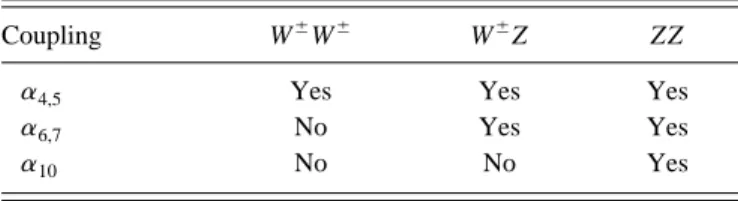
) ones. For the sake of clarity, we show in Table I the anomalous interac-tions that contribute to each of the reacinterac-tions ~9!. This table indicates the strategy that should be followed to understand the origin of the possible deviations from the SM.
The calculation of the matrix elements was performed nu-merically using two distinct tools. On one hand, we evalu-ated the scattering amplitudes in the unitary gauge using the HELASpackage@19#, with the SM contribution being gener-ated byMADGRAPH@20#. In this case, we wrote special sub-routines to evaluate the anomalous contributions ~4!–~8! to the vector-boson self-interactions. On the other hand, the same processes were evaluated using the COMPHEPpackage
@21#. The p4 chiral effective Lagrangian was implemented into COMPHEP in the unitary and the ’t Hooft–Feynman gauges. Despite the Feynman rules in the ’t Hooft–Feynman
gauge being cumbersome, this gauge maximizes the COMPHEP performance and allows us to double check our calculations by comparing the results in two gauges. The results from HELAS/MADGRAPH and COMPHEP were con-fronted and they indeed agreed.
The evaluation of the processes ~9!requires a very large computing power. The complexity of this calculation can inferred from the large number of diagrams involved. For instance, there are 1918 Feynman diagrams contributing to the W1W2 final state, while for W1Z there are 1503, and 978 for ZZ. As an illustration, we present, in Fig. 1, the complete set of Feynman diagrams for the subprocess uu
→W1W1dd which contributes to the W1W1 production
~9c!. The first diagram in this figure receives contributions from the anomalous interactions, giving rise to the signal, while all other graphs correspond to QCD and electroweak backgrounds. We neglected in our analyses the small contri-bution coming from subprocesses exhibiting two sea quarks in the initial state.
Strongly interacting symmetry breaking sectors modify the dynamics of longitudinal vector bosons. However, it is impossible to determine the polarization of vector bosons on an event-by-event basis, and consequently, we have to work harder to extract the SEWS signal. Taking into account that the electroweak production of transversely polarized vector bosons is approximately independent of the Higgs boson
TABLE I. The processes affected by the different quartic cou-plings~4!–~8!.
Coupling W6W6 W6Z ZZ
a4,5 Yes Yes Yes
a6,7 No Yes Yes
a10 No No Yes
mass, and that the VLVL production is small for light Higgs
bosons @4#, we define the signal for SEWS as an excess of events in the VV scattering channels with respect to the SM model with a light Higgs boson:, i.e.,
ssignal[s~ai!2sS MuMH5100 GeV, ~10!
where we sum over the vector-boson polarizations. In prin-ciple, we might have a signal even for ai[0 since there is
no Higgs boson in our model to cut off the growth of the scattering amplitudes. In this case, we should also study whether it is possible to establish that the anomalous cou-plingsai are compatible with zero or not.
In the effective-W approximation @16#, the signal is de-scribed by the scattering VLVL→VLVL. This process,
how-ever, does not respect the unitarity of the partial-wave am-plitudes (al
I
) at large subprocess center-of-mass energies MVV@2,15#. Therefore, the chiral expansion is valid only for
values of MVV and ai such that ual I
u&1/2. For higher VV invariant masses, rescattering effects are important to unita-rize the amplitudes. Taking into account this fact, we conser-vatively restricted our analyses to invariant masses MVV
,1.25 TeV. In the cases where it is not possible to recon-struct the VV invariant mass from the leptonic decay prod-ucts, this requirement corresponds to a sharp-cutoff unitari-zation@22#.
Since we evaluated the full matrix elements for the pro-cesses~9!, summed over the vector-boson polarizations, sev-eral backgrounds were automatically included, e.g., the
O(a4) and O(a2a
S
2) irreducible backgrounds qq
→qqVTVT(VLVT). Another important background is
top-quark pair production, i.e., qq(gg)→t t¯→W1W2bb¯ which was also taken into account, since we considered the W1W2bb¯ final state. Moreover, triple gauge boson produc-tion also contribute to the VV j j signature when one of the three boson decays hadronically. In addition to that we also evaluated the ‘‘continuum’’ VV production, qq(gg) →ggVV, where the vector bosons are produced in
associa-tion with gluons. In principle, we should explicitly include further backgrounds like the associated production of t t¯ pairs accompanied by a W6 or a Z, however, these contributions are negligible once we applied the jet veto and tag cuts de-scribed below@4#.
One should stress the importance of the jet-tagging and jet-vetoing cuts since the background can be efficiently sup-pressed by cutting in the jet rapidities and momenta@4#. In order to understand that, we must recall that the spectra of transversely ( fW/eT ) and longitudinally ( fW/eL ) polarized W in the effective W approximation are given by
fW/eT ~x, pT!5
a
4psin2uW
11~12x!2 2x
pT2
@pT21~12x!MW2#2,
~11!
fW/eL ~x, pT!5
a
4psin2uW
12x x
~12x!MW2 @pT21~12x!MW2#2,
~12!
where pTis the transverse momentum of the W6~jet!. From
the above expressions, we can learn that the transversely polarized W’s possess a higher pT than the longitudinally
polarized ones. Moreover, the spectator jets associated with WL6 are produced at large rapidities since their energies are of the order of TeV.
Forward ~backward!jets are characteristic configurations of the signal. At the same time, jets coming from the signal are well separated and their pT distribution does not peak
near zero because of massive vector-boson propagators. On the other hand, the situation is the opposite for some back-grounds: either their pT distributions peak at small values
due to photon, gluon or light quark t-channel exchange, or they have the tendency to be close to each other since the jets originate from gluon or photon splitting. This remarkable difference between the signal and the backgrounds allows us to substantially reduce the latter by requiring the tagging of forward jets. We can further reduce backgrounds, like t t¯ and VVV, by vetoing large jet activity in the central region of the detector @23#.
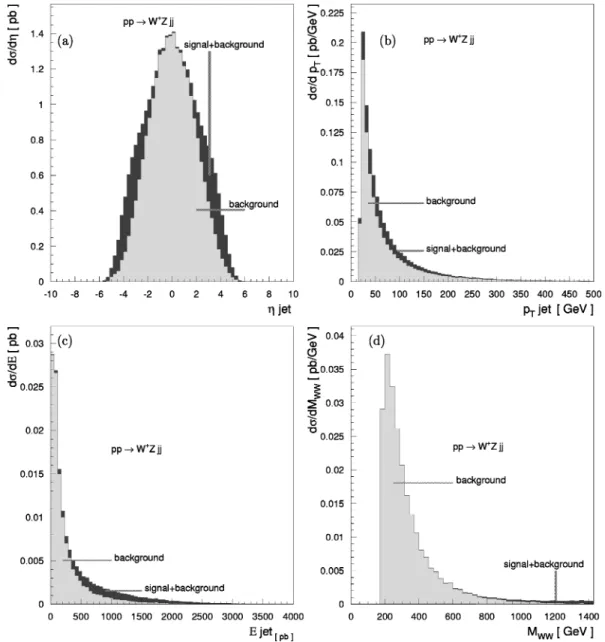
In Fig. 2, we show some kinematical distributions for the process p p→W1Z j j ~9d!. Figure 2~a!contains the pseudo-rapidity distribution of the jets, while we exhibit the pT ~
en-ergy!distribution of the jets in Figs. 2~b!,2~c!, and the invari-ant mass distribution of W1Z pairs in Fig. 2~d!. From these figures we can see that the jets associated with the signal are produced at large rapidities and carry a larger amount of energy, illustrating the importance tagging and jet-vetoing cuts.
In order to suppress the backgrounds and enhance the signal for anomalous quartic interactions we studied several kinematical distributions for the processes~9!, applying dif-ferent cuts on the final-state particles. Our results indicate that the cuts presented in Ref. @4#are able to improve con-siderably the signal/background ratio. We applied the fol-lowing set of kinematical cuts, keeping those from the above-mentioned paper and also suggesting some additional ones that could allow further suppression of the back-grounds.
~i! We required the existence of two jets satisfying pT
.20 GeV,uhu,5, and separated by DR[
A
(Dh2 1Df2) .0.5. The cut in pTis important not only to guarantee thatthe jets will be well defined, but also to suppress the back-ground due to the photon and gluon exchanges in the t chan-nel. At the same time, the DR cut is necessary, combined with the pT one, to remove the singularity coming from
gluon splitting in some background subprocesses.
~ii! We applied the jet-tagging and jet-vetoing cuts sug-gested by Bagger et al. @4#, i.e.,
E~jtag!.0.8 TeV ~except for W6W6!,
3.0,uy~jtag!u,5.0, pT~jtag!.40 GeV,
pT~jveto!.60 GeV ~30 GeV for W1W2!,
t t¯ production gives rise to a quite large background to the W1W2j j signal, and consequently, the requirement of a more stringent pT( jveto) cut for this process is important to improve the signal/background ratio.
~iii! We also required the invariant mass of the vector boson pair to be in the range 0.5,MVV,1.25 TeV. The
upper limit of this cut is quite important since it prevents the effective operators ~4!–~8! to be used in a energy regime where unitarity is violated and rescattering effects become important. The lower limit of this cut aims to reduce the background~see Fig. 2!.
In this work we considered the ‘‘gold-plated’’ events where the W’s and Z’s decay into electrons or muons, ignor-ing final states associated with the hadronic decay of the vector bosons. In order to make a more realistic estimation of the limits that can be imposed on the anomalous parameters,
one should take into account the detection efficiency of the final-state leptons. This problem was studied in Ref.@24#for W6 and Z decays in Higgs production processes. Imposing that the leptons satisfy the following cuts:
uhl
u,2, pTl.100 GeV, and pTmiss.100 GeV,
the detection efficiency for leptons originating from W ~Z!
decays is 43% ~52%! @24#. We also took into account the branching ratios of W6 and Z into electrons or muons (
l
5e orm),
BR~WW→
l
¯nll
¯nl!54.7%,BR~W1Z→
l
¯nll l
¯!51.5%,FIG. 2. Kinematical distributions for the process p p→W1Z j j:~a!pseudorapidity of the jets (h
j);~b!transverse momentum of the jets
( pTj);~c!energy of the jets (Ej); and~d!invariant mass of the W1Z pair ( MWW). The light gray area stands for the background while the
dark area represents the background plus the signal associated to a450.03. We required that pT jet
.20 GeV and the jet separationDRj j
BR~ZZ→4
l
!50.45%.At this point it is important to address the difference be-tween the results obtained using the full matrix elements and the effective W approximation. First, as it is well known, the effective W approximation overestimates the total yield of W pairs in the production of a heavy Higgs boson@25#. In order to verify that this is still true when there is no resonances, we computed the process p p→W1W1j j in the standard model, both in the effective W approximation and with the full ma-trix element, imposing only the cut pTW.20 GeV to avoid divergences in the effective W calculation. We obtain
sfull~p p→W1W1j j!50.385 pb,
seff W~p p→W1W1j j!52.92 pb,
which shows that the result in the effective W approximation is almost one order of magnitude larger than the full calcu-lation. This discrepancy reduces when the pTW cut is in-creased or when the W’s are required to be central @25#. Nonetheless, we should remember that we do not impose any cut on the W rapidity or pT in our realistic complete
calcu-lations.
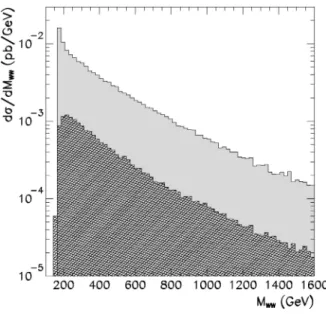
In Fig. 3, we compare the WW invariant mass distribution obtained using the effective W approximation and perform-ing the full calculation, imposperform-ing only the pTWcut. As seen in the figure, the excess is relatively larger at small MWW. In our analyses of the anomalous couplings, we required that MVV.500 GeV, keeping only the large VV invariant
masses. Notwithstanding, this cut reduces only slightly the difference between the effective W approximation and the full calculation, to a factor ;7. Moreover, after this MVV
cut, the effective W approximation reproduces the MVV dis-tribution shape.
It is also important to notice that we imposed strong veto and tag cuts on the final jets in our analyses to reduce the backgrounds. However, these cuts are impossible to imple-ment in the effective W approximation, and in consequence, the only way to obtain the final number of events in this approximation is to estimate the veto and tag efficiency from some related ‘‘full’’ calculation ~for instance, from the full SM part as done by Barger et al.!and assume that this effi-ciency is the same for the anomalous contributions. This in-troduces some unavoidable uncertainty in the approximate calculation.
IV. RESULTS
The most general expression for the total cross sections of the processes~9!can be written as
s5C01
(
j
ajCj1
(
j<kajakCj2k, ~13!
where j,k54, 5, 6, 7, or 10 and C0 is the cross section for
aj[0. In our calculations, we applied the cuts ~i!–~iii!and
used the CTEQ3M parton distributions @26#, with Q2 equal to the invariant mass of the parton system. We present in Table II our results for the coefficients C0,Cj,Cj2k, as well
as for the SM with a Higgs boson of mass MH
5100 GeV (CSM).
FIG. 3. MWW invariant mass distribution for the process p p
→W1W1j j in the effective W approximation ~light grey histo-gram! and in the full calculation ~dark grey histogram! with pT
W
.20 GeV cut.
TABLE II. Coefficients of the different combinations of cou-pling constants contributing to the total cross section in pb@see Eq.
~13!#, and also for the SM with a light Higgs ( MH5100 GeV).
These results were obtained applying the cuts~i!–~iii!.
W1W2 W1W1 W2W2 W1Z W2Z ZZ
CSM 0.049 0.0044 0.0009 0.018 0.0070 0.0044
C0 0.050 0.0061 0.0011 0.019 0.0074 0.0056
C4 0.21 20.38 20.062 20.14 20.062 0.066
C5 0.27 20.19 20.034 20.12 20.057 0.20
C6 0.036 20.14 20.062 0.066
C7 0.11 20.12 20.057 0.20
C10 20.00012
C424 18 27 4.3 14 5.4 13
C525 36 7.2 1.2 6.3 2.4 23
C626 0.67 14 5.4 49
C727 5.7 6.3 2.4 58
C10210 47
C425 46 28 4.4 11 4.2 31
C426 1.4 29 11 50
C427 3.6 11 4.2 55
C4210 47
C526 4.0 11 4.2 54
C527 12 13 4.8 69
C5210 47
C627 3.7 11 4.2 102
C6210 94
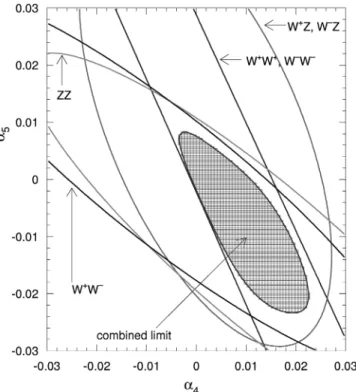
Given our definition of the signal ~10!and the above pa-rametrization of the anomalous cross section we can easily obtain the LHC attainable limits on any combination of genuinely quartic anomalous couplings. We exhibit in Fig. 4 the 1-s exclusion region in the planea43a5 for each pro-cess ~9! independently, assuming an integrated luminosity
L5100 fb21 and taking properly into account the detection efficiencies and leptonic branching ratios. In this analysis, we assumed that the SU(2)C violating interactions vanish.
As we can see, the W6Z, ZZ, and W1W2productions lead to similar bounds while the W6W6 give rise to somewhat weaker limits. Combining all channels allow us to improve the limits by a factor of approximately 2.
Figure 5 contains the 1-s exclusion region in the
a63a7 plane fora45a55a1050 and an integrated lumi-nosity of 100 fb21. The W6W6 production does not give rise to any bound since these interactions possess only ZZZZ and W1W2ZZ anomalous couplings. Moreover, the produc-tion of W1W2 pairs leads to weak bounds since these cou-plings contribute to this final state only through the subpro-cess ZZ→W1W2, which is suppressed. The best limits come from the ZZ pair production and the combined limits of ZZ and W6Z productions are only slightly better than the
ZZ bounds.
The anomalous interactiona10modifies only the ZZ pro-duction since it alters solely the vertex ZZZZ. We present in Fig. 6 the 1-s limits that can be obtained on this coupling from the ZZ pair production fora45a55a65a750 and an integrated luminosity of 100 fb21. Therefore, this coupling is the one that will be less constrained at the LHC.
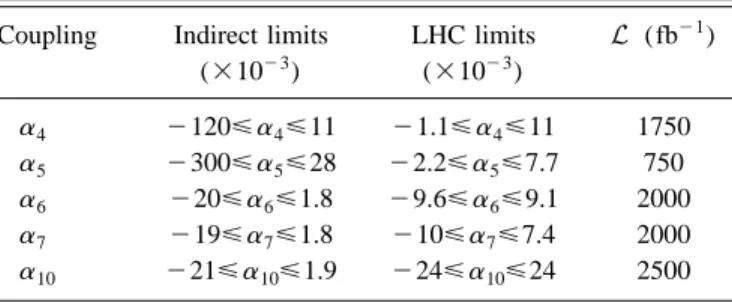
Table III shows the limits on each couplingai,i54, 5, 6,
FIG. 5. 1-sC.L. exclusion region in thea63a7plane from the
W1W2, W6Z, and ZZ productions. We applied all cuts and effi-ciencies discussed in the text and assumed that a45a55a1050 and an integrated luminosity of 100 fb21
.
FIG. 6. Number of events for ZZ production as a function ofa10
where the horizontal line represents a 64% C.L. effect. We applied all cuts and efficiencies discussed in the text and assumed thata4
5a55a65a750 and an integrated luminosity of 100 fb21
. FIG. 4. 1-s exclusion region in the a43a5 plane for the
W1W2, W6W6, W6Z, and ZZ channels. We applied all cuts and efficiencies discussed in the text and assumed that all SU(2)C
vio-lating couplings vanish and an integrated luminosity of 100 fb21
7, and 10, taking into account our results presented in Figs. 4, 5, and 6. These limits were obtained under the assumption that only one anomalous parameter is nonvanishing. For the sake of comparison, this table also contains the present indi-rect bounds on these anomalous couplings obtained from the precision measurements at the Z pole@13#for a scale of new physicsL52 TeV. As we can see, the direct bounds ona4 and a5 that can be obtained from the VV j j production at LHC are more restrictive than the present limits by one order of magnitude in some cases. Nevertheless, the attainable di-rect limits on the SU(2)C violating interactionsa6,a7, and
a10 are of the same order of the present indirect limits. Of course, some of the obtained limits are to be taken with a pinch of salt as they lay very close to the unitarity bounds for the anomalous couplings (uaiu&0.005). Therefore, we have
also estimated the required luminosity to get 90% C.L. limits inside the unitarity bounds. This is presented in the last col-umn of Table III.
It is also important to devise a strategy to disentangle the anomalous couplings in case a departure from the SM pre-diction is observed. In fact the simultaneous analysis of the W6W6j j, W1W2j j , W6Z j j, and ZZ j j productions allows us to narrow down the anomalous couplings associated with the observed effect. The anomalous couplings a4 and a5 possess the distinctive characteristic of giving rise to observ-able effects for all processes VV j j. On the other hand, the couplings a6 and a7 lead to large signals in the channels
W6Z and ZZ without any excess in the W6W6 reaction. Finally the anomalous coupling a10 gives rise only to an excess of events in the ZZ channel. The effects of a4 and
a5 (a6anda7) can only be separated if we have additional information like the triple gauge-boson production at the NLC, where the a’s appears in different combinations for the different channels.
V. CONCLUSIONS
In this paper we presented the first complete calculation of the reaction p p→VV j j taking into account anomalous quartic vector-boson couplings. Our calculations were done at tree level in two different gauges and without any approxi-mation, such as the effective W one or the equivalence theo-rem. Our results show the ability of the LHC to shed some light on the electroweak symmetry-breaking sector and to look for a possible signal of strongly interacting electroweak symmetry breaking.
The attainable LHC limits for the quartic anomalous pa-rameters are tighter than the present indirect bounds@13,14#, improving them by one order of magnitude in some cases. The LHC bounds are also one order of magnitude better than those which could be obtained from the study of triple gauge-boson production at the Next Linear Collider ~NLC! @6,9,10#. Notwithstanding, the study of the reaction VV
l l
(l
5e or n) at the NLC running at TeV energies@8,9#will be able to improve the LHC limits by a factor of 2 to 8, depending on the specific couplings.
The above results should be interpreted with care since the attainable bounds on the quartic couplings are very close to the unitarity limits for the anomalous couplings. In order to establish the real potentiality of the LHC to study these anomalous couplings, we have also estimated the required luminosity to get 90% C.L. limits inside the unitarity bounds, see Table III.
In our analyses, we assumed that the detection efficiencies of electrons and muons are the ones obtained from the pro-duction of heavy Higgs bosons. For a more realistic study one should construct a complete Monte Carlo generator in-cluding the vector-boson decays and detector resolution@27#. Such a generator will allow us not only to improve the lep-tonic cuts but also to study the hadronic decay channels of one of the gauge bosons, which could improve the limits on the anomalous couplings. We believe that even assuming this more realistic situation, the bounds presented in this paper will not change significantly.
ACKNOWLEDGMENTS
A.S.B. is grateful to A. Pukhov for important improve-ments of the COMPHEPpackage and to A. Solomin for the help in computing facilities. This work was supported by Fundac¸a˜o de Amparo a` Pesquisa do Estado de Sa˜o Paulo
~FAPESP!, by Conselho Nacional de Desenvolvimento Ci-entı´fico e Tecnolo´gico~CNPq!, by Programa de Apoio a Nu´-cleos de Exceleˆncia ~PRONEX!, by DGICYT under Grant No. PB95-1077, and by CICYT under Grant No. AEN96-1718.
@1#See for instance, the LEP Collaborations ALEPH, DELPHI, L3, OPAL, the LEP Electroweak Working Group, and the SLD heavy flavor group, CERN-PPE/97-154, December 1997.
@2#B. Lee, C. Quigg, and H. Thacker, Phys. Rev. Lett. 38, 883
~1977!; Phys. Rev. D 16, 1519 ~1977!; D. Dicus and V. Mathur, ibid. 7, 3111~1973!.
@3#J. Bagger, S. Dawson, and G. Valencia, Nucl. Phys. B399, 364
~1993!. TABLE III. 1-s limits on the anomalous quartic couplingsai
which will be accessible at LHC, as well as the present indirect bounds from Ref. @13#. The last column gives the luminosity re-quired to get 90% C.L. limits inside the unitarity bounds uaiu &0.005.
Coupling Indirect limits LHC limits L (fb21
) (31023
) (31023
)
a4 2120<a4<11 21.1<a4<11 1750
a5 2300<a5<28 22.2<a5<7.7 750
a6 220<a6<1.8 29.6<a6<9.1 2000
a7 219<a7<1.8 210<a7<7.4 2000
@4#J. Bagger et al., Phys. Rev. D 49, 1246 ~1994!; 52, 3878
~1995!.
@5#A. Dobado and M. J. Herrero, Phys. Lett. B 228, 495~1989!; J. F. Donoghue and C. Ramirez, ibid. 234, 361 ~1990!; A. Do-bado, D. Espriu, and M. J. Herrero, Z. Phys. C 50, 205~1991!; A. Dobado, M. J. Herrero, E. Ruiz, M. T. Urdiales, and J. R. Pelaez, Phys. Lett. B 352, 400~1995!; A. Dobado and M. T. Urdiales, Z. Phys. C 17, 965~1996!; J. R. Pelaez, Phys. Rev. D
55, 4193~1997!.
@6#S. Dawson, A. Likhoded, G. Valencia, and O. Yushchenko, BNL-HET-SD-7, in the Proceedings of 1996 DPF/DPB Sum-mer Study on New Directions for High-Energy Physics, Snow-mass, CO, hep-ph/9610299.
@7#V. Barger, K. Cheung, T. Han, and R. J. N. Philips, Phys. Rev. D 52, 3815~1995!.
@8#E. E. Boos, H. J. He, W. Kilian, A. Pukhov, and P. M. Zerwas, Phys. Rev. D 57, 1553~1997!.
@9#H. J. He, MSU-HEP-71120, hep-ph/9804210.
@10#G. Be´langer and F. Boudjema, Phys. Lett. B 288, 201~1992!; S. Dawson, et al., Proceedings of the 1996 DPF/DPB Summer Study on New Directions for High Energy Physics, Snowmass, CO, June 25-July 12, 1996, hep-ph/9610299; O. J. P. E´ boli, M. C. Gonzalez-Garcia, and J. K. Mizukoshi, Phys. Rev. D 58, 034008~1998!; T. Han, H.-J. He, and C.-P. Yuan, Phys. Lett. B 422, 294~1998!.
@11#O. J. P. E´ boli, M. C. Gonzalez-Garcia, and S. F. Novaes, Nucl. Phys. B411, 381~1994!.
@12#G. Be´langer and F. Boudjema, Phys. Lett. B 288, 210~1992!; O. J. P. E´ boli, M. B. Magro, P. G. Mercadante, and S. F. Novaes, Phys. Rev. D 52, 15~1995!.
@13#P. Hernandez and J. Vegas, Phys. Lett. B 307, 116~1993!; S. Lietti, O. J. P. E´ boli, M. C. Gonzalez-Garcia, and S. F. No-vaes, ibid. 339, 119~1994!; A. Brunstein, O. J. P. E´ boli, and M. C. Gonzalez-Garcia, ibid. 375, 233 ~1996!; S. Alam, S. Dawson, and R. Szalapski, Phys. Rev. D 57, 1577~1998!.
@14#Hong-Jian He, Yu-Ping Kuang, and C. P. Yuan, DESY-97-056, Lectures given at CCAST Workshop on Physics at TeV Energy Scale, Beijing, China, 15-26 July 1996, hep-ph/9704276.
@15#J. M. Cornwall, D. N. Levin, and G. Tiktopoulos, Phys. Rev. D
10, 1145 ~1974!; C. E. Vayonakis, Lett. Nuovo Cimento 17, 383 ~1976!; B. W. Lee, C. Quigg, and H. B. Thacker, Phys. Rev. D 16, 1519~1977!; M. S. Chanowitz and M. K. Gaillard, Nucl. Phys. B261, 379~1985!.
@16#G. L. Kane, W. W. Repko, and W. B. Rolnick, Phys. Lett.
148B, 367~1984!; S. Dawson, Nucl. Phys. B249, 42~1985!.
@17#T. Appelquist and C. Bernard, Phys. Rev. D 22, 200~1980!; A. Longhitano, ibid. 22, 1166 ~1980!; Nucl. Phys. B188, 118
~1981!.
@18#M. S. Chanowitz, M. Golden, and H. Georgi, Phys. Rev. D 36, 1490~1987!.
@19#H. Murayama, I. Watanabe, and K. Hagiwara, KEK report 91-11~unpublished!.
@20#W. Long and T. Steltzer, Comput. Phys. Commun. 81, 357
~1994!.
@21#E. E. Boos, M. N. Dubinin, V. A. Ilyin, A. E. Pukhov, and V. I. Savrin, SNUTP-94-116, hep-ph/9503280; P. A. Baikov
et al., hep-ph/9701412.
@22#V. Barger et al., Phys. Rev. D 42, 3052~1990!.
@23#U. Baur and E. W. N. Glover, Nucl. Phys. B347, 12~1990!; U. Baur and E. W. N. Glover, Phys. Lett. B 252, 683~1990!; V. Barger et al., Phys. Rev. D 42, 3052~1990!; V. Barger et al.,
ibid. 44, 1426~1991!; V. Barger et al., ibid. 46, 2028~1992!.
@24#ATLAS Technical Proposal, CERN/LHCC/94-43; ATLAS In-ternal Note, PHYS-NO-103.
@25#A. Abbasabadi, W. W. Repko, D. A. Dicus, and R. Vega, Phys. Rev. D 38, 2770~1988!; I. Kuss, ibid. 55, 7165~1997!.
@26#CTEQ Collaboration, MSUHEP-41024.