156
SIMULTANEOUS DEGRADATION OF SOME PHTHALATE
ESTERS UNDER FENTON AND PHOTO-FENTON OXIDATION
PROCESSES
BELDEAN-GALEA M.S. 1, COZMA A.M. 1, DIODIU R. 1,
ABSTRACT. – Simultaneous degradation of some phthalate esters under Fenton and Photo-Fenton oxidation processes. In this study the assessment of the degradation efficiency of five phthalates, DEP, BBP, DEHP, DINP and DIDP, found in a mixture in a liquid phase, using the Fenton and Photo Fenton oxidation processes, was conducted. It was observed that the main parameters that influence the Fenton oxidative processes of phthalates were the concentration of the oxidizing agent, H2O2, the concentration of the catalyst used, Fe2+, the pH value,
UV irradiation and the reaction time. For the Fenton oxidative process, the highest degradation efficiencies were 19% for DEP, 50% for BBP, 84% for DEHP, 90% for DINP and 48% for DIDP, when the experiments were carried out using concentrations of 20 mg L-1 phthalate mixture, 100 mg L-1 H2O2, 10 mg L-1 Fe2+ at
a pH value of 3, with a total reaction time of 30 minutes. For the Photo-Fenton oxidative process carried out in the same conditions as Fenton oxidative process, it was observed that after an irradiation time of 90 minutes under UV radiation the degradation efficiencies of phthalates were improved, being 22% for DEP, 71% for BBP, 97% for DEHP, 97% for DINP and 81% for DIDP.
Keywords: bis(2-etylhexyl) phthalate, diethyl phthalate, diisodecyl phthalate, diisononyl phthalate, benzyl butyl phthalate, Fenton, Photo Fenton.
1. INTRODUCTION
Phthalate esters are a class of organic compounds mainly used as plasticizers in the petrochemical industry and also found in all plastic products, paints, dies, coatings for nutritional supplements and pharmaceutical products, emulsifiers, lubricants, cosmetic products, glue, ink, detergents. Because phthalates are only physically bounded to the plastic material, without any chemical bounds, they can easily migrate into the environment or even in food products from the plastic wrappers they are packed in (Heudorf et al., 2007).
The most documented adverse effects of phthalate contamination are related with the reproductive system and refer mainly to fertility reduction and the histological modification of testicles (Heudorf et al., 2007). Studies in which the presence of bis(2-etylhexyl) phthalate (DEHP), diethyl phthalate (DEP), benzyl butyl (BBP) and dimethyl phthalate (DMP) metabolites were identified in human urine showed reductions in sperm count and in sperm mobility (Matsumoto et al., 2008).
1Babeş
-Bolyai University, Faculty of Environmental Science and Engineering, 30 Fântânele Street, 400294 Cluj-Napoca, Romania
157
The stability of these compounds in the environmental factors is high, several studies have shown that the biodegradation process is slow and does not occur at desired efficiencies (Staples et al., 1997). Moreover if it takes into account that bis(2-etylhexyl) phthalate (DEHP) is introduced on the list priority substances (Annex X, Directive 2000/60/EC), their removal from wastewater is necessary.
In the last time different advanced oxidation processes (AOPs) such as Fenton (H2O2), Photo-Fenton (hυ – H2O2), Ozone (O3), Photo-O3 etc. have been developed for the treatment of different xenobiotic organic compounds which are refractive to conventional biological or physical treatment (Bauer and Fallman, 1997; Al-Tawabini, 2003; Esmaeli et al., 2011; Tay et al., 2011). One of the most applied and promising method for the removal of organic compounds from aquatic samples is the Fenton AOP, due to the fact that the reagents used in this method are cheap, easy to handle and environmentally friendly (Litter, 2005). These processes are based
on the production and use of highly reactive hydroxyl radical (•OH), using the
Fenton reagent, a mixture of H2O2 and Fe 2+
, which go as far as even mineralizing the organic compounds into CO2 and H2O (Litter, 2005).
The aim of this study was to test the efficiency of the Fenton and Photo Fenton AOPs for the removal of a mixture of five phthalates such as diethyl phthalate (DEP), bis(2-etylhexyl) phthalate (DEHP), benzyl butyl phthalate (BBP), diisodecyl phthalate (DIDP), diisononyl phthalate (DINP) from water samples. The influences of the changes in the process variables (oxidant concentration, catalyst concentration, pH, UV radiation and process time) have been studied for a better comprehension of the phenomena.
2. MATERIAL AND METHODS
2.1. Materials
FeSO4•7H2O, H2O2 (30%w/w), methanol, hexane, NaOH and HCl were purchased from Merck. A mixture of DEHP, DEP, DIDP, DINP, BBP, all of 99% purity, purchased from Supelco, in concentration of 50 mg L-1 for each compound was prepared in a mixture of ultrapure water: methanol (80:20 v/v).
2.2. Experimental
158
at different times, the mixtures from the reactor were taken and extracted with 2 mL of hexane in a glass separator funnel according to Esmaeli et al. (2011) method. The mixture was then vigorously shaken for 5 minutes and subsequent allowed to the aquatic and organic phases separation. Next, the hexane layer was separated in a vial and evaporated to dryness under nitrogen. The residue was then dissolved in methanol and analyzed by high performance liquid chromatography (HPLC). All the experiments were conducted at room temperature (25ºC).
2.3. Analytical method
The analyses of the phthalates were carried out using a HPLC system, model Shimadzu, equipped with a 10LC module pomp, a 10LD UV/Vis detector and a manual injection valve. The separation of the compounds was performed on a reverse phase column type Luna C18 (25 cm x 4.5 mm id x 5 μm particle size) purchased from Phenomenex. An isocratic elution mode using a mobile phase containing 100% methanol at a flow rate of 0.8 mL min-1 was used for the HPLC analysis. The detection of the compounds was carried out at 240 nm wavelength.
The phthalate concentrations in the water samples were calculated using the calibration curve method. For this purpose, five standard solutions in concentrations of 2.5, 5, 10, 25 and 50 mg L-1 of each phthalate were prepared.
The limit of detection (LOD) and limit of quantification (LOQ) were determined taking into consideration the standard deviation of the response factor of the detector (σ) for each compound and the slope (S) of each calibration curve. These parameters have been calculated according to the following equations: LOD= 3.3σ/S
and LOQ= 10σ/S. The performances of the analytical method are presented in table
1.
Table 1.The regression equations, correlation coefficients (r), LODs, LOQs and extraction recoveries of the tested compounds
Compound Regression equations r σ LOD [mg L-1]
LOQ [mg L-1]
Extraction recoveries (%) DEP y = 0.596x + 0.5834 0.9996 0.13 0.72 2.26 102.32±5 BBP y = 0.452x + 3.7979 0.9921 0.16 1.17 3.65 108.26±5 DEHP y = 0.2993x + 2.0836 0.9932 0.12 1.32 4.01 90.95±3
DINP y = 0.0956 + 0.3421 0.9985 0.061 2.10 6.40 95.46±4 DIDP y = 0.1664 + 0.5409 0.9982 0.11 2.18 6.80 92.7±5
3. RESULTS AND DISCUSSIONS
3.1. Optimization of process parameters
159
3.2. Effect of hydrogen peroxide concentration
To determine the H2O2 concentration for which optimum phthalate degradation efficiency can be obtained, concentrations of H2O2 between 18 mg L
-1 and 120 mg L-1 were used. At different time intervals (10, 30 and 60 minutes) the reaction mixtures were extracted and analyzed by HPLC in order to monitor the phthalate degradation rate. Fe2+ concentration was maintained at a value of 10 mg L-1 (Yang et al., 2005).
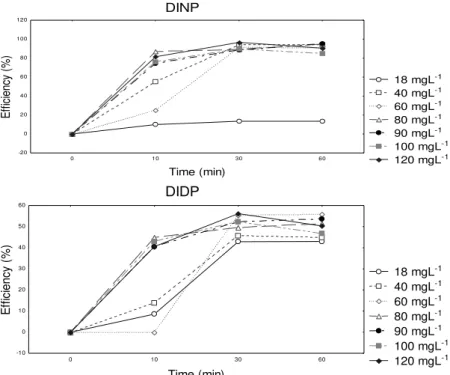
As can be seen in figure 1, DEP, BBP, DEHP, DINP and DIDP showed similar patterns of degradation. More exactly, the degradation was slow in the first 10 minutes of the experiments but rose to higher percentages after 30 minutes. The analyses realized after 60 minutes showed that there were no major changes in the phthalate concentrations in the last part of the experiments.
DEP
18 mgL-1
40 mgL-1
60 mgL-1
80 mgL-1
90 mgL-1
100 mgL-1
120 mgL-1
0 10 30 60
Time (min) -2 0 2 4 6 8 10 12 14 16 18 20 22 24 E ff ici en cy ( % ) BBP
18 mgL-1 40 mgL-1 60 mgL-1 80 mgL-1 90 mgL-1 100 mgL-1 120 mgL-1
0 10 30 60
Time (min) -10 0 10 20 30 40 50 60 E ffi ci en cy ( % ) DEHP
18 mgL-1
40 mgL-1
60 mgL-1
80 mgL-1
90 mgL-1
100 mgL-1
120 mgL-1
0 10 30 60
160
DINP
18 mgL-1
40 mgL-1
60 mgL-1
80 mgL-1
90 mgL-1
100 mgL-1
120 mgL-1
0 10 30 60
Time (min)
-20 0 20 40 60 80 100 120
E
ff
ici
en
cy
(
%
)
DIDP
18 mgL-1
40 mgL-1
60 mgL-1
80 mgL-1
90 mgL-1
100 mgL-1
120 mgL-1
0 10 30 60
Time (min)
-10 0 10 20 30 40 50 60
E
ff
ici
e
n
cy
(
%
)
Fig. 1. Effect of H2O2 concentration on phthalate degradation
It can also be observed that for BBP, DEHP, DINP and DIDP, the final degradation efficiencies varied differently when the experiments were conducted using H2O2 concentrations between 40 mg L
-1
and 120 mg L-1. The maximum efficiency for DEP (19%) was obtained at a concentration of 80 mg L-1 H2O2, for BBP (56%) at 60 mg L-1, for DEHP efficiencies between 88% and 90% where obtained for concentrations of H2O2 between 60 mg L
-1
and 100 mg L-1, for DINP (90%) at 40, 80 and 90 mg L-1 and for DIDP (56%) at 60 mg L-1 H2O2 respectively.
It can be concluded that the highest efficiency was registered at 100 mg L-1 H2O2. For this concentration the obtained efficiencies were 19% for DEP, 45% for BBP, 84% for DEHP, 85% for DINP and 48% for DIDP.
3.3. Effect of time
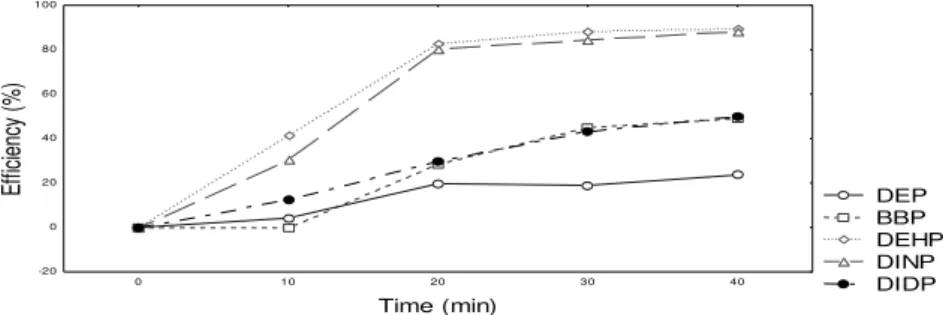
Because no significant changes were observed in the phthalate concentrations after 30 minutes in the previous experiments, another different experiment was conducted to determine the degradation pattern in correlation with the time parameter. For this purpose the degradation of the phthalates after 10, 20, 30 and 40 minutes were evaluated. The H2O2 concentration was set at 100 mg L
161
to reach the maximum efficiencies that can be obtained with the Fenton process for the tested compounds.
DEP BBP DEHP DINP DIDP
0 10 20 30 40
Time (min) -20
0 20 40 60 80 100
Ef
fici
en
cy
(%
)
Fig. 2. Influence of time on the Fenton degradation of phthalates
3.4. Effect of Fe2+ concentration
In order to find the optimum concentration of catalyst for which the degradation of phthalates reaches the maximum efficiency, concentrations of Fe2+ between 5 mg L-1 and 60 mg L-1 were tested. The concentration of H2O2 was maintained constant at a concentration of 100 mg L-1. The total reaction time was set at 30 minutes. As can be observed from figure 3, the maximum degradation took place at Fe2+ concentration of 10 mg L-1 for almost all the phthalate compounds, (50% degradation for BBP, 84% for DEHP, 90% for DINP and 43% for DIDP) except for DEP, which was degraded with maximum efficiency (23%) at a Fe2+ concentration of 20 mg L-1.
5 mg L-1
10 mg L-1
20 mg L-1
40 mg L-1
60 mg L-1
DEP BBP DEHP DINP DIDP
0 10 20 30 40 50 60 70 80 90 100
E
ffi
cie
ncy
(%
)
Fig. 3. Phthalate degradation efficiencies at different Fe2+ concentrations
3.5. Effect of Ph
In order to test the influence of pH on the Fenton degradation of phthalates, different experiments of 30 minutes were carried out at pH values between 1 and 5, with 100 mg L-1 H2O2, 10 mg L
-1
162
lowest efficiencies were obtained in the experiments conducted for the lowest (1) and highest (5) tested pH values.
1 2 3 4 5 DEP BBP DEHP DINP DIDP
0 10 20 30 40 50 60 70 80 90
E
ffi
cie
ncy
(
%
)
Fig. 4. Phthalate degradation efficiencies at different pH values
3.6. Photo Fenton degradation
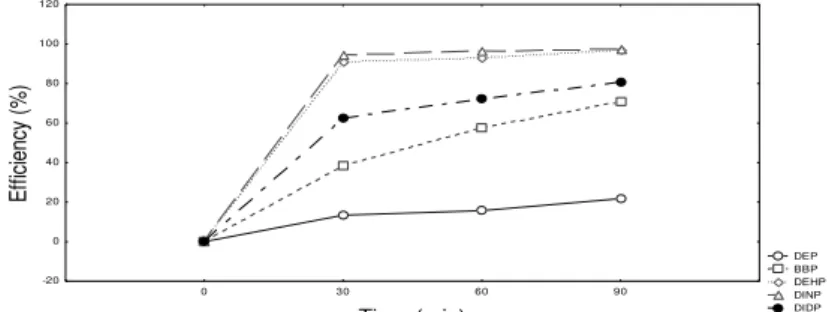
Based on the results obtained from the Fenton oxidation experiments, an attempt to increase the degradation efficiencies was made by using a Photo Fenton system. A deuterium arc lamp of 50 watts with a spectrum from 180 nm to 370 nm was added to the experimental installation used in Fenton experiments. The mixture of selected five phthalates was irradiated for different period of time, using as Fenton mixture 10 mg L-1 Fe2+, 100 mg/L H2O2, at pH value of 3. The phthalate concentration was maintained at 20 mg L-1. After 30, 60 and 90 minutes irradiation time, the reaction mixtures were extracted and analyzed. As can be seen in figure 5, only BBP and DIDP suffered noticeable increases in the degradation efficiencies compared to the results obtained in the Fenton experiments, while the degradation efficiency of DEP was almost the same and DEHP and DINP recorded an increase in efficiency of 13% and 7%.
DEP BBP DEHP DINP DIDP
0 30 60 90
Time (min) -20
0 20 40 60 80 100 120
E
ff
ici
en
cy
(
%
)
Fig. 5. Influence of time and UV radiation on phthalate degradation
4. CONCLUSIONS
The results this study show that for the Fenton AOP the degradation efficiencies of DEP, BBP, DEHP, DINP and DIDP were influenced by the concentrations of H2O2 and Fe
2+
163
The maximum degradation efficiencies, of 19% for DEP, 50% for BBP, 84% for DEHP, 90% for DINP and 48% for DIDP, were obtained in the experiments in which 100 mg L-1 H2O2, 10 mg L
-1
Fe2+ were used, at pH 3 after a total reaction time of 30 minutes.
In case of Photo-Fenton AOP only BBP and DIDP suffered noticeable increases in the degradation efficiencies, rising from 50% in the case of the Fenton oxidation to 71% after 90 minutes of irradiation for BBP, and from 48% to 81% in the case of DIDP. The degradation efficiency of DEP varied in very small limits around the value of 22% throughout the 90 minutes of irradiation and the degradation of both DEHP and DINP rose to 97%.
Acknowledgment
This work was perform in the frame of the Roumania-France Bilateral Cooperation, Program Brancusi, Project no. 705/2013 funded by UEFISCDI - Roumania and Project no 29541PE funded by Campus-France.
REFERENCES
1. Heudorf U., Mersch-Sundermann V., Angerer J., (2007), Phthalates: Toxicology and exposure, International Journal of Hygiene and Environmental Health, 210, 623-634.
2. Matsumoto M., Hirata-Koizumi M., Ema M., (2008), Potential adverse effect of phthalic acid esters on human health: A review of recent studies on reproduction, Regulatori Toxicology and Pharmacology, 50, 37-49.
3. Staples C.A., Peterson D.R., Parketon T.F., Adams W.J., (1997), The environmental fate of phthalate esters: A literature review, Chemosphere, 35(4), 667-749.
4. Bauer R., Fallman H., (1997), The Photo-Fenton Oxidation – A Cheap and Efficient Wastewater Treatment Method, Research on Chemical Intermediates, 23(4), 341-354.
5. Al-Tawabini B.S., (2003), Treatment of water contaminated with Di-n-butyl phthalate by photo-Fenton process, Global Nest: The International Journal, 5(1), 23-28.
6. Esmaeli R., Hassani A.H., Eslami A., Moghadam M.A., Safari A.A., (2011), Di-(2-Ethylhexyl) Phthalate Oxidative Degradation by Fenton Process in Synthetic
and Real Petrochemical Wastewater, Iranian Journal of Environmental Health and
Science Engineering, 8(3), 201-206.
7. Tay K.S., Rahman N.A., Abas M.R.B., (2011), Fenton degradation of dialkylphthalates: products and mechanism, Environmental Chemistry Letter, 9, 539-546.
8. Litter M.I., (2005), Introduction to Photochemical Advanced Oxidation Process for Water Treatment, Handbook of Environmental Chemistry, 2, 325-366.
9. Yang G.P., Zhao X.K., Sun X.J., Lu X.L., 2005, Oxidative degradation of DEP by
photochemically-enhanced Fenton reaction, Journal of Hazardous Materials,
B126, 112-118.
10. *** Directive 2000/60/EC -