• Nenhum resultado encontrado

Evaluation of outbreak response immunization in the control of pertussis using agent-based modeling

N/A
N/A
Protected

Academic year: 2017

Share "Evaluation of outbreak response immunization in the control of pertussis using agent-based modeling"

Copied!
22
0
0

Texto

(1)

Submitted

16 February 2016

Accepted

17 July 2016

Published

18 August 2016

Corresponding author

Alexander Doroshenko,

[email protected]

Academic editor

Alessandra Lo Presti

Additional Information and

Declarations can be found on

page 18

DOI

10.7717/peerj.2337

Copyright

2016 Doroshenko et al.

Distributed under

Creative Commons CC-BY 4.0

OPEN ACCESS

Evaluation of outbreak response

immunization in the control of pertussis

using agent-based modeling

Alexander Doroshenko

1

, Weicheng Qian

2

and Nathaniel D. Osgood

2

1

Faculty of Medicine and Dentistry, Department of Medicine, Division of Preventive Medicine,

University of Alberta, Edmonton, Alberta, Canada

2

Department of Computer Science, University of Saskatchewan, Saskatoon, Saskatchewan, Canada

ABSTRACT

Background

. Pertussis control remains a challenge due to recently observed effects

of waning immunity to acellular vaccine and suboptimal vaccine coverage. Multiple

outbreaks have been reported in different ages worldwide. For certain outbreaks, public

health authorities can launch an outbreak response immunization (ORI) campaign to

control pertussis spread. We investigated effects of an outbreak response immunization

targeting young adolescents in averting pertussis cases.

Methods

. We developed an agent-based model for pertussis transmission

repre-senting disease mechanism, waning immunity, vaccination schedule and pathogen

transmission in a spatially-explicit 500,000-person contact network representing a

typical Canadian Public Health district. Parameters were derived from literature and

calibration. We used published cumulative incidence and dose-specific vaccine coverage

to calibrate the model’s epidemiological curves. We endogenized outbreak response by

defining thresholds to trigger simulated immunization campaigns in the 10–14 age

group offering 80% coverage. We ran paired simulations with and without outbreak

response immunization and included those resulting in a single ORI within a 10-year

span. We calculated the number of cases averted attributable to outbreak immunization

campaign in all ages, in the 10–14 age group and in infants. The count of cases

averted were tested using Mann–Whitney

U

test to determine statistical significance.

Numbers needed to vaccinate during immunization campaign to prevent a single case

in respective age groups were derived from the model. We varied adult vaccine coverage,

waning immunity parameters, immunization campaign eligibility and tested stronger

vaccination boosting effect in sensitivity analyses.

Results

. 189 qualified paired-runs were analyzed. On average, ORI was triggered every

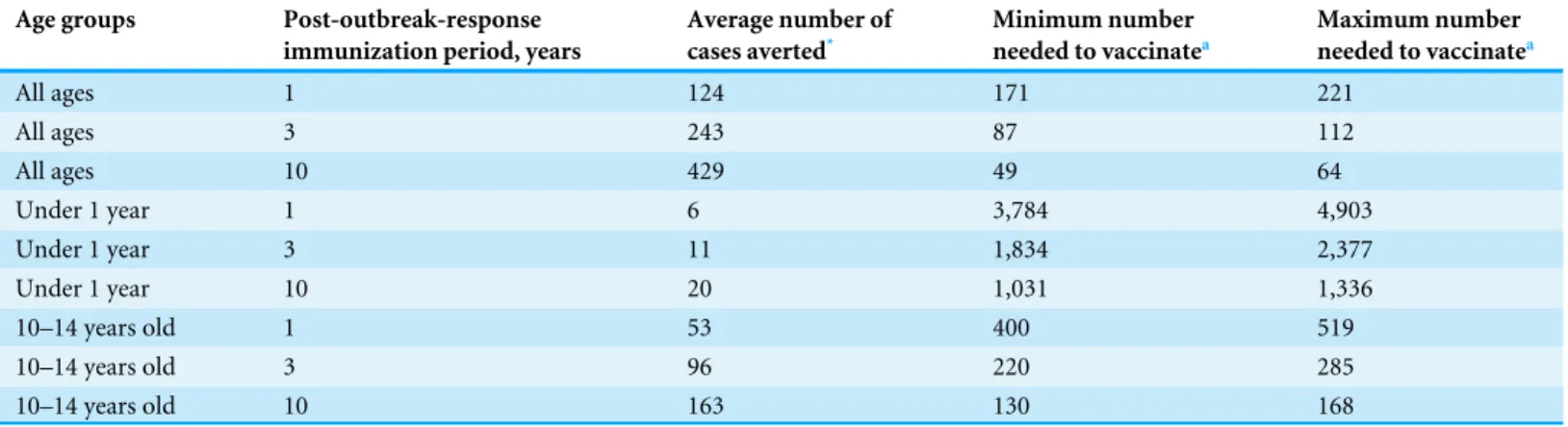
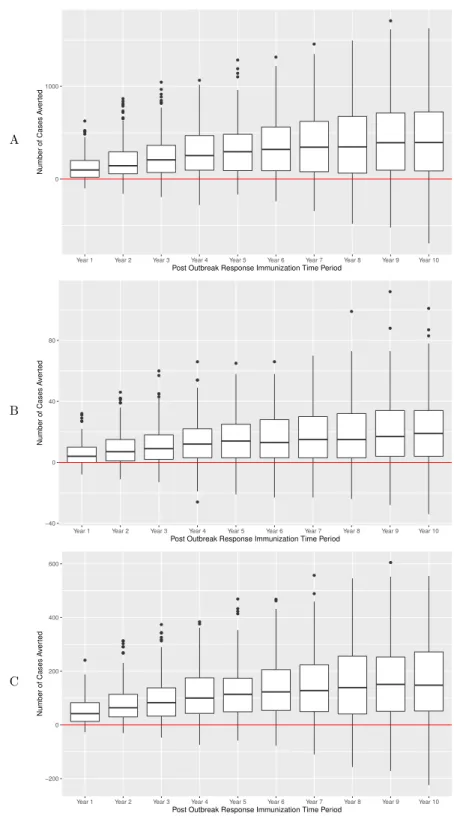
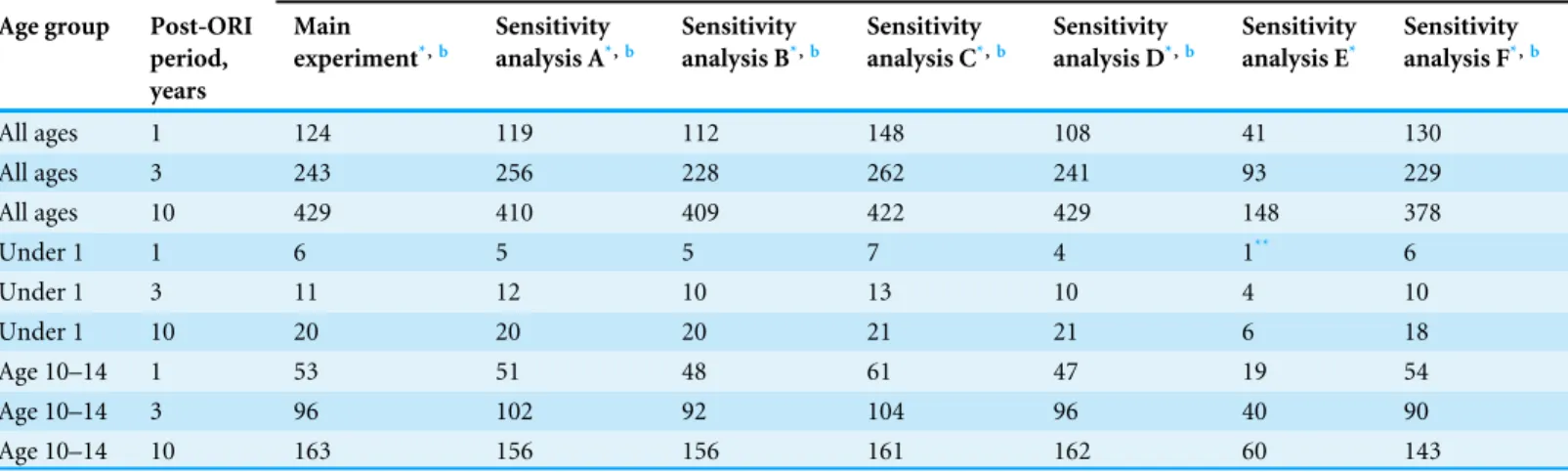
26 years. On a per-run basis, there were an average of 124, 243 and 429 pertussis cases

averted across all age groups within 1, 3 and 10 years of a campaign, respectively. During

the same time periods, 53, 96, and 163 cases were averted in the 10–14 age group, and 6,

11, 20 in infants under 1 (

p

<

0

.

001, all groups). Numbers needed to vaccinate ranged

from 49 to 221, from 130 to 519 and from 1,031 to 4,903 for all ages, the 10–14 age

group and for infants, respectively. Most sensitivity analyses resulted in minimal impact

on a number of cases averted.

(2)

outbreak of significant magnitude affecting predominantly the selected age and

achiev-ing a comprehensive vaccine coverage durachiev-ing the campaign. Economic evaluations and

comparisons with other control measures can add to conclusions generated by our

work.

Subjects

Computational Biology, Mathematical Biology, Epidemiology, Infectious Diseases,

Public Health

Keywords

Pertussis, Outbreak response immunization, Agent-based modeling, Waning

immunity

INTRODUCTION

Recent epidemiology of pertussis

In recent years, pertussis control has re-emerged as a prominent public health challenge,

with multiple outbreaks observed worldwide (

Tan, Dalby & Forsyth, 2015

), and with some

jurisdictions reporting the highest numbers of cases seen in decades (

California Department

of Public Health, 2015

). In Canada, the last peak in pertussis activity was seen in the

mid-1990s, after which incidence rates were gradually declining prior to a 2012 resurgence. This

recent increase was driven by outbreaks in several provinces/territories (

Smith et al., 2014

).

The national age-specific incidence rate remains highest among infants under 12 months

of age, an age group also suffering the most hospitalizations and deaths. However, recently

school-age children and younger adolescents have also borne a disproportionate burden,

particularly during outbreaks. During the 2012 New Brunswick outbreak, the highest

age-specific incidence rate fell in the 10–14 age group, which was twice as high as the incidence

rate among infants (1,240 vs. 660 per 100,000, respectively) (

Office of the Chief Medical

Officer of Health, 2014a

). Such increases in incidence rates among older children were

reported from several US states (

California Department of Public Health, 2015

;

Wisconsin

Department of Health Services, 2012

), suggesting a bimodal age distribution of cases in some

jurisdictions. During three most recent Minnesota outbreaks, the proportion of pertussis

cases among children 7–18 years old exceeded 60% (

Sanstead et al., 2015

).

The recent increase in pertussis activity is thought to be due to a combination of waning

immunity from acellular pertussis vaccine and sub-optimal vaccine coverage. In the

Ontario outbreak, cases were reported among unvaccinated individuals from a religious

community and among vaccinated school-aged children (

Deeks et al., 2014

). In New

Brunswick, 67% of cases in the 10–14 age group were up-to-date with their immunization

(

Office of the Chief Medical Officer of Health, 2014a

). Several studies estimated the annual

decline in protection after pertussis vaccination as ranging from 21% to 62% (

McGirr

& Fisman, 2015

;

Klein et al., 2012

;

Tartof et al., 2013

). Vaccine-derived protection among

individuals who were primed with the whole-cell pertussis vaccine is reported to be

greater compared to individuals who received purely acellular formulations (

Sheridan et

al., 2014

) Furthermore, natural disease confers even greater—but not life-long—protection

(

Wendelboe et al., 2005

). Genetic mutations in the

Bordetella pertussis

bacterium and better

(3)

Vaccination remains a cornerstone of public health measures to control pertussis.

Improving immunization schedule adherence by raising awareness among public is the

most commonly used intervention. The strategy of ‘‘cocooning’’ infants (vaccinating

parents and other individuals in close contact with infants) has been advocated, with

mixed reviews (

Rosenblum et al., 2014

;

Healy et al., 2015

). Immunizing pregnant women in

the third trimester of pregnancy to prevent pertussis disease in infants too young to receive

vaccination is recommended in the US (

Centers for Disease Control and Prevention, 2013

).

Modifications of the immunization schedule (changing the age of vaccine administration

or adding doses) have been discussed (

Libster & Edwards, 2012

). Developing new vaccines

will offer the best long-term control strategy, however it is not likely to occur in the short

term (

Meade, Plotkin & Locht, 2014

).

The ongoing occurrence of pertussis outbreaks presents a challenge to public health

au-thorities which may necessitate supplementary control measures. In Canada, immunization

of pregnant women is recommended only in outbreak situations (

Public Health Agency of

Canada, 2014b

). Early contact tracing and chemoprophylaxis of contacts has been advanced

as protective in control of school-based outbreaks (

Miguez Santiyan et al., 2015

). Outbreak

response immunization (ORI) has been employed if a particular group is disproportionately

affected and it is feasible to reach and vaccinate this group in a relatively short period of time

(

Office of the Chief Medical Officer of Health, 2014a

). ORI is supplementary immunization

given over and above the routine vaccination schedule, including to those who may be

fully immunized or those who did not receive their scheduled vaccines. Potential benefits

of ORI could accrue both in the short-term (terminating or limiting an ongoing outbreak)

and long-term (preventing future outbreaks) and may extend to age groups other than the

age group for whom ORI was targeted. The relevance of this intervention to all population

(all other age groups) reflects the fact that interrupting transmission among mostly affected

group may also decelerate transmission to other age groups with whom these individuals

come in contact. Furthermore, it is very important to see whether stopping outbreak in the

ORI target group can have a material effect on a particularly vulnerable population—babies

under 1 year of age. ORI may also blunt natural boosting from circulating sub-clinical

infections. The cost of such immunization campaigns, including emergency response

infrastructure, cost of vaccines and their delivery is high, and often not included in

routine immunization programs budgets. Evaluation of such immunization campaigns is

limited and the need for pertussis outbreak response research has been advocated (

World

Health Organization, 2009

). The objective of our study was to investigate the effect of

outbreak response immunization (ORI) among adolescents as an emergency public health

intervention in light of a recent re-emergence of pertussis outbreaks.

Modeling approaches for pertussis

Previous studies have used aggregate deterministic and stochastic models to understand

pertussis epidemiology and transmission and effects of vaccinations. In

Grenfell &

Anderson

’s

(1989)

deterministic model, reduction of pertussis cases attributed to

(4)

(

Hethcote, 1997

). Hethcote subsequently contributed multiple adaptations of this model

(

Hethcote, Horby & McIntyre, 2004

;

Van Rie & Hethcote, 2004

). Hethcote’s models were

adapted by other authors to evaluate effects of delays in pertussis immunization, improving

vaccine coverage (

Pesco et al., 2015

;

Pesco et al., 2013

) and effectiveness of a routine

adolescent booster (

Fabricius et al., 2013

).

Wearing & Rohani (2009)

used modeling to

estimate duration of pertussis immunity.

Gambhir et al. (2015)

used US surveillance data

to fit the model to estimate epidemiological and vaccine-related parameters responsible for

recent increases in pertussis activity and demonstrated difference in duration of protection

conferred by acellular versus whole-cell vaccine.

Sanstead et al. (2015)

developed an

agent-based model to characterize pertussis outbreaks in Minnesota.

Rationale for ABM

Impacts of interventions such as ORI cannot be summarized directly by collecting

surveillance data because of the lack of controls (absent ORI intervention for the same

outbreak). By contrast, such features and the complex interplay of waning immunity,

network-mediated transmission, falling vaccination coverage, immunity boosting effects

of exposure, and ORI and routine vaccination schedules make this investigation

well-suited to agent-based simulation modeling (

Mabry et al., 2010

). Such models can be used

to systematically evaluate health outcomes during pertussis outbreaks in an otherwise

identical context in the presence and absence of ORI. An agent-based modeling approach

was selected here due to several characteristics of the system involved, including—but

not limited to—the important role of individuals’ connections, the spatially clustered

character of outbreaks, the need for a finer-grained representation of both age and waning

immunity, and the need for a longitudinal lens to understand the impact of individual

vaccination compliance on vulnerability and to calibrate vaccination coverage data. An

agent-based approach was further valuable for representing certain ORI intervention

scenarios, particularly the restriction of administration of ORI to those with particular

classes of vaccination histories.

Methods

We developed an agent-based simulation model (ABM) and estimated the age-specific

effects of the pertussis ORI campaign in the 10–14 age group in simulated outbreaks in

terms of the number of cases averted over the short-, medium- and long-term (1, 3 and

10 years following ORI implementation) among young adolescents (ORI target group),

infants under 1 year and individuals of all ages. This study was approved by the Health

Research Ethics Board at the University of Alberta, study ID Pro00050642.

Model structure and agents characteristics

(5)

Figure 1

Model structure.

(A) Pertussis natural history statechart. (B) Demographic statechart. (C)

Vac-cination schedule statechart.

(6)

transitions between V, R and I states (with time and rate constants

τ ,α

and

γ

). Transitions

were expressed by time-based and exposure-based formulations (e.g., 2 year increments

to transition from higher to lower V states and 5 years to transition from higher to lower

R states). In order to more realistically model the shapes of epidemiological curves over

time to capture the outbreak dynamics that is critical to ORI triggering algorithms, we

added incubation periods to the state charts, based on triangular distribution. While earlier

adaptions of the Hethcote formulation typically assumed random mixing, in our model,

individuals are importantly exposed to pathogens over a contact network (see below). In

both cases, infection transmission is only possible to individuals who are susceptible (S

state) or in the lower two levels of vaccine- and naturally- induced immunity. Vaccination

and pathogen exposure boosts the level of both vaccine- and naturally induced immunity;

waning of immunity decreases such immunity over time. While in an infected state,

individuals in our model expose network connections, chosen with uniform probability,

to pathogen at an age-specific contact rate.

Demographic statecharts reflected a possible lifespan varying from 0 to 100 years

and illustrated individual mortality and (for female agents) fertility, with both being

characterized using age-specific hazard rates derived from Hethcote model. We used the

2004 Canadian population pyramid to initialize the simulation (

Fig. 1B

).

The vaccination schedule statechart is modeled on North American vaccination regimes.

It characterizes possible vaccination episodes at ages 2, 4, 6 and 18 months, and 4–6 and

11–14 years (dose 6 is given at 11–12 years of age in the US and in grades 7–9 in Canada),

with one adult (18 years or older) vaccination also depicted. The range of ages when an adult

dose is administered in our model is between 18 and 35. This reflects the fact that parents

of young children may receive such a dose as a part of ‘‘cocooning’’ strategy. Alternatively,

individuals presenting to emergency departments with tetanus-prone wounds may also

receive a pertussis-containing vaccine. At each such age juncture, a person has a vaccine

attitude- (acceptor, rejector or hesitant) (

Tables S1A

S1B

) and age- dictated probability of

securing a vaccination encounter; conditional on such an encounter, a vaccine is delivered.

In our model, we built a function to offer a catch-up vaccine if the previous dose is missed

up to the minimal age of the next dose (e.g., if 5th dose is missed, an individual can have

a chance to receive a catch-up dose up to the age of 11 years). The probability of offering

catch-up immunization is 90%, but this is conditional on an individual having a further

encounter with a vaccine provider, which in turn is dependent upon dose-specific vaccine

coverage as well as contingent on personal vaccine attitude (e.g., a vaccine rejecter will not

have a catch-up vaccine offered). Each occurrence of vaccination is associated with a fixed

chance of vaccine failure (

Fig. 1C

).

Network and spatial context

(7)

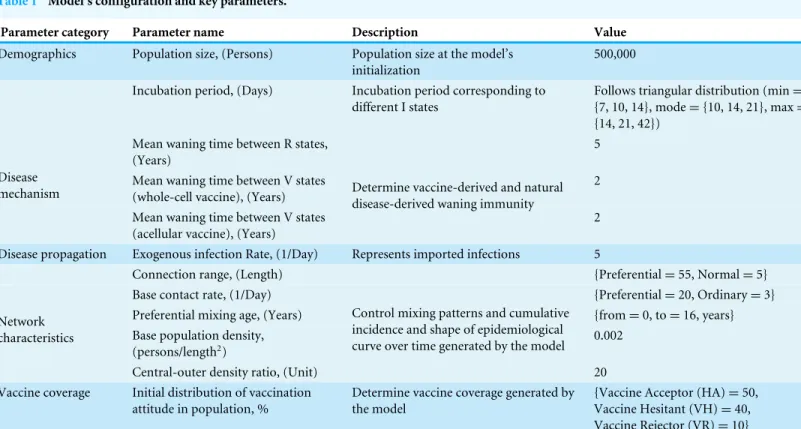
Table 1

Model’s configuration and key parameters.

Parameter category

Parameter name

Description

Value

Demographics

Population size, (Persons)

Population size at the model’s

initialization

500,000

Incubation period, (Days)

Incubation period corresponding to

different I states

Follows triangular distribution (min

=

{7, 10, 14}, mode

=

{10, 14, 21}, max

=

{14, 21, 42})

Mean waning time between R states,

(Years)

5

Mean waning time between V states

(whole-cell vaccine), (Years)

2

Disease

mechanism

Mean waning time between V states

(acellular vaccine), (Years)

Determine vaccine-derived and natural

disease-derived waning immunity

2

Disease propagation

Exogenous infection Rate, (1/Day)

Represents imported infections

5

Connection range, (Length)

{Preferential

=

55, Normal

=

5}

Base contact rate, (1/Day)

{Preferential

=

20, Ordinary

=

3}

Preferential mixing age, (Years)

{from

=

0, to

=

16, years}

Base population density,

(persons/length

2

)

0.002

Network

characteristics

Central-outer density ratio, (Unit)

Control mixing patterns and cumulative

incidence and shape of epidemiological

curve over time generated by the model

20

Vaccine coverage

Initial distribution of vaccination

attitude in population, %

Determine vaccine coverage generated by

the model

{Vaccine Acceptor (HA)

=

50,

Vaccine Hesitant (VH)

=

40,

Vaccine Rejector (VR)

=

10}

Based on their spatial location, agents were placed in a quasi-static assortive network in

which a pair of agents was connected only if they lay within a specified distance threshold

of each other. The model used different distance thresholds governing whether a given

pair of persons was connected according to the age group of pair members. Specifically,

while most pairs were connected only if they were within a certain range of each other, if

both members of the pair were between 0 and 16 years old (inclusive), an 11-fold larger

connection threshold was used guided by calibration.

Parameterization

We configured our model using key parameters given in

Table 1

. Disease mechanism

parameters pertaining to transitions between various

V

,

R

and

I

states were as described

in the

Hethcote (1997)

model. A primary vaccine failure probability described in the

literature (

McGirr & Fisman, 2015

), and incubation periods’ range reflecting literature

values (

Centers for Disease Control and Prevention, 2015

) were incorporated. Vaccine

coverage was generated by the model. To simulate the dynamics of vaccine coverage,

we classified all individuals into three groups: those who accept, reject and are hesitant

to receive vaccination. For each of these groups, we assigned vaccination probabilities. By

adding network characteristic parameters and an exogenous infection rate, we generated

real-time epidemiological curves.

Outbreaks and ORI triggers

(8)

tag (S

, S, S

+

). S and S

+

states would require exceedance of the 60-month moving

average (excluding designated outbreaks) by 2 and 3 standard deviations, respectively and,

additionally, exceedance of a specified monthly age-specific incidence rates (40 and 60 per

100,000, respectively); the latter being derived by examining surveillance and outbreak

reports (

California Department of Public Health, 2015

;

Office of the Chief Medical Officer

of Health, 2014a

;

Wisconsin Department of Health Services, 2012

;

Minnesota Department of

Health Pertussis, 2012

) and further by calibration. An outbreak was defined as occurring if

there were at least two consecutive months in the S state while ORI was triggered only in a

setting of three consecutive months in S states or two consecutive months in S

+

states. We

computed the rates of simulated outbreaks and ORI occurrence by dividing the number

of outbreaks and ORI interventions within a specified age group across all realizations

by the product of a total number of realizations in a given experiment and the 30 years

in each run (i.e., model run-years). For this study, we only triggered ORIs in the 10–14

age group. Reciprocals of the outbreak and ORI rates represent the mean period between

outbreaks within a given age group and

time between ORIs

, respectively. The latter was used

to evaluate sensitivity of our model to triggering ORIs. ORI implementation was modeled

as achieving 80% vaccination coverage for all individuals aged 10–14 at the time of ORI

administration.

Calibration and validation

To better capture epidemiological trends of pertussis, we employed both quantitative

and phenomenological approaches to validate and calibrate outputs from our model.

More specifically, for the latter, we used the pattern-oriented modeling (POM) technique

(

Grimm et al., 2005

;

Topping, Hoye & Olesen, 2010

;

Railsback & Grimm, 2012

) to optimize

our model structure to ensure that generated epidemiological curves are realistic. We

used this bottom-up strategy (

Railsback & Grimm, 2012

) to model the highly complex

system to improve our model robustness in a situation when interplay of multiple factors

governing pertussis transmission, outbreak propagation and vaccination dynamic are less

predictable and the understanding of the characteristics of the causal pathways involved

remains incomplete. We extensively varied most of our network parameters (connection

range, contact rate, exogenous infections rate) and studied resultant patterns by visual

inspection of baseline endemic activity, age-specific peaks of outbreaks and intervals

between outbreaks using a graphical-user interface. We identified obviously unrealistic

outputs and gradually converged towards a well-fitting combination of parameters.

Quantitatively, we adjusted model parameters to better match empirical cumulative

incidence and dose-specific vaccine coverage. We calibrated the model to bring the 30-year

cumulative incidence generated by the model in line with surveillance reports from

two public health jurisdictions of similar population size in Alberta (

Figs. 2A

and

S2

)

(

Alberta Health, 2015

). Comparability was defined as no more than 10% deviation between

Imagem

Figure 1 Model structure. (A) Pertussis natural history statechart. (B) Demographic statechart
Table 1 Model’s configuration and key parameters.
Figure 2 Model’s output validation and calibration. (A) 30-year model-generated cumulative incidence.
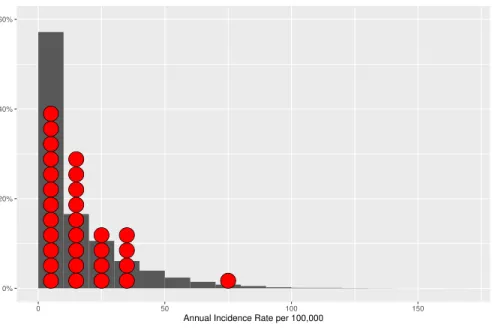
Figure 3 Distribution of the model-generated annual incidence rates in relation to empirical data.
+4

Referências

Documentos relacionados

The probability of attending school four our group of interest in this region increased by 6.5 percentage points after the expansion of the Bolsa Família program in 2007 and

Ao Dr Oliver Duenisch pelos contatos feitos e orientação de língua estrangeira Ao Dr Agenor Maccari pela ajuda na viabilização da área do experimento de campo Ao Dr Rudi Arno

Neste trabalho o objetivo central foi a ampliação e adequação do procedimento e programa computacional baseado no programa comercial MSC.PATRAN, para a geração automática de modelos

Ousasse apontar algumas hipóteses para a solução desse problema público a partir do exposto dos autores usados como base para fundamentação teórica, da análise dos dados

 Managers involved residents in the process of creating the new image of the city of Porto: It is clear that the participation of a resident designer in Porto gave a

If, on the contrary, our teaching becomes a political positioning on a certain content and not the event that has been recorded – evidently even with partiality, since the

 A todos que de uma maneira ou outra contribuíram para a realização deste trabalho.. Neste trabalho estudou-se novas alternativas para produção de ésteres via

E, se os educadores souberem aproveitar as potencialidades de seus alunos e alunas, podem obter bons êxitos, a começar pela disponibilidade das crianças, pois desse modo, as