Languages’ Education and Teaching
ISSN: 2198
–
4999, Doi Number: 10.18298/ijlet.1651
Year 4, Issue 3, December 2016, p. 20-35
FACTORS AFFECTING ENGLISH AS A FOREIGN LANGUAGE
TEACHERS’ PARTICIPATION IN ONLINE COMMUNITIES OF
PRACTICE: THE CASE OF WEBHEADS IN ACTION
Ali BOSTANCIOĞLU
1ABSTRACT
An online community of practice (OCoP) is a group of people, who are brought together by a shared interest and with the aim of deepening their understanding of an area of knowledge through regular interactions facilitated by computer mediated communication (CMC) tools. An OCoP can potentially provides teachers with those elements of effective professional development (PD), cited in the literature, such as; collaboration, opportunities for mentoring, and sustainability over time. In this sense, OCoPs can be considered as a viable alternative for teacher PD. If OCoPs are to become an alternative approach to teacher PD then it is important to understand what factors affect teachers’ participation in such communities. Therefore, through the case of Webheads in Action (WiA) OCoP, this study aimed to identify what factors contribute towards creating successful OCoPs. Members’ interactions in Wi“’s public group page were collated over a period of nine months and interviews with 24 members of the community (4 core, 9 active, 11 peripheral) were used to gather the data. Two major themes emerged in relation to factors affecting members’ participation in this OCoP. The first one was identified as the creation of a sense of belonging to the community which was achieved through various means such as having an initiation process and fostering trust and an inclusive community environment through community norms. The second was dynamism inherent in the community which manifested itself as new topics that kept members interested and participating, and a flow of continuous member recruitment to the community. In conclusion, this study highlighted the importance of the socio-affective dimension for designing and sustaining OCoPs.
Key Words: English as a foreign language (EFL), online community of practice (OCoP), teacher professional development.
1.
Introduction
Text Teaching is a dynamic process which is centred on certain variables such as the teacher, students, and classroom conditions (i.e. number of students, tools available). This dynamic interplay necessitates that teachers continuously adapt their teaching to suit their context. For example, in Turkey a project called F“TIH, which stands for Movement of Enhancing Opportunities and Improving Technology , has been started by the government and in line with the aims of this project classrooms have started to be equipped with interactive whiteboards, learning content to be digitized, and students to be provided with tablet computers (MoNE, n.d.). The aims and expectations of the FATIH project resulted in a push for teachers to adapt their teaching in a way that they would maximize the use of these technologies provided to them. In order to adapt to such changes, teachers generally get involved in professional development activities.
Professional development PD has been defined as any activity that is intended partly or primarily to prepare paid staff members for improved performance in present or future roles in the school districts (Little, 1987, p. 491). Engaging in PD is an important activity for teachers since this process can help teachers update their knowledge of a subject in the light of recent advances and/or exchange information and expertise with other teachers, experts, and/or academics (OECD, 1998). Results of the OECD Teaching And Learning International Survey (TALIS) suggest that teachers around the world are involved in various types of PD such as courses and workshops, education conferences and seminars, professional development networks, and informal dialogue (OECD, 2009). It is important that such PD opportunities are effective and meet teachers’ needs. However, researchers involved in writing the T“LIS report stated that a significant proportion of teachers think professional development does not meet their needs (OECD, 2009, p. 48).
In relation to the above point, online communities of practice (OCoPs) have recently been introduced and used as an alternative means of teacher PD. An OCoP can be defined as a group of people who share similar interests, aims, purposes or needs and share knowledge, collaborate or cooperate mainly via online communication networks and are guided by either formal or informal policies (based on definitions provided by Hunter, 2001; Jones & Preece, 2006; Wenger, White, & Smith, 2009). The reason for why OCoPs can be considered as an alternative means of PD is because OCoPs can potentially provide teachers with those elements of effective PD, cited in the literature, such as; collaboration, opportunities for mentoring, and sustainability over time (e.g. Cordingley, Bell, Thomason, & Firth, 2005; Darling-Hammond & McLaughlin, 1995; Walter & Briggs, 2012). In fact, evidence from studies investigating teachers’ PD and online communities highlight that teachers perceive such participation to be beneficial to their PD (e.g. Guzey & Roehrig, 2009; Kulavuz-Onal, 2013). If OCoPs are to become an alternative form of PD in the future then investigating factors that affect teachers’ participation in such communities becomes a worthwhile topic of investigation for the scientific inquiry. To date, however, there has been only a handful number of research studies investigating this topic (e.g. Booth, 2012; Hew, 2009; Lai, Pratt, Anderson, & Stigter, 2006). Therefore, the aim of this study was to contribute to both the field of teacher PD and OCoPs by studying the factors affecting teachers’ participation in an OCoP.
In line with the aim presented above, a case study design has been followed and Webheads in Action (WiA), which is a long standing OCoP of English as a foreign language (EFL) teachers around the world who gathered online in order to develop their knowledge and skills of integrating technology into their teaching, has been chosen to be studied (see Johnson, 2005; Kulavuz-Onal, 2013). WiA has been chosen as the case because it is considered that it provides an
extreme and critical case (Yin, 2014) since, unlike many other communities, it has existed for over 12
2.
Literature Review
2.1. Defining OCoPs
Text The concept of OCoP is based on the communities of practice (CoP) framework developed by Lave and Wenger in s. “ CoP can be described as a group of people who share a concern or passion for something they do, and learn how to do it better as they interact regularly (Wenger & Trayner, n.d., p. 1). This definition highlights the three fundamental characteristics of CoPs that Wenger et al. (2002; 2009) introduce, which are; a) shared domain, b) community, and c) practice. The
shared domain can be seen as the area of interest that brings individuals together (Wenger et al., 2002; 2009). The community aspect, on the other hand, refers to interactions taking place among members of a CoP (Wenger et al., 2002; 2009). Having gathered around a shared domain, members of a CoP engage in joint activities and participate in the negotiation of meaning which defines membership in a CoP. This process has also been described as mutual engagement where members acknowledge not only their own but also other members’ competence and knowledge, enabling each member to make meaningful connections with what other members share within the
community (Wenger et al., 2002). In this sense, mutual engagement binds members into a social entity. Members’ community) interactions around their shared interests (shared domain) result in a shared enterprise that can be considered as the practice of the community (Wenger et al., 2002; 2009). The practice includes both the activities that members of a community undertake together (i.e. exploring ideas and sharing information) and the products and artefacts that members create together (i.e. documents, tools, websites, articles, and so on). In line with the definition of a CoP and its three fundamental characteristics, for the purposes of this study, an OCoP has been defined as group of people who share similar interests, aims, purposes or needs and share knowledge, collaborate or cooperate mainly via online communication networks and are guided by either formal or informal policies. It can be seen that the most notable difference between the definition of a CoP and an OCoP is the form of communication which is mainly computer mediated in the latter and face-to-face in the former.
2.2. Theoretical foundations of OCoPs
proximal development ZPD . It should be noted that while Vygotsky has formed his theory of learning within the context of children’s development, his ideas have also been implemented in adult education. In fact, some researchers even used terms such as zone of proximal teacher development (Warford, 2011).
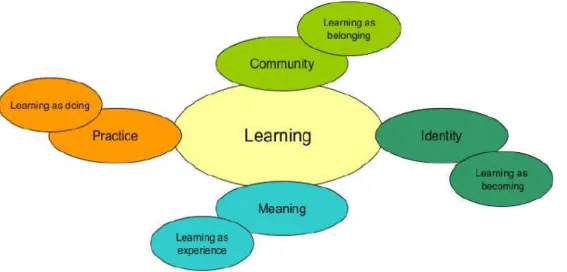
“s for Lave and Wenger’s (1991) Situated Learning theory, it is rooted in Vygotsky’s Sociocultural Learning theory. There are four main components of this social learning theory: 1) community that focuses on learning as belonging; 2) identity that considers learning as becoming; 3) meaning that refers to learning through our experiences of the social world; and 4) practice that can be seen learning while participating in an activity (see Figure 1). A key concept that is associated with Situated Learning theory and Communities of Practice (CoPs) is the concept of legitimate peripheral participation (LPP; Lave & Wenger, 1991). Lave and Wenger describe LPP as a process where learners’ initial participation in CoPs is peripheral and then in time, through their participation, those learners gain the knowledge and skills that enable them to move to full participation and become active and/or core members of the community (see Figure 2). To put it differently LPP allows new members to access the shared practices of a community and this process keeps the community alive by allowing those new members to be integrated to the community over time. Lave and Wenger (1991) refer to this as the process of community reproduction in which newcomers , in time through their observations of the community and gradually increased participation, become old-timers p. . The application of the Sociocultural Learning and Situated Learning theories in the context of teacher professional development suggest that teachers who join an OCoP go through various stages of LPP and move from being peripheral members to becoming active and/ or core members. Furthermore, it is also considered that this process allows teachers to scaffold one another, thereby potentially allowing the less experienced members to move through ZPD, advance their knowledge and skills, and develop professionally.
2.3. Teacher professional development and OCoPs
There are a number of research studies that have investigated teacher professional development in online communities. However, rather than including a long literature review on teacher professional development through online communities, it has been decided to provide a couple examples showing OCoPs potential for teacher professional development. This is because present study’s focus is factors affecting teachers’ participation in OCoPs.
advice and support to improve lesson plans when necessary, thus enabling the development of their skills in using and integrating technology. For example, the authors observed that Matt, one
Figure 1. Components of a social theory of learning, adapted from Wenger (1998, p. 5)
of the participants, made frequent use of Cmaptools2 in his teaching and uploaded them to his class
website, where he also directed questions to students and involved them in learning outside of school through their participation in online discussions. This can be considered to be an innovative pedagogy utilising technology in the sense that Matt used technology not only as a presentation tool but also took into consideration the context, his students and their abilities and engaged them actively in the learning process, which extended beyond the school thanks to technology.
The second study that is presented is Kulavuz-Onal’s (2013) netnography (online ethnography) which investigated the Webheads in Action (WiA) community that is also the community chosen as the case to be investigated in the present study. In addition to becoming a member of the WiA community, Kulavuz-Onal (2013) also interviewed members of the community and analysed the messages members shared with one another. Kulavuz-Onal (2013) concluded that EFL teachers who participated in her study had developed skills and knowledge of pedagogically sound technology integration for the language learning/teaching process. For example, as a result of her participation and interactions in the Wi“ community, ”eren one of the interviewees not only developed her repertoire [of technology tools] but also gained a better understanding of how contextual factors affected her choices and ways of applying various Web . tools in her teaching (Kulavuz-Onal, 2013, p. 264). Technologies, the use of which has been reported to be learned by members, included: blogs, wikis, and digital storytelling tools. The findings of studies presented above support the idea that OCoPs can, in fact, be able to provide opportunities for teachers’ professional development which, in return, highlight the importance of investigating factors that negatively and/or positively affect teachers’ participation in OCoPs.
2.4. Factors affecting teachers’ participation in OCoPs
Whilst there is evidence supporting potential benefits of participating in OCoPs for teachers’ professional development, to date, there have only been a handful of studies that investigated factors affecting such participation (e.g. Booth, 2012; Hew, 2009; Lai, et al., 2006). The studies conducted in this area have generally been qualitative studies which make it difficult to generalize their findings. “s such, ”litz , in her review on online learning communities, noted that the field has not yet produced a critical mass of work in any particular area of investigation, including
factors affecting teachers’ participation in online communities, that can be used to compare findings and derive informed conclusions p. . This highlights the need for more studies to be conducted in the field of OCoPs and teacher professional development, in this case factors affecting teachers’ participation in OCoPs. In addition, most of the communities that have previously been studied existed for less than a year; and been created by scientists for research purposes following a top-down approach (Blitz, 2013). Such top-top-down communities, however, contradict the assumptions of Sociocultural Learning theory that teachers will be in charge of creating, leading, and sustaining online collaborations for learning and professional development ”litz, , p. . Webheads in Action (WiA), on the other hand, is an OCoP which is organic and created by a group of online
teachers who participated in an online training and decided to continue their online interactions (Kulavuz-Onal, 2013). In this sense, finding from a case study on the WiA community can provide valuable insights to the field. Therefore, in line with the niches established above, the present study set out to answer the following research question: What are the reported factors that affect member participation in the WiA OCoP?
3.
Method
As detailed in the previous section, this study has been undertaken to investigate factors affecting EFL teachers’ participation in OCoPs through the case of Webheads in “ction Wi“ OCoP. In line with this intention, this section discusses the methodology followed to achieve the aims of this study.
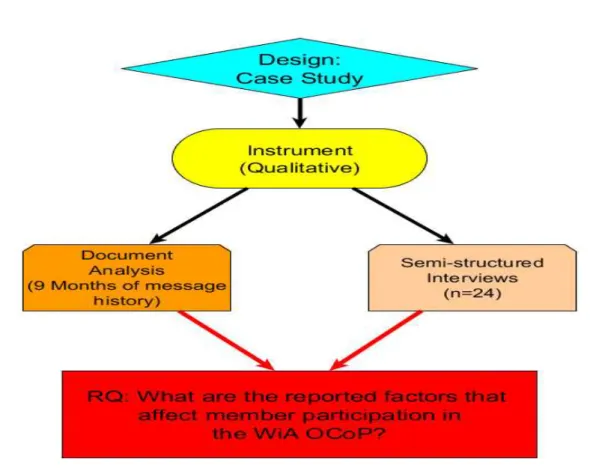
A qualitative case study design, which utilized interviews and document analysis, has been followed (see Figure 3). Following the invitation shared on the Wi“ community’s public Yahoo group page in the summer of 2014, 24 members of the community with various levels of participation (peripheral, active, and core members; Wenger, et al., 2002) volunteered to participate in the study. Furthermore, within group communications which were publicly available on the Yahoo group page were collated for a period of nine months (between October 2013 and June 2014) in order to support and/or challenge findings from the interview data.
The interview schedule was semi-structured since such interviews allow some basic structure to the questions, which can make it easier to compare individuals’ responses, whilst also allowing the flexibility of prompting and probing in order to follow up any specific issues of interests that emerge during the interviews (Cohen, Manion, & Morrison, 2007). Due to geographical distance between the researcher and the participants, interviews were held online through the use of Skype videoconferencing software. All interviews were recorded and transcribed afterwards.
Figure 3. Overview of methodology
As for the document analysis approach, a total of 190 message threads consisting of 566 messages which had been shared on Wi“’s public Yahoo group were collated between October and June 2014. The message threads were categorized (i.e. sharing resources, requesting help) and were used as a supplementary method for checking the themes generated from the interview data (Bryman, 1989).
Additionally, a number of steps were taken to establish the trustworthiness of the study. For example, in order to increase the credibility of the study a member checking procedure (Mertens, 2010) was followed in which the initial results were shared with the interviewees through a Webinar. Also in order to increase the transferability of the results, as much details as possible has been provided to offer a thick description Mertens, 10). Last but not least, it should be highlighted that the ethical guidelines suggested by the Association of Internet Researchers (AoIR, 2012) have been followed and ethical approval to conduct the present study has been granted by the Department of Education Ethics Committee at University of York, UK.
4.
Findings and Discussion
community have been discussed under two overarching themes in this section. The first is the creations of a sense of community and belonging and the second is dynamism inherent in the WiA community.
4.1. A sense of community and belonging
A sense of community has been defined as a feeling that members have of belonging … that members matter to one another … and a shared faith that members’ needs will be met through their commitment to be together McMillan & Chavis, as cited in Sharratt & Usoro, 2003). WiA members referred to one another as Webheads which implies that members of this community have developed a sense of belonging in the WiA community and over time have built a shared community identity:
… Thanks again Webheads! Thread , Message … when I became a Webhead… Sarah, “ctive member
Factors that have contributed to the creation of a sense of community and belonging have been identified as: having an initiation process for developing a shared community identity; voluntary participation; and having norms that guide member interactions.
4.1.1. Initiation process and development of a community identity
4.1.2. Voluntary participation
As explained above, following the BaW sessions participants were invited to join the WiA community. However, participating in a ”aW session does not oblige you to become part of the Webheads, you join if you wish ”etty, “ctive member . This suggested that it was those who were committed to the community that joined Wi“ in the end. Interviewees’ community interactions, in which they helped each other, were also on a voluntary basis. When considered in relation to the term Webhead which implies interviewees’ commitment to the community and its shared domain, this finding supports Wenger et al.’s claim , p. that for a community to form, the topic must be of more than just a passing interest see also ”ooth, Hew, . This finding also sheds light on why some of the online communities created for teachers might have failed (see for example Thang, Hall, Murugaiah, & Azman, 2011).
4.1.3. Community norms
Preece (2004) proposed that online communities need rules and/or norms which would guide members’ interactions. Interviewees’ responses showed that WiA interactions were, in fact, guided by a number of norms which, similar to findings of previous studies, seemed to facilitate community interactions (Booth, 2012; Hew, 2009). Those WiA norms were identified as: 1) providing support to other members; 2) being polite and respectful; 3) avoiding political and/or religious discussions; and 4) avoiding spamming.
they feel . “s such, the analysis of the message exchanges among Webheads showed that out of 190 (11 %) message threads had social support related content.
When it comes to respecting others and being polite, Delma (Active member) expressed that respect is something we value . Considering that members of the Wi“ are dispersed around the world and have different cultural backgrounds, it is not surprising that they consider respect as one of the main norms. Rebecca Peripheral member added that Webheads will respectfully respond to any query and Delma explained that when members share their ideas in the community it is possible that you may like them or not and you may discuss why you don’t like this or the other, always respectfully . In addition, Mary “ctive member expressed that politeness is at the top within the Wi“ community. Similarly, in Sally’s Peripheral member eyes, the Webheads are all very nice and polite [and] nobody is ever discouraging or making you feel stupid . In line with these observations, the analysis of public group messages showed that the use of terms such as please , dear , hugs from [….] , thanks , best wishes , cheers from […] , sorry for… were common.
Avoiding political and/or religious discussions was another norm reported by members. This is because Webheads perceived such discussions can result in conflicts, which could negatively affect community dynamics and divert community’s focus from its aims
…politics have been left aside and uhm we are all members of a community. We get together because we have these aims in mind which have to do with education and changing the paradigm of education Raine, “ctive member
We don't care what religion or which political party a person belongs to you know, we care about the individual, the individual who wants to learn, the individual who wants to share the knowledge etc. Delma, “ctive member
Avoiding spamming was another norm followed in the WiA community. Mike (Core member) explained that self-promotion or advertisements are not acceptable in the community unless they are aimed at initiating interactions. Vance (Moderator, Core member) elaborated on this issue further by stating that people can and are encouraged to promote their work if what they are promoting relates to the community and/or has academic value but not commercial . In fact, there had been an incident in the past in which one of the members started to harass the community by sending spams. In response to this, Vance (the moderator) banned the spammer and removed him from the group in order to protect the community.
I love it! ”ecause it's a way of having colleagues around the world but probably are doing the same as you are doing uhm and you learn from them. You share with them and they share with you their experiences Mary, “ctive member
Notably, the previous studies, which investigated successful teacher OCoPs, found that the norms of the community were enforced by the moderators, who were referred to as watchdogs Hew, , sheriffs or shepherds ”ooth, . These metaphors convey the idea that a moderator is responsible for maintaining the community as a safe place in which the members would feel secure enough to participate in online discussions. Different to those metaphors, in the present study, Vance’s Moderator role was likened to that of a cat herder by a number of interviewees, which Vance, himself, explained to reflect his hands-off management of the community. Vance explained that he would let members, who have problems, work it out . This implied that he did not want to be seen as an authority figure. Additionally, since no problems among members were observed in the public space of the community during the nine months of data collection, it seemed that the WiA community was self-organized and members were self-imposing the reported norms, another characteristic of successful online communities (Preece, 2004). In spite of this, however, when the community was harassed by one of its members in the past, it was Vance who took the initiative and blocked that member to restore order in the community. This suggests that Vance had a similar responsibility to the moderators who were referred to as watchdogs or sheriffs . Therefore, it can be interpreted that having a moderator who oversees the community is important for motivating members to participate by making them feel safe within the community.
4.2. Dynamism
Two main factors were identified to contribute to the dynamism inherent in the WiA community which were: 1) the dynamic nature of their shared domain; and 2) ongoing recruitment of new members to the community.
4.2.1. Dynamic nature of the shared domain
Wenger et al. , p. stated [a] domain is not a set of problems it evolves with the world and the community . This highlights the dynamic nature of the shared domain of a community suggesting it can change over time. Surprisingly enough, over the past 12 years that the WiA community had existed, the shared interest which brought them together did not seem to have changed. Similar to Johnson (2005) and Kulavuz-Onal’s findings, Webheads’ shared interest was identified as learning about the integration of technology into the language teaching/learning process. It is possible that the WiA group has sustained their interest in the educational uses of technology due to the fact that technology itself is a dynamic concept that has a fast pace of change. For example, Johnson (2005) reported that the WiA community, in its initial stages, used and held discussions about the use of synchronous text-chat technologies such as Yahoo! Messenger. More recently, however, they have started exploring the use of mobile devices and video conferencing tools such as Google+ Hangouts. In this sense, in line with Wenger et al.’s argument, it can be considered that community’s shared domain did, in fact, evolve over time. Therefore, it can be argued that the changes that take place within the shared domain provide the community with new topics around which to interact and lead discussions, which can be seen as a positive factor for members’ ongoing interactions and participation in the community.
4.2.2. Ongoing recruitment of members
Interview results showed that participants in this study joined the WiA community at different times, with some having become a member at the start of the community in 2002 (i.e. Vance) and some having joined just recently at the time of research (in 2014; i.e. Mona). This suggests that new members have been recruited to the community on an ongoing basis, which is in line with Lai et al.’s , p. claims that members join and leave communities of practice (CoPs) and that this inherent community turnover means there is a need for ongoing recruitment of members in order to sustain the critical mass (see also Wenger et al., 2002). Although in theory anyone who wants to join the WiA community can do so by simply registering themselves to Wi“’s Yahoo! group3, it was found that most of the interviewees participated in Becoming a Webhead (BaW)
online sessions prior to joining the community. In relation to this, while the need to recruit new members has been articulated in the literature, the process of how to recruit members to OCoPs does not seem to have received much attention, with the exception of Lai et al.’s , p. statement that community leaders usually recruit members privately . In fact, the findings of the
3
present study also lend support to Lai et al.’s claim, in the sense that the ”aW sessions- which brought new members to the community- were organized by core members of the WiA community who can also be considered as leaders/ coordinators. It can be argued that the BaW EVO sessions have provided a framework of apprenticeship or mentorship, which Wenger et al. , p. highlighted as a means to connect newcomers with old-timers . The analysis of data suggested that during the 10 years in which it ran, the BaW EVO session served the WiA OCoP as being an orientation and mentoring opportunity for new members, in which those new members became familiar with, not only the shared domain of the WiA community, but also met Webheads who mentored them prior to joining the WiA. Therefore, it is possible to argue that an induction program through which new members of the community are given orientation can be useful to motivate and integrate those members within the community (see also Wenger et al., 2009).
5.
Conclusion
Through studying the Webheads in Action OCoP, it is considered that a better understanding of OCoPs as social learning environments has been reached and the study contributed to the limited but growing body of research investigating teacher OCoPs. Based on the discussion of findings in the previous section, the following suggestions are offered as points of consideration for teachers, teacher educators, and policy makers. Since qualitative case studies are not generalizable and since each OCoP (including the case studied in this research) is unique and has its own characteristics, the findings of this study should not be treated as a prescription, in isolation from the contextual factors that might be present, for creating and/or sustaining OCoPs.
To begin with, it is important that teachers voluntarily participate in OCoPs rather than being mandated to participate. In order to increase teachers’ voluntary participation, we may work on creating opportunities to better inform teachers about the potential benefits of their participation in OCoPs (i.e. authentic, relevant, and flexible learning opportunities which are not constrained by time or location). In addition, this form of learning can be acknowledged and the time teachers are engaged with the community can be formally recognized by policy makers.
Additionally, since members join and leave online communities, it is important to develop mechanisms that would bring in new members. Such mechanisms can usefully provide induction and orientation to the community and its shared domain. This would help the development of a community identity allowing a better integration of new members.
6.
Acknowledgements
This research was made possible by a scholarship from Turkish Ministry of National Education to the author.
7.
References
AoIR. (2012). Ethical decision-making and Internet research: Recommendations from the AoIR ethics
working committee. Retrieved from http://www.aoir.org/reports/ethics2.pdf.
Blitz, C. L. (2013) Can online learning communities achieve the goals of traditional professional learning
communities? What the literature says. Washington, DC: U.S. Department of Education,
Institute of Education Sciences, National Center for Education Evaluation and Regional Assistance, Regional Educational Laboratory Mid-Atlantic.
Booth, S. E. (2012). Cultivating knowledge sharing and trust in online communities for educators.
Journal of Educational Computing Research, 47(1), 1-31.
Braun, V., & Clarke, V. (2006). Using thematic analysis in psychology. Qualitative Research in Psychology, 3(2), 77-101.
Bryman, A. (1989). Research methods and organisation studies. London: Routledge.
Carr, N., & Chambers, D. P. (2006). Teacher professional learning in an online community: The experiences of the national quality schooling framework pilot project. Technology, Pedagogy and Education, 15(2), 143-157.
Cohen, L., Manion, L., & Morrison, K. (2007). Research Methods in Education. New York: Routledge. cokehead. (n.d.). The dictionary of American slang Retrieved 25 May, 2015, from
http://dictionary.reference.com/browse/cokehead
Cordingley, P., Bell, M., Thomason, S., & Firth, A. (2005). The impact of collaborative continuing professional development (CPD) on classroom teaching and learning. Review: How do collaborative and sustained CPD and sustained but not collaborative CPD affect teaching and learning? In: Research Evidence in Education Library. London: EPPI-Centre, Social Science Research Unit, Institute of Education, University of London.
Darling-Hammond, L., & McLaughlin, M. W. (1995). Policies that support professional development in an era of reform. The Phi Delta Kappan, 76(8), 597-604.
Guzey, S. S., & Roehrig, G. H. (2009). Teaching science with technology: Case studies of science teachers’ development of technology, pedagogy, and content knowledge. Contemporary Issues in Technology and Teacher Education, 9(1), 25-45.
Hew, K. F. (2009). Determinants of success for online communities: An analysis of three communities in terms of members' perceived professional development. Behaviour and Information Technology, 28(5), 433-445.
Hunter, B. (2001). Against the odds: Professional development and innovation under less-than-ideal conditions. Journal of Technology and Teacher Education, 9(4), 473-496.
Johnson, C. M. (2005). Establishing an online community of practice for instructors of English as a foreign
language. Unpublished doctoral dissertation. Nova Southeastern University. Fort
Lauderdale, Floreida.
Kulavuz-Onal, D. (2013). English language teachers' learning to teach with technology through participation in an online community of practice: A netnography of Webheads in Action. Unpublished doctoral dissertation. University of South Florida. Florida.
Lai, K. W., Pratt, K., Anderson, M., & Stigter, J. (2006) Literature review and synthesis: Online
communities of practice. New Zealand: Ministry of Education.
Lave, J., & Wenger, E. (1991). Situated learning: Legitimate peripheral participation. Cambridge: Cambridge University Press.
Little, J. W. (1987). Teachers as colleagues. In V. Richardson-Koehler (Ed.), Educators’ Handbook: A
research perspective (pp. 491-518). New York: Longman.
Mertens, D. M. (2010). Research and evaluation in education and psychology: Integrating diversity with
quantiative, qualiutative, and mixed methods. Thousand Oaks, CA: Sage.
MoNE. (n.d.). About FATIH project Retrieved November 11, 2016, from http://fatihprojesi.meb.gov.tr/en/?page_id=10
OECD. (1998) Staying ahead: In-service training and teacher professional development. Paris: Author. OECD. (2009) Creating effective teaching and learning environments: First results from TALIS. Paris:
Author.
petrolhead. (n.d.). The dictionary of American slang Retrieved 25 May, 2015, from http://dictionary.reference.com/browse/petrolhead
Preece, J. (2004). Etiquette, empathy and trust in communities of practice. Stepping-stones to social capital. Journal of Universal Computer Science, 10(3), 194-202.
Rieber, R. W. (Ed.). (1997). The collected works of L. S. Vygotsky: (Volume 4) The history of the
development of higher mental functions. New York: Plenum Press.
Saldaña, J. . The coding manual for qualitative researchers. Thousand Oaks, CA: Sage.
Sharratt, M., & Usoro, A. (2003). Understanding knowledge-sharing in online communities of practice. Electronic Journal on Knowledge Management, 1(187-196).
Thang, S. M., Hall, C., Murugaiah, P., & Azman, H. (2011). Creating and maintaining online communities of practice in Malaysian smart schools: Challenging realities. Educational Action Research, 19(1), 87-105.
Vygotsky, L. (1978). Mind in society: The development of higher psychological processes. Cambridge, MA: Harvard University Press.
Walter, C., & Briggs, J. (2012). What professional development makes the most difference to teachers? A report sponsored by Oxford University Press.
Warford, M. K. (2011). The zone of proximal teacher development. Teaching and Teacher Education, 27, 252-258.
Wenger, E. (1998). Communities of practice: Learning, meaning, and identity. Cambridge: Cambridge University Press.
Wenger, E., McDermott, R., & Snyder, W. M. (2002). Cultivating communities of practice. Cambridge: MA: Harvard Business School Press.
Wenger, E., & Trayner. (n.d.). Introduction to communities of practice, from http://wenger-trayner.com/introduction-to-communities-of-practice/
Wenger, E., White, N., & Smith, J. D. (2009). Digital habitats: Stewarding technology for communities. Portland, OR: CPsquare.