Volume 2013, Article ID 385193,13pages http://dx.doi.org/10.1155/2013/385193
Review Article
Enhanced Optical Properties of Germanate and Tellurite Glasses
Containing Metal or Semiconductor Nanoparticles
Cid Bartolomeu de Araujo,
1Diego Silvério da Silva,
2Thiago Alexandre Alves de Assumpção,
2Luciana Reyes Pires Kassab,
3and Davinson Mariano da Silva
31Departamento de F´ısica, Universidade Federal de Pernambuco, 50740-540 Recife, PE, Brazil
2Departamento de Engenharia de Sistemas Eletrˆonicos, Escola Polit´ecnica da USP, 05508-900 S˜ao Paulo, SP, Brazil
3Laborat´orio de Tecnologia em Materiais Fotˆonicos e Optoeletrˆonicos, Faculdade de Tecnologia de S˜ao Paulo, CEETEPS/UNESP,
01124-060 S˜ao Paulo, SP, Brazil
Correspondence should be addressed to Luciana Reyes Pires Kassab; [email protected]
Received 14 December 2012; Accepted 17 January 2013
Academic Editors: R. Pode, P. D. Sahare, and D. Zhang
Copyright © 2013 Cid Bartolomeu de Araujo et al. his is an open access article distributed under the Creative Commons Attribution License, which permits unrestricted use, distribution, and reproduction in any medium, provided the original work is properly cited.
Germanium- and tellurium-based glasses have been largely studied due to their recognized potential for photonics. In this paper, we review our recent studies that include the investigation of the Stokes and anti-Stokes photoluminescence (PL) in diferent glass systems containing metallic and semiconductor nanoparticles (NPs). In the case of the samples with metallic NPs, the enhanced PL was attributed to the increased local ield on the rare-earth ions located in the proximity of the NPs and/or the energy transfer from the metallic NPs to the rare-earth ions. For the glasses containing silicon NPs, the PL enhancement was mainly due to the energy transfer from the NPs to the Er3+ions. he nonlinear (NL) optical properties of PbO-GeO2ilms containing gold NPs were also investigated. he experiments in the pico- and subpicosecond regimes revealed enhanced values of the NL refractive indices and large NL absorption coeicients in comparison with the ilms without gold NPs. he reported experiments demonstrate that germanate and tellurite glasses, having appropriate rare-earth ions doping and NPs concentration, are strong candidates for PL-based devices, all-optical switches, and optical limiting.
1. Introduction
Suitable composites for photonic applications have to present large transmittance, high refractive index, low cut-of phonon energy, and large nonlinear optical response. Germanate and tellurite glasses have these characteristics and were identiied as good hosts for trivalent rare-earth ions (REI) and metal or semiconductor nanoparticles (NPs) [1–12]. In these glasses, the linear and nonlinear optical properties may be largely enhanced due to the presence of the NPs. Speciically, in glasses containing metal NPs when the incident light or the photoluminescence (PL) wavelengths are near the localized surface plasmon resonance (LSPR) wavelength,�SP, a large PL enhancement may occur. In principle,�SP depends on the host and metal dielectric functions as well as on the
Table 1: Composition and parameters used for production of the glass samples. M/A refer to melting/annealing.
Sample Glass composition (wt.%) Dopants (wt.%) M/A temperature (∘C) M/A time (h)
PGO-Er/Yb:Ag 40.3GeO2-59.7PbO 0.5Er2O3-3.0Yb2O3-1.0AgNO3 1200/420 1/2
PGO-Eu:Ag 40.3GeO2-59.7PbO 0.5Eu2O3-3.0AgNO3 1200/420 1/3
BGO-Eu:Au 58.4GeO2-41.6Bi2O3 0.5Eu2O3-3.0Au2O3 1100/420 1/3
BGO-Er:Si 58.4GeO2-41.6Bi2O3 0.5Er2O3-0.2Si nanopowder 1100/420 1/3
TZO-Er:Ag 85.0TeO2-15.0ZnO 0.5Tm2O3-2.0AgNO3 800/325 20/2
TWB-Er:Ag 54.5TeO2-22.6WO3-22.7Bi2O3 1.0Er2O3-2.0AgNO3 760/360 45/1
he irst report on nucleation of silver NPs in germanate glasses (PbO-GeO2) was presented in [17], whereas the possibility of production of silver NPs in tellurite glasses was published for the irst time in [18]. Also it was reported for the irst time the nucleation of copper NPs in PbO-GeO2 thin ilms for applications in all-optical switching [19]. he various studies reported for germanate and tellurite glasses, with metallic NPs and diferent REI, demonstrated the large potential of these materials for photonic applications. On the other hand, the inluence of Si NPs on the PL properties of glasses remains a unexploited subject. Recently, we developed a procedure to nucleate Si NPs in germanate glasses that was very eicient to improve the PL properties of germanate glasses.
In this paper, we review recent experiments based on the nucleation of Ag, Au, and Si NPs in germanate and tellurite bulk glasses containing REI and discuss the optical behavior of the samples under diferent excitation conditions. Besides the work with bulk samples, the production of germanate thin ilms using the radio-frequency sputtering technique is also reported. he nucleation of gold NPs in the ilms is described, and a study of the NPs inluence on the ilms’ nonlinear optical properties is presented.
he paper is organized as follows. In Section 2, we describe the fabrication methods and the characterization techniques used to study the samples. In Section 3, the structural characteristics of the samples as well as their optical characteristics are discussed. Finally in Section4, we comment on the perspectives of applications for the kind of composites discussed here.
2. Methods
2.1. Production of the Bulk Samples. Germanate (GeO2 -PbO and GeO2-Bi2O3) and telurite (TeO2-ZnO and TeO2 -WO3-Bi2O3) glasses were prepared with high-purity reagents (99.999%) using the melt-quenching method followed by adequate heat treatment (HT) that depends on the transition temperature of each glass composition. he compositions studied are shown in Table1as well as the parameters used in the fabrication process.
he reagents were melted in crucibles made of platinum (for the tellurite glasses) or alumina (for the germanates). Mechanical stirring during the melting was applied to ger-manate glasses, to optimize transparency and homogeneity. Ater cooling to room temperature inside the furnace, the samples were polished, cut, and then submitted to additional
HT to nucleate metallic NPs (metallic ions Ag+and Au+from AgNO3 and Au2O3 are reduced to Ag0 and Au0, resp., for nucleation of the NPs). Samples without metallic NPs were also fabricated to be used as reference.
he melt-quenching technique was also used for the fabrication of the samples with silicon quantum dots mixing Si nanograins having average diameter of 100 nm with the base germanate glass constituents. he starting reagents were melted inside an alumina crucible for 1 h at 1200∘C, quenched in air in a preheated brass mold, and annealed at 420∘C to minimize internal stress. Finally, the glasses were cooled to room temperature inside the furnace. Ater cooling, the samples’ surfaces were polished to optical quality. Samples without Si-NCs and doped with Er3+ were also fabricated to be used as reference. Transparent glasses stable against crystallization were produced. he density of Si-NCs was controlled by heat-treating the samples for time intervals of 3, 48, and 72 hours, at 420∘C.
2.2. Production of the hin Film Samples. he production of noncrystalline ilms with and without gold NPs was made by RF sputtering (at 13.56 MHz) under 5.0 mTorr of argon. For the glass target preparation, the oxide powders were mixed and then submitted to 8 tons uniaxial press. hen, sinterization at 750∘C, for 10 h, was performed followed by HT at 370∘C, at room atmosphere. he ilms without NPs were prepared using a target with the composition 40GeO2 -60PbO (in wt%). he ilms with gold NPs were prepared using the same glass target and a metallic gold target (purity of 99.99%). he two targets were simultaneously sputtered. he ilms were deposited on silica substrates placed 15 cm far from the targets. he RF power applied in each target was 50 W for the GeO2-PbO target and 6 W for the gold target; the deposition time was set to obtain ilms with thickness of
≈1.0�m. he HT of the ilms was performed during diferent times and temperatures to nucleate the gold NPs.
2.3. Techniques Employed for Characterization of the Samples.
To investigate the size and shape of the NPs, a Transmis-sion Electron Microscope (TEM) operating at 200 kV and a high-resolution transmission electron microscope (HR-TEM) operating at 300 kV were used. electron difraction measurements were performed to conirm the crystalline structure of the NPs.
400 450 500 550 600 650 700 0.25 0.5 0.75 1 1.25 1.5 1.75 2 2.25 A b so rp tio n sp ec tr um (a.u .) 3h 48h 24h 72h Wavelength (nm) Without AgNO3 7F1
-5D
3
7F0
-5L6
7 F0
-5 D
2
(a)
400 450 500 550 600 650 700 0.25 0.5 0.75 1 A b so rp tio n sp ec tr um (a.u .) Wavelength (nm) Without Au2O3
350 750
3h
48h
24h
72h
7F0
-5D
1
7F1
-5D 1 7 F0 -5D 0
7F0
-5L6
7F0
-5D
3
7F0
-5D
2
(b)
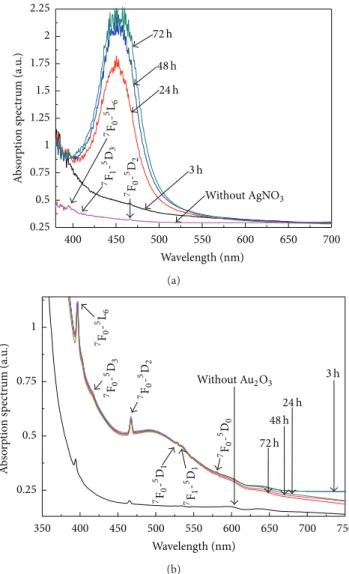
Figure 1: Absorption spectra of the Eu3+ doped samples heat-treated during diferent times. (a) PGO-Eu:Ag. (b) BGO-Eu:Au. Also presented are the spectra of both glasses without metallic NPs [1].
A spectrophotometer that operates in the visible and near-infrared regions was used to measure the absorption spectra of the samples.
PL spectra were measured with diferent kinds of excita-tion sources, depending on the sample. In the case of the Eu3+ doped samples, excitation at 405 nm was obtained from a 15 W xenon lamp followed by a 0.25 m monochromator equipped with a holographic grating and the signals were analyzed by a phase luorometer. For the Er3+doped samples, a CW 980 nm diode laser and an ytterbium laser operating at 1050 nm were used. For the Tm3+ doped samples, an Nd3+: YVO laser operating at 1047 nm was utilized the acquisition of signals was obtained with a monochromator with a photomultiplier connected to a lock-in and a computer. he nonlinear measurements at 532 nm were made using the second harmonic of a Nd: YAG laser (Q-switched and mode-locked), coupled to a pulse selector for experiments with single pulses of 80 ps at 7 Hz. he Z-scan technique
30 25 20 15 10 5 0
580 600 620 640 660 680 700 Wavelength (nm)
Without AgNO3
L u mines cence in te n si ty (a.u .) 3h 48h 24h 72h 5D 0
-7F0 5D0
-7F1
5 D
0
-7 F2
5D
0
-7F3 5D
0
-7F4
(a) 70 60 50 40 30 20 10 0 3h 48h 24h 72h
580 600 620 640 660 680 700 720 Wavelength (nm)
Without Au2O3
L umines cence in te n si ty (a.u .)
5D0
-7F0 5D
0
-7F1 5D
0
-7F2
5D
0
-7F3 5D
0
-7F4
(b)
Figure 2: Luminescence spectra of the Eu3+doped samples heat-treated for diferent times. (a) PGO-Eu:Ag. (b) BGO-Eu:Au. Also presented are the spectra of both glasses without metallic NPs. Excitation wavelength: 405 nm [1].
[20] was used to measure the nonlinear refractive index and nonlinear absorption coeicient of the samples. he response time of the nonlinearity was determined by a Kerr gate setup [21] based on a Ti-sapphire laser (800 nm; 76 MHz; 150 fs) as the light source. he signals were processed using a boxcar and a computer.
3. Results
3.1. Luminescence of Bulk PGO-Eu:Ag and BGO-Eu:Au. he inluence of the metallic NPs on electric-dipole and mag-netic-dipole transitions of Eu3+doped germanate glasses was studied in PGO-Eu:Au and BGO-Eu:Au samples with various NPs concentrations and their absorption spectra are shown in the Figures1(a)and1(b).
25
20
15
10
5
0
40
5
nm
578
nm
590
nm
61
4
nm
652
nm
695
nm
5L
6
5D
3
5D
2
5D
1
5D
0
7F
4
7F
3
7F
2
7F
1
7F
0
Ener
g
y (10
3cm −1)
Figure 3: Simpliied energy levels scheme of Eu3+ ions with indication of the radiative transitions observed. he shaded area indicates the position of the localized surface plasmon band [1].
(a)
(b)
Figure 4: TEM image of the Eu3+doped samples: (a) GeO2-PbO glass with silver NPs heat-treated for 72 hours, (b) GeO2-Bi2O3glass with gold NPs heat-treated for 24 hours [1].
400 450 500 550
0.2 0.3 0.4 0.5
400 600 800 1000 1200 1400 1600 0.2
0.4 0.6 0.8 1 1.2
Wavelength (nm)
2G
9/2
4S
3/2
4F
7/2
2H
11/2
Annealing time:
2h
24h
48h
72h
Yb3+(2F5/2)+Er3+(4I11/2)
4G
9/2
4I
9/2 4I13/2
4F
9/2
A
b
so
rp
tio
n
sp
ec
tr
um (a.u
.)
Wavelength (nm)
4F
3/2+4F5/2
Figure 5: Absorption spectra of PGO-Er/Yb:Ag glasses containing silver NPs for diferent heat-treatment times [2].
band centered at ≈500 nm and a background that extends toward the near infrared, due to the LSPR of the gold NPs and their aggregates.
PL spectra of the same samples for excitation at 405 nm are shown in the Figures2(a)and2(b).
he spectra consist of the 4f-4f transitions associated to the Eu3+ions:5D0-7F1(585 nm),5D0-7F2(614 nm),5D0-7F3 (650 nm), and5D0-7F4(700 nm). he results indicate that the PL amplitudes are afected by the presence of the metallic NPs, for both samples.
It is clearly noticed that the samples with either silver or gold NPs reach maximum PL enhancement for HT during 3 hours; for longer HT times, it is observed the quenching of the PL spectra for both samples. his behavior is understood considering that with the increasing of the HT time, more Eu3+ ions become so near from the NPs that energy transfer occurs from the directly excited ions to the NPs. he quenching phenomenon occurs because of short-distance Eu3+-NPs the dipole-dipole interaction between the ion and an NP becomes large [22].
A simpliied energy diagram of the Eu3+ion is shown in Figure3. Notice that the excitation and the PL wavelengths are near resonance with the LSPR.
Figure4shows the TEM images of both samples with a distribution of nearly spherical NPs that contributes to the relatively narrow LSPR bands observed in the absorbance spectra.
500 550 600 650 700 0
1 2 3 4 5
III I
II
Wavelength (nm)
Annealing time:
2h
24h
48h
72h
UC l
umines
cence in
te
n
si
ty (a.u
.)
(a)
0 10 20 30 40 50 60 70 80 0.7
0.8 0.9 1
Containing AgNO3 UCI/UCIII
UCII/UCIII
UCI/UCII
N
o
rm
alized in
te
gra
ted
in
te
n
si
ty ra
tio
Annealing time (hours)
(b)
Figure 6: (a) Frequency upconversion spectra of the of Er3+/Yb3+codoped PbO-GeO2glasses containing silver NPs for diferent heat-treatment times. (b) Normalized integrated upconversion intensity (UCI: peak centered at 525 nm, UCII: peak centered at 550 nm, and UCIII: peak centered at 662 nm) as a function of the annealing time [2].
Figure 7: TEM images of the samples annealed during 48 h at 420∘C [2].
gold NPs in the glasses produces a large PL enhancement. Our results are understood considering the energy transfer pro-cess from the metallic NPs to the ions and the enhancement of the conined electromagnetic ield in the vicinity of the NPs. he PL intensity enhancement associated to magnetic dipole transitions (5D0-7F1) of Eu3+ ions are due to the conined optical magnetic ield. Comparisons of the results for the mixed electric-dipole magnetic-dipole transition (5D0-7F3) with the relative growth of the 5D0-7F2 transition indi-cate that the inluence of optical magnetic ield is relevant also in this case. In other words, although the magnetic response at optical frequencies is usually weak, the location
20
15
10
5
0 4I15/2
4I
13/2
4I
11/2
4I
9/2
4F
9/2
4S
3/2
2H
11/2
2F
7/2
52
5
nm
550
nm
662
nm
Er3+ Yb3+
980nm
2F
7/2
2F
5/2
Ener
g
y (10
3cm −1)
Figure 8: Energy level diagram of Er3+and Yb3+ions illustrating possible upconversion pathways for Er3+/Yb3+codoped glasses. he solid straight lines with upward and down arrows indicate optical transitions; dotted lines and wavy arrows denote ET processes and non-radiative relaxation, respectively [2].
of europium ions in a region where the electromagnetic ield is conined contributes for the increase in the signals associated to magnetic dipole transitions. Furthermore, the 1000% enhancement of the PL corresponding to transition
5D
0-7F2is a remarkable result [1].
3.2. Energy Transfer and Frequency Upconversion in Bulk PGO-Er/Yb:Ag. he energy transfer and frequency upcon-version processes in Yb3+/Er3+doped PbO-GeO2glass were studied in the samples containing silver NPs. he excitation wavelength was 980 nm in resonance with the Yb3+transition
2F
7/2-2F5/2. he eicient energy transfer from resonantly
excited Yb3+ to Er3+ and the inluence of the Ag NPs con-tributed to large enhancement of the whole upconverted spectrum. Absorption and emission spectra of the PGO-Er/Yb:Ag samples for diferent HT times are shown in Figures
400 450 500 550 600 650 700 750 800 850 900 0
0.5 1 1.5 2 2.5 3
Wavelength (nm)
2h
24h
48h
72h
3F
2,3 3H
4
A
b
so
rp
tio
n
sp
ec
tra (a.u
.)
Figure 9: Absorption spectra of TZO-Tm:Ag glasses for diferent heat-treatment times [3].
and 662 nm that correspond, respectively, to the transitions
2H
11/2 → 4I15/2,4S3/2 → 4I15/2, and4F9/2 → 4I15/2can be
seen in Figure 6(a). Figure 6(b) shows that the relative intensity of the upconversion bands can be adjusted by an appropriate choice of the HT time that controls the amount of silver NPs formed in the sample.
he LSPR band is not observed in Figure5because the amount of silver NPs is not enough to originate a strong band. However, we estimate, with basis on the dielectric function of silver [19], that�SP is located between≈400 and≈500 nm, as shown in the Figure1(a). However, the presence of silver NPs in the samples is conirmed by the TEM images shown in Figure7.
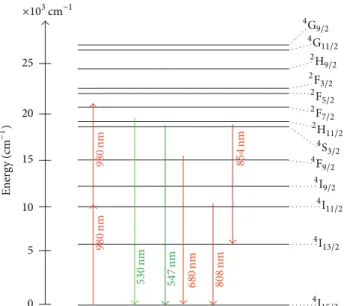
he emission peaks observed in the spectra of the Fig-ure6(a)are due the transitions indicated in the simpliied energy level diagram for the Er3+ and the Yb3+ ions in Figure8. he proximity between the green PL wavelengths and the LSPR favors the PL intensity enhancement. he red emission is also intensiied for larger values of annealing times and this is attributed to the nucleation of larger silver NPs and aggregates.
he ratio between the integrated intensities of transitions centered at 525 nm and 550 nm changes from 0.77 (HT≈0 h) to≈1.0 (HT≈50 h) because the transition at 525 nm is closest to the estimated LSPR wavelength than 550 nm.
In summary, with the present results we demonstrated the simultaneous exploitation of the enhanced local ield contribution due to silver NPs and energy transfer processes between two diferent RE ions in order to control the PL spectrum of the glassy composite material. his approach can be applied for diferent RE ions in order to improve the eiciency of luminescent displays.
3.3. Frequency Upconversion in Bulk TZO-Tm:Ag and TWB-Er:Ag. he frequency upconversion properties of Tm3+ doped TeO2-ZnO glasses containing silver nanoparticles was
400 440 480 520 560 600 640 680 0
25 50 75 100 125 150 175 200 225
Wavelength (nm)
L
u
mines
cence in
te
n
si
ty (a.u
.) 1G4→3H6
1G
4→3F4
Without silver NPs
2h
24h
48h
72h
(a)
725 750 775 800 825 850 875 900 0
100 200 300 400 500 600 700 800
Wavelength (nm)
L
u
mines
cence in
te
n
si
ty (a.u
.) 3H4→3H6
Without silver NPs
2h
24h
48h
72h
(b)
Figure 10: Emission spectra of TZO-Tm:Ag glasses for diferent heat-treatment times [3].
reported for the irst time in [3]. For excitation, we used a laser operating at 1050 nm. he inluence of the silver NPs in the infrared-to-visible and infrared-to-infrared upconversion processes associated to the Tm3+ ions was studied. Absorp-tion and emission spectra of the TZO-Tm:Ag samples heat-treated for diferent HT times are shown in Figures9and10, respectively.
Figure 11: TEM images of the samples heat-treated during 48 h [3].
Ener
g
y (
10
3cm −1)
0 5 10 15 20 25 30
1D
2
1G
4
3F
2,3
3H
4
3H
5
3F
4
3H
6
Tm3+
477
nm
650
nm
800
nm
105
0
nm
Figure 12: Simpliied energy level diagram of Tm3+ ions with indication of the upconversion pathways and wavelengths [3].
Figure 12presents a simpliied energy diagram for the Tm3+ions with indication of the excitation pathways and the PL transitions observed.
One order of magnitude enhancement is observed for the whole PL spectra that is a remarkable result. he spectra corresponding to HT during 72 hours show partial quenching of the PL intensity as reported for other samples.
he dependence of the upconversion signals with the laser intensity was analyzed to identify the routes correspond-ing to each upconversion emission. he log-log plots of the upconversion intensities corresponding to transitions1G4 →
3H
6,1G4 → 3F4and3H4 → 3H6present slopes of≈2.7,≈2.8,
450 500 550 600 650 700 750 800 850 900 950 1000 0
0.2 0.4 0.6 0.8 1 1.2 1.4 1.6 1.8
Wavelength (nm) Without Ag NPs
1h
24h
48h
72h
4F
3/2+4F5/2
4F
7/2
2H
11/2
4S
3/2 4
F9/2 4
I9/2 4I11/2
A
b
so
rp
tio
n
sp
ec
tra (a.u
.)
Figure 13: Absorption spectra of TBW-Er:Ag glasses for diferent heat-treatment times [4].
Without Ag NPs
1h
24h
48h
72h
500 550 600 650 700
0 0.03 0.06 0.09 0.12 0.15 0.18 0.21 0.24 0.27
640 660 680
0 0.005 0.01 0.015
Wavelength (nm)
L
u
mines
cence in
te
n
si
ty (a.u
.)
Figure 14: Emission spectra of TBW-Er:Ag glasses for diferent heat-treatment times [4].
and≈1.8, respectively. hese results indicate that the PL bands at 477 nm and 650 nm are due to the absorption of three laser photons, while the transition3H4 → 3H6is due to the absorption of two photons. Considering the mismatch between the incident photon energy and the energy levels, we conclude that the upconversion processes occur because the intermediate steps are phonon-assisted. Even the excited state absorption3F4→ 3F2,3which is resonant is followed by emission of phonons due to the decay from level3F2,3to the level3H4.
25
20
15
10
5
0
×103cm−1
4G
9/2
4G
11/2
2H
9/2
2F
3/2
2F
5/2
2F
7/2
2H
11/2
4S
3/2
4F
9/2
4I
9/2
4I
11/2
4I
13/2
4I
15/2
98
0
nm
530
n
m
547
nm
68
0
nm
808
nm
85
4
nm
Ener
g
y (cm
−1 )
98
0
nm
Figure 15: Simpliied Er energy levels diagram illustrating the-upconversion process by energy transfer and by excited state absorption.
0 10 20 30 40 50 60 70 80
0 0.5 1 1.5 2 2.5 3 3.5 4
530 550 630
Heat treatment (hours)
L
umines
cence in
te
n
si
ty (a.u
.)
Figure 16: Dependence of the upconverted signals on the heat treatment corresponding to2H11/2 → 4I15/2and4F9/2 → 4I15/2 transitions [4].
[4]. Absorption and PL spectra of the samples heat-treated for diferent time intervals are shown in Figures 13 and
14, respectively. A simpliied Er3+ energy diagram showing possible process related to the absorption of the laser energy is shown in Figure15.
By comparing the emission spectra of the sample without silver NPs with the sample heat-treated during 24 h it can be seen that the2H11/2 → 4I15/2, 4S3/2 → 24I15/2and4F9/2 →
4I
15/2 transitions increased by≈700%. For HT during 48 h
and 72 h, quenching of the PL is observed. he dependence of the upconverted intensities exhibited a quadratic dependence
with the laser intensity and the dependence with the HT time is shown in Figure16.
Figure17shows TEM images of a sample ater HT during 24 h. he black spots are due to the silver NPs which have average size of about 40 nm. A small amount of silver NPs was observed with average diameter of≈10 nm. he electron difraction pattern is also shown in the inset.
he results presented in this section demonstrate that the approach of increasing PL of rare-earth doped tellurite glasses by nucleation of metallic NPs can be successful also for this glass family that has proved already its importance for photonic applications.
3.4. Stokes and Antistokes Luminescence of BGO-Er:Si. he irst observation of PL enhancement in BGO-Er:Si excited at 980 nm was reported in [5]. he samples fabricated presented large concentration of Si NPs with sizes varying from 2 to 10 nm as it is illustrated in Figure18for the samples heat-treated during 3 h and 72 h.
Figures 19 and 20 present absorption and emission spectra of the samples studied including results for a sample without Si NPs used as reference sample. he PL signals were obtained by excitation of transition4I15/2-4I9/2.
Absorption bands associated with Er3+ions are observed as well as a broad absorption band in the range 450–550 nm that was ascribed to the electronic transition2P1/2 → 2P3/2 of Bi2+ ions, according to the literature [23, 24]. A partial quenching of the Er3+ transitions 4I15/2 → 2H11/2 and
4I
15/2 → 4F7/2due to the presence of the Bi2+ ions can be
observed. However, the quenching is reduced in the samples heat-treated during longer times. he PL band in the infrared region, centered at 1530 nm, is due to the4I13/2 → 4I15/2 transition. he Er3+ transitions that correspond to all PL bands are indicated in Figure 15. Note that the signal at 545 nm is enhanced by ≈200% for the sample heat-treated during 72 hours. For the other emissions centered at 525 nm, 660 nm, and 1530 nm, we observed ≈100% enhancement in the PL amplitudes for the samples heat-treated during 72 hours. In addition, although the PL spectrum becomes stronger for longer heat-treatment time, the bands’ proiles do not change. hese results indicate that a large fraction of the Er3+ions are located near the interfaces between the Si NPs and the germanate matrix. his is in accordance with [25] that showed a low solubility of Er3+in Si.
he laser intensity dependence of the visible PL bands indicates that in the upconversion process two laser photons are converted to one photon with larger frequency, while the behavior of the near-infrared emission is a simple downcon-version process involving the absorption of only one laser photon as illustrated in Figure21.
Figure 17: Transmission electron microscope images of TBW-Er:Ag sample with silver NPs ater heat-treatment of 24 h [4].
(a)
(b)
Figure 18: TEM images of Si NPs in Er3+doped GeO2-Bi2O3glasses heat-treated during 3 h (a) and during 72 h (b) [5].
state. he third possibility is the energy transfer from single Si NPs to erbium ions already excited by the incident laser to level4I11/2. hese three processes should be considered because of the large density of Si NPs in the samples. However, at the present stage of the work, it is not possible to identify
600 800 1000 1200 1400 1600 0.2
0.4 0.6 0.8 1 1.2 1.4 1.6
4I
13/2
4I
11/2
4I
9/2
4F
9/2
4S
3/2
2H
11/2
4F
7/2
Wavelength (nm)
Without Si
3h
48h
72h
A
b
so
rp
tio
n
sp
ec
tra (a.u
.)
Figure 19: Absorption spectra of Er3+ doped GeO2-Bi2O3 glass heat-treated during diferent time intervals to nucleate Si-NPs. he spectrum of a sample without NPs is shown for reference [5].
the actual mechanism contributing for the upconversion enhancement.
3.5. hird-Order Nonlinearity of PGO:Au Films. In order to exploit the large potential of germanate glasses for integrated optics, we developed a technique to produce PGO ilms containing silver NPs [26]. Radiofrequency cosputtering was used for deposition of noncrystalline ilms on silica substrates. he parameters of the fabrication process and the inluence of the HT on the optical properties of the ilms were investigated. Good quality PGO ilms were produced and their nonlinear response was studied. In this section, we report on the third-order optical properties of PGO ilms containing gold NPs (PGO:Au).
Without Si-NC
3h
48h
72h
2H
11/
2
-4I15
/2
4 S3/
2
-4 I15
/2
4F9/
2
-4I15
/2
500 550 600 650 700
0.05 0.1
0
In
ten
si
ty (a.u
.)
Wavelength (nm)
(a)
Without Si-NC
3h
48h
72h
4I15
/2
-4I13
/2
1400 1500 1600 1700 0.004
0.008 0.012 0.016
In
ten
si
ty (a.u
.)
Wavelength (nm)
(b)
Figure 20: Emission spectra of the Er3+doped GeO2-Bi2O3 glass with Si NPs heat-treated during diferent time intervals. (a) Infrared-to-visible frequency upconversion. (b) Frequency downconversion [5].
Notice that while the spectrum of the glass ilm without gold NPs is almost lat along the whole wavelength range, a strong absorption band centered at ≈575 nm (1.96 eV) is observed in the PGO: Au ilm due to the LSPR of the gold NPs. Figure 22(b)shows a TEM image of the sample and Figure22(c)presents the size distribution histogram of the NPs that have average diameter of 16 nm.
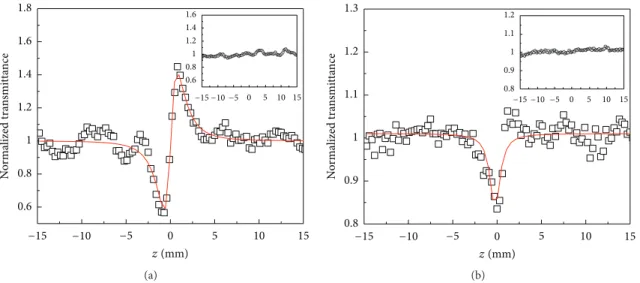
Figure23 shows Z-scan proiles for the ilms with and without gold. he Z-scan technique allows measurements of the third-order susceptibility of materials [20]. From the
closed apertureZ-scan proile, the amplitude and signal of the nonlinear refractive index�2are determined. A typical Z-scan proile of the ilm with gold is shown in Figure23(a)
indicating a focusing nonlinearity (�2 >0), while the inset in the igure shows the result for the ilm without gold NPs that has negligible nonlinearity. Figure23(b)shows an
open aperture Z-scan proile for the ilm with gold NPs and the inset shows negligible nonlinear absorption for the ilm without gold. his measurement allows obtaining the nonlinear absorption coeicient�2. he solid lines represent the theoretical itting to the experimental data based on the procedure introduced in [20].
0.6 0.8
1
0.5
1 Normalized laser power
N
o
rm
alized u
p
co
n
ver
sio
n
in
te
n
si
ty
�: 1
�: 1.9
Figure 21: Integrated luminescence intensity as a function of the laser intensity [5].
he values of�2 = (6 ± 1) × 10−10cm2/W measured at 532 nm and�2= (1.7±0.3)×104cm/GW are attributed to the NPs contribution, since we did not observe nonlinear signals in the ilm without gold. Carbon disulide (CS2), in a cell of 1 mm length, was used as standard calibration material with
�2= 3.1×10⁻¹⁴cm2/W [27].
he nonlinear birefringence induced in a pump-probe experiment using a Kerr gate setup was also studied using a laser operating at 800 nm (pulses of 150 fs at 76 MHz). Figure24 shows the behavior of the normalized Kerr gate signal of ilm with gold NPs as a function of the delay time between the pump and probe pulses.
he signal corresponding to CS2, with two decay times: a fast decay of<50 fs and a slow one of≈2 ps, is also shown to illustrate the time resolution of the apparatus. he symmetric signal obtained with the PGO:Au ilm indicates that the nonlinearity is faster than the laser pulse duration. Also, by measuring the behavior of the probe beam signal as a function of the pump beam intensity, we obtained�2 = (10 ± 2) ×
10−13cm2/W. In addition, we investigated the transmittance
of the ilm as a function of the laser intensity. No changes of the transmitted intensity was detected indicating that�2was smaller than the sensitivity of the setup (<60 cm/GW).
he nonlinear experiments revealed ultrafast response of the ilm with gold NPs and enhanced values of the nonlinear refractive index at 532 and 800 nm due to the presence of gold NPs. A large nonlinear absorption coeicient was measured at 532 nm indicating the possible use of the ilms for optical limiting in the picosecond regime. he HT of the ilms improved the igure of merit for all-optical switching in comparison with the results obtained with the ilms without gold NPs by two orders of magnitude at 800 nm [6].
4. Conclusion
400 500 600 700 800 0
0.5 1 1.5 2 2.5 3
A
b
so
rba
n
ce
�(nm)
Film with gold nanoparticles
PGO glass film
(a)
50nm
(b)
10 12 14 16 18 20 22 24 26 0
5 10 15 20 25 30 35
F
req
uenc
y (%)
Particle diameter (nm)
(c)
Figure 22: (a) Absorbance spectra of the PGO ilm with and without gold NPs at room temperature (ilms thickness: 1.1�m). (b) TEM image of the PGO:Au ilm. (c) Size distribution histogram of the gold NPs [5].
−15−10−5
−15 −10 −5 0 5 10 15
0.6 0.8 1 1.2 1.4 1.6 1.8
N
o
rm
alized tra
n
smi
tt
ance
𝑧(mm)
0.6 0.8 1 1.2 1.4 1.6
0 5 10 15
(a)
−15−10−5
−15 −10 −5 0 5 10 15
N
o
rm
alized tra
n
smi
tt
ance
0.8 0.9 1 1.1 1.2 1.3
𝑧(mm)
0 5 10 15
0.8 0.9 1 1.1 1.2
(b)
−0.5 0 0.5 1 1.5 2 2.5 3 0
0.2 0.4 0.6 0.8 1
N
o
rm
alized tra
n
smi
tt
ed signal (a.u
.)
Delay time (ps)
Figure 24: Normalized Kerr gate signal for CS2(open squares) and for the ilm with gold NPs (open circles). Laser wavelength: 800 nm. Beams’ intensities:�pump= 342MW/cm2and�probe= 45MW/cm2.
[27].
quality samples that present appropriate characteristics for photoluminescence-based devices. he possibilities to extend the work towards development of nonlinear optical com-posites are large, and we expect to be successful obtaining eicient materials for nonlinear photonics in the future.
Acknowledgments
his work was supported by the Conselho Nacional de Desenvolvimento Cient´ıico e Tecnol´ogico (CNPq) through the National Institute of Photonics (INCT Project) and by a grant from CNPq and FACEPE (Fundac¸˜ao de Amparo `a Ciˆencia do Estado de Pernambuco) through the PRONEX program.
References
[1] L. R. P. Kassab, D. S. Da Silva, and C. B. de Ara´ujo, “Inluence of metallic nanoparticles on electric-dipole and magnetic-dipole transitions of Eu3+doped germanate glasses,”Journal of Applied
Physics, vol. 107, no. 11, Article ID 113506, 2010.
[2] L. R. P. Kassab, F. A. Bomim, J. R. Martinelli, N. U. Wetter, J. J. Neto, and C. B. de Ara´ujo, “Energy transfer and frequency upconversion in Yb3+-Er3+-doped PbO-GeO2glass containing silver nanoparticles,”Applied Physics B, vol. 94, no. 2, pp. 239– 242, 2009.
[3] T. A. A. de Assumpc¸˜ao, D. M. da Silva, M. E. Camilo et al., “Frequency upconversion properties of Tm3+doped TeO2-ZnO glasses containing silver nanoparticles,”Journal of Alloys and
Compounds, vol. 536, supplement 1, pp. S504–S506, 2012.
[4] V. P. P. de Campos, L. R. P. Kassab, T. A. A. de Assumpc¸˜ao, D. S. da Silva, and C. B. de Ara´ujo, “Inluence of silver nanoparticles on the upconversion emission of TeO2-WO3-Bi2O3 glasses doped with Er3+,”Journal of Applied Physics, vol. 112, Article ID 063519, 2012.
[5] D. S. da Silva, L. P. Naranjo, L. R. P. Kassab, and C. B. de Ara´ujo, “Photoluminescence from germanate glasses containing silicon
nanocrystals and erbium ions,”Applied Physics B, vol. 106, no. 4, pp. 1015–1018, 2012.
[6] C. B. de Ara´ujo, T. R. Oliveira, E. L. Falc˜ao-Filho, D. M. da Silva, and L. R. P. Kassab, “Nonlinear optical properties of PbO-GeO2 ilms containing gold nanoparticles,”Journal of Luminescence, vol. 133, pp. 180–183, 2013.
[7] M. Yamane and Y. Asahara,Glasses for Photonics, Cambridge University Press, Cambridge, UK, 2000.
[8] O. Yasutake, “Recent progress in optics and photonics materials characteristics of tellurites glasses as novel iber raman gain media,”Ceramics Japan, vol. 41, no. 9, pp. 698–702, 2006. [9] M. J. F. Digonnet,Rare Earth Doped Fiber Lasers and Ampliiers,
Marcel Dekker, New York, NY, USA, 1993.
[10] L. R. P. Kassab and C. B. de Ara´ujo, “Germanate and tellurite glasses for photonic applications,” inPhotonics Research
Devel-opments, chapter 13, p. 385, Nova Science, New York, NY, USA,
2008.
[11] T. A. A. de Assumpc¸˜ao, L. R. P. Kassab, A. S. L. Gomes, C. B. de Ara´ujo, and N. U. Wetter, “Inluence of the heat treatment on the nucleation of silver nanoparticles in Tm3+doped PbO-GeO2 glasses,”Applied Physics B, vol. 103, pp. 165–169, 2011.
[12] Y. Chen, Q. Nie, T. Xu, S. Dai, X. Wang, and X. Shen, “A study of nonlinear optical properties in Bi2O3-WO3-TeO2 glasses,”
Journal of Non-Crystalline Solids, vol. 354, no. 29, pp. 3468–3472,
2008.
[13] A. J. Kenyon, P. F. Trwoga, M. Federighi, and C. W. Pitt, “Optical properties of PECVD erbium-doped silicon-rich silica: evi-dence for energy transfer between silicon microclusters and erbium ions,”Journal of Physics Condensed Matter, vol. 6, no. 21, pp. L319–L324, 1994.
[14] M. Fujii, M. Yoshida, Y. Kanzawa, S. Hayashi, and K. Yamamoto, “1.54 �m photoluminescence of Er3+ doped into SiO2 ilms containing Si nanocrystals: evidence for energy transfer from Si nanocrystals to Er3+,”Applied Physics Letters, vol. 71, no. 9, pp. 1198–1200, 1997.
[15] K. M. Choi, “A chemical strategy to improve the luorescence environments of erbium-ions doped into organically modiied hybrid glasses for laser ampliier applications,”Materials
Chem-istry and Physics, vol. 103, no. 1, pp. 176–182, 2007.
[16] S. Y. Seo, M. J. Kim, and J. H. Shin, “he Nd-nanocluster cou-pling strength and its efect in excitation/de-excitation of Nd3+ luminescence in Nd-doped silicon-rich silicon oxide,”Applied
Physics Letters, vol. 83, no. 14, pp. 2778–2780, 2003.
[17] L. P. Naranjo, C. B. de Ara´ujo, O. L. Malta, P. A. S. Cruz, and L. R. P. Kassab, “Enhancement of Pr3+luminescence in PbO-GeO2 glasses containing silver nanoparticles,”Applied Physics Letters, vol. 87, no. 24, Article ID 241914, 2005.
[18] C. B. de Ara´ujo, L. R. Kassab, R. A. Kobayashi, L. P. Naranjo, and P. A. S. Cruz, “Luminescence enhancement of Pb2+ions in TeO2 -PbO-GeO2glasses containing silver nanostructures,”Journal of
Applied Physics, vol. 99, Article ID 123522, 4 pages, 2006.
[19] L. A. G´omez, F. E. P. dos Santos, A. S. L. Gomes, C. B. de Ara´ujo, L. R. P. Kassab, and W. G. Hora, “Near infrared third non linearity of PbO-GeO2ilms containing Cu and CuO2 nanopar-ticles,”Applied Physics Letters, vol. 92, Article ID 141916, 3 pages, 2008.
[20] M. Sheik-Bahae, A. A. Said, T. H. Wei, D. J. Hagan, and E. W. Van Stryland, “Sensitive measurement of optical nonlinearities using a single beam,”IEEE Journal of Quantum Electronics, vol. 26, no. 4, pp. 760–769, 1990.
[22] P. N. Prasad,Nanophotonics, Wiley, New York, NY, USA, 2004. [23] J. Ren, G. Dong, S. Xu, R. Bao, and J. Qiu, “Inhomogeneous broadening, luminescence origin and optical ampliication in bismuth-doped glass,”Journal of Physical Chemistry A, vol. 112, no. 14, pp. 3036–3039, 2008.
[24] G. Chi, D. Zhou, Z. Song, and J. Qiu, “Efect of optical basicity on broadband infrared luorescence in bismuth-doped alkali metal germanate glasses,”Optical Materials, vol. 31, no. 6, pp. 945–948, 2009.
[25] D. J. Eaglesham, J. Michel, E. A. Fitzgerald et al., “Microstruc-ture of erbium-implanted Si,”Applied Physics Letters, vol. 58, no. 24, pp. 2797–2799, 1991.
[26] D. M. da Silva, L. R. P. Kassab, J. R. Martinelli, and C. B. de Ara´ujo, “Production and characterization of RF-sputtered PbO-GeO2 amorphous thin ilms containing silver and gold nanoparticles,”Journal of Non-Crystalline Solids, vol. 356, no. 44–49, pp. 2602–2605, 2010.
Submit your manuscripts at
http://www.hindawi.com
Scientiica
Hindawi Publishing Corporation http://www.hindawi.com Volume 2014Corrosion
International Journal of
Hindawi Publishing Corporation
http://www.hindawi.com Volume 2014
Hindawi Publishing Corporation
http://www.hindawi.com Volume 2014
Polymer Science
International Journal ofHindawi Publishing Corporation
http://www.hindawi.com Volume 2014
Ceramics
Journal ofHindawi Publishing Corporation
http://www.hindawi.com Volume 2014
Composites
Journal ofNanoparticles
Journal of Hindawi Publishing Corporationhttp://www.hindawi.com Volume 2014
International Journal of
Biomaterials
Hindawi Publishing Corporation
http://www.hindawi.com Volume 2014
Hindawi Publishing Corporation
http://www.hindawi.com Volume 2014
NANOSCIENCE
Journal of
Textiles
Hindawi Publishing Corporation
http://www.hindawi.com Volume 2014
Journal of
Nanotechnology
Hindawi Publishing Corporationhttp://www.hindawi.com Volume 2014
Journal of
Hindawi Publishing Corporation
http://www.hindawi.com Volume 2014
Crystallography
Journal ofThe Scientiic
World Journal
Hindawi Publishing Corporationhttp://www.hindawi.com Volume 2014
Hindawi Publishing Corporation
http://www.hindawi.com Volume 2014
Coatings
Journal ofAdvances in
Materials Science and Engineering
Hindawi Publishing Corporation
http://www.hindawi.com Volume 2014
Research
Hindawi Publishing Corporation
http://www.hindawi.com Volume 2014
Hindawi Publishing Corporation
http://www.hindawi.com Volume 2014
Metallurgy
Journal ofHindawi Publishing Corporation
http://www.hindawi.com Volume 2014
Hindawi Publishing Corporation
http://www.hindawi.com Volume 2014
Materials
Journal ofN
a
no
ma
te
ria
ls
Hindawi Publishing Corporation
http://www.hindawi.com Volume 2014
Journal of


![Figure 7: TEM images of the samples annealed during 48 h at 420 ∘ C [2].](https://thumb-eu.123doks.com/thumbv2/123dok_br/16163961.176454/5.900.472.817.500.681/figure-tem-images-samples-annealed-h-c.webp)
![Figure 9: Absorption spectra of TZO-Tm:Ag glasses for diferent heat-treatment times [3].](https://thumb-eu.123doks.com/thumbv2/123dok_br/16163961.176454/6.900.83.431.104.406/figure-absorption-spectra-tzo-glasses-diferent-treatment-times.webp)
![Figure 13: Absorption spectra of TBW-Er:Ag glasses for diferent heat-treatment times [4]](https://thumb-eu.123doks.com/thumbv2/123dok_br/16163961.176454/7.900.471.817.494.800/figure-absorption-spectra-tbw-glasses-diferent-treatment-times.webp)
![Figure 18: TEM images of Si NPs in Er 3+ doped GeO 2 -Bi 2 O 3 glasses heat-treated during 3 h (a) and during 72 h (b) [5].](https://thumb-eu.123doks.com/thumbv2/123dok_br/16163961.176454/9.900.473.811.433.726/figure-images-nps-doped-geo-glasses-heat-treated.webp)
![Figure 23 shows Z-scan proiles for the ilms with and without gold. he Z-scan technique allows measurements of the third-order susceptibility of materials [20]](https://thumb-eu.123doks.com/thumbv2/123dok_br/16163961.176454/10.900.81.430.101.628/figure-shows-proiles-technique-allows-measurements-susceptibility-materials.webp)