Vol-7, Special Issue3-April, 2016, pp2179-2189 http://www.bipublication.com
Case Report
The effect of communication skills training on decreasingthe nurses'
burnout in Hospital emergency wards of Tehran University
of Medical Sciences on 2015
Maryam kharaghani1*, Asie Salahshooria Fard2 and Mohammad Sahebalzamani 3
1 Msc of Nursing Education Tehran medical Sciences branch
Islamic Azad University, Tehran, Iran
2 faculty member, Tehran medical sciences branch
Islamic Azad University Tehran, Iran
3 PhD of Educational Management, Associate Professor,
Department of Management, Tehran Medical Sciences branch Islamic Azad University, Tehran, Iran*corresponding author
ABSTRACT
Stress is one of the natural and inevitable aspects of modern human'slife. Some defined it as stress or mental pressure and some considered it as a human physiological response to threatening environmental stimuli. According to the stress cognitive-emotional theory, if the stress is over capacity and continuous adjustment leads to physical and psychological exhaustion and impair the person's normal functioning. It has been proposed that the professional staff in health sector, due to facing multiple stressors such as mental, physical and interpersonal stress, experience higher levels of burnout compared to other professions. Jobs related to treatment including medical and nursing are the jobs that create tension.In this study, the effect of communication skills training on burnout has been developed in the form of tables and review graphs among nurses in hospital emergency department in Tehran University of Medical Sciences in 2015 and its results are analyzed in relation to the objectives of the study.The study is performed using data from the findings and in relation to the hypothesis,"Communication skills training is effective in reducing burnout". The results showed that the burnout in the area of emotional exhaustion has significant differences before and after training and the average in this area after training has decreased which mark an improvement.
Keywords: Communication skills, burnout, stress
INTRODUCTION
The bulk of each person's life is spent on employment and we can say more than half of our waking time people spend at work.In the workplace, five categories – physical, chemical, biological, psychological and environmental - threatens human health that the psychological stress is considered as a mental factor (Kuhpayehzadeh, 2011) and in the long run, erodes the psychic resistance of human and leads to burnout(Aqajani, 2013, p. 97-104). Among
disability.Some of its psychological consequences in the Nurses' Healthincludes cardiovascular disease, musculoskeletal, sleep problems and risky behaviors such as drug abuse, alcohol, smoking and reducing psychological well-being and mental health and reduced quality of life and health (Gibson-Mee S.2011). Burnout leaves many consequences in the family, personal and sociallife and organization including absenteeism, successive delays, psychological complaints, conflict, job changes and interpersonal conflicts with colleagues, to name afew (Bayne R.2012). 7.4% of nurses were absence from their work per week due to burnout or stress-related disability that is 80% more than other groups(Aghilinejad, 2010, pp. 44-48).
The word "burnout"is a term used to describe negative changes in attitudes and affective behavior of individuals faced with work-related pressures.The term has been first defined by FreudianBerger in 2006 when he saw signs of fatigue in his employees.He describes "burnout"as a state of fatigue and frustration fallowing sacrificing too much by staff without proper rewards in the workplace and introduce the physical, mental and emotional fatigue as a result of adverse conditions of work environment (Aghajanian, 2012, pp. 97-104). Burnout advances in response to chronic emotional pressure; it as a result, will interfere with the relationship between nurses and patients, colleagues, family and social environment. Burnout also is closely related with absenteeism and leaving nursing jobs and ultimately leads to reduced attention and care of patients (Heilterz, 2011, p. 21-29). Burnout has a set of signs and symptoms of emotional, behavioral and psychosomatic approach and organization. It may, in emotional dimension, use landmarks such as non-devotional manner with the patient, feelings of helplessness and lack of job satisfaction and in the attitude dimension, may the negative attitudes such as denunciation, blaming, lack of empathy with the patientbe shown and gradually the person suffers from low employment value,distrust of colleagues and
negligence.Behavioral signs include decreased job performance, limited social and recreation activities, and interpersonal problems.Psychosomatic symptoms include fatigue, headaches, gastrointestinal and sleep disorders. Organizationally, symptoms such as irregularities in the care of patients,absenteeism and workplace accidents(Emold, 2011, pp. 358-363).Mentally, people who suffer from burnout experience resignation and organizational isolation. In order to escape the consequences of burnout, they search new jobs and roles and executive agency and look for a career change into other jobs(Hargie, 2010, p. 18-27). Since the rate of burnout in health workers including nurses reduce efficiency and psychic trauma and dissatisfaction with the service, therefore, understanding the factors affecting it in service sectors and offering preventingsolutionscan be effective in promotion of mental health quality and service delivery level(Aqajani, 2012, pp. 97-104). Burnout is closely related to absenteeism from work and leaving work, decrease in level of patient care and an increase in medical errors and patients' less security; but the worst consequences is compromising the quality of patient care.So that according to American Nurses Hiring Associations, the nurses transferring at work is 32% and the professional dropout rate is 40% and every year, 1 out of every 10 nurses leaves his job(Harkin M, Vidar M.2014).
Burnout in medical personnel including nursesis important in two respects:
First, burnout decreases work efficiency, increases absenteeism from work,rises health costs and shift personnel, physical and behavioral changes and in some cases, it can lead to drug use.
mental health of people and improving the quality of services. Satisfaction of both the staff and the patients will be created by reducing burnout and evenimprovement of the effectiveness of actions will be overshadowed(Bulding, 2011, 41-48). Generally, the patients in the emergency departmentphysically are in a critical state and emergency department nurses in addition to endure some mental and physical pressures ruling inhospitals suffered some unique pressures due to time urgency which in turncreates negative emotions and eventually leads to burnout(Aqajani, 2012, pp. 97-104).
Communication play a key role in the nursing profession and in fact is the base of work of nurses in patient care (Doss et al., 2011, p. 38).
Many of the nurses' duties such as physical care of patients, emotional support and exchange of information with patientsis not possible without communication(Movahedi, 2011, pp. 23-34). Many experts consider the ability to communicate correctly as the most important features of medical staff (Zamani, 2010, pp. 1521-1528). So as you can determine the quality of services to patients in order to improve professional communication(Azimi Lowlati, 2011, pp. 108-125). In addition to being of the patient's communication important needs, is a very important aspect of nursing care that in addition to informing about the disease and its treatment leads to understanding the patient's concerns and make better empathy, emotional support, improving psychosocial outcomes and providing patient comfort(Gibson, 2011, p. 14).
In contrast, the lack of proper communication is of the main reasons for not recognizing the spiritual – social and psychological patients' needs(Helitzer et al., 2011, pp. 9-21) so as 15% of undesirable accidentsdirectly relate to communication problems between caregivers and patients and communication involves in more than 50% of cases.
Root of almost all the reported events that happened during caregiving in shifts is failure to use appropriate communication skills between
caregivers and patients so that 75% of medical errors and 65% of accidents during work shifts caused by inappropriate relationship(Bach, 2010, p. 300).
Four clinical features, together,constitute the essence of good clinical practiceas follows:Knowledge, communication skills, problem solving skills and physical examination of which the communication skills are the main components of clinical capabilities(Manaqeb, 2010, pp. 164-170).According to the American Society of Critical Care Nursing, nurses should also be skilled in the necessary communication skills and competence as are in other clinical skills(Baqchehqi, 2010, pp. 211-218).
So, today teaching interpersonal communication skills to nurses is the main way toimprove the quality of care because it changesthe behavior and attitude toward the usefulness of these skills, job satisfaction as well as identifying needs, creating positive changes in clinical status and consent of the patients(Pitel, 2009, pp. 28-38). Long-term and surface communication also causes of burnout in nurses and reduce the consent of the patients (Bahrami, 2012, pp. 37-54).
weak in many cases (Adib Haj Bagheri M, Lotfi S., F. Hosseini;2014).
One of the things that will lead to poor interpersonal communication is lack of awareness and inadequate knowledge of the above skills(Vakili, 2012, pp. 5-19).Evaluation of awareness and knowledge of nurses directly relates to their performance in relation to the patient(Rosenberg, 2011, pp. 2-8).Specialists studied the association between effective communication of nurses and reduction of pain in patients and increasing the recovery rate.Others have discussed about the connection of the awareness of the medical and nursing professional communication skills and all have concluded that nurses using effective listening skills, questioning, reflection and purification can be a great help in the treatment of patients(Rob M., 2009, p. 95). Nurses use these skills to collect information, reassuring, helping the patient, changing attitudes, views and opinions, encourage critical thinking, reducing anxiety, facilitating communication with each other and health care staff while improving patient care (Bayne, 2010, p. 34).Nurses' knowledge of effective communication skills is an essential component in the application of those skills.Since at any time, from schools to universities, there has been no detailed plan of how to teach these skills, therefore, this result is not so far-fetched(Burry. M, 2012, pp. 74-60). This result is not unexpected; considering the importance of these skills especially in the nursing professionin which is considered as nursing profession's moral and conscience responsibility then should think of ways to improve the skills, the level of knowledge of nurses in conjunction with the communication skills that it would otherwise not be achieved except through education(Wiles, 2011, pp. 161-169).
Lack of attention to burnout and communication skills training, thereupon, can results in injury frequencyin not only the health system employees and patients,but also the entire health care system. Since the researcher, as one of the nursing staff, has been witness of burnout and nurses'
communication skills shortage in interacting with patients and other relevant sources, it seems necessary to study scientifically in this area and use the obtained results in various aspects of the nursing profession. Given that similar researches hasnot been done in Iran, researchers were to evaluate thenurses' communication skills trainingimpacts on burnout among nurses working in the emergency department.
Literature review
qualitative and quantitative method was used to determine the scientific validity of the questionnaire.Anonymous questionnaires were distributed, along with a code and were completed self-reportedly and finally 197 questionnaires were distributed of which 173 questionnaires were completed and returned of which 7 questionnaires were excluded because of incomplete information.Data was analyzed using independent t-test and Spearman correlation descriptive and inferential statistics.
Farsi (2013) studied the relationship between burnout with the quality of work life of nurses in AJA hospitals to investigate the relationship between burnout with quality of work life of nurses in AJA hospitals.This cross-sectional study (descriptive-analytical) has beenfulfilled on 322 nurses of AJA in the city of Tehran.
Research environment is all wards of affiliated hospitals to the Islamic Republic of IranArmy In Tehran (seven hospitals).The target population includes nurses of AJA in Tehran in public and specialized sector in the morning, afternoon and night times or were in circulation duty. The multi-stage random sampling method were included. 297 Research Unit was needed to calculate the sample size. In this study, 380 questionnaires were given to nurses of which 322 questionnaires were completed. The response rate was approximately 85%.The main variables were burnout(Emotional exhaustion, depersonalization, and personal accomplishment) and the quality of working life(independence, decision-making, management, interpersonal relationships and support,rights and benefits of improved job prospects and the possibility of job).Data was collected using a questionnaire consists of three parts.The first part was based on the demographic information including age, sex, education level, marital status, number of children, and work experience as a nurse, shift work, hours of work per month, possession of overtime, the overtime hours per month, having a second job, absenteeism, and compliment with the program. And the second part includesMaslach Burnout Inventory to
As well, a statistically significant relationship was not found between depersonalization and quality of working life.The results of this research showsthat there is a negative correlation between burnout and quality of working life. Adopting appropriate measures in order to improve the quality of working life, elimination of predisposing factors, prevention, treatment and teaching coping skills and good communication are the current needs of policy making in health cares in such environments.
Harkin and Vidar (2014) in their work "comparison between burnout in the emergency department's nurses and the internal department's nurses" were to compare the incidence of burnout in nurses in the internal and the emergency wards todetermine theirdifferences to identify the relationship between individual factors and burnout.The descriptive study (2014) has analyzed nurses working in the emergency department and the internal wards of a general hospital in Ireland consists of 61 nurses including 31 and 30 nurses from the emergency and internal departments, respectively, who were randomly selected. The instrument used in this study was demographic questionnaire including personal information based on age, sex, marital status, factors related to work environment, duration of work in the Clinical Center, hours of work per week, and the number of days when s/he was patient during last 12 months. The Maslach Inventory was used to measure burnout in nurses in Emergency and internal departments. Reliability and validity of the tools in previous research had been proven. The obtained validity was (Cronbach's alpha) 70%. To collect information, an invitation with an explanation were sent by e-mail to internal and emergency department nurses together with the
above questionnaires and asked people to complete the questionnaire and then sending in back to the corresponding address.Data were analyzed using statistical software SPSS .V17 and descriptive statistics were used to analyze the data mean and mode.Mann-Whitney test was used for differentiating levels of burnout, differentiate between gender and burnout, and differentiate between degrees of other significant and insignificant factors in turnover in the emergency and internal departments' nurses.Spearman correlation was used to explain burnout and the duration of working time in the study subjects based on work hours.
Research method
This study, based on the objectives and nature, is a quasi-experimental study.It examines the effect of the independent variables on the dependent variable.In this way, the researchers in controlled conditions examined manipulation or intervention on the dependent variable.Samples are selected at random(Kosha, Soheila, Fesharaki M. 2013). In this research, the impact of the independent variable (communication skills training) on the dependent variables(job burnout) is measured.
Population and sample
The population included in this study is Emergency nurses in selected hospitals of Tehran University of Medical Sciences.The sample of 46 nurses was elected from Tehran University of Medical Sciences' hospitals that have the characteristics of the study.
Findings
- Objective 1
"Setting Burnout in emergency nurses before communication skills training in Hospital emergency department nurses in Tehran University of Medical Sciences in 2015"
Table 4-9 numerical indicators of burnout and the dimensions of the emergency nurses communication skills training 95-94
Burnout and its dimensions
minimum maximum Mean standard deviation
emotional exhaustion
Depersonalization 20 80 57/50 16/07
Individual Failing 20 88 58/41 15/43
Burnout 29/10 80/76 57/82 12/44
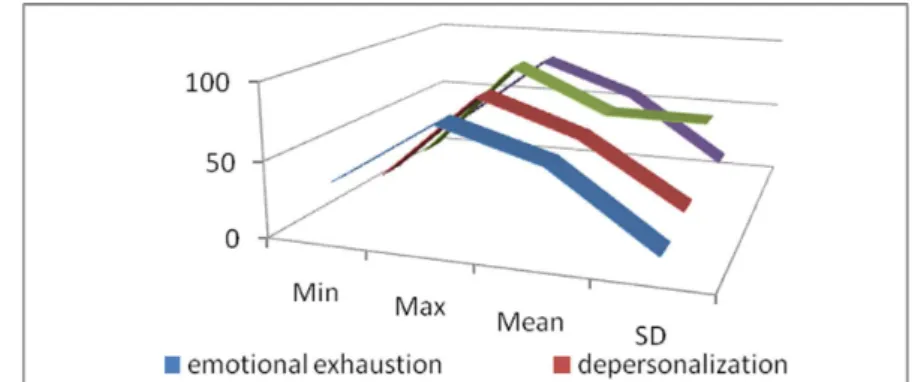
Chart4-1numerical indicators of burnout and the dimensions of the emergency nurses Communication skills training 94-95
Table (9-4)shows the numeric indices for burnout as well as its dimensions calculated out of 100, it suggests that the higher the scores represents more burnout.It can be seen that the average score of burnout in nursesis higher than median score 50.
- Objective 2
"Setting Burnout in emergency nurses after training communication skills to nurses in Hospital emergency department in Tehran University of Medical Sciences in 2015”
Table 4-10numerical indicators of burnout and the dimensions of the emergency nurses after communication skills training 94-95
Figure 4-2 numerical indicators of burnout and the dimensions of the emergency nurses after communication skills training 94-95
Table (4-10) shows the numerical indicators of burnout as well as its dimensions after training which have been calculated on the basis of 100 and the higher the score represents more burnout.It can be seen that the means of burnout and three areas after communication skills training is less than the median score (50).
- Objective 3
"Compare burnout emergency before and after training communication skills to nurses in Tehran University of Medical Sciences hospital's emergency departmentin 2015”
Burnout and its dimensions
minimum maximum Mean Standard Deviation
emotional exhaustion
25/71 57/14 39/74 8/11
Depersonalization
25 65 46/45 8/18
Lack of personal accomplishment
20 52 36/41 7/70
Burnout
Table 4-11 numerical indicators of burnout and the dimensions of the emergency nurses after communication skills training
Chart 4-3 numerical indicators of burnout and the dimensions of the emergency nurses after communication skills training
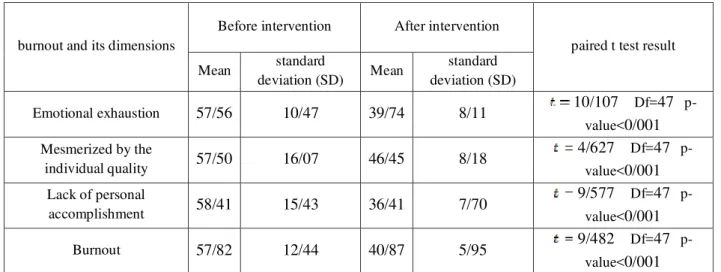
s paired t test results in Table (4-11) shows:
Burnout in the area of emotional exhaustion, before and after training, had a significant difference and the mean after training declined which shows improvement in this area (p-value < 0/001).Burnout in the area of depersonalization, before and after training, had a significant difference and the mean after training in this area declined which shows improvement in this area (p-value < 0/001).Burnout in terms of individual success, before and after training, had a significant difference and the mean after training in this area declined which shows improvement in this area (p-value < 0/001).Overall, the difference between the average burnout, before and after training, was statistically significant.It can be seen that thebefore training average score 57/82 after training has declined to 40/87 (p-value < 0/001).
- Objective 4
"Determining emergency nurses communication skills before training communication skills to nursesHospitals' emergency department of Tehran University of Medical Sciences in 2015”
Table 4-12Numerical indices for communication skills and its dimensions for the emergency nurses before Communication skills training 94-95
Communication skills and its dimensions minimum maximum Mean standard deviation
Ability to receive and send messages 14/81 77/78 50/53 13/07 Emotional control 16/67 74/07 51/80 11/55
Listening skills 26/67 80 50/31 13/79
Insight into the communication process 20 80 46/38 12/89 Communication associated with decisiveness 25 83/33 53/64 16/56 burnout and its dimensions
Before intervention After intervention
paired t test result
Mean standard
deviation (SD) Mean
standard deviation (SD)
Emotional exhaustion 57/56 10/47 39/74 8/11 10/107 Df=47
p-value<0/001
Mesmerized by the
individual quality 57/50 16/07 46/45 8/18
627 /
4 Df=47 p-value<0/001
Lack of personal
accomplishment 58/41 15/43 36/41 7/70
577 /
9 Df=47 p-value<0/001
Burnout 57/82 12/44 40/87 5/95 9/482 Df=47
Communication skills 24/96 67/33 50/53 8/01
Chart 4-4 numerical indices for communication skills and the dimensions for the emergency nurses before communication skills training 95-94
Table (4-12)show the numerical indices for communication skills as well as its dimensions before training which are calculated out of 100. It can be seen that the average score of communication skills in nurses before training is obtained 50/53 with a standard deviation of 8/01.
- Objective 5
"Determining emergency nurses' communication skills after training communication skills to nurses in emergency wards in selected hospitals of Tehran University of Medical Sciences in 2015”
Table 4-13 numerical indices for communication skills and the dimensions of the emergency nurses after communication skills training 94-95
Communication skills and its dimensions minimum maximum mean standard deviation
Ability to receive and send messages 37/04 62/96 51/72 6/49
Emotional control 33/33 70/37 50/09 6/97
listening skills 26/67 86/67 59/68 12/37
insight into the communication process 13/33 80 46/80 16/87
Communication associated with decisiveness 25 91/67 53/35 11/61
communication skills 37/59 69/95 50/49 6/27
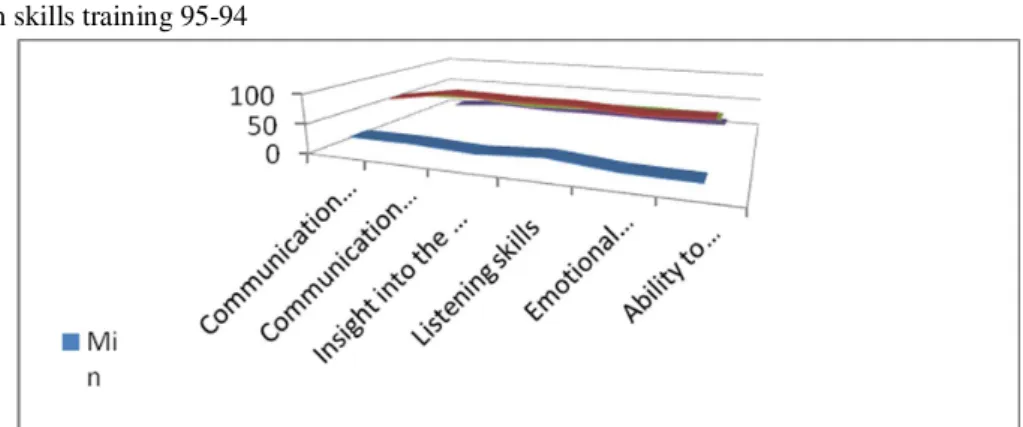
Figure 4-5 numerical indices communication skills and the dimensions of the emergency nurses after communication skills training 95-94
CONCLUSION
In this research, using the information derived from findings and in relation to the hypothesis"Communication skills training is effective in reducing burnout". The results showed that burnout in the area of emotional exhaustion, before and after training, has significant differences and after trainingaverage in this area has decreased which shows improvement in this area is (p <0.001).Burnout in the field of depersonalization, before and after training, had a significant difference and after training in this area average declined which shows improvement in this area (p <0.001).Burnout in the field of personal success, before and after training, had a significant difference and after training in this area average declined which shows improvement in this area (p <0.001).Overall, the obtained average burnout, before and after training, is statistically significant differences.It can be seen that the obtained average score is of 57.82 for before training and 40.87 for after training (p <0.001).Based on the data and findings it could be argued that the hypothesis is confirmed by achieving minor goals hypothesis and research. The overall research (2015) goal is to determine the effect of communication skills trainingon job burnout in Emergency wards in hospitals of Tehran University of Medical Sciences.
REFERENCES
1. AdibHajbagheri M, Lotfi S., HosseiniF..Stress and marital satisfaction of nurses. Journal of Health and Care, Volume XVI (1, 2) spring and summer 2014, pp. 9-18
2. Aqajanyan. (2012). Occupational burnout in different parts. Nursing and Midwifery Research Journal. Volume 9(2) pp. 97-104. 3. Dinarvand Hassan. (2012). Foundations of
Training Technology, 1st edition, Tehran: DaneshPazhoh press, p. 94.
4. -Aghajani MJ.2013.The professional burnout of nurses in different wards. Jornal of research development in nursing and midwifery.:9(2):97-104
5. -Aghilnejad M, Attrachi MS , Golabadi M, CHehregosha H.2010.Comparing stress level of women nurse of different units of Iran university hospital in autumn 2009.J Army university of Med sci .R Iran:8(1):44-48 6. -Bach Sh , Grant A.2010. Communication
&interpersonal skill for nurse .1th ed,southernhay:learning Matter Ltd ,p300 7. -Bayne R.2012 .Counseling and
communication skill for Medical and HealthPractitiones.5th ed. Leicester::British Psychological Association.P.34
8. -Burry M.2011 .health and Illness.1st ed. UK :Blackwell Scientific Publication.p.60-74 9. -Boulding W،Glickman sw.Manary MP،Staelin
R.Reaiation between patient Satisfaction with inpatient care and hospital readmission withtin30days.the American jornalof managedcare.2011:17(1):41-48
10.Emold C, Schneider N, Miller I, Yagil Y.2011. Communication skills ,working environment and burnout among oncology nurses .European Jornal of oncology Nursing:15(4):358-363
11.-Doss S,Depascal P,Handly K.2011.Patient-Nurse Partnership.Nephro K.2011.Patient-Nurse J. 38:115. 12.-Harkin M, Vidar M.2014. Comparing
burnout in emergency nurses and medical nurses .J clinical nursing study . 2(3)p152-163 13.-Kohpayezadeh J.2010.Professional burnout
and related factor in empolyeeof ex Iran university of medical science faculties in 2010.Razi jornalof medical science . 18(90):27-36
14.-Gibson –Mee S.2011.Communication skill to improve client Expreience of hospital . Learning Disability practice.14:28
16.-Hargie O ,McCartan P.2010 .Social Skills Training and Psychiatric Nursing .2nd ed .London :Croom Helm.p.18-27
17.-Robb M. Communication ,relationship and Care :a reader.1st ed. London: Open university Press.2009.P.95
18.-Rosenberg S, Silver LG.2011 .Therapeutic communication skill and student nurse in clinical setting . Teaching &learning in nursing . 6:2-8