Four Distinct Subgroups of Self-Injurious
Behavior among Chinese Adolescents:
Findings from a Latent Class Analysis
Xiuhong Xin1,2,3, Qingsen Ming1, Jibiao Zhang4, Yuping Wang5, Mingli Liu1,6, Shuqiao Yao1*
1Medical Psychological Institute, Second Xiangya Hospital, Central South University, Changsha, Hunan, 410011, China,2Department of Medical Psychology, Clinical Medical College, Ningxia Medical University, Yinchuan, Ningxia, China,3Mental Health Center, General Hospital of Ningxia Medical University, Yinchuan, Ningxia, China,4Psychology Department, School Education, Jianghan University, Wuhan, Hubei, China,5School of Humanities & Social Sciences, Xi’an Jiaotong University, Xi’an, China,6School of Education, Hunan University of Science and Technology, Xiangtan, Hunan, China
Abstract
Self-injurious behavior (SIB) among adolescents is an important public health issue world-wide. It is still uncertain whether homogeneous subgroups of SIB can be identified and whether constellations of SIBs can co-occur due to the high heterogeneity of these behav-iors. In this study, a cross-sectional study was conducted on a large school-based sample and latent class analysis was performed (n= 10,069, mean age = 15 years) to identify SIB
classes based on 11 indicators falling under direct SIB (DSIB), indirect SIB (ISIB), and sui-cide attempts (SAs). Social and psychological characteristics of each subgroup were exam-ined after controlling for age and gender. Results showed that a four-class model best fit the data and each class had a distinct pattern of co-occurrence of SIBs and external measures. Class 4 (the baseline/normative group, 65.3%) had a low probability of SIB. Class 3 (severe SIB group, 3.9%) had a high probability of SIB and the poorest social and psychological sta-tus. Class 1 (DSIB+SA group, 14.2%) had similar scores for external variables compared to class 3, and included a majority of girls [odds ratio (OR) = 1.94]. Class 2 (ISIB group, 16.6%) displayed moderate endorsement of ISIB items, and had a majority of boys and older adolescents (OR = 1.51). These findings suggest that SIB is a heterogeneous entity, but it may be best explained by four homogenous subgroups that display quantitative and qualitative differences. Findings in this study will improve our understanding on SIB and may facilitate the prevention and treatment of SIB.
Introduction
Self-injurious behavior (SIB, synonymous with self-harm behavior) refers to a series of behav-iors and intention that are performed deliberately and with the knowledge that they can or will result in some degree of physical or psychological injury to oneself [1–3]. SIB is a common risk a11111
OPEN ACCESS
Citation:Xin X, Ming Q, Zhang J, Wang Y, Liu M, Yao S (2016) Four Distinct Subgroups of Self-Injurious Behavior among Chinese Adolescents: Findings from a Latent Class Analysis. PLoS ONE 11 (7): e0158609. doi:10.1371/journal.pone.0158609
Editor:Zhicheng Carl Lin, Harvard Medical School, UNITED STATES
Received:January 28, 2016
Accepted:June 17, 2016
Published:July 8, 2016
Copyright:© 2016 Xin et al. This is an open access article distributed under the terms of theCreative Commons Attribution License, which permits unrestricted use, distribution, and reproduction in any medium, provided the original author and source are credited.
Data Availability Statement:Data may compromise
the privacy of study participants and may not be shared publicly. Data are available upon request to the authors.
Funding:This study was supported by grants from the National Key Technologies Research and Development Program of the 11th 5-year plan of China (no. 2009BAI77B02), and from the construct program of the key discipline in Hunan Province.
Competing Interests:The authors have declared
behavior, and has become a significant global public health issue [4,5]. Epidemiological studies indicated that the prevalence of SIB was 6.9% to 35.6% in adolescents [6–8]. SIB can lead to severe unanticipated harm or premature mortality. Death from SIB is the second leading cause of injury-related death and disability [3,5].
In the broadest sense, SIB includes all kinds of behaviors that can lead to physical and men-tal self injury. More specifically, SIB is characterized by direct and intentional self-injury that causes body tissue damage [8,9]; damage to oneself and injury to health, as an unintended by-product of activities such as smoking, binge drinking, etc. [2,3]; and suicide attempts (SA, con-sisting of suicide ideation, suicide plan and suicide behavior) [2,4]. A growing body of research shows that many individuals engage in SIBs using multiple methods (DSIB and/or ISIB), accompanied by various characteristics. For example, some researchers have examined the link between nonsuicidal self-injury (NSSI) and suicidal behavior [7,9]. Some researchers argued that there is a fine line dividing NSSI and SA and distinguishing between the two remains diffi-cult [10,11]. Other researchers aimed to determine the correlates of NSSI, such as smoking and drinking [7,8]. These studies have revealed that SIB includes a wide range of behaviors and intention, and different types of SIB often co-occur. People engaged in self-injury fall into a heterogeneous group. However, the identification of homogeneous subtypes of SIB would be empirically and realistically significant for researchers and clinicians [9,10,12]. Although many studies focused on the examination of differences and similarities among SIBs, such as compar-ing NSSI with SA, or NSSI+SA with SA alone, or NSSI+SA with no self-harm (NoSH)
[9,13,14], these studies used a variable-centered approach and can only distinguish between two or among three types of SIB. However, SIBs are involved in various types of behaviors. For example, if six binary variables are used to delineate various forms of SIB, 64 (26) different response patterns can be obtained from the data, which will be too complex and there are no acceptable solution to analyze them. An alternative method is needed to identify whether these combined SIBs co-occur in different homogeneous subgroups.
Latent class analysis (LCA) is a person-centered approach, which assumes that heteroge-neous individuals from a population can be‘‘typed”or grouped into smaller relatively homoge-nous subgroups with similar patterns of some behaviors or trait endorsements [15,16]. LCA can also be used to explain associations between a set of observed categorical variables through assumed unobserved, latent classes. Researchers have used this method to explore co-morbidity or to define subtypes based on combinations of emotional and behavioral problems [17–19]. To our knowledge, only a few studies have employed LCA to identify subgroups of individuals who engage in SIBs. For example, three studies identified four classes of self-injurers based on the method, descriptive features, and functions of self-injury [20–22]. Two studies identified three subgroups in terms of frequency, form, function, and age of onset of self-injury, and fre-quency of self-injury and risk of suicidal behavior, respectively [18,23]. And one study identi-fied two subgroups based on psychopathy and self-injurious thoughts and behaviour [24]. Although these studies have provided strong support for the heterogeneity of SIB manifesta-tions, subgroups were classified by the characteristics of NSSI only or its correlates, rather than the continuum of SIBs. These studies did not examine the potential co-occurrence of different types of DSIB, ISIB, and SA. In addition, participants in these studies were predominately young adults (college students) or adults. Thus, it is imperative to examine behavioral combi-nations, to identify whether all forms of self-injury can co-occur, and to characterize their pre-sentation among adolescents [4,11,25,26].
students. Differences in personality traits and social and psychological characteristics among the identified classes were then examined.
Materials and Methods
Subjects
Data were extracted from the National Science-Technology Support Plan Project“national assessment, early-warning and intervention model research on youth risk behavior”, a study of risk behavior and mental health status in junior and senior high-school students. A large-sam-ple multicenter and multistage cross-sectional survey design was used to recruit junior and senior high-school students from March, 2011 to September, 2011. First, ten cities were selected according to the social and economic development level (high, medium, and low) and the representation of mainland China’s geographic administrative divisions (northeastern, northwestern, northern, southeastern, southwestern, and southern). Then, we chose one to three combined junior and senior public high school(s) with medium-level teaching quality and college enrollment rate in each city. Finally, two classes per grade (7th–12th) were randomly selected at each school.
A total of 13,151 adolescents from 240 classes at 20 schools were recruited in the following 10 cities: Shanghai, Guangzhou, Hangzhou, Suzhou, Changsha, Chengdu, Shenyang, Yin-chuan, Cangzhou, and Langfang. Of 11,975 students who completed the questionnaire, 1906 students provided incomplete responses on 11 indicators for LCA or more than 5 items on a scale were excluded. The total sample thus included 10,069 adolescents [4725 (46.9%) males, 5344 (53.1%) females; mean age, 14.79±1.92 (range, 10–20) years] (Table 1andS1 Table include demographic information pertaining to age, grade, gender, race, family background, and parental education status for subjects and excluded sample). The response rate was 84.93%. Twelve participants whose age data were lost were excluded from the LCA.
Study Procedure
the items in questionnaires. Students could ask questions to better understand the survey items. Effective strategies were developed to protect the opt in/ opt out families and students from being identified. To maintain confidentiality, all students in a class received the survey, but the researchers asked the students who or whose parents refused to participate in the study just to leave the questionnaires blank, to protect them from being known by their peers. Stu-dents were then allowed 25–35 minutes to complete the self-report questionnaires. All data were centralized at the project responsible unit and the quality of questionnaires is ensured by team leaders who randomly visited study sites and verified the proper implementation of questionnaires.
Measures
Health-Risk Behavior Inventory for Chinese Adolescents. SIB was measured by an 11-item questionnaire (seeS2 Table), which used items extracted from the Health-Risk Behav-ior Inventory for Chinese Adolescents (HBICA) that has been validated with good psychomet-ric properties, including test-retest reliability, internal consistency, construct validity, and external validities [27,28]. Responses were dichotomized as“never”(0 score) or“at least once” (1 score). The nomenclatures of SIBs were defined explicitly and primarily. Self-cutting or self-burning, and self-scratching, self-biting, and/or hitting are the typical methods of DSIB, which are conceptualized as direct and intentional self-injury (self-harm) with body tissue damage, Table 1. Demographic Characteristics of Subjects.
Total Boys (n = 4725) Girls (n = 5344) χ2/t p
Age, y (12M) 14.79±1.92 14.80±1.92 14.79±1.93 0.48 0.630
Ethnicity (23M) 1.86 0.173
Han nationality 9508(94.6%) 4475(95.0%) 5033(94.4%)
Other ethnic minority 538(5.4%) 237(5.0%) 301(5.6%)
Onlyone child (112M) 82.74 <0.001
Yes 6170(62.0%) 3110(66.7%) 3060(57.8%)
No 3787(38.0%) 1554(33.3%) 2233(42.2%)
Family composition (188M)
Nuclear families 9084(91.9%) 4276(92.3%) 4808(91.6%) 2.91 0.405
Divorced families 394(4.0%) 181(3.9%) 213(4.1%)
Single-parent families 194(2.0%) 87(1.9%) 107(2.0%)
Remarried families 209(2.1%) 87(1.9%) 122(2.3%)
Paternal level of education(1038M) 4.03 0.259
Some primary school 703(7.8%) 354(8.3%) 349(7.3%)
Completed middle school 3569(39.5%) 1653(39.0%) 1916(40.0%)
Completed high school 2824(32.4%) 1379(32.5%) 1545(32.2%)
Completed higher education 1835(20.3%) 854(20.1%) 981(20.5%)
Maternal level of education(1110M) 1.86 0.602
Some primary school 1169(13.0%) 568(13.5%) 601(12.6%)
Completed middle school 3803(42.4%) 1774(42.3%) 2029(42.6%)
Completed high school 2541(28.4%) 1183(28.2%) 1358(28.5%)
Completed higher education 1446(16.1%) 667(15.9%) 779(16.3%)
Mmissing value (subjects did not state).
irrespective of motive or the extent of suicidal intent [29]. Behaviors such as smoking [29], binge drinking [7], unprotected sexual behavior [30], dangerous driving [26], drug abuse [26], and overeating [26] were categorized into ISIB. Likewise, suicide ideation, suicide plan, and sui-cide behavior were classified as SAs [2,31–33].
Barratt Impulsiveness Scale, Version 11th. Impulsivity was measured using the Chinese version of the Barratt Impulsiveness Scale, version 11th(BIS-11) [34]. This widely used 30-item self-report questionnaire has been shown to be reliable and valid among Chinese adolescents [35]. The participants rate the frequency of common activities on a scale ranging from 1 (rarely/never) to 4 (almost always/always). Item scores are summed to obtain an overall impul-siveness score, with higher scores indicating higher levels of impulsivity. In the current study, the Cronbach’s alpha coefficient for the BIS-11 was 0.79.
Rosenberg Self-Esteem Scale. Global self-esteem of subjects was acquired using the Chi-nese version of the 10-item Rosenberg Self-Esteem Scale (RSES) [36], which assesses partici-pants’self-related“general outlook on life”by measuring positive and negative feelings about themselves. Each item is rated on a four-point scale ranging from 1 (not at all in conformity with me) to 4 (completely in conformity with me). Higher scores indicate higher levels of self-esteem. The internal consistency of the RSES was 0.86 in the present study.
Center for Epidemiological Studies Depression Scale. The Center for Epidemiological Studies Depression Scale (CES-D) [37] is a 20-item measure designed to assess depressive symptoms in the general population. Participants’scores range from 1 (rarely) to 4 (most of the time) with regards to how often they have experienced each symptom in the past week. Total scores range from 20 to 80, with higher scores indicating higher levels of depressive symptoms. The Chinese version of the CES-D has been shown to have good psychometric properties for adolescents [38]. The internal consistency of the scale (Cronbach’s alpha coeffi-cient) was 0.89 in our sample.
Multidimensional Anxiety Scale for Children. Anxiety was assessed using the Multidi-mensional Anxiety Scale for Children (MASC) [39], a 39-item questionnaire designed to assess anxious symptoms in youth. Participants’scores range from 0 (never applies to me) to 3 (often applies to me) with regards to how often they have experienced each symptom in the past week. Total scores range from 0 to 117, with higher scores indicating higher levels of anxious symptoms [40]. The Cronbach’s alpha coefficient of the MASC was 0.93.
Cognitive Emotion Regulation Questionnaire. The Cognitive Emotion Regulation Ques-tionnaire (CERQ) [41] was designed to measure distinct cognitive emotion regulation strate-gies that individuals may use to cope with emotionally arousing life events. The CERQ is composed of nine subscales and two second-order subscales (adaptive and maladaptive strate-gies). Responses to the 36 items are structured using a five-point Likert scale ranging from 1 (almost never) to 5 (almost always). A higher subscale score indicated a greater propensity to employ the cognitive strategy in response to adverse or stressful events. The Chinese version of the CERQ has been shown to have good psychometric properties for adolescents [42]. Cron-bach’s alpha coefficients for the total scale and the adaptive and maladaptive strategies sub-scales were 0.68, 0.76, and 0.67, respectively.
Statistical Analyses
Descriptive analyses were used to examine demographic characteristics and the prevalence of SIBs. The chi-squared test was used to compare the prevalence of SIBs. These statistical analy-ses were conducted using Predictive Analytics Software (PASW version 18.0).
Following the descriptive analyses, a series of independently estimated LCAs were used to characterize groups of SIBs in adolescents. Eleven dichotomous items were used to define the latent classes. Due to the sampling methods and the nature of the phenomenon of SIB, the local independent assumption may not fulfill in this study. Multilevel latent class models were statistically modeled within school level when the data includes students nested in schools [45]. A series of models were estimated with the number of class ranging from one to six at level 1 (students) and one to three at level 2 (schools). A full information maximum likelihood (FIML) method was employed to handle missing data.
We used several recommended criteria [16] to facilitate model choice, including the Akaike Information Criterion (AIC), Bayesian Information Criterion (BIC), sample-size adjusted Bayesian Information Criterion (ssaBIC), average posterior probabilities, class size, the Lo-Mendell-Rubin’s adjusted likelihood ratio test (LMR-LRT), and entropy. A better-fit-ting model has a lower BIC and ssaBIC value [46]. The LMR-LRT provides apvalue, the sig-nificance of which indicates whether the k-1 class model is rejected in favor of the k class model. Entropy is an index used to assess the precision of latent class membership assign-ment; higher probability values indicate greater precision of classification, with a maximum value of 1. The proportions of individuals in each class were also presented. Currently, there is a lack of consensus on which criterion best identifies the best-fitting number of classes [47]. Final class selection is based on the model interpretability and parameter estimations. Following estimation of the optimal number of classes, a set of analyses was conducted to examine potential correlates of each class. Each individual was assigned to a specific class based on the highest posterior probability value for that individual in the retained latent class model.
We conducted a mean difference test with psychological and social correlates [personality traits (impulsivity and self-esteem), emotional status (depression and anxiety), regulation strat-egies (adaptive and maladaptive), and life events], using one-way analysis of variance, post hoc least significant difference tests, and chi-squared tests, to investigate the relationships between latent classes and auxiliary variables across classes. Multinomial logistic regression analysis was conducted to detect the effects of age and gender on latent class membership. These analyses were conducted using Mplus 7.0 software [48,49].
Results
Prevalence of SIBs
Classes Identified through LCA
LCA, conducted with age and gender as covariates, was applied to the 11-items SIBs in a sam-ple of 10,057 students (excluding 12 students with missing information). Parameters of fit and the proportion of individuals in each class were presented (S3 Table). All the fit indices contin-ued to improve with increasing number of classes, with the exception of the entropy index, which was the lowest at two classes. The AIC, BIC, and ssaBIC continued to decrease from one to six classes, but the relative magnitude of the decrease was smaller after the four-class solu-tion. The highest average latent class probabilities (84.6%, 82.3%, 83.9%, and 91.8%, respec-tively) for each participant’s membership resulted in a four-class solution.
Building of this four-class solution on Level 1, we specified a multilevel latent class model that utilized the parametric approach to account for the nested structure of the data. We esti-mated from one to three classes parametric random effects models. The BIC shows a much smaller increase from one class to three (72629.1, 72639.7, and 72647.5, respectively). More-over, entropy is maximized with two classes (0.80) and decreased to 0.44 with three classes. The two-class model appears to be the best model on Level 2 (schools). However, the propor-tion of school classificapropor-tion were 0.971 vs. 0.029 between the two classes at school level (there are 20 schools, but one of class’s proportion (2.9%) was much less than 5%, which suggested that there was no empirical significance at school level in our study. So we retained the original solution at single level LCA.
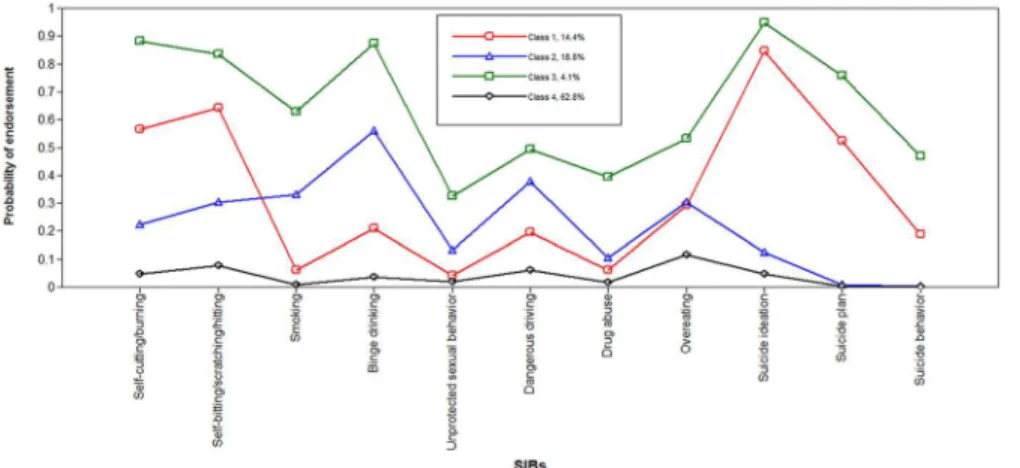
To our knowledge, a coherent criterion for the identification of the best-fitting model is lacking. According to empirical (goodness of fit statistics, lower BIC and SSABIC with trivial reduction after adding 5 or more classes, and higher entropy), and theoretical (practical interpretability) aspects and the parsimony principle, a four-class model was considered to fit the data best [46,50].Fig 1illustrates these latent classes as four distinct groups according to item probabilities.
The first class, named the DSIB+SA group (n= 1426, 14.2% prevalence), was characterized by high probabilities of DSIB (>0.80) and suicide ideation (0.85), a moderate probability
(0.52) of suicide plan, and a low probability (<0.30) of ISIB. The second class, named the ISIB
group (n= 1666, 16.6% prevalence), showed moderate endorsement of ISIB (probabilities of four ISIB items>0.30), low endorsement of DSIB (probability0.30), and very low endorse-ment of SA (probability of suicide ideation = 0.12, probabilities of suicide plan and suicide behavior<0.01). The third class, named the severe SIB group (n= 393, 3.9% prevalence),
Table 2. Prevalence (%) of SIBs in the Adolescents Stratified by Gender.
All % Male % Female % χ2 p OR 95% CI
Self-cutting/-burning 1899 18.9 798 16.9 1101 20.6 22.6 <0.001 1.28 [1.15, 1.41]
Self-biting/-scratching/-hitting 2333 23.2 976 20.7 1357 25.4 31.61 <0.001 1.31 [1.19, 1.44]
Smoking 1018 10.1 727 15.4 291 5.4 272.68 <0.001 0.32 [0.28, 0.37]
Binge drinking 1948 19.3 1114 23.6 834 15.6 102.10 <0.001 0.60 [0.54, 0.66]
Unprotected sexual behavior 555 5.5 402 8.5 153 2.9 153.43 <0.001 0.32 [0.26, 0.38]
Dangerous driving 1584 15.7 1011 21.4 573 10.7 215.55 <0.001 0.44 [0.40, 0.49]
Drug abuse 560 5.6 303 6.4 257 4.8 12.28 <0.001 0.74 [0.62, 0.88]
Overeating 1941 19.3 885 18.7 1056 19.8 1.71 0.19 1.07 [0.97, 1.18]
Suicide ideation 2147 21.3 788 16.7 1359 25.4 115.53 <0.001 1.70 [1.54, 1.88]
Suicide plan 1112 11.0 405 8.6 707 13.2 55.39 <0.001 1.63 [1.43, 1.85]
Suicide behavior 473 4.7 177 3.7 296 5.5 18.01 <0.001 1.51 [1.25, 1.82]
SIB = self-injurious behavior, OR = odds ratio, CI = confidence interval.
showed the highest endorsement of all items, indicating a severe high-risk profile. The fourth class, named the baseline/normative group (n= 6752, 65.3% prevalence), showed the lowest endorsement of all items (probabilities<0.08 except overeat), indicating a low-risk profile. It’s
important to note that the class counts and proportions of each class represent the classifica-tion of individuals based on the most likely latent class membership, which was different from proportions based on estimated posterior probabilities (S3 Table).
Class Differences in Correlates
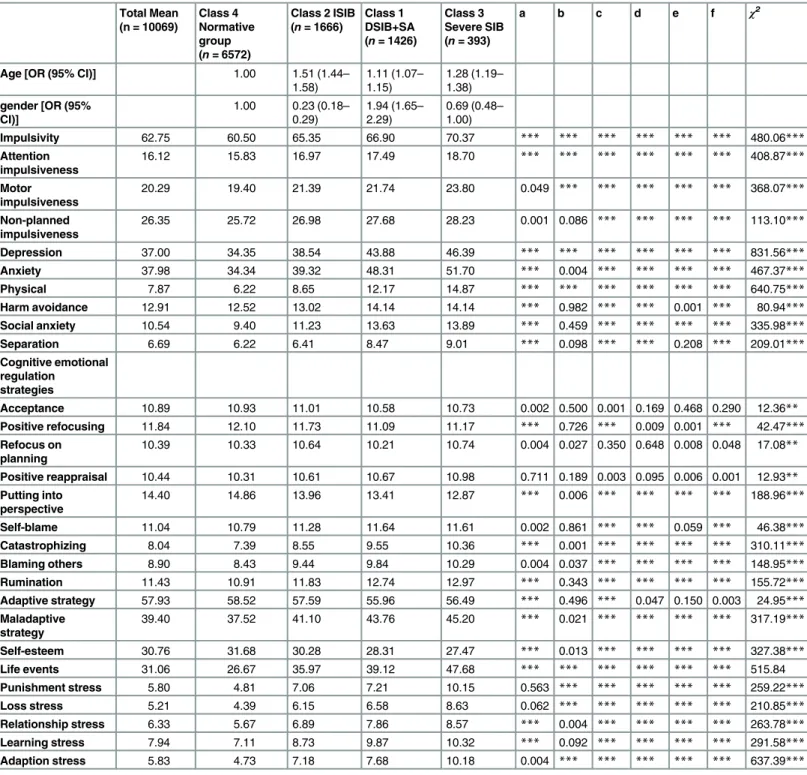
Table 3presents the results of analyses of correlates in classes. Significant differences among classes were observed for all correlates. Post hoc comparisons indicated that class 3 had the highest levels of impulsivity, depression, anxiety, and maladaptive strategies; highest frequency of negative life events; and lowest levels of self-esteem and adaptive strategies, whereas class 4 had the complete opposite performance to class 3. Class 1 was fall between class 3 and class 2. Similarities were also observed between classes. Specifically, no significant difference in non-planned impulsiveness, harm avoidance, social anxiety, separation anxiety, cognitive emo-tional regulation strategies (positive refocusing, self-blame, and rumination), adaptive strate-gies, or learning-related stress was observed between class 1 and 3. Similarly, no significant difference in separation anxiety, self-blame, and adaptive strategies was found between class 2 and 4. No significant difference in stress related to punishment or loss was observed between class 1 and 2.
Class Differences in Covariates (Age and Gender)
Multinomial logistic regression analysis revealed significant differences in age and gender between class 4 (low-risk group) and the other classes (Table 3). Older subjects were more likely to engage in SIB (ORs for classes 1–3 = 1.11, 1.51, and 1.28, respectively) than younger subjects. More girls were in class 1 (OR = 1.94) and more boys were in class 2 and 3 (ORs = Fig 1. Profiles of 4 SIB classes.Proportions for the latent classes were based on estimated posterior probabilities. Class 1: DSIB+SA group (high endorsement of DSIB and SI, moderate SP; 14.4%); Class 2: ISIB group (low endorsement of DSIB and SI, high ISIB, no endorsement of SP or SB; 18.8%); Class 3: severe SIB group (highest endorsement of all SIBs; 4.1%); Class 4: normative group (lowest endorsement of DSIB and ISIB, no endorsement of SP or SB; 62.8%); SIB: self-injurious behavior; DSIB: direct self-injurious behavior; SA: suicide attempt; SI: suicide ideation; SP: suicide plan; ISIB: indirect self-injurious behavior; SB: suicide behavior; Red: Class 1; Blue: Class 2; Green: Class 3; Black: Class 4.
Table 3. Differences in Correlates among the Four Classes.
Total Mean (n = 10069)
Class 4 Normative group (n= 6572)
Class 2 ISIB (n= 1666)
Class 1 DSIB+SA (n= 1426)
Class 3 Severe SIB (n= 393)
a b c d e f χ2
Age [OR (95% CI)] 1.00 1.51 (1.44–
1.58)
1.11 (1.07– 1.15)
1.28 (1.19– 1.38)
gender [OR (95% CI)]
1.00 0.23 (0.18– 0.29)
1.94 (1.65– 2.29)
0.69 (0.48– 1.00)
Impulsivity 62.75 60.50 65.35 66.90 70.37 *** *** *** *** *** *** 480.06***
Attention impulsiveness
16.12 15.83 16.97 17.49 18.70 *** *** *** *** *** *** 408.87***
Motor impulsiveness
20.29 19.40 21.39 21.74 23.80 0.049 *** *** *** *** *** 368.07***
Non-planned impulsiveness
26.35 25.72 26.98 27.68 28.23 0.001 0.086 *** *** *** *** 113.10***
Depression 37.00 34.35 38.54 43.88 46.39 *** *** *** *** *** *** 831.56***
Anxiety 37.98 34.34 39.32 48.31 51.70 *** 0.004 *** *** *** *** 467.37***
Physical 7.87 6.22 8.65 12.17 14.87 *** *** *** *** *** *** 640.75***
Harm avoidance 12.91 12.52 13.02 14.14 14.14 *** 0.982 *** *** 0.001 *** 80.94***
Social anxiety 10.54 9.40 11.23 13.63 13.89 *** 0.459 *** *** *** *** 335.98***
Separation 6.69 6.22 6.41 8.47 9.01 *** 0.098 *** *** 0.208 *** 209.01***
Cognitive emotional regulation
strategies
Acceptance 10.89 10.93 11.01 10.58 10.73 0.002 0.500 0.001 0.169 0.468 0.290 12.36**
Positive refocusing 11.84 12.10 11.73 11.09 11.17 *** 0.726 *** 0.009 0.001 *** 42.47***
Refocus on planning
10.39 10.33 10.64 10.21 10.74 0.004 0.027 0.350 0.648 0.008 0.048 17.08**
Positive reappraisal 10.44 10.31 10.61 10.67 10.98 0.711 0.189 0.003 0.095 0.006 0.001 12.93**
Putting into perspective
14.40 14.86 13.96 13.41 12.87 *** 0.006 *** *** *** *** 188.96***
Self-blame 11.04 10.79 11.28 11.64 11.61 0.002 0.861 *** *** 0.059 *** 46.38***
Catastrophizing 8.04 7.39 8.55 9.55 10.36 *** 0.001 *** *** *** *** 310.11***
Blaming others 8.90 8.43 9.44 9.84 10.29 0.004 0.037 *** *** *** *** 148.95***
Rumination 11.43 10.91 11.83 12.74 12.97 *** 0.343 *** *** *** *** 155.72***
Adaptive strategy 57.93 58.52 57.59 55.96 56.49 *** 0.496 *** 0.047 0.150 0.003 24.95***
Maladaptive strategy
39.40 37.52 41.10 43.76 45.20 *** 0.021 *** *** *** *** 317.19***
Self-esteem 30.76 31.68 30.28 28.31 27.47 *** 0.013 *** *** *** *** 327.38***
Life events 31.06 26.67 35.97 39.12 47.68 *** *** *** *** *** *** 515.84
Punishment stress 5.80 4.81 7.06 7.21 10.15 0.563 *** *** *** *** *** 259.22***
Loss stress 5.21 4.39 6.15 6.58 8.63 0.062 *** *** *** *** *** 210.85***
Relationship stress 6.33 5.67 6.89 7.86 8.57 *** 0.004 *** *** *** *** 263.78***
Learning stress 7.94 7.11 8.73 9.87 10.32 *** 0.092 *** *** *** *** 291.58***
Adaption stress 5.83 4.73 7.18 7.68 10.18 0.004 *** *** *** *** *** 637.39***
DSIB = direct self-injurious behavior, SA = suicide attempt, ISIB = indirect self-injurious behavior, a = class 1vs. class 2, b = class 1vs. class 3, c = class 1 vs. class 4, d = class 2vs. class 3, e = class 2vs. class 4, f = class 3vs. class 4.
*p<0.05;
**p<0.01;
***p<0.001.
CI = confidence interval.
Discussion
This was a large, cross-sectional, representative, school-based study on self-injurious behavior in adolescents. Four distinct latent classes were identified, and variation among classes in social and psychological correlates across age and gender were characterized. To our knowledge, this is the only report on the co-occurrence of SIBs and their correlates in adolescents identified by LCA.
This study demonstrated that the prevalence of SIBs in adolescents were various between different type of behaviors, but it is similar to previous reports [6,29,51]. The prevalence of sui-cide ideation, suisui-cide plan, and suisui-cide behavior is also similar to the reported prevalence in previous studies [52–54]. Consistent with previous reports [53,55], differences in self-harm behavior among adolescents of different genders were observed. The prevalence of DSIB and SA were significantly higher among girls than among boys. The prevalence of ISIBs in the pres-ent study is also similar to that found in a population-based study [56], but lower than that in an inpatient study [57]. The gender difference in the prevalence of ISIBs was also reported in these studies. However, there is a lack of consensus on gender differences in SIBs.
In this study, LCA was adopted to identify the appropriate number of distinct latent classes of SIBs based on a large sample size, eleven indicators, and a larger covariates, and identified four quantitatively and qualitatively distinct latent classes. The baseline normative (low-risk) class (class 4) comprised almost two-thirds (65.3%) of the adolescents. Adolescents in class 4 were characterized by the lowest endorsement of all SIB items, with the best mental-health status than adolescents in other three classes. In contrast, adolescents in the smallest group (class 3, the severe SIB group) displayed high levels of endorsement of all SIB items, with the poorest mental-health states. These findings suggested that adolescents with high stress levels and low self-esteem are more likely to engage in SIBs than adolescents with low stress levels and high self-esteem. Likewise, adolescents who engaged in SIBs showed the inability to regu-late emotion and tolerate distress. This is not surprising because SIBs have been associated with a variety of clinical disorders characterized by depression, anxiety, low self-esteem, impulsivity, maladaptive emotional regulation strategies, and frequent negative life events [11,33,58–67]. Therefore, measures of impulsivity, depression, anxiety, emotion regulation strategy, self-esteem, and negative life events may distinguish between groups at high and low risk of SIB.
Most interestingly, two intermediate classes emerged from the analysis. A slightly smaller (14.2%) DSIB+SA group (class 1) included adolescents who displayed higher levels of endorse-ment of items measuring DSIBs and suicide ideation, low probability of ISIB and suicidal behavior, and a moderate probability of suicide plan. The SIB profile in this group is similar to the description of deliberate self-harm, commonly defined as direct and intentional injury to one’s body tissue, regardless of suicide intent [12]. The strength of the majority of correlates for this group was second only to those for the severe SIB group (Class 3), with no difference between these groups in non-planned impulsiveness, harm avoidance, social anxiety, self-blame, rumination, or learning-related stress. However, correlations with other items in the DSIB + SA (class 1) group were superior to those in the severe SIB group (Class 3). These find-ings suggest a close association between DSIB + SA (class 1) and severe SIB (class 3).
psychological health was worse than that in the baseline/normative group, but superior to that in the severe SIB and DSIB+SA groups. Adolescents in this group also used the same adaptive strategies as adolescents in the baseline/normative group (class 4), and had the same stress lev-els related to punishment and loss as adolescents in the DSIB+SA group (class 1). However, St Germain and Hooley study reported no difference between individuals prone to DSIB and those likely to engage in ISIB in impulsivity, self-esteem, negative temperament, or depressive symptoms [26]. In addition, St Germain and Hooley [26] asserted that DSIB-prone individuals were more self-critical than those likely to engage in ISIB. In the present study, the DSIB group used more self-blame and rumination strategies than did the ISIB group, with levels similar to those of the severe SIB group (class 3).
In addition, these results strongly suggest that SIB is not a homogenous entity [1,10,14]. Instead, this study suggests the existence of various subtypes of SIB that adolescents may well fall into. These subtypes may include profiles in which individuals display moderate or high levels of one or more of the SIB components. The terms“(deliberate) self-harm”[12,69], “NSSI”[9],“SIB”[2],“self-mutilation”[2],“SA”(or“attempted suicide”),“suicide ideation” (or“suicidal intention”), and“suicidal behavior”[9] have been matters for debate for decades. Our classification could contribute to clarifying the explicitness of this nomenclature and oper-ational definitions to some degree. In common with other findings [70–73], we observed con-tinuums and overlapping behaviors among all forms of self-injury. These findings may be meaningful for research, education, and clinical practice, and they point to the need to recog-nize adolescents with this range of behaviors, particularly DSIBs due to their association with a high risk of SA [29,74]. Given that the intent of much self-injury and many SAs is ambivalent or undetermined [29], we argue that every adolescent who engages in DSIB, with or without suicidal intention, must be taken seriously. More research is needed to further examine and clarify the trajectories and common correlates of different forms of SIB.
We acknowledged that there are limitations of this study. Firstly, this study used the cross-sectional design, which precluded the determination of causality. Longitudinal data are needed to further explore the relationships between SIBs and their correlates. Secondly, the study relied on self-reported data from native measures to examine SIBs, although the instruments used were standardized and validated. Future research would benefit from using a more detailed data-collection method such as interview, or comparing the native measures with international commonly used scale. Thirdly, a series of behaviors within the broad definition of SIB catego-ries were recorded in dichotomous variables, which were used to determine the LCA solutions. Dichotomous variables have previously been used to record responses to the suicide item of the Beck Depression Inventory to analyze suicidal ideation in depressed college students [75]. However, the use of a full range of responses in SIB may provide more detailed information that could prove beneficial for future studies. Fourth, given that the classroom identifiers were missing from over half the participants, the effect of the classroom could not be estimated in the second level of the sample. Although school level dependencies were not seen in our sam-ple, they could potentially affect the statistical findings. Further study is needed to examine the effect of level dependencies.
Conclusion
Supporting Information
S1 Table. The Comparison of Demographic Characteristics between Excluded Sample and the Study Sample.
(DOC)
S2 Table. The Indicators of Latent Class Analysis which were Extracted from HBICA.
(DOC)
S3 Table. Parameters of Fit in the Latent Class Analysis.
(DOC)
Acknowledgments
The authors would like to thank the following people for their contributions in the study: Zhengyan Jiang (Zhejiang University), Jing Liu (Peking University), Jianqun Fang (Ningxia Medical University), Wenbing Gao (Chinese Academy of Sciences), Yanqing Tang (China Medical University), Jin Jing (Sun Yat-Sen University), Wenqing Fu (Suzhou University), Yi Huang (Sichuan University), and Wei Hong (Peking University). We also thank all of the sub-jects for their participant and the employees in schools involved in the study for their
assistance.
Author Contributions
Conceived and designed the experiments: SQY. Performed the experiments: XHX QSM JBZ YPW MLL. Analyzed the data: XHX QSM. Contributed reagents/materials/analysis tools: XHX QSM JBZ YPW MLL. Wrote the paper: XHX.
References
1. Herpertzs S. Self-injurious behaviour: Psychopathological and nosological characteristics in subtypes of self-injurers. Acta Psychiatr Scand. 1995; 91: 57–68. PMID:7754789
2. Nock MK. Self-injury. Annu Rev Clin Psychol. 2010; 6: 339–63. doi:10.1146/annurev.clinpsy.121208. 131258PMID:20192787
3. Whitlock J. Self-Injurious Behavior in Adolescents. Plos Medicine. 2010; 7: e1000240. PMID: 20520850
4. Hawton K, Saunders KEA, O'Connor RC. Self-harm and suicide in adolescents. Lancet. 2012; 379: 2373–82. doi:10.1016/s0140-6736(12)60322-5PMID:22726518
5. Norton R, Kobusingye O. Injuries. N Engl J Med. 2013; 368: 1723–30. doi:10.1056/NEJMra1109343 PMID:23635052
6. Hawton K, Rodham K, Evans E, Weatherall R. Deliberate self harm in adolescents- self report survey in schools in England. BMJ. 2002; 325: 1207–11. PMID:12446536
7. Cheung YT, Wong PW, Lee AM, Lam TH, Fan YS, Yip PS. Non-suicidal self-injury and suicidal behav-ior: prevalence, co-occurrence, and correlates of suicide among adolescents in Hong Kong. Soc Psy-chiatry Psychiatr Epidemiol. 2013; 48: 1133–44. doi:10.1007/s00127-012-0640-4PMID:23262815
8. Zetterqvist M, Lundh LG, Dahlstrom O, Svedin CG. Prevalence and function of non-suicidal self-injury (NSSI) in a community sample of adolescents, using suggested DSM-5 criteria for a potential NSSI dis-order. J Abnorm Child Psychol. 2013; 41: 759–73. doi:10.1007/s10802-013-9712-5PMID:23344701
9. Hamza CA, Stewart SL, Willoughby T. Examining the link between nonsuicidal self-injury and suicidal behavior: a review of the literature and an integrated model. Clin Psychol Rev. 2012; 32: 482–95. doi: 10.1016/j.cpr.2012.05.003PMID:22717336
10. Kapur N, Cooper J, O'Connor RC, Hawton K. Non-suicidal self-injury vs. attempted suicide: new diag-nosis or false dichotomy? Br J Psychiatry. 2013; 202: 326–8. doi:10.1192/bjp.bp.112.116111PMID: 23637107
Psy-12. Skegg K. Self-harm. Lancet. 2005; 366: 1471–83. doi:10.1016/s0140-6736(05)67600-3PMID: 16243093
13. Brausch AM, Gutierrez PM. Differences in non-suicidal self-injury and suicide attempts in adolescents. J Youth Adolesc. 2010; 39: 233–42. doi:10.1007/s10964-009-9482-0PMID:19941045
14. Nock MK, Joiner TE Jr., Gordon KH, Lloyd-Richardson E, Prinstein MJ. Non-suicidal self-injury among adolescents: diagnostic correlates and relation to suicide attempts. Psychiatry Res. 2006; 144: 65–72. doi:10.1016/j.psychres.2006.05.010PMID:16887199
15. Henry KL, Muthén B. Multilevel Latent Class Analysis: An Application of Adolescent Smoking Typolo-gies with Individual and Contextual Predictors. Struct Equ Modeling. 2010; 17: 193–215. doi:10.1080/ 10705511003659342PMID:21057651
16. Muthén B, Muthén lk. Integrating Person-Centered and Variable-Centered Analyses Growth Mixture Modeling With Latent Trajectory classes. Alcohol Clin Exp Res. 2000; 24: 882–91. PMID:10888079
17. Weich S, McBride O, Hussey D, Exeter D, Brugha T, McManus S. Latent class analysis of co-morbidity in the Adult Psychiatric Morbidity Survey in England 2007: implications for DSM-5 and ICD-11. Psychol Med. 2011; 41: 2201–12. doi:10.1017/S0033291711000249PMID:21375797
18. Hamza CA, Willoughby T. Nonsuicidal self-injury and suicidal behavior: a latent class analysis among young adults. PLoS One. 2013; 8: e59955. doi:10.1371/journal.pone.0059955PMID:23544113
19. Rodgers S, Grosse Holtforth M, Muller M, Hengartner MP, Rossler W, Ajdacic-Gross V. Symptom-based subtypes of depression and their psychosocial correlates: a person-centered approach focusing on the influence of sex. J Affect Disord. 2014; 156: 92–103. doi:10.1016/j.jad.2013.11.021PMID: 24373526
20. Klonsky ED, Olino TM. Identifying clinically distinct subgroups of self-injurers among young adults: a latent class analysis. J Consult Clin Psychol. 2008; 76: 22–7. doi:10.1037/0022-006X.76.1.22PMID: 18229979
21. Bracken-Minor KL, McDevitt-Murphy ME, Parra GR. Profiles of Non-Suicidal Self-Injurers and Associ-ated Patterns of Alcohol Use. J Psychopathol Behav Assess. 2012; 34: 552–63. doi: 10.1007/s10862-012-9306-5
22. Somer O, Bildik T, Kabukcu-Basay B, Gungor D, Basay O, Farmer RF. Prevalence of non-suicidal self-injury and distinct groups of self-injurers in a community sample of adolescents. Soc Psychiatry Psy-chiatr Epidemiol. 2015; 50: 1163–71. doi:10.1007/s00127-015-1060-zPMID:25952581
23. Whitlock J, Muehlenkamp J, Eckenrode J. Variation in nonsuicidal self-injury: identification and features of latent classes in a college population of emerging adults. J Clin Child Adolesc Psychol. 2008; 37: 725–35. doi:10.1080/15374410802359734PMID:18991124
24. Dhingra k, Boduszek D, Palmer D, Shevlin M. Psychopathy and self-injurious thoughts and behaviour: application of latent class analysis. J Ment Health. 2014; 24: 4–8. doi:10.3109/09638237.2014. 910645PMID:24784913
25. Duffy DF. Self-injury. Psychiatry. 2009; 8: 238–40.
26. St Germain SA, Hooley JM. Direct and indirect forms of non-suicidal self-injury: evidence for a distinc-tion. Psychiatry Res. 2012; 197: 78–84. doi:10.1016/j.psychres.2011.12.050PMID:22406394
27. Auerbach RP, Claro A, Abela JRZ, Zhu X, Yao S. Understanding Risky Behavior Engagement Amongst Chinese Adolescents. Cognit Ther Res. 2009; 34: 159–67. doi:10.1007/s10608-009-9238-x
28. Wang M, Yi J, Cai L, Hu M, Zhu X, Yao S, et al. Development and psychometric properties of the health-risk behavior inventory for Chinese adolescents. BMC Med Res Methodol. 2012; 12: 94. doi:10. 1186/1471-2288-12-94PMID:22770389
29. Brunner R, Kaess M, Parzer P, Fischer G, Carli V, Hoven CW, et al. Life-time prevalence and psycho-social correlates of adolescent direct self-injurious behavior: a comparative study of findings in 11 Euro-pean countries. J Child Psychol Psychiatry. 2014; 55: 337–48. doi:10.1111/jcpp.12166PMID: 24215434
30. Madge N, Hawton K, McMahon EM, Corcoran P, De Leo D, de Wilde EJ, et al. Psychological character-istics, stressful life events and deliberate self-harm: findings from the Child & Adolescent Self-harm in Europe (CASE) Study. Eur Child Adolesc Psychiatry. 2011; 20: 499–508. doi: 10.1007/s00787-011-0210-4PMID:21847620
31. Pearce CM, Martin G. Predicting suicide attempts among adolescents. Acta Psychiatr Scand. 1994; 90: 324–28. PMID:7872035
32. Sveticic J, De Leo D. The hypothesis of a continuum in suicidality: a discussion on its validity and practi-cal implications. Ment Illn. 2012; 4: e15. doi:10.4081/mi.2012.e15PMID:25478116
34. Patton JH, Stanford MS, Barratt ES. Factor structure of the Barratt impulsiveness scale. J Clin psychol. 1995; 51: 768–74. PMID:8778124
35. Yao S, Yang H, Zhu X. An examination of the psychometric properties of the Chinese version of the Barratt Impulsiveness. Percept Mot Skills. 2007; 104: 1169–82. PMID:17879649
36. Song H, Cai H, Brown JD, Grimm KJ. Differential item functioning of the Rosenberg Self-Esteem Scale in the US and China: Measurement bias matters. Asian J Soc Psychol. 2011; 14: 176–88. doi:10.1111/ j.1467-839X.2011.01347.x
37. Radloff LS. The CES-D scale a self-report depression scale for research in the general population. Appl Psychol Meas. 1977; 1: 385–401.
38. Wang M, Armour C, Wu Y, Ren F, Zhu X, Yao S. Factor structure of the CES-D and measurement invariance across gender in Mainland Chinese adolescents. J Clin Psychol. 2013; 69: 966–79. doi:10. 1002/jclp.21978PMID:23775279
39. March JS, PARKER JD, Sullivan K, Stallings P, Conners CK. The Multidimensional Anxiety Scale for Children (MASC): factor structure, reliability, and validity. J Am Acad Child Adolesc Psychiatry. 1997; 36: 554–65. PMID:9100431
40. Yao S, Zou T, Zhu X, Abela JR, Auerbach RP, Tong X. Reliability and validity of the Chinese version of the multidimensional anxiety scale for children among Chinese secondary school students. Child Psy-chiatry Hum Dev. 2007; 38: 1–16. doi:10.1007/s10578-006-0039-0PMID:17109221
41. Garnefski N, Kraaij V, Spinhoven P. Manual for the use of the Cognitive Emotion Regulation Question-naire. Leiderdorp, The Netherlands: DATEC. 2002.
42. Zhu X, Auerbach RP, Yao S, Abela JRZ, Xiao J, Tong X. Psychometric properties of the Cognitive Emo-tion RegulaEmo-tion QuesEmo-tionnaire: Chinese version. Cogn & Emot. 2008; 22: 288–307. doi:10.1080/ 02699930701369035
43. Liu XC, Oda S, Peng X, Asai K. Life events and anxiety in Chinese medical students. Soc psychiatry psychiatr epidemiol. 1997; 32: 63–67. PMID:9050346
44. Xin X, Yao S. Validity and reliability of the Adolescent Self-rating Life Events Checklist in middle school students [in Chinese]. Chin Ment Health J. 2015; 29: 355–60.
45. Zhang NL. Hierarchical Latent Class Models for Cluster Analysis. J Mach Learn Res. 2004; 5: 697– 723.
46. Nylund KL, Asparonhov T, Muthen B. Deciding on the number of classes in latent class analysis and growth mixture modeling: A Monte Carlo simulation study. Struct Equ Modeling. 2007; 14: 535–69.
47. Rhebergen D, van der Steenstraten IM, Sunderland M, de Graaf R, ten Have M, Lamers F, et al. An examination of generalized anxiety disorder and dysthymic disorder by latent class analysis. Psychol Med. 2013; 44: 1701–12. doi:10.1017/s0033291713002225PMID:24020863
48. Asparouhov T, Muthén B. Exploratory Structural Equation Modeling. Struct Equ Modeling. 2009; 16: 397–438. doi:10.1080/10705510903008204
49. Muthén LK, Muthén BO. Mplus user's guide. In: Muthén M, editor. 7thedn ed. Los Angeles, CA. 2012. 50. Kendler KS, Ohlsson H, Sundquist K, Sundquist J. A latent class analysis of drug abuse in a national
Swedish sample. Psychol Med. 2013; 43: 2169–78. doi:10.1017/S0033291713000081PMID: 23369638
51. Shek DT, Yu L. Self-harm and suicidal behaviors in Hong Kong adolescents: prevalence and psychoso-cial correlates. Sci World J. 2012; 2012: 932540. doi:10.1100/2012/932540
52. Wang J, Hausermann M, Wydler H, Mohler-Kuo M, Weiss MG. Suicidality and sexual orientation among men in Switzerland: findings from 3 probability surveys. J Psychiatr Res. 2012; 46: 980–6. doi: 10.1016/j.jpsychires.2012.04.014PMID:22591853
53. Law BM, Shek DT. Self-harm and suicide attempts among young Chinese adolescents in Hong Kong: prevalence, correlates, and changes. J Pediatr Adolesc Gynecol. 2013; 26: S26–32. doi:10.1016/j. jpag.2013.03.012PMID:23683824
54. Wang J, Deng X, Wang J, Wang X, Xu L. The associations between health risk behaviors and suicidal ideation and attempts in an urban Chinese sample of adolescents. J Affect Disord. 2010; 126: 180–7. doi:10.1016/j.jad.2010.02.121PMID:20226537
55. Madge N, Hewitt A, Hawton K, de Wilde EJ, Corcoran P, Fekete S, et al. Deliberate self-harm within an international community sample of young people: comparative findings from the Child & Adolescent Self-harm in Europe (CASE) Study. J Child Psychol Psychiatry. 2008; 49: 667–77. doi: 10.1111/j.1469-7610.2008.01879.xPMID:18341543
56. Møhl B, Cour Pl, Skandsen A. Non-Suicidal Self-Injury and Indirect Self-Harm Among Danish High
57. Liu RT, Frazier EA, Cataldo AM, Simon VA, Spirito A, Prinstein MJ. Negative life events and non-sui-cidal self-injury in an adolescent inpatient sample. Arch Suicide Res. 2014; 18: 251–8. doi:10.1080/ 13811118.2013.824835PMID:24712970
58. O'Connor RC, Rasmussen S, Hawton K. Adolescent self-harm: a school-based study in Northern Ire-land. J Affect Disord. 2014; 159: 46–52. doi:10.1016/j.jad.2014.02.015PMID:24679388
59. Auerbach RP, Abela JR, Zhu X, Yao S. Understanding the role of coping in the development of depres-sive symptoms: Symptom specificity, gender differences, and cross-cultural applicability. Br J Clin Psy-chol. 2010; 49: 547–61. doi:10.1348/014466509X479681PMID:20100400
60. Tatnell R, Kelada L, Hasking P, Martin G. Longitudinal analysis of adolescent NSSI: the role of intraper-sonal and interperintraper-sonal factors. J Abnorm Child Psychol. 2014; 42: 885–96. doi: 10.1007/s10802-013-9837-6PMID:24343795
61. Kokkevi A, Rotsika V, Arapaki A, Richardson C. Adolescents' self-reported suicide attempts, self-harm thoughts and their correlates across 17 European countries. J Child Psychol Psychiatry. 2012; 53: 381–9. doi:10.1111/j.1469-7610.2011.02457.xPMID:21895649
62. Resch F, Parzer P, Brunner R, group Bs. Self-mutilation and suicidal behaviour in children and adoles-cents: prevalence and psychosocial correlates: results of the BELLA study. Eur Child Adolesc Psychia-try. 2008; 17 Suppl 1: 92–8. doi:10.1007/s00787-008-1010-3PMID:19132308
63. Klonsky ED. Non-suicidal self-injury in United States adults: prevalence, sociodemographics, topogra-phy and functions. Psychol Med. 2011; 41: 1981–86. doi:10.1017/S0033291710002497PMID: 21208494
64. Bridge JA, Goldstein TR, Brent DA. Adolescent suicide and suicidal behavior. J Child Psychol Psychia-try. 2006; 47: 372–94. doi:10.1111/j.1469-7610.2006.01615.xPMID:16492264
65. Gratz KL. Risk Factors for and Functions of Deliberate Self-Harm: An Empirical and Conceptual Review. Clin Psychol: Sci & Prac. 2006; 10: 192–205. doi:10.1093/clipsy.bpg022
66. Harrington R. Depression, suicide and deliberate self-harm in adolescence. Br Med Bull. 2001; 57: 47– 60. PMID:11719923
67. Yang J, Yao S, Zhu X, Zhang C, Ling Y, Abela JR, et al. The impact of stress on depressive symptoms is moderated by social support in Chinese adolescents with subthreshold depression: a multi-wave lon-gitudinal study. J Affect Disord. 2010; 127: 113–21. doi:10.1016/j.jad.2010.04.023PMID:20554013
68. American Psychiatric Association. DSM-5 Section III. Available:http://www.psychiatry.org/practice/ dsm/dsm52013.
69. Muehlenkamp JJ, Claes L, Havertape L, Plener PL. International prevalence of adolescent non-suicidal self-injury and deliberate self-harm. Child Adolesc Psychiatry Ment Health. 2012; 6: 10. doi:10.1186/ 1753-2000-6-10PMID:22462815
70. Cloutier P, Martin J, Kennedy A, Nixon MK, Muehlenkamp JJ. Characteristics and co-occurrence of adolescent non-suicidal self-injury and suicidal behaviours in pediatric emergency crisis services. J Youth Adolesc. 2010; 39: 259–69. doi:10.1007/s10964-009-9465-1PMID:19856090
71. Hsu YF, Chen PF, Lung FW. Parental bonding and personality characteristics of first episode intention to suicide or deliberate self-harm without a history of mental disorders. BMC Public Health. 2013; 13: 421. doi:10.1186/1471-2458-13-421PMID:23635081
72. Wilkinson P, Kelvin R, Roberts C, Dubicka B, Goodyer I. Clinical and psychosocial predictors of suicide attempts and nonsuicidal self-injury in the Adolescent Depression Antidepressants and Psychotherapy Trial (ADAPT). Am J Psychiatry. 2011; 168: 495–501. doi:10.1176/appi.ajp.2010.10050718PMID: 21285141
73. Hooley JM. Self-harming behavior: Introduction to the special series on non-suicidal self-injury and sui-cide. Appl Prev Psychol. 2008; 12: 155–58. doi:10.1016/j.appsy.2008.08.001
74. Crawford T, Geraghty W, Street K, Simonoff E. Staff knowledge and attitudes towards deliberate self-harm in adolescents. J Adolesc. 2003; 26: 623–33. Available:http://www.ncbi.nlm.nih.gov/pubmed/ 12972273. PMID:12972273