Triplet Repeats under Conditions Conducive to Y
N
R
N
Y
Triplex Formation
Miriam Mancuso1,2, Mimi C. Sammarco1¤, Ed Grabczyk1*
1Department of Genetics, Louisiana State University Health Sciences Center, New Orleans, Louisiana, United States of America,2Department of Medicine, Louisiana State University Health Sciences Center, New Orleans, Louisiana, United States of America
Abstract
Background:Expansion of an unstable GAANTTC repeat in the first intron of the FXN gene causes Friedreich ataxia by reducing frataxin expression. Structure formation by the repeat has been implicated in both frataxin repression and GAANTTC instability. The GAANTTC sequence is capable of adopting multiple non-B DNA structures including YNRNY and RNRNY triplexes. Lower pH promotes the formation of YNRNY triplexes by GAANTTC. Here we used the bacterial transposon Tn7 as an in vitrotool to probe whether GAANTTC repeats can attract a well-characterized recombinase.
Methodology/Principal Findings:Tn7 showed a pH-dependent preference for insertion into uninterrupted regions of a Friedreich ataxia patient-derived repeat, inserting 48, 39 and 14 percent of the time at pH 7, pH 8 and pH 9, respectively. Moreover, Tn7 also showed orientation and region specific insertion within the repeat at pH 7 and pH 8, but not at pH 9. In contrast, transposon Tn5 showed no strong preference for or against the repeat duringin vitrotransposition at any pH tested. YNRNY triplex formation was reduced in predictable ways by transposon interruption of the GAANTTC repeat. However, transposon interruptions in the GAANTTC repeats did not increase the in vitrotranscription efficiency of the templates.
Conclusions/Significance:We have demonstrated that transposon Tn7 will recognize structures that form spontaneously in GAANTTC repeats and insert in a specific orientation within the repeat. The conditions used forin vitrotransposition span the physiologically relevant range suggesting that long GAANTTC repeats can form triplex structuresin vivo, attracting enzymes involved in DNA repair, recombination and chromatin modification.
Citation:Mancuso M, Sammarco MC, Grabczyk E (2010) Transposon Tn7 Preferentially Inserts into GAANTTC Triplet Repeats under Conditions Conducive to YNRNY
Triplex Formation. PLoS ONE 5(6): e11121. doi:10.1371/journal.pone.0011121
Editor:Sebastian D. Fugmann, National Institute on Aging, United States of America
ReceivedJanuary 27, 2010;AcceptedMay 21, 2010;PublishedJune 15, 2010
Copyright:ß2010 Mancuso et al. This is an open-access article distributed under the terms of the Creative Commons Attribution License, which permits
unrestricted use, distribution, and reproduction in any medium, provided the original author and source are credited.
Funding:This research was supported by National Institutes of Health (NIH) grant R01NS046567 from the National Institute of Neurological Disorders and Stroke and by grants from the Friedreich’s Ataxia Research Alliance (FARA http://www.curefa.org/) and the Muscular Dystrophy Association (MDA http://www.mda.org/) to EG. Open Access publication charges for this article were paid by an LSUHSC Research Enhancement Fund grant. The funders had no role in study design, data collection and analysis, decision to publish, or preparation of the manuscript.
Competing Interests:The authors have declared that no competing interests exist. * E-mail: [email protected]
¤ Current address: Department of Cell and Molecular Biology, Tulane University, New Orleans, Louisiana, United States of America
Introduction
Friedreich ataxia (FRDA) is caused by an expansion of GAANTTC repeats in the first intron of the frataxin (FXN) gene [1]. The normal repeat size in the FXN gene is 6 to 30 repeats. Most affected FRDA patients are homozygous for large expansions, usually greater than 600 repeats [1,2]. Friedreich ataxia patients show a marked decrease in both frataxin mRNA and protein levels [1]. Frataxin reduction and disease severity and progression correlate with the size of the smaller expanded allele [3,4]. The correlation is not perfect, in part, because the repeats display continued somatic instability. Whether the repeat expands or contracts is tissue-specific. GAANTTC repeats tend towards contraction in most tissues examined [5]. However, disease relevant tissues of FRDA patients show a bias towards age-dependent expansion [6]. In a tissue culture model we have demonstrated rapid, continuous incremental expansion by GAANTTC repeats in human cells [7].
triplex [19]. To form intra-molecular triplexes an RNY sequence also requires mirror symmetry [15,16,20], so interruptions in a repeat can constrain intra-molecular structure formation.
Interruptions in an unstable repeat sequence have a stabilizing effect on the repeats. We have demonstrated that even a single point mutation in a long GAANTTC repeat will significantly reduce the rate of expansion in human cells [7]. Interruptions may generally serve to stabilize trinucleotide repeats by anchoring the two strands of the DNA duplex in proper alignment, preventing slippage [21]. Alternatively, interruptions may stabilize trinucle-otide repeats by breaking up the repeat stretch into smaller functional lengths, thereby limiting the formation of DNA secondary structures. Indeed, a fully interrupted FXN repeat allele (GAAGGA instead of GAA) did not form secondary structures and did not inhibit gene expression [22].
We are interested in probing the role DNA structures may have in attracting enzymes involved in DNA repair, recombination and chromatin modification, as some of these may be involved in expansion of the repeat or transcription repression mediated by the repeat. Here we use the bacterial transposon Tn7 as anin vitro tool to probe whether GAANTTC repeats can attract a well-characterized recombinase. Tn7 encodes five transposition genes (TnsABCDE) that in combination define two separate transposi-tion pathways [23]. In the first pathway, TnsABC (the core recombinase) interacts with TnsD bound to a specific site,attTn7, to promote integration adjacent to theglmSgene providing a safe-haven for the transposon [24]. A second pathway uses TnsABC+ TnsE to promote transposition to sites unrelated to attTn7. Recently, TnsE has been shown to interact with the b-clamp subunit of the bacterial DNA replication complex to direct Tn7 to insert into replicating DNA [25]. In the absence of TnsD and TnsE, transposition mediated by a hyperactive TnsABC* occurs into many different target sites with low selectivity [26]. However, this hyperactive TnsABC has also been shown to preferentially insert Tn7 adjacent to triplex-forming oligomers psoralen cross-linked to plasmid DNA targets [27,28] and adjacent to an intramolecular YNRNY triplex [27]. This apparent targeting of structure led us to use Tn7 as a model system for DNA transactions triggered by structures intrinsic to GAANTTC repeats.
Here we show that transposon Tn7 preferentially inserts into an FRDA patient-derived GAANTTC repeat tract in target plasmids. Tn7 insertion was pH dependent and occurred in a region-specific and orientation-specific manner within the repeat. Tn7 did not preferentially insert into interrupted areas of the repeat tract predicted to be less likely to form structures. On the other hand, transposon Tn5 showed no preference for any part of the repeat tract and inserted at random in target plasmids at all pH conditions used. Plasmids containing a transposon interrupted GAANTTC repeat showed a decrease in YNRNY triplex formation potential. However, reduced ability to form YNRNY triplex structures did not correlate with RNA transcript levels obtained duringin vitrotranscription.
Results
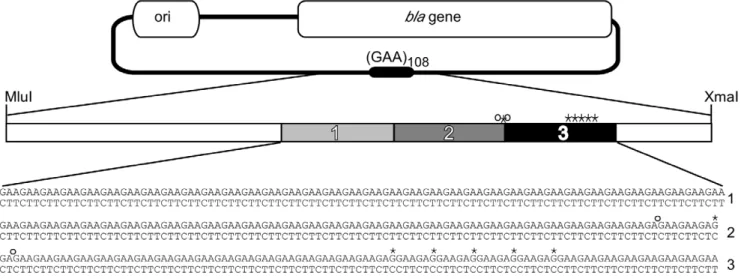
In order to investigate the means and consequences of targeting GAANTTC repeats for interruption, we chose to use a (GAANTTC)108 allele already containing several point
interrup-tions (Figure 1). This strategy provided several benefits. First, the interrupted (GAANTTC)108allele cloned into pBAD18 remained
stable through repeated transfection and growth cycles in bacteria, in contrast to an uninterrupted (GAANTTC)88repeat in pBAD18
that we had worked with previously [12]. Second, the point interruptions provided landmarks for more easily determining transposon location within the repeat. Finally, the interruptions were largely clustered within the distal third of the repeat (Figure 1), enabling us to determine if these interruptions affected transposition within the repeat.
Tn7 preferentially inserts into uninterrupted GAANTTC repeats at lower pH
We used the Genome Priming System (GPS-1) by New England Biolabs to achieve Tn7 transposition into target plasmids. The system uses Tn7 transposition proteins TnsA, TnsB and a hyperactive TnsCA225V protein to achieve efficient in vitro transposition [26]. The transposon carried a selectable marker, so that plasmids containing Tn7 integrants could be recovered from transfected bacteria. The transposon donor plasmids we used
Figure 1. Experimental Target. Plasmid targets forin vitrotransposition reactions contained 108 GAANTTC repeats. Hollow boxes indicate essential regions (ori,bla) of the plasmid excluded from recoverable transposition events. The expected frequency of insertion into the (GAANTTC)108region
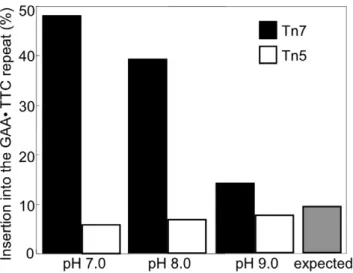
had an R6K-corigin of replication requiring specific host factors for replication [29], so that co-transformants do not complicate analysis. An initial restriction digest of miniprep DNA prepared from doubly selected transformed target plasmids was used to rapidly determine whether the transposon inserted into the repeat-bearing region of the target plasmid (Figure 1). DNA sequencing using primers from the ends of the Tn7 transposon was then used to determine precisely where the transposon had inserted within the repeat-bearing fragment. To aid in discussing our results, the GAANTTC repeat was divided into thirds. Repeats 1–36 made up the first third, repeats 37–72 the second, and repeats 73–108 the last (Figure 1). GAANTTC repeats readily form YNRNY DNA triplex structures in supercoiled plasmids [18,19] particularly when in their native flanking sequence [19]. Given the reported propensity for Tn7 to insert next to YNRNY DNA structures [27,28] we reasoned that encouraging structure formation within the GAANTTC repeat would lead to an increase in Tn7 insertion. We therefore conductedin vitrotransposition reactions at pH 7.0 to encourage YNRNY DNA structures, as well as at the recommended pH 8.0. Transposition reactions were also con-ducted at pH 9.0 where YNRNY triplex formation is less favored [30,31]. The expected occurrence of insertion into the repeat was calculated based on the size of the repeat compared to the size of the rest of the plasmid (minus the bla gene and the origin of replication). The expected percentage of insertion into the repeat if Tn7 inserts at random was calculated to be about 9%. However, when triplex formation was encouraged at pH 7.0, of ninety-six insertions analyzed, 48% were within the GAANTTC repeat (Figure 2). At pH 8.0, of 120 insertions analyzed, 39% of insertions occurred within the repeat. At pH 9.0, where the acid stabilized YNRNY triplex formation is discouraged, only 14% of 96 insertions occurred within the repeat (Figure 2). As a control in vitro transposition system, we chose the EZ::TN system to insert Tn5
into our target plasmids. In stark contrast to Tn7, Tn5 showed no preference for inserting into the GAANTTC repeat at any pH value tested (Figure 2).
Neither transposon inserted into a short normal allele containing only 9 GAANTTC repeats under any conditions (not shown). Finer analysis of Tn7 insertions within the long GAANTTC repeat by DNA sequencing showed that an uninter-rupted stretch of 18 GAANTTC repeats located between the interruptions in region 3 of the repeat was also not a frequent target for insertion (Figure 3). The majority of insertions into the repeat at pH 7.0 and pH 8.0 were in the first and second regions. However, when YNRNY triplex formation was discouraged by conducting reactions at pH 9.0, there was less bias in the insertion location (Figure 3). Integration into the same base position can indicate a preferred spot, or be the result of analysis of sibling colonies. To limit the number of siblings that were analyzed, we limited the analysis to 24 colonies from individual transposition reactions. In 20 cases, 2 or more transposons were in the same location. In 15 of these cases the transposons were in opposite orientation, or from different transposition reactions, leaving just 5 of the duplicates shown in Figure 3 as potential sibling clones.
Tn7 shows orientation-specific insertion into GAANTTC repeats at lower pH
Transposon Tn7 has been shown to exhibit polarity with respect to insertion next to psoralen cross-linked triplex forming oligonucleotide structures [27,28]. We were also able to discern a polarity with regard to the orientation of Tn7 insertion within the GAANTTC (Figure 3). When the transposition reaction was performed at pH 7.0 or pH 8.0, more than 75% of total insertions in the first part of the repeat occurred with the transposon in the left to right, or the ‘‘plus’’ orientation relative to the 59 to 39
orientation of the GAA strand. For insertions in the second part of the repeat, the majority was also in the ‘‘plus’’ orientation. In contrast, in the third part of the repeat, the few insertions that occurred were mostly in the ‘‘minus’’ orientation. At pH 9.0, there was little bias in orientation for the few insertions that occurred in the repeat (Figure 3).
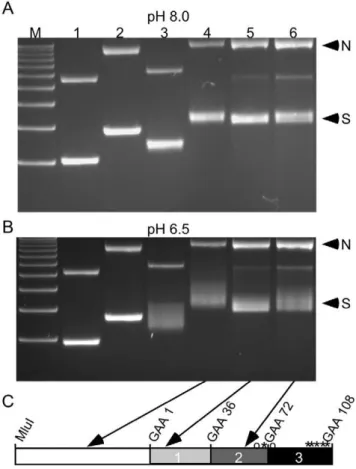
The formation of triplex DNA is able to relax negative supercoils such that covalently closed plasmids can fluctuate between being partially relaxed and supercoiled [18]. We can visualize this as a change in electrophoretic mobility when samples are subject to electrophoresis at a pH compatible with YNRNY triplex formation. To determine whether the insertion of a transposon would inhibit triplex formation, we analyzed the electrophoretic mobility of plasmids containing a Tn5 transposon at different areas along the repeat (Figure 4). We used Tn5 for these experiments, because Tn5 inserted at random within the repeat, and we were able to obtain plasmids containing Tn5 at desired locations and orientations along the repeat. At pH 8.0, bands representing the supercoiled forms of samples (S in Figure 4) migrate as relatively tight bands (Figure 4A). However, at pH 6.5, supercoiled samples containing 108 repeats exhibit variable migration indicating partial relaxation due to the formation of DNA secondary structures (Figure 4B, lanes 3–6). When the transposon is inserted adjacent to, but outside the repeat, there is little difference compared to plasmids without transposon insertion (compare lanes 3 and 4). When a transposon is inserted into the repeat, we see a variable decrease in relaxation, depending upon the location of the insertion within the repeat tract. For instance, interrupting the uninterrupted first region of GAANTTC repeats results in a much closer approximation to normal supercoiled mobility at pH 6.5 (lane 5) compared to insertion near a pre-existing interruption in the second region of the repeat (lane 6). Figure 2. Preferential insertion into the (GAANTTC)108repeat by
Tn7 is pH dependent.Bars indicate transposon insertion into the (GAANTTC)108repeat as a percentage of total insertions in the target
plasmid at several pH values. Transposon Tn7 (black bars) shows a pH dependent bias for insertion into the repeat, inserting 48, 39 and 14 percent of the time at pH 7, pH 8 and pH 9, respectively. In contrast, transposon Tn5 is not attracted to the GAANTTC repeat, inserting 6, 7 and 8 percent of the time at pH 7, pH 8 and pH 9, respectively. Insertion location was determined by a combination of restriction digest mapping and DNA sequencing. The expected frequency based on target size is 9% (gray bar). For pH 7 and pH 9 n = 96, for pH 8 n = 120.
The formation of secondary structures by GAANTTC may contribute to a block in transcription elongation and reduce the amount of full-length transcript in FRDA [8–10]. We have demonstrated in the past that such a block to transcription elongation does occur in simple,in vitroT7 transcription systems, and is exacerbated by negative supercoiling in the template [11,18]. This led us to investigate whether insertion of a transposon would interrupt the repeat to a degree that would allow an increase in transcription. To achieve this, oligodeox-ynucleotides were used to insert a T7 promoter next to the repeats in selected clones. Because negative supercoils can help stabilize many non-B DNA structures, we wanted to be able to directly compare the products of transcription from relaxed, linear templates and negatively supercoiled templates. Therefore, a fragment of the plasmids containing the T7 promoter, and the FXN repeat region (with or without Tn5 insertions) was moved into a vector containing two self-cleaving ribozymes [32]. The arrangement was such that one ribozyme cut site was located 106 bases upstream of the T7 promoter, and the other 216 bases downstream of the GAANTTC tract. Thus, self-cleavage of the downstream ribozyme produced identical transcripts from super-coiled templates, or templates made linear by restriction digestion downstream of the ribozyme. We performedin vitrotranscription on supercoiled and linear templates and compared the transcript yield (Figure 5).
The effect of negative supercoiling on transcript yield was less for this sequence than we had seen in the past with 88 uninterrupted GAANTTC repeats [11]. However, a small
difference is discernible, comparing lanes 1 and 2 for linear or supercoiled templates in Figure 5. Unexpectedly, the presence of the mini Tn5 transposon also attenuated full-length transcription by T7 RNA polymerase, although this was not exacerbated by negative supercoiling (compare lanes 1 and 3 for both linear and supercoiled templates in Figure 5). In contrast to the differential effects seen on YNRNY triplex formation in Figure 4, there was little difference seen in transcript yield when a transposon was adjacent to, or within the GAANTTC repeat (compare lanes 4 with lanes 5 and 6 in Figure 5).
Discussion
We have shown that structure formation by a Friedreich ataxia patient-derived GAANTTC repeat tract directs Tn7 transposition to the repeat in vitro. The transposon inserts in a region-specific and orientation-specific manner within the repeat in the absence of its usual target specificity proteins TnsD or TnsE, suggesting that structures formed by the repeat somehow replace functions of those specificity factors. In the cell, Tn7 uses two distinct transposition target site selection pathways encoded by five genes (TnsABCDE). TnsA, TnsB and TnsC provide a core recombina-tion machine that mediates the DNA strand breakage and joining reactions [23]. TnsD directs high frequency orientation-specific insertion by TnsABC into a single site in theE. coli genome called attTn7 in a process that involves TnsD distorting the target site [33]. The combination of TnsABC and TnsE promotes insertion into DNA undergoing lagging strand synthesis. In particular, TnsE Figure 3. The location and orientation of Tn7 insertion within the GAANTTC repeat is pH dependent.Depictions of the MluI to XbaI fragment containing the GAANTTC repeat with vertical lines indicating Tn7 insertion events at pH 7, pH 8 and pH 9 both within and near the repeat. The repeat is divided into thirds, and point deletions and substitutions in the GAA repeat are indicated by open circles and asterisks, respectively. Lines extending above represent insertions events in the (+) orientation, defined as the transposon oriented from left to right. Lines extending below
represent insertion events in the (2) orientation with the transposon oriented right to left. Insertions performed at pH 7 and pH 8 show a strong bias for the left to right (+) orientation of the transposon. At pH 7.0 and pH 8.0, Tn7 shows a bias for insertion within the largely uninterrupted regions 1
and 2. In contrast, region 3, an area where the GAANTTC repeat contains multiple interruptions, is not a favored target for insertion. Location of insertion was determined by DNA sequencing.
promotes preferential insertion into transferred conjugal DNA using two critical features: DNA structure and specific binding to the slidingb-clamp [25,34].
In the absence of TnsD and TnsE, a hyperactive TnsABC* complex directs transposition into many different target sites with low selectivity [26], but has also been shown to recognize and preferentially insert adjacent to psoralen cross-linked triplex forming oligomers [27]. Tn7 insertion is orientation-specific, with the right side of Tn7 towards the cross-linked third strand, and is specific for pyrimidine oligonucleotides bound in a YNRNY triplex [28]. In our system, the pH dependence of structure formation by the GAANTTC repeat that results in Tn7 insertion suggests a YNRNY triplex. Long stretches of polypurine-polypyrimidine sequences such as GAANTTC can adopt an intramolecular YNRNY triplex structure sometimes called H-DNA [15,16,20]. H-DNA forms when duplex DNA is opened up and the polypyrimidine (Y) strand folds back onto the duplex forming a triple stranded YNRNY helix. Two isomers can form: H-y3, and H-y5, depending on whether the part of the Y strand that folds over to become the third strand is from the 39or the 59end, respectively [20]. We do
not know whether H-y3 or H-y5 predominates in the GAANTTC repeats in our plasmids, although we can predict that structures formed as a consequence of DNA opening in an A and T rich stretch derived from an AluSx element immediately upstream of the GAANTTC repeat would favor the H-y3 conformation. In addition, we saw that insertion of a Tn5 transposon near that A and T rich stretch had a strong effect on YNRNY triplex formation at pH 6.5 in gel mobility assays (see Figure 4, lane 5). Finally, spontaneous opening from within the interrupted, and slightly more GC rich region 3 of the repeat (the 59end of the Y strand) would discourage H-y5 structures in that end of the repeat, unlike the uninterrupted GAANTTC repeats that formed a bi-triplex due to opening at both flanking ANT stretches [19]. The bias in polarity of Tn7 transposition into the repeat suggests that a specific structure may be instigating the insertions. Alternatively, it may indicate that Tn7 tracks on the DNA with a particular orientation. However, the nature of the predominant structures formed in the transposition assay buffer, or the subset of structures responsible for attracting the insertion events must await future studies.
It is noteworthy that YNRNY triplex formation by the GAANTTC repeat is spontaneous and not covalently constrained by psoralen cross-links, yet stable enough to effectively attract Tn7 insertion at pH 7 or even the slightly alkaline pH 8. A hallmark of the YNRNY triplex is its pH dependency owing to the need for protonation of the third strand cytosine base in order to form stable Hoogsteen bonds with the central guanine in a CNGNC triplet [15,16,20]. Figure 4. Interruptions in the GAANTTC repeat alter pH
dependent formation of secondary structure.The electrophoretic mobility of nicked (N) and supercoiled (S) plasmids at pH 8.0 and pH 6.5 is shown in A and B, respectively. M = 1KB plus ladder, Lane 1:9 repeats, no transposon. Lane 2:9 repeats and Tn5 transposon 59 of the first repeat. Lane 3:108 repeats, no transposon. Lane 4:108 repeats and transposon Tn5 86 bases 59of the first repeat. Lane 5:108 repeats and transposon at repeat 8. Lane 6:108 repeats and transposon at repeat 57. Arrows indicate the repeat region containing the Tn5 transposon in plasmids run in lanes 4, 5 and 6 on the schematic representation of the repeat target in panel C. The size of the plasmid in lane 1 is 4815 bp; in lane 2, 6328 bp; in lane 3, 5100 bp; in lanes 4–6 6613 bp.
doi:10.1371/journal.pone.0011121.g004
Figure 5. Interrupting the (GAANTTC)108repeat with a
However, the GAANTTC repeat is only one third GNC, so its pH dependency is much less than that of a more GNC rich RNY sequence. Intramolecular triplexes are additionally stabilized by the energy gained by relaxation of local negative supercoils [16,35]. Consequently, even in the complete absence of divalent cations during gel electrophoresis we see evidence for substantial YNRNY triplex formation at pH 6.5 for the sequence used in this study (see figure 4), and for uninterrupted GAANTTC sequences we have seen triplex formation at neutral pH [18]. Divalent cations, although not essential for YNRNY triplex formation will help stabilize the triplex [16] and the presence of magnesium in the transposition reaction buffer apparently pushed the stability of the triplex up to pH 8.0, judging by the similarity of Tn7 transposition events to those at pH 7.0. However, it is likely that cytosine protonation was not sufficient at pH 9 to support YNRNY triplex structures [30,31] even in the presence of negative supercoiling and a stabilizing divalent cation.
Our data agree with previous work that shows it is likely that GAANTTC repeats can form the YNRNY triplex under physiolog-ically relevant pH and ionic conditions [19]. We speculate that structure formation by the repeat contributes to GAANTTC repeat instability. Uninterrupted GAANTTC repeat sequences display high levels of genomic instability, with a tendency towards progressive expansion [6,7]. Interruptions in the purity of the repeats reduce the expansion rate in human cells. While the work here is a proof of concept that GAANTTC repeats can be specifically targeted for interruption, we do not suggest that Tn7 could be the basis for any sort of useful therapy. However, our demonstration of a recombinase targeting a spontaneously formed triplex DNA structure under physiologically relevant conditions has wider implications. DNA structure has been described at multiple chromosomal translocation break points [36], particularly in cases where RAG recombinase is involved [37,38]. It is likely that a number of enzymes involved in DNA transactions are attracted to DNA structure, in addition to Tn7 transposase and RAG recombinase. Future identification of such complexes in human nuclei that target GAANTTC repeats may provide the key to understanding both why GAANTTC repeats expand, and how they subsequently repress gene expression.
Materials and Methods
PCR amplification of genomic DNA
Primers 517F (59GGCTTAAACTTCCCACACGTT 39) and 629R (59 AGGACCATCATGGCCACACTT 39) were used in the amplification of human genomic DNA. PCR parameters included 94uC for 2 minutes, 30 cycles of 94uC for 30 seconds, 68uC for 1 minute and 30 seconds plus 10 seconds added every cycle, followed by 72uC for 10 minutes and a 4uC hold. The pH of MOPS (3-[N-morpholino] propanesulfonic acid) is much less temperature dependent than that of Tris and it provides better results for GAANTTC repeats than standard PCR reactions. Therefore, amplification was done in MOPS + Triton buffer (20 mM MOPS pH 8.2, 2 mM MgSO4, 5 mM (NH4)2SO4, 0.1%
TritonX-100), 0.25 mM each dNTP, and 1 U Takara Ex enzyme (TaKaRa Bio). PCR products were resolved on a 1% agarose gel containing ethidium bromide in TAE buffer (40 mM Tris-Acetate pH 8.0, 2 mM EDTA). DNA was visualized by UV transillumination.
Gel Purification
To obtain an expanded FXN allele, the PCR product band corresponding to an individual allele was excised from an agarose gel after resolution. The gel slice was centrifuged through spun
polyester fiber, phenol chloroform extracted, sodium acetate/ ethanol precipitated and resuspended in TE (10 mM Tris pH 8.0, 1 mM EDTA). Secondary amplification, to increase the yield of gel-purified samples, was performed. PCR parameters for secondary amplification were: 94uC for 2 minutes, 15 cycles of 94uC for 1 minute, 64uC for 2 minutes, 72uC for 1 minute 30 seconds, followed by 72uC for 10 minutes and a 4uC hold. Products were resolved and extracted as above.
Molecular cloning
The plasmid pBad18 [39] was digested with restriction enzymes NheI and XmaI. Purified secondary amplifications of genomic samples were digested with restriction enzymes AvrII and XmaI. The double digested vector and PCR products were gel purified. A 1:1 vector to insert molar ratio was ligated using T4 ligase (Invitrogen) and transformed into Xl-1Blue MRF’ (Stratagene). Transformants were selected using ampicillin (100mg/ml). Plasmids were isolated using alkaline lysis as described [40] unless otherwise indicated. Ligations resulted in a pBad18 plasmid containing either 9 or 108 GAANTTC repeats and 59 and 39 flanking regions contain 266 and 168 bases, respectively ofFXN sequence. The size of the plasmids was 4815 base pairs and 5100 base pairs, respectively. The sequence of the cloned, expanded allele is available online (GenBank accession number GU722204).
Transposon Insertion
The GPS-1in vitrotransposition system (New England Biolabs) was used as directed by the manufacturer to insert transposon Tn7 into plasmids containing 9 or 108 GAANTTC repeats. Briefly, pGPS2.1 donor DNA was incubated with target DNA (0.08mg) in the presence of TnsABC* transposase in GPS buffer (25 mM Tris-HCl pH 8.0, 2 mM DTT and 2 mM ATP) for 10 minutes at 37uC. The pH of the GPS buffer was adjusted to pH 7.0 and pH 9.0 for some experiments. Start solution (15 mM magnesium acetate, final concentration) is added and incubated at 37uC for 1 hour. After heat inactivation at 75uC for 10 minutes, the reaction was transformed into Xl-1Blue MRF’ cells. Plasmids were selected using ampicillin (100mg/ml) with chloramphenicol (15mg/ml). The transposon donor plasmids had an R6K-corigin of replication and do not replicate in Xl-1 Blue. 24 colonies were analyzed from each transposition experiment. Transposon loca-tion was first mapped by MluI/XmaI digesloca-tion. The localoca-tion of transposition events in the smaller MluI/XmaI fragment (in or near the repeat) was determined by DNA sequencing using primer N (59ACTTTATTGTCATAGTTTAGATCTATTTTG 39) and primer S (59 ATAATCCTTAAAAACTCCATTTCCACCCCT 39) of the GPS system.
The EZ::TN,Kan-2.in vitroinsertion system (Epicentre) was used as directed by the manufacturer to insert a Tn5 transposon into target plasmids containing 9 or 108 GAANTTC repeats. Briefly, target DNA was incubated with EZ::TNTM,KAN-2.
transposition events in the smaller MluI/XmaI fragment (in or near the repeat) was determined by DNA sequencing using primers Kan2-FP-1 (59 ACCTACAACAAAGCTCTCAT-CAACC 39) and Kan2-RP-1 (59 GCAATGTAACATCAGA-GATTTTGAG 39) of the EZ-TN system.
Addition of T7 promoter to selected plasmids
When annealed, oligonucleotides T7a (59 CCGCTAATTAA-TACGACTCACTATAGGGA 39) and T7b (59 CGCGTCC-CTATAGTGAGTCGTATTAATTA 39) leave sticky ends corre-sponding to MluI and AgeI restriction sites. The oligonucleotides (10mM, final concentration) were mixed in 50 mM NaCl in TE at 75uC. The temperature was gradually cooled allowing oligonu-cleotides to anneal. A 1:10,000 dilution of the annealed linker was ligated to AgeI/MluI digested plasmids.
Cloning between self-cleaving ribozymes
Plasmids containing the inserted T7 promoter were digested with XmaI and AgeI, to release the repeats (some interrupted with transposon Tn5) linked to the T7 promoter. A plasmid containing two self-cleaving ribozymes in tandem, TAN1 [32] was linearized by restriction digest with XmaI, which cuts between the two ribozymes. Phosphates were removed from the cut ends of the TAN1 plasmid with bacterial alkaline phosphatase (BAP). The repeat inserts were then ligated to XmaI cut TAN1. Construct integrity was verified by sequencing with primers 2515a (59
CGTCGCCAGTCAAGTAACAA 39) and 3232b (59 CCAAAA-GACGGCAATATGGT 39) that prime from within the TAN1 vector. Aliquots of these templates described in the figure legends were then used forin vitrotranscription. The size in base pairs (bp) of these transcription vectors was as follows: TAN1-9GAA, 9108 bp; TAN1-108GAA, 9403 bp; TAN1-9GAA-Tn5, 10621 bp; TAN1-108GAA-Tn5, 10916 bp.
Gel mobility assay
Samples were separated by electrophoresis on a 1% agarose gel in TAE buffer (40 mM Tris-Acetate pH 8.0, 2 mM EDTA) for 5 hours at a constant voltage of 60v. Electrophoresis was conducted at pH 6.5, and pH 8.0 in a buffer puffer (Owl Separation Systems) recirculating electrophoresis box in order to maintain a uniform pH. Gels were stained with ethidium bromide for visualization after electrophoresis.
In vitrotranscription
Concentration matched templates, either supercoiled or linear-ized by restriction digestion with AvrII (which cuts 100 bases
downstream of the second ribozyme cleavage site in TAN1) were prepared. Aliquots were added to T7 transcription buffer (50 mM HEPES pH 8.0, 100 mM NaCl, 20 mM MgCl2, 10 mM DTT and 0.5 mM each NTP), and T7 RNA polymerase containing RNase inhibitor (Ambion) was added to start the reactions. Samples were transcribed for 30 minutes at 37uC. The reaction was stopped with the addition of loading buffer containing 5 mM EDTA. Electrophoresis was done on a 1% agarose gel containing ethidium bromide in TAE buffer pH 8.0. Samples were then transferred to a nylon membrane overnight.
Northern blot
Following transfer, the membrane was UV cross-linked for one minute. The blot was washed 2X 5 minutes in 2XSSC, 0.1% SDS followed by pre-hybridization in 7% SDS, 0.5M NaPO4
pH 7.5 and 1 mM EDTA for 30 minutes at 55uC. A biotinylated DNA probe, biomlu (59 TTTCTGCCGTGATTATAGA-CACTTTTGTTACGCGT 39), designed to bind 296 to 260 bases upstream of the first repeat was denatured at 100uC for 10 minutes and then added to the blot in hybridization buffer at a final concentration of 0.03mM. The probe was allowed to bind for 30 minutes at 55uC, followed by a decrease in temperature to 45uC for 30 minutes, and 37uC for 30 minutes. The membrane was then washed 2X 5 minutes in 2X SSC, 0.1% SDS and then washed 5 minutes in TBST (10 mM Tris pH 8.0, 150 mM NaCl and 0.05% Tween 20). The membrane was blocked overnight in TBST with 0.5% Hammerstein grade casein. Horseradish peroxidase-avidin (0.125mg/ml final concentration) was then added for 1 hour, followed by washing 3X 5 minutes in TBST. Chemiluminescence using ECL Advance (Amersham) was then used to detect probe binding. Images of the blots were obtained using a Kodak Gel Logic 440 imaging system. Analysis and quantitation was performed with Kodak Molecular Imaging software.
Acknowledgments
We thank Dr. Bronya Keats for providing us with Friedreich ataxia patient DNA samples, and for all her past support.
Author Contributions
Conceived and designed the experiments: MM EG. Performed the experiments: MM. Analyzed the data: MM EG. Contributed reagents/ materials/analysis tools: MCS. Wrote the paper: MM MCS EG.
References
1. Campuzano V, Montermini L, Molto MD, Pianese L, Cossee M, et al. (1996) Friedreich’s ataxia: autosomal recessive disease caused by an intronic GAA triplet repeat expansion. Science 271: 1423–1427.
2. Pandolfo M (2008) Friedreich ataxia. Arch Neurol 65: 1296–1303.
3. Filla A, De Michele G, Cavalcanti F, Pianese L, Monticelli A, et al. (1996) The relationship between trinucleotide (GAA) repeat length and clinical features in Friedreich ataxia. Am J Hum Genet 59: 554–560.
4. Montermini L, Richter A, Morgan K, Justice CM, Julien D, et al. (1997) Phenotypic variability in Friedreich ataxia: role of the associated GAA triplet repeat expansion. Ann Neurol 41: 675–682.
5. De Biase I, Rasmussen A, Monticelli A, Al-Mahdawi S, Pook M, et al. (2007) Somatic instability of the expanded GAA triplet-repeat sequence in Friedreich ataxia progresses throughout life. Genomics 90: 1–5.
6. De Biase I, Rasmussen A, Endres D, Al-Mahdawi S, Monticelli A, et al. (2007) Progressive GAA expansions in dorsal root ganglia of Friedreich’s ataxia patients. Ann Neurol 61: 55–60.
7. Ditch S, Sammarco MC, Banerjee A, Grabczyk E (2009) Progressive GAANTTC
repeat expansion in human cell lines. PLoS Genet 5: e1000704.
8. Bidichandani SI, Ashizawa T, Patel PI (1998) The GAA triplet-repeat expansion in Friedreich ataxia interferes with transcription and may be associated with an unusual DNA structure. Am J Hum Genet 62: 111–121.
9. Ohshima K, Montermini L, Wells RD, Pandolfo M (1998) Inhibitory effects of expanded GAA.TTC triplet repeats from intron I of the Friedreich ataxia gene on transcription and replication in vivo. J Biol Chem 273: 14588–14595. 10. Sakamoto N, Chastain PD, Parniewski P, Ohshima K, Pandolfo M, et al. (1999)
Sticky DNA: self-association properties of long GAA.TTC repeats in R.R.Y triplex structures from Friedreich’s ataxia. Mol Cell 3: 465–475.
11. Grabczyk E, Usdin K (2000) The GAANTTC triplet repeat expanded in Friedreich’s ataxia impedes transcription elongation by T7 RNA polymerase in a length and supercoil dependent manner. Nucleic Acids Res 28: 2815–2822. 12. Grabczyk E, Mancuso M, Sammarco MC (2007) A persistent RNANDNA hybrid
formed by transcription of the Friedreich ataxia triplet repeat in live bacteria, and by T7 RNAP in vitro. Nucleic Acids Res 35: 5351–5359.
14. Herman D, Jenssen K, Burnett R, Soragni E, Perlman SL, et al. (2006) Histone deacetylase inhibitors reverse gene silencing in Friedreich’s ataxia. Nat Chem Biol 2: 551–558.
15. Wells RD, Collier DA, Hanvey JC, Shimizu M, Wohlrab F (1988) The chemistry and biology of unusual DNA structures adopted by oligopurine.oli-gopyrimidine sequences. Faseb J 2: 2939–2949.
16. Frank-Kamenetskii MD, Mirkin SM (1995) Triplex DNA structures. Annu Rev Biochem 64: 65–95.
17. Usdin K, Grabczyk E (2000) DNA repeat expansions and human disease. Cell Mol Life Sci 57: 914–931.
18. Grabczyk E, Usdin K (2000) Alleviating transcript insufficiency caused by Friedreich’s ataxia triplet repeats. Nucleic Acids Res 28: 4930–4937. 19. Potaman VN, Oussatcheva EA, Lyubchenko YL, Shlyakhtenko LS,
Bidichandani SI, et al. (2004) Length-dependent structure formation in Friedreich ataxia (GAA)n*(TTC)n repeats at neutral pH. Nucleic Acids Res 32: 1224–1231.
20. Htun H, Dahlberg JE (1988) Single strands, triple strands, and kinks in H-DNA. Science 241: 1791–1796.
21. Pearson CE, Sinden RR (1998) Trinucleotide repeat DNA structures: dynamic mutations from dynamic DNA. Curr Opin Struct Biol 8: 321–330. 22. Ohshima K, Sakamoto N, Labuda M, Poirier J, Moseley ML, et al. (1999) A
nonpathogenic GAAGGA repeat in the Friedreich gene: implications for pathogenesis. Neurology 53: 1854–1857.
23. Bainton RJ, Kubo KM, Feng JN, Craig NL (1993) Tn7 transposition: target DNA recognition is mediated by multiple Tn7-encoded proteins in a purified in vitro system. Cell 72: 931–943.
24. Waddell CS, Craig NL (1989) Tn7 transposition: recognition of the attTn7 target sequence. Proc Natl Acad Sci U S A 86: 3958–3962.
25. Parks AR, Li Z, Shi Q, Owens RM, Jin MM, et al. (2009) Transposition into Replicating DNA Occurs through Interaction with the Processivity Factor. Cell 138: 685–695.
26. Biery MC, Stewart FJ, Stellwagen AE, Raleigh EA, Craig NL (2000) A simple in vitro Tn7-based transposition system with low target site selectivity for genome and gene analysis. Nucleic Acids Res 28: 1067–1077.
27. Rao JE, Miller PS, Craig NL (2000) Recognition of triple-helical DNA structures by transposon Tn7. Proc Natl Acad Sci U S A 97: 3936–3941.
28. Rao JE, Craig NL (2001) Selective recognition of pyrimidine motif triplexes by a protein encoded by the bacterial transposon Tn7. J Mol Biol 307: 1161–1170. 29. Filutowicz M, Rakowski SA (1998) Regulatory implications of protein assemblies
at the gamma origin of plasmid R6K - a review. Gene 223: 195–204. 30. Collier DA, Wells RD (1990) Effect of length, supercoiling, and pH on
intramolecular triplex formation. Multiple conformers at pur.pyr mirror repeats. J Biol Chem 265: 10652–10658.
31. Asensio JL, Lane AN, Dhesi J, Bergqvist S, Brown T (1998) The contribution of cytosine protonation to the stability of parallel DNA triple helices. J Mol Biol 275: 811–822.
32. Banerjee A, Sammarco MC, Ditch S, Wang J, Grabczyk E (2009) A Novel Tandem Reporter Quantifies RNA Polymerase II Termination in Mammalian Cells. PLoS ONE 4: e6193.
33. Kuduvalli PN, Rao JE, Craig NL (2001) Target DNA structure plays a critical role in Tn7 transposition. EMBO J 20: 924–932.
34. Peters JE, Craig NL (2001) Tn7 recognizes transposition target structures associated with DNA replication using the DNA-binding protein TnsE. Genes Dev 15: 737–747.
35. Htun H, Dahlberg JE (1989) Topology and formation of triple-stranded H-DNA. Science 243: 1571–1576.
36. Raghavan SC, Lieber MR (2006) DNA structures at chromosomal translocation sites. Bioessays 28: 480–494.
37. Posey JE, Pytlos MJ, Sinden RR, Roth DB (2006) Target DNA structure plays a critical role in RAG transposition. PLoS Biol 4: e350.
38. Raghavan SC, Chastain P, Lee JS, Hegde BG, Houston S, et al. (2005) Evidence for a triplex DNA conformation at the bcl-2 major breakpoint region of the t(14;18) translocation. J Biol Chem 280: 22749–22760.
39. Guzman LM, Belin D, Carson MJ, Beckwith J (1995) Tight regulation, modulation, and high-level expression by vectors containing the arabinose PBAD promoter. J Bacteriol 177: 4121–4130.