
An Alternative Method for the Measurement of
Stellar Nuclear-Reaction Rates
J. O. Fern´andez Niello
1, A. Arazi
1,2, T. Faestermann
2, K. Knie
2, G. Korschinek
2,
E. Richter
3, G. Rugel
4, and A. Wallner
41Laboratorio TANDAR, C.N.E.A., Av. del Libertador 8250, 1429 Buenos Aires, Argentina 2Physikdepartment der Technischen Universit¨at M¨unchen, 85748 Garching, Germany
3Forschungszentrum Rossendorf, Postfach 51 01 19, 01314 Dresden, Germany 4
Ludwig-Maximilians Universit¨at M¨unchen, Schillerstraße 42, 80336 M¨unchen, Germany
Received on 30 October, 2002
For charged-particle induced reactions occurring in astrophysical scenarios, projectile energies are usually well below the Coulomb barrier of the reacting system. Hence, extremely small cross section reactions pose a difficult task for laboratory measurements. Most commonly, these energy-dependent cross sections are studied by detecting the emitted prompt gamma rays following the de-excitation of the produced compound nucleus. In this work we propose an alternative way for the measurement of the extremely small cross sections of the
25Mg(p,γ)26Al resonant reaction, namely the use of the Accelerator Mass Spectrometry (AMS) technique.
I
Introduction
In the understanding of the nucleosynthesis of the elements in stars, one of the most important quantities is the reaction rate. This quantity must be evaluated in terms of the stel-lar temperature T, and its determination involves the knowl-edge of the excitation functionσ(E) of the specific nuclear reaction leading to the final nucleus. The particular case of proton capture reactions plays an important role in stellar process of intermediate-mass elements.
In several cases, the formation of a compound nucleus is dominated by a resonant process: the entrance channel, formed by a projectile P impinging on a target nucleus A, evolves into an excited state of a compound nucleus B = P + A, which ultimately decays into lower-lying states with the subsequent emission of gamma rays. This process oc-curs at well-defined center of mass (CM) energies, ECM =
EX −Q, where EX is the energy of the excited states of the compound nucleus B andQis theQ-value of the reac-tion [1].
In a stellar environment, the reaction rate per particle pair is calculated as [2]
< σv >= ∞ Z
0
σ v φ(v) dv, (1)
whereσ is the energy-dependent reaction cross section, v
the relative velocity between the reacting particles andφ(v) is the velocity distribution of these particles in the stellar plasma.
Nuclei participating in thermonuclear reactions can be considered as non-relativistic and non-degenerate ones, therefore, their velocitiesv(and hence their energiesE) fol-low a Maxwell-Boltzmann distribution,
⌋
φ(v) = 4π v2³ m
2π kT ´3/2
exp µ
−mv
2
2kT 
∝ E exp µ
− E kT

, (2)
⌈
where E =12mv 2
represents the kinetic energy of the nucleus with mass m, and T refers to the temperature of the gas. This distribution reaches a maximum value at E =kT. The second term defining the reaction rate is the cross section for the compound nucleus formation. This can be described by three factors: a geometrical one,σ = πλ/2 ∝ E−1
; a
< σv >= r
8
µπ
1 (kT)3/2
∞ Z
0
S(E) exp "
− E kT−
πe2Z PZA
~
r 2µ
E #
dE, (3)
⌈
whereµis the reduced mass andZP andZAare the atomic numbers of projectile and target, respectively.
The exponential term, product of the tunneling probabil-ity and the energy distribution of the projectiles, results in the so-calledGamow peak[2], which is centered at
E0= "
πe2
ZPZA
kT
~c
r
µc2
2 #2/3
, (4)
and is characterized by a width of
∆E0= r
16E0kT
3 . (5)
In case of non-resonant reactions (direct capture), the factorS(E)varies slowly with energy and the energy de-pendence of the reaction rate is therefore characterized only by the Gamow peak. For narrow resonances instead (where, e.g., the total widthΓ = ΓP+ Γγis much smaller than the resonant energy ER), which is the case of the25
Mg(p,γ)26 Al resonances, the energy dependence of the cross section can be described by the Breit-Wigner expression
σ(E) =λ
2
ω
4π
ΓPΓγ (E−ER)2+ (Γ/2)2
, (6)
whereλdenotes the wavelength of the projectile andω is a statistical factor which depends on the spins of projectile (JP) and target nucleus (JA) as well as on the angular mo-mentumJ of the excited state in the compound nucleus,
ω= 2J+ 1
(2JP + 1)(2JA+ 1)
. (7)
Using the Breit-Wigner formula for the cross section, the stellar reaction rate per particle pair yields
< σv >= µ 2π
µkT ¶3/2
~2ωγexp
·
−ER kT ¸
(8) whereωγ=ωΓPΓγ/Γis the resonance strength.
In nuclear astrophysics experiments resonance strengths are usually determined through the on-line detection of the gamma-ray emitted by the reaction products. For the case of a thick target (energy loss much larger than the resonance width) the reaction yieldY is proportional to the resonance strength, which can be obtained as [2]
ωγ=Y 2 λ2
dE
n dx M
M +m (9)
whereM andmare the masses of the target and projectile respectively, nthe atomic density anddE/dxthe stopping power.
Due to the barrier penetration factor, the reaction cross section drops exponentially and, hence, the strengths de-crease very rapidly with decreasing resonance energy ER. Therefore, an experimental determination of such weak resonances requires high beam intensities and, if gamma-detection techniques are applied, an effective suppression of background radiation, too. Effects of cosmic rays within the detector material or cosmic-ray interaction in passive-shielding material around the detectors restrain the low-energy studies of thermonuclear reactions in the laboratory, since an ubiquitous background level may exceed consider-ably the reaction-induced counting rate.
In this work we propose to overcome some of such problems arising from the low counting rate, by using the extremely high sensitivity of the accelerator mass spectro-metry technique (AMS) for the detection of small amounts of long-lived radioisotopes. In particular, we want to ad-dress the stellar occurrence of the25Mg(p,γ) capture reac-tion leading to26Al.
II
The
26Al radioisotope
The long-lived radioisotope26
Alg, with a half-life of7.2×
105
yr, is a fundamental piece to understand the nucleosyn-thesis process of intermediate mass nuclei.26
Al is produced both through the beta decay of26
Si and, predominantly, via proton capture on25Mg. In the first case, the ground state of 26
Al (Jπ = 5+
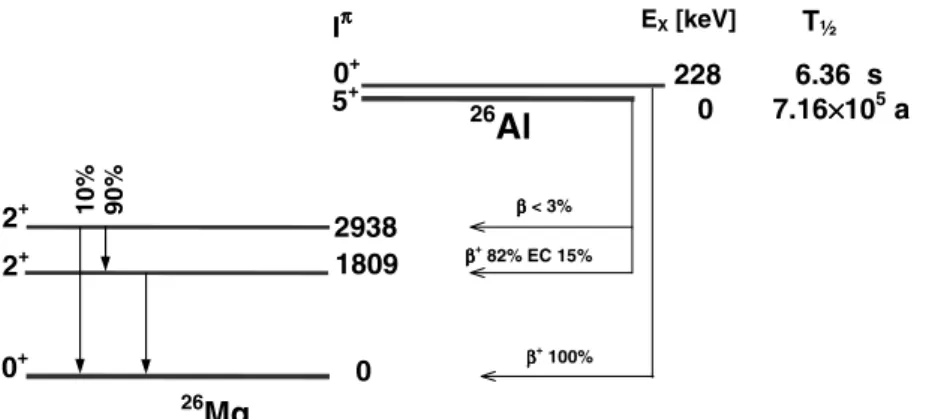
) is bypassed and the decay of26Si populates an isomeric state26Alm(T1/2 = 6.35s,Jπ = 0+). Inter-nal transitions from this isomer to the ground state26Algare inhibited due to the large spin difference. The only decay mode of this isomer state is the beta decay to the ground state of26
Mg, which is free of anyγ-ray emission (see Fig. 1).
Similar spin considerations forbid the decay from the ground state of26
Al to the ground state of the even-even 26
Mg nucleus. Beta decay or electron capture from the ground state of26
Al feeds predominantly the first excited state of26
Mg. This level decays to the ground state of26 Mg with the emission of a 1.806 MeV gamma ray.
The interest in the study of 26
Al nucleosynthesis pro-cesses has two milestones: On the one side, the discovery of a26
Mg excess in the Allende meteorite, which was inter-preted as an evidence for the liveβ-decay of26
0 7.16××××105 a 0+
5+ 26
Al
228 6.36 s EX [keV]
Iππππ T½
2+
0 26
Mg
1809
0+
β β β
β+ 82% EC 15%
β β β
β+ 100%
β β β β < 3%
2+ 10 2938
%
90
%
Figure 1. Decay scheme for26Al. The ground state decays predominantly to the first state of26MgJπ
= 2+(EX= 1809 keV). The residual
part of theβ+-decay (3%) feeds the second excited state of26Mg at an excitation energy of EX= 2938 keV (J π
= 2+).
228
0
6414
6398
6364 6343
0+ 5+
E
X=E
CM+Q
(keV)
6436
4 -3+
2 -0+ 4 -(4,5)
6496 6551 6598 6680
(4,5)+ 2+
3
-6610
I
ππππ(2-6)
-26
Al
>60 levels
4
-6724
Q = 6307 111
59 37
E
P(keV)
134
95 197 254 303 316 389 435
Nova
Supernova
W-R
AGB
Figure 2. Level scheme of26Al above the26Mg+p threshold. Also shown in this figure are the proton energies (in the laboratory system) that match the resonances. The arrows in the left part indicate the Gamow energy for the case of novae and supernovae and Wolf-Rayet or AGB stars and their widths resemble the width of the Gamow peak (see text).
Astrophysical sources of 26
Al production within our Galaxy are not well established. Possible production sites are supernovae, novae or massive stars (in the Asymptotic Giant Branch or in the Wolf Rayet phases). The proton temperature of supernovae or novae is in the order of T= 2×10⁸
K, whereas in massive stars hydrogen burning occurs at temperatures around T= 5×10⁷
K[5]. These tempera-tures correspond to proton energies of around 200 keV and 100 keV, respectively (see Eq. 4). Hence, solving the contro-versy concerning potential production sites of26
Al demands a precise determination of the production rate for the capture reaction25
Mg(p,γ) over the above-mentioned proton ener-gies.
The Coulomb barrier for the p+25
Mg reaction in the center-of-mass system is 2860 keV, i.e. the energies of in-terest are well below it. Within this range, the 25
Mg(p,
were, instead, estimated from spectroscopic factors pro-vided by the25Mg(3He, d)26Al reaction [9, 10]. Therefore, 25
Mg(p,γ)26
Al measurements were done only for resonant states populated in supernova or nova events and no direct information is available for those resonance strengths which determine the hydrostatic hydrogen burning in massive stars.
Table 1. Resonance strengths for the25Mg(p,γ)26Al reaction. The first column indicates the proton energies in the laboratory system. The second column gives the corresponding excitation energies for the excited states of26Al above threshold. Column three gives the results forωγfrom previous works [6].
EP(keV) EX(keV) ωγ(eV)
434.6 6724 0.9±0.2
389.0 6680 0.40±0.05
316.1 6610 0.07±0.01
303.5 6598 (5.1±0.6)×10−5
254.0 6551 (5.1±0.6)×10−6
197.0 6496 (7.4±0.9)×10−7
135.1 6436 ≤1.5×10⁻¹⁰a)
112.3 6414 2.1×10⁻¹¹a)
95.8 6398 1.2×10⁻¹⁰a)
59.8 6364 2.8×10⁻¹³a)
38.4 6343 2.4×10⁻²⁰a)
a)Values determined using the25Mg(3He, d)26Al reaction
III
The proposed method
AMS is a very sensitive technique capable of tracing long-lived radioisotope concentrations (ratio of the unstable to the stable nuclei) down to levels of about 10−15
. This sensitivity is used to perform an off-line measurements of26
Al nuclei formed when 25
Mg target foils are bombarded with high-intensity low-energy proton beams. The26
Al ions produced by this reaction are stopped and collected in the foil. After the irradiation, these targets are chemically processed in or-der to be used as sample material in an ion source. In this way, small amounts of produced26
Al nuclei can be detected by means of the AMS technique at the Munich MP tandem accelerator.
It should be noted that in this procedure we measure the production of the26Al in its ground state, which is the ac-tual source of the 1.806 MeV gamma ray and, therefore, the main issue of astrophysical interest. The produced26
Al nu-clei in the isomeric state decay to 26
Mg before the AMS measurement takes place. In the following we will discuss in more detail the relevant steps in this procedure, such as target construction, proton beam energy, chemical treatment of the Mg-targets and the AMS measurement itself.
The projectile energy is chosen such that all protons meet the resonant energy within the target thickness, taking into account the energy loss and dispersion due to straggling of protons in the target material. The targets themselves are made of25MgO (enriched to 93%), evaporated on a glass-carbon backing. MgO is chemically more stable than atomic
magnesium and it has a lower sputtering rate when bom-barded by low-energy protons. Due to the same sputtering considerations a large target area (4×4cm2
) is used. In the AMS measurement, the26
Al counting rate (typi-cally lower than one atom per minute) must be normalized to the intensity of the27Al beam. Hence,27Al carrier ma-terial must be added in a well known amount, which can be estimated as follows: Considering a typical integrated pro-ton dose onto the25
MgO target, an amount of about 105 atoms of26
Al is produced. In order to be measurable, the 26
Al/27
Al ratio has be≥10−14
, well above the natural back-ground level of any Al material. Hence, the27
Al carrier should be limited to 100µg or even less.
The 26
Al radioisotope has a stable isobar, 26 Mg. Although enriched 25
Mg targets are used, macroscopic amounts (about 2%) of26
Mg are present. This isobaric in-terference is partially avoided through a very careful chem-ical separation technique. The sample material is dissolved in HCl and three successive precipitations are done adding NH3, each followed by several washings with extremely pure water (< 0.5 ppb Mg). By these means, a reduction of Mg down to 5 ppm on 500µg samples is achieved.
Most commonly, 26
Al AMS-measurements are per-formed producing negative atomic Al beams in the ion source because Mg negative ions are unstable and, there-fore, interference from the isobar26
Mg is avoided. How-ever, in this case, the small amount of 26
Al atoms to be measured requires an optimization of the ion source perfor-mance. Therefore we used AlO−
ions, as the yield of neg-ative oxide ions from the ion source turned to be around 25 times larger than that of the atomic ones, Al−
. Molecular ions are dissociated during the stripping process at the ter-minal of the tandem accelerator. In this case, however,26Mg is injected as well, since MgO−
ions are prolific and stable, and26
Al ions need then to be separated from26
Mg effec-tively at the final stage of the AMS analyzing system[11]. It should be noted that26
Mg ions have the same magnetic rigidity and velocity as their isobar26
Al, and hence they circumvent the beam analysis systems (analyzing magnet, Wien filter, etc.) throughout the accelerator beam line.
The mass difference between 26
Mg and 26 Al (∆M/M ≈ 1×10⁻⁴
) is too small for an efficient sepa-ration in the AMS facilities and, therefore, special detection techniques to distinguish these isobars are required. Our measurements are performed at a final particle energy of 95 MeV from the tandem accelerator for the selected26
Al7+ ions. This allows isobar separation by means of a gas-filled magnet. Finally the26
Al ions were identified by their posi-tion, residual energy, differential energy losses and incident angle with a gas ionization chamber placed at the exit of the magnet[12].
300 350 400 450 0.01
0.1 1
RE
S
O
NA
NCE
S
TRE
NG
TH [
e
V
]
RESONANCE ENERGY [keV]
Figure 3. Preliminary AMS results [13](full circles) and the ac-cepted values [6] (open circles) of the resonance strengthsωγat proton laboratory energies of 316, 389, and 434 keV.
IV
Conclusions
Summarizing, we expect that the ultra high sensitivity of AMS will allow us to overcome some of difficulties aris-ing from the gamma background of on-line determination of extremely low cross sections. This method was proven by measuring resonances at 434, 389 and 316 keV for the 25
Mg(p,γ)26Al reaction. However, in order to address the main question of this study, whether the 26Al production stems from nova or from AGB or Wolf-Rayet stars, cross sections for lower proton energies have to be determined ex-perimentally. For this reason, measurements of this reaction cross section down to 96 keV are in progress.
References
[1] C. E. Rolfs, H. P. Trautvetter, and W. S. Rodney, Rep. Prog. Phys.50, 233 (1987).
[2] C. E. Rolfs and W. S. Rodney,Cauldrons in the Cosmos(The University of Chicago Press, Chicago, 1988).
[3] G.J. Wasserburg and D.A. Papanastassiou, Essays in Nu-clear Astrophysics, ed. C.A. Barnes, D.D. Clayton, and D.N. Schramm, (Cambridge University Press, 1982).
[4] W. Mahoney, J.C. Ling, A.S. Jacobson, and R. Lingenfelter, Ap. J.262, 742 (1982).
[5] N. Prantzos and R. Diehl, Phys. Rep.267, 1 (1996). [6] C. Iliadis, L. Buchmann, P.M. Endt, H. Herndl, and M.
Wi-escher, Phys. Rev. C53, 475 (1996).
[7] K. Elix, H.W. Becker, L. Buchmann, J. G ¨orres, K.U. Kettner, M. Wiescher, and C. Rolfs, Z. Phys. A293, 261 (1979). [8] C. Iliadis, Th. Schange, C. Rolfs, U. Schr ¨oder, E.
Somor-jai, H.P. Trautvetter, K. Wolke, P.M. Endt, S.W. Kikstra, A.E. Champagne, M. Arnould, and G. Paulus, Nucl. Phys. A512, 509 (1990).
[9] A.A. Rollefson, V. Wijekumar, C.P. Browne, M. Wiescher, H.J. Hausman, W.Y. Kim, and P. Schmalbrock, Nucl. Phys A507, 413 (1990).
[10] A.E. Champagne, A.J. Howard, M.S. Smith, P.V. Magnus, and P.D. Parker, Nucl. Phys. A505, 384 (1989).
[11] A. Arazi, T. Faestermann, J. Fern´andez Niello, K. Knie, G. Korschinek, E. Richter, G. Rugel, and A. Wallner, New As-tronomy Rev.46, 525 (2002).
[12] K. Knie, T. Faestermann, G. Korschinek, G. Rugel, W. R ¨uhm, and C. Wallner, Nucl. Instr. and Meth. B172, 717 (2000). [13] A. Arazi, T. Faestermann, J. O. Fern´andez Niello, K. Knie,

 and the ac- ac-cepted values [6] (open circles) of the resonance strengths ωγ at proton laboratory energies of 316, 389, and 434 keV.](https://thumb-eu.123doks.com/thumbv2/123dok_br/18979964.456671/5.892.122.454.97.349/figure-preliminary-results-circles-resonance-strengths-laboratory-energies.webp)
