10.1128/AEM.66.10.4361-4365.2000.
2000, 66(10):4361. DOI:
Appl. Environ. Microbiol.
Melo and James Borneman
Bei Yin, David Crowley, Gerd Sparovek, Wanderley Jose De
Soil Reclamation Gradient
Bacterial Functional Redundancy along a
http://aem.asm.org/content/66/10/4361
Updated information and services can be found at:
These include:
REFERENCES
http://aem.asm.org/content/66/10/4361#ref-list-1
This article cites 21 articles, 8 of which can be accessed free at:
CONTENT ALERTS
more»
articles cite this article),
Receive: RSS Feeds, eTOCs, free email alerts (when new
http://journals.asm.org/site/misc/reprints.xhtml
Information about commercial reprint orders:
http://journals.asm.org/site/subscriptions/
To subscribe to to another ASM Journal go to:
on January 16, 2014 by UNESP - Universidade Estadual Paulista
http://aem.asm.org/
Downloaded from
on January 16, 2014 by UNESP - Universidade Estadual Paulista
http://aem.asm.org/
0099-2240/00/$04.0010
Copyright © 2000, American Society for Microbiology. All Rights Reserved.
Bacterial Functional Redundancy along a Soil Reclamation Gradient
BEI YIN,1DAVID CROWLEY,2GERD SPAROVEK,3WANDERLEY JOSE DE MELO,4
ANDJAMES BORNEMAN1*
Department of Plant Pathology1and Department of Environmental Sciences,2University of California,
Riverside, California 92521, and Department of Soil Science, ESALQ, University of Sao Paulo, Piracicaba CP 9, CEP 13.418.900,3and Department of Technology, Universidade
Estadual Paulista, Jaboticabal, SP, CEP 14870-000,4Brazil
Received 17 March 2000/Accepted 18 July 2000
A strategy to measure bacterial functional redundancy was developed and tested with soils collected along a soil reclamation gradient by determining the richness and diversity of bacterial groups capable of in situ growth on selected carbon substrates. Soil cores were collected from four sites along a transect from the Jamari tin mine site in the Jamari National Forest, Rondonia, RO, Brazil: denuded mine spoil, soil from below the can-opy of invading pioneer trees, revegetated soil under new growth on the forest edge, and the forest floor of an ad-jacent preserved forest. Bacterial population responses were analyzed by amending these soil samples with individual carbon substrates in the presence of bromodeoxyuridine (BrdU). BrdU-labeled DNA was then sub-jected to a 16S-23S rRNA intergenic analysis to depict the actively growing bacteria from each site. The number and diversity of bacterial groups responding to four carbon substrates (L-serine,L-threonine, sodium citrate, anda-lactose hydrate) increased along the reclamation-vegetation gradient such that the preserved forest soil
samples contained the highest functional redundancy for each substrate. These data suggest that bacterial func-tional redundancy increases in relation to the regrowth of plant communities and may therefore represent an important aspect of the restoration of soil biological functionality to reclaimed mine spoils. They also suggest that bacterial functional redundancy may be a useful indicator of soil quality and ecosystem functioning.
Identification of microbial community characteristics that influence terrestrial ecosystem performance is of considerable importance to ecology and conservation biology. One long-standing assumption has been that ecosystem stability and pro-ductivity are influenced by biodiversity (7, 16). This concept has been particularly well supported by empirical studies on plant communities (8, 15, 23, 31). For example, a long-term study of grasslands showed that more diverse plant communi-ties were more resistant to a major drought (24). Recently, this concept has been extended to below-ground diversity, in which species loss at various trophic levels was shown to negatively influence several parameters such as respira-tion and organic-matter decomposirespira-tion (19). When assess-ing biodiversity, meanassess-ingful characterization must consider not only the number and distribution of species but also func-tional diversity and redundancy. Funcfunc-tional diversity can be defined as the number of distinct processes or functions that are carried out by a community, whereas functional redun-dancy is a measure of the number of different species within the various functional groups or guilds (10).
One of the best community-based approaches for indexing the functional diversity of microbial communities has been the use of substrate or metabolic fingerprinting. Here, microbial communities are typically screened for their ability to utilize selected carbon substrates by using MicroPlates (Biolog, Hay-ward, Calif.) (9, 33). A potential limitation of this strategy is that the substrate utilization patterns are examined in liquid media, which may introduce a culture bias that can vary de-pending on the medium used (20, 22). This bias may lead to a depiction of the functional diversity that does not reflect the natural microbial community, since the majority of
microor-ganisms cannot be ready cultured in standard media. An alter-native technique that avoids this bias characterizes substrate utilization patterns by measuring CO2 respiration after se-lected carbon substrates are added to soil (5).
Although potentially an important ecosystem performance parameter, functional redundancy of microbial communities has not been well studied. Culture-based methods have been used to study the impact of heavy metals on the numbers of different species that are capable of using selected rare sub-strates (28). This work showed that elevated heavy metal levels resulted in a decline in the number of different microorganisms that used these substrates. It also provided the basis for con-cern about decreased reliability in the degradation of possibly toxic compounds that might eventually accumulate to undesir-able levels in soils. Similar concern could also be expressed about any activity that causes a disturbance or decline in func-tional redundancy.
This report presents a culture-independent strategy to ex-amine bacterial functional redundancy and tests its use with soils collected along a vegetation gradient on reclaimed mine spoils. This study focused on a tin mine spoil in Rondonia, Brazil, at a location that has proved to be extraordinarily dif-ficult to revegetate. On this site, natural revegetation follows a pattern in which a few pioneer tree species eventually become established in spot locations and begin to deposit organic mat-ter on the soil surface. Revegetation also proceeds from the forest edge, where there is dense plant growth due to the availability of light and seeds and from organic-matter depo-sition. As the forest is reestablished, the canopy closes between the pioneer community and the old forest growth. Introduction of organic matter along the vegetation gradient should in-crease the range of different niches that can be occupied by soil microorganisms. It was thus hypothesized that functional re-dundancy of the soil bacterial community on this mine spoil would increase in relation to the revegetation pattern and plant succession. The site sampled within the preserved forest had
* Corresponding author. Mailing address: Department of Plant Pa-thology, University of California, Riverside, CA 92521. Phone: (909) 787-3584. Fax: (909) 787-4294. E-mail: [email protected].
4361
on January 16, 2014 by UNESP - Universidade Estadual Paulista
http://aem.asm.org/
been previously characterized as one that was unusually rich in organic matter, a consequence of its prior prehistoric use as an Amazon Indian settlement. These anthropogenic soils (terra preta) resulted from hunting, gardening, and agroforestry and are distinguished by deep organic-rich soil profiles (6). Other survey evidence in this area suggests that the Indian group Karitiana, described as a small remnant population from Northern Amazonas (4), probably developed the site. The soil transect across the revegetation gradient thus provided a par-ticularly interesting sample set for testing of the functional-redundancy analysis.
MATERIALS AND METHODS
Soil collection.Four intact soil cores measuring 10 cm deep and 8 cm wide were collected using individual sterile soil-coring devices that encase the soil in a stainless steel sleeve with a removable ring on both the top and bottom of the core. The sleeved soil samples were then excavated, and the top and bottom rings were removed so that the interfacing soil at either end could be aseptically removed. The cores were then wrapped in aluminum foil and placed in boxes for transport to the laboratory. The soil cores were shipped to the laboratory at the University of California, Riverside, which required 3 days, and were then frozen at270°C until used in the experiment. Soil cores were collected from denuded mine spoil approximately 100 m from the forest edge (soil site 1); from under-neath a pioneer tree,Cecropia sciadophylla, in the same location (soil site 2); from the forest edge in dense vegetation (soil site 3); and from a prehistoric Amazon Indian archaeological site in the adjacent, mature preserved forest (soil site 4) (Fig. 1). The first three soils consisted of a coarse mine spoil material consisting largely of crushed rock and sand. The soil from the archeological site was characterized by a deep, organic matter-enriched A soil horizon that was approximately 1 m thick and overlaid a clay ultisol in the B horizon. In the laboratory, soil samples that had been stored at270°C were taken from the freezer, removed from the cores, sieved to pass a 1.0-mm screen, and then air dried at 30°C.
Soil incubation and DNA extraction.Soil samples (0.5 g) were amended with 5 mg of a single carbon substrate (eitherL-serine,L-threonine, sodium citrate, or a-lactose hydrate), 5ml of 100 mM bromodeoxyuridine (BrdU), and 60ml of H2O and incubated in petri dishes (60 by 15 mm) at room temperature in the dark. After 24 h, DNA was extracted from the soil samples with the FastDNA Kit for Soil as described by the manufacturer (Bio 101, Vista, Calif.).
Immunocapture of BrdU-labeled DNA. Immunocapture of BrdU-labeled DNA was performed by a modification of previously described methods (2, 27). A 9-ml volume of herring sperm DNA (0.63 mg per ml in phosphate-buffered saline [PBS]) was heated at 95°C for 5 min, quickly cooled on ice for 5 min, mixed with 1ml of anti-BrdU antibody (Boehringer Mannheim, Indianapolis, Ind.), and rotated at room temperature in the dark for 30 min. An 8-ml volume of BrdU-labeled DNA was combined with 2ml of PBS, heated at 95°C for 5 min, quickly cooled on ice for 5 min, mixed with the herring sperm DNA–anti-BrdU antibody mixture, and rotated at room temperature for 30 min in the dark. Dynabeads (M-450) coated with sheep anti-mouse immunoglobulin G (3.13ml) were washed
once with 50ml of PBS containing 0.1% bovine serum albumin per ml (PBS-BSA) as described by the manufacturer (Dynal, Lake Success, N.Y.), resus-pended in 3.13ml of PBS-BSA, and added to the BrdU-labeled DNA–anti-BrdU antibody mixture. This was rotated at room temperature for 30 min in the dark and washed three times each with 100ml of PBS-BSA using magnetic separation. The pellets were resuspended in 10ml of 1.7 mM BrdU in PBS-BSA and rotated at room temperature for 30 min in the dark, and the BrdU-labeled DNA fraction (supernatant) was collected by magnetic separation.
Community structure analysis.Bacterial 16S-23S rRNA intergenic fragments were amplified in 10ml of PCR mixture containing the following final concen-trations or amounts: 1 ml of immunocaptured DNA or 1ml of 1:40-diluted uncaptured soil DNA, 50 mM Tris (pH 8.3), 2.5 mM MgCl2, 500mg of BSA per ml, 250mM concentrations of each deoxynucleoside triphosphate, 2mM forward primer 1406F (TGYACACACCGCCCGT) (11), 4 mM reverse primer 23SR (GGGTTBCCCCATTCRG) (3), and 5 U ofTaqDNA polymerase. All reagents were combined and heated at 94°C for 2 min. Thirty-five cycles of PCR were performed at 94°C for 0 s, 52°C for 10 s, and 72°C for 30 s, followed by one episode at 72°C for 2 min. PCRs were performed in 10-ml glass capillary tubes with a model 1002 Rapidcycler (Idaho Technologies, Idaho Falls, Idaho).
Functional-redundancy analysis.The 16S-23S rRNA intergenic-region PCR products were resolved by electrophoresis on 2% agarose gels and photo-graphed. The DNA-banding profiles obtained from the photographs were con-verted into computer digital images using an image scanner. A peak analysis was performed to resolve the individual peaks and quantify the band intensities using Scion Image (Scion Corp., Frederick, Md.). The number and diversity of bacteria capable of utilizing each substrate were estimated by using the number of bands as a representation of the number of different organisms (richness) and the intensity of the bands as the number of individuals within an organism type. The diversity index used was Shannon’s index:H5 2S(ni/N) ln (ni/N), whereniis the
area of each peak andNis the sum of all peak area.
RESULTS AND DISCUSSION
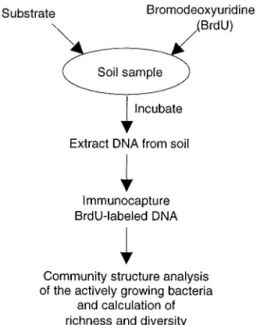
A culture-independent strategy to measure bacterial func-tional redundancy in environmental samples was developed. This approach is an extension of the aforementioned Biolog (9) and CO2respiration (5) methods combined with a tech-nique that permits the identification of actively growing bac-teria (2). A carbon substrate and the thymidine analog BrdU are added to soil (Fig. 2). After incubation, the organisms that grow in response to the amendment are identified by a com-munity structure analysis of the BrdU-labeled DNA, which is isolated by immunocapture. In this study, the bacterial com-munity analyses were performed by resolution of PCR ampli-fied 16S-23S rRNA intergenic-region fragments on 2% agarose gels, where the size heterogeneity of these fragments provides a simple method to depict bacterial community structure (3).
FIG. 1. Soil collection sites for samples analyzed in this study. Thexandy
axes designate the map coordinates for this site: 1, bare mine spoil approximately 100 m from the forest edge; 2, mine spoil from underneath a pioneer tree,
Cecropia sciadophylla; 3, mine spoil from the forest edge in dense vegetation; and 4, undisturbed soil from a prehistoric Amazon Indian archaeological site in mature preserved forest.
FIG. 2. Strategy to measure bacterial functional redundancy in soil.
4362 YIN ET AL. APPL. ENVIRON. MICROBIOL.
on January 16, 2014 by UNESP - Universidade Estadual Paulista
http://aem.asm.org/
The number of DNA bands provides a measure of the number of different organisms (richness), while the intensity of each band represents the number of individuals within an organism type. Since functional redundancy can be defined as the num-ber of different species that perform a specified function, the richness of bacteria capable of utilizing a selected substrate can be used as a measure of this parameter. An alternative mea-sure of functional redundancy can be obtained by measuring the bacterial diversity instead of the richness, providing an accounting of both the number of different organisms that perform a specified function and their distribution.
A test of the functional-redundancy analysis was done on four soils taken along a vegetation gradient from a tin mine site in Brazil which had been subjected to strip mining of the overburden (Fig. 1). With the exception of the preserved forest soil adjacent to the mine, the soil at this location was severely disturbed and depleted of organic matter since all of the over-burden was processed by crushing, sieving, and washing of the gravel, which was then replaced over the mine spoil with no further amendments or topsoil. Several attempts to revegetate this site by tree plantings had failed, although after several years a few pioneer species had become established. For the functional-redundancy analysis, four different carbon sub-strates were selected: two amino acids,L-serine andL
-threo-nine; one carboxylic acid, sodium citrate; and one carbohy-drate,a-lactose hydrate (Fig. 3A). The selected substrates are representatives of different chemical groups commonly used in Biolog MicroPlates. The community structure banding pat-terns show that the soils capable of supporting more plant life also contain a greater variety of bacteria that responded to the carbon substrate amendments. The richness and diversity val-ues, calculated from these data, confirm this visual observation for all substrates (Fig. 4A).
For comparison, we also measured the total bacterial diver-sity of the four soils by analyzing the uncaptured DNA isolated in the substrate amendment experiments described in the pre-vious paragraph. As expected, the uncaptured DNA showed higher diversity and richness values (Fig. 4B) than did immu-nocaptured samples (Fig. 4A). The rDNA fingerprints also showed that the four different carbon amendments had little impact on the total bacterial communities within each soil type (Fig. 3B) while revealing significant differences in the popula-tions that grew in response to the substrates (Fig. 3A). In addition, these data showed that changes in soil quality, as
FIG. 3. Bacterial community structure analysis of four soils collected along a mine reclamation gradient in Rondonia, Brazil, were performed on immunocaptured (A) and noncaptured (B) DNA. Lanes: 1, soil site 1; 2, soil site 2; 3, soil site 3; 4, soil site 4. The carbon substrates used wereL-serine (S),L-threonine (T), sodium
citrate (C), anda-lactose (L).
FIG. 4. Bacterial species richness and Shannon diversity indices from four soils taken along a mine reclamation gradient were calculated by using the community structure data from Fig. 3. Four substrate amendments were used:
L-serine ({),L-threonine (■), sodium citrate (E), anda-lactose (F). Values were
obtained from immunocaptured (A) and noncaptured (B) DNA. Error bars represent standard error measurements from three replicate PCR experiments.
on January 16, 2014 by UNESP - Universidade Estadual Paulista
http://aem.asm.org/
evaluated by the ability to support plant growth along the reclamation gradient, correlated positively with bacterial func-tional redundancy whereas total bacterial richness and diver-sity were relatively constant for all soils except the denuded mine spoil (soil site 1). This result suggests that bacterial func-tional redundancy increases in relation to the regrowth of plant communities and may represent an important aspect of the restoration of soil biological functionality to reclaimed mine spoils in the Amazon forest.
Investigators in various disciplines such as agriculture, con-servation, and reclamation science have attempted to measure soil quality. Abiotic measures of soil quality have included analyses of physical and chemical parameters, whereas biotic indicators have included measurements of enzyme activities, microbial biomass, and keystone species and enumerations of culturable microorganisms on agar media. Given the positive relationships between biodiversity and ecosystem performance identified in other studies (see the introduction for references), it may prove fruitful to use species diversity (26) and functional redundancy (this report) as indicators of soil quality. The mo-lecular approach of Torsvik et al. (26) has been used to show that chemical pollutants decrease the diversity of bacteria in soil (1) and marine sediment (25). In our work, there was a clear positive correlation between the bacterial functional re-dundancy of soils and the regrowth of plant communities along a mine reclamation gradient. When evaluating biological di-versity, it is important to distinguish between these two param-eters, since changes in microbial diversity do not always cor-respond to changes in functional redundancy (1) (see above). Total bacterial diversity values provide a broad measure of biological diversity, whereas functional diversity determina-tions yield targeted assessments of the diversity within a func-tional group.
The extent and role of functional redundancy in microbial communities are unknown. Its purpose and importance has been debated, with some viewing it as an unnecessary luxury and others suggesting that it promotes reliability and is there-fore an essential component of ecosystem productivity (12, 18, 31, 32). Determining the role of redundancy in ecosys-tem functioning is of significant importance and may provide the basis for more rational decisions concerning the value of biological diversity (32). The work described in this report should advance microbial ecology investigations by providing a new approach to examine bacterial functional redundancy in soil. To optimize this strategy toward a comprehensive func-tional-redundancy measurement, substrate selection could en-compass a wide range of chemical groups; for example, the Eco MicroPlates (Biolog) use 31 different carbon substrates. Alter-natively, this strategy could be used for highly focused inves-tigations where only specific and narrowly defined substrates (not necessarily carbon) are used (30).
One current limitation of this functional-redundancy meth-od is the resolving power of the community structure analysis. In this study, the community data were obtained using ribo-somal intergenic spacer analysis (3). Other methods such as denaturing gradient gel electrophoresis (17) and terminal re-striction fragment length polymorphism (13) could also be used. Unfortunately, none of these methods can accurately depict the true diversity of bacteria in a soil sample, since communities that may contain thousands of different spe-cies are resolved into approximately 10 to 50 groups. Thor-ough examination of rDNA clone libraries by extensive nu-cleotide sequence analysis, amplified rDNA restriction analysis (ARDRA) (14, 29), or future breakthroughs in DNA micro-array approaches may significantly increase the resolution of this functional-redundancy analysis. Another potential
limita-tion of this method is the breadth of organisms that incorpo-rate BrdU. A definitive determination of this range will not be obtained without a comprehensive examination of numerous bacteria from all taxonomic groups. Thus far, with a few no-table exceptions, it appears that the majority of bacteria incor-porate [3
H]thymidine (21). Since BrdU has been successfully used as a thymidine analog in numerous applications, it is likely that most organisms will also take up and incorporate BrdU. In addition, although the purpose of this strategy is to identify the organisms that respond to specified amendments, any or-ganism that is growing at the time of the analysis will also be identified. Finally, in this research we attempted to preserve the soils as closely as possible by taking intact cores and then minimizing storage and contamination problems by freezing them. Ideally, samples such as these should be processed im-mediately. Studies examining functional redundancy and com-munity structures will need to consider the best methods avail-able for preserving samples prior to their analysis.
ACKNOWLEDGMENT
We thank FAPESP (Fundac¸a˜o de Amparo a` Pesquisa do Estado de Sa˜o Paulo) for financial support.
REFERENCES
1.Atlas, R. M., A. Horowitz, M. Krichevsky, and A. K. Bej.1991. Response of microbial populations to environmental disturbance. Microb. Ecol.22:249– 256.
2.Borneman, J.1999. Culture-independent identification of microorganisms that respond to specified stimuli. Appl. Environ. Microbiol.65:3398–3400. 3.Borneman, J., and E. W. Triplett.1997. Molecular microbial diversity in soils
from eastern Amazonia: evidence for unusual microorganisms and microbial population shifts associated with deforestation. Appl. Environ. Microbiol.
63:2647–2653.
4.Callegarijacques, S. M., F. M. Salzano, T. A. Wwimer, T. A. Hutz, F. F. Black, S. E. B. Santos, J. F. Guerreiro, M. A. Mestriner, and J. P. Pandy.
1994. Further blood genetic-studies on Amazonian diversity—data from 4 Indian groups. Ann. Hum. Biol.21:465–481.
5.Degens, B. P., and J. A. Harris. 1997. Development of a physiological approach to measuring the catabolic diversity of soil microbial communities. Soil Biol. Biochem.29:1309–1320.
6.Denevan, W. M.1996. A bluff model of riverine settlement in prehistoric Amazonia. Ann. Assoc. Am. Geogr.86:654–681.
7.Ehrlich, P. R., and A. H. Ehrlich.1981. Extinction: the causes and conse-quences of the disappearance of species. Random House, New York, N.Y. 8.Ewel, J. J., M. J. Mazzarino, and C. W. Berish.1991. Tropical soil fertility changes under monocultures and successional communities of different structure. Ecol. Appl.1:289–302.
9.Garland, J. L., and A. L. Mills.1991. Classification and characterization of heterotrophic microbial communities on the basis of patterns of community-level sole-carbon-source utilization. Appl. Environ. Microbiol.57:2351–2359. 10. Gaston, K. J.1996. Biodiversity: a biology of numbers and difference.
Black-well Scientific Publications Ltd., Oxford, United Kingdom.
11. Lane, D. J.1991. 16S/23S rRNA sequencing, p. 115–175.InE. Stackebrandt and M. Goodfellow (ed.), Nucleic acid techniques in bacterial systematics. John Wiley & Sons, Inc., New York, N.Y.
12. Lawton, J. H., and V. K. Brown.1993. Redundancy in ecosystems, p. 255– 270.InE. D. Schulze and H. A. Mooney (ed.), Biodiversity and ecosystem function. Springer Verlag, New York, N.Y.
13. Liu, W. T., T. L. Marsh, H. Cheng, and L. J. Forney.1997. Characterization of microbial diversity by determining terminal restriction fragment length polymorphisms of genes encoding 16S rRNA. Appl. Environ. Microbiol.63:
4516–4522.
14. Massol-Deya, A. A.1995. Bacterial community fingerprinting of amplified 16S and 16-23S ribosomal DNA gene sequences and restriction endonucle-ase analysis (ARDRA), p. 1–8.InA. D. L. Akkermans, J. D. Van Elsas, and F. J. De Bruijn (ed.), Molecular microbial ecology manual. Kluwer Academic Publishers, Dordrecht, The Netherlands.
15. McNaughton, S. J.1993. Biodiversity and function of grazing ecosystems, p. 361–384.InE. D. Schulze and H. A. Mooney (ed.), Biodiversity and eco-system functioning. Springer Verlag, New York, N.Y.
16. McNaughton, S. J.1977. Diversity and stability of ecological communities: a comment on the role of empiricism in ecology. Am. Nat.111:515–525. 17. Muyzer, G., E. C. D. Waal, and A. G. Uitterlinden.1993. Profiling of complex
microbial populations by denaturing gradient gel electrophoresis analysis of polymerase chain reaction amplified genes coding for 16S rRNA. Appl. Environ. Microbiol.59:695–700.
4364 YIN ET AL. APPL. ENVIRON. MICROBIOL.
on January 16, 2014 by UNESP - Universidade Estadual Paulista
http://aem.asm.org/
18.Naeem, S.1998. Species redundancy and ecosystem reliability. Conserv. Biol.
12:39–45.
19. Naeem, S., L. J. Thompson, S. P. Lawler, J. H. Lawton, and R. M. Woodfin.
1994. Declining biodiversity can alter the performance of ecosystems. Nature (London)368:734–737.
20. Ovreas, L., and V. Torsvik.1998. Microbial diversity and community struc-ture in two different agricultural soil communities. Microb. Ecol.36:303–315. 21. Robarts, R. D., and T. Zohary.1993. Fact or fiction—bacterial growth rates and production as determined by (methyl-3H)-thymidine? Adv. Microb. Ecol.13:371–425.
22. Smalla, K., U. Wachtendorf, H. Heuer, W.-T. Liu, and L. Forney.1998. Analysis of BIOLOG GN substrate utilization patterns by microbial com-munities. Appl. Environ. Microbiol.64:1220–1225.
23. Swift, M. J., and J. M. Anderson.1993. Biodiversity and ecosystem function in agricultural systems, p. 15–41.InE. D. Schulze and H. A. Mooney (ed.), Biodiversity and ecosystem function. Springer Verlag, New York, N.Y. 24. Tilman, D., and J. A. Downing.1994. Biodiversity and stability in grasslands.
Nature (London)367:363–365.
25. Torsvik, V., F. L. Daae, R. A. Sandaa, and L. Ovreas.1998. Novel techniques for analysing microbial diversity in natural and perturbed environments. J. Biotechnol.64:53–62.
26. Torsvik, V., J. Goksoyr, and F. L. Daae.1990. High diversity in DNA of soil bacteria. Appl. Environ. Microbiol.56:782–787.
27. Urbach, E., K. L. Vergin, and S. J. Giovannoni.1999. Immunochemical detection and isolation of DNA from metabolically active bacteria. Appl. Environ. Microbiol.65:1207–1213.
28. Van Beelen, P., and P. Doelman.1997. Significance and application of mi-crobial toxicity tests in assessing ecotoxicological risks of contaminants in soil and sediment. Chemosphere34:455–499.
29. Vaneechoutte, M., R. Rossau, P. Devos, M. Gillis, D. Janssens, N. Paepe, A. Derouck, T. Fiers, G. Claeys, and K. Kersters.1992. Rapid identification of bacteria of the Comamonadaceae with amplified ribosomal DNA-restriction analysis (ARDRA). FEMS Microbiol. Lett.93:227–234.
30. Victorio, L., K. A. Gilbride, D. G. Allen, and S. N. Liss.1996. Phenotypic fingerprinting of microbial communities in wastewater treatment systems. Water Res.30:1077–1086.
31. Vitousek, P. M., and D. U. Hooper.1993. Biological diversity and terrestrial ecosystem biogeochemistry, p. 3–14.InE. D. Schulze and H. A. Mooney (ed.), Biodiversity and ecosystem functioning. Springer Verlag, New York, N.Y.
32. Walker, B. H.1992. Biodiversity and ecological redundancy. Conserv. Biol.6:
18–23.
33. Zak, J. C., M. R. Willig, D. L. Moorhead, and H. G. Wildman.1994. Func-tional diversity of microbial communities: a quantitative approach. Soil Biol. Biochem.26:1101–1108.