Palavras chave: Comunidade florestal Diversidade funcional Características funcionais Estrutura da comunidade Gradiente ambiental Histórico: Recebido 12/11/2016
Aceito 30/01/2017 Keywords: Forest community functional diversity functional traits community structure environmental gradient
1 Beijing Normal University - Beijing, China Correspondência:
DOI: 10.1590/01047760201723012264
Jin-Tun Zhang1+, Xiaohang Bai1, Dan Shao1
FUNCTIONAL DIVERSITY AND ITS ATTRIBUTE FACTORS IN THE YUNMENG MOUNTAIN NATIONAL FOREST PARK IN BEIJING, CHINA
ABSTRACT: The interaction of diversity with environmental gradients is an important topic in ecology. This study investigated the pattern of change in functional diversity in forest communitiesalong an altitudinal gradient in Yunmeng Mountain National Forest Park, China. Forty-two quadrats measuring 10 x 10 m in the forest communities were set up along this altitudinal gradient; plant species, traits and environmental variables
were measured and recorded. Six functional diversity indices, namely, Modified functional
attribute diversity (MFAD), Functional diversity plot-based dendrogram index (FDp), Functional diversity community-based dendrogram index (FDc), Functional evenness (FEve), Functional divergence (FDiv) and Functional dispersion (FDis), were used to calculate functional diversity. The results showed that functional diversity varied greatly in forest communities in the Yunmeng Mountain Forest Park. Functional diversity was
significantly correlated with elevation and slope position and somewhat correlated with
soil depth. Functional diversity increased with an increase in the elevation and decreased as the slope position changed from valley bottom to hill ridge. Functional diversity was closely related to species richness. The six functional diversity indices were all applicable to functional diversity studies of forest communities.
DIVERSIDADE FUNCIONAL E SEUS FATORES DE ATRIBUTO NO PARQUE FLORESTAL NACIONAL DA MONTANHA YUNMENG EM PEQUIM, CHINA
RESUMO: A interação da diversidade com gradientes ambientais é um tópico importante na ecologia. Este estudo investigou o padrão de mudança na diversidade funcional em
comunidades florestais ao longo de um gradiente altitudinal no Parque Florestal Nacional
da Montanha Yunmeng, China. Quarenta e dois quadrantes medindo 10 x 10 m foram
alocados nas comunidades florestais ao longo deste gradiente altitudinal; espécies e
características de plantas, bem como variáveis ambientais foram medidas e registradas. Seis índices de diversidade funcional, sendo eles, atributo funcional de diversidade
modificado (MFAD), índice de diversidade funcional baseada no dendrograma da parcela
(PDp), índice de diversidade funcional baseada no dendrograma da comunidade (FDc), regularidade funcional (FEve), divergência funcional (FDiv) e dispersão funcional (FDis), foram utilizados para calcular a diversidade funcional. Os resultados mostraram que a
diversidade funcional variou muito nas comunidades florestais do Parque Florestal da Montanha Yunmeng. Diversidade funcional foi significativamente correlacionada com a
elevação e a posição de inclinação do terreno e pouco correlacionada com profundidade de solo. Diversidade funcional aumentou com o aumento na elevação e diminuiu quando a posição de inclinação mudou de fundo de vale para o cume da colina. Diversidade funcional foi altamente relacionada com riqueza de espécies. Os seis índices de diversidade funcional
MOUNTAIN NATIONAL FOREST PARK IN BEIJING, CHINA
INTRODUCTION
Functional diversity can reflect ecosystem functions and their changes (PODANI and SCHMERA , 2006), and it is related to community composition, structure, and interactions with environmental gradients (PETCHEY and GASTON 2002; SPASOJEVIC et al. 2014; ZHANG et al. 2015a). Therefore, functional diversity has become a key concept in studies of biodiversity and ecosystem functioning (ACKERLY and CORNWELL, 2007; CASANOVES et al., 2011). Functional diversity is the variation of species functions within a community or
ecosystem, and functional traits can be used to reflect
species functions in a community (Mason et al. 2005). Some authors have used the term “functional trait diversity” to denote functional diversity (ZHANG et al., 2013a). The different types of and changes in plant functional traits can be used to describe the amount of community functional diversity (VILLEGER et al., 2008).
Studies on functional diversity are the bases for nature conservation and have been paid much attention by conservationists and ecologists (AUSTRHEIM, 2002; MUHUMUZA and BYARUGABA, 2009). In a large city such as Beijing, mountains are extremely important in nature conservation and ecological protection for citizens because most natural forests occur in mountainous regions of limited area (LOMOLINO, 2001; CUI et al., 2008). Patterns of variation of species diversity along environmental gradients in mountains have frequently been studied (AUSTRHEIM, 2002; PAVOINE and BONSALL, 2011; PERRONNE et al., 2014). However, functional diversity and its patterns of change along environmental gradients have not yet been adequately analyzed (FETENE et al., 2006; ALBERT et al., 2012; ZHANG et al., 2014).
The Yunmeng Mountain National Forest Park is the closest forest park to downtown Beijing city and is a well-known eco-tourism site for citizens (ZHANG et al., 2013b; SPASOJEVIC et al., 2014). Secondary forests are
significant for economic and ecological development in
this region and should be under reasonable conservation and utilization. Some studies related to ecology, including
floristic characteristics and plant species resources (HE
et al., 1992), tourism resources and assessment (WANG et al. 2004), restoration and recovery of degraded vegetation at lower areas (DAI et al., 1990), have been conducted in the Yunmeng Mountain Forest Park. However, the changes in functional diversity associated with the major environmental gradients have not been examined in this forest park. In this work, we attempt to characterize the pattern of functional diversity variation of secondary forest communities along environmental
gradients, to identify the key environmental variables affecting functional diversity, to test the hypothesis that the highest functional diversity may appear at middle elevations along elevation gradients in the Yunmeng Mountain Forest Park, and to test the effectiveness and applicability of functional diversity indices.
MATERIALS AND METHODS
Study area
The Yunmeng Mountain National Forest Park (YMNFP), located at 40°26´- 40°38´N, 116°40´- 116°50´E, is in the Huairou district and Miyun county of the Beijing city administrative entity and is approximately 85 km from downtown Beijing. YMNFP has an area of 2208 ha. Its elevation varies from 700 m to 1,414 m. The climate of this region is typical warm-temperate and is strongly affected by the subhumid monsoon from the southeast. The annual mean temperature is approximately 10ºC, and the mean monthly temperatures in January and July are -7ºC and 25ºC, respectively. The annual mean precipitation varies between 600 mm and 700 mm. During the year, most precipitation (more than 70%) falls from June through September. The main soil types are drab soil and brown forest soil. The vegetation is mainly secondary broad-leaved deciduous forest, with a small area of planted coniferous forest. YMNFP is a
significant eco-tourism destination for Beijing’s citizens.
It has beautifully strange peaks, exquisitely grotesque rocks, ponds and waterfalls, forests, and striking and vividly memorable landscapes (WANG et al. 2004).
Sampling
Based on a general survey, 15 sampling plots separated by 50 meters in altitude were set up along an elevational gradient between 750 and 1414 m ASL. We established 2-4 quadrats of 10 m ×10 m within each sampling plot along the contour line. In all, there were 42 quadrats. The species name, abundance, cover, height and basal area for tree species (DBH >2.5cm, height >3m), and the species name, cover and average height for shrub and herb species were measured and recorded in each quadrat. The tree height was measured with a laser height meter (RD 1000), and shrub and herb height were measured with a steel tape measure.
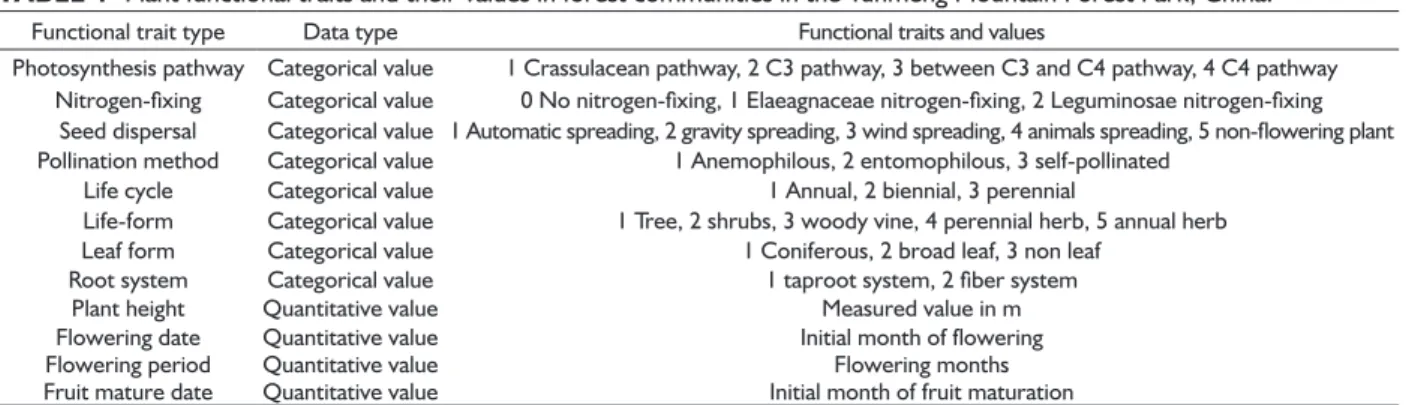
Twelve functional traits were chosen to demonstrate species functions in the plant community (Table 1). The pollination mechanism, photosynthetic pathway, seed dispersal, root system, and nitrogen-fixing
and life cycle were investigated in the fi eld. To calculate
functional diversity indices, a data matrix of plant species by functional traits in a quadrat was constructed, with a total of 42 data matrices for the 42 quadrats.
Six environmental factors, namely, altitude, slope, slope aspect, slope position, litter thickness, and soil depth were also measured and recorded for each quadrat. A GPS was used to measure elevation, and a compass meter was used to measure the slope and slope aspect. The soil depth was measured with a soil depth instrument, and the litter thickness was measured directly with a ruler. The measured values of slope aspect were transformed into values on a numerical scale of 1 through 8 as follows: 1 (337.6°-360°, 0-22.5 °), 2 (22.6°-67.5°), 3 (292.6°-337.5°), 4 (67.6°-112.5°), 5 (247.6°-292.5°), 6 (112.6°-157.5°), 7 (202.6°-247.5°), and 8 (157.6°-202.5°). The greater the value is, the more sunlight availability is. The slope position was recorded on a scale of 1 – 5 for valley bottom; lower, middle, and upper hill positions; and hill ridge, respectively (ZHANG et al., 2014).
Functional diversity indices
Six common indices for measuring functional diversity were used to calculate functional diversity in the studied communities:
Modifi ed functional attribute diversity (MFAD)
For a data matrix of S species × N traits, the
functional units were defi ned by combining the species
with the same values on all of the traits into one unit. This procedure will reduce the number of distinct species categories considered from S to M (M≤S), where dij is the distance between functional units i and j and M is the number of functional units.
M ij i,j
d
MFAD M
=
å
[1]TABLE 1 Plant functional traits and their values in forest communities in the Yunmeng Mountain Forest Park, China.
Functional trait type Data type Functional traits and values
Photosynthesis pathway Categorical value 1 Crassulacean pathway, 2 C3 pathway, 3 between C3 and C4 pathway, 4 C4 pathway
Nitrogen-fi xing Categorical value 0 No nitrogen-fi xing, 1 Elaeagnaceae nitrogen-fi xing, 2 Leguminosae nitrogen-fi xing Seed dispersal Categorical value 1 Automatic spreading, 2 gravity spreading, 3 wind spreading, 4 animals spreading, 5 non-fl owering plant Pollination method Categorical value 1 Anemophilous, 2 entomophilous, 3 self-pollinated
Life cycle Categorical value 1 Annual, 2 biennial, 3 perennial
Life-form Categorical value 1 Tree, 2 shrubs, 3 woody vine, 4 perennial herb, 5 annual herb Leaf form Categorical value 1 Coniferous, 2 broad leaf, 3 non leaf
Root system Categorical value 1 taproot system, 2 fi ber system Plant height Quantitative value Measured value in m Flowering date Quantitative value Initial month of fl owering Flowering period Quantitative value Flowering months Fruit mature date Quantitative value Initial month of fruit maturation
Functional diversity based on dendrogram (FDp and FDc)
Functional diversity based on a dendrogram refers to the sum of the branch lengths of the dendrogram produced by a clustering based on a data matrix of species × traits. FDp denotes the plot-based functional diversity index, and FDc denotes the community-based index (PETCHEY and GASTON 2006).
Functional evenness (FEve)
FEve measures the regularity of spacing between species in the functional trait space and the evenness in the distribution of species abundance. The minimum spanning tree (MST) was used to transform a multidimensional space to a distribution on a single axis. This index measures both the sum of branch lengths in the MST and the evenness in species abundances (VILLÉGER et al. 2008). This index is defi ned as follows:
There are S-1 branches in an MST containing S
species, and each of the b branch lengths is divided by the sum of the abundance of the species linked. EWb is the weighted evenness, dijis the Euclidean distance between species i and j on branch b, and wi and wj are the relative abundances of these species. It is useful to compute the partial weighted evenness by dividing by the sum of the weighted evenness values across the branches.
Functional divergence (Fdiv)
Functional divergence is related to the way in which abundance is distributed within the volume of the [2]
[3]
MOUNTAIN NATIONAL FOREST PARK IN BEIJING, CHINA
Functional dispersion (Fdis)
Fdis is the mean dist ance of the species to the centroid I of all species in the functional trait space. This index considers the relative abundance. C = { c1, c2, …, cN} is the vector having the coordinates of the weighted centroid in the N-dimensional trait space, and N is the number of traits, where wi is the relative abundance of species i and zi is the distance of species i to the weighted centroid C.
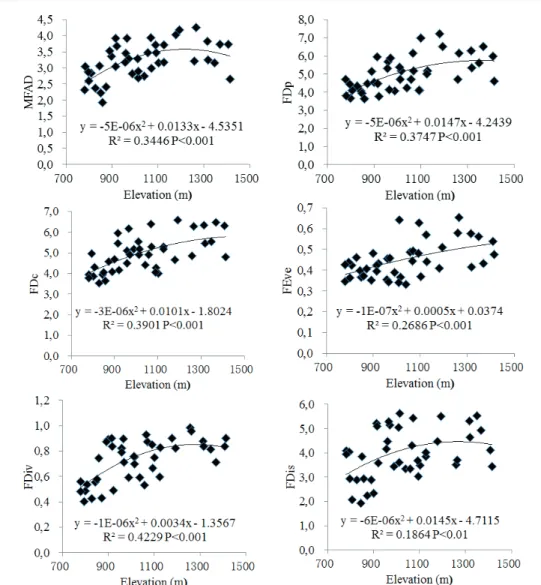
showed similar relationships with elevation and slope position gradients. Functiona l diversity increased with elevation and reached its maximum near the summit of the mountain (Figure 1). Functional diversity gradually decreased with slope position, changing from the valley bottom to the hill ridge, with the maximum values at the valley bottom and lower hill positions (Figure 2). The relationships between functional diversity and elevation and slope position were non-linear. The six functional diversity indices provided similar results because they were closely related to each other (Table 2).
[5] functional trait space, where dGi is the functional distance from species i to the center of gravity of the species that form the vertices of the convex hull; and
dG
is the mean distance of the S species to the center of gravity; and wi is the relative abundance of species i.[6]
Species diversity
The following four species diversity indices were used; species number (as a richness index), D=S ; the Shannon-Wiener index: H'= −
∑
PilnPi; the Simpson index:( )2 1 1 S i i D P =
= −∑ and the Pielou evenness index, E=H' ln( )S . In
the se formulas, Piis the relative abundance of species i,
Pi=Ni/N, Niis the abundance of species i, N is the sum of abundance for all species in a quadrat, and S is the number of species present in a quadrat.
Spearman correlation and regression analyses were used to analyze the relationships among functional diversity, environmental variables and species diversity.
RESULTS
The functional diversity demonstrated by the six indices showed marked changes in the forest communities
in the Yun meng Mountain Forest Park. Modifi ed functional
attribute diversity (MFAD)varied between 1.931 and 4.265, Functional diversity plot-based dendrogram index (FDp) between 3.609 and 7.248, Functional diversity community-based dendrogram index (FDc) between 3.520 and 6.599, Functional evenness (FEve) between 0.331 and 0.652, Functional divergence (FDiv) between 0.400 and 0.958, and Functional dispersion (FDis) between 1.943 and 5.614.
Functional diversity was signifi cantly correlated
with elevation (Figure 1) and with slope position (Fig. 2) in the Yunmeng Mountain Forest Park. All six indices
TABLE 2 Spearman correlation coeffi cients between
functional diversity indices in the Yunmeng Mountain Forest Park, China.
MFAD FDp FDc FEve FDiv FDis
MFAD 1.000
FDp 0.526*** 1.000
FDc 0.579*** 0.656*** 1.000
FEve 0.332* 0.263 0.321* 1.000
FDiv 0.530*** 0.550*** 0.522*** 0.268 1.000
FDis 0.394** 0.598*** 0.701*** 0.067 0.386* 1.000
* P<0.05, ** P<0.01, *** P<0.001
In additio n to elevation and slope position, soil
depth was also important in infl uencing spatial variation
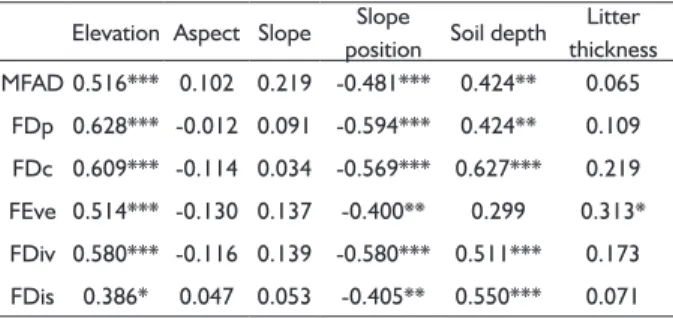
of functional diversity in the Yunmen g Mountain Forest Park (Table 3). The litter thickness played a special role in functional evenness (FEve). However, the slope
and aspect were not signifi cant for functional diversity
change in the Park (Table 3). Although different indices
showed different signifi cances for their relationships
with functional diversity, the positive or negative nature of the relationships was clear. Elevation, soil depth and litter thickness had positive correlations, slope position and aspect negative correlations with the functional indices (Table 3).
TABLE 3 Spearman correlation coeffi cients between
functional diversity and environmental variables in the Yunmeng Mountain Forest Park, China.
Elevation Aspect Slope Slope
position Soil depth Litter thickness MFAD 0.516*** 0.102 0.219 -0.481*** 0.424** 0.065
FDp 0.628*** -0.012 0.091 -0.594*** 0.424** 0.109
FDc 0.609*** -0.114 0.034 -0.569*** 0.627*** 0.219
FEve 0.514*** -0.130 0.137 -0.400** 0.299 0.313*
FDiv 0.580*** -0.116 0.139 -0.580*** 0.511*** 0.173
FDis 0.386* 0.047 0.053 -0.405** 0.550*** 0.071
All of the functional diversity indices were
signifi cantly correlated with species richness and
diversity (Shannon-Wiener index) in the studied forest communities (Figure 3, Table 4). Functional diversity was positively related to species richness and diversity, i.e., functional diversity increased with species richness and diversity increased. The relationships of functional diversity to species evenness and the Simpson index
were not signifi cant.
DISCUSSION
Functional diversity is an indicator of ecosystem functioning (MASON et al., 2005) and can be used to demonstrate the relationships among community composition, structure, function and environmental variables (ZHANG et al., 2013a). The studied functional
FIGURE 1 Change of functional diversity along an elevational gradient in the Yunmeng Mountain Forest Park, China. MFAD, FDp,
FDc, FEve, FDiv, and FDis refer to modifi ed functional attribute diversity, plot-based functional diversity, community-based functional diversity, functional evenness, functional divergence, and functional dispersion indices, respectively.
TABLE 4 Spearman correlation coeffi cients between
functional diversity and species diversity in the Yunmeng Mountain Forest Park, China.
Species richness
Shannon-Wiener index
Pielou Evenness
Simpson index
MFAD 0.611*** 0.247 -0.201 0.162
FDp 0.425** 0.340* -0.016 0.026
FDc 0.391* 0.396** 0.019 -0.083
FEve 0.046 0.036 -0.167 0.186
FDiv 0.404** 0.203 -0.147 0.271
FDis 0.281 0.428** 0.133 -0.300
* P<0.05, ** P<0.01, *** P<0.001
MOUNTAIN NATIONAL FOREST PARK IN BEIJING, CHINA
environment (DE BELLO et al., 2006). There were eight forest communities distributed along the altitudinal gradient in the Yunmeng Mountain Forest Park (DAI et al., 1990). They were, from the lower to the upper hills, Comm. Pinus tabulaeformis, Comm. Juglans mandshurica, Comm. Fraxinus rhynchophylla + Acer truncatum + Tilia amurensis, Comm. Quercus mongolica, Comm. Betula dahurica, Comm. Populus davidiana + Betula platyphylla,
andComm. Larix principis-rupprechtii (CUI et al., 2008; ZHANG et al., 2013b). The variation in functional diversity along the studied elevational gradient is consistent with that of the forest communities. Each community has its own composition, structure, function and inner environment and therefore has special functional diversity (SPASOJEVIC et al. 2014; ZHANG et al. 2014).
Functional diversity indices were signifi cantly
correlated with elevation and slope position gradients in the Park. This result suggests that elevation and slope position were key factors affecting functional diversity in this park (DE BELLO et al. 2006; ZHANG et al. 2014). This fi nding was consistent with the conclusion that elevation and slope position were the most important environmental variables
infl uencing forest structure, diversity and distribution in
the studied park (DAI et al. 1990; CUI et al. 2008). All six indices showed the same pattern, namely, that forest functional diversity increased in a polynomial manner along the elevational gradient (ZHANG et al. 2013a). This is due to that different elevation represents different environmental conditions. The maximum functional diversity appeared near the summit of the mountain
FIGURE 2 Relationships of functional diversity with slope position in the Yunmeng Mountain Forest Park, China. MFAD, FDp,
(1414 m), the minimum functional diversity at the base of the mountain (750 m). Usually, an elevation gradient represents a comprehensive gradient of temperature and water conditions in temperate mountains, i.e., changes in temperature and water conditions will affect the pattern of change of functional diversity with elevation (AUSTRHEIM, 2002; PERRONNE, et al. 2014). The pattern, found by this study, of change in functional diversity along the elevation gradient is not consistent with the most commonly observed pattern, namely, that the highest diversity appears at intermediate elevations (ZHANG, et al. 2013c; VILLEGER, e t al. 2008). The reason for this difference is that the elevational gradient from 750 m to 1,414 m is relatively short in the Yunmeng
Mountain Forest Park (BOEHNKE, et al. 2014). Some other studies on low or middle mountains gave the similar results (PERRONNE, et al. 2014; ZHANG, et al. 2014; TARDELLA, et al. 2016 ).
All of the indices showed the same pattern, namely, that forest functional diversity decreased in a polynomial manner along the slope position gradient from the valley bottom to the hill ridge in the Park ( ZHANG, et al. 2013b). Along this gradient, the water conditions, soil depth, and litter thickness decreased, while temperature and light
availability increased, further infl uencing functional diversity (SPASOJEVIC, et al. 2014).
Soil depth also signifi cantly affected functional
diversity in the Yunmeng Mountain Forest Park. This result is
FIGURE 3 Relationships of functional diversity to species richness in the Yunmeng Mountain Forest Park, China. MFAD, FDp, FDc,
MOUNTAIN NATIONAL FOREST PARK IN BEIJING, CHINA
consistent with the general conclusion that soil depth and soil
type are significant for forest distribution and development
in the Beijing Mountains (ZHANG et al., 2014). Soil depth is related to root system volume and nutrient availability (PERRONNE et al., 2014), and hence, influences functional diversity (BOEHNKE et al., 2014). Functional evenness was
correlated with litter thickness. This result may reflect soil
water and nutrient properties, patterns, and characteristics (DUIVENVOORDEN and CUELLO, 2012).
Functional diversity was closely related to species richness and diversity in the Park. All of the functional diversity indices increased in a polynomial manner as species richness and diversity increased, i.e., these relationships were non-linear (RICOTTA and MORETTI 2008; ZHANG et al.
2013c). This finding suggested that functional diversity and
species richness and diversity were interrelated with each other but were distinct and not mutually interchangeable (BUTTERFIELD and SUDING 2013; ZHANG et al. 2014). Some changes in functional traits may go beyond the sorts of variations that can be interpreted only based on taxonomic variation (DE BELLO et al. 2009; CASANOVES et al. 2011), and this entire question merits further study. Our study has shown that functional diversity and species diversity can be used as indicators of forest composition, structure, functioning, and inner environment and should not be interchanged (ZHANG et al. 2014).
The six functional diversity indices used were all effective in quantifying functional diversity and its variation in the forests of the Yunmeng Mountain Forest Park. These indices were all based on the functional distances
between species in functional trait space; they reflect
certain theoretical differences (SONG and ZHANG 2013; CASANOVES et al. 2011). MFAD combined species with the same trait values into a functional unit; FDp and FDc were based on the sum of the lengths of the dendrogram branches; FEve emphasized the evenness of species traits and abundance; FDiv was related to the abundance distribution within the functional volume; and FDis measured the distance of species from the functional centroid (CASANOVES et al. 2011; BOEHNKE et al. 2014; ZHANG et al. 2015b). The similar results found for these
indices in the current study’s analysis of functional diversity reflected that they were correlated with each other; as also
argued elsewhere, it is preferable to use only a few selected indices in the same study (AUSTRHEIM 2002; ZHANG et al. 2013c). MFAD, FDc and FDiv should be recommended in the similar studies according to the results of this work.
ACKNOWLEDGMENTS
We thank the three anonymous referees and editors for their constructive comments and suggestions on the manuscript. This study was
financially supported by the National Natural Science
Foundation of China (No. 31170494) and the Specialized Research Fund for the Doctoral Program of Higher Education (Grant No. 20120003110024).
REFERENCES
ACKERLY, D. AND CORNWELL W. A. trait-based approach to community assembly: partitioning of species trait values
into within-and among-community components. Ecology
Letters 10(2): 135-145, 2007.
ALBERT, C.H., DE BELLO, F., BOULANGEA,T, I., PELLET, G., LAVOREL, S., THUILLER, W. On the importance of
intraspecific variability for the quantification of functional
diversity. Oikos 121: 116-126, 2012.
AUSTRHEIM, G. Plant diversity patterns in semi-natural
grasslands along an elevational gradient in southern
Norway. Plant Ecology 161 (2): 193-205, 2002.
BOEHNKE, M., KROEBER, W., WELK, E., WIRTH, C., BRUELHEIDE, H. Maintenance of constant functional diversity during secondary succession of a subtropical forest in China.
Journal of Vegetation Science, 25: 897-911, 2014.
BUTTERFIELD, B.J. AND SUDING, K.N. Single-trait functional indices outperform multi-trait indices in linking environmental gradients and ecosystem services in a
complex landscape. Journal of Ecology, 101: 9-17, 2013.
CASANOVES, F., PLA, L., DI RIENZO, J., DIAZ, S. 2011. FDiversity: a software package for the integrated analysis of
functional diversity. Methods in Ecology and Evolution
2: 233-237, 2011.
CUI, G.F., XING, S.H., ZHAO, B. Conservation of mountain
plants and vegetation in Beijing. Beijing: China Forestry Press. (In Chinese), 2008.
DAI, X.B., CHEN L.Z., HUANG, J.H. The restoration of the destroyed forest vegetation in Yunmeng Mountain, Beijing.
Vegetatio, 87: 145-150, 1990.
DE BELLO, F., LEPŠ, J. AND SEBASTIA, M.T. Variations in species and functional plant diversity along climatic and
grazing gradients. Ecography 29: 801–810, 2006.
DE BELLO, F., THUILLER, W., LEPŠ, J., CHOLER, P., CLEMENT, J., MACEK, P., SEBASTIA, M. T. AND LAVOREL, S. Partitioning of functional diversity reveals the scale and
extent of trait convergence and divergence. Journal of
Vegetation Science 20: 475–486, 2009.
DUIVENVOORDEN, J.F., CUELLO, N.L. Functional trait state diversity of Andean forests in Venezuela changes with altitude.
Journal of Vegetation Science23: 1105-1113, 2012.
FETENE, M., ASSEFA, Y., GASHAW, M., WOLDU, Z. AND BECK, E. Diversity of afroalpine vegetation and ecology of treeline species in the Bale Mountains, Ethiopia, and the
influence of fire. In Spehn, E. M., Liberman, M. and Korner,
C. ed. Land Use Change and Mountain Biodiversity,
HE, S.Y, XING, Q.H., YIN, Z. T. Flora of Beijing. Beijing: Beijing Press. (In Chinese), 1992.
LOMOLINO, M.V. Elevation gradients of species diversity:
historical and prospective views. Global Ecology and
Biogeography 10: 3-13, 2001.
MASON, N. W. H., MOUILLOT, D., LEE, W. G. E WILSON, J. B. Functional richness, functional evenness and functional divergence: the primary components of functional diversity.
Oikos 111(1): 112-118, 2005.
MUHUMUZA, M., BYARUGABA, D., Impact of land use on the ecology of uncultivated plant species in the Rwenzori
mountain range, mid western Uganda. African Journal of
Ecology, 47: 614-621, 2009.
PAVOINE, S., BONSALL, M.B. Measuring biodiversity
to explain community assembly: a unified approach. Biological Review 86: 792-812, 2011.
PERRONNE, R., MAUCHAMP, L., MOULY, A., GILLET, F. Contrasted taxonomic, phylogenetic and functional diversity patterns in semi-natural permanent grasslands
along an altitudinal gradient. Plant Ecology and Evolution,
147: 165-175, 2014.
PETCHEY, O. AND GASTON, K. Functional diversity (FD),
species richness and community composition. Ecology
Letters 5(3): 402-411, 2002.
PETCHEY, O. AND GASTON, K. Functional diversity: back
to basics and looking forward. Ecology Letters 9(6):
741-758, 2006.
PODANI, J. AND SCHMERA, D. On dendrogram-based
measures of functional diversity. Oikos, 115, 179–185, 2006.
RICOTTA, C. AND MORETTI, M. Quantifying functional diversity with graph-theoretical measures: advantages and
pitfalls. Community Ecology 9(1): 11-16, 2008.
SONG, N.Q. ZHANG, J.T. An index for measuring functional diversity in plant communities based on neural network
theory. Journal of Applied Mathematics, Volume 2013,
Article ID 320905, 6 pages, 2013.
SPASOJEVIC, M. J., COPELAND, S., SUDING, K.N. Using functional diversity patterns to explore metacommunity dynamics: a framework for understanding local and regional
influences on community structure. Ecography, 37: 939-949, 2014.
TARDELLA, F. M., PIERMARTERI, K., MALATESTA, L., CATORCI, A. Environmental gradients and grassland trait variation:
Insight into the effects of climate change. Acta
Oecologica-International Journal of Ecology, 76: 47-60, 2016.
VILLEGER, S., MASON, N. W. H. AND MOUILLOT, D. New multidimensional functional diversity indices for a
multifaceted framework in functional ecology. Ecology
89:2290–2301, 2008.
WANG, Z. J., CAI, J., ZHANG, Q.X. Effects of tourism on forest landscapes in Yunmengshan National Forest Park.
Hebei Forestry Science and Technology, 20: 32-35. (in Chinese), 2004.
ZHANG, J.T., ZHANG, B., LI, M., ZHU, X.Functional diversity
and conservation of Phellodendron amurense communities
in the Dongling Mountain of Beijing, China. Botanical
Sciences, 91 (4): 505-513, 2013a.
ZHANG, J.T., XU, B., LI, M. Vegetation patterns and species diversity along elevational and disturbance gradients in
the Baihua Mountain Reserve, Beijing, China. Mountain
Research and Development, 33(2): 170-178, 2013b.
ZHANG, J.T., SONG, N.Q., FAN, L.H. Evaluation of nine distance-based measures of functional diversity applied to
forest communities. Annals of Forest Research, 56(1):
43-52. 2013c.
ZHANG, J.T., LI, M. NIE, E.B. Pattern of functional diversity along an altitudinal gradient in the Baihua Mountain Reserve of
Beijing, China. Brazilian Journal of Botany,37: 37-45. 2014.
ZHANG, J.T., XIAO, J., LI, L.F. Variation of plant functional diversity along a disturbance gradient in mountain meadows
of the Donglingshan Reserve, Beijing, China. Russian
Journal of Ecology, 46(2): 157–166, 2015a.
ZHANG, J.T., ZHANG, B., QIAN, Z.Y. 2015b. Functional
diversity of Cercidiphyllum japonicum communities in the
Shennongjia Reserve, central China. Journal of Forestry