The Different Physiological and Antioxidative
Responses of Zucchini and Cucumber to
Sewage Sludge Application
Anna Wyrwicka1*, Magdalena Urbaniak2,3
1University of Lodz, Faculty of Biology and Environmental Protection, Department of Plant Physiology and Biochemistry, Lodz, Poland,2University of Lodz, Faculty of Biology and Environmental Protection, Department of Applied Ecology, Lodz, Poland,3European Regional Centre for Ecohydrology of the Polish Academy of Sciences, Lodz, Poland
Abstract
The present study investigates the effect of soil amended with sewage sludge on oxidative changes in zucchini and cucumber plants (Cucurbitaceae) and the consequent activation of their antioxidative systems and detoxification mechanisms. The plants were grown in pots containing soil amended with three concentrations of sewage sludge (1.8 g, 5.4 g and 10.8 g per pot), while controls were potted with vegetable soil. The activities of three antioxidative enzymes, ascorbate peroxidase (APx), catalase (CAT) and guaiacol peroxidase (POx), were assessed, as well as of the detoxifying enzyme S-glutathione transferase (GST). Lipid peroxidation was evaluated by measuring the extent of oxidative damage;α-tocopherol content, the main lipophilic antioxidant, was also measured. Visible symptoms of leaf blade damage after sewage sludge application occurred only on the zucchini plants. The zucchini and cucumber plants showed a range of enzymatic antioxidant responses to sewage sludge application. While APx and POx activities increased significantly with increasing sludge concentration in the zucchini plants, they decreased in the cucumber plants. More-over, although the activity of these enzymes increased gradually with increasing doses of sewage sludge, these levels fell at the highest dose. An inverse relationship between perox-idases activity and CAT activity was observed in both investigated plant species. In con-trast, although GST activity increased progressively with sludge concentration in both the zucchini and cucumber leaves, the increase in GST activity was greater in the zucchini plants, being visible at the lowest dose used. The results indicate that signs of sewage sludge toxicity were greater in zucchini than cucumber, and its defense reactions were mainly associated with increases in APx, POx and GST activity.
Introduction
The production of sewage sludge is steadily increasing, and with it the importance of the ques-tion of its safe and sustainable disposal, as it often contains a variety of toxic compounds. These pollutants include inorganic compounds such as heavy metals, and organic chemicals,
a11111
OPEN ACCESS
Citation:Wyrwicka A, Urbaniak M (2016) The Different Physiological and Antioxidative Responses of Zucchini and Cucumber to Sewage Sludge Application. PLoS ONE 11(6): e0157782. doi:10.1371/journal.pone.0157782
Editor:Haitao Shi, Hainan University, CHINA
Received:March 14, 2016
Accepted:June 3, 2016
Published:June 21, 2016
Copyright:© 2016 Wyrwicka, Urbaniak. This is an open access article distributed under the terms of the Creative Commons Attribution License, which permits unrestricted use, distribution, and reproduction in any medium, provided the original author and source are credited.
Data Availability Statement:All relevant data are within the paper and its Supporting Information file.
Funding:The project was funded by the Ministry of Science and Higher Education programme under the name "Iuventus Plus" for the years 2015-2017 granted on the basis of the decision number 0492/ IP1/2015/73, MU (http://www.nauka.gov.pl/). The funders had no role in study design, data collection and analysis, decision to publish, or preparation of the manuscript.
such as Polycyclic Aromatic Hydrocarbons (PAHs) and other Persistent Organic Pollutants (POPs) characterized by high persistence, potential for bioaccumulation, biomagnification, and toxicity [1–6]. Consequently, the storage and utilization of such deposits present a risk for the environment, and specific methods are required to ensure safe disposal.
One such method is phytoremediation, which is based on the use of physiological processes of vegetation and microorganisms to extract, degrade, stabilize and/or remove contaminants from given matrices [7–9]. However, the plants used in phytoremediation not only need a high capacity to absorb pollutants, but also should be resistant to the stress caused by their presence. Plant-based techniques are inexpensive and socially acceptable, can be applied on a large scale and in most cases are carried out successfully. Although phytoremediation techniques are known to be capable of removing heavy metals [10–12], the process of organic compound phy-toremediation still requires elucidation. The key problems are associated with the
hydropho-bicity of organic compounds (log Kowbetween 5.0 to 8.3). Studies have shown that substances
with a log Kowgreater than 3.5 are not available to plants, since they are strongly adsorbed by
soil particles and do not pass into the soil solution from which they could be taken up [13–14].
However, an exception is the group of plants belonging to theCucurbitaceae, including among
others, the cucumber, squash and pumpkin [15–17]. This group of plants has the potential to
accumulate higher levels of organic compounds in their tissues [5,17–30], and the accumulated
compounds have been found to originate from the soil rather than the air [15].
The use of sludge contaminated with a range of inorganic and organic compounds as fertil-izer may affect the development and physiology of the plants grown on it. On the one hand, the addition of sewage sludge to soil creates better conditions for plant growth by improving the physicochemical properties of soils, such as total organic carbon content, cation exchange capacity and microbiological profile [31–32]. On the other hand, repeated application of sew-age sludge increases not only the heavy metal content in soil, but also its uptake and accumula-tion in plant tissues [33]. Therefore, a number of studies have assessed the methods used to reduce sludge toxicity, such as composting the sludge with plant material [32], the use of sur-factant amendment [6] or conversion of sludge to sewage sludge biochar [34]. Most current studies regarding the impact of sewage sludge on crops concern mainly biomass growth or improvement of soil conditions. There are few papers addressing the biochemical changes caused by the application of sewage sludge.
Many worldwide studies report that abiotic stresses, such as the presence in soil of inorganic compounds, such as heavy metals [35], or organic compounds, such as PCBs and PCDD/F [5], or the presence of osmotic stress [36], UV radiation [37] and acid rain [38–40] are the main causes of secondary oxidative stress [41]. This phenomenon, occurring in plant tissues, is char-acterized with overproduction of Reactive Oxygen Species (ROS) such as superoxide anions
(O2-), hydroxyl radicals (OH) and peroxyl radicals (ROO), singlet oxygen (1O2) and
hydro-gen peroxide (H2O2). These molecules are highly reactive and may cause the oxidation of
important cellular compounds, resulting in lipid peroxidation and irreversible protein degrada-tion, as well as reduced plant growth and development, by damaging nucleic acids and other biologically important molecules. Although ROS are produced as a natural phenomenon in plant tissues which accompanies photosynthesis and respiration [42], the balance between their production and disposal is disturbed under oxidative stress.
enzymes such as superoxide dismutase (SOD; EC 1.15.1.1) [43] or catalase (CAT; EC 1.11.1.6) [44] can directly remove ROS, while such others as ascorbate peroxidase (APx; EC 1.11.1.1) or glutathione reductase (GR; 1.8.1.7), related to the Halliwell-Asada cycle, work using low molec-ular weight antioxidants [45]. Another group of antioxidant enzymes comprises phenolic per-oxidases, e.g. guaiacol peroxidase (POx; EC 1.11.1.7) [46]. These enzymes are present in the plant cell wall in soluble forms. The peroxidases involved in the defense response are responsi-ble for the stiffening of the cell wall. The non-enzymatic system includes antioxidants such as ascorbic acid [47], glutathione and other non-protein thiol groups [48], phenolic compounds
[49], carotenoids andα-tocopherol [50].
Glutathione S-transferase (GST; EC 2.5.1.18) [51] is one of the biotransformation enzymes which take part in the second phase of xenobiotic detoxification and catalyse conjugation of the chemical pollutant to an endogenous substrate: reduced glutathione. Plant GSTs were dis-covered as a part of herbicide detoxification in terrestrial plants but many authors have demon-strated their involvement in the detoxification of polycyclic aromatic hydrocarbons (PAHs),
PCBs and heavy metals [5,12,52].
This study evaluates the physiological response of two plant species belonging to the
Cucur-bitaceaefamily, zucchini and cucumber, to the compounds present in sewage sludge. To iden-tify differences between the two investigated species, the following characteristics were examined: morphological change, degree of oxidative reaction assessed as TBARS content, and
the concentration ofα-tocopherol, the main lipophilic, non-enzymatic antioxidant. In
addi-tion, the study measures the enzymatic activities of APx, CAT and POx to determine the effi-ciency of the antioxidative system, and uses GST activity to evaluate the performance of detoxification reactions.
Materials and Methods
Soil preparation
Sewage sludge from the Lodz Municipal Wastewater Treatment Plant (LM WWTP) was col-lected. It was dried at 70°C for 72 hours, then homogenized into small particles with a mortar and used as soil fertilizer for zucchini and cucumber cultivation. The information regarding the content of toxic substances in control soil and in the soil amended with sewage sludge at dose of
9 tha-1is presented inTable 1. The vegetable potting soil (specific for the above vegetable
growth) used in the experiment was from Hollas Sp. z o.o. Pasłęk. Sewage sludge was obtained
from the resources of the Lodz Wastewater Treatment Plant (location: Sanitariuszek 66, 93–469
Łódź, Central Poland) as part of a research and scientific cooperation between the Wastewater
Treatment Plant, the University of Lodz and the European Regional Centre for Ecohydrology of the Polish Academy of Sciences, Lodz. Our experiment was carried out in the growth chambers in the laboratory of the Department of Plant Physiology and Biochemistry, University of Lodz.
Four treatments were used: a control (C) in which no sludge was added, and three
treat-ments of 1.8 g, 5.4 g and 10.8 g sewage per pot. The first corresponds to a dose of 3 tonnes ha-1
yr-1permitted by the Regulation of the Minister of the Environment dated 6 February 2015
concerning municipal sewage sludge (Dz.U. Nr 2015 r., poz. 257); the second is equivalent to 9
tonnes, the permitted amount for three years applied in one dose; and the third, 18 tonnes ha-1
yr-1is above the permitted level. Treatments are designated by the numerical dose per pot.
Plant material
Zucchini (Cucurbita pepoL.) cv“Atena Polka”and cucumber seeds (Cucumis sativusL.) cv
23 ± 0.5°C with 16 h light/8 h dark cycle with 250μmol m-2s-1photon flux density during the
light period and 60% relative humidity. Three-week old zucchini plants and five-week old cucumber plants with five fully expanded leaves were used for subsequent analysis. All bio-chemical analyses were carried out on the second, third and fourth leaves from the control and treated plants. The leaves were harvested in the middle of the 16 h light period.
Preparation of enzyme extracts from leaf tissues
The leaves of the zucchini and cucumber plants were ground (1:10, w/v) in an ice-cold mortar using 50 mM sodium phosphate buffer (pH 7.0) containing 0.5 M NaCl, 1 mM EDTA, and 1 mM sodium ascorbate. The slurry was filtered through two layers of Micracloth. The filtrates of homogenized zucchini and cucumber leaves were then centrifuged (15000g x 15 min). After centrifugation, the supernatant was collected and APx, CAT, GST and POx activities as well as protein concentration and degree of lipid peroxidation were measured.
Enzyme assay
APx activity [EC 1.11.1.11] was assayed following the oxidation of ascorbate to
dehydroascor-bate at 265 nm (ε= 13.7 mM−1cm−1) according to Nakano and Asada with some
modifica-tions [53]. The assay mixture contained 50 mM sodium phosphate buffer pH = 7.0, 0.25 mM
sodium ascorbate, 25μM H2O2and the enzyme extract (5–10μg protein). The addition of
H2O2started the reaction. The obtained values were compared with those of another reaction
mixture without the enzyme extract to correct for non-enzymatic oxidation of ascorbate. The
enzyme activity was expressed in nkat mg-1protein.
CAT activity [EC 1.11.1.6] was measured spectrophotometrically according to Dhinsa et al. [43]. A reaction mixture composed of 50mM sodium phosphate buffer (pH = 7.0), 15 mM
H2O2and the enzyme extract (5–10μg protein) was used. The decomposition of H2O2(ε=
45.2 mM−1cm−1) was measured at 240 nm. CAT activity was expressed in
μkat mg-1protein.
Table 1. Physico-chemical properties of the untreated and sewage sludge amended soil at the dose of 9 tha-1.
Properties Unit Control Soil mixed with 9 t/ha of sewage sludge
pH 6.02+/-0.4 6.4+/-0.4
Total Organic Carbon g/kg 15.18 22.67
Total Nitrogen % 0.52+/-0.08 0.66+/-0.10
N-NO3 mg/kg d.w. 782+/-234 859+/-257
P mg/kg d.w. 437+/-88 728.7+/-146
K mg/kg d.w. 2341+/-445 2809+/-534
Ca mg/kg d.w. 2640+/-501 2755+/-523
Mg mg/kg d.w. 1099 1221
Cl mg/kg d.w. 69.4+/-17.4 127.3+/-31.8
Na mg/kg d.w. 150 190
Pb mg/kg d.w. 5.7+/-1.4 7.1+/-1.8
Cd mg/kg d.w. <0.21 <0.21
Cr mg/kg d.w. <4.2 31.3+/-6.4
Cu mg/kg d.w. 22.2+/-4.6 31.3+/-6.4
Ni mg/kg d.w. 4.9+/-1.1 6.4+/-1.5
Zn mg/kg d.w. 22.4+/-4.2 72.8+/-13.6
Fe mg/kg d.w. 2297+/-430 3311+/-619
Mn mg/kg d.w. 115+/-23.7 112.3+/-23.1
The total GST activity [EC 2.5.1.18] was determined with 1-chloro-2,4-dinitrobenzene (CDNB) according to Habig et al. with some modification [54]. GST catalyses the conjugation of L-glutathione (GSH) to CDNB through a thiol group of GSH. The product of CDNB
conju-gation with GSH, dinitrophenyl thioether, absorbs at 340 nm (ε= 9.6 mM−1cm−1). The
reac-tion solureac-tion contained 100 mM potassium phosphate buffer (pH 6.25), 0.75 mM CDNB, 30
mM GSH and the enzyme extract (50μg protein). The enzyme activity was expressed in nkat
mg-1protein.
POx activity [EC 1.11.1.7] was assayed with guaiacol according to Maehly and Chance, with modifications, [55]. The reaction mixture contained 49 mM sodium acetate buffer (pH 5.6) 5
mM guaiacol, 15 mM H2O2, and the enzyme extract (15–25μg protein). A linear increase in
absorbance at 470 nm was observed due to the formation of tetraguaiacol (the millimolar
extinction coefficient of tetraguaiacol at 470 nm;ε= 26.6 mM−1cm−1). This was monitored for
four minutes at 25°C. The enzyme activity was expressed inμkat mg-1protein.
All assays were performed spectrophotometrically (UNICAM UV 300 UV-visible spec-trometer) at 25°C.
Degree of lipid peroxidation (TBARS)
Concentration of lipid peroxides was estimated spectrofluorometrically according to Yagi [56] by measuring the content of 2-thiobarbituric acid reactive substances (TBARS). The concentra-tion of lipid peroxides was calculated in terms of 1,1,3,3-tetraethoxypropane, which was used
as a standard and expressed in nmol g-1fresh mass.
Protein content
The protein content was determined by Bradford’s method [57] with standard curves prepared using bovine serum albumin.
Determination of
α
-tocopherol
Whole leaves were homogenized (1:5 w/v) in an ice-cold mortar using 50 mM sodium phos-phate buffer, pH 7.0, containing 0.5 M NaCl, 1 mM EDTA and 1 mM sodium ascorbate. Crude
homogenate obtained after filtration was assayed forα-tocopherol content according to Taylor
et al. [58]. After saponification of the sample with KOH in the presence of ascorbic acid,α
-tocopherol was extracted with n-hexane. Fluorescence of the organic layer was measured at 280 nm (excitation) and 310 nm (emission) using a F-2500 Fluorescence Spectrophotometer
(Hitachi, Limited, Tokyo Japan). The concentration ofα-tocopherol was expressed asμg g-1
fresh mass of the original plant tissue.
Statistical analysis
All measurements were performed in two replicates in three to four independent experiments
(n= 6–8). Variation is given as the standard deviation (S.D.) of means. The nonparametric
Mann-Whitney Rank Sum Test was used to evaluate the significance of differences between
mean values.P= 0.05 was taken as the level of significance.
Results
Chlorotic spots and bleaching appeared in some parts of the leaf surface, particularly within the ribs, for the plants treated with the medium dose (5.4g). These changes were found most commonly on the oldest leaves and the intensity of changes increased with leaf age. Addition-ally, the edges of the leaves demonstrating these changes were slightly rolled downward and the surface was distorted between the leaf ribs.
At the highest dose (10.8g), the changes were similar but more intense: the white spots on the leaves were more numerous, necrotic changes appeared particularly on the edges of the leaves and the leaves themselves became umbrella-shaped. Moreover, the plants were much smaller than controls. In contrast to zucchini, no signs of damage were seen on cucumber plants regardless of the variant.
Fig 1. Visible injuries on leaves of zucchini and cucumber grown on the control and sewage sludge amended soil.
Sewage sludge application did not cause significant changes in TBARS concentration, an indicator of oxidative lipid damage, in the zucchini nor the cucumber plants (Fig 2). TBARS concentrations were slightly higher at medium and high doses (5.4g and 10.8g) in the zucchini leaves and in the low and medium doses (1.8g and 5.4g) in cucumber. However, the changes were statistically significant only in the cucumber leaves at the medium dose of 5.4g (129% of
the control value, P<0.05).
The concentration ofα-tocopherol, a lipophilic antioxidant, increased with sewage sludge
addition both in the zucchini and cucumber leaves. However, significant changes were
observed only for the maximum dose of 10.8g: 265% (P<0.01) for zucchini and 160%
(P<0.05) for cucumber, compared with the control (Fig 3).
The nature of the changes observed for the antioxidative enzyme system was closely con-nected with both the investigated plant species and with the dose of sewage sludge. In the leaves of the zucchini plants, APx activity was highest at the medium dose (5.4g) (270% of the control
value; P<0.001); however it was still significantly higher than controls at the other doses: 178%
for 1.8g (P<0.01) and 217% for 10.8g (P<0.001) (Fig 4). In contrast, the cucumber plants
dem-onstrated significant decreases to 55% (P<0.01), 53% (P<0.01) and 47% (P<0.05) for doses of
1.8g, 5.4g and 10.8g, respectively.
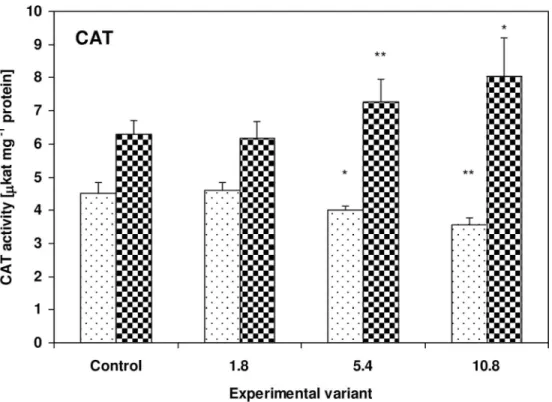
CAT activity showed the opposite tendency. While it decreased to 89% (P<0.05) and 79%
(P<0.01) of control values in the zucchini leaves, it increased to 116% (P<0.01) and 128%
(P<0.05) of control values in the cucumber leaves for the 5.4g and 10.8g doses, respectively
(Fig 5).
POx activity increased in the zucchini leaves to 149% (P<0.05), 265% (P<0.001) and 234%
(P<0.001) of control values, and decreased to 67% (P<0.001), 63% (P<0.001) and 48%
(P<0.001) of controls in the cucumber leaves, for the 1.8g, 5.4g and 10.8g doses, respectively
(Fig 6).
Fig 2. TBARS concentration in the leaves of zucchini (square without filling) and cucumber (square with dots) grown on the control and sewage sludge amended soil.Concentrations are expressed in nmol g-1f.m. Bars represent S.D. of means (n= 5–8). Symbols (*), (**), and (***) indicate values that differ significantly from controls atP<0.05,P<0.01, andP<0.001, respectively. Activities are expressed in nkat mg-1 protein.
The activity of GST, one of the main detoxifying enzymes, was increased in the leaves of both investigated plants. In the zucchini plants, GST activity increased even after the addition
of the smallest dose of sludge, reaching 123% (P<0.01), 193% (P<0.001) 199% (P<0.001) of
control values for the 1.8g, 5.4g and 10.8g doses respectively. In the cucumber leaves, GST
activity was found to be 124% (P<0.05) and 175% (P<0.01) of control values for the 5.4g and
10.8g doses, respectively (Fig 7).
Fig 3.α-Tocopherol concentration in the leaves of zucchini (square without filling) and cucumber
(square with dots) grown on the control and sewage sludge amended soil.Concentrations are expressed inμg g-1f.m. For further explanation, seeFig 2.
doi:10.1371/journal.pone.0157782.g003
Fig 4. Activity of APx in the leaves of zucchini (square without filling) and cucumber (square with dots) grown on the control and sewage sludge amended soil.For further explanation, seeFig 2.
Discussion
Although abiotic stresses are known to have a significant influence on plants, the impact of sewage sludge supplementation on plant growth and oxidative damages remains poorly under-stood, as does antioxidative response. Our findings demonstrate the different responses to
sew-age sludge application by zucchini and cucumber, two members of theCucurbitaceaefamily.
Due to its high organic matter and nutrient content, sewage sludge is regarded as an excellent fertilizer; however, the presence of associated micropollutants can hamper this positive influ-ence on plant growth and development.
Our findings indicate that sewage sludge has a stronger effect on the zucchini than the cucumber plants, as demonstrated by the changes observed on the leaves after sewage sludge application. This difference could be attributed to either an increased sensitivity of zucchini plants to the substances present in the sewage sludge, or to a greater uptake of toxic compounds from the soil. In fact, some studies report that zucchini plants take up persistent organic pollut-ants (POPs) such as PCDD, PCDF and PCB from soil to a greater extent than cucumber plpollut-ants [15,23–24]. Many reports have identified discrepancies between members of theCurbitaceae with regard to their uptake of hydrophobic components: for example, zucchini were found to be far more contaminated with chlordecone than cucumber plants grown in the same medium [59]. Moreover, there is evidence that zucchini can accumulate metals such as zinc and cad-mium to a similar extent as spinach, which is known to be an effective bioaccumulator of heavy metals [60]. Hence, the morphological changes such as white spots or protrusions observed on the zucchini leaf blades in the present study (Fig 1) may well be the result of higher accumula-tion of toxic substances from the applied sewage sludge than demonstrated by the cucumber plants. For effective phytoremediation of pollutants present in sewage sludge, it is crucial to use
Fig 5. Activity of CAT in the leaves of zucchini (square without filling) and cucumber (square with dots) grown on the control and sewage sludge amended soil.Activities are expressed inμkat mg-1 protein. For further explanation, seeFig 2.
plants that have the ability to take up, translocate and accumulate the toxic substances it contains.
Environmental stresses may cause excessive ROS formation, which has the potential to
interact with many cellular components, resulting ininter aliadamage to membrane lipids and
proteins. Many reports indicate that oxidative stress is an important component of the plant response to various toxic chemicals such as heavy metals [35], insecticides [61] or herbicides [62]. The concentration of TBA-reactive substances is one indicator of the degree of lipid oxi-dative damage. Although damage to the zucchini leaves was visible, only a slight increase in TBARS concentration was found in the tissues (Fig 2). This greater degree of lipid peroxidation appeared only in the 5.4g and 10.8g sewage samples, and these doses correlated with the
sever-ity of changes observed on the leaves. However, the concentration ofα-tocopherol, the main
antioxidant of the lipid fraction, also increased significantly in these variants, particularly for the maximum (10.8g) dose (Fig 3); this reflects its protective role, which is associated with pre-venting the formation of lipid peroxides from cellular lipids. In contrast to zucchini, the cucumber plants did not show any morphological changes nor any progressive increase in TBARS related to stress severity; however, the variant administered the highest dose of sewage
sludge (10.8g) did display elevated levels ofα-tocopherol. It is possible that in the case of
cucumber plants, the antioxidant defense was not sufficient to completely block the formation
of lipid peroxides at the 5.4g dose. For the 10.8g sample, the increase inα-tocopherol
concen-tration was much lower in cucumber (163% of control) than zucchini plants (267% of control).
Fig 6. Activity of POx in the leaves of zucchini (square without filling) and cucumber (square with dots) grown on the control and sewage sludge amended soil.Activities are expressed inμkat mg-1protein. For further explanation, see Fig 2.
The type of technology used for sludge treatment is another factor with a significant impact on the oxidative damage experienced by the plants and their antioxidative response. The appli-cation of anaerobic mesophillic digested (AM) and autothermal thermophilic aerobic digested
(ATAD) sludge on alfalfa (Medicago sativaL.) plants caused a significant increase in the
con-centration of malondialdehyde (MDA), a major cytotoxic product of lipid peroxidation, in the underground plant organs but not in the leaves [63]. Supplementation with AM sludge, the type used in the present study, tends to result in a lesser degree of oxidative stress in plant tis-sues than ATAD sludge. Moreover, the ability to scavenge ROS excess appears to be more suc-cessful in plants treated with AM than those with ATAD sludge. It is possible that the small range of lipid oxidative damage observed in the tested zucchini and cucumber plants may be due to the fact that AM technology was used to treat the sludge. It has been found that refinery sludge inhibited the growth of alfalfa and induced oxidative stress, but had little impact on lipid peroxidation [64], while another study showed that in alfalfa plants, the application of sewage sludge was associated with a significant reduction in the degree of oxidative damage to
lipids during drought, as well as H2O2concentration [65]. It is possible that the wide range of
nutrients present in the sludge exert a beneficial influence by reducing the effect of toxic sub-stances that can cause oxidative stress, and consequently, oxidative damage.
On the other hand, the degree of lipid peroxidation (TBARS content) inSinapis alba,
Triti-cum aestivum,Phaseolus vulgarisandVicia fabaseedlings was found to clearly increase in the
presence of pollutants such as 1,2,4–trichlorobenzene, carbazole, fluorene or phenanthridine.
In these cases, TBARS content could be considered a biomarker for this kind of soil
contamina-tion [66–67] and serve as an early warning of phytotoxicityin vivo.
One defensive strategy used by plants to counter the effects of oxidative stress is based around adjusting the response to the environmental stressors through changes in the activity of antioxidant enzymes. The zucchini and cucumber plants investigated in this study showed a diversity of enzymatic antioxidant responses to sewage sludge application. While APx activity
Fig 7. The activity of GST in the leaves of zucchini (square without filling) and cucumber (square with dots) grown on the control and sewage sludge amended soil.Activities are expressed in nkat mg-1 protein. For further explanation, seeFig 2.
in the zucchini plants increased significantly after the application of sewage sludge, it decreased in the cucumber plants (Fig 4). Moreover, similar changes were observed in the tested plants with regard to POx activity (Fig 6). The activities of APx and POx in the leaves of zucchini plants changed in a concentration-dependent manner: rising with increasing quantities of sewage sludge, reaching their highest value in the 5.4g sample, and then falling in the highest sewage sludge dose (10.8g). Nevertheless, the values observed at 10.8g were still higher than controls.
A similar trend in APx activity, first increasing and then declining, was also observed in Arabidopsis thalianaplants treated with increasing phenantrene concentrations [68]. Both
APx and glutathione peroxidase activity changed in the same way inArabidopsis thaliana
plants exposed to 2,3,7,8-tetrachlorinated dibenzo-p-dioxin [69]. A similar situation
concern-ing APx and POx was also found in phenol-treatedArabidopsis thalianaplants [70]. It is
possi-ble that the decline in APx and POx activities observed at the maximum sewage sludge dose (10.8g) indicates that the production of toxic ROS may have overwhelmed the plant antioxi-dant systems at this dose, causing the observed damage to tissue structures.
In both the zucchini and cucumber plants, an inverse relationship was observed between the activity of peroxidases and the activity of CAT. While in the zucchini plants, APx and POx activity rose and CAT activity fell with increasing amounts of sewage sludge, the opposite
situa-tion was observed in the cucumber plants (Figs4–6). It is worth noting that the morphological
changes appeared only on the zucchini leaves. It cannot be excluded that, in the investigated plants, this behavior may be associated with a model of antioxidant response where APx and GST activities rise and CAT decreases. It is possible that despite the transient increase in TBARS concentration, morphological changes on the leaves of cucumber plants were pre-vented by increased CAT activity, and stressor-triggered biochemical changes tend to appear much earlier in plant tissues than visible toxicity symptoms. On the other hand, CAT activity is highly sensitive to the presence of many toxic substances; for example cyanide, azide,
hydroxyl-amine, 3-amino-1,2,4-triazole, mercaptoethanol, urea and H2O2have been found to act as
CAT inhibitors [71–73]. As zucchini plants have been found to be capable of more efficient absorption of substances from the soil, including toxic substances, it seems possible that the presence of absorbed substances or their metabolites in tissues may inhibit CAT activity. In
addition, CAT is not capable of decomposing H2O2if the compound is present at
concentra-tions too low for APx activity, due to its high Michaelis constant (Km) [71]. H2O2acts as a
sig-naling molecule: it initiates a signal transduction leading to enzyme activation or the expression of genes encoding such proteins as GST and POx [74]. A rapid decline of CAT
mRNA observed the phenanthrene-treatedArabidopsis thalianaplants has been attributed to
an attempt to increase H2O2signaling and induce PCD [68]. Similar changes have also been
observed after O3and Cd2+stress [75–76]. Previous studies suggest that reduction of CAT
activity is a distinctive, non-specific reaction of plants to stress factors such as low temperature
[77], salinity [78], water deficit [79], SO2fumigation [80], herbicides [81] and acid rain [82].
Similar trends were seen in GST activity in both zucchini and cucumber leaves; it increased gradually with the quantity of sewage sludge used. However, the increase in GST activity was higher in the zucchini plants and was observed even at the lowest administered dose. Increased GST activity in plant tissues indicates exposure to xenobiotics [83]. GST catalyzes the conjuga-tion of electrophilic substrates with reduced glutathione, resulting in the formaconjuga-tion of products
which are more polar and less toxic [52,84]. In other studies, GST activity has been found to
significantly increase after exposure to a range of pollutants, including PAHs [67], hexachloro-benzene [83] and atrazine [85], and during detoxification of heavy metals [86–88]. The activity
of GST was fond to be significantly elevated in the aquatic macrophyteCeratophyllum
demer-sumwhen exposed to low 3-chlorobiphenyl concentrations [89]. However, reduced GST
Among the investigated plants of theCucurbitaceaefamily, zucchini showed more pro-nounced signs of toxicity than cucumber after sewage sludge application. The defensive reac-tions of zucchini plants are mainly associated with increases in peroxidase, APx, POx and GST activity. As the results of the lipid peroxide assay indicate a low level of oxidative damage in the tested plant tissues, the antioxidant system appears to function efficiently. However, further studies are needed to integrate knowledge about the activity and efficiency of the antioxidative system, and the detoxification reactions associated with the uptake of toxic compounds such as heavy metals and organic substances from sewage sludge.
Supporting Information
S1 Supporting Information. (XLS)
Author Contributions
Conceived and designed the experiments: AW MU. Performed the experiments: AW. Analyzed the data: AW. Contributed reagents/materials/analysis tools: AW MU. Wrote the paper: AW MU.
References
1. Cunningham SD, Anderson TA, Schwab AP, Hsu FC. Phytoremediation of soils contaminated with organic pollutants. Adv Agron. 1996; 56: 55–114.
2. Mattina MJI, Iannucci-Berger W, Dykas L, Pardus J. Impact of long-term weathering, mobility, and land use on chlordane residues in soil. Env Sci Technol. 1999; 33 (14): 2425–2431.
3. Nagajyoti PC, Lee KD, Sreekanth TVM. Heavy metals, occurrence and toxicity for plants: a review. Env Chem Lett. 2010; 8(3): 199–216
4. Gworek B, Klimczak K, Kijeńska M. The relation between polyaromatic hydrocarbon concentration in sewage sludge and its uptake by plants:Phragmites communis,Polygonum persicariaandBidens tri-partita. PloS one. 2014; 9 (10): e109548. doi:10.1371/journal.pone.0109548PMID:25310699
5. Wyrwicka A, Steffani S, Urbaniak M. The effect of PCB-contaminated sewage sludge and sediment on metabolism of cucumber plants (Cucumis sativusL.). Ecohydrol Hydrobiol. 2014; 14 (1) 75–82.
6. Liao Ch, Liang X, Lu G, Thai T, Xu W, Dang Zhi. Effect of surfactant amendment to PAHs-contaminated soil for phytoremediation by maize (Zea maysL.). Ecotox Environ Safe. 2015; 112: 1–6.
7. Macek T, Mackova M, Kas J. Exploitation of plants for the removal of organics in environmental remedi-ation. Biotechnol Adv. 2000; 18: 23–34. PMID:14538117
8. Gent MPN, White JC, Parrish ZD, Isleyen M, Eitzer BD, Mattina MJI. Uptake and translocation ofp,p' -dichlorodiphenyldichloroethylene supplied in hydroponics solution toCucurbita. Environ Toxicol Chem. 2007; 26(12): 2467–2475. PMID:18020671
9. Gerhardt KE, Huang X-d, Glick BR, Greenberg BM. Phytoremediation and rhizoremediation of organic soil contaminants: Potential and challenges. Plant Sci. 2009; 176: 20–30.
10. Ivanov VB, Bystrova EI, Seregin IV. Comparative impacts of heavy metals on root growth as related to their specificity and selectivity. Russ J Plant Physiol. 2003; 50 (3): 398–406.
11. Reddy AM, Kumar SG, Jyothsnakumari G, Thimmanaik S, Sudhakar Ch. Lead induced changes in anti-oxidant metabolism of horsegram (Macrotyloma uniflorum(Lam.) Verdc.) and bengalgram (Cicer arieti-numL.). Chemosphere. 2005; 60(1): 97–104. PMID:15910908
12. Lyubenova L, Nehnevajova E, Herzig R, Schröder P. Response of antioxidant enzymes inNicotiana tabacumclones during phytoextraction of heavy metals. Environ Sci Pollut R. 2009; 16 (5): 573–581.
13. Briggs GG, Bromilow RH, Evans AA. Relationships between lipophilicity and root uptake and transloca-tion of non-ionised chemicals by barley. Pestic Sci. 1982; 13 (5): 495–504.
14. Hatzinger PB, Alexander M. Effect of aging of chemicals in soil on their biodegradability and extractabil-ity. Environ Sci Technol. 1995; 29 (2): 537–545. doi:10.1021/es00002a033PMID:22201403
16. Mattina MI, Eitzer BD, Iannucci-Berger W, Lee WY, White JC. Plant uptake and translocation of highly weathered, soil-bound technical chlordane residues: Data from field and rhizotron studies. Environ Tox-icol Chem. 2004; 23 (11): 2756–2762. PMID:15559292
17. Parrish ZD, White JC, Isleyen M, Gent MPN, Iannucci-Berger W, Eitzer BD, et al. Accumulation of weathered polycyclic aromatic hydrocarbons (PAHs) by plant and earthworm species. Chemosphere. 2006; 64 (4): 609–618. PMID:16337258
18. Engwall M, Hjelm K. Uptake of dioxin-like compounds from sewage sludge into various plant species–
assessment of levels using a sensitive bioassay. Chemosphere. 2000; 40 (9–11): 1189–1195. PMID: 10739061
19. Mattina MJI, Iannucci-Berger W, Dykas L. Chlordane uptake and its translocation in food crops. J Agr Food Chem. 2000; 48 (5): 1909–1915.
20. White JC. Differential bioavailability of field-weatheredp,p0-DDE to plants of theCucurbitaand Cucu-misgenera. Chemosphere. 2002; 49 (2): 143–152. PMID:12375861
21. White JC, Wang X, Gent MPN, Iannucci-Berger W, Eitzer BD, Schultes NP, et al. Subspecies-level vari-ation in the phytoextraction of weatheredp,p'-DDE byCucurbita pepo. Environ Sci Technol. 2003; 37 (19): 4368–4373. PMID:14572087
22. White JC, Parrish ZD, Isleyen M, Gent MPN, Iannucci-Berger W, Eitzer BD, et al. Uptake of weathered p,p0-DDE by plant species effective at accumulating soil elements. Microchem J. 2005; 81 (1): 148–
155.
23. Inui H, Wakai T, Gion K, Kim YS, Eun H. Differential uptake for dioxin-like compounds by zucchini sub-species. Chemosphere. 2008; 73 (10): 1602–1607. doi:10.1016/j.chemosphere.2008.08.013PMID: 18835616
24. Zhang H, Chen J, Ni Y, Zhang Q, Zhao L. Uptake by roots and translocation to shoots of polychlorinated dibenzo-p-dioxins and dibenzofurans in typical crop plants. Chemosphere. 2009; 76 (6): 740–746. doi: 10.1016/j.chemosphere.2009.05.030PMID:19541345
25. Low JE, WhitfieldÅslund ML, Rutter A, Zeeb BA. Effect of plant age on PCB accumulation byCucurbita pepossp.pepo. J Environ Qual. 2010; 39 (1): 245–50. doi:10.2134/jeq2009.0169PMID:20048312
26. White JC. Inheritance ofp,p’-DDE phytoextraction ability in hybridizedCucurbita pepocultivars. Envi-ron Sci Technol. 2010; 44 (13): 5165–5169. doi:10.1021/es100706tPMID:20507162
27. WhitfieldÅslund ML, Lunney AI, Rutter A, Zeeb BA. Effects of amendments on the uptake and distribu-tion of DDT inCucurbita pepossp.pepoplants. Environ Pollut. 2010; 158 (2): 508–513. doi:10.1016/j. envpol.2009.08.030PMID:19762136
28. Greenwood SJ, Rutter A, Zeeb BA. The absorption and translocation of polychlorinated biphenyl con-geners byCucurbita pepossp.pepo. Environ Sci Technol. 2011; 45 (15): 6511–6516. doi:10.1021/ es200598uPMID:21696136
29. Low JE,Åslund MLW, Rutter A, Zeeb BA. The effects of pruning and nodal adventitious roots on
poly-chlorinated biphenyl uptake byCucurbita pepogrown in field conditions. Environ Pollut. 2011; 159 (3): 769–775. doi:10.1016/j.envpol.2010.11.015PMID:21168941
30. Matsuo S, Yamazaki K, Gion K, Eun H, Inui H. Structure-selective accumulation of polychlorinated biphenyls inCucurbita pepo. J Pestic Sci. 2011; 36: 363–369.
31. Antolín MC, Pascual I, García C, Polo A, Sánchez-Díaz M. Growth, yield and solute content of barley in soils treated with sewage sludge under semiarid Mediterranean conditions. Field Crop Res. 2005; 94 (2–3): 224–237.
32. Tejada M, Gómez I, Fernández-Boy E, Díaz M-J. Effects of sewage sludge andAcacia dealbata com-posts on soil biochemical and chemical properties. Commun Soil Sci Plan. 2014; 45 (5): 570–580.
33. Lakhdar A, ben Achiba W, Montemurro F, Jedidi N, Abdelly Ch. Effect of municipal solid waste compost and farmyard manure application on heavy-metal uptake in wheat. Commun Soil Sci Plan. 2009; 40 (21–22): 3524–3538.
34. Waqas M, Khan S, Qing H, Reid BJ, Chao C. The effects of sewage sludge and sewage sludge biochar on PAHs and potentially toxic element bioaccumulation inCucumis sativaL. Chemosphere. 2014; 105: 53–61. doi:10.1016/j.chemosphere.2013.11.064PMID:24360844
35. Gonçalves JF, Becker AG, Pereira LB, Rocha JBT, Cargnelutti D, Tabaldi LA, et al. Response of Cucu-mis sativusL. seedlings to Pb exposure. Braz J Plant Physiol. 2009; 21 (3): 175–186.
36. Hernández JA, Campillo A, Jiménez A, Alarcón JJ, Sevilla F. Response of antioxidant systems and leaf water relations to NaCl stress in pea plants. New Phytol. 1999; 141: 241–251.
37. Dai Q, Yan B, Huang S, Liu X, Peng S, Miranda MLL, et al. Response of oxidative stress defense sys-tems in rice (Oryza sativa) leaves with supplemental UV-B radiation. Physiol Plant. 1997; 101: 301–
38. Velikova V, Yordanow I, Edreva A. Oxidative stress and some antioxidant systems in acid rain-treated bean plants. Protective role of exogenous polyamines. Plant Sci. 2000; 151: 59–66.
39. Wyrwicka A, Skłodowska M. Influence of repeated acid rain treatment on antioxidative enzyme activi-ties and on lipid peroxidation in cucumber leaves. Environ Exp Bot. 2006; 56 (2): 198–204.
40. Wyrwicka A, Skłodowska M. Intercompartmental differences between cytosol and mitochondria in their respective antioxidative responses and lipid peroxidation levels in acid rain stress. Acta Physiol Plant. 2014; 36 (4): 837–848.
41. Mittler R. Oxidative stress, antioxidants and stress tolerance. Trends Plant Sci. 2002; 7: 405–410. PMID:12234732
42. Møller IM. Plant mitochondria and oxidative stress: electron transport, NADPH turnover, and metabo-lism of reactive oxygen species. Annu Rev Plant Physiol Plant Mol Biol. 2001; 52: 561–591. PMID: 11337409
43. Dhindsa RS, Plumb-Dhindsa P, Thorpe TA. Leaf senescence: correlated with increased levels of mem-brane permeability and lipid peroxidation, and decreased levels of superoxide dismutase and catalase. J Exp Bot. 1981; 32: 93–101.
44. Willekens H, Inzé D, Van Montagu M, Van Camp W. Catalases in plants. Mol Breed. 1995; 1: 207–228.
45. Jiménez A, Hernández JA, del Río LA, Sevilla F. Evidence for the presence of the ascorbate– glutathi-one cycle in mitochondria and peroxisomes of pea leaves. Plant Physiol. 1997; 114: 275–284. PMID: 12223704
46. Tayefi-Nasrabadi H, Dehghan G, Daeihassani B, Movafegi A, Samadi A. Some biochemical properties of guaiacol peroxidases as modified by salt stress in leaves of salt-tolerant and salt-sensitive safflower (Carthamus tinctorius L.cv.) cultivars. Afr J Biotech. 2011; 10: 751–763.
47. Noctor G, Foyer CH. Ascorbate and glutathione: keeping active oxygen under control. Annu Rev Plant Phys. 1998; 49: 249–279.
48. Tausz M, Grill D. The role of glutathione in stress adaptation of plants. Phyton. 2000; 40: 111–118.
49. Karolewski P, Giertych MJ. Changes in the level of phenols during needle development in Scots pine populations in a control and polluted environment. Eur J For Pathol. 1995; 25: 297–306.
50. Schafer RQ, Wang HP, Kelley EE, Cueno KL, Martin SM, Buettner GR. Comparingβ-carotene, vitamin E and nitric oxide as membrane antioxidants. Biol Chem. 2002; 383: 671–681. PMID:12033456
51. Edwards R, Dixon DP. Metabolism of natural and xenobiotic substances by the plant glutathione S-transferase superfamily. In: Sandermann H, editor. Ecological Studies vol. 170, Molecular Ecotoxicol-ogy of Plants. Berlin Heidelberg: Springer-Verlag; 2004. pp. 17–50.
52. Marrs KA. The functions and regulation of glutathione S-transferases in plants. Annu Rev Plant Phys. 1996; 47: 127–158.
53. Nakano Y, Asada K. Hydrogen peroxide is scavenged by ascorbate-specific peroxidase in spinach chloroplasts. Plant Cell Physiol. 1981; 22: 867–880.
54. Habig WH, Pabst MJ, Jakoby WB. Glutathione S-transferases. The first enzymatic step in mercaptane acid formation. J Biol Chem. 1974; 246: 7130–7139.
55. Maehly AC, Chance B. The assay of catalases and peroxidases. In: Glick D, editor. Methods of Bio-chemical Analysis Vol. 1. New York: Interscience Publishers Inc; 1954. pp. 357–425.
56. Yagi K. Assay for serum lipid peroxide level its clinical significance. In: Yagi K, editor. Lipid Peroxides in Biology and Medicine. London, New York: Acad Press Inc; 1982. pp. 223–241.
57. Bradford MM. A rapid and sensitive method for the quantification of microgram quantities of protein uti-lizing the principle of protein-dye binding. Anal Biochem. 1976; 72: 248–254. PMID:942051
58. Taylor SL, Tappel AL. Sensitive fluorometric methods for tissue tocopherol analysis. Lipids 1976; 11: 530–538. PMID:948248
59. Clostre F, Letourmy P, Turpin B, Carles C, Lesueur-Jannoyer M. Soil type and growing conditions influ-ence uptake and translocation of organochlorine (chlordecone) by Cucurbitaceae species. Water Air Soil Pollut. 2014; 225 (10): 2153.
60. Mattina MI, Lannucci-Berger W, Musante C, White JC. Concurrent plant uptake of heavy metals and persistent organic pollutants from soil. Environ Pollut. 2003; 124 (3): 375–378. PMID:12758018
61. Mitton FM, Ribas Ferreira JL, Gonzalez M, Miglioranza KSB, Monserrat JM. Antioxidant responses in soybean and alfalfa plants grown in DDTs contaminated soils: Useful variables for selecting plants for soil phytoremediation? Pestic Biochem Phys. 2015; doi:10.1016/j.pestbp.2015.12.005
63. Antolín MC, Muro I, Sánchez-Díaz M. Sewage sludge application can induce changes in antioxidant status of nodulated alfalfa plants. Ecotox Environ Safe. 2010; 73: 436–442.
64. Martí MC, Camejo D, Fernández-García N, Rellán-Alvarez R, Marques S, Sevilla F, et al. Effect of oil refinery sludges on the growth and antioxidant system of alfalfa plants. J Hazar Mater. 2009; 171 (1–
3): 879–885.
65. Antolín MC, Muro I, Sánchez-Díaz M. Application of sewage sludge improves growth, photosynthesis and antioxidant activities of nodulated alfalfa plants under drought conditions. Environ Exp Bot. 2010; 68: 75–82.
66. Wan L, Peijun L, Qixing Z, Tieheng S, Peidong T, Huaxia X. Short-term toxic effects of chlorobenzenes on broadbeen (Vicia faba) seedlings. Sci China Ser C. 2005; 48 (1): 33–39.
67. Pašková V, Hilscherová K, Feldmanová M, Bláha L. Toxic effects and oxidative stress in higher plants exposed to polycyclic aromatic hydrocarbons and theirN-heterocyclic derivatives. Environ Tox Chem. 2006; 25 (12): 3238–3245.
68. Liu H, Weisman D, Ye YB, Cui B, Huang YH, Colón-Carmona A, et al. An oxidative stress response to polycyclic aromatic hydrocarbon exposure is rapid and complex inArabidopsis thaliana. Plant Sci. 2009; 176 (3): 375–382.
69. Hanano A, Almousally I, Shaban M. Phytotoxicity effects and biological responses ofArabidopsis thali-anato 2,3,7,8-tetrachlorinated dibenzo-p-dioxin exposure. Chemosphere. 2014; 104: 76–84. doi:10. 1016/j.chemosphere.2013.10.060PMID:24275148
70. Xu J, Su ZH, Chen C, Han HJ, Zhu B, Fu XY, et al. Stress responses to phenol inArabidopsisand tran-scriptional changes revealed by microarray analysis. Planta. 2012; 235 (2): 399–410. doi:10.1007/ s00425-011-1498-5PMID:21927950
71. Bartosz G. Oxidative stress in plants. Acta Physiol Plant. 1997; 19: 47–64.
72. Scott D. Catalase. In: Reed G, editor. Enzymes in food processing. Second edition. New York, San Francisco, London: Academic Press; 1975.
73. Switala J, Loewen PC. Diversity of properties among catalases. Arch Biochem Biophys. 2002; 401: 145–154. PMID:12054464
74. Levine A, Tenhaken R, Dixon R, Lamb C. H2O2from the oxidative burst orchestrates the plant hyper-sensitive disease resistance response. Cell. 1994; 79: 583–593. PMID:7954825
75. Ludwikow A, Gallois P, Sadowski J. Ozone-induced oxidative stress response inArabidopsis: tran-scription profiling by microarray approach. Cell Mol Biol Lett. 2004; 9 (4B): 829–42. PMID:15647800
76. Schützendübel A, Nikolova P, Rudolf C, Polle A. Cadmium and H2O2-induced oxidative stress in Popu-lus×canescensroots. Plant Physiol Biochem. 2002; 40 (6–8): 577–584.
77. Kang H-M, Saltveit ME. Activity of enzymatic antioxidant defence systems in chilled and heat shocked cucumber seedling radicles. Physiol Plant. 2001; 113: 548–556.
78. Zhu Z, Wei G, Li J, Qian Q, Yu J. Silicon alleviates salt stress and increases antioxidant enzymes activ-ity in leaves of salt-stressed cucumber (Cucumis sativusL.). Plant Sci. 2004; 167: 527–533.
79. Boo YC, Jung J. Water deficit–induced oxidative stress and antioxidative defenses in rice plants. J Plant Physiol. 1999; 155: 255–261.
80. Tanaka K, Otsubo T, Kondo N. Participation of hydrogen peroxide in the inactivation of Calvin-cycle SH enzymes in SO2-fumigated spinach leaves. Plant Cell Physiol. 1982; 23: 1009–1018.
81. Feierabend J, Kemmerich P. Mode of interference of chlorosis-inducing herbicides with peroxisomal enzyme activities. Physiol Plant. 1983; 57: 346–351.
82. Gabara B, Skłodowska M, Wyrwicka A, Glińska S, Gapińska M. Changes in the ultrastructure of chloro-plasts and mitochondria and antioxidant enzyme activity inLycopersicon esculentumMill. leaves sprayed with acid rain. Plant Sci. 2003; 164: 507–516.
83. Roy S, Lindström-Seppä P, Huuskonen S, Hänninen O. Responses of biotransformation and antioxi-dant enzymes inLemna minorandOncorhynchus mykissexposed simultaneously to hexachloroben-zene. Chemosphere. 1995; 30 (8): 1489–1498.
84. Pascal S, Scalla R. Purification and characterization of a safener-induced glutathione S-transferase from wheat (Triticum aestivum). Physiol Plant. 1999; 106 (1): 17–27.
85. Tang J, Hoagland KD, Siegfried BD. Uptake and bioconcentration of atrazine by selected freshwater alga. Environ Toxicol Chem. 1998; 17 (6): 1085–1090.
86. Hamoutène D, Roméo M, Gnassia M, Lafaurie M. Cadmium effects on oxidative metabolism in a
marine seagrass:Posidonia oceanica. Bull Environ Contam Toxicol. 1996; 56: 327–334.
88. Ferrat L, Pergent-Martini C, Roméo M. Assessment of the use of biomarkers in aquatic plants for the evaluation of environmental quality: application to seagrasses. Aquat Toxicol. 2003; 65 (2): 187–204. PMID:12946618