Croat. Chem. Acta 88 (1) (2015) 59–65. http://dx.doi.org/10.5562/cca2520
Original Scientific Article
Eosin Y Catalyzed Visible-light-promoted One –Pot Facile Synthesis of
1,3,4- Thiadiazole
Vishal Srivastava,a Pravin K. Singh,b and Praveen P. Singhc,*
a
Laboratory of Green Synthesis, Department of Chemistry, University of Allahabad, Allahabad – 211002, India
b
Food Analysis and Research Lab, Centre of Food Technology, University of Allahabad, Allahabad – 211002, India
c
Department of Chemistry, United College of Engineering & Research, Naini, Allahabad - 211010, India
RECEIVED JULY 23, 2014; REVISED DECEMBER 26, 2014; ACCEPTED JANUARY 9, 2015
Abstract. A novel one-pot visible light irradiated synthesis of 1,3,4-thiadiazole from aldehydes and thioacyl hydrazides have been reported in presence of eosin Y as an organophotoredox catalyst at room temperature under aerobic condition. This synthesis includes application of air and visible light as inex-pensive, readily available, non-toxic and sustainable regents, which fulfils the basic principle of green chemistry.
Keywords: Eosin Y, visible-light, organophotoredox, green chemistry, aerobic condition
INTRODUCTION
Sunlight is a unique and renewable natural source.1 The development of methods to efficiently harness the solar radiation energy has emerged as one of the central sci-entific challenges of the twenty first century.2−3 There-fore, some pioneering researchers have dedicated to converting solar energy into chemical energy for chemi-cal transformations.4−5 Recently, a surge of interest from the synthetic community has brought photoredox mani-folds to the forefront of catalysis. In this sequence visi-ble light photoredox catalysis has recently received much attention in organic synthesis owing to ready availability, sustainability, non-toxicity and ease of handling of visible light.6−11 In their revolutionary work in this area, MacMillan,12 Yoon13 and Stephenson14−15 have used Ruthenium and Iridium complexes as the photoredox catalyst, which has inspired the develop-ment of several powerful methods for various chemical transformations useful in organic synthesis.16
However, these transition metal based photocata-lysts disadvantageously exhibit high cost, low sustain-ability and potential toxicity. Recently, a superior alter-native to transition metal photoredox catalysts, espe-cially metal-free organic dyes such as eosin Y, fluo-rescein, Rose Bengal, nile red, perylene and rhodamine B have been used as economically and ecologically superior surrogates for Ru(II) and Ir(II) complexes in visible-light promoted organic transformations
involv-ing SET17−20 (single electron transfer). These organic dyes have got much more attention with the last few years also due to easy handling, eco-friendly and have great potential for applications in visible-light-mediated organic synthesis,21−24 which fulfils the basic principle of green chemistry.
The five-membered heterocyclic compounds have a great application and importance in heterocyclic chemistry. Among them thiadiazole is a versatile moiety that exhibits a wide variety of biological activities. Thiadiazole moiety acts as “hydrogen binding domain” and “two-electron donor system”. It also acts as a con-strained pharmacophore. Many drugs containing thiadi-azole nucleus are available in the market such as aceta-zolamide, methaaceta-zolamide, sulfamethazole, etc. 1,3,4-thiadiazoles are associated with diverse pharmacologi-cal activities such as analgesic,25 antidepressant, anxio-lytic,26 anticonvulsant,27−28 anti-inflammatory,29 antim-icrobial,30 anti-tubercular,31 antitumor,32 and anti-viral activities.33
develop-ment of novel environdevelop-mentally benign synthesis41−44 herein we report a simple, visible light irradiated, effi-cient and green protocol for the synthesis of 1,3,4-thiadiazoles, using eosin Y as photocatalyst with excel-lent yield as depicted in Scheme 1.
EXPERIMENTAL
Melting points were determined by open glass capillary method and are uncorrected. All chemicals used were reagent grade and were used as received. 1H NMR and 13
C NMR spectra were recorded on a Bruker AVANCE DPX (400 MHz and 75 MHz) FT spectrometer in DMSO using TMS as an internal reference (chemical shift in δ, ppm). Mass spectra were recorded on JEOL SX-303 (FAB) mass spectrophotometer at 70ev. Ele-mental analyses were carried out using a Coleman automatic C,H,N analyser.
General Procedure for the Synthesis of 2,5-disubsti-tuted 1,3,4-thiadiazole 4(a−n):
A solution of an aldehyde 1(a−n) (1.0 mmol) and an thioacylhydrazide 2(a−n) (1.0 mmol) in MeCN (3 mL) was heated at 65 °C for 2−6 h to form the corresponding thioacylhydrazone (as monitored by TLC). Then, eosin Y (2.0 mol%) and TMP (2.0 equiv.) were added and the mixture was irradiated with green LEDs (2.4 W, 120 lm) with stirring under an air atmosphere at rt for 10−18 h. After completion of the reaction (monitored by TLC), water (5 mL) was added and the mixture was extracted with EtOAc (3 × 5 mL). The combined organic phase was dried over MgSO4, filtered and evaporated under reduced pressure. The resulting product was purified by silica gel column chromatography using a gradient mix-ture of hexane/ethyl acetate as eluent to afford an ana-lytically pure sample of 4(a−n). All the products are known compounds and were characterized by the com-parison of their spectral data with those reported in the literature. In the 1H NMR spectra, signal of respective protons of newly synthesized compounds 4(a−n)
showed the peaks for -CH3, -OCH3 and aromatic pro-tons.
4a. 2-(4-chlorophenyl)-5-phenyl-1,3,4-thiadiazole m.p. 180 ºC, m/z: 272.02; Mol. Wt: 272.75; 1H NMR (400 MHz, DMSO-d6) δ/ppm: 7.41−7.60 (m, 5H, ArH),
7.65−7.74 (d, 2H, J = 8.1 Hz, 2´, 6´-ArH), 8.02−8.15 (d, 2H, J = 8.4 Hz, 3´, 5´-ArH), 13C NMR (75 MHz, DMSO-d6) δ/ppm: 128.7, 128.9, 129.2, 129.3, 130.9, 131.6, 133.5, 134.3, 174.1; Anal. Calcd for C14H9ClN2S: C, 61.65; H, 3.33; N, 10.27. Found: C, 61.42; H, 3.31; N, 10.25.
4b. 2-(3-chlorophenyl)-5-phenyl-1,3,4-thiadiazole m.p. 187 ºC, m/z: 272.02; Mol. Wt: 272.75; 1H NMR (400 MHz, DMSO-d6) δ/ppm: 7.41−7.60 (m, 5H, ArH), 7.65−7.74 (dd, 1H, J = 8.1 Hz, J = 8.9 Hz, 5´-ArH), 7.80−7.85 (d, 1H, J = 8.1 Hz, 4´-ArH), 7.91−8.00 (d, 1H, J = 8.3 Hz, 6´-ArH), 8.04−8.13 (s, 1H, 2´-ArH), 13C NMR (75 MHz, DMSO-d6) δ/ppm: 127.4, 128.7, 128.8, 129.0, 129.2, 130.9, 133.5, 134.8, 134.9, 174.1; Anal. Calcd for C14H9ClN2S: C, 61.65; H, 3.33; N, 10.27. Found: C, 61.42; H, 3.31; N, 10.25.
4c. 2-(2-chlorophenyl)-5-phenyl-1,3,4-thiadiazole m.p. 195 ºC, m/z: 272.02; Mol. Wt: 272.75; 1H NMR (400 MHz, DMSO-d6) δ/ppm: 7.41−7.60 (m, 7H, ArH, 4´, 5´- ArH), 7.65−7.70 (d, 1H, J = 8.1 Hz, 3´-ArH), 7.73−7.78 (d, 1H, J = 8.1 Hz, 6´-ArH), 13C NMR (75 MHz, DMSO-d6) δ/ppm: 127.3, 128.7, 128.9, 129.2, 129.3, 130.1, 130.9, 132.2, 133.5, 136.9, 174.1; Anal. Calcd for C14H9ClN2S: C, 61.65; H, 3.33; N, 10.27. Found: C, 61.42; H, 3.31; N, 10.25.
4d. 2-(4-methoxyphenyl)-5-phenyl-1,3,4-thiadiazole m.p. 215 ºC, m/z: 268.07; Mol. Wt: 268.33; 1H NMR (400 MHz, DMSO-d6) δ/ppm: 3.83 (s, 3H, -OCH3), 7.41−7.50 (m, 5H, ArH), 7.58−7.69 (d, 2H, J = 8.1 Hz, 3´, 5´-ArH), 8.05−8.13 (d, 2H, J = 8.4 Hz, 2´, 6´- ArH), 13
C NMR (75 MHz, DMSO-d6) δ/ppm: 55.8, 114.8, 125.8, 128.5, 128.7, 129.2, 130.9, 133.5, 160.6, 174.1; Anal. Calcd for C15H12N2 OS: C, 67.14; H, 4.51; N, 10.44. Found: C, 67.12; H, 4.50; N, 10.40.
4e. 2,5-diphenyl-1,3,4-thiadiazole
m.p. 140 ºC, m/z: 238.06; Mol. Wt: 238.31; 1H NMR (400 MHz, DMSO-d6) δ/ppm: 7.41−8.03 (m, 10H, ArH), 13C NMR (75 MHz, DMSO-d6) δ/ppm: 128.7, 129.2, 130.9, 133.5, 174.1; Anal. Calcd for C14H10N2 S: C, 70.56; H, 4.23; N, 11.76. Found: C, 67.12; H, 4.50; N, 10.40.
7.63−7.84 (d, 2H, J = 8.2 Hz, 2´, 6´-ArH), 8.00−8.13 (d, 2H, J = 8.5 Hz, 3´, 5´-ArH), 13C NMR (75 MHz, DMSO-d6) δ/ppm: 123.1, 128.7, 129.2, 129.7, 130.9, 132.1, 132.5, 133.5, 174.1; Anal. Calcd for C14H9BrN2S: C, 53.01; H, 2.86; N, 8.83. Found: C, 52.99; H, 2.84; N, 8.81.
4g. 2-(3-bromophenyl)-5-phenyl-1,3,4-thiadiazole m.p. 258 ºC, m/z: 317.96; Mol. Wt: 317.20; 1H NMR (400 MHz, DMSO-d6) δ/ppm: 7.41−7.60 (m, 5H, ArH), 7.67−7.78 (d, 1H, J = 8.2 Hz, J = 8.7 Hz, 5´-ArH), 7.81−7.89 (d, 1H, J = 8.3 Hz, 4´-ArH), 7.90−8.02 (d, 1H, J = 8.1 Hz, 6´-ArH), 8.04−8.14 (s, 1H, 2´-ArH), 13C NMR (75 MHz, DMSO-d6) δ/ppm: 122.2, 128.1, 128.7, 129.2, 129.9, 130.9, 131.4, 133.1, 133.5, 135.7, 174.1; Anal. Calcd for C14H9BrN2S: C, 53.01; H, 2.86; N, 8.83. Found: C, 52.99; H, 2.84; N, 8.81.
4h. 2-(4-nitrophenyl)-5-phenyl-1,3,4-thiadiazole
m.p. 230 ºC, m/z: 283.04; Mol. Wt: 283.31; 1H NMR (400 MHz, DMSO-d6) δ/ppm: 7.41−7.60 (m, 5H, ArH), 7.70−7.94 (d, 2H, J = 8.1 Hz, 2´, 6´-ArH), 8.01−8.18 (d, 2H, J = 8.3 Hz, 3´, 5´-ArH), 13C NMR (75 MHz, DMSO-d6) δ/ppm: 124.4, 128.4, 128.7, 129.2, 130.9, 133.5, 139.6, 147.9, 174.1; Anal. Calcd for C14H9N3O2S: C, 59.35; H, 3.20; N, 14.83. Found: C, 59.31; H, 3.18; N, 14.81.
4i. 2-(3-nitrophenyl)-5-phenyl-1,3,4-thiadiazole
m.p. 242 ºC, m/z: 283.04; Mol. Wt: 283.31; 1H NMR (400 MHz, DMSO-d6) δ/ppm: 7.41−7.60 (m, 5H, ArH), 7.69−7.79 (d, 1H, J = 8.1 Hz, J = 8.7 Hz, 5´- ArH), 7.82−7.88 (d, 1H, J = 8.2 Hz, 4´- ArH), 7.90−8.03 (d, 1H, J = 8.2 Hz, 6´-ArH), 8.04−8.16 (s, 1H, 2´-ArH), 13C NMR (75 MHz, DMSO-d6) δ/ppm: 122.8, 123.9, 128.7, 129.2, 130.1, 130.9, 133.5, 134.4, 148.4, 174.1; Anal. Calcd for C14H9N3O2S: C, 59.35; H, 3.20; N, 14.83. Found: C, 59.31; H, 3.18; N, 14.81.
4j. 2-phenyl-5-(p-tolyl)-1,3,4-thiadiazole
m.p. 155 ºC, m/z: 252.07; Mol. Wt: 252.33; 1H NMR (400 MHz, DMSO-d6) δ/ppm: 2.34 (s, 3H, -CH3), 7.41−7.60 (m, 5H, ArH), 7.69−7.80 (d, 2H, J = 7.9 Hz, 3´,5´-ArH), 7.90−7.98 (d, 2H, J = 8.1 Hz, 2´,6´-ArH), 13
C NMR (75 MHz, DMSO-d6) δ/ppm: 21.3, 127.4, 128.7, 129.2, 129.5, 130.5, 130.9, 131.7, 133.5, 174.1; Anal. Calcd for C15H12N2S: C, 71.40; H, 4.79; N, 11.10. Found: C, 71.38; H, 4.77; N, 11.08.
4k. 2-(4-chlorophenyl)-5-(p-tolyl)-1,3,4-thiadiazole m.p. 160 ºC, m/z: 286.03; Mol. Wt: 286.78; 1H NMR (400 MHz, DMSO-d6) δ/ppm: 2.34 (s, 3H, -CH3), 7.29−7.38 (d, 2H, J = 7.8 Hz, 3´´, 5´´-ArH), 7.46−7.55 (d, 2H, J = 8.2 Hz, 3´, 5´-ArH), 7.65−7.74 (d, 2H, J = 7.8 Hz, 2´´, 6´´-ArH), 8.02−8.15 (d, 2H, J = 8.2 Hz, 2´, 6´-ArH), 13C NMR (75 MHz, DMSO-d6) δ/ppm: 21.3, 127.4, 128.9, 129.3, 129.5, 130.5, 131.6, 131.7, 134.3, 174.1; Anal. Calcd for C15H11ClN2S: C, 62.82; H, 3.87;
N, 9.77. Found: C, 62.80; H, 3.85; N, 9.75.
4l. 2-(3-chlorophenyl)-5-(p-tolyl)-1,3,4-thiadiazole m.p. 162 ºC, m/z: 286.03; Mol. Wt: 286.78; 1H NMR (400 MHz, DMSO-d6) δ/ppm: 2.34 (s, 3H, -CH3), 7.29−7.38 (d, 2H, J = 7.8 Hz, 3´´, 5´´-ArH), 7.65−7.74 (d, 2H, J = 7.8 Hz, 2´´, 6´´-ArH), 7.77−7.84 (dd, 1H, J = 8.1 Hz, J = 8.9 Hz, 5´-ArH), 7.86−7.89 (d, 1H, J = 8.1 Hz, 4´-ArH), 7.91−8.00 (d, 1H, J = 8.3 Hz, 6´-ArH), 8.04−8.13 (s, 1H, 2´-ArH), 13C NMR (75 MHz, DMSO-d6) δ/ppm: 21.3, 127.4, 128.8, 129.0, 129.5, 130.5, 131.7, 134.8, 134.9, 174.1; Anal. Calcd for C15H11ClN2S: C, 62.82; H, 3.87; N, 9.77. Found: C, 62.80; H, 3.85; N, 9.75.
4m. 2-(2-chlorophenyl)-5-(p-tolyl)-1,3,4-thiadiazole m.p. 168 ºC, m/z: 286.03; Mol. Wt: 286.78; 1H NMR (400 MHz, DMSO-d6) δ/ppm: 2.34 (s, 3H, -CH3), 7.29−7.38 (d, 2H, J = 7.8 Hz, 3´´, 5´´-ArH), 7.41−7.60 (m, 7H, ArH, 4´, 5´-ArH), 7.65−7.74 (d, 2H, J = 7.8 Hz, 2´´, 6´´-ArH), 7.75−7.84 (d, 1H, J = 8.2 Hz, 3´-ArH), 7.86−7.98 (d, 1H, J = 8.2 Hz, 6´-ArH), 13C NMR (75 MHz, DMSO-d6) δ/ppm: 21.3, 127.3, 127.4, 128.9, 129.3, 129.5, 130.1, 130.5, 131.7, 132.2, 136.9, 174.1; Anal. Calcd for C15H11ClN2S: C, 62.82; H, 3.87; N, 9.77. Found: C, 62.80; H, 3.85; N, 9.75.
4n. 2-(4-methoxyphenyl)-5-(p-tolyl)-1,3,4-thiadiazole m.p. 220 ºC, m/z: 282.08; Mol. Wt: 282.36; 1H NMR (400 MHz, DMSO-d6) δ/ppm: 2.34 (s, 3H, -CH3), 3.83 (s, 3H, -OCH3), 7.29−7.38 (d, 2H, J = 7.8 Hz, 3´´, 5´´-ArH), 7.58−7.69 (d, 2H, J = 8.1 Hz, 3´, 5´-ArH), 7.65−7.74 (d, 2H, J = 7.8 Hz, 2´´, 6´´-ArH), 8.05−8.13 (d, 2H, J = 8.4 Hz, 2´, 6´-ArH), 13C NMR (75 MHz, DMSO-d6) δ/ppm: 21.3, 55.8, 114.8, 125.8, 127.4, 128.5, 129.5, 130.5, 131.7, 160.6, 174.1; Anal. Calcd for C16H14N2 OS: C, 68.06; H, 5.00; N, 9.92. Found: C, 68.03; H, 4.98; N, 9.89.
RESULTS AND DISCUSSION
Table 1. Screening and control experimentsa
Entry Visible Light Eosin Y Air Time / h Yield / %b
1 + + + 24 12c
2 + + + 10 97
3 − + + 24 n.r.d
4 + − + 24 n.r.
5 + + − 24 n.r.
6 + + + 10 45e
7 + + N2 24 trace
8 + + O2 10 97
9 + + + 10 97f
10 + + + 10 60g
11 + + + 10 42h
a
Reaction conditions: thioacylhydrazone (1.0 mmol), eosin Y (2.0 mol%), TMP (2.0 equiv.), MeCN (3.0 mL), green LEDs 2.4W, 120 lm irradiation under an air atmosphere at rt.
bIsolated yield of the product (4a−n). n.r. = no reaction. c
The reaction was conducted without TMP base in MeCN. d
The reaction was carried out in the dark. e
The reaction was carried out using 20 W CFL (compact fluorescent lamp). f
The reaction was carried out with 3.0 equiv. of TMP. g
The reaction was carried out 1.0 equiv. of TMP. h
The reaction was carried out with 1.0 mol% of eosin Y.
Table 2. Optimization of reaction conditionsa
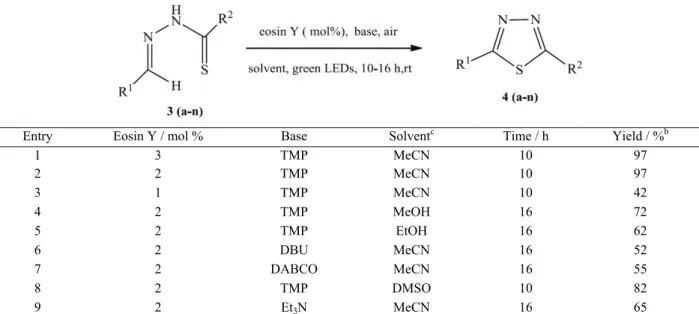
Entry Eosin Y / mol % Base Solventc Time / h Yield / %b
1 3 TMP MeCN 10 97
2 2 TMP MeCN 10 97
3 1 TMP MeCN 10 42
4 2 TMP MeOH 16 72
5 2 TMP EtOH 16 62
6 2 DBU MeCN 16 52
7 2 DABCO MeCN 16 55
8 2 TMP DMSO 10 82
9 2 Et3N MeCN 16 65
a
Reaction conditions: thioacylhydrazone (1.0 mmol), eosin Y (2.0 mol%), TMP (2.0 equiv.), MeCN (3.0 mL), green LEDs 2.4W, 120 lm irradiation under an air atmosphere at rt.
b
3−5). The reaction did not proceed satisfactorily when a household 20 W fluorescent lamp was used instead of green LEDs (Table 1, entries 6 versus 2). Notably, the same result was obtained on using O2 (balloon) instead of an air atmosphere (Table 1, entry 8 versus 2), whereas in the absence of any gas or under a nitrogen atmo-sphere no product formation was detected (Table 1, entry 5, 7). These results establish that visible light, base, photocatalyst and air all are essential (+) for the reaction and support the photocatalytic model of the reaction. Thiadiaazole exhibit various biological activi-ties and has greater synthetic utility in medicinal chem-istry. The use of novel one-pot visible light irradiated synthesis using eosin Y as an organophotoredox cata-lyst fullfill the basic need of green chemistry.
Next, the reaction conditions were optimized with respect to solvents and the catalyst used in the reaction. In all the tested solvents (MeCN, DMSO, MeOH and EtOH) the yield of 4a−n was >55 % (Table 2), which indicates that the reaction is not very sensitive to
reac-tion media. MeCN was the best solvent in terms of the reaction time and yield (Table 2, entry 1), hence it was used throughout the synthesis. When the amount of the catalyst was decreased from 2 mol% to 1 mol%, the yield of 4(a−n) considerably reduced (Table 2, entry 3), but the use of 3 mol% of the catalyst did not affect the yield (Table 2, entry 1).
Under the established reaction conditions in hand, the reaction was tried in a one-pot procedure starting directly from an aldehyde 1(a−n) and an thioacylhy-drazide 2(a−n) to give the desired product 4( a−n) as depicted in Scheme 2.
To our delight, it worked well and a number of symmetrical and unsymmetrical 2, 5-disubstituted 1,3,4-thiadiazoles were successfully synthesized starting di-rectly from various aldehydes 1(a−n) and thioacylhy-drazides 2(a−n) (Tables 3).
This clearly shows that the reaction is very mild and applicable to aryl and alkyl, tolerates considerable functional group variations like MeO, Br, Cl and NO2 in Scheme 2. One-pot facile synthesis of 1,3,4-thiadizole directly from aldehyde and thioacylhydrazide.
Table 3. Eosin Y catalysed synthesis of 1,3,4-thiadizole
Entry R1 R2 Product Time / h Yield / %
1 4-Cl.C6H4 C6H5 4a 14 82
2 3-Cl.C6H4 C6H5 4b 14 85
3 2-Cl.C6H4 C6H5 4c 13 87
4 4-OCH3.C6H4 C6H5 4d 10 96
5 C6H5 C6H5 4e 10 92
6 4-Br.C6H4 C6H5 4f 14 85
7 3-Br.C6H4 C6H5 4g 14 86
8 4-O2N.C6H4 C6H5 4h 18 78
9 3-O2N.C6H4 C6H5 4i 18 84
10 4-CH3.C6H4 C6H5 4j 10 96
11 4-Cl.C6H4 4-CH3.C6H4 4k 12 83
12 3-Cl.C6H4 4-CH3.C6H4 4l 12 86
the substrate, which results the desired product 4(a−n)
in good to excellent yields (78−97 %). However, alde-hydes 1(a−n) and thioacylhydrazides 2(a−n) with an electron-donating group on the aromatic ring appear to react faster and afford marginally higher yields in com-parison to those bearing an electron withdrawing group. On the basis of the above observations and the lit-erature precedents, a plausible mechanism involving photoredox catalysis for the oxidative cyclization of acylhydrazones is depicted in Scheme 3. On absorption of visible light, the organophotoredox catalyst eosin Y (EY) is excited to its singlet state 1EY* which through inter system crossing (ISC) comes to its more stable triplet state 3EY* and undergoes a single electron trans-fer (SET). 3EY* may undergo both reductive and oxida-tive quenching.45−49 A SET from A to 3EY* generates thioacyl radical B, which undergoes intramolecular cyclization (5-endo-trig) to form C followed by attack of O2
to give the product 4, successively. The forma-tion of superoxide radical anion (O2
) during the reac-tion was confirmed by the detecreac-tion of the resulting H2O2 using KI/starch indicator.50
CONCLUSION
In conclusion, we have developed a novel organocata-lysed method for the synthesis of 1,3,4-thiadiazoles di-rectly from aldehydes and thioacylhydrazides in a one-pot
procedure by using inexpensive eosin Y as a powerful organophotoredox catalyst at rt. The reaction involves visible light, a base and O2 (air) as a valuable reagents. This synthetic pathway includes a superior visible light promoted and Eosin Y organophotoredox catalysed methodology, which is superior in comparison to all other alternative synthetic methods for 1,3,4-thiadiazoles. This synthesis widens the scope of substrates for visible light photoredox reactions. The present methodology also offers many advantages of green chemistry such as high atom economy, reduced reaction time, one-pot consoli-dated procedure and high efficiency.
Acknowledgements. We sincerely thank SAIF, CDRI, Luck-now and IISc Banglaore for providing microanalyses and spectra.
REFERENCES
1. N. S. Lewis, Science 315 (2007) 798–801. 2. O. Morton, Nature 443 (2006) 19−22. 3. D. G. Nocera, Daedalus 135 (2006) 112−115.
4. D. Mandler and I. Willner, J. Am. Chem. Soc. 106 (1984) 5352– 5353.
5. O. Ishitani, S. Yanagida, S. Takamuku, and C. Pac, J. Org. Chem. 52 (1987) 2790–2796.
6. D. A. Nicewicz and T. M. Nguen, ACS Catal. 4 (2014) 355. 7. J. Xiea, H. Jina, P. Xua, and C. Zhu, Tetrahedron Lett. 55 (2014)
36.
8. X. Lang, X. Chen, and J. Zhao, Chem. Soc. Rev. 43 (2014) 473.
9. J. Hu, J. Wang, T. H. Nguyen, and Zheng, 9 (2013) 1977.
10. D. Rovelli, M. Fagnoni, and A. Albini,42 (2013) 97.
11. T. P. Yoon, M. A. Ischay, and J. N. Du2 (2010) 527.
12. D. A. Nicewicz and D. W. C. MacMillan(2008) 77. 13. M. A. Ischay, M. E. Anzovino, J. Du, and T. P. Yoon
130(2008) 12886.
14. J. M. R. Narayanam and C. R. J. Stephenson40 (2011) 102.
15. J. M. R. Narayanam, J. W. Tucker, and C. R. J. Stephenson
131(2009) 8756.
16. J. W. Tucker and C. R. J. Stephenson,77 (2012) 1617.
17. X.-J. Yang, B. Chen, L.-Q. Zheng, L.-Z. Wu, and C.-H. Tung,
16 (2014) 1082.
18. Y. C. Teo, Y. Pan and C. H. Tan5 (2013) 235. 19. K. Fidaly, C. Ceballos, A. Falguières, M. S.-I. Veitia, A. Guy,
and C. Ferr14 (2012) 1293.
20. D.-T. Yang, Q.-Y. Meng, J.-J. Zhong, M. Xiang, Q. Liu, and
L.-Z. Wu
21. Y.-Q. Zou, J.-R. Chen, X.-P. Liu, L.-Q. Lu, R. L. Davis, K. A. Jørgensen and W.-J. Xiao51(2012) 784. 22. D. P. Hari and B. König13(2011) 3852.
23. M. Neumann, S. Füldner, B. König, and K. Zeitler, 50 (2011) 951.
24. V. Rey, S. Soria-Catro, J. E. Argüello, and A. B. Peñéñory 50 (2009) 4720.
25. S. Schenone, C. Brullo, O. Bruno, F. Bondavalli, A. Ranise, W. Filippelli, B. Rinaldi, A. Capuano, and G. Falcon 14(2006) 1698.
26. F. Clerici and D. Pocar44 (2001) 931.
27. M. R. Stillings, A. P. Wellbournt, and D. S. Walter, 29(1986) 2280.
28. C. B. Chapleo, M. Myers, P. L. Myers, J. F. Saville, A. C. B. Smith, M. R. Stillings, I. F.Tulloch, D. S. Walter, and A. P. Welbour29(1986) 2273.
29. M. D. Mullicon, M. W. Willson, D. T. Conor, C. R. Kostlan, and D. J. Schrie36 (1993) 1090.
30. S. Servi, M. Genc, S. Gur, and M. Koca,40 (2005) 687.
31. A. Foroumadia, S. Enamic, A. Hassanzadehb, M. Rajaeeb, K. Sokhanverb, M. Hasan, and A. Shafieea, 15 (2005)4488.
32. E. E. Oruc, S. Rollas, F. Kandemirli, N. Shvets, and A. S. Dimogl12 (2004) 5651.
33. J. Matysiak54(2006) 988.
34. E. Roduner, W. Kaim, B. Sarkar, V. B. Urlacher, J. Pleiss, R. Glser, W.-D. Einicke, G. A. Sprenger, U. Beifuß, E. Klemm, C. Liebner, H. Hieronymus, S.-F. Hsu, B. Plietker, and S. Laschat,
(2013) 82.
35. Z. Shi, C. Zhang, C. Tang, and N. Jiao,41 (2012) 3381.
36. D. P. Hari, T. Hering, and B. König (2012) 5334. 37. S. Samanta, S. Das, and P. Biswas,78 (2013)
11184.
38. G. Crank and A. J. Mursydi, PhotoChem. Photobio. 53 (1990) 30.
39. Y.-Q. Zou, J.-R. Chen, X.-P. Liu, L.-Q. Lu, R. L. Davis, K. A. Jørgensen, and W.-J. Xiao,51 (2012) 784.
40. J. Zhang, L. Wang, Q. Liu, Z. Yang, and Y. Huang, 49 (2013) 11662.
41. I. R. Siddiqui, P. K. Singh, V. Srivastava, and J. Singh, Indian J.
Chem. 46B (2007) 1716−1720.
42. V. Srivastava, P. K. Singh, and P. P. Singh, 87(2) (2014) 91.
43. V. Srivastava, P. K. Singh, and P. P. Singh,
50(4) (2014) 573.
44. P. K. Singh and I. R. Siddiqui, Indian J. Chem. 48B (2009) 1013.
45. D. C. Neckers and O. M. Valdes-Aguilera, Adv. Photochem. 18 (1993) 315.
46. M. V. Encinas, A. M. Rufs, S. G. Bertolotti, and C. M. Previtali,
(2009) 2762.
47. T. Lizarides, T. McCormick, P. Du, G. Luo, B. Lindley, and R. Eisenberg131 (2009) 9192.
48. S. H. Lee, D. H. Nam, and C. B. Park351 (2009) 2589.
49. T. Xiao, X. Dong, Y. Tang, and L. Z354 (2012) 3195.
50. G. K. Fekarurhobo, S. S. Angaye, and F. G. Obomann, J. Emerg.