
Ar
ti
cle
0103 - 5053 $6.00+0.00
*e-mail: [email protected]
Silica Functionalized Sulfonic Acid Catalyzed One-Pot Synthesis of
4,5,8a-Triarylhex-ahydropyrimido[4,5-
d
]pyrimidine-2,7(1
H
,3
H
)-diones under Liquid Phase Catalysis
Princy Gupta, Vineet Kumar and Satya Paul*
Department of Chemistry, University of Jammu, 180-006 Jammu, India
Neste trabalho descreve-se a catálise sob fase líquida de 4,5,8a-triarylhexahydropyrimido[4,5-d] pyrimidine-2,7(1H,3H)-diones (4a-k) em um pote, catalisada por SiO2-SO3H. O catalisador é preparado facilmente, sendo altamente estável, muito simples de usar e reciclável após cinco vezes sem perda signiicativa de atividade.
SiO2-SO3H catalyzed one-pot synthesis of 4,5,8a-triarylhexahydropyrimido[4,5-d ]pyrimidine-2,7(1H,3H)-diones (4a-k) is reported under liquid phase catalysis. The catalyst is easily prepared, highly stable, very simple to handle and recycled for ive times without loss of signiicant activity.
Keywords: pyrimido[4,5-d]pyrimidine, silica functionalized sulfonic acid, liquid phase catalysis, recyclability, solid acid catalysis
Introduction
Pyrimido[4,5-d]pyrimidines are an important class of fused heterocycles since they have close resemblance with purine and pteridine systems.1 This nucleus is
associated with a diverse range of biological activities2-4
such as anti-allergic, bronchodilators, vasodilators, antihypertensive, and as phosphodiesterase inhibitors. Recently, pyrimido[4,5-d]pyrimidine analogues of folic acid were found to show antitumor activity.5 Thus, the
preparation of this heterocyclic nucleus has attracted great attention. Most methods for the preparation of pyrimido[4,5-d]pyrimidines are based on the manipulation of uracils.6 Some patents have also been reported.2-4 The
Biginelli reaction7 has been employed for the synthesis
of hexahydropyrimido[4,5-d]pyrimidine-2,7-diones8
by the one-pot condensation of acetophenone, urea and aldehydes. The most recent method involves the condensation of aldehydes, urea and alkyl arylketones in acetic acid using catalytic amounts of KHSO4 via the Biginelli reaction.9 Though this method is simple
and gives high yield of products, it suffers from the disadvantage of using toxic and environment unfriendly acetic acid as solvent. Thus, a simple, cost-effective and environment-friendly procedure is needed for the synthesis of pyrimido[4,5-d]pyrimidines.
Heterogeneous solid acid catalysts10 for the synthesis of
ine chemicals have attracted considerable attention from both environmental and economical perspectives. Recently, more emphasis is made on solid acids containing organic-inorganic hybrids in which acid functionality is covalently anchored onto inorganic support. These solid acids ind increased advantages such as easy separation from the reaction medium; reactions are usually clean and selective; procedures are usually cost-effective; and the catalyst is stable and hence can be recycled, which leads to high turn-over numbers. Among various covalently anchored solid acids, silica functionalized sulfonic acid (SiO2-SO3H)11
inds more utility in organic synthesis.
In this paper, we report a silica functionalized sulfonic acid (SiO2-SO3H) catalyzed synthesis of 4,5,8a-triarylhexahydropyrimido[4,5-d ]pyrimidine-2,7(1H,3H)-diones by one-pot condensation of aldehydes, urea and alkyl arylketones via stirring in acetonitrile at 80 oC using catalytic amounts of KHSO
4 under liquid phase
catalysis (Scheme 1).
Results and Discussion
sulfuric acid, to give SiO2-SO3H (Scheme 2) according to the literature method with slight modifications.12
The SiO2-SO3H was characterized by infrared spectroscopy, thermal analysis and elemental analysis. The IR spectra of pure silica shows peak in the range of 3600-3200 cm-1 attributed to the hydroxyl stretching of
internal silanol groups. The propyl groups attached to the silicon framework in MPS (3-mercaptopropyl silica) are identiied by methylene stretching bands at 2925 and 2854 cm-1. The band which appeared at 2575 cm-1 due to the
–SH group in MPS, disappeared in SiO2-SO3H conirming that –SH was completely oxidized to -SO3H. Further, new bands at 1404 cm-1 were due tothe asymmetric stretching
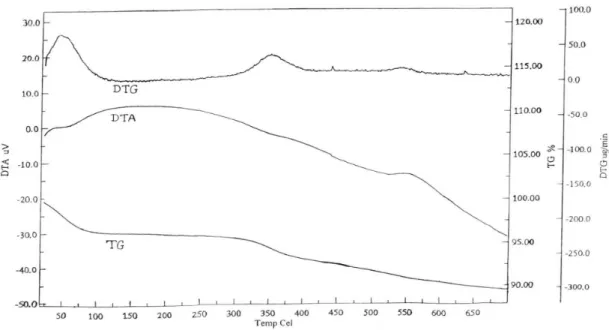
of SO2 moieties. This conirms the presence of sulfonic acid groups onto the surface of silica. The stability of SiO2 -SO3H was determined on the basis of thermogravimetric analysis (TGA). The TGA curve (Figure 1) shows the initial weight loss below 100 °C, which was attributed to residual solvent or water molecules trapped into the silica gel framework. The subsequent weight loss occurs between 300 and 600 °C which was due to the loss of organic functionalities covalently anchored onto the surface of
silica. Thus, the catalyst is stable up to 300 °C and hence it is safe to carry out the reaction at 80 oC. The amount of sulfur
content loaded onto the surface of silica was determined by elemental analysis. Typically, a loading of 0.3 mmol g-1
(SO3H group) onto the surface of silica was obtained. 4,5,8a-Triarylhexahydropyrimido[4,5-d ]pyrimidine-2,7(1H,3H)-diones (4a-k) were synthesized by stirring a mixture of an aromatic aldehyde, urea, an aromatic ketone, and KHSO4 in acetonitrile at 80 oC in the presence
of SiO2-SO3H. To select the optimum conditions for the synthesis of 4, 4-chlorobenzaldehyde, urea, and 4-luoroacetophenone were selected as the test substrates. The reaction with test substrates in the ratio of 2:3:1 in the presence of KHSO4 (1 eq.) was carried out under different set of conditions with respect to different catalysts in varied molar concentrations, temperature, and solvents. Firstly, the reaction with test substrates was carried out in the presence of different catalysts like SiO2-HClO4, SiO2-PPA, SiO2-SO3H and without catalyst. The results are summarized in Table 1. SiO2-SO3H was found to be the best catalyst in terms of reaction time, yield and recyclability. Further, the reaction was carried out with
Scheme 1.
H2N NH2
O
Ar O
HN
N
H NH
NH
Ar
O O
4a-k
, KHSO4
CH3CN , 80 oC
R
CHO
R R
+
1
2
3
SiO2
O O O
Si
SO3-H+
varied concentrations of SiO2-SO3H and it was found that the catalyst equivalent to 4.5 mol% of SO3H was suficient for the reaction to proceed in quantitative yield. Secondly, to select the appropriate solvent, the reaction with test substrates was carried out in ethanol, toluene and acetonitrile. It was found that acetonitrile was the optimum solvent since in the case of ethanol and toluene, the reaction did not go to completion even after 20 h of stirring at 80 oC. The non-occurrence of reaction in ethanol
and toluene may be due to the poor solubility of the products in these solvents. Further, Shi et al.9 have used KHSO
4 as
condensing agent for the synthesis of 4 in acetic acid. In order to ind out the role of KHSO4 in our protocol, the reaction in the case of test substrates was attempted in the absence and presence of KHSO4 and found that lower yield (25%) was obtained without adding KHSO4, whereas in the presence of KHSO4, 4c was obtained in 95% isolated yield in 10 h. Thus, the optimum conditions selected are: aldehyde (2 mmol), urea (3 mmol), ketone (1 mmol),
KHSO4 (1 mmol), SiO2-SO3H (0.3 g, 4.5 mol% SO3H), acetonitrile (8 mL) and 80 oC as the reaction temperature.
To demonstrate the versatility of the developed protocol, aldehydes and ketones substituted with different aryl groups possessing both withdrawing and electron-releasing groups were chosen and excellent results were obtained (Table 2).
When using a solid acid catalyst, the most important point is the deactivation and recyclability of the catalyst. To test this, a series of ive consecutive runs for the synthesis of 4c were carried out with the same catalyst and results are shown in Figure 2. The results demonstrate that SiO2 -SO3H is highly active, stable and recyclable up to 5th use
without loss of signiicant activity.
Experimental
General
Melting points were determined on a Analab melting point apparatus and are uncorrected. Silica gel (K100, 0.063 - 0.200 mm) was purchased from Merck (Germany) and sulfuric acid and hydrogen peroxide as 30% aqueous solution were purchased from Loba Chemicals Pvt. Ltd (India).
1H NMR spectra were obtained on a Bruker DPX 200 NMR
spectrometer (200 MHz) in DMSO-d6 using tetramethylsilane as an internal standard. The IR spectra were recorded using KBr disc on Perkin Elmer FT-IR spectrophotometer and mass spectral data were obtained on ESI-esquires 3000 Bruker Daltonics spectrometer. Thermal analysis was carried out on Perkin Elmer Pyris Diamond Thermal Analyzer with heating rate of 10 °C min-1 and elemental analysis was carried out on Figure 1. TG-DTG-DTA of silica functionalized sulfonic acid (SiO2-SO3H).
Table 1. Effect of different catalysts for the synthesisa of 4c under liquid
phase catalysis
Entry Catalyst Time / h Yieldb / (%)
1 No catalyst 15 Traces
2 Silica-HClO4 12 56
3 Silica-PPA 12 60
4 SiO2-SO3H 10 95
aReaction conditions: 4-chlorobenzaldehyde (2 mmol), urea (3 mmol),
Leco-CHNS-932 elemental analyzer manufactured by Leco Corporation, USA Australia. The reactions were monitored qualitatively by TLC.
Preparation of silica functionalized sulfonic acid (SiO 2 -SO3H)
Silica gel (10 g, K 100, 0.063-0.200 mm) was added to a solution of 1:1 conc. HCl and distilled water (200 mL) in a round-bottom lask (500 mL) and the reaction mixture was stirred at 120 °C for 24 h. The activated silica was iltered off, washed with distilled water until the washings were neutral and dried in a hot air oven at 110 °C for 10 h.
Activated silica (10 g) was added to a solution of 3-mercaptopropyl(trimethoxy)silane (10 mmol, 0.982 g)
in dry toluene (150 mL) and refluxed for 24 h. The 3-mercaptopropyl silica (MPS) was iltered off, washed with hot toluene and dried at 110 °C for 5 h. To a mixture of 3-mercaptopropyl silica (MPS, 5 g) and 30% H2O2 solution (50 mL), conc. H2SO4 (0.078 g, 0.8 mmol) was added and the reaction mixture was stirred at room temperature for 20 h. The solid was iltered off and washed with excess distilled water until the washings were neutral. In order to conirm that all the sulfonic acid groups are protonated, the solid material was further suspended in 0.05 mol L-1 H
2SO4 (30 mL) for 5 h. The solid was then
iltered off and washed with excess distilled water until the washings were neutral. Finally, it was dried at 110 °C for 5 h.
General procedure for the synthesis of 4,5,8a-hexahydro-pyrimido[4,5-d]pyrimidine-2,7(1H,3H)-diones (4a-k)
To a mixture of an aromatic aldehyde 1 (2 mmol), urea 2 (3 mmol), an aromatic ketone 3 (1 mmol), KHSO4 (1 mmol) and SiO2-SO3H (0.3 g, 4.5 mol%) in a round-bottom lask (50 mL), acetonitrile (8 mL) was added. The reaction mixture was stirred at 80 °C in an oil-bath for the appropriate time (Table 2). After completion of the reaction (monitored by TLC), the reaction mixture was iltered off at the reaction temperature and washed with hot acetonitrile (3 × 10 mL). The product was obtained after removal of the solvent under reduced pressure and crystallization from EtOH-DMF. The catalyst was washed with distilled water followed by chloroform (2 × 10 mL) and hot acetonitrile (2 × 10 mL). It was dried at 110 °C for 2 h. It could be used further for carrying out the reaction.
Figure 2. Recyclability of the SiO2-SO3H for the one-pot synthesis of 4c
from 4-chlorobenzaldehyde, urea, 4-luoroacetophenone and KHSO4 by stirring in acetonitrile at 80 oC for 10 h.
Table 2. One-pot synthesisa of 4,5,8a-triarylhexahydropyrimido[4,5-d]pyrimidine-2,7(1H,3H)-diones (4a-k) in the presence of SiO
2-SO3H by stirring in
acetonitrile at 80 oC using KHSO 4
Product R Ar Time / h Yieldb / (%) mp /lit. mp9 / (oC)
4a H 4-FC6H4 12 94 288-289/290-291
4b 4-Cl 2-pyridyl 10 94 >300/>300
4c 4-Cl 4-FC6H4 10 95 236-238/238-240
4d 4-Cl 4-(OCH3)C6H4 10 95 >300/>300
4e 4-Br 2-pyridyl 12 96 >300/>300
4f 4-Br 4-(CH3)C6H4 12 95 >300/>300
4g 4-Br 4-FC6H4 12 96 234-236/235-238
4h 4-Br 4-(OCH3)C6H4 12 96 >300/>300
4i 3-(NO2) 4-(CH3)C6H4 12 94 >300/>300
4j 3-(NO2) 2-pyridyl 12 95 279-281/281-283
4k 4-(OH)-3-(OCH3) 4-FC6H4 12 95 185-190
aReaction conditions: The reactions were carried out by stirring a mixture of aromatic aldehyde (2 mmol), urea (3 mmol), aromatic ketone (1 mmol),
The structures of the products were conirmed by IR,
1H NMR, mass spectral data and comparison with authentic
samples prepared according to the literature methods.
Spectral data of some selected compounds
8 a ( 4 F l u o ro p h e n y l ) 4 , 5 d i p h e n y l h e x a h y d ro -pyrimido[4,5-d]pyrimidine-2,7(1H,3H)-dione (4a)
IR (KBr) ν
max/cm
-1: 3440, 3230, 1684, 1603, 1508,
1224, 1158, 700. 1H NMR (200 MHz, DMSO-d
6): d2.90
(m, 1H, CH), 4.26 (d, 2H, CH), 6.72-6.77 (t, 4H, Harom), 6.94 (bs, 2H, NH), 6.98-7.13 (m, 8H, Harom), 7.18 (bs, 2H, NH), 7.20-7.27 (m, 2H, Harom). MS (ESI): 417 (M++1).
4,5-Bis(4-chlorophenyl)-8a-(4-luorophenyl)hexahydro-pyrimido[4,5-d]pyrimidine-2,7(1H,3H)-dione (4c)
IR (KBr) ν
max/cm
-1: 3413, 3235, 3094, 1685, 1604, 1509,
1337, 1234, 836, 765, 688. 1H NMR (200 MHz, DMSO-d 6): d2.92-2.96 (m, 1H, CH), 4.20 (d, 2H, CH), 6.76 (t, 2H, Harom), 6.88 (bs, 2H, NH), 7.02 (bs, 2H, NH), 7.02-7.25 (m, 10H, Harom). MS (ESI): 485 (M++1).
4 , 5 - B i s ( 3 - n i t ro p h e n y l ) - 8 a - ( 4 - t o l y l ) h ex a h y d ro-pyrimido[4,5-d]pyrimidine-2,7(1H,3H)-dione (4i)
IR (KBr) ν
max/cm
-1: 3407, 3209, 3081, 1675, 1582,
1526, 1509, 1482, 1250, 1098, 694. 1H NMR (200 MHz,
DMSO-d6): d2.27 (s, 3H, CH3), 3.02-3.07 (m, 1H, CH), 4.38 (d, 2H, CH), 6.70-6.81 (m, 2H, Harom and 2H, NH buried), 7.02-7.08 (d, 2H, Harom), 7.12 (bs, 2H, NH), 7.35-7.90 (m, 8H, Harom). MS (ESI): 503 (M++1).
4,5-Bis(4-hydroxy-3-methoxy)-8a-(4-luorophenyl)hexa-hydropyrimido[4,5-d]pyrimidine-2,7(1H,3H)-dione (4k)
IR (KBr) ν
max/cm
-1: 3500, 2920, 2846, 1654, 1508, 1384,
1288, 1031, 819, 630. 1H NMR (200 MHz, DMSO-d 6): d 2.94-2.98 (m, 1H, CH), 3.89 (s, 6H, 2xOCH3), 4.22 (d, 2H, CH), 6.86 (bs, 2H, NH), 7.00 (bs, 2H, NH), 7.04-7.30 (m, 10H, Harom), 8.80 (s, 2H, OH). MS (ESI): 509 (M++1).
Conclusions
I n c o n c l u s i o n , w e h ave d eve l o p e d a m i l d and simple procedure for the one-pot synthesis of 4,5,8a-triarylhexahydropyrimido[4,5-d ]pyrimidine-2,7(1H,3H)-diones (4a-k) by stirring a mixture of aromatic aldehyde, urea and alkyl arylketones at 80 °C using silica functionalized sulfonic acid (SiO2-SO3H) under liquid phase catalysis. The methodology offers several advantages such as: i) high yield of products with high purity; ii)
work-up procedure is simple; iii) catalyst can be recovered by simple iltration and reused for ive consecutive runs
without loss of signiicant activity; iv) tolerates variety of functional groups such as methoxy, nitro, hydroxyl and halides; and v) no use of toxic and hazardous reagents.
Acknowledgements
We thank the Head, Institute Instrumentation Centre, Indian Institute of Technology (IIT) Roorkee for TGA; and Director, IIIM for library and spectral studies.
References
1. Lunt, E. InComprehensive Organic Chemistry; Barton, D.; Ollis, W. D., eds.; Pergamon: Oxford, 1974, vol. 4, p. 493; Brown, J. D. In Comprehensive Heterocyclic Chemistry; Katritzky, A. R.; Rees, C. W., eds.; Pergamon: Oxford, 1984, vol. 3, p. 57; Clercq, E. D.; Beraaerts, R.; J. Biol. Chem., 1987, 262, 14905.
2. Coates, W. J.; EP 351,058, 1990. (CA 113: P40711). 3. Kitamura, N.; Onishi, A.; EP 163, 599, 1984. (CA 104:
P186439).
4. Raddatz, P.; Bergmann, R.; Ger. Pat. 3601731, 1988. (CA 109: P54786).
5. Delia, T. J.; Baumann, M.; Bunker, A.; Heterocycles 1993, 35, 1397.
6. Hirota, K.; Kitade, Y.; Senda S.; Halat M. J.; Watanabe, K. A.; Fox, J. J.; J. Org. Chem.1981, 46, 846; Su, T. L.; Huang J. T.; Burchanal, J. H.; Watanabe, K. A.; Fox, J. J.; J. Med. Chem.
1986, 29, 709; Prajapati, D.; Sandhu , J. S.; Synthesis1988, 342.
7. Biginelli, P.; Gazz. Chim. Ital.1893, 23, 360.
8. Sedova, V. F.; Mamaev, V. P.; Khim. Geterotsikl. Soed.1970, 5, 691; Sedova, V. F.; Baranova, L. V.; Mamaev, V. P.; Izv. Sib. Otd. Akad. Nauk SSSR, Ser. Khim, Nauk1972, 6, 96; Sedova, V. F.; Shkurko, O. P.; Chem. Heterocycl. Compd. (Engl. Transl.)
2004, 40, 194.
9. Shi, F.; Jia, R.; Zhang, X.; Tu, S.; Yan, S.; Zhang, Y.; Jiang, B.; Zhang, J.; Yao, C.; Synthesis2007, 2782.
10. Wilson, K.; Clark, J. H.; Chem. Commun.1998, 2135; Salehi, P. ; Dabiri, M. ; Zoligol, M. A. ; Fard, M. A. B.; J. Braz. Chem. Soc. 2004, 15, 773 ; Budarin,V. L.; Clark, J. H.; Luque, R.; Macquarrie, D. J.; Chem. Commun.2007, 634; Sharma, S. D.; Gogoi, P.; Konwar, D.; Green Chem.2007, 9, 253; Wang, Q.–Y.; Sheng, S.–R.; Wei, M.–H.; Xie, Z.–L.; Liu, X.–L.; Synth. Commun.2007, 37, 1019; Selvakumar, S.; Chidambaram, M.; Singh, A. P.; Catal. Commun.2007, 8, 777; Bigdeli, M. A.; Heravi, M. M.; Mahdavinia, G. H.; J. Mol. Catal. A: Chem.
A: Chem.2008, 279, 63; Shinde, S. V.; Jadhav, W. N.; Lande, M. K.; Gadekar, L. S.; Arbad, B. R.; Kondre, J. M.; Karade, N. N.; Catal. Lett.2008, 125, 57; Dos Santos, A. A.; Brito Jr., G. A.; Archilha, M. V. L.; Bele, T. G. A.; Dos Santos, G. P.; De Mello, M. B. M.; J. Braz. Chem. Soc. 2009, 20, 42; Da Silva, C. R. B; Gonçalves, V. L. C.; Lachter, E. R.; Mota, C. J. A.; J. Braz. Chem. Soc. 2009, 20, 201.
11. Karimi, B.; Khalkhali, M.; J.Mol. Catal. A: Chem.2007, 271, 75; Shylesh, S.; Samuel, P. P.; Srilakshmi, C.; Parischa, R.; Singh, A. P.; J. Mol. Catal. A: Chem.2007, 274, 153; Gupta, R.; Paul, S.; Gupta, R.; J. Mol. Catal. A: Chem.2007, 266, 50; Reddy, S. S.; Raju, B. D.; Kumar, V. S.; Padmasri, A. H.; Narayanan, S.; Rao, K. S. R.; Catal. Commun.2007, 8, 261;
Karam, A.; Gu, Y.; Jérôme, F.; Douliez, J.–P.; Barrault, J.; Chem. Commun.2007, 2222; Das, B.; Suneel, K.; Venkateswarlu, K.; Ravikanth, B.; Chem. Pharm. Bull. 2008, 56, 366; Castanheiro, J. E.; Guerreiro, L.; Fonseca, I. M.; Ramos, A. M.; Vital, J.; Stud. Surf. Sci. and Catal.2008, 174, 1319; Nakajima, K.; Okamura, M.; Kondo, J. N.; Domen, K.; Tatsumi, T.; Hayashi, S.; Hara, M.; Chem. Mater.2009, 21, 186.
12. Das, B.; Venkateswarlu, K.; Holla, H.; Krishnaiah, M.; J. Mol. Catal. A: Chem.2006, 253, 107.
Received: May 1, 2009
![Table 2. One-pot synthesis a of 4,5,8a-triarylhexahydropyrimido[4,5-d]pyrimidine-2,7(1H,3H)-diones (4a-k) in the presence of SiO 2 -SO 3 H by stirring in acetonitrile at 80 o C using KHSO 4](https://thumb-eu.123doks.com/thumbv2/123dok_br/18994863.461878/4.892.78.404.460.723/table-synthesis-triarylhexahydropyrimido-pyrimidine-diones-presence-stirring-acetonitrile.webp)
