A Meta-Analysis of Typhoid Diagnostic
Accuracy Studies: A Recommendation to
Adopt a Standardized Composite Reference
Helen L. Storey
1*
, Ying Huang
2, Chris Crudder
1, Allison Golden
1, Tala de los Santos
1,
Kenneth Hawkins
11Diagnostics Program, PATH, Seattle, Washington, United States of America,2Fred Hutchinson Cancer Research Center, Seattle, Washington, United States of America
Abstract
Novel typhoid diagnostics currently under development have the potential to improve
clini-cal care, surveillance, and the disease burden estimates that support vaccine introduction.
Blood culture is most often used as the reference method to evaluate the accuracy of new
typhoid tests; however, it is recognized to be an imperfect gold standard. If no single gold
standard test exists, use of a composite reference standard (CRS) can improve estimation
of diagnostic accuracy. Numerous studies have used a CRS to evaluate new typhoid
diag-nostics; however, there is no consensus on an appropriate CRS. In order to evaluate
exist-ing tests for use as a reference test or inclusion in a CRS, we performed a systematic
review of the typhoid literature to include all index/reference test combinations observed.
We described the landscape of comparisons performed, showed results of a meta-analysis
on the accuracy of the more common combinations, and evaluated sources of variability
based on study quality. This wide-ranging meta-analysis suggests that no single test has
sufficiently good performance but some existing diagnostics may be useful as part of a
CRS. Additionally, based on findings from the meta-analysis and a constructed numerical
example demonstrating the use of CRS, we proposed necessary criteria and potential
com-ponents of a typhoid CRS to guide future recommendations. Agreement and adoption by all
investigators of a standardized CRS is requisite, and would improve comparison of new
diagnostics across independent studies, leading to the identification of a better reference
test and improved confidence in prevalence estimates.
Introduction
Typhoid fever causes considerable disease burden, with recent estimates at 21.6 million
ill-nesses in 2000 and 26.9 million in 2010 [
1
,
2
]. These estimates are extrapolated from limited
population-based studies and further compromised by the poor accuracy of current typhoid
diagnostics. The most accepted method used for typhoid detection is blood culture [
3
]. It is
desirable to diagnose typhoid fever because of its perfect specificity, but with sensitivity around
a11111
OPEN ACCESS
Citation:Storey HL, Huang Y, Crudder C, Golden A, de los Santos T, Hawkins K (2015) A Meta-Analysis of Typhoid Diagnostic Accuracy Studies: A Recommendation to Adopt a Standardized Composite Reference. PLoS ONE 10(11): e0142364. doi:10.1371/journal.pone.0142364
Editor:Henk D. F. H. Schallig, Royal Tropical Institute, NETHERLANDS
Received:May 29, 2015
Accepted:October 21, 2015
Published:November 13, 2015
Copyright:© 2015 Storey et al. This is an open access article distributed under the terms of the
Creative Commons Attribution License, which permits unrestricted use, distribution, and reproduction in any medium, provided the original author and source are credited.
Data Availability Statement:All relevant data are within the paper and its Supporting Information files.
Funding:This research was made possible by a grant from the Bill and Melinda Gates Foundation (grant #OPP1063918,www.gatesfoundation.org). The funders had no role in the study design, data collection and analysis, decision to publish, or preparation of the manuscript.
50% in most clinical settings, there is much room for improvement [
4
,
5
]. New diagnostic tests
for typhoid fever are in development which may relieve this shortfall; however, a problem
remains in regard to determining the best reference test with which to evaluate new diagnostics
[
6
,
7
]. Using a reference test with imperfect diagnostic accuracy may cause newer technologies
to appear better or worse than they really are, which in turn clouds the evaluation of their
util-ity as a tool to improve disease burden estimates [
8
]. Additionally, to compare across index
tests with statistical rigor, a common reference test should be used.
Lack of a perfect gold standard in diagnostic research is not an uncommon situation, and
yet there is no universally accepted solution to the problem [
9
]. One method to improve
diag-nostic accuracy when no perfect reference test exists is to develop a composite reference
stan-dard (CRS) [
10
]. A CRS combines more than one imperfect diagnostic test with the goal of
increasing diagnostic accuracy (compared to truth: the true presence of infection). If the
indi-vidual tests in the CRS are highly specific, combining them by declaring CRS positive if either
test is positive should give greater sensitivity than either test alone [
10
]. This would also enable
combining multiple types of testing, such as direct detection of the bacteria with culture and
immune detection with an antibody-based assay. Compared to other methods such as
discrep-ant resolution and latent class analysis, an ideal consensus CRS has the advdiscrep-antage that it is
more clearly defined, independent of the results of the index test, and more straightforward to
interpret [
10
]. Particularly in the context of typhoid diagnostic field evaluations, the consensus
CRS approach to addressing imperfect reference tests may be the most feasible and meaningful
for the researchers performing the studies.
In order to evaluate tests for use as a reference test or inclusion in a CRS, we conducted a
systematic review of the typhoid literature. We described the types of reference tests that are
being used to evaluate new typhoid diagnostics, and summarized by meta-analysis the
diagnos-tic accuracy of available index tests when compared to the most common reference test (blood
culture), including the evaluation of variability due to study quality. We then discussed how a
standardized CRS, rather than a single reference test, may improve the evaluation of new
typhoid diagnostics using a constructed numerical example. Finally, based on the results of our
systematic review, meta-analysis, and the constructed numerical example, we proposed
recom-mended criteria and potential components of a CRS for consensus-building and discussion.
Agreement and adoption of a standardized composite reference method would enable
compar-ison of diagnostic performance data across independent studies, leading to improved
confi-dence in prevalence estimates.
Methods
Search strategy and inclusion criteria
table (18). A diagnosis based on clinical indicators was considered a diagnostic test if classified
as positive or negative. Additional papers were identified from references or collaborators (2).
The search strategy was updated September 2013 and nine additional abstracts were identified,
of which one paper was added to the study. In total, 413 index/reference comparisons from 139
papers were included in the meta-analysis (
Fig 1
) [
12
–
181
].
Evaluation of studies
Data were extracted from the selected studies with consensus from two investigators and
using Microsoft Excel and Access. Many of the included papers reported results for more
than one comparison of index and reference tests (
S3 Table
). Each comparison was classified
by the method of detection of the index and reference tests, and broadly grouped in the
fol-lowing six categories: clinical indicators, antibody, antigen, nucleic acid, viable bacteria, or
composite. Each index and reference test was specified in as much detail as was given,
including specimen type, sample size, and commercial availability (manufacturer and test kit
specified). Also recorded were the number of samples analyzed, and the number of true
positives, false positives, true negatives, and false negatives for each comparison. If the
abso-lute value for each cell of the 2x2 contingency table was not reported in the paper, it was
cal-culated from reported sensitivities and specificities where possible. Some cohort studies
included additional healthy controls as part of their analysis, and that data was excluded
from this analysis. If a case-control study analyzed data separately for different control
groups, all control groups were combined in this analysis. Where possible, the same antibody
test separately evaluating more than one Ig isotype were combined. The data was included
separately when not possible to combine.
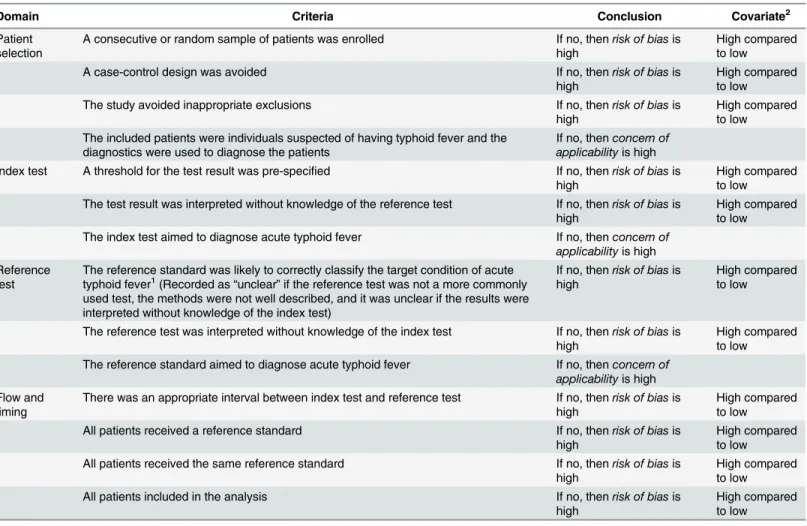
Each study was evaluated using the QUADAS-2 tool, which assesses the quality of
diagnos-tic accuracy studies [
182
]. The QUADAS-2 tool includes four domains: patient selection, index
test, reference standard, and flow and timing. All domains are evaluated for risk of bias, and
the first three domains are also evaluated for concerns regarding applicability (
Table 1
).
Mea-sures of bias or applicability were assessed as potential covariates to adjust for in the
meta-regression analysis.
Table 1. Quality assessment of diagnostic accuracy studies.
Domain Criteria Conclusion Covariate2
Patient selection
A consecutive or random sample of patients was enrolled If no, thenrisk of biasis high
High compared to low
A case-control design was avoided If no, thenrisk of biasis
high
High compared to low
The study avoided inappropriate exclusions If no, thenrisk of biasis
high
High compared to low The included patients were individuals suspected of having typhoid fever and the
diagnostics were used to diagnose the patients
If no, thenconcern of applicabilityis high Index test A threshold for the test result was pre-specified If no, thenrisk of biasis
high
High compared to low The test result was interpreted without knowledge of the reference test If no, thenrisk of biasis
high
High compared to low The index test aimed to diagnose acute typhoid fever If no, thenconcern of
applicabilityis high Reference
test
The reference standard was likely to correctly classify the target condition of acute typhoid fever1(Recorded as
“unclear”if the reference test was not a more commonly used test, the methods were not well described, and it was unclear if the results were interpreted without knowledge of the index test)
If no, thenrisk of biasis high
High compared to low
The reference test was interpreted without knowledge of the index test If no, thenrisk of biasis high
High compared to low The reference standard aimed to diagnose acute typhoid fever If no, thenconcern of
applicabilityis high Flow and
timing
There was an appropriate interval between index test and reference test If no, thenrisk of biasis high
High compared to low
All patients received a reference standard If no, thenrisk of biasis
high
High compared to low All patients received the same reference standard If no, thenrisk of biasis
high
High compared to low
All patients included in the analysis If no, thenrisk of biasis
high
High compared to low
Summary of variables included in the QUADAS-2 tool assessing the quality of diagnostic accuracy studies. The criteria determined a study’s risk of bias or concern of applicability. When the domain-specific criteria were not met, the study had a high risk of bias or concern of applicability with respect to that domain. When the domain-specific criteria were all unclear, the risk of bias or concern of applicability was unclear.
1The currently available tests to detect typhoid fever are not suf
ficiently accurate; therefore, this question was problematic. 2
“Unclear”= missing.
Analysis and statistical methods
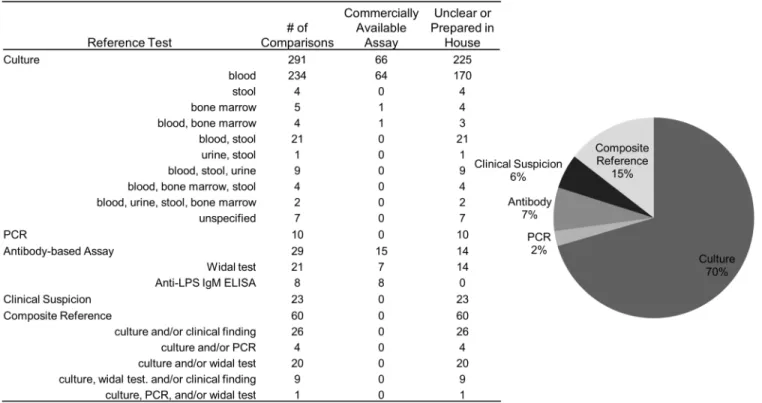
All index/reference combinations were first summarized by type of reference standard used
(
Fig 2
). Index tests were then categorized into five broad groups, based on the detection of
nucleic acid, antigen, antibody, viable bacteria, or clinical features (including composite tests).
Diagnostic accuracies of individual index tests were analyzed using meta-analysis when
partic-ular index/reference combinations were present in more than five comparisons, to increase the
relevance of the conclusions. The majority of meta-analyses were based on combinations using
blood culture as the reference test. Statistical analyses were performed using STATA
111.2
(StataCorp, TX, USA) and R version 3.1.3 (
https://www.r-project.org/
). Summary results were
calculated in the meta-analysis using bivariate random effects binomial regression (STATA
command:
metandi
), and listed in the text as follows: summary sensitivity (Sens) (95%
Confi-dence Interval, CI), summary specificity (Spec) (95% CI), and summary diagnostic odds ratio
(DOR) (95% CI) [
183
,
184
]. Sources of heterogeneity in the summary estimates were
investi-gated in the meta-regression analysis, also using bivariate random effects binomial regression
(STATA command:
midas
) [
185
]. Potential covariates were transformed into dichotomous
variables and evaluated as appropriate for each index test (
Table 1
) [
182
]. The hierarchical
summary receiver operating characteristic curves were also generated [
186
].
Constructed numerical example
To illustrate how the observed sensitivity and specificity of an index test may vary compared to
individual reference tests or a CRS, a constructed numerical example was generated with
assumptions on disease prevalence and the joint distribution of index and reference tests
con-ditional on disease status. The assessed CRS was fever positive
and
either test A positive
or
test
Fig 2. Comparisons by reference test.Summary of the 139 papers by reference test, including 413 index/reference comparisons. Of the culture reference tests, 80% were blood culture, making up 57% of all reference tests.
B positive, i.e. CRS = ((fever) AND (test A positive) OR (test B positive)). Because test accuracy
compared to truth (true presence of infection) is not measurable, and no current reference test
is an adequate proxy for truth, assumptions were made regarding the prevalence of disease, as
well as true test characteristics of the index test, test A, and test B.
Prevalence of typhoid fever was assumed to be 20%, though many factors vary prevalence
esti-mates, such as participant ages, region, and surveillance method. Studies conducting active
com-munity-based surveillance have determined the prevalence of typhoid fever among blood
cultures taken to be 2.3%, 2.8%, and 5.0% in five Asian countries, Kenya, and Bangladesh,
respec-tively [
187
–
189
]. However, other non-surveillance hospital-based studies have observed the
pro-portion of suspected typhoid patients with positive blood cultures to be 72.8% and 30.4% in
Vietnam and sub-Saharan Africa, respectively [
86
,
190
]. A prevalence of 20% was selected for
illustration purposes. Fever, defined by the World Health Organization (WHO) as
37.5°C for
3 days, compared to truth was 80% sensitive and 20% specific. Most typhoid fever patients
have fever at clinical presentation, but there are many other causes of fever [
191
]. Additionally,
in a recent study, the WHO case definition for suspected typhoid fever demonstrated sensitivity
and specificity of 82.6% and 36.3%, respectively [
3
,
169
]. Fever is assumed to be independent of
all diagnostic tests, conditional on disease. Test A was considered to be blood culture because of
its wide appeal, and the sensitivity and specificity of blood culture compared to truth was 50%
and 100%, respectively [
4
,
5
]. Test B was a hypothetical second test, which was assumed to be
85% sensitive and specific. Test A and test B were independent, conditional on disease. The
index test compared to truth was assumed to be 80% sensitive and 90% specific, as the accuracy
of a new diagnostic test would probably need to reach these standards [
192
].
The CRS based on individual tests described above had 74% sensitivity and 88% specificity
compared to truth (
S1 Text
). Two situations were evaluated: (1) independence between index
test, test A, and test B, conditional on disease; and (2) dependence between either index test
and test A, or index test and test B, conditional on disease. We constructed these situations to
demonstrate how a range of conditional dependence may vary the results; however, it is
unlikely that technologically the index test would be unrelated to either test A or test B due to
related biomarkers or methods for detecting biomarkers. Though the degree of correlation is
largely unknown, the minimum and maximum values it can achieve can be determined by the
accuracy of the individual tests [
193
]. Assuming various conditional dependence structures
between tests, the following sensitivities and specificities were calculated based on Bayes
’
theo-rem: (1) index test compared to test A; (2) index test compared to test B; and (3) index test
compared to CRS (
S1 Text
). Example R code for computing these values is included in
S1 Text
as well.
Results
Systematic review
comparisons used reference tests that were developed in house or did not specify how the assay
was acquired. Four comparisons were dropped from the meta-analysis because no positives
were detected by the reference test (true positives + false negatives = 0). Of the remaining
com-parisons, 286 had a high risk of bias and 22 had a high concern of applicability in any domain.
Other participant characteristics that were initially examined as sources of heterogeneity were
later not used in the analysis due to a large proportion of comparisons missing data (176
miss-ing age, 189 missmiss-ing fever duration, and 294 missmiss-ing prior antibiotic use).
There were 60 comparisons from 20 studies that evaluated an index test for typhoid
detec-tion compared to a CRS. The CRS included the following: culture, PCR, and Widal assay (1);
culture and PCR (1); culture and Widal assay (10); and culture and clinical features (9). Exact
criteria for a positive reference test result varied from study to study, such as Widal assay titer
cutoff, culture specimen and methods, PCR technique, and specifics of clinical features (
Fig 2
).
Reference tests may be combined in a CRS definition by either an
“
and
”
or
“
or
”
statement.
Most of the comparisons evaluated used an
“
or
”
statement to combine reference tests (both
test A and test B are measured, and a positive test result by either A
or
B classifies the person as
CRS positive).
Meta-analysis
Index tests detecting viable bacteria.
From the systematic review, 18 comparisons
detected viable bacteria by culture as the index test. This group of assays had considerable
vari-ability in methods of culturing, with few studies using automated culture systems (2). The year
of publication ranged from 1979 to 2013. The specimens cultured included variable quantities
of blood (13), blood clot (1), bone marrow (1), urine (2), and stool (1). Reference tests included
cultures using a different specimen (7), such as blood culture compared to bone marrow
cul-ture, as well as PCR assays (2), clinical features (6), and composite references combining more
than one reference test (3). The only index and reference test combination with at least five
comparisons was blood culture compared to bone marrow culture, which gave the following
summary results: Sens = 68% (52
–
81%), Spec = 75% (35
–
94%), and DOR = 6 (2
–
27).
Index tests detecting
S
.
typhi
antigen.
The 66 assays that detected antigen included an
assortment of analyte specificity, specimen type, and reference test. The year of publication
ranged from 1980 to 2013. The specimens assayed included serum (34), blood culture
superna-tant or broth (22), and urine (10). The techniques used for antigen detection varied and all but
two were in-house preparations. Reference tests included various types of culture (43),
anti-body-based assays (8), PCR (1), and composite references (14). Of the 66 comparisons, there
were no combinations of index and reference tests with five or more comparisons.
Index tests using clinical features or more than one assay.
There were three comparisons
with index tests that included clinical features and an antibody-based assay, one comparison
with only clinical features, one comparison with more than one antibody-based assay, and
three comparisons that combined blood culture and an antibody-based assay. These eight
com-parisons varied in index test attributes as well as reference test attributes. All reference tests
included blood culture and some included other reference attributes, such as clinical features
(4) and culture of other specimens (1). No combinations of index and reference tests had five
or more comparisons.
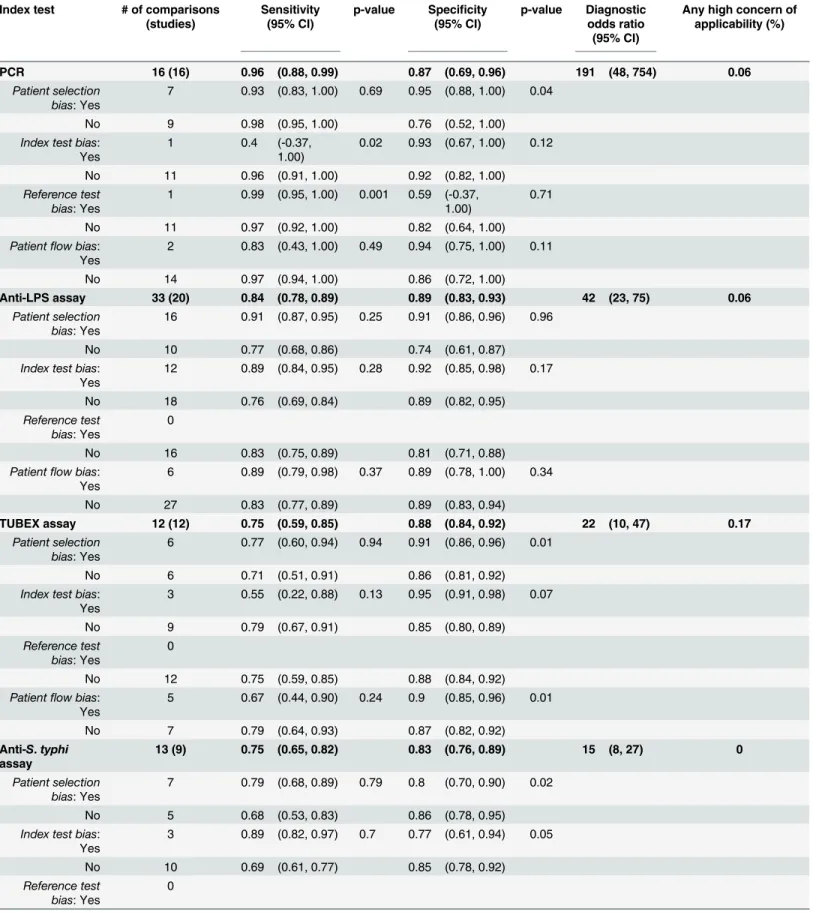
assay (1), clinical features (5), or a composite reference (1). Among the 16 comparisons that
evaluated a PCR-based index test to blood culture, the summary results were: Sens = 96% (88
–
99%), Spec = 87% (69
–
96%), and DOR = 191 (48
–
754). (
Table 2
)
Index tests detecting antibodies.
Antibody-based index tests were the most abundant,
with 293 comparisons, of which 133 were Widal assays. The non-Widal assays ranged in
publi-cation year from 1979 to 2013. Analyte specificity varied and included the following
antigen-specific antibody responses: flagellin (2), lipopolysaccharide (LPS, 43), LPS and flagellin (1),
membrane preparation (3), outer membrane protein (OMP, 50), porins (1), whole
S
.
typhi
(20), unspecified Salmonella (2), O-9 analyte (17), Vi antigen (7), O and/or H antigen (10), O,
H, and Vi antigen (1), and an unspecified analyte (3). Of the assays using the OMP analyte, 41
were the commercially available kit Typhidot (Reszon Diagnostics International, Malaysia).
Additionally, all of the 17 assays using the O-9 analyte were the commercially available kit
TUBEX
1TF
(IDL, Sweden). Specimens used were most often serum, with two assays using
lymphocyte culture supernatant, two using blood, one using plasma, and two using saliva.
Immunoglobulin (Ig) isotypes evaluated included IgA (7), IgM (53), IgG (28), IgM and IgG
together (30), and IgM, IgG, and IgA together (3); 39 studies did not specify the Ig isotype
eval-uated. Reference tests included PCR (3), Widal assays (10), culture (122), clinical features (1),
and composite references (24).
Investigating only comparisons that used blood culture as a reference test, four index
ana-lytes were evaluated with five or more comparisons: anti-LPS, anti-
S
.
typhi
, TUBEX, and
Typhidot. Anti-LPS assays compared to blood culture (n = 33) had the following summary
results: Sens = 84% (78
–
89%), Spec = 89% (83
–
93%), DOR = 42 (23
–
75) (
Table 2
). TUBEX
assays compared to blood culture (n = 12) had the following summary results: Sens = 75% (59
–
85%), Spec = 88% (84
–
92%), DOR = 22 (10
–
47) (
Table 2
). Anti-
S
.
typhi
assays compared to
blood culture (n = 13) had the following summary results: Sens = 75% (65
–
82%), Spec = 83%
(76
–
89%), DOR = 15 (8
–
27) (
Table 2
). Typhidot assays compared to blood culture (n = 20)
had the following summary results: Sens = 84% (73
–
92%), Spec = 80% (67
–
89%), DOR = 22
(9
–
57). (
Table 2
)
The Widal assays ranged in publication year from 1977 to 2013. Among these assays, the
analytes assessed included O antigen alone (58), H antigen alone (31), O and H antigens
together (32), and unspecified antigen (12). Titer cutoffs of the Widal assays also varied by
study, ranging from 1:20 to 1:640, with many unspecified (25). Reference tests included PCR
(3), antibody-based assays (11), clinical features (11), culture (94), and composite references
(14). Restricting analysis to comparisons with blood culture as the reference test, the Widal
assay summary results were (n = 65): Sens = 69% (61
–
75%), Spec = 83% (77
–
88%), DOR = 11
(7
–
17). (
Table 2
)
Table 2. Meta-analysis results by study quality.
Index test # of comparisons
(studies)
Sensitivity (95% CI)
p-value Specificity (95% CI)
p-value Diagnostic
odds ratio (95% CI)
Any high concern of applicability (%)
PCR 16 (16) 0.96 (0.88, 0.99) 0.87 (0.69, 0.96) 191 (48, 754) 0.06
Patient selection bias: Yes
7 0.93 (0.83, 1.00) 0.69 0.95 (0.88, 1.00) 0.04
No 9 0.98 (0.95, 1.00) 0.76 (0.52, 1.00)
Index test bias: Yes
1 0.4 (-0.37,
1.00)
0.02 0.93 (0.67, 1.00) 0.12
No 11 0.96 (0.91, 1.00) 0.92 (0.82, 1.00)
Reference test bias: Yes
1 0.99 (0.95, 1.00) 0.001 0.59 (-0.37, 1.00)
0.71
No 11 0.97 (0.92, 1.00) 0.82 (0.64, 1.00)
Patientflow bias: Yes
2 0.83 (0.43, 1.00) 0.49 0.94 (0.75, 1.00) 0.11
No 14 0.97 (0.94, 1.00) 0.86 (0.72, 1.00)
Anti-LPS assay 33 (20) 0.84 (0.78, 0.89) 0.89 (0.83, 0.93) 42 (23, 75) 0.06
Patient selection bias: Yes
16 0.91 (0.87, 0.95) 0.25 0.91 (0.86, 0.96) 0.96
No 10 0.77 (0.68, 0.86) 0.74 (0.61, 0.87)
Index test bias: Yes
12 0.89 (0.84, 0.95) 0.28 0.92 (0.85, 0.98) 0.17
No 18 0.76 (0.69, 0.84) 0.89 (0.82, 0.95)
Reference test bias: Yes
0
No 16 0.83 (0.75, 0.89) 0.81 (0.71, 0.88)
Patientflow bias: Yes
6 0.89 (0.79, 0.98) 0.37 0.89 (0.78, 1.00) 0.34
No 27 0.83 (0.77, 0.89) 0.89 (0.83, 0.94)
TUBEX assay 12 (12) 0.75 (0.59, 0.85) 0.88 (0.84, 0.92) 22 (10, 47) 0.17
Patient selection bias: Yes
6 0.77 (0.60, 0.94) 0.94 0.91 (0.86, 0.96) 0.01
No 6 0.71 (0.51, 0.91) 0.86 (0.81, 0.92)
Index test bias: Yes
3 0.55 (0.22, 0.88) 0.13 0.95 (0.91, 0.98) 0.07
No 9 0.79 (0.67, 0.91) 0.85 (0.80, 0.89)
Reference test bias: Yes
0
No 12 0.75 (0.59, 0.85) 0.88 (0.84, 0.92)
Patientflow bias: Yes
5 0.67 (0.44, 0.90) 0.24 0.9 (0.85, 0.96) 0.01
No 7 0.79 (0.64, 0.93) 0.87 (0.82, 0.92)
Anti-S.typhi
assay
13 (9) 0.75 (0.65, 0.82) 0.83 (0.76, 0.89) 15 (8, 27) 0
Patient selection bias: Yes
7 0.79 (0.68, 0.89) 0.79 0.8 (0.70, 0.90) 0.02
No 5 0.68 (0.53, 0.83) 0.86 (0.78, 0.95)
Index test bias: Yes
3 0.89 (0.82, 0.97) 0.7 0.77 (0.61, 0.94) 0.05
No 10 0.69 (0.61, 0.77) 0.85 (0.78, 0.92)
Reference test bias: Yes
0
Constructed numerical example
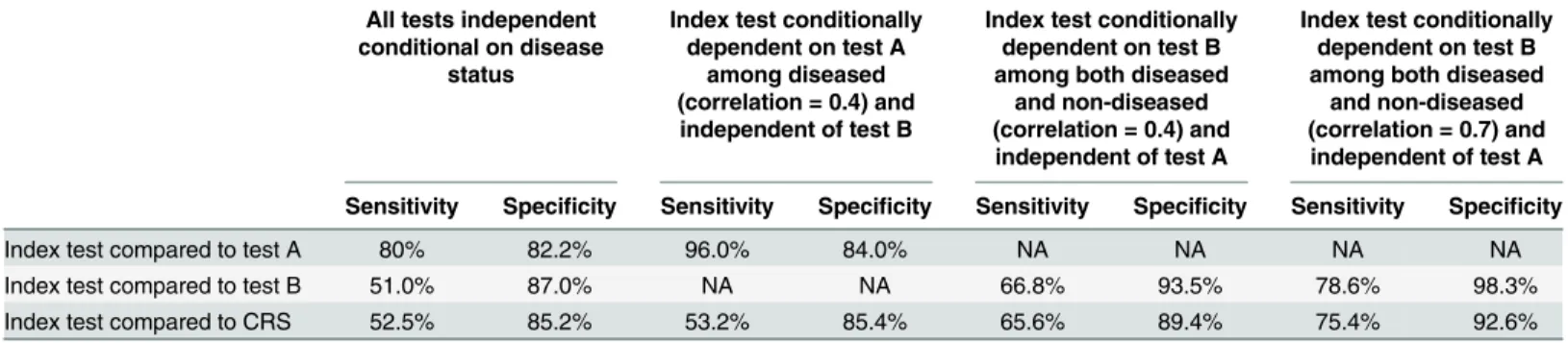
At a prevalence of 20% with a 50% sensitive and 100% specific test A, when the index test and
test A are conditionally independent, the index test compared to test A provides an unbiased
estimate of the true sensitivity of the index test, but underestimates specificity. When the index
test is conditionally dependent on test A among subjects declared as
“
diseased
”
with a
correla-tion of 0.4, the index test compared to test A appears to overestimate sensitivity considerably.
Specificity is still underestimated, but to a lesser extent compared to the conditionally
indepen-dent scenario. (
Table 3
)
For test B with 85% sensitivity and 85% specificity, when the index test and test B are
condi-tionally independent, the index test compared to test B underestimates sensitivity considerably.
Specificity is only slightly underestimated. Note that the underestimation of sensitivity using
Table 2. (Continued)
Index test # of comparisons
(studies)
Sensitivity (95% CI)
p-value Specificity (95% CI)
p-value Diagnostic
odds ratio (95% CI)
Any high concern of applicability (%)
No 6 0.67 (0.62, 0.71) 0.87 (0.79, 0.92)
Patientflow bias: Yes
3 0.89 (0.82, 0.97) 0.7 0.77 (0.61, 0.94) 0.05
No 10 0.69 (0.61, 0.77) 0.85 (0.78, 0.92)
Typhidot assay 20 (17) 0.84 (0.73, 0.92) 0.8 (0.67, 0.89) 22 (9, 57) 0.05
Patient selection bias: Yes
9 0.84 (0.68, 0.99) 0.57 0.87 (0.75, 0.98) 0.96
No 9 0.85 (0.71, 0.99) 0.79 (0.63, 0.95)
Index test bias: Yes
2 0.5 (-0.02,
1.00)
0.14 0.79 (0.47, 1.00) 1
No 13 0.84 (0.72, 0.95) 0.8 (0.68, 0.92)
Reference test bias: Yes
0
No 14 0.78 (0.62, 0.89) 0.85 (0.71, 0.93)
Patientflow bias: Yes
5 0.63 (0.34, 0.91) 0.02 0.88 (0.74, 1.00) 0.58
No 15 0.89 (0.81, 0.96) 0.77 (0.63, 0.91)
Widal assay (any antigen)
65 (51) 0.69 (0.61, 0.75) 0.83 (0.77, 0.88) 11 (7, 17) 0.05
Patient selection
bias:1Yes 29
No 31
Index test bias: Yes
19 0.68 (0.57, 0.79) 0.24 0.88 (0.81, 0.95) 0.21
No 34 0.65 (0.57, 0.74) 0.79 (0.71, 0.87)
Reference test bias: Yes
0
No 42 0.66 (0.57, 0.73) 0.84 (0.76, 0.90)
Patientflow bias: Yes
13 0.73 (0.59, 0.87) 0.41 0.8 (0.67, 0.93) 0.04
No 52 0.68 (0.60, 0.75) 0.84 (0.78, 0.90)
Summary diagnostic accuracies of index tests withfive or more comparisons and blood culture as the reference test. Meta-analysis performed using bivariate random effects binomial regression.
1Could not be determined.
test B as the reference results partially from the imperfect specificity of test B and the good
sen-sitivity of the index test. A portion of subjects declared as diseased by test B are actually
non-diseased and will tend to be declared as
“
non-diseased
”
by the index test, making the index test
appear less sensitive than it actually is. Increasing the correlation between the index test and
test B to 0.4 among diseased and non-diseased, the underestimation in sensitivity is decreased
while specificity is slightly overestimated. When the correlation is increased to 0.7, the
sensitiv-ity estimate of the index test using test B as the reference is closer to the true sensitivsensitiv-ity of the
index test, with overestimation in specificity further increased.
When all tests are conditionally independent, results comparing the index test to the CRS
appear similar to those comparing the index test to test B, with a slightly larger sensitivity
esti-mate and smaller specificity estiesti-mate. When the index test is conditionally dependent on test A
among diseased with a correlation of 0.4 and conditionally independent of test B, a slight
increase in sensitivity and decrease in specificity are observed. If the index test is instead
condi-tionally dependent on test B with a correlation of 0.4 among diseased and non-diseased and
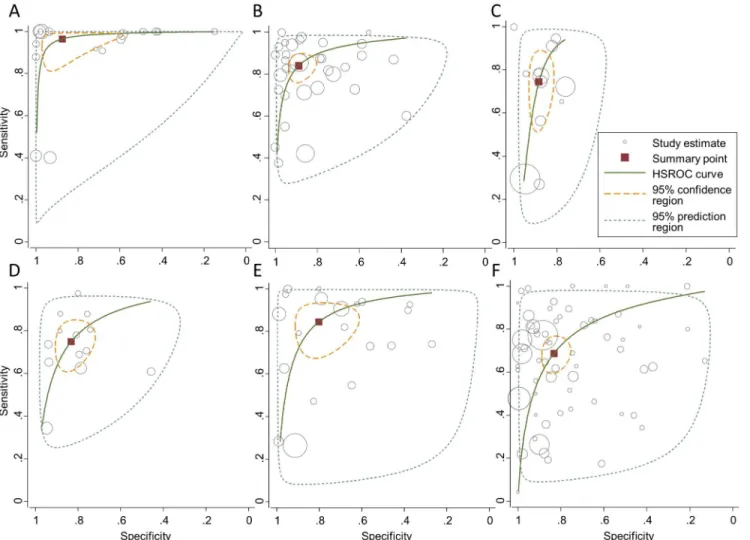
Fig 3. Meta-analysis results.Graphical illustration of sensitivities (y-axis) and specificities (x-axis) corresponding to comparisons included in the meta-analysis: PCR-based assays (A), anti-LPS assays (B), TUBEX1assays (C), anti-S.typhiassays (D), Typhidot assays (E), Widal assays (F). Meta-analysis
was performed using bivariate random effects binomial regression (STATA command:metandi). Sizes of individual study estimates (grey circle) represent sample size. Summary point (red square), hierarchical summary receiver operating characteristic curves (green line), 95% confidence regions (yellow dashed line), and 95% prediction regions (grey dashed line) are depicted.
conditionally independent of test A, the index test compared to the CRS has an observed
sensi-tivity closer to that using test B as the reference, with the observed specificity approximating
true specificity. When the correlation is increased to 0.7, the index test compared to the CRS
will slightly underestimate sensitivity and approximate the true specificity. This observed
sensi-tivity and specificity are closest to truth among all comparisons, in the sense that the absolute
bias is less than 5% for both sensitivity and specificity.
In
S4 Table
, we also explored results varying disease prevalence from 5% to 70%. Disease
prevalence alters the interpretation of the observed performance of the index test relative to the
reference test. There are some general patterns in the data: the specificity of the index test
dif-fers from truth with less magnitude for lower prevalence values, for most combinations of
ref-erence test and its correlation with index test explored; and, the sensitivity of the index test
differs from truth with less magnitude at higher prevalence values, for most combinations of
reference test and its correlation with index test explored. For some combinations of reference
test and its correlation with index test, there are, however, switches in the directionality of the
differences as prevalence changes (see
S4 Table
). Moreover, when disease prevalence is low
(5%), using a reference test with imperfect sensitivity (50%) but perfect specificity gives an
observed sensitivity and specificity fairly close to their true value when the index test is
inde-pendent of the reference test conditional on disease status, not necessitating the use of a CRS.
However, for larger prevalence, a reference test with low sensitivity can lead to severe bias in
observed specificity, which may be alleviated with the use of a CRS. Interested readers can use
the R code presented in
S1 Text
to explore the impact of parameter settings on the comparison
between observed and true performance of the index test.
Discussion
Based on our systematic review, numerous reference tests have been used to evaluate new
typhoid diagnostics, with blood culture being the most commonly used test. Most studies
included fever as an inclusion criterion, and further classified patients as having typhoid fever
if fever reached a duration and/or temperature cutoff, which varied by study. A clinical
crite-rion such as fever, in combination with another reference test, is a composite reference, though
often it was not shown as such. Additionally, there were many studies that clearly stated their
use of a composite reference, demonstrating willingness to use and general acceptance of
com-posite reference standards by typhoid researchers. In the 21 studies that stated use of a CRS as
Table 3. Constructed numerical example.
All tests independent conditional on disease
status
Index test conditionally dependent on test A
among diseased (correlation = 0.4) and independent of test B
Index test conditionally dependent on test B among both diseased
and non-diseased (correlation = 0.4) and independent of test A
Index test conditionally dependent on test B among both diseased
and non-diseased (correlation = 0.7) and independent of test A
Sensitivity Specificity Sensitivity Specificity Sensitivity Specificity Sensitivity Specificity
Index test compared to test A 80% 82.2% 96.0% 84.0% NA NA NA NA
Index test compared to test B 51.0% 87.0% NA NA 66.8% 93.5% 78.6% 98.3%
Index test compared to CRS 52.5% 85.2% 53.2% 85.4% 65.6% 89.4% 75.4% 92.6%
Assumed sensitivity and specificity of the three tests: index test, 80% and 90%; test A, 50% and 100%; test B, 85% and 85%. Comparing the index test to a CRS = (fever) AND ((test A positive) OR (test B positive)). Fever, test A, and test B are independent conditional on disease status. Index test is independent of fever conditional on disease status.
the reference method, however, no two studies employed an identical CRS. The individual tests
included in the CRS varied and were not well standardized, causing the resulting CRS to also
vary and muddle comparisons across studies.
To evaluate the diagnostic accuracy of common index tests, a single reference test was used
for comparison. Blood culture, the most common reference test used because of its perfect
specificity, has unacceptably low sensitivity for many populations. Culturing more blood may
improve the sensitivity of the test, as one setting demonstrated a sensitivity of 87.5% when
using automated blood culture with 10 ml of blood [
194
]. Another study among children older
than 60 days observed that the proportion of blood culture positives increased with each ml of
blood cultured [
195
]. Though culturing 10 ml of blood may improve the diagnostic accuracy of
blood culture, it may not be a feasible volume to obtain from patients, especially children, who
are most impacted by the disease.
The meta-analysis provided a systematic process without necessitating assumptions to
eval-uate the accuracy of common index tests; however, the accuracy measures determined in the
meta-analysis are still biased by the inaccuracy of the reference test. Antibody-based assays
may be informative but standardization is essential. The available data are too varied in assay
methods, Ig isotypes examined, and interpretation of results to form strong conclusions about
a particular test
’
s diagnostic accuracy. More extensive evaluation of specific assays with few
comparison studies may highlight promising tools. Additionally, there is the issue of regional
variation in antibody responses. Healthy populations in regions with highly endemic typhoid
fever have greater disease-specific antibody titers compared to regions with low or little typhoid
fever, requiring diagnostic titer cutoffs to vary by region [
7
,
194
]. Based on our findings, PCR
demonstrates promising results so far; however, fewer studies have been performed and these
methods are still being modified and validated. Finally, study quality significantly impacted
measures of sensitivity and specificity, though not to the same degree across assays. Statistical
methods accounting for imperfect reference tests, such as latent class analysis, may help inform
the selection of the CRS components, as well as its validation [
9
]. Latent class analysis offers
additional benefits to dealing with an imperfect reference test compared to a CRS; however, the
straightforward nature of calculating a CRS is preferable for routine practice.
In the constructed numerical example we considered combining blood culture, which has
low sensitivity and perfect specificity, along with fever and another test with good sensitivity
and specificity to generate a CRS that has improved sensitivity over blood culture at the cost of
some specificity. Though actual performance of a CRS cannot be determined by this method, it
explores how a CRS may compare to standalone reference tests in the evaluation of a new
index test. We observed that the performance of the index test compared to the CRS depends
on the correlation between the index test and the components of the CRS, which should be
taken into account when interpreting the observed sensitivity and specificity of an index test
relative to a CRS. Additionally, a CRS using an
“
or
”
statement will increase the reference test
positives (true positives and false negatives) compared to using a single component of the CRS.
A small increase in reference test positives will have a greater effect on observed sensitivity
than specificity when the absolute number of reference test positives is much less than the
number of reference test negatives, such as in low-prevalence studies. Additionally, high
preva-lence settings may benefit more from use of a CRS instead of a single imperfect test as
reference.
composite reference within the context of scarce resources. Strong advocacy by typhoid
opin-ion leaders will be required to translate recommendatopin-ions into consensus, and consensus into
consistent action by the community. In order to validate the diagnostic accuracy of a new test,
results from multiple studies in diverse regions will be needed. Additionally, use of a CRS
would lead to improved confidence in prevalence estimates, which may help guide typhoid
vac-cination efforts. While a new CRS for typhoid may still be imperfect compared to diagnostic
truth, there is much to gain from the adoption of a standardized composite reference.
In addition to the findings above, which are based on reviewing the literature, conducting a
meta-analysis, and exploring a constructed numerical example, we think there are a number of
considerations that are also important. First, one agreed upon composite reference should be
adopted by all investigators to enable the leveraging of multiple studies in rigorous
meta-analy-sis. That CRS should not include new technologies that are candidates for evaluation by the
CRS, as this biases accuracy measures [
10
]. For example, newer technologies such as PCR may
demonstrate superior diagnostic accuracy to the tests included in the CRS; however, studies
evaluating these technologies are few, and their inclusion in the current CRS would prevent
further validation and potential adoption in the future.
To achieve reproducibility, individual reference test components in the CRS need to be
stan-dardized. Clinical signs used should match the WHO definition of suspected typhoid fever:
37.5°C for
3 days. This feature may be considered a screening criteria or a component of
the CRS using an AND rule (fever positive AND positive based on some algorithm of other
tests), depending on study design. The important issue is that CRS positive cases also meet the
WHO definition for suspected typhoid fever. Also, if blood culture is used, it is necessary to
specify blood volume and media or culture system, at a minimum. Including blood culture is
recommended because of its widespread use, 100% specificity, and ability to isolate the
organ-ism for further investigation, such as drug resistance. Additionally, a commercially available
antibody-based assay, which is technologically feasible in many settings, is more likely to
gen-erate reproducible results through use of a standardized product and protocol, though issues
with performance variability can still arise. Only two commercially available antibody-based
assays had been evaluated in a sufficient number of studies to be summarized in our
meta-anal-ysis, TUBEX
TF
and Typhidot. In a recent meta-analysis comparing the same two tests, the
TUBEX assay showed comparable summary sensitivity and specificity as this study (69% and
88%, respectively), while sufficient studies were not available to evaluate Typhidot by the same
metrics [
196
].Of note: the current manufacturer of TyphiDot (Reszon Diagnostics
Interna-tional Sdn. Bhd., Selangor, Malaysia) has only been making this test since ca. 2010, and many
of the studies that established the diagnostic accuracy of this product were performed with the
tests made by the previous manufacturer (Malaysian Bio-Diagnostic Research, Sdn. Bhd,
Bangi, Malaysia). To our knowledge, there is no published equivalence data that establishes
continuity in performance after the change in manufacturing site, which may warrant
addi-tional evaluation studies.
Finally, studies should use a prospective cohort design and clearly specify inclusion and
exclusion criteria. Patient selection bias significantly impacted the observed specificity of
sev-eral evaluated index tests (PCR, TUBEX, anti-
S
.
typhi
assays). Covariates such as age, fever
duration, and prior antibiotic use may be important to consider, though there were insufficient
data to evaluate these variables in this study. Ultimately, the proposed CRS should be viewed as
a dynamic diagnostic tool. Evaluation and revision as newer technologies are validated and
demonstrate improved diagnostic accuracy is encouraged, with the ultimate goal of identifying
a robust gold standard.
techniques were utilized to summarize the diagnostic accuracy of similar comparisons across
studies. Limitations in this work arose from the diversity of diagnostic tests used by different
investigators, and how those tests were performed. As a result, many comparisons could not be
included in the meta-analysis or had to be summarized in broader groups. Incomplete
descrip-tion of methods and confounding factors also limited our ability to assess heterogeneity across
studies. Finally, this analysis was based on published literature only; however, publication bias
was not detected in the meta-analysis, as assessed by Deeks
’
funnel plot asymmetry test
(p
>
0.05) [
197
].
Better diagnostic tests to detect typhoid fever are needed to improve disease burden
esti-mates and potentially accelerate the adoption of new typhoid vaccines where they are needed
most [
198
,
199
]. For this to happen, standardization, consensus, and broad adoption of a single
gold standard based on a composite reference are required so that new technologies can be
confidently judged for their diagnostic accuracy. Additionally, uniform reporting of diagnostic
test accuracy study results conforming to the STARD guidelines and QUADAS-2 tool should
remain the standard to enable facile comparison of studies [
182
,
200
]. Necessary next steps
include a broad discussion by stakeholders of the merits of a CRS to build consensus, and
selec-tion of the CRS components, followed by validaselec-tion of the CRS in a well-designed clinical
study. The work presented in this paper is an important initial step, and combined with
statisti-cal analyses such as latent class analysis, may further increase confidence in using a CRS.
Ulti-mately, using a CRS as an improved gold standard for typhoid fever will contribute to an
increased awareness of the real global cost of the typhoid epidemic.
Supporting Information
S1 Table. PRISMA Checklist.
(DOC)
S2 Table. Systematic review search terms.
(DOCX)
S3 Table. Index/reference combinations.
(XLSX)
S4 Table. Constructed numerical example: Difference from true accuracy at 5%, 20%, and
70% prevalence.
(DOCX)
S1 Text. Detailed derivations for constructed numerical example.
(DOCX)
S2 Text. Forest plots of meta-analysis results.
(DOCX)
Author Contributions
Conceived and designed the experiments: HS YH AG TdlS KH. Performed the experiments:
HS YH CC KH. Analyzed the data: HS YH CC KH. Wrote the paper: HS YH CC AG TdlS KH.
References
1. Buckle G, Walker C, Black R (2012) Typhoid fever and paratyphoid fever: Systematic review to esti-mate global morbidity and mortality for 2010. J Glob Health 2: 010401. doi:10.7189/jogh.02.010401
2. Crump JA, Luby SP, Mintz ED (2004) The global burden of typhoid fever. Bull World Health Organ 82: 346–353. PMID:15298225
3. WHO (2003) The diagnosis, treatment, and prevention of typhoid fever.
4. Gilman RH, Terminel M, Levine MM, Hernandez-Mendoza P, Hornick RB (1975) Relative efficacy of blood, urine, rectal swab, bone-marrow, and rose-spot cultures for recovery of Salmonella typhi in typhoid fever. Lancet 1: 1211–1213. PMID:48834
5. Wain J, Pham VB, Ha V, Nguyen NM, To SD, Walsh AL, et al. (2001) Quantitation of bacteria in bone marrow from patients with typhoid fever: relationship between counts and clinical features. J Clin Microbiol 39: 1571–1576. PMID:11283089
6. Baker S, Favorov M, Dougan G (2010) Searching for the elusive typhoid diagnostic. BMC Infect Dis 10: 45. doi:10.1186/1471-2334-10-45PMID:20205702
7. Parry CM, Wijedoru L, Arjyal A, Baker S (2011) The utility of diagnostic tests for enteric fever in endemic locations. Expert Rev Anti Infect Ther 9: 711–725. doi:10.1586/eri.11.47PMID:21692675
8. Whiting PF, Rutjes AW, Westwood ME, Mallett S (2013) A systematic review classifies sources of bias and variation in diagnostic test accuracy studies. J Clin Epidemiol 66: 1093–1104. doi:10.1016/j. jclinepi.2013.05.014PMID:23958378
9. Reitsma JB, Rutjes AW, Khan KS, Coomarasamy A, Bossuyt PM (2009) A review of solutions for diagnostic accuracy studies with an imperfect or missing reference standard. J Clin Epidemiol 62: 797–806. doi:10.1016/j.jclinepi.2009.02.005PMID:19447581
10. Alonzo TA, Pepe MS (1999) Using a combination of reference tests to assess the accuracy of a new diagnostic test. Stat Med 18: 2987–3003. PMID:10544302
11. Moher D, Liberati A, Tetzlaff J, Altman DG (2009) Preferred reporting items for systematic reviews and meta-analyses: the PRISMA statement. PLoS Med 6: e1000097. doi:10.1371/journal.pmed. 1000097PMID:19621072
12. Abdel Wahab MF, Haseeb AN, Hamdy HS, Awadalla YA (1996) Comparative study between paraty-phoid A and typaraty-phoid fever cases. J Egypt Public Health Assoc 71: 539–551. PMID:17214195
13. Abdoel TH, Pastoor R, Smits HL, Hatta M (2007) Laboratory evaluation of a simple and rapid latex agglutination assay for the serodiagnosis of typhoid fever. Trans R Soc Trop Med Hyg 101: 1032–
1038. PMID:17673269
14. Abraham G, Teklu B, Gedebu M, Selassie GH, Azene G (1981) Diagnostic value of the Widal test. Trop Geogr Med 33: 329–333. PMID:7342378
15. Akoh JA (1991) Relative sensitivity of blood and bone marrow cultures in typhoid fever. Trop Doct 21: 174–176. PMID:1746041
16. Ali A, Haque A, Sarwar Y, Mohsin M, Bashir S, Tariq A (2009) Multiplex PCR for differential diagnosis of emerging typhoidal pathogens directly from blood samples. Epidemiol Infect 137: 102–107. doi:
10.1017/S0950268808000654PMID:18413005
17. Almogren A, Shakoor Z, Adam MH, Gadelrab MO, Musa HA (2012) Modifications influencing Widal test reactivity in a novel microplate assay. Pol J Microbiol 61: 137–142. PMID:23163213
18. Ambati SR, Nath G, Das BK (2007) Diagnosis of typhoid fever by polymerase chain reaction. Indian J Pediatr 74: 909–913. PMID:17978448
19. Andrews JR, Prajapati KG, Eypper E, Shrestha P, Shakya M, Pathak KR, et al. (2013) Evaluation of an electricity-free, culture-based approach for detecting typhoidal Salmonella bacteremia during enteric fever in a high burden, resource-limited setting. PLoS Negl Trop Dis 7: e2292. doi:10.1371/ journal.pntd.0002292PMID:23853696
20. Anusha R, Ganesh R, Lalitha J (2011) Comparison of a rapid commercial test, Enterocheck WB((R)), with automated blood culture for diagnosis of typhoid fever. Ann Trop Paediatr 31: 231–234. doi:10. 1179/1465328111Y.0000000030PMID:21781418
21. Aquino RL, Lansang MA, Quimpo VS, Sombrero LT, Saniel MC (1991) Evaluation of a single Widal test in the diagnosis of enteric fever. Southeast Asian J Trop Med Public Health 22: 375–379. PMID:
1818388
22. Aziah I, Ravichandran M, Ismail A (2007) Amplification of ST50 gene using dry-reagent-based poly-merase chain reaction for the detection of Salmonella typhi. Diagn Microbiol Infect Dis 59: 373–377. PMID:17964105
24. Banchuin N, Appassakij H, Sarasombath S, Manatsathit S, Rungpitarangsi B, Komolpit P, et al. (1987) Detection of Salmonella typhi protein antigen in serum and urine: a value for diagnosis of typhoid fever in an endemic area. Asian Pac J Allergy Immunol 5: 155–159. PMID:3130067
25. Begum Z, Hossain MA, Musa AK, Shamsuzzaman AK, Mahmud MC, Ahsan MM, et al. (2009) Com-parison between DOT EIA IgM and Widal Test as early diagnosis of typhoid fever. Mymensingh Med J 18: 13–17. PMID:19182742
26. Beig FK, Ahmad F, Ekram M, Shukla I (2010) Typhidot M and Diazo test vis-a-vis blood culture and Widal test in the early diagnosis of typhoid fever in children in a resource poor setting. Braz J Infect Dis 14: 589–593. PMID:21340299
27. Bhutta ZA, Mansurali N (1999) Rapid serologic diagnosis of pediatric typhoid fever in an endemic area: a prospective comparative evaluation of two dot-enzyme immunoassays and the Widal test. Am J Trop Med Hyg 61: 654–657. PMID:10548305
28. Buck RL, Escamilla J, Sangalang RP, Cabanban AB, Santiago LT, Ranoa CP, et al. (1987) Diagnostic value of a single, pre-treatment Widal test in suspected enteric fever cases in the Philippines. Trans R Soc Trop Med Hyg 81: 871–873. PMID:3450013
29. Cardona-Castro N, Gotuzzo E, Rodriguez M, Guerra H (2000) Clinical application of a dot blot test for diagnosis of enteric fever due to Salmonella enterica serovar typhi in patients with typhoid fever from Colombia and Peru. Clin Diagn Lab Immunol 7: 312–313. PMID:10702512
30. Casanueva V, Cid X, Cavicchioli G, Oelker M, Cofre J, Chiang MT (1992) Serum adenosine deami-nase in the early diagnosis of typhoid fever. Pediatr Infect Dis J 11: 828–830. PMID:1408480
31. Castonguay-Vanier J, Davong V, Bouthasavong L, Sengdetka D, Simmalavong M, Seupsavith A, et al. (2013) Evaluation of a simple blood culture amplification and antigen detection method for diag-nosis of Salmonella enterica serovar typhi bacteremia. J Clin Microbiol 51: 142–148. doi:10.1128/ JCM.02360-12PMID:23100346
32. Chaicumpa W, Thin-Inta W, Khusmith S, Tapchaisri P, Echeverria P, Kalambaheti T, et al. (1988) Detection with monoclonal antibody of Salmonella typhi antigen 9 in specimens from patients. J Clin Microbiol 26: 1824–1830. PMID:3183027
33. Chart H, Cheesbrough JS, Waghorn DJ (2000) The serodiagnosis of infection with Salmonella typhi. J Clin Pathol 53: 851–853. PMID:11127268
34. Chaudhry R, Laxmi BV, Nisar N, Ray K, Kumar D (1997) Standardisation of polymerase chain reac-tion for the detecreac-tion of Salmonella typhi in typhoid fever. J Clin Pathol 50: 437–439. PMID:9215131
35. Cheesbrough JS, Taxman BC, Green SDR, Mewa FI, Numbi A (1997) Clinical definition for invasive Salmonella infection in African children. Pediatr Infect Dis J 16: 277–283. PMID:9076815
36. Chew SK, Cruz MS, Lim YS, Monteiro EH (1992) Diagnostic value of the Widal test for typhoid fever in Singapore. J Trop Med Hyg 95: 288–291. PMID:1495127
37. Chitkara YK, Urquhart AE (1979) Fluorescent Vi antibody test in the screening of typhoid carriers. Am J Clin Pathol 72: 87–89. PMID:377949
38. Choo KE, Razif AR, Oppenheimer SJ, Ariffin WA, Lau J, Abraham T (1993) Usefulness of the Widal test in diagnosing childhood typhoid fever in endemic areas. J Paediatr Child Health 29: 36–39. PMID:8461177
39. Choo KE, Oppenheimer SJ, Ismail AB, Ong KH (1994) Rapid serodiagnosis of typhoid fever by dot enzyme immunoassay in an endemic area. Clin Infect Dis 19: 172–176. PMID:7948526
40. Choo KE, Davis TM, Ismail A, Tuan Ibrahim TA, Ghazali WN (1999) Rapid and reliable serological diagnosis of enteric fever: comparative sensitivity and specificity of Typhidot and Typhidot-M tests in febrile Malaysian children. Acta Trop 72: 175–183. PMID:10206117
41. Choo KE, Davis TM, Henry RL, Chan LP (2001) Serum C-reactive protein concentrations in Malaysian children with enteric fever. J Trop Pediatr 47: 211–214. PMID:11523761
42. Chow CB, Wang PS, Cheung MW, Yan WW, Leung NK (1987) Diagnostic value of the Widal test in childhood typhoid fever. Pediatr Infect Dis J 6: 914–917. PMID:3696823
43. Coovadia YM, Singh V, Bhana RH, Moodley N (1986) Comparison of passive haemagglutination test with Widal agglutination test for serological diagnosis of typhoid fever in an endemic area. J Clin Pathol 39: 680–683. PMID:2424936
44. Das S, Rajendran K, Dutta P, Saha TK, Dutta S (2013) Validation of a new serology-based dipstick test for rapid diagnosis of typhoid fever. Diagn Microbiol Infect Dis 76: 5–9. doi:10.1016/j. diagmicrobio.2013.01.012PMID:23420012
46. Dong B, Galindo CM, Shin E, Acosta CJ, Page AL, Wang M, et al. (2007) Optimizing typhoid fever case definitions by combining serological tests in a large population study in Hechi City, China. Epide-miol Infect 135: 1014–1020. PMID:17217551
47. Duthie R, French GL (1990) Comparison of methods for the diagnosis of typhoid fever. J Clin Pathol 43: 863–865. PMID:2229436
48. Dutta S, Sur D, Manna B, Sen B, Deb AK, Deen JL, et al. (2006) Evaluation of new-generation sero-logic tests for the diagnosis of typhoid fever: data from a community-based surveillance in Calcutta, India. Diagn Microbiol Infect Dis 56: 359–365. PMID:16938421
49. el Fattah MM, Hassan EM, Shaheen H, Awad RA, Girgis N (1991) Evaluation of enzyme-linked immu-nosorbent assay for detection of Salmonella typhi antigen and antibodies. J Egypt Public Health Assoc 66: 145–157. PMID:1724780
50. Fadeel MA, Crump JA, Mahoney FJ, Nakhla IA, Mansour AM, Reyad B, et al. (2004) Rapid diagnosis of typhoid fever by enzyme-linked immunosorbent assay detection of Salmonella serotype typhi anti-gens in urine. Am J Trop Med Hyg 70: 323–328. PMID:15031525
51. Fadeel MA, House BL, Wasfy MM, Klena JD, Habashy EE, Said MM, et al. (2011) Evaluation of a newly developed ELISA against Widal, TUBEX-TF and Typhidot for typhoid fever surveillance. J Infect Dev Ctries 5: 169–175. Article. PMID:21444985
52. Gasem MH, Smits HL, Goris MG, Dolmans WM (2002) Evaluation of a simple and rapid dipstick assay for the diagnosis of typhoid fever in Indonesia. J Med Microbiol 51: 173–177. PMID:11865843
53. Gopalakrishnan V, Sekhar WY, Soo EH, Vinsent RA, Devi S (2002) Typhoid fever in Kuala Lumpur and a comparative evaluation of two commercial diagnostic kits for the detection of antibodies to Sal-monella typhi. Singapore Med J 43: 354–358. PMID:12437043
54. Guerra-Caceres JG, Gotuzzo-Herencia E, Crosby-Dagnino E, Miro-Quesada M, Carrillo-Parodi C (1979) Diagnostic value of bone marrow culture in typhoid fever. Trans R Soc Trop Med Hyg 73: 680–
683. PMID:538809
55. Gupta A, My Thanh NT, Olsen SJ, Sivapalasingam S, My Trinh TT, Phuong Lan NT, et al. (2006) Eval-uation of community-based serologic screening for identification of chronic Salmonella typhi carriers in Vietnam. Int J Infect Dis 10: 309–314. PMID:16412678
56. Gupta AK, Rao KM (1981) A simple bactericidal antibody test for sero-diagnosis of typhoid fever. J Immunol Methods 42: 121–125. PMID:7240754
57. Handojo I, Dewi R (2000) The diagnostic value of the ELISA-Ty test for the detection of typhoid fever in children. Southeast Asian J Trop Med Public Health 31: 702–707. PMID:11414416
58. Handojo I, Edijanto SP, Probohoesodo MY, Mahartini NN (2004) Comparison of the diagnostic value of local Widal slide test with imported Widal slide test. Southeast Asian J Trop Med Public Health 35: 366–370. PMID:15691138
59. Haque A, Ahmed J, Qureshi JA (1999) Early detection of typhoid by polymerase chain reaction. Ann Saudi Med 19: 337–340. PMID:17277535
60. Haque A, Ahmed N, Peerzada A, Raza A, Bashir S, Abbas G (2001) Utility of PCR in diagnosis of problematic cases of typhoid. Jpn J Infect Dis 54: 237–239. PMID:11862006
61. Hassanein F, Mostafa FM, Elbehairy F, Hammam HM, Allam FA, El-Rehaiwy M, et al. (1975) Study of the pattern of Widal test in infants and children; II. Pattern of Widal test in children with enteric fevers. An attempt to define the diagnostic titer for upper Egypt. Gaz Egypt Paediatr Assoc 23: 173–180. PMID:816698
62. Hatta M, Goris MG, Heerkens E, Gooskens J, Smits HL (2002) Simple dipstick assay for the detection of Salmonella typhi-specific IgM antibodies and the evolution of the immune response in patients with typhoid fever. Am J Trop Med Hyg 66: 416–421. PMID:12164298
63. Hatta M, Mubin H, Abdoel T, Smits HL (2002) Antibody response in typhoid fever in endemic Indone-sia and the relevance of serology and culture to diagnosis. Southeast AIndone-sian J Trop Med Public Health 33: 742–751. PMID:12757221
64. Hatta M, Smits HL (2007) Detection of Salmonella typhi by nested polymerase chain reaction in blood, urine, and stool samples. Am J Trop Med Hyg 76: 139–143. PMID:17255243
65. Heiba I, Girgis NI, Farid Z (1989) Enzyme-linked immunosorbent assays (ELISA) for the diagnosis of enteric fever. Trop Geogr Med 41: 213–217. PMID:2688222
66. Herath HM (2003) Early diagnosis of typhoid fever by the detection of salivary IgA. J Clin Pathol 56: 694–698. PMID:12944555
68. Hirschl A, Stanek G, Rotter ML, Chau PY, Niemetz AH (1985) Antibody response to somatic antigen of Salmonella typhi in areas endemic and non-endemic for typhoid fever. Infect Control 6: 110–114. PMID:3845062
69. Hoffman SL, Flanigan TP, Klaucke D, Leksana B, Rockhill RC, Punjabi NH, et al. (1986) The Widal slide agglutination test, a valuable rapid diagnostic test in typhoid fever patients at the Infectious Dis-eases Hospital of Jakarta. Am J Epidemiol 123: 869–875. PMID:3962968
70. Hosoglu S, Geyik MF, Akalin S, Ayaz C, Kokoglu OF, Loeb M (2006) A simple validated prediction rule to diagnose typhoid fever in Turkey. Trans R Soc Trop Med Hyg 100: 1068–1074. PMID:
16697432
71. Hosoglu S, Bosnak V, Akalin S, Geyik MF, Ayaz C (2008) Evaluation of false negativity of the Widal test among culture proven typhoid fever cases. J Infect Dev Ctries 2: 475–478. PMID:19745527
72. House D, Wain J, Ho VA, Diep TS, Chinh NT, Bay PV, et al. (2001) Serology of typhoid fever in an area of endemicity and its relevance to diagnosis. J Clin Microbiol 39: 1002–1007. PMID:11230418
73. House D, Chinh NT, Diep TS, Parry CM, Wain J, Dougan G, et al. (2005) Use of paired serum samples for serodiagnosis of typhoid fever. J Clin Microbiol 43: 4889–4890. PMID:16145168
74. Ismail TF, Smits H, Wasfy MO, Malone JL, Fadeel MA, Mahoney F (2002) Evaluation of dipstick sero-logic tests for diagnosis of brucellosis and typhoid Fever in egypt. 40: 3509–3511.
75. Itah AY, Akpan CJ (2004) Correlation studies on Widal agglutination reaction and diagnosis of typhoid fever. Southeast Asian J Trop Med Public Health 35: 88–91. PMID:15272749
76. Jackson AA, Ismail A, Ibrahim TA, Kader ZS, Nawi NM (1995) Retrospective review of dot enzyme immunoassay test for typhoid fever in an endemic area. Southeast Asian J Trop Med Public Health 26: 625–630. PMID:9139364
77. Jesudason M, Esther E, Mathai E (2002) Typhidot test to detect IgG & IgM antibodies in typhoid fever. Indian J Med Res 116: 70–72. PMID:12592993
78. Jesudason MV, Sridharan G, Mukundan S, John TJ (1994) Vi-specific latex agglutination for early and rapid detection of Salmonella serotype typhi in blood cultures. Diagn Microbiol Infect Dis 18: 75–78. PMID:7520382
79. Jesudason MV, Sridharan G, Arulselvan R, Babu PG, John TJ (1998) Diagnosis of typhoid fever by the detection of anti-LPS & anti-flagellin antibodies by ELISA. Indian J Med Res 107: 204–207. PMID:
9670617
80. Jesudason MV, Sivakumar S (2006) Prospective evaluation of a rapid diagnostic test Typhidot for typhoid fever. Indian J Med Res 123: 513–516. PMID:16783041
81. Jindal N, Aggarwal IB, Arora A, Arora S (1992) Diagnostic accuracy of IgM antibody detection in typhoid by a modification in Widal test. Indian J Med Res 95: 224–226. PMID:1478724
82. John TJ, Sivadasan K, Kurien B (1984) Evaluation of passive bacterial agglutination for the diagnosis of typhoid fever. J Clin Microbiol 20: 751–753. PMID:6490859
83. Kalhan R, Kaur I, Singh RP, Gupta HC (1998) Rapid diagnosis of typhoid fever. Indian J Pediatr 65: 561–564. PMID:10773905
84. Kariuki S, Mwituria J, Munyalo A, Revathi G, Onsongo J (2004) Typhoid is over-reported in Embu and Nairobi, Kenya. Afr J Health Sci 11: 103–110. PMID:17298127
85. Kawano RL, Leano SA, Agdamag DM (2007) Comparison of serological test kits for diagnosis of typhoid fever in the Philippines. J Clin Microbiol 45: 246–247. PMID:17065261
86. Keddy KH, Sooka A, Letsoalo ME, Hoyland G, Chaignat CL, Morrissey AB, et al. (2011) Sensitivity and specificity of typhoid fever rapid antibody tests for laboratory diagnosis at two sub-Saharan Afri-can sites. Bull World Health Organ 89: 640–647. doi:10.2471/BLT.11.087627PMID:21897484
87. Khanam F, Sheikh A, Sayeed MA, Bhuiyan MS, Choudhury FK, Salma U, et al. (2013) Evaluation of a Typhoid/Paratyphoid Diagnostic Assay (TPTest) Detecting Anti-Salmonella IgA in Secretions of Peripheral Blood Lymphocytes in Patients in Dhaka, Bangladesh. PLoS Negl Trop Dis 7: e2316. doi:
10.1371/journal.pntd.0002316PMID:23951368
88. Khoharo H, Shuaib A, Fatima Q (2009) Prospective evaluation of a rapid diagnostic test Dot EIA (Typhidot) for typhoid fever. JDUHS 3: 127–131.
89. Khoharo HK (2011) A comparative study of the typhidot (Dot-EIA) and Widal tests in blood culture positive cases of typhoid fever. Trop Doct 41: 136–138. doi:10.1258/td.2011.100406PMID:
21576347
91. Koeleman JG, Regensburg DF, van KF, MacLaren DM (1992) Retrospective study to determine the diagnostic value of the Widal test in a non-endemic country. Eur J Clin Microbiol Infect Dis 11: 167–
170. PMID:1396731
92. Korbsrisate S, Thanomsakyuth A, Banchuin N, McKay S, Hossain M, Sarasombath S (1999) Charac-terization of a phase 1-d epitope on Salmonella typhi flagellin and its role in the serodiagnosis of typhoid fever. Asian Pac J Allergy Immunol 17: 31–39. PMID:10403007
93. Kulkarni ML, Rego SJ (1994) Value of single Widal test in the diagnosis of typhoid fever. Indian Pediatr 31: 1373–1377. PMID:7896336
94. Kumar A, Arora V, Bashamboo A, Ali S (2002) Detection of Salmonella typhi by polymerase chain reaction: implications in diagnosis of typhoid fever. Infect Genet Evol 2: 107–110. PMID:12797986
95. Kumar G, Pratap CB, Mishra OP, Kumar K, Nath G (2012) Use of urine with nested PCR targeting the flagellin gene (fliC) for diagnosis of typhoid fever. J Clin Microbiol 50: 1964–1967. doi:10.1128/JCM. 00031-12PMID:22493333
96. Levine MM, Grados O, Gilman RH, Woodward WE, Solis-Plaza R, Waldman W (1978) Diagnostic value of the Widal test in areas endemic for typhoid fever. Am J Trop Med Hyg 27: 795–800. PMID:
686246
97. Ley B, Mtove G, Thriemer K, Amos B, von SL, Hendriksen I, et al. (2010) Evaluation of the Widal tube agglutination test for the diagnosis of typhoid fever among children admitted to a rural hdospital in Tanzania and a comparison with previous studies. BMC Infect Dis 10: 180. doi: 10.1186/1471-2334-10-180PMID:20565990
98. Ley B, Thriemer K, Ame SM, Mtove GM, von SL, Amos B, et al. (2011) Assessment and comparative analysis of a rapid diagnostic test (Tubex(R)) for the diagnosis of typhoid fever among hospitalized children in rural Tanzania. BMC Infect Dis 11: 147. doi:10.1186/1471-2334-11-147PMID:21609455
99. Lim PL, Fok YP (1987) Detection of group D salmonellae in blood culture broth and of soluble antigen by tube agglutination using an O-9 monoclonal antibody latex conjugate. J Clin Microbiol 25: 1165–
1168. PMID:3611308
100. Lim PL, Tam FC, Cheong YM, Jegathesan M (1998) One-step 2-minute test to detect typhoid-specific antibodies based on particle separation in tubes. J Clin Microbiol 36: 2271–2278. PMID:9666004
101. Malla T, Malla KK, Thapalial A, Shaw C (2007) Enteric fever: a retrospective 6-year analysis of 82 pae-diatric cases in a teaching hospital. Kathmandu Univ Med J (KUMJ) 5: 181–187.
102. Massi MN, Shirakawa T, Gotoh A, Bishnu A, Hatta M, Kawabata M (2003) Rapid diagnosis of typhoid fever by PCR assay using one pair of primers from flagellin gene of Salmonella typhi. J Infect Che-mother 9: 233–237. PMID:14513391
103. Massi MN, Shirakawa T, Gotoh A, Bishnu A, Hatta M, Kawabata M (2005) Quantitative detection of Salmonella enterica serovar Typhi from blood of suspected typhoid fever patients by real-time PCR. Int J Med Microbiol 295: 117–120. PMID:15969472
104. Mathai E, Jesudason MV (1989) Coagglutination test in the diagnosis of typhoid fever. Indian J Med Res 89: 287–289. PMID:2628289
105. Mekara Y, Maneekarn N, Vithayasai V, Makonkawkeyoon S (1990) Determination of antibody from typhoid patients against lipopolysaccharide and protein antigens of Salmonella typhi. Asian Pac J Allergy Immunol 8: 95–101. PMID:2091664
106. Mishra M, Thakar YS, Chande C, Tankhiwale NS, Saoji AM (1998) Rapid detection of enteric fever by coagglutination and countercurrent immunoelectrophoresis. Indian J Pathol Microbiol 41: 391–396. PMID:9866897
107. Mukherjee C, Malik A, Khan HM (1993) Rapid diagnosis of typhoid fever by co-agglutination in an Indian hospital. J Med Microbiol 39: 74–77. PMID:8326516
108. Munoz O, Hernandez-Velarde R, Garduno-Rodriguez G, Gonzalez-Arroyo S, Gutierrez G (1979) Detection of antibodies to Salmonella "O" antigens in typhoid fever by counterimmunoelectrophoresis. II. Assessment in patients with typhoid fever and in a healthy population. Arch Invest Med (Mex) 10: 33–38.
109. Murphy JR (1993) Diarrhoeal disease: current concepts and future challenges. Rapid detection of enteric infections by measurement of enteric pathogen-specific antibody secreting cells in peripheral blood. Trans R Soc Trop Med Hyg 87 Suppl 3: 27–30. PMID:8108845
110. Nagarajan AG, Karnam G, Lahiri A, Allam US, Chakravortty D (2009) Reliable means of diagnosis and serovar determination of blood-borne Salmonella strains: quick PCR amplification of unique genomic loci by novel primer sets. J Clin Microbiol 47: 2435–2441. doi:10.1128/JCM.00327-09PMID:19535522