EVALUATION OF SURFACE CONDITION AFTER FINISHING AND
POLISHING OF A FLOWABLE COMPOSITE MATERIAL
Bogdan MUNTEANU1, Sorin ANDRIAN 2, Laura URSU3, Simona STOLERIU4, Gianina
IOVAN5, Cristina-Angela GHIORGHE4, Galina PANCU6, Irina NICA 6
1 PhD Student, Odontology-Periodontology Dept., Fixed Restorations, Faculty of Dental Medicine, ”Gr.T.Popa” UMPh Iaşi, Romania 2 Professor, Odontology-Periodontology, Fixed Restorations Dept., Faculty of Dental Medicine, ”Gr.T.Popa” UMPh Iaşi, Romania 3 Researcher, “Petru Poni” Institute of Macromolecular Chemistry Iaşi, Romania
4Lecturer, Odontology-Periodontology, Fixed Restorations Dept., Faculty of Dental Medicine, ”Gr.T.Popa” UMPh Iaşi, Romania 5Associate Professor, Odontology-Periodontology, Fixed Restorations Dept., Faculty of Dental Medicine, ”Gr.T.Popa” UMPh Iaşi,
Romania
6 Univ. Assistant, Odontology-Periodontology, Fixed Restorations Dept., Faculty of Dental Medicine, ”Gr.T.Popa” UMPh Iaşi,
Romania
Corresponding author: bog1803@ yahoo.com
Abstract
The aim of the study was to evaluate the surface condition, after inishing and polishing with 3 different systems, of a lowable composite material, starting from the microstructure experimentally analyzed by atomic force microscopy.
Materials and method. The material tested in the present study was Filtek Ultimate Flowable Restorative (3M ESPE) composite. 20 cylindrical samples, 5 mm in diameter and 2 mm thick, were prepared by using metallic molds. The samples were randomly divided into 4 groups: a group containing 5 control samples, not subjected to inishing and 3 groups formed, each, of 5 samples for each of the three inishing and polishing systems, respectively system 1: the two-step Sof-Lex (3M ESPE), system 2: multi-stepSuper Snap (Shofu, Inc. Kyoto, Japan) and system 3: multi-step OptiDisc (KerrHawe SA, Switzerland). The surfaces of the samples were analyzed by atomic force microscopy. For quantitative evaluations, the rugosity parameter (Ra), and the mean deviation of the determined
proile were calculated.
Results. All 3 polishing systems determined an increase of the Ra parameter, comparatively with the control
samples; the highest mean Ra value, of 1.19 µm, was
recorded for system 3, followed by system 2 (mean Ra
value = 1.12 µm), while the lowest mean value, of 1.10 µm, was registered for system 1.
Conclusions. All three systems under investigation induced increased rugosity on the surfaces of the samples prepared from the Filtek Ultimate Flowable Restorative (3M ESPE) composite resin. The most abrasive system appears to be OptiDisc (KerrHawe SA, Switzerland), followed by the Super Snap (Shofu, Inc. Kyoto, Japan) system, the one recording the lowest abrasion being Sof-Lex (3M ESPE).
Keywords: lowable composites, inishing and polishing systems, AFM
1. INTRODUCTION
Nowadays, the composite materials most frequently used for direct restorations may be included in one of the following categories: composite resins with microfilling, with nanofilling, hybrid, packable and flowable composites [1]. Most of the composites for direct
resatoration evidence high putty consistency, as a result of their charging with inorganic particles,
which confer to them increased resistance to wear and optimum physical properties. However, certain clinical situations require the utilization of a less viscous composite, capable of being most intimely adapted to the cavity walls. To this end, launched on the market, starting with 1996, were the so-called lowable composite resins [2].
Flowable composites have a iller charge of about 37%-53% volumetric ratios. Their lowing properties recommend them as ideal materials for restoration of class I small cavities, by the technique of preventive restoration with resin [3], of class II ultraconservative ones [4], for ditches or pits sealing [5], or for restoration of non-cariogenic cervical lesions [6]. Whichever the topography of the cavity to be restored, in
the end of the intervention, the restorative
can be attained through inishing and polishing systems, whose eficiency depends on material’s composition, expressed by the ratio between the organic and the inorganic compound. However, in practice, a perfectly smooth surface is dificult to obtain, as the organic matrix and, respectively, the inorganic illing particles show different hardness values and, implicitly, different resistance to wear [9,10].
Sometimes, during the functional adaptation stage of restoration, removal of the material surplus or marginal contouring, performed with inishing and polishing instruments, is necessary. In their turn, such interventions inluence the surface condition of the restoration, by the lexibility degree of the support on which the abrasive powder is impregnated, by its hardness
and also by the diameter of the particles forming it [9-11].
The aim of the present study was to evaluate
the surface condition, after finishing and
polishing with 3 different systems, of a lowable composite material, analyzed by atomic force microscopy.
2. MATERIALS AND METHOD
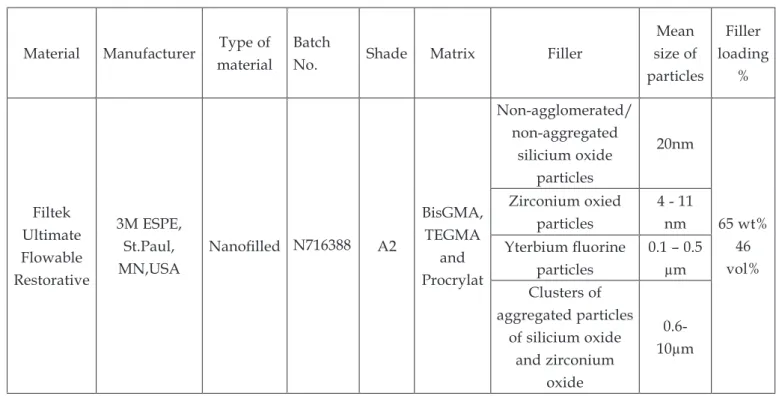
The material used for the study was Filtek Ultimate Flowable Restorative (3M ESPE), a lowable nano-composite, activated in visible radiation, radio-opaque and possessing high luidity. Selected nuance: A2. The structure of the material is presented in Tablel 1.
Table 1. Details on the material tested in the study*
Material Manufacturer Type of material
Batch
No. Shade Matrix Filler
Mean size of particles
Filler loading
%
Filtek Ultimate Flowable Restorative
3M ESPE, St.Paul, MN,USA
Nanoilled N716388 A2
BisGMA, TEGMA
and Procrylat
Non-agglomerated/ non-aggregated
silicium oxide particles
20nm
65 wt% 46 vol% Zirconium oxied
particles
4 - 11 nm Yterbium luorine
particles
0.1 – 0.5 µm Clusters of
aggregated particles of silicium oxide
and zirconium oxide
0.6-10µm
Bis-GMA: Bisphenol A diglycidyl dimethacrylate ether; TEGDMA: Triethyleneglycoldimethacrylate; Procrylate: (2,2-bis [4-(3-methacryloxypropoxy) phenyl] propane)
* Data offered by manufacturer
20 cylindrical samples, 5 mm in diameter and 2 mm thick, were prepared by the above-presented material, by means of metallic molds, placed on a glass plaque. Between the molds and the plaque, a celluloid matrix was inserted, for obtaining an as smooth as possible surface.
Following illing of the mold, another celluluoid matrix was put above the sample, while, with a second glass plaque, slight pression was applied for the removal of the material in excess and of the possible air voids.
Galina PANCU, Irina NICA
for assuring complete polymerization of the material. A source equipped with a LED (light emitting diode) of Optilight LD MAX – Gnatus type, with a wavelength ranging between the 470 – 480 nm interval, was used. Further on, the samples were randomly divided into 4 groups: a group containing 5 control samples, not subjected to inishing, and 3 groups, each formed of 5 samples for each of the three inishing and polishing systems considered for analysis.
System 1: The Sof-Lex (3M ESPE) 2-step system
is formed of disposable spiral wheels for inishing and polishing, made of a thermoplastic elastomer impregnated with aluminium oxide particles. The beige spiral wheel is recommended for inishing, smoothing and removal of the scratches
produced during the restoration stages, while
the white one is recommended for inal polishing. During inishing and polishing, each spiral wheel was used only once for each sample, the
procedure involving no water spraying, no paste,
for 1 min (30 sec for each wheel), the contra angle
hand piecebeing employed at a speed of
10,000-20,000 rpm, according to the recommendations of the manufacturer.
System 2: The multi-step Super Snap (Shofu, Inc.
Kyoto, Japan) system is made of disks for
contouring, finishing, polishing and
superpolishing. The disks have no metallic ring,
do not expose themandrelon the active surface
and are impregnated with aluminium oxide
powder of various granulation. In the present
study, violet disks were successively employed for inishing, green ones for polishing and, in the
end, red ones for superpolishing.
During inishing and polishing, each abrasive disk was used only once for each sample, the procedure, applied for 1 min (20 sec for each
disk), involving no water spraying or paste, the
contra angle hand piece being employed at a speed of 10,000-20,000 rpm, according to the recommendations of the manufacturer.
System 3: The multi-step OptiDisc (KerrHawe
SA, Switzerland)system is formed of (extra-coarse
brown) disks for contouring, (coarse beige) for inishing, (orange) for polishing and (yellow) for superpolishing, manufactured from a transparent, lexible polyester impregnated with aluminium oxide particles of different sizes. The mandrel is ixed on the disk in a silicone ring which maintains
the distance from the active part, thus preventing
scratching of the surfaces on which the operation
is done. The system also contains an Optishine brush for inal polishing.
A coarse beige disk and a coarse orange and yellow disk were employed for inishing and respectively, polishing. Final polishing made use of an Optishine brush. The procedure, applied for 1 min (20 sec for each disk), involved no
water spraying, or paste, the contra angle hand
piece being employed at a speed of 10,000-20,000 rpm in the case of disks and of 5,000 rpm, respectively, for the brush, according to the recommendations of the manufacturer.
Two perpendicular inishing and polishing
directions were followed for each of the three
systems. In the end, the residual powder remaining on the surface of the samples was cleaned with a steam jet under pressure (STEAMY- MINI, REITEL GmbH, Germany).
For surface characterization, both the control and the polished samples were analyzed on a NTEGRA SPECTRA (NT-MDT) atomic force microscope for obtaining information on surface
topography and for calculating the rugosity
parameters. Quantitative characterization of microstructures involved calculation of the rugosity parameters. In the present study, the
mean arithmetic deviation of the evaluated proile, Ra,
was employed.
3. RESULTS
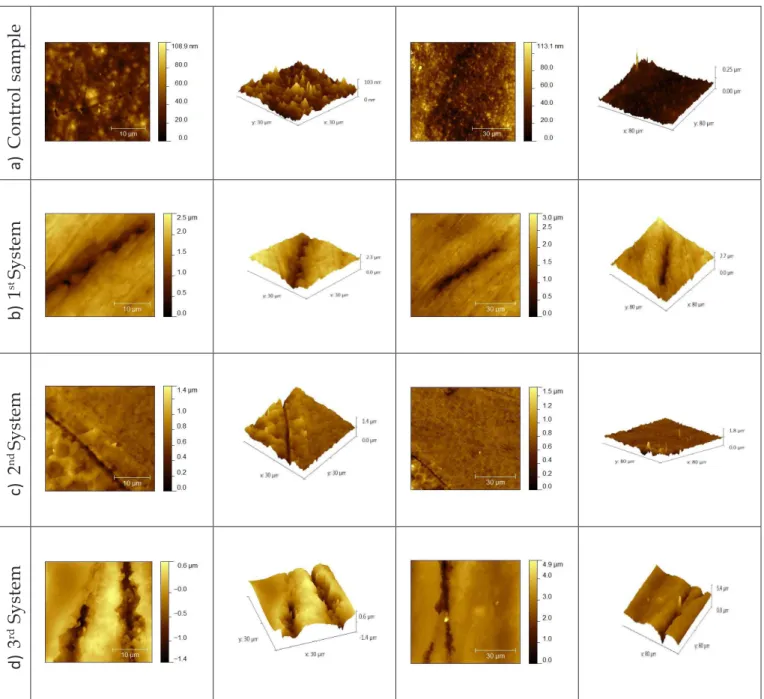
Figure 1 illustrates the surface condition, as
evidenced by AFM, for Filtek Ultimate Universal Flowable Restorative composite at various magniication powers, for both a control sample and a sample inished with the polishing systems 1-3. The surface characteristics were identiied with both bi- and tri-dimensional images.
The microstructure of the control sample
evidences the occurrence, on the surface, of very
ine, uniformly distributed particles. 3D images evidence slight vertical deviations, of maximum 0.2 µm, which indicates a low rugosity. The
surface of the samples inished with System 1 (Fig. 1b) is characterized by the occurrence of micro-channels. More than that, their depth may be evaluated as being below 2 µm. Polishing with
micro-hollows, even if iner and less deep, of maximum 1 µm. The dimensions of the particles
from the surface could not be distinctly evidenced. System 3 (Fig. 1d) produces a lower number of hollows on the surface, yet wider and much deeper, of about 5 µm.
For a quantitative evaluation of all the above observations, the rugosity parameter, Ra, and
the mean arithmetic deviation of the profile
under analysis were calculated. The
determinations were made on (80×80) µm2
surfaces. The mean values of Ra – calculated
for the control samples and for those finished and polished with Systems 1-3 - are listed in Figure 2. Generally, utilization of finishing and polishing systems increases the rugosity parameter Ra, comparatively with the reference.
The highest mean value of Ra, of 1.19 µm, was
registered for System 3, followed by System 2, with a mean Ra value of 1.12 µm, whereas the
lowest mean value of Ra, of 1.10 µm, was
recorded for System 1.
a)
C
on
tr
ol
s
am
pl
e
b)
1
st Sys
te
m
c)
2
n
d Sys
te
m
d)
3
rd S
ys
te
m
Fig. 1. AFM-obtained microstructure of the Filtek Ultimate Flowable Restorative composite at various
Galina PANCU, Irina NICA
0.000 0.200 0.400 0.600 0.800 1.000 1.200
Control sample
1st System
2nd System
3rd System 0.91
1.10 1.12 1.19
RA(µm)
Fig.2. Variation in the rugosity of the Filtek Ultimate
Flowable Restorative composite following inshing
and polishing with Systems 1-3
4. DISCUSSIONS
The atomic force microscopy (AFM) offers, apart from information related to the microstructural phases of the surface, the
advantage of a structure of “heights”, on perpendicular direction, of the surfaces of the
analyzed samples, which permits calculation of the rugosity parameters.
In the present study, the Ra value obtained for
the control samples, which had been photopolymerized in contact with the celluloid matrix, was lower, comparatively with the values attained for each of the three inishing and polishing systems employed. These results agree
with a series of studies which evidenced that, in
the case of composite resins, the smoothest surface may be obtained when the material is intimately photopolymerized with a celluloid matrix [12,13]. Nevertheless, this surface layer, polymerized in contact with the matrix, has a higher content of organic component than the subadjacent one, [14-16] which explains why its removal through inishing and polishing increases the surface resistance of the material [17,18].
To be eficient, a inishing system should be impregnated with abrasive particles whose hardness is higher than that of the inorganic illing particles from the composite. Otherwise, during the inishing and polishing stages of restoration, the supericial, rich in resin, layer – known as possessing weak physical and mechanical properties – is removed, the iller particles
remaining in bold relief within the surface layer [19,20]. In the structure of the anlayzed composite
resin, the organic matrix prevails, in volumetric
ratios, comparatively with the anorganic compound, which renders the material more susceptible to the abrasive action of the inishing and polishing systems. The anorganic compound contains a mixture of non-agglomerated/non-aggregated particles of silicium oxide and zirconium oxide with nanometric size, dispersed among the clusters of particles with micrometric size. Possibly, the nanometric particles from the surface layer had been the irst one to be eliminated during inishing and polishing.
The three inishing systems analyzed in the present study include devices impregnated with aluminium oxide powder, their application following the same sequentiality. The experiment
was initiated on the device with the coarsest granulation, continuining, in descreasing order,
up to the inest one. Accordingly, in the composite material here under evaluation, all the three systems produced increased rugosity values. Preferential removal, off the material surface, of the inest particles and of some parts of the organic matrix might explain the different rugosity obtained with the three inishing and polishing systems.
5. CONCLUSIONS
Within the limits of the present study, the conclusion may be drawn that, in the analyzed lowable composite, utilization of multi-step inishing and polishing systems causes an obvious increase of the rugosity parameter, comparatively with the samples polymerized in contact with a celluloid matrix. The highest values were registered for the multi-step OptiDisc
(KerrHawe SA, Switzerland) system, associated
with the Optishine brush, followed by the
multi-step Super Snap (Shofu, Inc. Kyoto, Japan) one, the
lowest values of rugosity being recorded for the
two-step Sof-Lex (3M ESPE) system.
References
2. García AH, Lozano MAM, Vila JC, Escribano AB, Fos Galve P. Composite resins. A review of the materials and clinical indications. Medicina Oral Patologia Oral Y Cirugia Bucal. 2006;11:E215–20. 3. Randall G, Cohen DDS. The Expanded Use of
Improved Flowable Composite. [Internet]. 2008 [cited 2016 Jan 26]; 62–72. Available from: www. dentaltown.com/pdfs/dtjune08pg62.pdf
4. Majety KK, Pujar M. In vitro evaluation of microleakage of class II packable composite resin restorations using lowable composite and resin modiied glass ionomers as intermediate layers. J Cons Dent. 2011;14:414–17.
5. Beauchamp J, Cauield PW, Crall JJ, Donly K, Feigal R, Gooch B, et al. Evidence-based clinical recommendations for the use of pit-and-issure sealants. J Am Dent Assoc. 2008;139:257–67.
6. Kubo S, Yokota H, Yokota H, Hayashi Y. Three-year clinical evaluation of a lowable and a hybrid resin composite in non-carious cervical lesions. J Dent. 2010;38:191–200.
7. Stoleriu S, Iovan G, Pancu G, Nica I, Andrian S. Study concerning the inluence of the inishing andpolishing systems on the surface state of various types of composite resins. Rom J Oral Rehabilit. 2013;5(3):78-83.
8. Erdemir U, Sancakli HS, Yildiz E.The effect of one-step and multi-one-step polishing systems on the surface roughness and microhardness of novel resin composites. Eur J Dent. 2012;6:198-205.
9. Reis AF, Giannini M, Lovadino JR, dos Santos Dias CT. The effect of six polishing systems on the surface roughness of two packable resin-based composites. Am J Dent. 2002;15:193-7.
10. Balan A, Sandu AV, Stoleriu S, Pintiliciuc VS, Toma V. Effect of Different Finishing and Polishing Systems on the Surface Roughness of Composite Resins. Mat Plast. 2015; 52(1): 55-57.
11. Yap AU, Lye KW. Surface characteristics of tooth-coloured restoratives polished utilizing different polishing systems. Oper Dent. 1997; 22:260-5. 12. Sarac D, Sarac YS, Kulunk S, Ural C, Kulunk T. The
effect of polishing techniques on the surface roughness and color change of composite resins. J Prosthet Dent. 2006;96(1):33-40.
13. Uctasli MB, Bala O, Gull A. Surface roughnessof lowable and packable composite resin materials after inishing with abrasive disc. J Oral Rehabil 2004;31:1197-202.
14. Helvatjoglou-Antoniadi M, Papadogianis Y, Koliniotou-Kubia E, Kubias S. Surface hardness of light-cured and self-cured composite resins. J Prosthet Dent. 1991;65:215–20.
15. Stanford WB, Fan PL, Wozniak WT, Stanford JW. Effects of inishing on color and gloss of composites with different illers. J Am Dent Assoc.1985;110:211–3. 16. Joniot SB, Gregoire GL, Auther AM, Roques YM.
Three-dimensional optical perilometry analysis of surface states obtained after inishing sequences for three composite resins. Oper Dent. 2000;25:311–5. 17. Lim CC, Neo J, Yap A. The inluence of inishing
time on the marginal seal of a resin-modiied glass-ionomer and polyacid-modiied resin composite. J Oral Rehabil. 1999;26:48–52.
18. Michelle Alexandra Chinelatti,Daniela Thomazatti Chimello,Renata Pereira Ramos,Regina Guenka Palma-Dibb.Evaluation of the surface hardness of composite resins before and after polishing at different times. J Appl Oral Sci. 2006 Jun; 14(3):188– 92.
19. Yap AU, Mok BY. Surface inish of a new hybrid aesthetic restorative material. Oper Dent. 2002;27:161-6.