Submitted26 November 2014 Accepted 3 March 2015 Published24 March 2015
Corresponding author
Meike Ramon,
[email protected], [email protected]
Academic editor
Alessandro Tavano
Additional Information and Declarations can be found on page 14
DOI10.7717/peerj.850
Copyright
2015 Ramon
Distributed under
Creative Commons CC-BY 4.0
OPEN ACCESS
Perception of global facial geometry is
modulated through experience
Meike Ramon
Institute of Research in Psychology, Institute of Neuroscience, Universit´e catholique de Louvain, Louvain-La-Neuve, Belgium
Institute of Neuroscience and Psychology, University of Glasgow, Glasgow, United Kingdom
ABSTRACT
Identification of personally familiar faces is highly efficient across various viewing conditions. While the presence of robust facial representations stored in memory is considered to aid this process, the mechanisms underlying invariant identification remain unclear. Two experiments tested the hypothesis that facial representations stored in memory are associated with differential perceptual processing of the overall facial geometry. Subjects who were personally familiar or unfamiliar with the identi-ties presented discriminated between stimuli whose overall facial geometry had been manipulated to maintain or alter the original facial configuration (seeBarton, Zhao & Keenan, 2003). The results demonstrate that familiarity gives rise to more efficient processing of global facial geometry, and are interpreted in terms of increased holistic processing of facial information that is maintained across viewing distances.
Subjects Neuroscience, Cognitive Disorders, Psychiatry and Psychology
Keywords Personal familiarity, Face processing, Real-life exposure, Viewing distances, Holistic processing, Face geometry effect, Facial configuration
Holistic face processing refers to the ability to simultaneously integrate facial infor-mation into a unified percept (Sergent, 1984;Young, Hellawell & Hay, 1987;McKone, Martini & Nakayama, 2003;Rossion, 2008). This ability, which other authors have coined configural or face interactive processing (Goffaux, 2009; for a review see e.g.,Maurer, Le Grand & Mondloch, 2002), is considered a hallmark of human face processing expertise (Mondloch et al., 2007). Paradigms commonly used to measure holistic processing include the composite face illusion (Young, Hellawell & Hay, 1987), the whole-part advantage (Tanaka & Farah, 1993), or the face inversion effect (Yin, 1969), all of which demonstrate the inter-dependency of perceiving information in upright faces (for recent reviews see e.g.,Rossion, 2009;Rossion, 2013).
Figure 1 Examples of stimuli used in Experiments 1 and 2.Stimulus manipulations included combined changes of the inter-ocular and nose-mouth distance, giving rise to the four possible combinations depicted here. Two types of changes were considered as “less” (black borders), or “more” distorting (gray borders), as the eyes and mouth were moved either in the same (eyes/mouth out, eyes/mouth in) or opposite (eyes out/mouth in, eyes in/mouth out) direction, thereby respectively preserving, or altering the original facial configuration.
eyes (e.g., eyes closer and mouth down), as compared to those that preserved the original aspect ratio (e.g., eyes farther apart and mouth down; seeFig. 1for an illustration). In healthy observers, thisface geometry effect was found for upright, but not inverted face discrimination. Moreover, the effect was not observed in the prosopagnosic patient TS, regardless of stimulus orientation. These findings were taken to reflect observers’ ability to “integrate local spatial information into overall facial structure.”
These independent observations are to our knowledge the only studies having used this paradigm. As both reported a lack of a face geometry effect in two cases of acquired prosopagnosia, we reasoned that the manipulations used to measure the face geometry effect may represent an alternative measure of holistic processing and face processing efficiency. However, subtle differences between the aforementioned studies give rise to a number of questions.
First, are healthy observers with normal holistic face processing abilities equally capable of discerning manipulations of facial geometry? The previous studies—using both unfamiliar and personally familiar faces—indicate that this might indeed be the case. However, the reported observations were made using two initially unfamiliar identities (Barton, Zhao & Keenan, 2003) presented repeatedly over a large number of trials, or a larger group of personally familiar ones encountered repeatedly in real-life situations (Ramon & Rossion, 2007; M Ramon, T Busigny, G Gosselin and B Rossion, unpublished data). Consequently, it is not clear whether discrimination of changes of the overall facial configuration, as well as the observation of a face geometry effect require extensive (experimental, or real-life) exposure to the face stimuli used. Moreover, it remains to be determined whether the observation of a face geometry effect is confined to situations where stimuli are presented simultaneously.
The present study reports two experiments conducted to address the above questions, testing subjects of an independent, larger cohort than previously (Ramon & Rossion, 2007; M Ramon, T Busigny, G Gosselin and B Rossion, unpublished data). Here, using the same manipulations, the first experiment served to replicate the finding that healthy observers can discern manipulations of the overall facial geometry, and show and advantage for more as compared to less distorting ones (i.e., a face geometry effect) when comparing face stimuli to internally stored facial representations. Observers who were personally familiar with the individuals depicted performed veridicality decisions between simultaneously presented original faces paired with altered versions that involved more or less distorting changes of the overall facial configuration. In line with previous findings (Barton, Zhao & Keenan, 2003;Ramon & Rossion, 2007; M Ramon, T Busigny, G Gosselin and B Rossion, unpublished data), we observed a face geometry effect, i.e., an advantage for discriminating between original and more distorting changes of the facial configuration.
face geometry effect. Together, these results indicate that personal familiarity is associated with more efficient integration of the overall facial configuration, i.e., holistic processing, but that the observation of a face geometry effect may depend on stimuli being presented simultaneously.
MATERIALS AND METHODS
The personally familiar faces from which stimuli were created were comparably familiar to all individuals of the peer groups tested (senior year psychology master students from the University of Louvain). This procedure has been applied elsewhere (M Ramon, T Busigny, G Gosselin and B Rossion, unpublished data) and bears the advantage of having stimulus sets of personally familiar faces, that are identical across subjects, and larger in size (here: 26 and 14 identities in Experiments 1 and 2, respectively) than those utilized in studies using subject-specific sets of personally familiar faces (e.g., two (Arsalidou et al., 2010) to six (Gobbini et al., 2013) personally familiar identities). Control subjects tested in Experiment 2 were psychology students from a different cohort who were unfamiliar with the identities depicted; all subjects received financial compensation for participation. The experiments were undertaken with the understanding and written consent of each subject, and conform to The Code of Ethics of the World Medical Association (Declaration of Helsinki). Consent for publication was obtained for individuals depicted in the figures exemplifying stimuli used.
Despite offering more control of the stimulus material (all images were taken under identical conditions by the experimenter, as opposed to being provided by subjects; e.g.,Gobbini et al., 2013), and enabling larger numbers of trials (with comparably less image repetitions), the approach of using faces derived from the same cohort comes at the expense of a limited number of available potential participants. As previously (Ramon, Caharel & Rossion, 2011;Ramon, in press), classical parametric statistical methods were complemented with robust techniques (percentile bootstrap analyses). Given their higher statistical power and robustness to deviations from the assumed optimal distribution parameters, the latter are particularly recommended, given small sample sizes and/or unknown theoretical distributions of a statistic of interest (Ad`er, Mellenbergh & Hand, 2008). To investigate performance differences related to the experimental manipulations, for each behavioral measure subjects were sampled with replacement and differences between the bootstrap populations for the conditions in question were computed. This process was repeated 999 times, leading to a distribution of bootstrapped estimates of the mean differences across conditions. Differences between the sample means were considered significant if the 95% bootstrap confidence intervals (btCIs) did not include zero. Relying on an estimation of the H1, this bootstrap technique tends to have more
Experiment 1: Veridicality decisions for personally familiar faces across manipulations of overall facial geometry
Participants. Thirteen subjects who were personally familiar with the faces presented as stimuli (mean age: 24±1; eight female; one left-handed male) participated in Experiment 2.
Stimuli.Full frontal color photographs of 26 students were cropped of hair and external features using Adobe Photoshop. The resulting stimuli (originals; 154–183 pixels wide, 218–256 pixels high) were modified to create four altered face stimuli per identity. The inter-ocular and nose-mouth distances could be either increased or decreased, with changes always applied in conjunction; that is, the eyes were moved either out (EO) or in (EI), and the mouth was moved up (MU) or down (MD), giving rise to one image per experimental condition (EO MU,EI MD,EI MU,EO MD) per identity. Given the size of the stimuli, the features were displaced by two pixels per feature. The stimulus modifications applied to each original face are illustrated inFig. 1.
Apparatus and procedure.Stimuli were displayed using Eprime software, on a 19′′ monitor (58 cm viewing distance, 1,280×1,024 pixel resolution). Stimulus (i.e., face) size comprised 4.5–5.2◦(width) and 6.5–7.5◦(height) of visual angle (VA), respectively. Participants performed a veridicality decision task: they decided which of two juxtaposed stimuli (presented until response provided) displayed the original face of the identity depicted on a given trial by pressing a left or right key, respectively. The experiment consisted of four blocks of equal length with interleaved pauses. In total, participants completed 208 trials (26 identities×four change types×two possible locations for original faces) which were separated by a 1,000 ms inter-trial interval and randomly assigned to the four blocks (trial presentation randomized). Prior to the actual experiment, participants completed four practice trials (excluded from analysis).
Experiment 2: Delayed matching across manipulations of overall facial geometry for personally familiar and unfamiliar faces
Participants. Two groups of twelve subjects each were tested in Experiment 2. Participants of the experimental group (mean age: 23±1, eight females) and control group (mean age: 20±1, ten females) differed only with respect to their personal familiarity with the identities presented as stimuli (familiar, unfamiliar).
Stimuli.A subset of stimuli created for Experiment 1 was used in Experiment 2; this subset included original (i.e., veridical) faces of 14 individuals and their respective modified versions (seeFig. 1). This smaller stimulus set was chosen given the different procedure and number of trials necessary (see below). Since stimuli were presented individually here and thus could be presented at a larger size (between 185 and 218 pixels in width, and 260 and 307 pixels in height due to inter-individual differences in face size and shape), feature displacements amounted to∼5 pixels per feature for each of the four possible modified versions of a face.
height comprised 5.4–6.3◦(width) and 7.8–9.0◦(height) of VA, respectively. Participants performed a delayed matching to sample task, requiring same/different decisions between the sample and subsequently presented probe stimulus on a given trial by pressing a left or right key, respectively.
Prior to the experiment, participants completed two practice blocks (32 trials each, all excluded from the analyses) throughout which two female identities and their respective altered versions were presented. Subjects were prompted to be as accurate as possible and attempt to achieve over 80% correct. The two blocks differed in that for the first, feedback was provided on each individual trial, while during the second block feedback was provided after the first and second half of the practice block. After both practice blocks, the total score was provided and participants were again encouraged to perform as accurately as possible and maintain high scores.
Throughout the actual experiment, stimuli derived from 12 other individuals faces (six female) were presented. The presentation parameters were identical to those used in practice blocks. A fixation cross was presented for 400 ms, followed by a 200 ms blank and a sample stimulus displayed for 500 ms. After a 600 ms ISI, a probe stimulus was presented for a maximum of 3,000 ms during which responses were recorded. Consecutive trials were spaced by a 900 ms inter-trial interval; the positions of sample and probes were jittered randomly to avoid participants adopting local matching strategies.
Trials required to investigate the research question posed in Experiment 2 were those for which sample and probe stimuli depicted the original face paired with each altered version (EO MU,EI MU,EO MD,EI MD). In total there were 96 of these (original/altered) trials of interest: 12 identities×four pairs×two orders (original probe followed by altered sample, or vice versa). An additional 96 trials, also requiring a “different” response, were included which involved presentation of two altered versions as samples and probes (altered/altered). These trials were included to avoid subjects performing their decisions by focusing on a single facial region. Altered/altered trials were chosen so that each of the six possible combinations occurred at least once per identity; an additional two trials per identity was chosen pseudo-randomly ensuring that overall all combinations occurred with equal frequency. Note that performance on these catch trials could not be distinguished in terms of “more” or “less” distorting changes, as the consecutively presented stimuli sometimes involved a single change (eyes or mouth, e.g., ifEO MD andEO MUwere presented in succession) or combinations of changes (both eyes and mouth, e.g., ifEO MDandEI MUwere presented consecutively).1A further 192 trials 1Investigating the effect of single
inter-feature relational changes as a function of region, or as compared to combined changes on discrimination performance is an interesting research question in itself (see e.g.,Barton, Zhao & Keenan, 2003;Malcolm, Leung & Barton, 2004). However, this was not the research question addressed here; each of these conditions was represented by fewer trials, as compared to the trials of interest (original/altered), therefore making direct comparisons impossible.
Figure 2 Results for Experiment 1: veridicality decision task.(A) Number of errors and normalized RTs (calculated by dividing the mean RT per condition by the mean across conditions) for more and less distorting conditions (bars represent standard errors). Single subjects’ ranked differences in (B) number of errors and (C) RTs between conditions.
Each participant completed 384 trials (excluding practice trials; identical sample-probe combinations used across subjects), with interleaved pauses every 64 (randomly presented) trials, after which feedback on performance was provided. The presence of a face geometry effect was investigated based on, and provided sufficiently high discrimination performance for, the 96 trials of interest involving consecutive presentation of original and altered facial configurations.
RESULTS
Experiment 1: Veridicality decisions for personally familiar faces across manipulations of overall facial geometry
Experiment 1 assessed whether specific alterations of theoverall facial configuration would be discriminated more readily than others in personally familiar faces. Note that other authors have used the term ‘facial configuration’ to refer to single distances between individual features (Maurer, Le Grand & Mondloch, 2002), or include other facial information (e.g., face contour;Sergent, 1984;Young, Hellawell & Hay, 1987). Here ‘facial configuration’ refers to the spatial relationship between the most diagnostic internal facial features—the eyes/eyebrows and mouth (see e.g.,Haig, 1985;Gosselin & Schyns, 2001;Sadr, Jarudi & Sinha, 2003)—using stimulus manipulations originally introduced byBarton, Zhao & Keenan (2003). Participants who were personally familiar with the individuals depicted performed identity veridicality decisions for image pairs comprising the original face, along with one that was modified with respect to its facial configuration (seeFig. 1). In line with previous findings (Barton, Zhao & Keenan, 2003;Ramon & Rossion, 2007; M Ramon, T Busigny, G Gosselin and B Rossion, unpublished data), modifications that alter the original facial configuration (i.e., are more distorting) were hypothesized to be more readily perceived than those that preserve it (i.e., are less distorting).
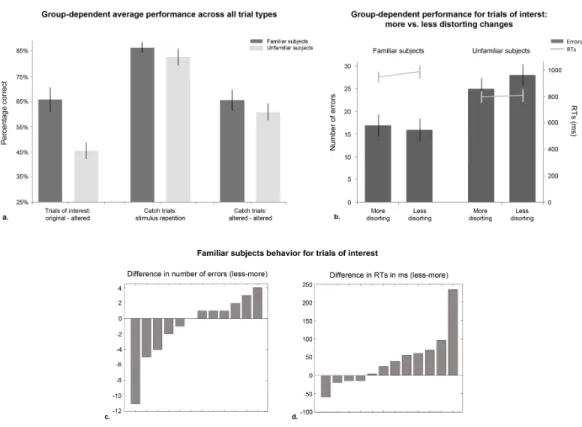
Figure 3 Results for Experiment 2.(A) Mean performance per group for each of the three trial types presented: trials of interest considered for analyses (original paired with altered facial configurations), and catch trials (stimulus repetition or stimuli depicting different alterations of the facial configuration; see Methods). Percentage correct (as opposed to number of errors) is displayed because the total number of trials involving stimulus repetition was equal to the sum of those requiring “different” responses (original/altered, altered/altered). Note that the control subjects’ performance for trials of interest did not differ from chance level. (B) Familiar and unfamiliar subjects’ discrimination performance for trials of interest, separately for more and less distorting changes of the overall facial configuration (bars represent standard errors), which were not associated with significant differences in performance. Single subjects’ ranked differences in (C) number of errors and (D) RTs between conditions.
Experiment 2: Delayed matching across manipulations of overall facial geometry for personally familiar and unfamiliar faces
Experiment 1 demonstrated an advantage for detecting more over less distorting alter-ations of the overall facial geometry, i.e., a face geometry effect, when subjects performed veridicality decisions between original and altered faces of personally familiar individuals. Following this observation, in Experiment 2 two groups of observers performed a delayed matching task, which did not require face identification but merely same/different decisions between consecutively presented stimuli. Performance for discriminating changes in the overall facial geometry was considered an index of holistic processing, the hypothesis being that personal familiarity with faces leads to increased integration of facial information from across the entire face, manifesting in terms of more efficient perception of global facial geometry, and potentially a face geometry effect.
Although only trials involving original/altered faces were relevant to investigate the emergence of a face geometry effect, subjects’ accuracy for catch trials was inspected to ensure sufficient performance.Figure 3Adisplays the groups’ mean performance for trials of interest and both types of catch trials. Independent sample t-Tests revealed no differences in the groups’ performance for catch trials involving stimulus repetition, t(22)=.94, ns, or presentation of two altered versions,t(22)=.86, ns. However, for the trials of interest, i.e., stimulus pairs involving original and altered facial configurations, familiar subjects performed significantly better than unfamiliar controls,t(22)=3.50, p=.001. AX2test of proportions revealed that the controls’ performance did not differ significantly from chance (p=.24), contrary to that of familiar subjects’ (p< .02). Although only familiar subjects’ data were therefore further analyzed for potential face geometry effects, unfamiliar subjects’ performance for more, as compared to less distorting trials is displayed inFig. 3B.
The planned comparison yielded no significant difference between discriminating more or less distorting changes (accuracy:t(11)= −.77; RTs:t(11)= −1.72; both ns). Percentile bootstrapped estimates of the mean difference between distortion types (i.e., more and less distorting alterations of overall facial geometry) confirmed the parametrically observed lack of a difference between less and more distorting conditions (btCIs for all measures: accuracy: [−.07, .02]; RTs: [−88, 3]). Individual subjects’ differences in number of errors and RT across conditions are displayed inFigs. 3Cand3D.
GENERAL DISCUSSION
were rooted in the idea that repeated real life exposure with personally familiar faces would give rise to differential processing of global facial geometry.
Barton et al.’s (2003) seminal experiment involved an oddity paradigm, in which observers were required to indicate which of three simultaneously presented unfamiliar face stimuli was different from the remaining (identical) two. In their experiment various manipulations of facial information, including changes of feature color, or single inter-feature distances, were discriminated. Additionally, the overall facial configuration was also manipulated via combinations of altered inter-feature distances between the most diagnostic facial features: the eyes and mouth (Haig, 1985;Gosselin & Schyns, 2001; Sadr, Jarudi & Sinha, 2003). Beyond finding more efficient discrimination for the latter, the authors reported that specific changes to the overall facial configuration were more readily discerned: those that distorted, as opposed to maintained the original feature configuration. Importantly, this was observed only in healthy controls, but not in a case of acquired prosopagnosia.
Experiment 1 involved simultaneous veridicality decisions between the original face of personally familiar individuals and a modified version, in which the overall configuration had been altered. Replicating our previous findings under identical experimental conditions (Ramon & Rossion, 2007; M Ramon, T Busigny, G Gosselin and B Rossion, unpublished data), subjects showed a face geometry effect for correct RTs—i.e., superiority for discriminating more, as compared to less distorted versions of the original inter-feature ratios (Fig. 2). The lack of a significant effect for accuracy scores, as reported byBarton, Zhao & Keenan (2003), may be related to the difference in paradigms and tasks applied. In Barton et al.’s (2003) study, subjects had to identify the ‘odd’ one out of a set of three face stimuli. Here, however, subjects had to identify the veridical face of one of their classmates that was presented together with its more or less distorting version. Comparable accuracy scores across conditions were achieved at the expense of prolonged RTs when trials involved less distorting changes of the overall facial configuration; that is, faces presented on these trials required more visual inspection to be correctly rejected as foils deviating from the facial representation stored in memory. As all features were displaced independently, perception of only the eye or mouth location in isolation would not have led to this observed benefit for more, over less distorting changes of the facial configuration. The observation of this face geometry effect is therefore interpreted in terms of subjects perceiving both sources of information simultaneously, i.e., integrating information from across the entire face.
exhibited a face geometry effect as found in Experiment 1. Two interesting observations were made in Experiment 2. First, only familiar observers were able to detect the presence of a difference in face pairs consisting of original and altered versions, while unfamiliar observers performed at chance (Fig. 3A). As both the inter-ocular and nose/mouth distances had to be considered simultaneously, controls’ insufficient performance indicates that they were not capable of doing so. Secondly, no face geometry effect was observed in familiar observers (Fig. 3B). That is, under sequential matching conditions, the presence of a facial representation stored in memory led to enhanced face discrimination performance, but not the observation of a face geometry effect.
At first sight the results of Experiment 2 may seem to contradict those reported by Barton, Zhao & Keenan (2003): contrary to familiar subjects, our unfamiliar healthy observers were not able to discern manipulations of the overall facial geometry. However, two related aspects might account for these seemingly conflicting findings. First, despite using a comparable number of trials, Barton et al.’s (2003) stimuli depicted onlytwo identities, leading to a larger degree of experimental familiarization with their unfamiliar face stimuli which may have facilitated discrimination performance. Moreover, the unfamiliar faces used here were “subjected to judgments of sameness and difference” (Sergent, 1984). This was done in the context of a delayed matching task involving sequential, as opposed to simultaneous stimulus presentation. The introduction of a delay interval between the presentation of probe and sample faces has been associated with a decay of the inner features (e.g.,Rock, Halper & Clayton, 1972;Walker-Smith, 1978). This delay is likely to have increased task difficulty for discrimination of subtle changes of the facial configuration applied to thesame identity.
An open question the present study cannot answer concerns which aspects of real-life familiarity lead to this increased processing efficiency. Previous research suggests that processing of personally familiar faces calls upon different processes than those involved in recognition of famous or experimentally familiarized faces (Tong & Nakayama, 1999; Knappmeyer, Thornton & B¨ulthoff, 2003;Carbon, 2008). One main difference between personally familiar and unfamiliar, or experimentally learned faces, concerns the degree of variability in the visual input at encoding or learning phases. Experimentally acquired familiarity typically involves image learning (e.g.,Caldara et al., 2005;Tanaka et al., 2006;Herzmann & Sommer, 2007;Herzmann & Sommer, 2010;Barsics & Br´edart, 2012), and/or a restricted number of different images per identity (O’Donnell & Bruce, 2001; Gobbini & Haxby, 2006;Tanaka et al., 2006), most commonly presented with constant stimulus size. Personally familiar faces on the other hand are encountered across a range of viewing conditions, rendering their representations and therefore identification robust to variations such as changes in viewpoint and exposure across different viewing distances. With varied viewing distance, the visual information projected to the retina changes, leading to differences in the available spatial frequency content (Sowden & Schyns, 2006). As demonstrated inFig. 4, personally familiar faces can be reliably identified despite large variations of available information associated with changes in viewing distances, and are processed with higher efficiency than their unfamiliar counterparts (Kemp, Towell & Pike, 1997;Bruce et al., 1999).
These visual input variations during face learning in real-life scenarios may form the basis for familiarity-dependent differential processing manifesting in terms of prioritized detection or increased behavioral recognition speed (Herzmann et al., 2004;Ramon, Ca-harel & Rossion, 2011;Gobbini et al., 2013). They may also account for familiarity-related differences in perceptual processing suggested by studies of oculo-motor patterns (Van Belle et al., 2010), discrimination of feature displacements (Brooks & Kemp, 2007;Ramon, in press), and spatial frequency thresholds (Watier & Collin, 2009). Importantly, changes in viewing distances lead to perception of an individual’s facial configuration across a range of spatial frequencies, which may be responsible for the increased discrimination sensitivity observed here, and familiarity-dependent differences in processing of vertical inter-feature distances (Ramon, in press).
Further studies are required to address this assumption, ideally involving larger sample sizes to detect potentially small effects. Moreover, a longitudinal approach would be favorable in order to e.g., track the development of participants’ sensitivity to the overall facial configuration throughout the course of familiarization. A further necessary aspect such studies should consider is the systematic control of visual input variations, e.g., viewing distances (Sowden & Schyns, 2006), facial motion (Knappmeyer, Thornton & B¨ulthoff, 2003) and viewpoint changes (Stevenage & Osborne, 2006) throughout the course of familiarity acquisition.
B Rossion, unpublished data). They are interpreted as evidence that personal familiarity with faces is associated with increased sensitivity to the overall facial configuration, i.e., holistic processing. Taken together, the results reported here indicate that holistic processing is facilitated by the presence of a facial representation stored in memory.
ACKNOWLEDGEMENTS
The author expresses her gratitude to Bruno Rossion, under the supervision of which the experiments were carried out. Further thanks are directed to Philippe Schyns and Luca Vizioli, to all participants for their cooperation, as well as two anonymous reviewers for their helpful comments on an earlier version of this paper.
ADDITIONAL INFORMATION AND DECLARATIONS
Funding
Meike Ramon is supported by the Belgian National Foundation for Scientific Research (FNRS). The funders had no role in study design, data collection and analysis, decision to publish, or preparation of the manuscript.
Grant Disclosures
The following grant information was disclosed by the author: Belgian National Foundation for Scientific Research (FNRS).
Competing Interests
The author declares there are no competing interests.
Author Contributions
• Meike Ramon conceived and designed the experiments, performed the experiments, analyzed the data, contributed reagents/materials/analysis tools, wrote the paper, prepared figures and/or tables, reviewed drafts of the paper.
Human Ethics
The following information was supplied relating to ethical approvals (i.e., approving body and any reference numbers):
The experiments were undertaken with the understanding and written consent of each subject, and conform to The Code of Ethics of the World Medical Association (Declaration of Helsinki). Consent for publication was obtained for individuals depicted in the figures exemplifying stimuli used.
Supplemental Information
REFERENCES
Ad`er HJ, Mellenbergh GJ, Hand DJ. 2008.Advising on research methods: a consultant’s companion. Huizen: Johannes van Kessel Publishing.
Arsalidou M, Barbeau EJ, Bayless SJ, Taylor MJ. 2010.Brain responses differ to faces of mothers and fathers.Brain and Cognition74(1):47–51DOI 10.1016/j.bandc.2010.06.003.
Barsics C, Br´edart S. 2012.Recalling semantic information about newly learned faces and voices.
Memory20:527–534DOI 10.1080/09658211.2012.683012.
Barton JJS, Zhao J, Keenan JP. 2003.Perception of global facial geometry in the inversion effect and prosopagnosia.Neuropsychologia41:1703–1711DOI 10.1016/S0028-3932(03)00115-5. Brooks KR, Kemp RI. 2007.Sensitivity to feature displacement in familiar and unfamiliar faces:
beyond the internal/external feature distinction.Perception36:1646–1659DOI 10.1068/p5675. Bruce V, Henderson Z, Greenwood K, Hancock P, Burton M, Miller P. 1999.Verification of
face identities from images captured on video.Journal of Experimental Psychology: Applied 5:339–360.
Burt PJ, Adelson EH. 1983.The Laplacian pyramid as a compact image code.IEEE Transactions
on Communications31:532–540DOI 10.1109/TCOM.1983.1095851.
Caldara R, Schyns P, Mayer E, Smith ML, Gosselin F, Rossion B. 2005.Does prosopagnosia take the eyes out of face representations? Evidence for a defect in representing diagnostic facial information following brain damage.Journal of Cognitive Neuroscience17:1652–1666
DOI 10.1162/089892905774597254.
Carbon CC. 2008.Famous faces as icons. The illusion of being an expert in the recognition of famous faces.Perception37:801–806DOI 10.1068/p5789.
DavidoffJ. 1986.The mental representation of faces: spatial and temporal factors.Perception &
Psychophysics40:391–400DOI 10.3758/BF03208198.
Gobbini MI, Haxby JV. 2006.Neural response to the visual familiarity of faces.Brain Research
Bulletin71:76–82DOI 10.1016/j.brainresbull.2006.08.003.
Gobbini MI, Gors JD, Halchenko YO, Rogers C, Guntupalli JS, Hughes H, Cipolli C. 2013. Prioritized detection of personally familiar faces.PLoS ONE 8(6):e66620
DOI 10.1371/journal.pone.0066620.
Goffaux V, Rossion B. 2007.Face inversion disproportionately impairs the perception of vertical but not horizontal relations between features.Journal of Experimental Psychology: Human
Perception and Performance33:995–1002.
Goffaux V. 2009.Spatial interactions in upright and inverted faces: re-exploration of spatial scale influence.Vision Research49:774–781DOI 10.1016/j.visres.2009.02.009.
Gosselin F, Schyns PG. 2001.Bubbles: a technique to reveal the use of information in recognition tasks.Vision Research41:2261–2271DOI 10.1016/S0042-6989(01)00097-9.
Haig ND. 1985. How faces differ–a new comparative technique.Perception 14:601–615
DOI 10.1068/p140601.
Herzmann G, Sommer W. 2007.Memory-related ERP components for experimentally learned faces and names: characteristics and parallel-test reliabilities.Psychophysiology44:262–276
DOI 10.1111/j.1469-8986.2007.00505.x.
Herzmann G, Sommer W. 2010.Effects of previous experience and associated knowledge on retrieval processes of faces: an ERP investigation of newly learned faces.Brain Research14:54–72
Herzmann G, Schweinberger SR, Sommer W, Jentzsch I. 2004.What’s special about personally familiar faces? A multimodal approach. Psychophysiology 41:688–701
DOI 10.1111/j.1469-8986.2004.00196.x.
Hole GJ. 1994.Configurational factors in the perception of unfamiliar faces.Perception23:65–74
DOI 10.1068/p230065.
Kemp R, Towell N, Pike G. 1997.When seeing should not be believing: photographs, credit cards and fraud.Applied Cognitive Psychology11:211–222
DOI 10.1002/(SICI)1099-0720(199706)11:3<211::AID-ACP430>3.0.CO;2-O.
Knappmeyer B, Thornton IM, B¨ulthoffHH. 2003.The use of facial motion and facial form during the processing of identity.Vision Research43:1921–1936DOI 10.1016/S0042-6989(03)00236-0. Loftus GR, Harley EM. 2004. How different spatial-frequency components contribute to
visual information acquisition.Journal of Experimental Psychology: Human Perception and
Performance30:104–118.
Malcolm GL, Leung C, Barton JJ. 2004.Regional variation in the inversion effect for faces: differential effects for feature shape, feature configuration, and external contour.Perception 33(10):1221–1231DOI 10.1068/p5372.
Maurer D, Le Grand R, Mondloch CJ. 2002.The many faces of configural processing.Trends in
Cognitive Sciences6:255–260DOI 10.1016/S1364-6613(02)01903-4.
McKone E, Martini P, Nakayama K. 2003.Isolating holistic processing in faces (and perhaps objects). In: Peterson M, Rhodes G, eds.Perception of faces, objects, and scenes: analytic and
holistic processes. Oxford: Oxford University Press, 92–119.
Mondloch C, Pathman T, Maurer D, Le Grand R, de Schonen S. 2007.The composite face effect in six-year-old children: evidence of adult-like holistic face processing.Visual Cognition 15:564–577DOI 10.1080/13506280600859383.
O’Donnell C, Bruce V. 2001.Familiarisation with faces selectively enhances sensitivity to changes made to the eyes.Perception30:755–764DOI 10.1068/p3027.
Ramon M.Differential processing of vertical inter-feature relations due to real-life experience with personally familiar faces. Perception In Press.
Ramon M, Rossion B. 2010.Impaired processing of relative distances between features and of the eye region in acquired prosopagnosia-two sides of the same holistic coin?Cortex46:374–389
DOI 10.1016/j.cortex.2009.06.001.
Ramon M, Caharel S, Rossion B. 2011.The speed of recognition of personally familiar faces.
Perception40:437–449DOI 10.1068/p6794.
Ramon M, Rossion B. 2007.What’s lost in prosopagnosia? An investigation of familiar face processing in a single-case of pure prosopagnosia working in a kindergarten [Abstract].Journal
of Vision7:122aDOI 10.1167/7.9.122.
Rock I, Halper F, Clayton T. 1972.The perception and recognition of complex figures.Cognitive
Psychology3:655–673DOI 10.1016/0010-0285(72)90025-4.
Rossion B. 2009.Distinguishing the cause and consequence of face inversion: the perceptual field hypothesis.ACTA Psychologica132:300–312DOI 10.1016/j.actpsy.2009.08.002.
Rossion B. 2013.The composite face illusion: a whole window into our understanding of holistic face perception.Visual Cognition21:139–253DOI 10.1080/13506285.2013.772929.
Rossion B. 2014.Understanding face perception by means of prosopagnosia and neuroimaging.
Rossion B, Caldara R, Seghier M, Schuller AM, Lazeyras F, Mayer E. 2003. A network of occipito-temporal face-sensitive areas besides the right middle fusiform gyrus is necessary for normal face processing.Brain126:2381–2395DOI 10.1093/brain/awg241.
Rossion B. 2008.Picture-plane inversion leads to qualitative changes of face perception.Acta
Psychologica128:274–289DOI 10.1016/j.actpsy.2008.02.003.
Sadr J, Jarudi I, Sinha P. 2003.The role of eyebrows in face recognition.Perception32:285–293
DOI 10.1068/p5027.
Sekunova A, Barton JJ. 2008.The effects of face inversion on the perception of long-range and local spatial relations in eye and mouth configuration.Journal of Experimental Psychology:
Human Perception and Performance34:1129–1135.
Sergent J. 1984.Configural processing of faces in the left and the right cerebral hemispheres.
Journal of Experimental Psychology: Human Perception and Performance10:554–572.
Smith FW, Schyns PG. 2009.Smile through your fear and sadness: transmitting and identifying facial expression signals over a range of viewing distances.Psychological Science20:1202–1208
DOI 10.1111/j.1467-9280.2009.02427.x.
Sowden PT, Schyns PG. 2006.Channel surfing in the visual brain.Trends in Cognitive Sciences 10:538–545DOI 10.1016/j.tics.2006.10.007.
Stevenage SV, Osborne CD. 2006.Making heads turn: the effect of familiarity and stimulus rotation on a gender-classification task.Perception35:1485–1494DOI 10.1068/p5409. StollhoffR, Jost J, Elze T, Kennerknecht I. 2010.The early time course of compensatory face
processing in congenital prosopagnosia.PLoS ONE5(7):e11482
DOI 10.1371/journal.pone.0011482.
Tanaka JW, Farah MJ. 1993. Parts and wholes in face recognition. Quarterly
Journal of Experimental Psychology. A, Human Experimental Psychology 46:225–245
DOI 10.1080/14640749308401045.
Tanaka JW, Curran T, Porterfield AL, Collins D. 2006.Activation of preexisting and acquired face representations: the N250 event-related potential as an index of face familiarity.Journal of
Cognitive Neuroscience18:1488–1497DOI 10.1162/jocn.2006.18.9.1488.
Tong F, Nakayama K. 1999.Robust representations for faces: evidence from visual search.Journal
of Experimental Psychology: Human Perception and Performance25:1016–1035.
Van Belle G, Lef`evre P, Rossion B. 2015.Face inversion and acquired prosopagnosia reduce the size of the perceptual field of view.Cognition31:403–408DOI 10.1016/j.cognition.2014.11.037. Van Belle G, Ramon M, Lef`evre P, Rossion B. 2010. Fixation patterns during recognition
of personally familiar and unfamiliar faces.Frontiers in Psychology1:20DOI 10.3389/fp-syg.2010.00020.
Walker-Smith GJ. 1978.The effects of delay and exposure duration in a face recognition task.
Perception & Psychophysics24:63–70DOI 10.3758/BF03202975.
Watier NN, Collin CA. 2009.Effects of familiarity on spatial frequency thresholds for face matching.Perception38:1497–1507DOI 10.1068/p6396.
Wilcox RR. 2012.Introduction to robust estimation and hypothesis testing. 2nd ed. San Diego: Academic Press.
Yin RK. 1969.Looking at upside-down faces.Journal of Experimental Psychology81:141–145
DOI 10.1037/h0027474.
Young AW, Hellawell D, Hay DC. 1987.Configurational information in face perception.