JSCS–4359 633.879.6
Original scientific paper
Kinetic behaviour of the DPPH radical-scavenging activity of
tomato waste extracts
SLADJANA M. SAVATOVIĆ, GORDANA S. ĆETKOVIĆ*#,
JASNA M. ČANADANOVIĆ-BRUNET# and SONJA M. DJILAS#
Faculty of Technology, University of Novi Sad, Bulevar cara Lazara 1, 21000 Novi Sad, Serbia
(Received 10 April, revised 16 June 2012)
Abstract: The kinetic behaviour of tomato waste extracts (obtained from six genotypes) and standard antioxidant compounds (ascorbic and caffeic acid) were investigated using the 2,2-diphenyl-1-picrylhydrazyl radical test. Based on the time required for the reaction to reach steady state, the investigated extracts showed very slow (steady state ≥ 180 min) antiradical behaviour, ascorbic acid acted as a rapid antioxidant (steady state < 5min) while caffeic acid is a rapid–intermediate antioxidant (5 min < steady state < 20 min). The efficient concentrations at different kinetic times EC50,t were determined for all
extracts, as well as for ascorbic and caffeic acid. The EC50,t was used as a
parameter to screen and compare antiradical activites of food extracts with slow kinetic action. Irrespective of the time considered, a comparison of the EC50,t values for extracts of tomato waste obtained from different tomato
ge-notypes showed that their DPPH radicals-scavenging activity decreased in the order O2 > Knjaz > Bačka > Saint Pierre > Rutgers > Novosadski niski. The
tomato waste extracts showed very slow kinetic action, which is probably the result of the different kinetic bevaviour of the phenolic compounds present in tomato waste, as well as other antioxidants (vitamins, carotenoids, etc.). Keywords: tomato waste; DPPH radicals; free radical scavenger; kinetic be-haviour.
INTRODUCTION
By-products of fruits and vegetables processing represent a major disposal problem for the industry concerned, but they are also promising sources of anti-oxidant compounds, which may be used for various purposes in the food, phar-maceutical and cosmetic industries.1 The most abundant vegetable-processing
waste is tomato pomace, produced in tomato juice and paste factories. It consists
* Corresponding author. E-mail: [email protected]
# Serbian Chemical Society member.
of tomato peel, seeds and a part of the pulp, and contains valuable nutritional compounds (on a dry weight basis): mainly fibres (59.03 % d.w.), total sugars (25.73 % d.w.), proteins (19.27 % d.w.), pectins (7.55 % d.w.), total fats (5.85 % d.w.), minerals (3.92 % d.w.) and antioxidants.2–4
Several methods have been proposed to measure the antioxidant activity of pure compounds and plant extracts, such as FRAP (Ferric Reducing Antioxidant Power), ORAC (Oxygen Radical Absorbance Capacity), ESR (Electron Spin Re-sonance), ABTS (2,2-azinobis(3-ethyl-benzothiazoline-6-sulphonate) and DPPH (2,2-diphenyl-1-picrylhydrazyl).5 Usually, the antioxidant activity is examined at
a fixed endpoint, which may not consider the kinetic characteristics of the anti-oxidant. However, an investigation of the kinetic behaviour could provide more complete information about the antioxidant properties and could be more im-portant than the total antioxidant capacites determined at a fixed endpoint.6
The DPPH test is one of the oldest and the most frequently used methods for the determination of the antioxidant activity of food extracts.7–9 Some authors
used different initial DPPH radical concentrations and reaction times in order to define the kinetic model for understanding the antioxidant behaviour. In the case of food extracts with very slow kinetic behaviour, the treatment of DPPH test data could be simplified to easily screen food extracts.10
The main objective of this study was to evaluate the kinetic behaviour of ra-dical scavenging activity of tomato waste (from juice processing, obtained from different tomato genotypes – Bačka, Knjaz, Novosadski niski, O2, Rutgers and Saint Pierre).
MATERIALS AND METHODS Chemicals and materials
2,2-Diphenyl-1-picrylhydrazyl (DPPH), caffeic acid and L-ascorbic acid were obtained from Sigma (St. Louis, USA). All other chemicals and reagents were of the highest analytical grade.
Tomato genotypes (Bačka, Knjaz, Novosadski niski, O2, Rutgers and Saint Pierre) grown
in the fields of the Institute of Field and Vegetable Crops, Novi Sad, Serbia were taken for the experiments. The materials include new (Bačka, Knjaz, Novosadski niski and O2) and
tradi-tional (Rutgers and Saint Pierre) genotypes. Waste preparation and extraction procedure
Tomatoes (1 kg) of each genotype were washed and cut into four pieces and tomato juice was prepared using a juice processor Neo, SK-400. Fresh tomato waste was dried (25 °C, 1.03 mbar, 15 h, and 30 °C, 0.001 mbar, 4.5 h) in a vacuum-dryer (Alpha 2-4 LSC Martin Christ, Osterode, Germany). The weights of the dry tomato wastes were measured in triplicate.
evaporated to dryness under reduced pressure at 40 °C on a water bath.The weights of the extracts, i.e., ethanol extractive values, were taken as the average of triplicate analyses. DPPH Radical scavenging activity
The DPPH radicals scavenging activity of the tomato waste extracts was determined spectrophotometrically using the DPPH method of Espin et al.,11 modified for this assay.
Briefly, 0.5 ml of a solution containing from 0.05 to 2 mg of extract in distilled water or 0.5 ml of distilled water (control) were mixed with 1.5 ml of a 90 μM DPPH radical solution and 3 ml of methanol. The mixture was shaken vigorously and incubated at room temperature for 120 min. The absorbance at 515 nm was measured at different intervals (after 10, 20, 30, 60, 120, 150 and 180 min) using a UV-1800 spectrophotometer (Shimadzu, Kyoto, Japan) against a blank that had been prepared in a similar manner as the control, by replacing the DPPH radicals solution with methanol. The level of remaining DPPH• in the reaction medium was calculated using the following equation:
Remaining DPPH• (%) = 100×ASample/AControl
where AControl is the absorbance of the control reaction and ASample is the absorbance in the
presence of the extract measured at different time intervals.
The efficient concentration at different times EC50,t (mg extract mg-1 DPPH•) was the
amount of the extracts in relation to the amount of initial DPPH•, which was calculated using the following equation:
EC50,t = IC50,t/[DPPH•]t=0
where IC50,t is the inhibitory concentration at different times, defined as the concentration of
extract (mg mL-1) required to scavenge 50 % of DPPH• and [DPPH•]t=0 is the initial concen-tration of DPPH• (mg mL-1).
Ascorbic and caffeic acid were used as reference radical scavengers. Statistical analysis
All measurements were performed in triplicate and the results are presented as mean ± SD. The IC50 values were calculated using Microsoft Office Excel 2003.
RESULTS AND DISCUSSION
Waste from six tomato genotypes were obtained as by-products in juice pro-cessing. In a previous study,12 it was shown that tomato waste contained
signi-ficant amounts of hydrophillic antioxidants, polyphenolics and ascorbic acid, which were identified as being responsible for antiradical activities. Based on the significant antioxidant activity of the selected tomato waste at a fixed end-point, as well as the well known health benefits of polyphenolics and ascorbic acid, this by-product has potential as value-added ingredients for functional foods. The re-sults of the antioxidant activity based on measurments at a fixed end-point to-gether with those based on kinetic data provide comprehensive information on the total antioxidant property of sample.13 In this work, kinetic parametars were
evaluted to clarify the antioxidant activity of tomato waste extracts.
an absorption maximum at 515 nm. This purple colour generally fades/disappears when an antioxidant is present in the medium.16 Antioxidant molecules can quench
DPPH free radicals (i.e., by providing hydrogen atoms or by electron donation, conceivably via a free-radical attack on the DPPH molecule) and convert them to a colourless/bleached product (i.e., 2,2-diphenyl-1-hydrazine, or a substituted analogous hydrazine), resulting in a decrease in absorbance at 515 nm.17,18
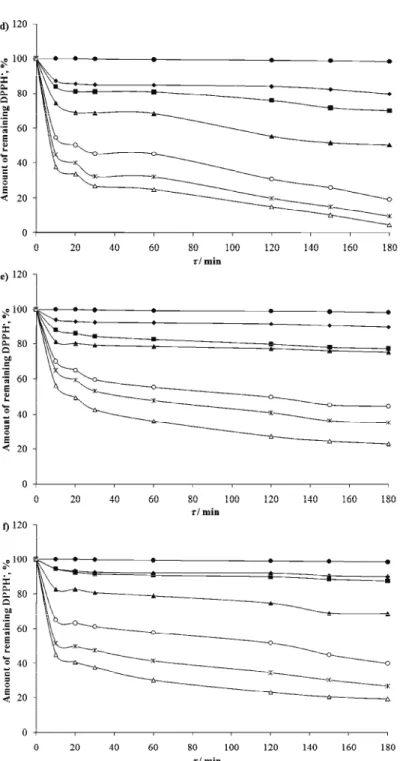
Kinetic studies of the DPPH–extract reaction were performed to estimate the scavenging activity of the extracts as a function of time. The free DPPH radical is quite stable for more than 180 min at 20 °C in the reaction medium. Hence, it al-lows the evaluation of the radical scavenging activity of the extracts within that time. The kinetics of DPPH annihilation by different tomato waste extracts are shown in Figs. 1a–1f. Immediately after the addition of the tomato waste extracts to the reaction medium, the absorbance of DPPH at 515 nm dropped, due to the decrease of DPPH concentration in the medium. Clearly, the highest rate of DPPH decay occurs within the first 10 min of reaction. Although, the extract solutions maintained their antioxidant effect until the end of the experiment (180 min).
Based on the time required for the reaction to reach steady state, four re-action kinetic types (rapid, intermediate, slow and very slow) were found.8,10 For all tomato waste extracts, a steady state was not attained even after 180 min of reaction. Thus, the investigated extracts are classified as showing very slow be-haviour. At each time, it was possible to compare the antioxidant activity of ex-tracts.10 For example, in the presence of 37.04 mg of Novosadski niski extract
per mg DPPH radicals, after 180 min, when the steady state was almost reached, about 23.39 % of the initial DPPH radicals remained in the medium. In the pre-sence of the same concentration of O2 extract, 4.40 % of initial DPPH radicals
remained in the medium after the same time.
The concentrations required to decrease twofold the DPPH concentration at the chosen reaction time (EC50,t) were calculated from the reaction kinetics
ob-tained with different concentrations of the tomato waste extract. First, the re-maining DPPH radicals percentage was plotted as function of extracts concen-tration at applied reaction time (10, 20, 30, 60, 120, 150 and 180 min). The
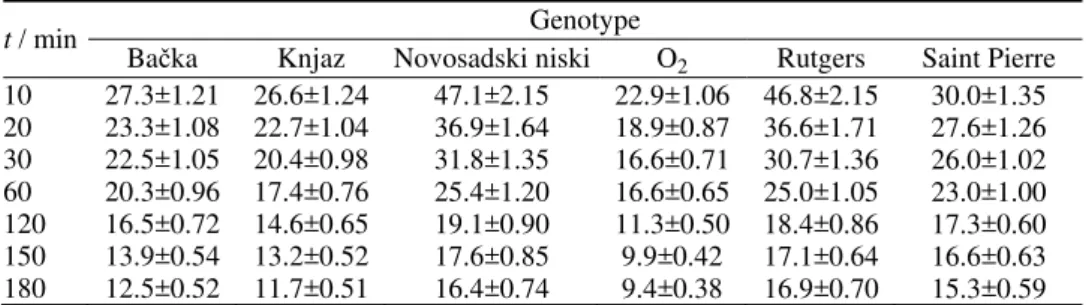
EC50,t values were determined at all the kinetic times. The EC50,t values of
to-mato waste extracts and their kinetic classification are presented in Table I. A lower EC50,t value indicates a higher DPPH radicals scavenging activity.
Ascorbic and caffeic acid were used as reference radical scavengers. A compa-rison of the EC50,t values for the extracts showed that the DPPH radical sca-venging activity of the extracts decreased in the order of O2 > Knjaz > Bačka >
Saint Pierre > Rutgers > Novosadski niski. The EC50,t value for ascorbic acid,
was 0.14 mg mg–1 DPPH• at 5 min (steady state < 5 min; rapid antioxidant), while the EC50,t value for caffeic acid was lower, 0.09 mg mg–1 DPPH• at 20
Fig. 1. Kinetic behaviour of: a) Bačka, b) Knjaz, c) Novosadski niski, d) O2, e) Rutgers and
TABLE I. EC50,t (mg extract mg-1 DPPH) values of tomato waste extracts and their kinetic
classification; the results are mean values of three determinations ± standard deviation.
Range of time to reach steady state: ≥ 180 min; kinetic classification: very slow
t / min Genotype
Bačka Knjaz Novosadski niski O2 Rutgers Saint Pierre
10 20 30 60 120 150 180 27.3±1.21 23.3±1.08 22.5±1.05 20.3±0.96 16.5±0.72 13.9±0.54 12.5±0.52 26.6±1.24 22.7±1.04 20.4±0.98 17.4±0.76 14.6±0.65 13.2±0.52 11.7±0.51 47.1±2.15 36.9±1.64 31.8±1.35 25.4±1.20 19.1±0.90 17.6±0.85 16.4±0.74 22.9±1.06 18.9±0.87 16.6±0.71 16.6±0.65 11.3±0.50 9.9±0.42 9.4±0.38 46.8±2.15 36.6±1.71 30.7±1.36 25.0±1.05 18.4±0.86 17.1±0.64 16.9±0.70 30.0±1.35 27.6±1.26 26.0±1.02 23.0±1.00 17.3±0.60 16.6±0.63 15.3±0.59
served that the EC50,t value of the tomato waste extracts were higher than those
of the individual antioxidant compounds.
According to literature data, phenolic compounds, vitamins, carotenoids, etc., show different antiradical kinetic action. For example, ascorbic acid is a rapid antioxidant, caffeic acid was classified as a rapid–intermediate antioxidant, toco-pherol and gallic acid show intermediate kinetic behaviour, while ferulic acid, quercetin and rutin are slow antioxidants.6 Furthermore, carotenoids act as
inter-mediate or slow antioxidant.19,20 It can be proposed that the different kinetic
be-haviour of the phenolic compounds, present in tomato waste, as well as other constituents (vitamins, carotenoids etc.), determined the antiradical activity of this natural source of antioxidants.
CONCLUSIONS
In this study, DPPH radicals scavenging activity of tomato waste extracts (obtained from six genotypes) was applied to determine their kinetic behaviour. Expression of the results in terms of the kinetic approach not only takes into ac-count the activity of an antioxidant, but also provides information on how quickly the antioxidant acts. All extracts showed a very slow kinetic action, which is pro-bably result of the different kinetic behaviour of the antioxidants present in to-mato waste. The chemical characteristics of the antioxidant compounds in toto-mato waste will be further investigated and more research is required to establish bioavailability and real benefits in vivo.
И З В О Д
DPPH АНТИРАДИКАЛСКОКИНЕТИЧКОПОНАШАЊЕ
ЕКСТРАКАТАОТПАДАПАРАДАЈЗА
СЛАЂАНАМ. САВАТОВИЋ, ГОРДАНАС. ЋЕТКОВИЋ, ЈАСНАМ. ЧАНАДАНОВИЋ-БРУНЕТИСОЊАМ. ЂИЛАС
Технолошкифакултет, УниверзитетуНовомСаду, БулеварцараЛазара 1, 21000 НовиСад
Кинетичкопонашањеекстракатаотпадапарадајза (добијениходшестгенотипова)
иантиоксидативних једињења (аскорбинскаикафенакиселина) испитаноје 2,2-дифе
-нил-1-пикрилхидразилрадикалтестом. Наосновувремена потребногзауспостављање
динамичке равнотежереакције, испитиваниекстрактисупоказаливеома споро (≥ 180
min), аскорбинскакиселинабрзо (< 5 min), акофеинскакиселинаумерено–брзоанти
-радикалско понашање (5 до 20 min). Ефективнеконцентрацијеуразличитимкинетич
-ким временима, EC50,t, се користекаопараметар за поређење антирадикалске актив
-ностиантиоксиданата и екстраката прехрамбренихпроизвода различитогкинетичког
деловањаиодређенесузасвеекстракте, аскорбинскуикофеинскукиселину. Безобзира
на разматрано време, поређењем EC50,t испитиваних екстраката утврђен је следећи
редоследантирадикалскеактивностиекстракта: О2 > Књаз > Бачка > СентПјер > Rutgers
> Новосадскиниски. Екстрактиотпадапарадајзасупоказаливеомаспороантирадикал
-скопонашање, штојевероватнопоследицаразличитихкинетичкихособинакакофенол
-них једињењаприсутнихуотпаду парадајза, такоидругихприсутних антиоксиданата
(витамини, каротеноиди, итд.).
(Примљенo 10. априла, ревидирано 16. јуна 2012)
REFERENCES
1. A. Schieber, F. C. Stintzing, R. Carle, Trends Food Sci. Techol.12 (2001) 401 2. M. Del Valle, M. Cámara, M. E. Torija, J. Sci. Food Agric.86 (2006) 1232
3. W. Peschel, F. Sánchez-Rabaneda, W. Diekmann, A. Plescher, I. Gartzia, D. Jiménez, R. Lamuela-Raventós, S. Buxaderas, C. Codina, Food Chem.97 (2006) 137
4. D. Naviglio, F. Pizzolongo, L. Ferrara, B. Naviglio, A. Aragòn, A. Santini, Afr. J. Food Sci. 2 (2008) 37
5. R. Scherer, H. T. Godoy, Food Chem.112 (2009) 654
6. C. Sanchez-Moreno, J. A. Larrauri, F. Saura-Calixto, J. Sci. Food Agric.76 (1998) 270 7. A. K. Ratty, J. M. Sunatomo, N. P. Das, Biochem. Pharmacol.37 (1988) 989
8. W. Brand-Williams, M. E. Cuvelier, C. Berset, Food Sci. Technol.-Lebensm.-Wiss. Technol. 28 (1995) 25
9. P. Stratil, B. Klejdus, V. Kubán, J. Agric. Food Chem.54 (2006) 607 10. G. Kansci, E. Dongo, C. Genot, Nahrung47 (2003) 434
11. J. C. Espin, C. Soler-Rivas, H. J. Wichers, J. Agric. Food Chem.48 (2000) 648
12. S. Savatović, G. Ćetković, J. Čanadanović-Brunet, S. Djilas, Int. J. Food Sci. Nutr. 63 (2012) 129
13. P. Terpinc, M. Bezjak, H. Abramovič, Food Chem.115 (2009) 740 14. B. Özcelik, J. H. Lee, D. B. Min, J. Food Sci.68 (2003) 487
15. D. Villãno, M. S. Fernández-Pachón, M. L. Moyá, A. M. Troncoso, M. C. García-Parrilla, Talanta71 (2007) 230
16. B. Matthäus, J. Agric. Food Chem.50 (2002) 3444
18. B. Ribeiro, J. Rangel, P. Valentão, P. Baptista, R. M. Seabra, P. B. Andrade, J. Agric. Food Chem.54 (2006) 8530
19. C. Sgherri, C. Pinzino, F. Navari-Izzoa, R. Izzoa, J. Sci. Food Agric. 91 (2011) 1128 20. A. Jiménez-Escrig, I. Jiménez-Jiménez, C. Sánchez-Moreno, F. Saura-Calixto, J. Sci. Food