AUGUSTO SALES
WHY MERGER TALKS COLLAPSE
An exploratory study about the contributing factors to
‘wedding cold feet' and deal making failure in Mergers and Acquisitions from the perspective of active deal making professionals in Brazil
Ficha catalográfica elaborada pela Biblioteca Mario Henrique Simonsen/ FGV
Sales, Augusto
Why merger talks collapse : an exploratory study about contributing factors to ‘wedding cold feet’ and deal making failure in mergers and acquisitions from the perspective of active deal making professionals in Brazil / Augusto Sales. - 2014.
66 f.
Dissertação (mestrado) - Escola Brasileira de Administração Pública e de Empresas, Centro de Formação Acadêmica e Pesquisa.
Orientador: Marco Túlio Zanini. I nclui bibliografia.
1. Empresas – Fusão e incorporação. 2. Negociação (Administração de empresas). I . Zanini, Marco Túlio Fundão. I I . Escola Brasileira de Administração Pública e de Empresas. Centro de Formação Acadêmica e Pesquisa. I I I .Título.
AUGUSTO SALES
WHY MERGER TALKS COLLAPSE: an exploratory study about contributing factors to ‘wedding cold feet' and deal making failure in Mergers and Acquisitions from the perspective of active deal making professionals in Brazil
Master's thesis presented to Corporate International Master's program, Escola Brasileira de Administração Pública, Fundação Getulio Vargas, as a requirement for obtaining the title of Master in Business Management.
Advisor: Professor Dr. Marco Tulio Zanini
AKNOWLEDGEMENTS
During the work with this thesis several persons have helped me and I want to express
our gratitude to them. I would like to thank my advisory Dr. Prof. Marco Tulio Zanini for all
the help, insights and valuable comments he has given.
To my colleagues at KPMG and the KPMG Alumni network, I would like to thank them
for inspiring discussions and all the contacts they have provided.
I would like to thank the interview respondents, which for confidentiality reasons I
cannot list their names. Without their help this thesis would never have been possible.
Finally, I would like to thank all of the staff and professors from FGV, ESADE and
ABSTRACT
SALES, Augusto. Why merger talks collapse: an exploratory study about contributing factors behind ‘wedding cold feet' and deal making failure in Mergers and Acquisitions from the perspective of active deal making professionals in Brazil. One basic question encouraged this study: after all the effort, expectations and money usually invested in dealmaking, why are so many transactions simply abandoned, even when the benefits are clear for the business, shareholders, customers and employees? Thesis (Master in Business Management) - Escola Brasileira de Administração Pública e de Empresas, Fundação Getúlio Vargas, Rio de Janeiro, 2014.
....
LIST OF FIGURES
Figure 1 - What was the rationale behind the acquisition?
Figure 2 – Annual evolution by number of transactions
Figure 3 – FDI inflows by country
Figure 4 - Outward FDI x International M&A
Figure 5 - Coverage of the deal cycle
LIST OF TABLES
Table 1 - Build x Buy (Advantages x disadvantages)
Table 2 - The main due diligence topics
Table 3 - The other due diligence disciplines
Table 4 - Advisor and Buyer/Seller
SUMMARY
1 INTRODUCTION ... 9
1.1 OVERVIEW ... 9
1.2 THE NO-DEAL PHENOMENA: THE ILLUSTRATIVE CASE OF PUBLICIS AND OMNICON MEGA MERGER ... 10
2 OBJECTIVES ... 13
2.1 OBJECTIVE, RELEVANCE AND STRUCTURE ... 13
3 LITERATURE REVIEW ... 14
3.1 OVERVIEW OF MERGERS AND ACQUISITIONS (“M&A”) ... 14
3.1.1 Introduction ... 14
3.1.2 Key motives behind Mergers and Acquisitions ... 14
3.1.3 M&A in Brazil ... 19
3.2 THE M&A PROCESS ... 21
3.2.1 Strategy formulation ... 24
3.2.2 Target screening and approach ... 25
3.2.3 Due diligence ... 27
3.2.4 Valuation ... 30
3.2.5 Negotiation ... 31
3.2.6 Closing, Integration and Consolidation ... 31
4 RESEARCH METHOD ... 32
4.1 INTRODUCTION ... 32
4.2 SCOPE AND APPROACH ... 33
4.3 INTERVIEWS ... 34
4.4 SCOPE LIMITATIONS ... 38
5 DATA ANALYSIS ... 40
5.1 FINDINGS AND DISCUSSIONS ... 40
5.1.1 What are the typical roles in an M&A process? ... 40
5.1.2 What is the usual deal flow? ... 43
5.1.3 Is it possible to determine where does usually a merger talk collapse? ... 44
5.1.4 What are the common factors contributing to the collapse of merger talks? ... 45
5.1.5 Is that a price for walking away from a deal?... 50
5.1.6 Other considerations ... 52
6 CONCLUSION ... 56
1.1 OVERVIEW
Coffey, Garrow and Holbeche (2002) affirmed that M&A represents a ‘marriage’, not always of two equal partners.1
In fact, the sequence of events that usually culminates in the marriage of two companies resembles well the typical sequence of events that brings a couple together. It all starts with some sort of flirting, then the relationship starts to evolve and gets a bit more serious, leading to the engagement period, commitment and eventually marriage, followed by the day after, honeymoon and life goes on (or not!).
If a merger can be illustrated by a marriage, then the purpose of this study is to understand why brides are left at the altar and which factors are behind ‘wedding cold feet’ in mergers and acquisitions.
M&A activity is a relatively well studied phenomenon in management spaces, by both academics and practitioners. These studies have contributed to shed light on issues such as the alignment between deal making and strategy, critical success factors in mergers and acquisitions, managing the acquisition process, conducting due diligence, valuations and post-deal integrations. Other interesting topics include CEO overconfidence in M&A processes and the question of why transactions fail to create value. However, very few attempts have been made to study the “No-deal” phenomenon or why merger talks fail to reach the completion phase, which is the process of actually signing the sales and purchase agreement, commonly referred to as the “SPA”.
In summary, one basic question encouraged this study: after all the effort, expectations and money usually invested in dealmaking, why are so many transactions simply abandoned, even when the benefits are clear for the business, shareholders, customers and employees?
1 Coffey, J., Garrow, V. and Holbeche, L. Reaping the benefits of Mergers and Acquisitions: In search of the
This exploratory study examines contributing factors to deal making failure from the perspectives of active deal making professionals in Brazil. The study does not attempt to cover hostile deals or management buy-outs.
1.2 THE NO-DEAL PHENOMENA: THE ILLUSTRATIVE CASE OF PUBLICIS AND OMNICON MEGA MERGER
The mega merger between the two gigantic advertising groups Publicis and Omnicon is a good example of a deal that on paper appeared exceptional but collapsed before completion. The transaction was officially announced2 on July 28, 2013 and nearly one year later negotiations were terminated.3
The press release announcing the transaction, dated July 28, 2013, highlighted a number of sensible factors supporting the deal rationale:
“Merger of equals to create Publicis Omnicom Group, a best-in-class communications, advertising, marketing and digital services company with combined 2012 revenue of $22.7 billion / €17.7 billion. Combined market capitalization of $35.1 billion / €26.5 billion:
Brings together iconic agency brands, offering clients industry-leading breadth of services, global reach and the most highly recognized and awarded talent
Jointly led by Omnicom CEO John Wren and Publicis Groupe CEO Maurice Lévy as co- CEOs
Provides compelling benefits for clients, employees and shareholders
Publicis Groupe and Omnicom shareholders will each hold approximately 50% of the new company’s equity
New entity expected to be listed on the NYSE and Euronext Paris and included in S&P 500 and CAC 40”
2 Press release 28/07/13: Omnicom and Publicis Group to merge, available from
http://newsflash.publicisgroupe.net/uploadedDocs/20130728_280713_Publicis_Omnicom_Gruop_EN.pdf
(accessed on May 16, 2014)
3 Press release 05/09/14: Publicis and Omnicom agree to terminate proposed merger of equals, available from http://newsflash.publicisgroupe.net/uploadedDocs/20140509_09-05-14_PRESS_RELEASE_ENG_FINAL.pdf
The document explains with a good level of detail that the two companies were seeking economies of scale and revenue and cost synergies by integrating the two businesses as well as leveraging their talent pools, thus creating tremendous value for the shareholders. Aside from immediate gains, the US$35 billion transaction would result in the largest advertising company in the world dethroning the market leader, WPP.
Theoretically, although the combination of assets, income statements and cash flows looked promising, analysts were skeptical about the corporate culture gap between the two companies, particularly focused on the stereotyped differences between the French and U.S. North-American cultures.
Martin Sorrell, CEO of the biggest rival, London-based WPP, spoke to Bloomberg about the transaction, classifying it as “an extremely bold, brave and surprising move” (…) but showed a very skeptical sentiment about soft factors: “time will tell if the cultures will click and whether clients and talent benefit – and how the $500 million of synergies will be generated without job cuts”.4
However, ten months later the companies failed to get through the “engagement” phase and never actually got to the altar. Again, the wedding metaphor is used to illustrate the merger.
As reported by The Telegraph, Publicis CEO, Maurice Lévy said to the press: “we got divorced by mutual consent: neither side is at fault; and no compensation has been paid.” (…) “It was a wonderful project that would have created the world’s number one [advertising] group.” (…) “It is quite painful and unpleasant to have to give up. But there was a price I was not willing to pay: the soul of Publicis.”5
In fact, it seems like Publicis left Omnicon at the altar after a long engagement period.
4 Publicis to Combine with Omnicom to Create Top Advertiser, available from http://www.bloomberg.com/news/
print/2013-07-28/publicis-to-merge-with-omnicom-to-form-biggest-advertising-firm.html (accessed on May 16, 2014)
5 WPP targets Samsung after Publicis-Omnicom deal collapses: French and American bosses behind the failed
$35bn merger go from champagne toasts to 'egg on faces', says Sir Martin Sorrell, available from
The Telegraph complements the analysis of this transaction collapse by unveiling that Mr. Lévy denied that a clash of egos had played a role in his, and Omnicon’s CEO John Wren’s, failure to complete the $35bn deal.
As illustrated by the Publicis-Omnicom deal, it is interesting that although merger talks are usually backed up with a robust set of numbers crunched by internal teams and external advisors, and in most cases with a compelling story justifying the strategic rationale, when the deal is called off very little information is shared by the parties with the public, including investors and regulators. In comparison, when the deal is completed and the sales and purchase agreement is signed, usually a good amount of information is reported, synergy numbers are supposedly validated, and strategic rationale is confirmed. The same cannot be said of merger talks that are abandoned and deals that fail to go through. Usually, very little data is released and companies tend to refuse to give detailed information about the factors behind the failure and justifications tend to be unclear and subjective.
According to various media reports6 covering the Publicis-Omnicom deal, the failure was attributable to a combination of factors, from the peculiar incapacity to reach a practical agreement of who would be the CFO of the new merged company to real-life tax complications. However, a number of analysts observing the deal negotiations reported that corporate culture clash was perhaps the main factor contributing to the deal’s collapse. A lot of energy was spent; the companies were in serious negotiations for about one year and invested approximately US$100 million in professional fees to consultants and advisors.
6 At Odds, Omnicom and Publicis End Merger; available from http://dealbook.nytimes.com/2014/05/08/ad-agency-giants-said-to-call-off-35-billion-merger/?_php=true&_type=blogs&_r=0; Fait Accompli: How the Publicis-Omnicom Merger Died, available from http://www.adweek.com/news/advertising-branding/fait-accompli-how-publicis-omnicom-merger-died-157592; Omnicom-Publicis merger collapses: Raft of
disagreements between two sides leads to failure of efforts to create world's biggest advertising group, available from http://www.theguardian.com/media/2014/may/09/omnicom-publicis-merger-collapses; Publicis and Omnicom Call Off Mega-Merger: Deal to Create World's Largest Agency Company Crashes and Burns, available from http://adage.com/article/agency-news/publicis-omnicom-call-mega-merger/293119/; Battle for control destroyed $35-billion Omnicom-Publicis merger, available from
http://www.reuters.com/article/2014/05/09/us-omnicom-group-publicis-groupe-idUSBREA4713R20140509;
The Lesson From The Omnicom-Publicis Fiasco: Big Is Not A Strategy, available from
http://www.forbes.com/sites/avidan/2014/05/11/the-lesson-from-the-omnicom-publicis-fiasco-big-is-not-a-strategy; Omnicom, Publicis Scrap $35 Billion Merger as Cultures Clash, available from
http://www.bloomberg.com/news/2014-05-09/omnicom-publicis-abandon-35-billion-global-advertising-merger.html; O que impediu um final feliz para Publicis e Omnicom, available on
2.1 OBJECTIVE, RELEVANCE AND STRUCTURE
The objective of this study is to shed some light on factors behind the collapse of merger talks. The study is relevant since very little research has been done on the No-Deal phenomena and the results of this study could be further explored by researchers and M&A practitioners in creating a framework that would enable companies to detect deal failure at the beginning of the process or even avoid it by taking specific preventive measures.
3 LITERATURE REVIEW
3.1 OVERVIEW OF MERGERS AND ACQUISITIONS (“M&A”)
3.1.1 Introduction
Mergers and acquisitions have been seen as a corporate strategy which has received wide acceptance and become a frequent alternative to foster corporate growth. Productivity and operational excellence also represent important drivers of profits, but in an environment where executives are pressured to generate increasing earnings, organic activities (internal development) tend to offer limited growth opportunities, forcing companies to seek inorganic growth strategies, particularly mergers, acquisitions and joint ventures.
For the purpose of this study, the terms “Mergers and Acquisitions”, “M&A”, “Transaction”, “Deal” or “Merger” will be used interchangeably to denote any combination of two or more companies in which the assets and liabilities of a company are absorbed, merged or combined into a buying firm or new entity.
To understand the No-Deal phenomena first is necessary to understand the M&A journey in terms of its definitions, statistics, motives, processes and later move on to highlight the reasons for which merger talks collapse even when on paper they seem logical, with their potential to significantly create value if well executed.
3.1.2 Key motives behind Mergers and Acquisitions
The motives for pursuing a transaction are numerous and generally acquisitions are at the center of any expansion strategy debate. Mergers and acquisitions are justified for several reasons and they should be aligned to an organization's srategic plans on a case by case basis.
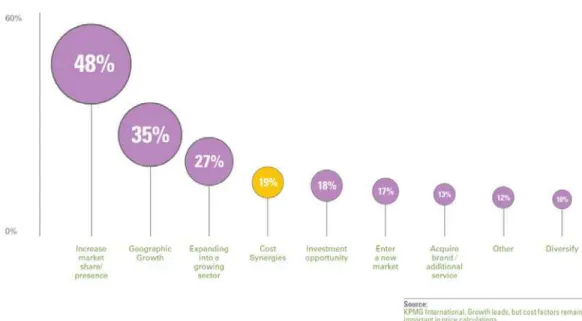
In a research study commissioned by KPMG and released in 2012, 162 deal makers were anonymously interviewed and asked to speak about recent transactions and the motives behind them.7
Figure 1 - What was the rationale behind the acquisition Source: KPMG, A new dawn: Good deals in challenging time, 2012
Based on the survey, respondents said that M&A is mostly driven by five main factors:
1. Growth aspirations: increase market share, geographic growth, expand into growing sector, enter new market, new brand or service, acquire IP/new technology;
2. Synergies: intention to capture synergies (e.g. cost synergies);
3. Transformation agenda: use M&A as a catalyst for corporate transformation (transformational strategy);
4. Risk management: using M&A to diversify investment portfolio and reduce risk;
The variety of reasons for chasing acquisition targets is further explained by Hubbard (2013) who lists analogous or complementary reasons 8 for starting M&A talks:
1. Acquisition of resources: new products, technology, brands, talent management and natural resources);
2. Vertical integration: merging participants of the value chain;
3. Market entry: entering and expanding in new markets and geographies;
4. Following a client: partnering with a client to enter a new geography
5. Economies of scale: merging in the name of size
6. Enhance market share: looking for market dominance
7. Tax incentives: mergers can offer tax advantages
8. Competitive differentiation: achieving differentiation by doing mergers and acquisitions
Harari (1997) also enumerated a number of reasons given by executives to justify a mergers and acquisitions9:
1. Synergies: capturing synergies by merging
2. Cost-savings: saving costs by absorbing internalizing some activities via M&A;
3. Economies of scale: saving by achieving sizable operations;
4. Cross-business: capturing cross selling opportunities
8 Hubbard N. A. (2013) Conquering Global Markets: Secrets from the World’s Most Successful Multinationals,
Palgrave Macmilan, UK
5. Distribution channels for products: acquiring new distribution channels for existing products
6. Products for distribution channels: acquiring new products to be distributed using existing channels
7. Bigger is better: the notion that a size brings bargaining power and market dominance
Jensen (1982) identified another set of reasons that include:
1. Access resources or supply: in an environment of scarce or controlled supply, putting the hands on the source of raw materials can be a key differentiator
2. Technological expertise: acquisition of technology can be accelerated via M&A;
3. Acquisition of talent: sometimes M&A allows to capture new talent professionals;
4. Geographical expansion: relying on M&A to enter new geographies;
5. New products: using M&A to acquire new products;
6. Diversification: Managing risk via diversification
Porter (1980) goes beyond typical value creation motivations for acquisitions and includes the chance of irrational desire of an acquisition target attributable to the idiosyncrasies of its management.10 In other words, pure vanity, eccentricity, and the need to demonstrate power can all be attributed.
These authors have detailed a number of factors that can be categorized into five main common realms:
1. Growth agenda: geographic expansion, new products and brands, increase market share, “bigger is better”;
2. Operational efficiency: cost reduction, synergies, economies of scale, distribution channels, transformation, acquisition of talent;
3. Risk management: diversification, access to resources, guarantee supply, vertical integration;
4. Opportunistic deal: investment or divestment opportunity, tax benefits; and
5. Irrational: eccentricity and vanity.
Alam, Khan and Zafar (2014) conclude that the basic concept behind transactions is the fundamental assumption that two companies together are of more value than those two companies when they are separate stand-alone entities11.
This notion is also shared by Haspeslagh and Jemison (1990). They agree that “the essential task in any acquisition is to create value that becomes possible when two organizations are combined”. The authors go on to further explain that the value created by a merger is distinct and “would not exist if the firms operated separately”, closing the loop saying that “the analysis, negotiation and internal selling of an acquisition candidate and ultimately premium offered are all predicated on this central idea” of value creation by business combination12.
11 Alam, A., Khan, S. and Zafar F. Strategic Management: Managing Mergers and Acquisitions. International
Journal of BRIC Business Research (IJBBR) Vol 3, Number 1, February 2014
12 Haspeslagh, P. and Jemison, D. Managing Acquisitions: Creating Value Through Corporate Renewal, Free
The present-day professional M&A market in Brazil was forged in the middle of the 1990s when the Plano Real (“Real Plan”) promoted macroeconomic stabilization, reduction of inequality, inflation control and contributed to set the basis for the existing regulatory framework in different areas of the economy. As the Brazilian economy continued to strengthen, the country became a fertile land for mergers, acquisitions and joint ventures.
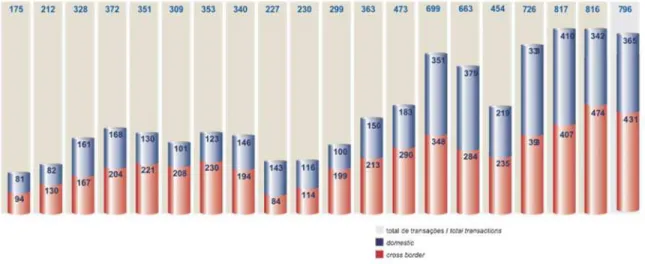
Many sectors in Brazil are under consolidation, which leads to increased M&A activity. The number of transactions grew consistently over the seven years prior to 2013, from 363 in year 2005 to 798 transactions last year.13
Figure 2 – Annual evolution by number of transactions
Source: KPMG, Pesquisa de Fusões e Aquisições 2013 – 4o Trimestre: Espelho das transações realizadas no Brasil, 2014
13 KPMG, Pesquisa de Fusões e Aquisições 2013 – 4o Trimestre: Espelho das transações realizadas no Brasil,
Historically, according to the KPMG M&A Surveys in Brazil, cross-border transactions represent around 40% to 50% of the total number of deals completed and announced, demonstrating that a significant part of the volume of foreign direct investment (“FDI”) attracted to Brazil is directed toward mergers, acquisitions and joint ventures.
The importance of the foreign investor is corroborated by the current massive inflow of capital in Brazil. According to OECD statistics, in 2012 Brazil was ranked third globally for FDI inflows, only behind the U.S. and China. 14
Figure 3 – FDI inflows by country
Source: OECD International Direct Investment Statistics 2013, OECD Publishing
14 OECD International Direct Investment Statistics 2013, OECD Publishing FDI inflows by country - USD Billions (2012)
by crossing OECD and Dealogic statistics15:
Figure 4 - Outward FDI x International M&A
3.2 THE M&A PROCESS
The M&A process can be summarized into three stages: pre-deal, during the deal and post-deal with seven clear work streams. An attempt to link the three transaction stages to the stages of the wedding metaphor are demonstrated below:
I. Pre-deal (the “flirting phase”)
1) Strategy formulation
2) Target screening and approach
II. During the deal (the “engagement phase”)
3) Due diligence
4) Valuation
5) Negotiation
6) Closing (or “Completion”) – the “wedding day”
III. Post deal (the “marital” or the “day after phase”)
7) Integration
8) Consolidation
Gole and Hilger (2009) present a slightly similar process that includes16:
I. Planning – the “flirting phase”
1) Establishment a growth strategy
2) Screening and selecting candidates
II. Investigation – the “engagement phase”
3) Establishment of diligence objectives
4) Validation of value
5) Development of actionable findings
III. Execution – the “marital phase”
6) Negotiation and completion – the “wedding day”
7) Integration
8) Post-deal assessment
3.2.1 Strategy formulation
Gole and Hilger (2009) state that “it is a central tenet of M&A best practice that investment strategy, and acquisitions in particular, should be guided and driven by purposeful strategic planning”. During the strategic review process executives need to address the advantages and disadvantages of organic versus inorganic growth (“buy” or “build” analysis). A central question is whether the organization has the capability to develop the desired competence internally, at what cost and how much time and effort are required. After evaluating that, the executives assess how that would compare to the possibility of buying that competence in the marketplace.
Internal development (build) Acquisition (buy)
Potential
advantages
Control over execution Focused development Control over cost
Speed of execution Cross-company synergies Complementary expertise Removal of a competitor Low market entry risk
Potential
disadvantages
Lengthy execution period Inbred perspective
Uncertain market acceptance Increased competition
High integration risk High entry cost
Unwanted assets and unwelcome liabilities
Source: Gole, W. J, Hilger, P. J. Due diligence: an M&A value creation approach. John Wiley & Sons, Inc. 2009)
Table 1 - Build x Buy (Advantages x disadvantages)
This concept is reinforced by Cullinan and Holland (2002) who believe “the chances for transactional success dramatically improve when the target’s business is aligned with the buyer’s strategic goals”. 17 Hubbard (2013) agrees that pre-acquisition planning is a key factor in the acquisition process and he builds on the idea that without proper planning the acquirer puts himself at risk since it limits the information available for discussion with the target company and jeopardizes the evaluation of synergies and due diligence process. “Understanding the vision and plan going forward is also fundamental to employee retention and gaining ‘acceptance’ and, in some cases, enthusiasm from target employees”.
17 Cullinan, G. and Holland, T. Strategic due diligence- Excerpted from Global deal making: definitive guide to
In real life, transactions can also happen in a reactive way. For example, a seller hires a financial advisor to search for a buyer and this advisor knocks on the door of a number of companies that are supposedly potential buyers. On a number of occasions, some of these buyers who were approached had not been considering an acquisition and therefore were not fully prepared for a deal. Consequently, the process skips two important steps: (1) strategic review and (2) target screening. Instead of a solid understanding of the company’s strategic position and a proactive search for the right target company that fits that strategy, in a reactive approach, the buyer has very little time to plan before jumping into the due diligence process. This is confirmed by Gole and Hilger (2009), “If organizations are continually reacting to deals as they are brought to market, they run the risk of being enticed into randomly acquiring businesses unaligned to their organization goals and objectives”18
3.2.2 Target screening and approach
“Acquisitions are strategic tools”19, suggests Howson (2003), and identifying and approaching an acquisition target is only sensible after a proper strategic review is exercised in which M&A has been identified as the logical means. As previously discussed, a target screening exercise should only begin with the establishment of goals and objectives. According to Jensen (1982), “many companies jump the gun and begin looking without first considering what kind of company would best further their strategic goals”. 20
Jensen (1982) enumerates four phases of the target screening and approach process:
1) Defining objectives: an acquisition-minded company should start the process by determining the three or four most important strategic benefits that an ideal acquisition would provide.
18 Gole, W. J and Hilger, P. J. Due diligence: an M&A value creation approach. John Wiley & Sons, Inc. 2009 19 Howson, P. Due diligence: the critical stage in acquisitions and mergers. Gower Publishing Limited, 2003,
Reprinted 2008
2) Establishing criteria: the buyer should define measures and attributes, in line with strategic objectives, that are important to define the target company. These attributes could be size, geographic presence, technologies, talent or certain resources, for example. If the objective is to conquer a specific region, the target company needs to have a presence in that region. If the goal is to increase revenue by 40%, the target company needs to be large enough to enable revenue synergies to achieve the objective of 40% revenue growth.
3) Identifying candidates: the screening process is based on market research, public and private databases, industry and trade associations, consultants and subject matter experts.
4) Finding information: once potential candidates have been identified, the next task is to qualify those candidates by gathering information on them available to the public to determine which are most suitable. This is a process that requires time and organization. Sources of information include annual reports, credit reports, financial statements, newspaper articles, trade magazines, analysis reports and interviews with market participants, regulators, industry observers and analysts.
5) Contacting prospects: the final step is to contact top prospects, either directly or via the use of an intermediary. The purpose of the first contact is not to make a deal, but rather to arrange a meeting to make an introduction and if possible understand the so-called “willingness to transact”.
date. Getting from the first approach to a deal can take a long time and according to Howson (2003), can produce extreme reactions: “some potential vendors will rejoice, thinking they are about to get rich, others may be deeply offended, others say ‘no’ when they mean ‘yes’ and yet others go away only to come back again”. These reactions are the result of not only a company’s corporate culture and transaction background, but also the personalities of those involved. Howson (2003) concludes that “if a deal is to happen at some point both parties will perceive a mutual interest and decide to take preliminary discussions further”.
Again, according to Howson (2003), “If an approach does lead to mutual interest, both parties will want to begin serious negotiations” and if “there is sufficient agreement between them to continue” the “due diligence can therefore begin”.
Note: in a sell-side situation, the process is quite similar and instead of screening to identify an acquisition target, the company is performing an investor search.
3.2.3 Due diligence
It is at the due diligence period where the two companies agree to get to know each other better and share critical and strategic information, particularly on financial, commercial, operational, people, legal and tax aspects. Due diligence is a detailed investigation of the target company and its results will support the negotiations, valuation, deal structuring and post-deal integration.
Due diligence is one of the most important procedures used to study, investigate and evaluate a transaction. As explained by Bing (1996), “it normally occurs after the parties involved in a deal have decided the deal is (…) feasible and after a preliminary understanding has been reached (or appears reachable), but before a binding contract is signed”.
Due diligence is a process tailored to the needs of the parties involved and usually entails looking at historical data, prospective information and to some extent the physical condition of the assets and/or talent to be acquired. In short, as defined by Bing (1996), it is the “verification that the investment complies with the investor’s criteria”, as defined during the target screening exercise.
Howson (2003) lists 14 types of possible areas to be covered during a due diligence exercise. He highlights the Financial, Legal and Commercial areas as the most common due diligence topics. As secondary topics, it is possible to see due diligence exercises covering Human Resources & Culture, Management, Pensions, Tax, Environmental, Information Technology (IT), Technical, Operational, Intellectual Property Rights (IPRs), Property, Antitrust, Insurance & Risk areas.
Table 2 - The main due diligence topics
Due diligence topic Focus of inquiries Results sought
Financial Validation of historical information, review of management and systems
Confirm underlying profit. Provide basis for valuation
Legal Contractual agreements,
problem-spotting
Warranties and indemnities, validation of all existing contracts, sale and purchase agreement
Commercial Market dynamics, target's competitive position, target's commercial prospects
Sustainability of future profits, formulation of strategy for the combined business, input to valuation
Due diligence topic Focus of enquiries Results sought
Human Resources and culture
Make-up of the workforce, terms and condition of employment, level of commitment and motivation, organizational culture
Uncovering any employment liabilities, assessing the potential Human Resources costs and risks of doing the deal, prioritizing the HR issues that need to be dealt with during integration, assessing cultural fit, costing and planning the post-deal HR changes
Management Management quality, organizational
structure
Identification of key integration issues, outline of new structure for the combined business
Pension Various pension plans and plan
valuations Minimize the risks of underfunding
Tax Existing tax levels, liabilities and
arrangements
Avoid any unforeseen tax liabilities, opportunities to optimize position of combined business
Environmental
Liabilities arising from sites and processes, compliance with regulations
Potential liabilities, nature and cost of actions to limit them
IT Performance, ownership and
adequacy of current systems
Feasibility of integrating systems;
associated costs. IT plans for the operational efficiency and competitive advantage
Technical Performance, ownership and
adequacy of current technology
Value and sustainability of product technology
Operational Production techniques, validity of
current technology
Technical threats; sustainability of current methods; opportunities for improvement; investment requirements
Intellectual Property Rights (IPRs)
Validity, duration and protection of
patents and other IPRs Expiration; impact and cost
Property Deeds, land registry records and
lease agreements
Confirmation of title. Valuation and costs/ potential of property assets
Antitrust
The various national filing
requirements (some of which can be expensive if not complied with); degree of market/information sharing with competitors
Merger control filing and clearance; an assessment of any antitrust risks posed by the target's activities; an assessment of the enforceability of the target's contracts
Insurance/Risk
Present, future and, most
importantly, past exposures of the business. The structure and cost of the existing program
The costs and benefits of retaining risk versus transferring it
Bing (1996) lists topics to be covered by the due diligence exercise without defining the field it fits into. Topics include Capital structure and Ownership, Management, Products and Services, R&D and Technology, Real Estate and Facilities, Markets, Competition and Customers, Marketing, Pricing, Advertising and PR, Manufacturing, Purchasing, HR, Employee Compensation and Benefits, Corporate Culture, Legal, Information Systems, Budgeting and Planning, Insurance and Bonding, Environmental, Debt and Banking, Investments and Cash Management, Taxes, Accounting, Cash, Accounts Receivables, Inventory Fixed and Other Assets, Liabilities, Backlog and Income Recognition, Cost of Sales, Selling and Administrative Expenses, Intercompany Transactions, Investment Issues.
Drastic consequences can result from the failure to perform proper due diligence, overlooking critical areas, and particularly non-financial matters. According to Bing (1996), “financial statements provide thumbnail sketches of a business and its history, supplying few clues and insights into a company’s present, and (…) a reasonable guess of its near-term future”.21
Note: in a sell-side situation, the seller prepares for the due diligence to be performed by the acquirer. In a merger of equals, reciprocal due diligence is applicable.
3.2.4 Valuation
The gifted professor and respected valuation authority Aswath Damodaran uses Oscar Wilde’s definition of a cynic to make a distinction between value and price: he is the one who “knows the price of everything and the value of nothing22”. According to Damodaran “that characterization would fit many investors who regard investing as a game and define winning as staying ahead of the pack”23.
Deal usually goes ahead when valuation portrays a win-win situation for both acquirer and seller (Gole and Hilger, 2009). For the acquirer, the combined value of the acquirer business to the buyer exceeds the purchase price and for the seller the amount received is higher than other alternatives, including continuing to own the stand-alone business.
21 Bing, G. Due Diligence Techniques and Analysis: Critical Questions for Business Decisions. Quorum Books.
Westport, Connecticut. 1996
22 Wilde, O. The Picture of Dorian Gray. Enhanced Books, 2014 (First Published in Lippincott’s Magazine, June
1890)
23 Damodaran, A. The Little Book of Valuation: How to Value a Company, Pick a Stock, and Profit. John Wiley
is unlikely to destroy value (Gole and Hilger, 2009).
3.2.5 Negotiation
Naturally, negotiations start at the beginning of the process (e.g. when approaching the counterparty) and continues until the closing of the transaction.
The critical stage in negotiations is right after the due diligence when due diligence findings are aggregated and factored into the valuation model to determine the combined value of the acquisition (Gole and Hilger, 2009). If the value of the target company is lower than previously thought, a higher premium is required to be paid and it could lead to a renegotiation of the terms of the transaction.
3.2.6 Closing, Integration and Consolidation
Closing is the action of signing the Sales and Purchase Agreement (“SPA”). This is equivalent to a “yes” in a wedding. After the closing, there is no way back. The merger is completed.
4 RESEARCH METHOD
4.1 INTRODUCTION
As previously discussed, one basic question encouraged this study: After all the effort, expectations and money usually invested in dealmaking, why are so many transactions simply abandoned, even when the benefits are clear for the business, shareholders, customers and employees?
This study is characterized as an exploratory qualitative research approach. According to Chizzotti (1995), exploratory research generally “provokes the clarification of a situation to raise awareness of it”24. This research method was chosen to offer specialized techniques for obtaining information25 (Bauer and Gaskell, 2003), which results in rich and substantive descriptions of the phenomenon being studied26 (Vieira, 2004).
The qualitative approach was chosen, mainly, due to difficulty of collecting statistical data on potential factors contributing to deal failure. Merger talks collapse for a number of reasons, objective and subjective. This type of information is usually confidential, treated with a lot of discretion and motives behind failure are usually not disclosed. According to Neves (1996), “qualitative research (...) comprises a set of different interpretative techniques which aim to describe and decode the components of a complex system of meanings”27.
Exploratory research is characterized by its flexibility and versatility with respect to methods and is more appropriate when there is little accumulated and systemized knowledge28 (Vergara, 2000).
The qualitative research conducted aimed to extract impressions and experiences from executives directly involved in promising M&A talks that collapsed. The source of information
24 Chizzotti, A. Pesquisa em Ciências Humanas e Sociais. São Paulo. Cortez, 1995
25 Bauer, M. W. e Gaskel, G. [ed.] Pesquisa qualitativa com texto, imagem e som. Um manual prático.
[Qualitative Researching with Text, Image and Sound: a Practical Handbook] (P. A. Guareschi, Trans.) Petrópolis: Editora Vozes, 2003
26 Vieira, M.M.F. Por uma boa pesquisa qualitativa. In Vieira, M.M.F., Zouain, D.M. (Org). Pesquisa qualitativa
em administração. Volume 2. Rio de Janeiro, FGV, 2004
27 Neves, J.L., Pesquisa qualitativa: características, usos e possibilidades. Caderno de pesquisa em
administração. FEA-USP. São Paulo, V.1 N.3 2º Semestre, 1996
professionals, private equity, advisors, and investment bankers.
In exploratory research studies, the concept of representation of the sample is not applicable. From the sample chosen for convenience, data collection was done through 16 in-depth interviews which aimed to extract the greatest possible amount of objective and subjective elements linked to the formation of a decision taken to abandon a transaction. The 16 interviewees were chosen based on their level of experience and roles played in the transaction processes. The objective was to cover the whole deal flow.
The proposal of this work, which has never been done before on this subject in the mainstream academic space, is to investigate the reasons that lead to 'transaction cold feet’ in order to reveal something that is usually omitted, not disclosed in press releases, underexplored in terms of depth by both the popular and specialized press, and rarely discussed in detail by the parties involved.
4.2 SCOPE AND APPROACH
The qualitative approach focuses on how people interpret and give meaning to their experiences and the world in which they live. The researcher uses a qualitative approach to explore the behavior, perspectives and experiences of the people involved in the object of study. It can be said that aspects of a qualitative investigation focus on how humans interpret and make sense of their reality.
The qualitative research method is interpretative rather than descriptive (Vergara, 2000). Therefore, one of the advantages of this method is that it allows you to change the direction of the investigation once ideas or data are discovered or continue until the possibilities are exhausted or another direction is discovered (Bauer and Gaskell, 2003).
In exploratory research studies, the concept of representation of the sample is not applicable. From the sample chosen for convenience, data collection was done through 16 in-depth interviews which aimed to extract the greatest possible amount of objective and subjective elements linked to the formation of a decision taken to abandon a transaction.
Therefore, the technique of sampling for qualitative research purposes is classified as non-probabilistic. According to Malhotra (2001), non-probabilistic sampling relies on the personal judgment of the researcher, and not on the possibility to select sample elements29. Consequently, the researcher can arbitrate or, consciously, decide which elements should be included in the sample. The non-probabilistic samples can provide good estimates of population characteristics, but do not allow an objective evaluation of the precision of the sample results. Since there is no way to determine the probability of choosing any particular element for inclusion in the sample, the estimates obtained are not statistically projectable to the population.
4.3 INTERVIEWS
The research was conducted in 2014, between March and June. In this period were made 16 individual interviews with open questions. After each interview, the data was analyzed to detect recurring ideas, links and to understand the correlation between the different dialogues as well as different points of view.
The body of data comes from executives, of both genders, who are actively working on M&A processes and witnessed at least one transaction that was not completed, in which at least one of the parties involved was a Brazilian company. The body of data, therefore, is non-probabilistic, selected for convenience.
whole deal flow:
Strategy and Business development (“BD”) professionals usually brought in
before the deal takes shape and with direct contact with top management considering (or not) deal making. Strategy and Business development professionals usually participate before, during the deal, and sometimes after.
Deal management professionals are individuals hired to coordinate the M&A
process, negotiate, value e close the deal. The Deal Management professionals are usually responsible for target (or investor) approach; liaising with due diligence and valuation teams and attorneys responsible for drafting the SPA.
Due diligence professionals run the transaction evaluation (e.g. due diligence)
process
Legal advisors are responsible for drafting the SPA and performing legal due
diligence
Integration professionals are consultants hired to perform Post Deal Integration
work. These professionals not rarely are brought in during the due diligence phase.
To unveil the underlying drivers of the non-deal phenomena, the choice was to perform face-to-face interviews with professionals with extensive experience in deal making. These specialists were selected for having experience in transactions that did go through but also participated in merger talks that were never completed.
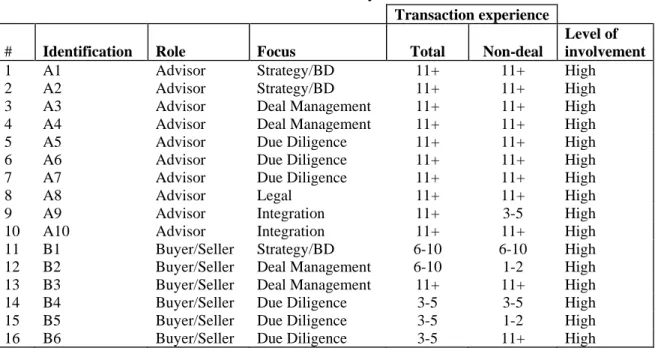
We grouped the interviewees in two groups: (A) Advisor and (B) Buyer/Seller. For confidentiality reasons, names were omitted.
Table 4 - Advisor and Buyer/Seller
Transaction experience
# Identification Role Focus Total Non-deal
Level of involvement
1 A1 Advisor Strategy/BD 11+ 11+ High
2 A2 Advisor Strategy/BD 11+ 11+ High
3 A3 Advisor Deal Management 11+ 11+ High
4 A4 Advisor Deal Management 11+ 11+ High
5 A5 Advisor Due Diligence 11+ 11+ High
6 A6 Advisor Due Diligence 11+ 11+ High
7 A7 Advisor Due Diligence 11+ 11+ High
8 A8 Advisor Legal 11+ 11+ High
9 A9 Advisor Integration 11+ 3-5 High
10 A10 Advisor Integration 11+ 11+ High
11 B1 Buyer/Seller Strategy/BD 6-10 6-10 High
12 B2 Buyer/Seller Deal Management 6-10 1-2 High
13 B3 Buyer/Seller Deal Management 11+ 11+ High
14 B4 Buyer/Seller Due Diligence 3-5 3-5 High
15 B5 Buyer/Seller Due Diligence 3-5 1-2 High
16 B6 Buyer/Seller Due Diligence 3-5 11+ High
Source: Interview program. Prepared by the author
This study aims to investigate a subjective concept. The option to conduct in-depth interviews as a data collection technique can be justified as long as it promotes a greater understanding of the motivations, beliefs, attitudes, and feelings about a particular underlying subject (Malhotra, 2006).
In-depth interviews further explore the reasons that lead to a particular reaction as a result of the facts or situations presented (Bauer e Gaskell, 2003).
favorable reasons include altruism, the pursuit of emotional satisfaction and intellectual satisfaction”30 (Lodi, 1991).
The questions, which were relative open, were conducted according to the characteristics of the interviewee and flowed according to their personal experience and willingness to share. However, a malleable free script with relevant questions on the subject was used as a guide during these interviews in order to contextualize the topic under investigation and better understand the depth of the respondent's relationship with the M&A process, for example:
1) What is your role in the transaction?
2) How many transactions have you participated in?
3) How many have you seen abandoned?
4) How active was your participation in these processes?
5) In your opinion, based on your personal experience, what factors lead to the abandonment of a transaction? Think about an emblematic transaction that you have participated which was not completed. What contributing factors lead one or the two parties to walk away from the deal? Is there a price for walking away from a deal? Please comment.
7) Finally, have you witnessed transactions that were not supposed to be completed, which one or the two parties demonstrated ‘cold feet’ or hesitation but at the end decided to go ahead? What were the consequences? Please comment.
An analysis of the content was used to treat the information collected. It is an “extremely useful analysis technique, especially in qualitative research, which emphasizes the need for systemization of testimonials and relies on the study of language”31 (Dellagnello e Silva, 2005). Still, according to Gill (2003) there is no single perspective on content analysis, but rather a number of different styles of analysis32.
At the pre-analysis stage, transcription of testimonials was performed, which were then examined and organized by certain factors that culminated in the abandonment of the transaction. At the end, the data was interpreted with the objective of extracting, from the information gathered, the relationships between message elements and the simultaneous presence of two or more elements in a testimonial.
Interviewees are actively working professionals and based in the cities of São Paulo and Rio de Janeiro and selected by accessibility of the author via professional networks.
4.4 SCOPE LIMITATIONS
The reliability criteria for qualitative research should not relate to those of quantitative research, particularly with reference to the representation of the respondents when compared to the broader population.
A number of limitations could be considered when assessing the results of this study, including the fact that the sample consisted of 16 participants. It should be pointed out that the concept of a representative sample does not apply to this research study, making it impossible to generalize the results in relation to any definable population (Bauer and Gaskell, 2003).
Qualitative research is a discovery or exploratory process (Vieira, 1996) and the most appropriate method to understand phenomena for which there is not much knowledge available (Vergara, 2004), which is the case for deal making failure, hesitation or ‘cold feet’ in transactions.
31 Dellagnello, E. H. L. E Silva, R.C. Análise do conteúdo e sua aplicação em pesquisa de administração. In
Pesquisa qualitativa: teoria e prática. Volume 2. Rio de Janeiro. FGV, 2004
32 Gill R. Análise de Discurso. In Bauer M.W., Gaskell G. Pesquisa qualitativa com texto, imagem e som: um
Furthermore, although the nature of exploratory probing does not allow the formulation of hypotheses a priori (Vergara, 2000), it is believed that through analysis of the testimonials collected it is possible to generate new assumptions which may be useful to further explore the topic and conduct future research studies, thus contributing to develop knowledge on business administration in general and, more specifically in the field of Mergers and Acquisitions.
The interviews seem to have achieved some reasonable level of empirical saturation3334 (Glasser and Strauss, 1967; Strauss and Corbin, 1998) and indicated specific conclusions.
Finally, the information gathered consisted mostly of recollections and interpretations of the interviewees, a group of active seasoned professionals with valuable insights and vast experience and knowledge about deal making. It is important to mention that, as individuals, they could have introduced bias and subjective elements from their diverse personal involvement with the subject under study: the “No-deal” phenomena. Additionally, the diverse sample may mask important trends and findings if the study were made among a particular subset of participants.
33 Strauss, A. L. and Corbin, J. M. Basics of qualitative research: techniques and procedures for developing
grounded theory. Sage Publications Inc., 1998
34 Glaser, B.G. and Strauss, A.L. The Discovery of grounded theory: strategies for qualitative research. Chicago.
5 DATA ANALYSIS
5.1 FINDINGS AND DISCUSSIONS
In this section of the study, it is presented the analysis of the interviews performed as well as the information gathered, key findings and interpretation. When interpreting the data, the focus was directed to the contributing factors to the collapse of merger talks. Interviewees were very collaborative and the rich data obtained from the interviews was filtered so it is presented only the information relevant to the study, instead of state them all, because it could disturb the reader.
The data is presented following the logic order of the conversations with the interviewees:
1) The typical roles in a transaction; 2) The usual deal flow;
3) When usually a merger talk collapse;
4) Common factors contributing to the collapse of merger talks; 5) The price for walking away from a deal; and
6) Other considerations.
5.1.1 What are the typical roles in an M&A process?
As confirmed by the interviews, the roles performed in transactions are directly related to which party the professional is representing (e.g. buyer, seller, advisor), combined with its contribution to the deal evaluation (e.g. strategy, due diligence, valuation) and the different stages of the transaction process (e.g. pre-deal, during the deal, post-deal).
The main actors in a deal are:
Buyer and seller
to another company.
In a so-called merge of equals, the figure of buyer and seller might be not very clear or easy to identify; in certain cases not even present at all. If the new merged company maintain a 50/50 shareholding structure with no special powers or benefits to any of the parties.
Buyers and Sellers can be grouped by its nature: Corporate or Private Equity. Corporate includes public (listed companies) and private companies. Private Equity is usually composed by investment firms dedicated to investment in the private equity of operating companies and they make a living by acquiring, fixing and selling business.
Finally, based on the origin of capital, Buyers and Sellers can be classified between domestic (Brazilian) and foreign companies. Interviewees also groped companies based on the type of capital: family-owned, public (listed) companies, multinationals and state-controlled entities.
Note that governments and state-owned companies can go shopping and, according to interviewees, their motives and rational to engage in a deal involve a reasonable level of political interest.
Advisors
Advisors support buyers and sellers to source, evaluate and manage a deal. They usually work side by side with executives in blended teams or in supporting functions feeding decision makers. The number of advisors can be large depending on the size and complexity of the transaction.
The perimeter of the work of advisors can vary a lot but typical scope work can be grouped according to the deal stages.
During the pre-deal phase, buyers and sellers are evaluating the opportunities to invest in a market or divest a business. In this phase is generally not uncommon for CEOs, CFOs and Boards to get an external view to develop or validate Strategy formulation process.
Stage 2: Deal advisory
Deal advisory starts with the identification of targets for acquisition or potential investors to invest in a company. Buyers and sellers can make use of advisors to manage the deal. The work involves negotiation and project management. The deal manager will coordinate other advisors and internal teams with view to close the best possible transaction. The remuneration is based on success fee and is role played by specialized financial advisory firms, M&A boutiques and investment bankers.
During the deal is also performed due diligence, valuation and the drafting of key deal documents, including memorandum of understanding, offer letter and the SPA.
Stage 3: Post deal advisory
Post deal advisory is usually consultancy dedicated to plan and execute a smooth integration process, preparing the merging companies for the Day 1 and after. They also work on calculating and validating synergies. Aside from integration teams, in the post deal phase, a number of consulting work can be used to support the new merged entity.
5.1.2 What is the usual deal flow?
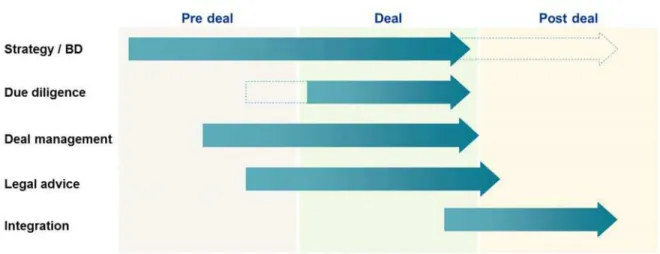
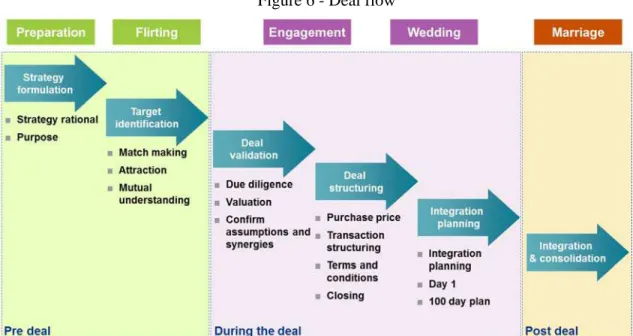
Interviewees confirmed the deal flow previously discussed in the literature review, explaining that in practice some of the phases tend to run concomitantly, so there is some level of flexibility how things are done in practice. They also corroborated that merger talks tend to collapse as the companies start to get to know each other in more detail; relatively similar to what happens during the engagement phase of the ‘flirting, engagement and wedding’ analogy. The more you know more susceptible are you to see beyond the first impression.
With the contribution from literature and the interview program, we propose the following deal flow:
Figure 6 - Deal flow
Source: prepared by the author
5.1.3 Is it possible to determine where does usually a merger talk collapse?
As previously discussed, not all M&A processes reach a successful conclusion. As the parties become more and more familiar with one another, sometimes a negative perception emerges that the opportunity for potential value creation does not compensate for the cost of merging. In these cases, one or both parties decide to abort the negotiations and walk away from the deal. “Deal breaker” is the industry jargon for an issue that, if unresolved during negotiations, would cause one or more parties to walk away from a deal.
According to the interviews, merger talks usually collapse somewhere between deal validation and deal structuring, specifically during or right after the due diligence.
“It’s at the due diligence when information is exchanged and skeletons in closet can be unveiled” (Advisor, Deal management)
“All relevant issues discovered during the due diligence exercise will impact valuation [purchase price], terms and conditions of the deal to be closed as well as the structure of the deal. Sometimes, the risks are so high that surpasses the price to be paid by the target, destroying the deal”. (Advisor, Deal management)
“It’s during the due diligence when deal breakers arise”. (Buyer/Seller, Due diligence)
“A risk revealed during the due diligence phase may be manageable with proper deal structuring. Depending on the situation, certain measures can be adopted to try shielding the merged entity or ‘newco’. This is particularly valid for tax, labor and legal risks. Advisors bring their market experience to design mechanisms to mitigate the risks, without eliminating them, but bringing a better level comfort to the parties involved.” (Advisor, Legal)
“In certain cases, the deal structure proposed by the sellers need to be negotiated. Sometime the transaction falls apart because of lack of flexibility between the parties. Obviously, it all involves cash to be paid or received and respective timing of cashing it.” (Buyer/Seller, Deal management)
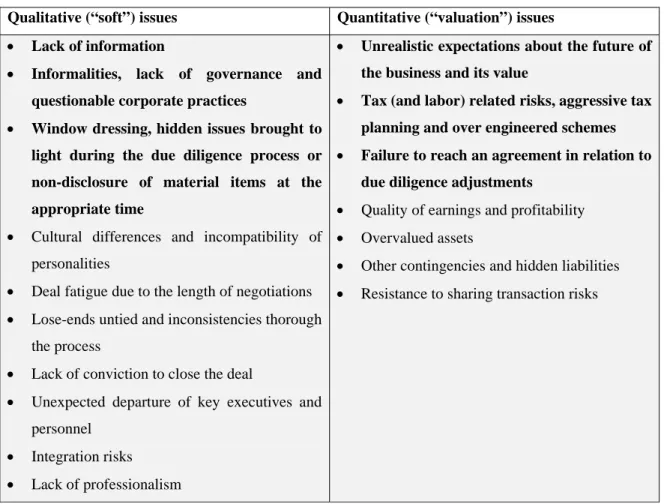
Analyzing the results of the interview program, it is possible to classify deal breakers into two categories: qualitative and quantitative.
Qualitative issues are difficult to be measured in numbers but can represent real thread to the deal, the acquirer or the new merged entity. Quantitative issues can be translated into numbers and factored in the purchase price, adjusting the valuation model and/or normalizing multiples.
Although a number of issues were reported, six main topics were recurrently attributable to having a great influence on deal collapse:
1) Window dressing;
2) Unrealistic expectations in relation to the valuation of the business;
3) Tax related risks, aggressive tax planning and over engineered schemes;
4) Lack of information during the due diligence exercise;
5) Disputes of interpretation and failure to reach an agreement in relation to due diligence proposed adjustments;
Table 5 - Qualitative x Quantitative issues
Qualitative (“soft”) issues Quantitative (“valuation”) issues
Lack of information
Informalities, lack of governance and questionable corporate practices
Window dressing, hidden issues brought to light during the due diligence process or non-disclosure of material items at the appropriate time
Cultural differences and incompatibility of
personalities
Deal fatigue due to the length of negotiations Lose-ends untied and inconsistencies thorough
the process
Lack of conviction to close the deal
Unexpected departure of key executives and
personnel Integration risks Lack of professionalism
Unrealistic expectations about the future of the business and its value
Tax (and labor) related risks, aggressive tax planning and over engineered schemes
Failure to reach an agreement in relation to due diligence adjustments
Quality of earnings and profitability Overvalued assets
Other contingencies and hidden liabilities Resistance to sharing transaction risks
According to the interviewees, it is not uncommon that, in preparation for a sales process, many target companies make debatable adjustments to the financial statements and management reports to make the rosiest possible picture to potential buyers. This can jeopardize credibility and eventually lead to the merger talk collapse.
“Numbers that have no proper support forecasts based on wishful thinking, hidden issues brought to light during the due diligence process or non-disclosure of material items at the appropriate time are typical manifestation of window dressing in transactions. This obviously impacts trust, which is fundamental for any type of negotiation, particularly in M&A” (Advisor, Due diligence)
5.1.4.2 Unrealistic expectations in relation to the valuation of the business
Different expectations in terms of value of the business being sold or merged was the second most common issue reported by the interviewees.
“It is normal to see gaps in the expectations between sellers and buyers. The more sophisticated the seller is, less dissonance will be seen in the negotiation. For example, I have seen cases where the sellers do not have a clear idea of what a discount cash flow is and what they have in mind in a multiple thrown in the air by some amateur advisor. This creates a lot of confusion and at the end we have to try educating the seller on how to proper value a business. The problem is that when the seller has a number in the head is difficult to override it.” (Buyer/Seller, Strategy/BD)
5.1.4.3 Tax (and labor) related risks
The tax environment in Brazil is complex, it changes with some frequency and the burden is one of the highest in world. According to interviewees, it is not uncommon to see Brazilian companies, particularly family-owned business and mid-size companies trying to reduce the burden.
schemes to reduce tax burden can have a direct impact on the perception of risk and consequently the valuation of the company to be acquired” (Buyer/Seller, Due diligence)
“Tax evasion is more difficult with the new tax electronic systems in place (e.g. SPED) but still out there” (Advisor, Due diligence)
5.1.4.4 Lack of information (or preparation)
“There is nothing more frustrating for us than signing a non-binding offer, kick-off the due diligence period and realize the target company is not prepared for the deal. There was this particular transaction where the information was so scarce and we had to hire an accounting firm to reconstruct the target company accounting and build information for us so we could analyze and evaluate the business opportunity. Sellers were managing the business on a cash basis and had very little structured financial information to share. This transaction was a pain. We tried very hard because it was an interesting asset in a geography that was key for us to expand into… but after months digging the scarce information available we decided to walk away.” (Buyer/Seller, Strategy/BD)
5.1.4.5 Failure to reach an agreement in relation to due diligence proposed adjustments;
At the end of the due diligence period, buyer and seller get together to discuss the key due diligence issues and respective impacts on the negotiation and valuation of the target company as well as mechanisms to mitigate risks identified during the process.
“During the financial due diligence we tend to focus on assets that could be overstated or with risk of realization, unrecorded liabilities or hidden contingencies, working capital trends, CAPEX trends. On the income statements side, we investigate the quality of earnings, non-recurring items impacting EBTIDA, related party transactions, provisions, allocations, capitalization of expenses and cut-off issues. The due diligence report includes a summary of all adjustments identified with will feed the valuation model and price negotiations. Obviously, there are cases were the perception of risk of the sellers are very different than buyers and it creates an impasse, sometimes, difficult to reconcile… and the deal collapses. (Advisor, Due diligence).
Questionable practices, informalities and lack of governance were listed by interviewees as one of the main factors contributing to merger talks collapse.
A seasoned due diligence advisor summarized well the sentiment shared by most interviewees:
“Talking about deal making in Brazil, I understand there cases that may lead to the abandonment of a transaction due to qualitative issues, particularly those involving reckless management, fraudulent acts, criminal and clearly contrary to the laws are those that can have weight in the decision. Still, this decision depends on the type of investor and objectives of the transaction. Institutional investors (PE's, Investment Funds and the like) are more reluctant to treat such issues as listed above. However, Brazilian strategic investors may have a more complacent view (in the sense of being able to resolve the situation in the 'post-acquisition') because of the necessity of acquisition of the asset (or entity, or technological knowledge, or withdraw a potential competitor) .The price drop is also related to the type of investor. Funds and PE's may resent the gains (short and medium term) that could be assessed given the potential of the target company was not acquired. Strategic buyers may face a future major competitor, or fail to acquire certain knowledge or technology that could lead to a jump in levels of revenue, EBITDA and market share. In general, the most visible consequences at first are issues involving litigation and contingencies (materialized and not materialized) arising from tax, tax and labor issues. But concerns about fraud, and acts and conduct contrary to the laws also imposed itself as probable future problems. Having said that, I perceive a clear distinction between Brazilians and foreign investors: local deal makers are more complacent and tolerant in relation to ethical issues. U.S., European and Japanese investors are very much concerned about reputational risk and FCPA type of issues.” (Advisor, Due diligence)
Another interviewee confirmed: