EFFICIENCY OF A NEW DOMESTIC CARBOHYDRATE-PROTEIN PRODUCT IN THE PRACTICE OF TRAINING ELITE ATHLETES
Vdovenko N.V.1, Ivanova A.M.1, Khrobatenko О.V.2, Rossokha G.V.1, Kostyuchenko V.I. 3 State Scientific Research Institute of Physical Culture and Sports1
Kyiv National University of Trade and Economics2
The National University of Physical Education and Sport of Ukraine3
Annotation. The effect of the use of the new course of the carbohydrate-protein product on the performance efficiency of skilled athletes (Greco-Roman). In the experiment involved 14 athletes aged 18-25 years who gave written consent to participate in the study. Developed and clinically tested a specialized carbohydrate-protein food product. The drink contains in its composition: glucose, sucrose, whey protein concentrate, creatine monohydrate, citrulline malate, mineral complex and ATP-lipid complex. The study was conducted in two micro-cycles (2 weeks). Athletes take a drink as follows: pre-workout (30-40 minutes) - 250 ml of the drink, after a training session during the recovery period - 250 ml of the drink. It is established that the use of the drink has a positive effect on the performance of athletes performance during the execution of a sub-maximal anaerobic power in the area of energy supply. Argues that course application beverage reduces the severity of manifestations of lactate acidosis after exercise by improving the utilization of lactate. Found a significant decrease in the concentration of lactate in the blood of athletes in the 7th minute of recovery in relation to the original data.
Key words: greco–roman wrestling, performance, ergogenic factors.
Introduction1
The current system of elite athletes training cannot exist without the implementation of new technologies and the use of the latest scientific developments. One of the aspects of optimizing training and competitive activities of elite athletes is the additional stimulation of physical performance and body recovery after intense physical and psycho-emotional overload on the edge of the limits of the human possibilities [1, 4].
Solving the problem of rational use of modern effective ergogenic means and methods that not prohibited the practice of training athletes is impossible without research. Study should be aimed on the development and testing of effective means for elite athletes and concerning to the individual characteristics of the organism, sport specifics and training period.
Selection the aforementioned means and techniques, aimed at improving the process of Greco-Roman elite wrestlers training, has to solve a number of important tasks [5, 8]:
• improve the physical performance of athletes by increasing the adaptive capacity of the athlete organism during training load and competitive events;
• accelerate functional recovery of an athlete after strenuous exercise;
• improve and accelerate the adaptation of athletes to various climatic and geographical conditions of training and competition activities (middle mountain, humid and hot climate, an abrupt change in time zones during flying and desynchronization that occurs as a result, etc.).
• prevent the emergence pathological changes, impaired of body functions and so on.
Concerning to great importance and practical significance of natural products with ergogenic effect in sports of higher achievements staff of laboratory ergogenic factors in sport (State Research Institute of Physical Culture and Sport) in cooperation with experts from the Department of commodity science and examination of food products (Kyiv National University of Trade and Economics) designed and clinically tested specialized carbohydrate-protein product. The drink contains: glucose, sucrose, whey protein concentrate, creatine monohydrate, Citrulline Мalate, mineral complex and ATP-loaded liposomes.
Aim, material and methods.
The aim of research - to examine the impact of the new carbohydrate-protein product course intake on the physical performance of high-level wrestlers.
Greco-Roman elite wrestlers (male, age 18–25 years) participated in research. Our study took place before competition period and all athletes were practically healthy.
14 wrestlers gave written consent to participate in the study after they had received oral and written explanations about the purpose, procedures and potential risks of the study.
All experimental procedures were approved by the Bioethics Commission of the State Scientific Research Institute of Physical Culture and Sports. The main studies have been conducted in the laboratories of the State Scientific Research Institute of Physical Culture and Sports.
We estimated the level of athletes’ functional performance with the using bicycle ergometer Ergomedic 894 C Monark (Sweden). The participants warmed up by pedaling for 10 min at 60 rpm. After a standard recovery period athletes performed the maximum possible intensity work which was achieved by the maximum number of bicycle pedaling turns with 10% of athletes` body weight (Wingate test) [6, 10]. We took capillary blood sampling on the third and seventh minute of recovery for determining lactate and glucose concentrations. Concerning to the results of Wingate test we defined the absolute and relative values of peak, average and minimum power during all the work and also average values of mean power for every 5 sec. Testing the athletes on bicycle performed twice - at the beginning and end of the study. Before each testing athletes had a day off.
The concentration of lactate and glucose were determined in athletes` peripheral blood with use of biochemical analyzer LP-400 firms "Dr. Lange" (Germany).
Individual typological characteristics of higher nervous activity and sensorimotor reactions (neural properties) were investigated with use of computer systems "Diagnosis 1" [3].
The optimal mode (the definition of simple and complex visual-motor reactions) and mode imposed rhythm (determination of the functional mobility level and strength of nervous processes) were used in our investigation.
Memory function was studied using a test that determine the amount of short-term memory. The volume of short-term memory is defined in percentages.
Methods of assess human`s perception of time are using for diagnosing the fatigue and athletes` emotional intensity [2].
Perception of time were investigated using the modified test Halberg F. (1978) "Individual minute". The error was estimated by given time interval, 30 seconds.
Statistical analysis of the research`s results carried out using a software package «GraphPad Prism version 5.00 for Windows» (GraphPad software Inc., USA). Significance of differences was determined using nonparametric statistical methods (p ≤ 0,05).
Results.
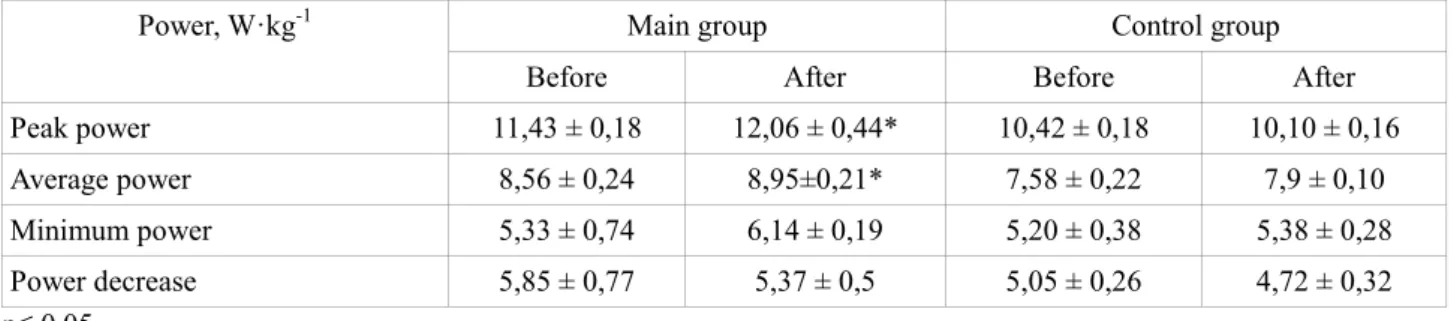
Our data indicate that course intake the carbohydrate-protein beverage has a positive effect on performance of athletes during submaximal work power in anaerobic energy supply. Table 1 shows the values of anaerobic power of wrestlers that were received during the 30-seconds maximal exercise test on bicycle "Monark Peak Bike".
Table 1 Effect of course intake carbohydrate-protein beverage on athletes` performance during the 30-seconds maximal
exercise test on bicycle "Monark Peak Bike" (X ± σ)
Power, W·kg-1 Main group Control group
Before After Before After
Peak power 11,43 ± 0,18 12,06 ± 0,44* 10,42 ± 0,18 10,10 ± 0,16
Average power 8,56 ± 0,24 8,95±0,21* 7,58 ± 0,22 7,9 ± 0,10
Minimum power 5,33 ± 0,74 6,14 ± 0,19 5,20 ± 0,38 5,38 ± 0,28
Power decrease 5,85 ± 0,77 5,37 ± 0,5 5,05 ± 0,26 4,72 ± 0,32
р≤ 0,05
Thus, peak and average power of the work statistically significant increased in main group of athletes, while athletes in the control group mentioned above parameters have not changed.
Thus, we can assume that wrestlers who consumed a new carbohydrate-protein product, due to higher rates alactate anaerobic power during testing pressure could develop greater peak power and maintain higher average power to overcome testing load. Minimum power and power decrease during the test on bicycle did not show a significant difference between both groups.
Table 2 Effect of course intake carbohydrate-protein beverage on the concentration of lactate and glucose in the blood of
athletes after 30-seconds of maximal exercise test on a bicycle ergometer (X ± σ)
Data Main group Control group
Before After Before After
Lactate, mmol∙l-1
3rd minute 14,27±1,33 14,12±0,49 11,71±0,78 12,49±0,72
7th minute 13,77±1,01 12,88±0,27* 9,96±0,98 10,32±1,02
maximum 15,21±1,23 14,13±0,48 11,71±0,78 12,49±0,72
Glucose,
mmol∙l-1 3rd minute 5,54±0,12 5,33±0,17 5,34±0,15 5,13±0,06
7th minute 5,57±0,11 5,32±0,18 5,33±0,17 5,23±0,17
р≤ 0,05
Thus, we can conclude that the course intake of new carbohydrate-protein product has a positive effect on the performance of elite athletes functional performance during test loads. These changes in energy metabolism occur by optimizing the processes associated with the anaerobic energy mechanisms. This is improved by better utilization of lactate after the test load.
Analysis of the data on physiological parameters showed tendency to decrease time of sensorimotor responses in the main group of athletes who received carbohydrate-protein product, that indicated the improvement of reaction rate (Table 3). In the control group, marked trend towards worsening simple sensorimotor reaction time after weeks of cycle training, which may indicate the development of fatigue in this group of athletes.
Table 3 Effect of course intake carbohydrate-protein beverage on physiological indicators of athletes (X ± σ)
Data
Main group Control group
Before After Before After
The latent period of simple
sensorimotor reaction, (ms) 230,50±6,94 221,30±7,25 218,10±14,61 256,60±8,06
Memory (reproduced
percentage figures), % 51,14±5,37 62,00±3,61 65,00±6,63 61,60±7,65
Accuracy of reproduction in the
time 30 s interval, s 33,43±2,14 29,29±0,97* 30,00±1,23 31,67±1,12
As a result of the studies observed trend towards improved memory function in the main group. Thus, in this group of athletes increased the percentage of reproduced figures by 10.9%, while in the control group of athletes memory got worse by 3.4%. The results showed also significant improving accuracy of time perception in main group of athletes compared with the control group, which may indicate a greater resistance to emotional stress in athletes who consumed carbohydrate-protein product.
Conclusions.
1. The course intake carbohydrate-protein product has a positive effect on the wrestlers physical performance, resulting in a significant increase in anaerobic capacity during a 30-seconds maximal exercise test on bicycle "Monark Peak Bike". This is improved by significant increase in peak and average power during the mentioned above test.
2. We found that the course intake carbohydrate-protein beverage reduces the negative effects of the acidosis resulting from lactate accumulation after exercise, by improving utilization of lactate. There is statistically significant decrease in the concentration of blood lactate data athletes in 7 minutes recovery relative to the original data.
References
1 Koval' I.V., Vdovenko N.V., Siechenogova L.I. Aktual'ni problemi fizichnoyi kul'turi i sportu [Actual problems of physical culture and sports], 2010, vol.17, pp. 34-40.
2 Kiselev Iu.Ia. Pobedi! Razmyshleniia i sovety psikhologa sporta [Victory! Thoughts and tips of sports psychologist], Мoscow, SportAkademPress, 2002, 328 p.
3 Makarenko M.V. Fiziologichnij zhurnal [Physiological Journal], 1999, vol. 4(45), pp. 125 – 131.
4 Polievskij S.A. Osnovy individual'nogo i kollektivnogo pitaniia sportsmenov [Fundamentals of individual and collective power athletes], Moscow, Physical Culture and Sport, 2005, 384 p.
5 Olejnik S.A., Guninoj L.M., Sejfully R.D. Farmakologiia sporta [Pharmacology sports]. Kiev, Olympic Literature, 2010, 640 p.
6 Bar-Or O. The Wingate anaerobic test, An update on methodology, reliability and validity. Sports Medicine, 1987, vol. 4, pp.381-394.
7 Brisswalter J.B., Collardeau M., Arcelin R. Effects of acute physical exercise on cognitive performance. Sports Medicine, 2002, vol. 32, pp. 555-566.
8 Burke L. Practical sports nutrition. Human Kinetics, 2007, 532 p.
9 Hogervorst E., Riedel W., Jeukendrup A., Jolles J. Cognitive performance after strenuous physical exercise. Perceptual and Motor Skills, 1996, vol. 83, pp. 479-488.