AGD Landscape & Environment 4 (1) 2010. 11-22.
THE EFFECT OF ARIDIFICATION ON DRY AND WET HABITATS OF ILLANCS MICROREGION, SW GREAT HUNGARIAN PLAIN,
HUNGARY
ZSUZSANNA LADÁNYI – ÁRON JÓZSEF DEÁK – JÁNOS RAKONCZAI
University of Szeged, Department of Physical Geography and Geoinformatics, H-6722 Szeged, Egyetem u. 2-6. E-mail: [email protected]
Received 30 August 2010; accepted in revised form 16 October 2010
Abstract
By the beginning of the 21st century, investigations aiming landscape history and landscape changes became especially important in the environmental research. The decreasing number of natural areas called the attention of the world to the rapid changes in the landscape caused by human activities and climate change. Certain places are facing with increased problems caused by the sensitiveness of landscapes. In Hungary, in the Danube–Tisza Interfluve a continuous groundwater-table sinking process was observed, as a result of anthropogenic effects of the last century and the consequences of climate change. On the highest part of this mesoregion (e. g. Illancs microregion), the decrease of the groundwater-level has reached 7 metres compared with the 1970s which affected significantly the nature and the local inhabitants as well. This study aimed to investigate the effect of this aridification process on dry and wet habitats of Illancs microregion. It reveals the ongoing processes in the landscape, referring to the previously affecting factors. In case of dry habitats, fragmentation and invasive species play important role as threatening factors. Wet habitats are significantly decreasing, shift of the vegetation zones can be observed. The stands are degraded, their steppification is dominant and can be observed only in the deepest parts of the depressions.
Keywords: landscape changes, aridification, dry habitats, wet habitats, water-shortage
1. Introduction
European landscapes were highly affected by human activities in the 20th century.
Due to industrialisation, extension of settlements and intensive agriculture, many natural areas were degraded or disappeared. By recognising the importance of the decrease of biodiversity, several international cooperations were born in order to protect habitats and species (e. g. Birds Directive and Habitat Directive in connection with Natura 2000 network, Ramsar Convention on wetlands). Investigations aiming landscape history and landscape changes have come to the front in scientific research by the beginning of the 21st century (Küstler, 1999;
Rackham, 2000; Biró, 2006; Molnár, 1997, 2007), as understanding the ongoing processes in the landscape and realising the possible and effective management for nature conservation require this type of knowledge too.
total amount of natural, semi-natural and degraded natural vegetation to 1.800.000 hectares covering only 19.4% of the country. 17.3% of this is seriously degraded, 46.8% is moderate degraded, 32.6 % is semi-natural and 3.3% is natural area (Bölöni et al. 2008). The further degradation and disappearance of natural habitats can be caused by more threatening factors nowadays. The most serious ones are the spread of invasive species, the degradation effect of overkept games, the non-sustainable practice of sylviculture and the drainage of wetlands (Molnár et al. 2008). The increasing number of years with drought (Pálfai, 2000) also contributes to the degradation.
As a result of the human activities in the last century (forestation, melioration, extended settlements, increased drinking-water consumption and need for irrigation water) and the consequences of climate change, a continuous groundwater-table sinking process can be observed in the Danube–Tisza Interfluve (Pálfai, 1994; Kuti et al. 2002; Rakonczai and Bódis, 2002; VITUKI 2005). On the highest part of the Sand Ridge, the groundwater-level has decreased by 7 metres in 2003 (which was a dry year) compared to the 1970s. In an area of around 10,000 km2, the water
shortage has reached 4.8 billion m3 which is equal to the amount of the total annual
Hungarian water-use (Rakonczai, 2007). According to model calculations, water shortage can be explained much more by natural causes (precipitation shortage, climate change) in the highest part of the Danube–Tisza Interfluve (Szanyi and Kovács, 2009).
Because of the special geographical features of the landscape, the Danube–Tisza Interfluve is a popular research field for soil and earth science, hydrology and physical geography considering its additional water-shortage problem. Among its landscape historical research the vegetation reconstruction based on historical maps and regional-scale analysis created by Bíró (2003, 2006) is remarkable. Our research area, the Illancs microregion (Fig. 1a) is an area highly affected by the mesoregional groundwater-table sinking process. This area was previously underresearched, but nowadays several ecological, landscape ecological and geobotanical studies were born (Horváth, 2004; Bíró, 2006; Pándi, 2006; Csecserits et al. 2010). Majority of its natural habitats became cultivated or degraded as a result of the intensive sylviculture and agriculture in the 20th century. This paper
aims to investigate the state and the changes of dry sandy and wet habitats of this microregion and their landscape-historical relations in two protected natural areas and in two former wet habitats dominated sample areas.
2. Sample area and methods
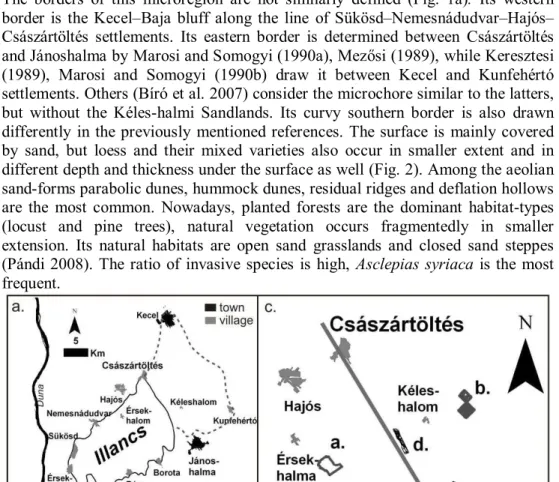
The borders of this microregion are not similarly defined (Fig. 1a). Its western border is the Kecel–Baja bluff along the line of Sükösd–Nemesnádudvar–Hajós– Császártöltés settlements. Its eastern border is determined between Császártöltés and Jánoshalma by Marosi and Somogyi (1990a), Mezősi (1989), while Keresztesi (1989), Marosi and Somogyi (1990b) draw it between Kecel and Kunfehértó settlements. Others (Bíró et al. 2007) consider the microchore similar to the latters, but without the Kéles-halmi Sandlands. Its curvy southern border is also drawn differently in the previously mentioned references. The surface is mainly covered by sand, but loess and their mixed varieties also occur in smaller extent and in different depth and thickness under the surface as well (Fig. 2). Among the aeolian sand-forms parabolic dunes, hummock dunes, residual ridges and deflation hollows are the most common. Nowadays, planted forests are the dominant habitat-types (locust and pine trees), natural vegetation occurs fragmentedly in smaller extension. Its natural habitats are open sand grasslands and closed sand steppes (Pándi 2008). The ratio of invasive species is high, Asclepias syriaca is the most frequent.
Fig. 1. a. Settlements of Illancs microregion and the different microregion-borders; b. Location of the Illancs microregion; c. Location of the sample areas. The line represents the disputed eastern border of the microregion. (a. Hajósi Homokpuszta NR; b. Kéleshalmi Homokbuckák NR; c. former wet habitats dominated blow-out near Borota; d. Lake Kélesi).
meadows, where open sand grasslands dominate, were analysed because significant decrease and fragmentation of natural areas were observed in the microregion. These areas are still representing the former natural vegetation of the area and their infection with Asclepias syriaca is not significant. Moreover, Kéles-halmi Homokbuckák NR is located in the disputed part of the microregion defined with different borders, therefore the comparison of these protected areas can contribute to the determination of the proper border. Wet habitats were chosen around the examined dry habitats for analysis. The borders of the dry habitats dominated meadows are equal to the official protected areas, while the borders of the wet habitats dominated sample areas are determined according to the landuse. The land-cover changes were analysed by topographical maps of the 1950s (MNH 1955) and actual ortophotos (FÖMI 2005). The habitat mapping was based on the categories of the Hungarian National Habitat Classification System (Bölöni et al. 2007) using ortophotos (FÖMI 2005). We present the state of the sample areas on the base of the habitat pattern and species composition with special regard to the consequences of water-shortage. The study of the above mentioned two sand-dune areas with complex view – considering e.g. both geomorphology and vegetation – is important as they have a key role in determining the northeastern microregion-border (between Illancs and Kiskunságian Sandlands). For the geomorphological analysis, digital elevation models of the sample areas were created based on the contours of the topographical maps from the 1980s. To determine the mesoforms, slope and aspect values were analysed. For the data evaluation ArcMap 9.3 software was used.
3. Results 3.1. Dry habitats
The first difference between the two sample areas is that the Hajósi Homokpuszta NR has steppe while the Kéles-halmi Homokbuckák NR has rather forest-steppe physiognomy (Fig. 3). It can be explained by their different historical land-use. Both protected areas have open sand grassland matrix, into which poplar-juniper steppe woodlands are incorporated in Kéleshalom while in Hajósi Homokpuszta NR it is substituted by Crataegus monogyna dominated dry shrubs. This fact alone can’t explain the border of microregions as there is no data on Juniperus communis in this region which would be older than 250 years. Therefore, it isn’t known exactly, if there were sand dunes with Juniperus communis in the Danube–Tisza Interfluve before the 19th century at all(Molnár, 2003).
Fig. 3. a., Habitat map of Hajósi Homokpuszta Nature Reserve; b. Habitat map of Kéleshalmi Homokbuckák Nature Reserve (key according to A–NÉR (Bölöni et al. 2007)) G1: Open sand grassland, M5: Poplar-juniper steppe woodland, OG: Trodden weed community, P2b: Dry shrub, P2BxS2: Mixture of dry shrub and cultivated poplar forest, S1: Locust-tree forest, S1xM5: Transition between locust tree and poplar steppe woodland M5xS1: Locust-tree infected Poplar-juniper steppe woodland. P8: Cut-off area, S4: Planted pine forest S6: Invasive tree-species dominated spontaneous forest, U10: Hamlet
the closeness and species composition of grasslands. The steep slopes and the upper parts of dunes are characterised by Festuca vaginata, Stipa borysthenica. On their windward sides Fumana procumbens subtype occurs while on leeward sides more closed grasslands with Stipa capillata dominate. The speciality of Hajósi Homokpuszta NR is the Festuca wagneri dominated sand steppe which is a transition between open sand grasslands and closed sand steppes (TIR 2010). The species composition shows this too: open sand grassland species (Stipa
borysthenica, Alkanna tinctoria, Festuca vaginata etc.), closed sand steppe species
(Chrysopogon gryllus, Galium verum, Salvia pratensis etc.) or common species of
both types (Stipa capillata, Potentilla arenaria etc.) also occur. On both sample areas significant amount of Crataegus monogyna occurs (Figure 4.). Current process on these grasslands is the intensive spread of Crataegus monogyna,
especially in Hajósi Homokpuszta NR which can be explained by its steppe physiognomy and its partial abandonment too, which needs an active grassland management of nature conservation.
Fig. 4. a. Areal share of habitat patches of the sample areas, b. Number of habitat patches (due to a huge fire event in the north part of Kéleshalmi Homokbuckák NR forests were damaged and cut out (P8), only the south part was analysed)
These grasslands have also protected and strictly protected species like Dianthus
serotinus, Alkanna tinctoria, Stipa borysthenica, Iris arenaria, Adonis vernalis,
Crocus reticulatus, Onosma arenaria, Tragopogon floccosus, Corispermum
nitidum etc. Both protected areas became partially cultivated during the 20th
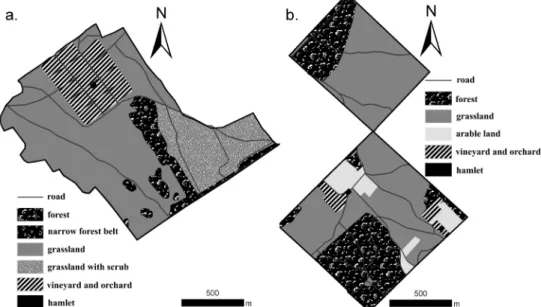
Crataegus monogyna (Fig. 3a, 5a.) on the place of the former boundary and the lack of the classical sand dunes (Figure 6/a.) still refer to it in the landscape. The Kéleshalmi Homokbuckák NR became partially cultivated in this period too. On the topographical maps of the 1950s (MNH 1955), 2 hamlets with arable lands, vineyards and orchards can be identified (Fig. 5b.). The human landscape transformation is also shown by the surface-planations which were made in order to make the dunes cultivable (Fig. 6b). The northern part of this sample area was afforested in the end of the 20th century, but because of a fire in the beginning of
the 2000s, the forest was cut out. After the abandonment of this plot invasive species (mostly Asclepias syriaca) have spread on this disturbed place.
Fig. 5. Land-cover of sample areas in the 1950–1960s (MNH 1955) on the sample areas (a. Hajósi Homokpuszta NR;b. Kéleshalmi Homokbuckák NR)
Fig. 6. Relief model of the examined sample areas on the basis of topographical maps form the 1980s (a. Hajósi Homokpuszta NR; b. Kéleshalmi Homokbuckák NR)
3.2 Wet habitats
Fens and marshes belonged to the natural habitats of the dune zones in the deflation hollows too. The depressions between dune-fields were characterised by wet habitats like Molinia fens (Bíró, 2006). As a result of meliorization began in the 1940s and the precipitation shortage (as a consequence of climate change), their extension decreased significantly. Such habitats could be found in the depressions along the southern border of Illancs according to historical maps (HIM 1764–1787, HIM 1806–1869, HIM 1872–1884, MNH 1955) until the 1970s.
The sample area west from Borota (Fig. 7a.) was presumably characterised by fen and saline habitats before the meliorization. Fens remained mainly in the northern part of the sample area, mostly as drying-out Molinia fens and fen tall-herb communities. The groundwater-table decrease is shown by the spread of Crataegus
monogyna on Molinia fen, which is typical species of dry steppes. In the middle of
the area a shift of vegetation zones can be observed: sand steppe grasslands took the place of Molinia fen in the deflation hollows, whereas Molinia fen moved to the channel crossing the sample area. Saline habitats are represented in their dried-out, steppificated varieties, mostly in the south part of the sample area. These are characterised by Agrostis stolonifera and Festuca arundinacea – this latter species refers to sand burial –, but their ratio is exceeded by Dactylis glomerata and
Festuca pseudovina showing the result of steppification. Other sand steppe
asplenifolia and Juncus gerardi represents the remains of saline meadows. Marks of leaching process are demonstrated by the higher ratio of Agropyron repens and
Poa angustifolia. In all the other parts of the examined area, the previous wet
habitats have totally transformed to sand steppe grasslands. Due to grazing with sheep, the invasion of Asclepias syriaca is not significant.
Fig. 7. Habitat maps of the sample areas former determined by wetter habitats a. Sample area west from Borota; b. Blow-out near Kéleshalom with the Lake Kélesi. Habitat cathegories (key according to A–NÉR (Bölöni et al. 2007)): D2: Molinia fen, D5 Fen tall-herb community, H5b: Sand steppe grassland, H5bxD2: Former Molinia fen became a sand steppe grassland, H5bxF2: Former saline meadow became a sand steppe grassland, H5bxF2xD2: Former transition between Molinia fen and saline meadow became a sand steppe grassland, OCxH5b: Highly weedy sand steppe grassland, OC: Weedy dry grassland, OD: Soft-stem invasive vegetation, P2b: Dry shrub, RA: Tree-groups of native species, S1: Locust-tree forest, S2: Cultivated poplar forest, T8: Small-scale vineyard and orchard, T1: Large-scale arable land, U10: hamlet, B5: Sedgefield, H5bxOC Weedy sand steppe grassland, J1axRA: Group of fen-shrubs and native trees, OG: Trodden weed community
angustifolia and the Mentha aquatica. On the edges of the blow-out sand steppe grasslands occur, but this habitat-type occupies the former cultivated regenerating meadows too.
4. Summary
Natural and anthropogenic processes of the 20th century highly affected the natural
and semi-natural habitats in the microregion. In case of dry habitats mainly land-use changes and their consequences – like afforestation, fragmentation – caland-used significant alterations. The grasslands incorporated into planted forests are threatened by the spread of dry shrubs on non-managed places and by the invasion
of Asclepias syriaca on disturbed places. The ratio of natural grasslands is really
small and they are characterised by less invasive species. The two examined protected areas covered by sand grasslands don’t show enough difference in geomorphology and species composition to be sorted into different microregions. On the examined wet habitats, the shift of vegetation zones is dominating. The remains of fen and saline habitats can be identified, but only in the deepest parts of blow-outs. Only their dried-out, steppificated varieties are represented, many times they are totally transformed into sand steppe grasslands. Sluice in the channel occurs just in the northern part of sample area west from Borota, which is permanently closed that has contributed to the preservation of Molinia fens in the channel. This fact shows the importance of water retention in this landscape. The actual land-use has a big role in the formation of landscape too. Near to the sample area in Borota hardly any Asclepias syriaca occurs on a fallow, which is clearly the positive effect of grazing with sheep. However a lot of stringing plants occur
(Carduus nutans, Ononis spinosa) in sand steppe grasslands, so their naturalness is
medium. Sand steppe grasslands with more natural species-composition on the edges of the blow-outs support the regeneration of abandoned arable lands and of the drying-out wet meadows.
References
Biró, M. (2003): Landscape history of sandlands in the Danube–Tisza Interfluve in the last 250 years. In: Molnár, Zs. ed.: Dry sand vegetation of Kiskunság. TermészetBÚVÁR Alapítvány Kiadó, Budapest, pp. 71-82. (in Hungarian)
Biró, M. (2006): Vegetation reconstruction and its application based on historical maps in the Danube– Tisza Interfluve. PhD thesis, Pécs, 139 p. (in Hungarian)
Biró, M. – Révész, A – Molnár, Zs. – Horváth, F. (2007): Regional habitat pattern of the Danube– Tisza Interfluve in Hungary I. – The landscape structure andhabitat pattern; the fen and alkali vegetation. Acta Botanica Hungarica 49 (3-4): 267-303.
Bölöni, J. – Molnár, Zs. – Kun, A. – Biró, M. (2007): Hungarian National Habitat Classification System. Institute of Ecology and Botany, Hungarian Academy of Sciences, Vácrátót, 184 p.
Csecserics, A. – Botta-Dukát, Z.– Rédei, T. – Kröel-Dulay, Gy. – Szabó, R. – Szitár, K. – Czúcz, B. (2010): Is there a connection between landscape environment and the presence of Ambrosia artemissiifolia in different habitats? IVth Hungarian Landscape Ecology Conference. Kerekegyháza In press. (in Hungarian)
FÖMI (2005): Ortophotos from 2005 in Hungary. Institute of Geodesy, Cartography and Remote Sensing, Budapest.
HIM (1764–1787): Maps of the First Military Survey. Scale: 1:28.800. Institute and Museum of War History and Map Store, Budapest.
HIM (1806–1869): Maps of the Second Military Survey. Scale: 1:28.800. Institute and Museum of War History and Map Store, Budapest.
HIM (1872–1884): Maps of the Third Military Survey. Scale: 1:25.000. Institute and Museum of War History and Map Store, Budapest.
Horváth, A. (2004): Comparising geobotanical and coenological evaluation of loess vegetation in Illancs microregion. Actual flora and vegetation research in the Carpathian Basin VI, Keszthely, p. 30. (in Hungarian)
Keresztesi, Z.– Marosi, S. – Pécsi, M. – Somogyi, S. (1989): Division of natural landscapes in Hungary. In: Pécsi M. ed.: National Atlas of Hungary. Geographical Research Institute, Hungarian Academy of Sciences. Budapest, pp. 86–87. (in Hungarian)
Kiss, T. – Tornyánszki, É. (2006): Geomorphological analysis of sand-blown areas in the Danube– Tisza Interfluve. Proceedings of the 3rd Hungarian Geographical Conference, Geographical Research Institute, Hungarian Academy of Sciences, (in Hungarian)
Kuti L. – Vatai J. – Müller T.– Kerék B. (2002): Changes of groundwater-table depth in the Danube-Tisza Interfluve. Földtani Közlöny 132: 317-325. (in Hungarian)
Küstler, H. (1999): Geschichte der Landschaft in Mitteleuropa Von der Eiszeit bis zur Gegenwart. Verlag C.H Beck, München. 424 p.
Marosi, S. – Somogyi, S. eds. (1990a): Cathaster of the Hungarian microregions I. Budapest, p. 479. (in Hungarian)
Marosi, S. – Somogyi, S. eds. (1990b): Map supplement of the Cathaster of the Hungarian microregions. Budapest. (in Hungarian)
Mezősi, G. (1989): Evaluation of microregions in the point of plant growing. In: Pécsi, M. (ed.): National Atlas of Hungary. Geographical Research Institute, Hungarian Academy of Sciences, Budapest. pp. 92/A. (in Hungarian)
MNH (1955): Gauss-Krueger topographical maps. Scale: 1:25.000. Tóth Ágoston Cartography Institute of the Hungarian Military, Budapest.
Molnár, Zs. (1997): The land-use historical approach to study vegetation history at the century scale. In Tóth E. ed. 1997: International conference on Research, Conservation, Management. Aggtelek, Conference Proceedings. pp. 345-354.
Molnár, Zs. (2007): Historical landscape ecology surveys in the Great Hungarian Plain. PhD thesis. Pécs, 223 p. (in Hungarian)
Molnár, Zs. – Bartha, S. – Seregélyes, T. – Illyés, E. – Tímár, G. – Horváth, F. – Révész, A. – Kun, A. – Botta-Dukát, Z. – Bölöni, J. – Biró, M. – Bodonczi, L. – Deák, J.Á. – Fogarasi, P. – Horváth, A. – Isépy, I. – Karas, L. – Kecskés, F. – Molnár, Cs. – Ortmann-né Ajkai, A. – Rév, Sz. (2007): A grid-based, satellite-image supported, multi-attributed vegetation mapping method (MÉTA). Folia Geobotanica 42, 225-247.
Molnár, Zs. – Bölöni, J. – Horváth, F. (2008):Threatening factors encountered: actual endangerment of the Hungarian (semi-)natural habitats. Acta Botanica Hungarica 50 (Suppl): 199–217. Molnár, Zs. (ed) (2003): Dry sand vegetation of Kiskunság. Kecskemét. 68 p. (in Hungarian)
Pálfai, I. (2000): Sensitiveness of the Great Hungarian Plain in the point of inland excess waters and droughts. In: Pálfai, I. ed.: The role and significance of water in the Great Hungarian Plain. A Nagyalföld Alapítvány Kötetei 6. pp. 85-96. (in Hungarian)
Pándi, I. (2006): Dél-kiskunsági homokbuckások vegetációja és tájhasználat-története. (Land-use history and vegetation of sandlands in the South-Kiskunság). Conference of the 1st Hungarian Landscape Ecology, 2006. IV. 7-9. Debrecen (in Hungarian)
Pándi, I. (2008): Illancs microregion. In: Király G.– Molnár Zs.– Bölöni J.– Csiky J.– Vojtkó A. eds.: Vegetation of microregions in Hungary. Institute of Ecology and Botany, Hungarian Academy of Sciences, Vácrátót, p. 23. (in Hungarian)
Rackham, O. (2000): The history of the countryside. Phoenix press, London, 445 p.
Rakonczai, J. – Bódis, K. (2002): Consequences of environmental changes in the subsurface waters of the Great Hungarian Plain). In: Jakucs László, a tudós, az ismeretterjesztõ és a mûvész. Pécs. pp. 227-238. (in Hungarian)
Rakonczai, J. (2007): Global change and landscape change in Hungary. Geografia fisica e dinamica quaternaria. 30, 229-232.
Szanyi, J. – Kovács, B. (2009): 3D Hydrodinamical model for the sustainable development of subsurface water-use in the region near the border of Hungary and Serbia. INTERREG III/A HUSER0602/131 (in Hungarian)
TIR (2010): Nature Conservation Information System, Public Relations Module. Available online at: http://geo.kvvm.hu/tir/. Last access: 2010.06.21.