Non-target effects of a glyphosate-based
herbicide on Common toad larvae
(
Bufo bufo
, Amphibia) and associated
algae are altered by temperature
Fabian Baier1, Edith Gruber1, Thomas Hein2,3,
Elisabeth Bondar-Kunze2,3, Marina Ivankovic2, Axel Mentler4, Carsten A. Bru¨hl5, Bernhard Spangl6and Johann G. Zaller1
1Institute of Zoology, University of Natural Resources and Life Sciences Vienna (BOKU), Vienna, Austria
2Institute of Hydrobiology and Aquatic Ecosystem Management, University of Natural Resources and Life Sciences Vienna (BOKU), Vienna, Austria
3WasserCluster Lunz–Biologische Station GmbH, Lunz am See, Austria
4Institute of Soil Research, University of Natural Resources and Life Sciences Vienna (BOKU), Vienna, Austria
5Institute for Environmental Sciences, Universita¨t Koblenz-Landau, Landau, Germany 6Institute of Applied Statistics and Computing, University of Natural Resources and Life Sciences
Vienna (BOKU), Vienna, Austria
ABSTRACT
Background:Glyphosate-based herbicides are the most widely used pesticides in agriculture, horticulture, municipalities and private gardens that can potentially contaminate nearby water bodies inhabited by amphibians and algae. Moreover, the development and diversity of these aquatic organisms could also be affected by human-induced climate change that might lead to more periods with extreme temperatures. However, to what extent non-target effects of these herbicides on amphibians or algae are altered by varying temperature is not well known.
Methods:We studied effects of five concentrations of the glyphosate-based herbicide formulation Roundup PowerFlex (0, 1.5, 3, 4 mg acid equivalent glyphosate L-1as a one time addition and a pulse treatment of totally 4 mg a.e. glyphosate L-1) on larval development of Common toads (Bufo bufo, L.; Amphibia: Anura) and associated algae communities under two temperature regimes (15 vs. 20C).
Results: Herbicide contamination reduced tail growth (-8%), induced the occurrence of tail deformations (i.e. lacerated or crooked tails) and reduced algae diversity (-6%). Higher water temperature increased tadpole growth (tail and body length (tl/bl) +66%, length-to-width ratio +4%) and decreased algae diversity (-21%). No clear relation between herbicide concentrations and tadpole growth or algae density or diversity was observed. Interactive effects of herbicides and temperature affected growth parameters, tail deformation and tadpole mortality indicating that the herbicide effects are temperature-dependent. Remarkably, herbicide-temperature interactions resulted in deformed tails in 34% of all herbicide treated tadpoles at 15C whereas no tail deformations were observed for the
herbicide-free control at 15C or any tadpole at 20C; herbicide-induced mortality
was higher at 15 C but lower at 20C.
Submitted22 August 2016
Accepted30 September 2016
Published1 November 2016
Corresponding author
Johann G. Zaller, [email protected]
Academic editor
Ann Hedrick
Additional Information and Declarations can be found on page 15
DOI10.7717/peerj.2641
Copyright 2016 Baier et al.
Distributed under
Discussion:These herbicide- and temperature-induced changes may have decided effects on ecological interactions in freshwater ecosystems. Although no clear dose-response effect was seen, the presence of glyphosate was decisive for an effect, suggesting that the lowest observed effect concentration (LOEC) in our study was 1.5 mg a.e. glyphosate L-1water. Overall, our findings also question the relevance of pesticide risk assessments conducted at standard temperatures.
Subjects Agricultural Science, Biodiversity, Conservation Biology, Ecology, Environmental Sciences
Keywords Non-target effects, Pesticides, Agrochemicals, Aquatic organisms, Amphibia, Algae, Ecotoxicology, Agroecology, Herbicides, Climate change
INTRODUCTION
With almost a third of their species threatened, amphibians are the most vulnerable vertebrate group on earth (International Union for Conservation of Nature, 2004). Amphibian declines and extinctions are caused by multiple factors and their interaction: alien species, over-exploitation and land use change, global change, increased use of pesticides and other toxic chemicals and infectious diseases (Aldrich et al., 2016;
Blaustein et al., 2011;Bru¨hl et al., 2013;Collins & Storfer, 2003). In their natural habitats, especially anuran amphibians are always associated with algae communities that
constitute an important source of nutrition during larval development; however, algae are likewise affected by similar environmental factors as amphibians (Whitehead et al., 2009; Wilson et al., 2003). The current study examined the effects of a glyphosate-based herbicide on growth and development of larvae of Common toads (Bufo bufoL.) and on the composition of the associated algal communities. Additionally, as climate change scenarios predict more frequent extreme temperature events (IPCC, 2013), we also assessed whether different water temperatures alter potential herbicide effects. Moreover, toad spawning ponds can vary considerably in their depths and in their water temperature. Globally, Common toads are mainly distributed in Europe living in habitats from lowland to mountain areas up to 2,500 m a.s.l. (Arnold & Ovenden, 2002; Recuero et al., 2012). Since Common toads frequently spawn in ponds located near agriculturally used areas or because they need to cross these landscapes during their seasonal migrations from the spawning ponds to woody overwintering sites, they are frequently exposed to pesticides (Berger, Graef & Pfeffer, 2013;Lenhardt, Bru¨hl & Berger, 2015). Common toads were selected as a study organism also for ethical reasons because they are among the least threatened of the generally endangered animal class of Amphibia.
or close to aquatic environments, however, contamination of water bodies through drift, surface runoff and direct overspray has been reported (Battaglin et al., 2009;Berger, Graef & Pfeffer, 2013;Peruzzo, Porta & Ronco, 2008). Nevertheless, several studies report detrimental effects of glyphosate-based herbicide formulations to amphibians during their aquatic and terrestrial life stages (Baylis, 2000;Bru¨hl, Pieper & Weber, 2011;Duke & Powles, 2008;Fryday & Thompson, 2012;Relyea, 2011;Tsui & Chu, 2003). Glyphosate-based herbicides tested in concentrations ranging between 0.021 mg acid equivalent (a.e.) L-1to 6.0 mg a.e. L-1affected growth and development of North American larval anurans (Edge et al., 2014;Lanctoˆt et al., 2014;Navarro-Martı´n et al., 2014;Relyea, 2004), showed other sub-lethal morphological and behavioral effects (Cauble & Wagner, 2005; Mann & Bidwell, 1999;Moore, Chivers & Ferrari, 2015;Mun˜oz, Rojas & Bautista, 2014) and even lead to acute mortality when exposed to high doses (Fuentes et al., 2011; Moore et al., 2012;Relyea, 2005b;Williams & Semlitsch, 2010). However, concerning effects of glyphosate-based herbicides on native European amphibian species only very little is known (Wagner & Lo¨tters, 2013). Moreover, it has been shown that herbicide formulations, i.e. the products that are actually used in the field, are more detrimental to tadpoles and other aquatic organisms than the active ingredient glyphosate itself (Folmar, Sanders & Julin, 1979;Howe et al., 2004;Relyea, 2005b). However, unfortunately these adjuvants are usually not declared and considered company secrets (Mullin et al., 2016;Wagner et al., 2013). Besides amphibians, several studies also show that freshwater microalgae are particularly vulnerable to glyphosate-based herbicides because of their physiological and biochemical similarity with terrestrial plants (Annett, Habibi & Hontela, 2014;Tsui & Chu, 2003) mainly by initiating oxidative stress in algae (Annett, Habibi & Hontela, 2014).
Thus, the objectives of the current study were to assess whether (i) herbicide concentrations affect the development of Common toad larvae and associated algae communities and (ii) temperature alters potential herbicide effects. To investigate these objectives we conducted a climate chamber experiment using a full factorial design with five herbicide concentrations at two temperature levels over 24 days. We hypothesized that a higher temperature will accelerate the growth and development of tadpoles, hence reducing the duration of their exposure to the herbicide. When higher
temperature reduces exposure to the herbicide more than it enhances detrimental effects of the herbicide, then its net effect could be beneficial. Regarding herbicide effects we also hypothesized that increasing temperatures would increase detrimental effects of the herbicide with increasing concentrations because multiple stressors might decrease resources of amphibians for detoxification and/or temperature regulation (Noyes et al., 2009; Rohr, Madison & Sullivan, 2003).
MATERIAL AND METHODS
Experimental setup
The study was conducted between April 14 and May 9, 2015 in a laboratory at the University of Natural Resources and Life Sciences Vienna (BOKU), Austria. This study was carried out in strict accordance with the recommendations in the Austrian animal experimentation law (Tierversuchsgesetz 2012, BGBl. I Nr. 114/2012) with a permission from the Austrian Federal Ministry of Science, Research and Economy (permit
number BMWFW-66.016/0002-WF/V/3b/2015). Anesthetic MS222 (Triacin, Sandoz, Switzerland) was used when necessary to ameliorate animal suffering. The experiment was carried out using a full-factorial design, with herbicide concentration (five levels) and temperature (two levels) as factors. Two climate chambers set at different temperatures (15 and 20 C) with a 12 h light/dark-cycle were used to set up the two temperature
conditions. Light intensity of both climate chambers was measured using a Lux Meter (Voltcraft LX-1108 Lux-Meter; Conrad electronics, Hirschau, Germany) resulting in 5,575 ± 106 lux (mean ± SD) in both chambers. We established the following
herbicide concentrations: 0, 1.5, 3, 4 mg a.e. L-1(acid equivalent; which equals 0, 3.13, 6.25, 8.33ml L-1of the Roundup PowerFlexÒ formulation) from the start and
4 mg a.e. L-1applied as a pulse treatment starting initially with 1.5 mg a.e. L-1and adding another 1.5 mg a.e. L-1on day 5 and 1 mg a.e. L-1(2.08ml L-1) on day 11 after starting the
experiment, respectively. In the field, glyphosate concentrations in amphibian breeding ponds are generally highly variable depending on potential pesticide drift or input through leaching by water or soil erosion. Worst-case expected environmental
a micro-pipette. This Roundup formulation is available in Europe since 2014 and admitted for usage in agriculture, horticulture, forestry, vineyards, municipalities and private gardens until 2022 (AGES, 2015). Afterwards the solutions were mixed thoroughly by shaking and turning the canisters upside down. Four liters of pure coal-filtered water (in case of the control) or the mixtures were then filled into each experimental unit, i.e. polypropylene plastic tubs (volume: 5-L, length: 28 cm, width: 19 cm, height: 14 cm), accounting for five replicates per treatment. Each climate chamber contained 25 tubs, making up a total of 50 tubs for the two temperature treatments.
Common toad (Bufo bufoL.) spawn containing approx. 750 eggs from different clutches was hand-collected on 14 April 2015 from a pond in Neuwaldegg, Vienna (4814′26.31″N; 1616′34.945″E; altitude 290 m a.s.l.). Toad eggs were sampled with
permission of the pond owner (Vienna Municipal Department 49—Forestry, permit number MA49-808754/2014/3) and the respective authority for nature conservation (Vienna Municipal Department 22—Environmental Protection, permit number MA22-1629490/2014). Five randomly chosen eggs of the whole spawn were added into each experimental tub, accounting for a total of 250 eggs used for this experiment.
Measurements and analyses
Larval development was determined according toGosner (1960)using a binocular microscope (Nikon SMZ 745; Nikon, Tokyo, Japan). Conforming to this scheme the development of anurans is assigned to 46 stages (Gosner stage (Gs)), from undivided eggs (Gs 1) to completely metamorphosed individuals (Gs 46). At the start of our experiment all tadpoles were in Gs 8. As additional morphological parameters we measured bl, body width (bw) and tail length (tl) from photographs taken of tadpoles from all treatments at May 8, when the maturity of larval amphibians reached Gs 30 and Gs 35 at 15 and 20 C, respectively. Measurements on photographs were conducted
using the free image analysis software ImageJ (version 1.48v, Wayne Rasband, National Institute of Health, USA:http://imagej.nih.gov/ij). Body condition (bc) was calculated as body length-to-width ratio. Tail deformations (Bantle et al., 1998;Cooke, 1981) were assessed when taking the tadpoles out into Petri dishes for morphological measurements at the end of the experiment. A clear distinction could be made between undeformed (Fig. 1A), lacerated (Fig. 1B) or curved tails (Fig. 1C); only curved tails were considered deformed (Cooke, 1981) as lacerated tails could also originate from injuries by
intraspecific competition.
Each tub was inspected daily for dead individuals. All larvae were fed ad libitum with same amounts of ground fish food (Tetramin) after reaching Gs 22. When most of the 20C-treated tadpoles reached Gs 35 (indentations 1–2 of the hind limbs develop at
this stage) the experiment was terminated. Water samples of all tubs (also the 15C ones)
were taken after thoroughly mixing with a glass stirring rod using a 100 ml plastic beaker; samples were preserved by adding five drops of Lugol iodine solution.
species determination, the phytoplankton samples were gently mixed by inverting the sample bottle. Initially a preliminary scan was made of a settled 5 ml sample in order to determine the volume to be used for the analyses. For the qualitative analysis at least 5 ml of the sample were analyzed. As a high number of algal cells were present, 1 ml was loaded into a sedimentation chamber of appropriate volume for quantitative analysis. The chamber was topped with a round glass top plate and algae were allowed to settle onto the base of the settling chamber. The method consists of two parts—analysis of non-diatom phytoplankton (“soft algae”) and analysis of diatoms. For the non-diatom phytoplankton analysis, algal cells were enumerated in a settling chamber using an inverted microscope at 400magnification. Only living forms (i.e. chloroplast containing cells) were counted. At this magnification diatoms are enumerated as a group. For diatom analyses, the samples were pretreated with strong oxidants, cleaned and embedded on glass slides in Naphrax. Actual identification and enumeration of diatoms was done under oil immersion (1,000) and for the quantitative analyses a minimum of 500 frustules was counted (2 frustules = 1 diatom cell) per sample (slide). For the quantitative analyses a minimum of 30 microscopic fields is required, including no less than 300 cells. If 300 cells were not observed within the 30 microscopic fields, enumeration was continued until at least 300 were counted. The area counted was recorded to calculate cell number per volume. Algal taxa were identified to the lowest taxonomic rank possible. The
taxonomical identification was done using standard literature for species determination (Hinda´k et al., 1978;Krammer & Lange-Bertalot, 1986;Krammer & Lange-Bertalot, 1988; Krammer & Lange-Bertalot, 1991a;Krammer & Lange-Bertalot, 1991b). Species names were checked at the algae base database (AlgaeBase, 2015). Quantitative assessment was conducted according to Utermo¨hl (1958). The density is presented as cell number L-1.
Water temperature and water oxygen concentration were measured using an Oxymeter (WTW Oxi 90; WTW GmbH, Weilheim, Bavaria, Germany) and pH was measured using a pH-Meter (WTW pH-95; WTW GmbH, Weilheim, Bavaria, Germany). Solved oxygen content, pH-value and temperature of the water in the tubs was first measured on April 14, shortly before introducing the eggs. Henceforth, measurements were performed
every third day until May 8. A data logger measuring temperature every 15 min was placed in the middle section of each climate chamber at the start of the experiment. The mean temperature during the experiment was 14.4 vs. 18.3 C for the 15 vs. 20C
treatment, respectively.
Water samples (500 ml) of each tub were taken at the start and end of the experiment and immediately stored in a freezer at-18C before they were analysed for glyphosate
and its main metabolite aminomethylphosphonic acid (AMPA) in the laboratories of the BOKU Department of Forest and Soil Sciences using a HPLC-MS/MS method (Popp et al., 2008;Todorovic et al., 2013).
Statistical analyses
All statistical analyses were carried out using the open-access software R (version 3.2.1, The R Foundation for Statistical Computing:http://www.r-project.org);awas set at 0.05.
Shapiro-Wilks tests and QQ-plots were used to check normality of data. Percentage mortality was arcsin-transformed prior to analysis. To examine whether herbicide concentrations and temperature affected toad larvae morphology, analyses of covariance (ANCOVA) with pH, measured water temperature and oxygen levels as co-variables were conducted. Effects of herbicide and temperature on pH and dissolved oxygen were tested using a two-way ANOVA. To analyze effects of herbicide, temperature, pH and dissolved oxygen on algae density and diversity a different ANCOVA model was used as samples were only taken at one point of time. To assess the effects of algae density and diversity on bl, bw, tl and bl to bw ratio of tadpoles a one-way ANCOVA was conducted. When significant effects were given by the ANCOVA (P < 0.05) a Tukey HSD test was conducted for mean comparisons of herbicide and temperature levels. Water pH and oxygen concentrations were used as covariates in all ANCOVA models. Correlations were tested using Pearson’s test. Values in the text are means ± standard deviation.
RESULTS
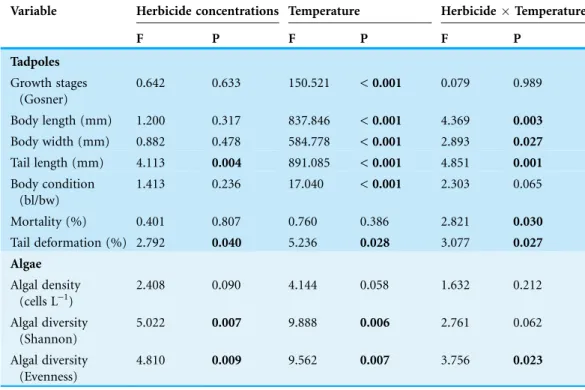
Herbicide contamination significantly affected tadpole tl at 15C but not at 20C,
occurrence of tail deformations only at 15C and algae diversity (Shannon- and
evenness-index) mainly at 20C (Figs. 2and3;Table 1). Herbicide concentrations neither affected
larval development, bl, bw, bc, mortality of tadpoles or algae density (Figs. 2and3; Table 1).
Temperature significantly affected larval growth parameters (bl, bw, tl and bc), larval development (Gs) and occurrence of tail deformations of tadpoles as well as algae diversity (Shannon- and evenness-index); however it did not affect tadpole mortality or algae density (Figs. 2and3;Table 1). Algal communities contained between 25–43 species, with the highest species number in the 15C treatment (Fig. 3). Diatom algae
dominated in species number and abundance in all mesocosms.
longest tails (17.79 ± 0.31 mm) at 3 mg a.e. L-1under 20C (Fig. 2A). At 15C tadpoles
in tubs contaminated with the herbicide had averaged across herbicide concentrations 7.8% shorter tails compared to the control treatment (Fig. 2A).
Twenty four days after experiment start, tadpoles of the 15C chamber were on average
in Gs 29, whereas tadpoles at 20C were in Gs 35 (Fig. 2E). The bc was highly significantly
affected by temperature, being reduced by 4.2% at 15C compared to 20C, on average
across herbicide concentrations (Fig. 2D;Table 1). The highest bc (1.46 ± 0.05) was found at 3 mg a.e. L-1under 20C, the lowest bl-to-bw ratio (1.36 ± 0.04) at 0 mg a.e. L-1
under 15C. Tadpole bl and bw also differed significantly under different temperature
regimes. Body length at 15C was lower by 35.4% on average compared to 20C; whereas
bw at 15C was lower by 32.4% on average compared to 20C (Fig. 2C). At 15C bl at
0 mg a.e. L-1(8.0 ± 0.18 mm) was significantly higher compared to the other herbicide treatments (7.67 ± 0.55 mm); at 20 C average bl (11.99 ± 0.39 mm) was unaffected
by herbicide concentrations (Fig. 2C). At 15C bw at 4p mg a.e. L-1(5.33 ± 0.33 mm) was
significantly lower compared to the other herbicide concentrations (5.67 ± 0.29 mm); at 20C bw (8.29 ± 0.39 mm) was unaffected by herbicide concentrations.
At the end of the experiment on average 34.0 ± 14.8% of the tadpoles at 15C showed
deformed tails, while none at 20C had deformed tails (Fig. 2B). Most deformed tadpoles
(56.0 ± 26.0%) were found at 1.5 mg a.e. L-1, however, no relation to herbicide
concentration was found. No deformed tadpoles were found in the control group without
herbicide addition. Whenever deformations occurred the tip of their tails was crooked in one direction (Fig. 1C).
Mortality was unaffected by herbicide treatment or temperature, but significantly affected by their interaction: on average, 6.4 ± 0.8% of larvae died at 15C vs. 5.6 ± 0.9%
at 20 C (Fig. 2F; Table 1). The highest mortality rate under 15 C was found at
4p mg a.e. L-1(12.0 ± 1.1% mortality), whereas under 20C it was found at 0 mg a.e. L-1
(8.0 ± 1.1% mortality); mortality of control at 15 C was 4.0 ± 0.9%. No larvae died at
1.5 mg a.e. L-1 under 15 C and at 4p mg a.e. L-1under 20 C (Fig. 2F).
Algal species of four different families were observed in the experiment, namely: Chlorophyceae (six spp.), Trebouxiophyceae (two spp.), Xanthophyceae (one spp.) and Bacillariophyceae (34 spp.). Algae Shannon diversity index under 15C was across
treatments 20.7% higher than at 20C (Fig. 3C). At 15C the highest Shannon index
was found at 0 mg a.e. L-1(2.48 ± 0.27), whereas under 20C the highest Shannon index
was observed at 4 mg a.e. L-1(2.29 ± 0.06;Fig. 2). The lowest Shannon index was seen at 3 mg a.e. L-1(2.14 ± 0.18) under 15C and at 4p mg a.e. L-1(1.23 ± 0.39) under
20C (Fig. 3C). Algal density was unaffected by herbicide concentrations or
temperature (Table 1). Averaged across concentrations we observed 33 species and 2.9E + 07 ± 7.8E + 06 algae cells L-1at 15C vs. 30 species and 4.9E + 07 ± 3.0E + 07 algae
cells L-1at 20C (Figs. 3A and3B).
Table 1 ANCOVA results for the effects of herbicide concentrations (0, 1.5, 3, 4, 4p mg a.e. L-1) and
temperature (15 vs. 20C) on growth stages, body length (bl), body width (bw), tail length, body condition (bl/bw), mortality and occurrence of tail deformations of Common toad larvae and diversity of associated algal communities.
Variable Herbicide concentrations Temperature HerbicideTemperature
F P F P F P
Tadpoles Growth stages
(Gosner)
0.642 0.633 150.521 < 0.001 0.079 0.989
Body length (mm) 1.200 0.317 837.846 < 0.001 4.369 0.003 Body width (mm) 0.882 0.478 584.778 < 0.001 2.893 0.027 Tail length (mm) 4.113 0.004 891.085 < 0.001 4.851 0.001 Body condition
(bl/bw)
1.413 0.236 17.040 < 0.001 2.303 0.065
Mortality (%) 0.401 0.807 0.760 0.386 2.821 0.030
Tail deformation (%) 2.792 0.040 5.236 0.028 3.077 0.027 Algae
Algal density (cells L-1)
2.408 0.090 4.144 0.058 1.632 0.212
Algal diversity (Shannon)
5.022 0.007 9.888 0.006 2.761 0.062
Algal diversity (Evenness)
4.810 0.009 9.562 0.007 3.756 0.023
Note:
Herbicide concentrations affected water pH and water oxygen concentrations, temperature treatment reduced water oxygen concentration (data provided in Supplemental Information S1). At 15C, water pH in the control (8.34 ± 0.13) was
significantly lower than at treatments with herbicide addition (8.64 ± 0.48), at 20C
control showed the lowest value (8.27 ± 0.07), whereas the pulse treatment had the highest (8.55 ± 0.41). Across temperatures water oxygen concentration increased with increasing herbicide concentrations. The lower temperature treatment showed higher oxygen values throughout all herbicide concentrations, the highest being 13.58 ± 4.50 mg L-1 for the 4 mg a.e. L-1treatment at 15 C, whereas the control at 20C had the lowest
average oxygen value with 9.24 ± 0.68 mg L-1. No significant effect of herbicide by temperature interaction on water pH or oxygen was observed. The temperature of the climate chamber had a significant influence on water temperature levels of the tubs, which differed by 3.9C. The mean temperature of the 15 and 20C treatment was 14.4 ± 1.3C
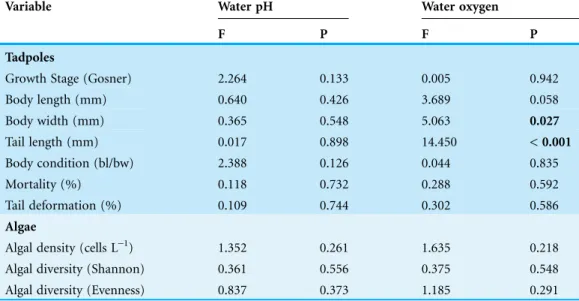
and 18.3 ± 1.3C, respectively. Tadpole bw and tl were significantly affected by water
oxygen concentration; however, they not affected by water pH (Table 2). Although bw was significantly affected by water oxygen concentration, those parameters were not
significantly correlated. Tail deformation was not affected by pH or dissolved oxygen content (Table 2).
Neither algal density nor algal diversity showed any significant effects on bl, bw, tl and bc, although algal density had a marginal effect on tadpole bl (F = 4.096, P = 0.060).
Results of glyphosate and AMPA analyses confirmed the indented concentrations at the start of the experiment: < 5.0, 1,557.5 ± 33.6, 3,002.0 ± 6.3, and 4,050.7 ± 300.7mg
glyphosate L-1and generally < 2.5mg AMPA L-1for the 0, 1.5, 3, 4 mg L-1one time
herbicide application, respectively. Glyphosate and AMPA for the first 1.5 mg L-1addition
Table 2 ANCOVA results for the effects of water pH and oxygen concentration and time on development, body length, body width, tail length, body condition, mortality and tail deformation ofBufo bufotadpoles and diversity of associated algae communities.
Variable Water pH Water oxygen
F P F P
Tadpoles
Growth Stage (Gosner) 2.264 0.133 0.005 0.942
Body length (mm) 0.640 0.426 3.689 0.058
Body width (mm) 0.365 0.548 5.063 0.027
Tail length (mm) 0.017 0.898 14.450 < 0.001
Body condition (bl/bw) 2.388 0.126 0.044 0.835
Mortality (%) 0.118 0.732 0.288 0.592
Tail deformation (%) 0.109 0.744 0.302 0.586
Algae
Algal density (cells L-1) 1.352 0.261 1.635 0.218
Algal diversity (Shannon) 0.361 0.556 0.375 0.548
Algal diversity (Evenness) 0.837 0.373 1.185 0.291
Note:
of the 4p mg L-1treatment was with 1,764.3 ± 61.8mg glyphosate L-1higher than intended.
At the end of the experiment measured concentrations across temperature treatments were: < 5.0, 1,491.4 ± 148.6, 2,923.6 ± 124.8, 3,979.6 ± 193.7, 6,568.3 ± 1,490.3mg
glyphosate L-1and < 2.5, 34.6 ± 13.1, 66.0 ± 35.6, 130.7 ± 16.2, 201.4 ± 29.8mg AMPA L-1,
for the 0, 1.5, 3, 4 mg L-1one time herbicide and 4 mg L-1pulse treatment, respectively.
DISCUSSION
Our study showed for the first time for Common toads that potential contaminations of spawning ponds with the glyphosate-based herbicide Roundup PowerFlex can reduce the tail growth of toad larvae, lead to tail deformations and reduce the diversity of associated algal communities. Increased water temperature accelerated tadpole development and growth and reduced algal diversity. Moreover, significant interactions between herbicide contamination and temperature affected most morphological parameters (bl, bw, tl, bc, mortality, tail deformation) and algal diversity (evenness-index), suggesting that the herbicide effects are temperature-specific. However, we found no clear indications of a relation between herbicide concentration and tadpole growth parameters or algae diversity or density. However, the presence of glyphosate was decisive for an effect, suggesting that the lowest observed effect concentration (LOEC) was 1.5 mg a.e. glyphosate L-1water.
Overall, our findings for a European amphibian species corroborate former studies showing effects of different Roundup formulations on the growth of mainly North-American amphibian species (Edge et al., 2014;Howe et al., 2004;Lanctoˆt et al., 2014; Navarro-Martı´n et al., 2014;Relyea, 2004;Relyea, 2012;Wojtaszek et al., 2004). Our results of 4.2% decrease in tl ofB. bufotadpoles in tubs containing Roundup PowerFlex (15C) compared to the control is in line with findings of a previous study where we
tested effects of Roundup LB Plus onB. bufodevelopment (Baier et al., 2016). However, the current findings are in contrast to findings of elongated tails ofRana sylvaticustreated with 2.9 mg a.e. L-1VisionMax (Navarro-Martı´n et al., 2014). In any case it appeared that these glyphosate-based herbicides interfere with molecular signaling processes or growth factors influencing tail growth. Clearly, detailed studies are needed to investigate the underlying mechanisms. Another explanation for a reduced tadpole growth after herbicide addition could be an herbicide-induced decrease of algae diversity that are an important food source for tadpoles (Wojtaszek et al., 2004). Also, in our current
experiment algae were the preferred food for tadpoles although they were offered ad libitum ground fish food. Our finding that herbicide concentrations affected tadpole growth only at 15 but not at 20 C suggests that increasing temperature did not
significantly enhance the toxicity of the tested herbicide. This observation may also indicate heat hardening in the 20C groups, perhaps caused by an induction of
escape less easily from predators than longer tailed ones (Hoff & Wassersug, 2000;Wilbur & Semlitsch, 1990). Also, tadpole tails are important energy and calcium reservoirs for metamorphosis eventually resulting in smaller toads (Vitt & Caldwell, 2013).
As expected, and in accordance with other studies (Derakhshan & Nokhbatolfoghahai, 2015;Sanuy, Oromı´ & Galofre´, 2008), we found that tadpoles at 20C developed and
grew much faster than at 15C, with tl being 1.6, bl 1.4 and bw 1.4 times higher on
average. Higher temperature also accelerated tadpole development with tadpoles at 20C reaching Gs 35, whereas individuals at 15C reached on average Gs 29 until the
experiment was terminated; bc (i.e. bl to bw ratio) was slightly increased by 5% at higher temperatures. Temperature also had a significant effect on the occurrence of deformed tails, as they were only observed on herbicide treated specimens at 15C but absent at
20C. Although climate change models predict higher temperatures during breeding
periods (Laloe¨ et al., 2014), breeding and hibernation phenologies of ectotherms might shift to earlier dates during warmer springs for compensating the warmer climate (Benard, 2015;Gao et al., 2015;Klaus & Lougheed, 2013). In some cases, the phenological shifts following warmer springs and winters even resulted in lower temperatures for the developing tadpoles (Benard, 2015). Overall there is still a great lack of data regarding seasonal variations in the water temperature of aquatic bodies used as spawning bonds and to what extent global climate change might affect these.
The ecologically most significant results of the current study are perhaps the interactive effects between herbicide and temperature on various parameters regarding tadpoles and algae. To our knowledge it is the first time that such herbicide-temperature
interactions for a glyphosate-based herbicide was studied on European toad species and their associated algae. In the herbicide treated tubs at 15C 34% of all tadpoles had
deformed tails, whereas no deformed tails occurred in the herbicide-free control at 15C
or in all herbicide concentrations at 20C. Generally, deformation rates > 5% are
considered unnatural and are therefore implemented amphibian monitoring guidelines (Wagner et al., 2014). However, in our experiment tail deformations were not related to herbicide concentrations; to what extent other principles than a dose-response relationship might be effective would need further studies perhaps by also using a greater sample size (Vandenberg et al., 2012). Substantial tail deformations by 50–90% due to glyphosate-based herbicides have also been found for the tropical frog speciesScinax nasicuswhen exposed to 3.0–7.5 mg L-1of Glyfos (Lajmanovich, Sandoval & Peltzer, 2003). Also herbicides containing other active ingredients than glyphosate, e.g.
isoproturon, have also been reported causing deformations in larvae ofBombina variegata
andRana arvalisat rather low concentrations (0.1–100mg L-1) (Greulich, 2004).
the products (Cox & Surgan, 2006;Cuhra, Traavik & Bøhn, 2013;Mullin et al., 2015; Relyea, 2005b).
Interactive effects between herbicide and temperature resulted in a herbicide-induced decrease of bl, bw and tl by 2–10% at 15C, but the same parameters seemed to be
(not significantly) increased by 2–8% at 20C for tadpoles in herbicide treated tubs
compared to non-treated tubs. Overall, very little is known about combined effects of pesticides and temperature on aquatic organisms, especially amphibians (Holmstrup et al., 2010;Rohr, Sesterhenn & Stieha, 2011;Wagner & Lo¨tters, 2013), as most studies investigated herbicide effects at one temperature level only. A study using Roundup Original MAX found effects on tail depth and body depth but not on the bl ofRana pipiensandR. sylvaticustadpoles at 12C (Relyea, 2012). Similar to our findings
snout-vent length ofRana pipienslarvae decreased when treated with 0.6 and 1.8 mg a.e. L-1 Roundup Original and Roundup Transorb at 20C (Howe et al., 2004). In contrast with
our study, growth rates of R. clamitanstadpoles treated with 1.43 mg a.e. L-1Vision herbicide at 20 C increased (Li, Cohen & Rohr, 2013). Again, an explanation for these
contrasting findings could be that these glyhosate-based herbicides usually differ considerably in the formulation of their active ingredients (Cuhra, Bøhn & Cuhra, 2016) their not-declared adjuvants that have been shown to be as detrimental to non-target species as the active ingredient (Mann & Bidwell, 2001;Relyea, 2005a;Wagner et al., 2013). To what extent spawning ponds used by amphibians are contaminated with glyphosate-based herbicides is very much dependent on regional circumstances, e.g. how careful herbicide application was conducted following regulations and distances to water bodies. Generally, most studies reporting glyphosate concentrations of surface waters considered larger lakes or streams, while many amphibians are using small, shallow and non-flowing water bodies for spawning. Nevertheless, reported glyphosate concentrations found in surface waters shortly after application scored between 0.27–3.10 mg a.e. L-1
(Wagner et al., 2013).
Algae diversity (Shannon- and evenness-index) in our experiment was significantly reduced by herbicides and increased temperatures, whereas herbicide effects were more pronounced at higher temperature than at lower temperature (herbicidetemperature interaction). Reductions of algal cells after herbicides application were lower as expected by a pesticide supposed to kill plants. Possible effects of glyphosate-based herbicide formulations on aquatic algae communities have rarely been investigated and our study appears to be among the few addressing this topic for algae communities. Growth of green algae (Scenedesmus acutus, S. quadricauda) was inhibited by technical grade glyphosate and Ron-do, a glyphosate formulation used in aquatic environments (Sa´enz et al., 1997). In toxicity tests analyzing the effect of glyphosate based herbicides on single species of diatoms and green algae, stronger negative effects on the diatom species (Skeletonema costatum) were observed (Tsui & Chu, 2003). Other studies found growth of
pathway (Shick & Dunlap, 2002), it is possible, that glyphosate-based herbicides lead to a decrease of the build up of these amino acids (Shick et al., 1999), probably also increasing the effects of temperature stress on algal communities. As expected in our study, dissolved oxygen level was negatively correlated to water temperature. This means that the colder the water, the higher the oxygen content becomes (Wetzel, 2001). Although values of water oxygen concentrations varied broadly across temperature and herbicide treatments, we ruled out a lack of oxygen, as the lowest value measured being 8.2 mg L-1, which is considered to be sufficient for proper development of tadpoles (Ultsch, Bradford & Freda, 1999). As a consequence of increased temperature dissolved oxygen levels decreased, which also affected tadpole growth. Contrary to our study, others found decreasing water pH levels with increasing Roundup concentrations (Tsui & Chu, 2003); however, this could also be due to unknown adjuvants in the different formulations used.
CONCLUSIONS
Our findings might contribute several additional aspects to the broad discussion on non-target effects of pesticides. First, as extreme temperature events will most likely become more frequent due to human-induced climate change (IPCC, 2013), it seems imperative to address non-target effects of pesticides also in a climate-change context (Ko¨hler & Triebskorn, 2013;Rohr & Palmer, 2013). The herbicide-temperature interactions in the current and a previous (Baier et al., 2016) experiment suggest that interspecific and intraspecific relationships in aquatic ecosystems will most likely be affected when taxa respond differently to these environmental stressors. Second, chronically sub-lethal effects in the morphology and body deformations as well as changes in algae communities such as observed in the current study and their ecological consequences should attract more attention. Third, our study also suggests that ecotoxicological protocols assessing non-target effects of pesticides conducted under constant temperature levels might
underestimate real world conditions, especially for poikilothermic vertebrates.
ACKNOWLEDGEMENTS
We are grateful to Mathias Jedinger for sharing his experience during the experimental phase and to Andreas Kitzler (Agilent Technologies Austria) for giving us extensive technical input and support for glyphosate analyses. The manuscript was improved by incorporating comments and suggestions of three anonymous reviewers.
ADDITIONAL INFORMATION AND DECLARATIONS
Funding
Grant Disclosures
The following grant information was disclosed by the authors:
Austrian Ministry of Agriculture, Forestry, Environment and Water Management (BMLFUW): 100977.
Competing Interests
The authors declare that they have no competing interests.
Author Contributions
Fabian Baier conceived and designed the experiments, performed the experiments, analyzed the data, wrote the paper, prepared figures and/or tables, reviewed drafts of the paper.
Edith Gruber conceived and designed the experiments, performed the experiments, wrote the paper, prepared figures and/or tables, reviewed drafts of the paper. Thomas Hein analyzed the data, wrote the paper, reviewed drafts of the paper. Elisabeth Bondar-Kunze analyzed the data, wrote the paper, reviewed drafts of the
paper.
Marina Ivankovic analyzed the data, reviewed drafts of the paper.
Axel Mentler contributed reagents/materials/analysis tools, wrote the paper. Carsten A. Bru¨hl analyzed the data, wrote the paper, reviewed drafts of the paper. Bernhard Spangl analyzed the data, reviewed drafts of the paper.
Johann G. Zaller conceived and designed the experiments, performed the experiments, wrote the paper, prepared figures and/or tables, reviewed drafts of the paper.
Animal Ethics
The following information was supplied relating to ethical approvals (i.e., approving body and any reference numbers):
This study was carried out in strict accordance with the recommendations in the Austrian animal experimentation law (Tierversuchsgesetz 2012, BGBl. I Nr. 114/2012) with a permission from the Austrian Federal Ministry of Science, Research and Economy (permit number BMWFW-66.016/0002-WF/V/3b/2015).
Field Study Permissions
The following information was supplied relating to field study approvals (i.e., approving body and any reference numbers):
Toad eggs were sampled with permission of the pond owner (Vienna Municipal Department 49—Forestry, permit number MA49-808754/2014/3) and the respective authority for nature conservation (Vienna Municipal Department 22—Environmental Protection, permit number MA22-1629490/2014).
Data Deposition
Supplemental Information
Supplemental information for this article can be found online athttp://dx.doi.org/ 10.7717/peerj.2641#supplemental-information.
REFERENCES
AGES. 2015.List of authorised/approved plant protection products in Austria.Available at
http://pmg.ages.at(accessed 29 September 2015).
Aldrich A, Junghans M, Aeberli C, Bru¨hl CA, Streissl F, Schmidt BR. 2016.Amphibians and plant-protection products: what research and action is needed?Environmental Sciences Europe28(1):17DOI 10.1186/s12302-016-0085-6.
AlgaeBase. 2015.Database of information on algae that includes terrestrial, marine and freshwater organisms.Available athttp://www.algaebase.org(accessed 2 October 2015).
Annett R, Habibi HR, Hontela A. 2014.Impact of glyphosate and glyphosate-based herbicides on the freshwater environment.Journal of Applied Toxicology34(5):458–479 DOI 10.1002/jat.2997.
Arnold EN, Ovenden D. 2002.A Field Guide to the Reptiles and Amphibians of Britain and Europe. London: HarperCollins.
Baier F, Jedinger M, Gruber E, Zaller JG. 2016.Temperature-dependence of glyphosate-based herbicide’s effects on egg and tadpole growth of Common Toads.Frontiers in Environmental Science4(28):51DOI 10.3389/fenvs.2016.00051.
Bantle J, Dumont J, Finch R, Linder G, Fort D. 1998.Atlas of Abnormalities: A Guide for the Performance of FETAX. Stillwater: Oklahoma State University Press.
Battaglin WA, Rice KC, Focazio MJ, Salmons S, Barry RX. 2009. The occurrence of glyphosate, atrazine, and other pesticides in vernal pools and adjacent streams in Washington, DC, Maryland, Iowa, and Wyoming, 2005–2006. Environmental Monitoring and Assessment 155(1–4):281–307 DOI 10.1007/s10661-008-0435-y.
Baylis AD. 2000. Why glyphosate is a global herbicide: strengths, weaknesses and prospects. Pest Management Science56(4):299–308
DOI 10.1002/(SICI)1526-4998(200004)56:4<299::AID-PS144>3.0.CO;2-K.
Benard MF. 2015.Warmer winters reduce frog fecundity and shift breeding phenology, which consequently alters larval development and metamorphic timing.Global Change Biology
21(3):1058–1065DOI 10.1111/gcb.12720.
Berger G, Graef F, Pfeffer H. 2013.Glyphosate applications on arable fields considerably coincide with migrating amphibians.Scientific Reports3:2622DOI 10.1038/srep02622.
Blaustein AR, Han BA, Relyea RA, Johnson PTJ, Buck JC, Gervasi SS, Kats LB. 2011.The complexity of amphibian population declines: understanding the role of cofactors in driving amphibian losses.Annals of the New York Academy of Sciences1223(1):108–119
DOI 10.1111/j.1749-6632.2010.05909.x.
Bru¨hl CA, Pieper S, Weber B. 2011.Amphibians at risk? Susceptibility of terrestrial amphibian life stages to pesticides.Environmental Toxicology and Chemistry30(11):2465–2472
DOI 10.1002/etc.650.
Bru¨hl CA, Schmidt T, Pieper S, Alscher A. 2013.Terrestrial pesticide exposure of amphibians: an underestimated cause of global decline?Scientific Reports3:1135DOI 10.1038/srep01135.
Cauble K, Wagner RS. 2005.Sublethal effects of the herbicide glyphosate on amphibian metamorphosis and development.Bulletin of Environmental Contamination and Toxicology
75(3):429–435DOI 10.1007/s00128-005-0771-3.
Collins JP, Storfer A. 2003.Global amphibian declines: sorting the hypotheses.Diversity and Distributions9(2):89–98DOI 10.1046/j.1472-4642.2003.00012.x.
Cooke AS. 1981.Tadpoles as indicators of harmful levels of pollution in the field. Environmental Pollution Series A, Ecological and Biological25(2):123–133 DOI 10.1016/0143-1471(81)90012-X.
Cox C, Surgan M. 2006.Unidentified inert ingredients in pesticides: implications for human and environmental health.Environmental Health Perspectives114(12):1803–1806
DOI 10.1289/ehp.9374.
Cuhra M, Bøhn T, Cuhra P. 2016.Glyphosate: too much of a good thing?Frontiers in Environmental Science4:28DOI 10.3389/fenvs.2016.00028.
Cuhra M, Traavik T, Bøhn T. 2013.Clone- and age-dependent toxicity of a glyphosate commercial formulation and its active ingredient in Daphnia magna.Ecotoxicology22(2):251–262 DOI 10.1007/s10646-012-1021-1.
Derakhshan Z, Nokhbatolfoghahai M. 2015.Thermal tolerance limits and effects of temperature on the growth and development of the green toad,Bufotes viridis. German Journal of Herpetology51(2):129–136.
Dı´az-Villanueva JF, Dı´az-Molina R, Garcı´a-Gonza´lez V. 2015.Protein folding and mechanisms of proteostasis.International Journal of Molecular Sciences16(8):17193–17230
DOI 10.3390/ijms160817193.
Duke SO, Powles SB. 2008.Glyphosate: a once-in-a-century herbicide.Pest Management Science
64(4):319–325DOI 10.1002/ps.1518.
Edge C, Thompson D, Hao C, Houlahan J. 2014.The response of amphibian larvae to exposure to a glyphosate-based herbicide (Roundup WeatherMax) and nutrient enrichment in an ecosystem experiment.Ecotoxicology and Environmental Safety109:124–132
DOI 10.1016/j.ecoenv.2014.07.040.
Folmar LC, Sanders HO, Julin AM. 1979.Toxicity of the herbicide glyphosate and several of its formulations to fish and aquatic invertebrates.Archives of Environmental Contamination and Toxicology8(3):269–278DOI 10.1007/BF01056243.
Franz JE, Mao MK, Sikorski JA. 1997.Glyphosate: A Unique Global Herbicide. Washington, D.C.: American Chemical Society.
Fryday S, Thompson H. 2012.Toxicity of pesticides to aquatic and terrestrial life stages of amphibians and occurrence, habitat use and exposure of amphibian species in agricultural environments. In: Food and Environment Research Agency, ed.Supporting Publications 2012: EN-343. Sand Hutton: European Food Safety Authority, 348.
Fuentes L, Moore LJ, Rodgers JH, Bowerman WW, Yarrow GK, Chao WY. 2011.Comparative toxicity of two glyphosate formulations (Original formulation of RoundupÒ
and Roundup WeathermaxÒ
) to six North American larval anurans.Environmental Toxicology and Chemistry
30(12):2756–2761DOI 10.1002/etc.670.
Gao X, Jin C, Llusia D, Li Y. 2015.Temperature-induced shifts in hibernation behavior in experimental amphibian populations.Scientific Reports5:11580 DOI 10.1038/srep11580.
Giesy JP, Dobson S, Solomon KR. 2000.Ecotoxicological risk assessment for RoundupÒ
Gosner KL. 1960.A simplified table for staging anuran embryos and larvae with notes on identification.Herpetologica16(3):183–190.
Greulich K. 2004.Einfluss von Pestiziden auf Laich und Larven von Amphibien am Beispiel eines Herbizides (Isoproturon) und eines Insektizides (Cypermethrin). Studien und Tagungsberichte (Band 49). Potsdam: Landesumweltamt Brandenburg.
Hinda´k F, Cyrus Z, Marvan P, Javornicky´ P, Koma´rek J, Ettl H, Sla´decˇkova´ A, Popovsky´ J, Puncˇocha´rova´ M, Lhotsky´ O. 1978.Sladkovodne´ Riasy. Bratislava: Slovenske´ Pedagogicke´ Nakladatelstvo.
Hoff KV, Wassersug RJ. 2000.Tadpole locomotion: axial movement and tail functions in a largely vertebraeless vertebrate.American Zoologist40(1):62–76DOI 10.1093/icb/40.1.62.
Holmstrup M, Bindesbøl A-M, Oostingh GJ, Duschl A, Scheil V, Ko¨hler H-R, Loureiro S, Soares AMVM, Ferreira ALG, Kienle C, Gerhardt A, Laskowski R, Kramarz PE, Bayley M, Svendsen C, Spurgeon DJ. 2010.Interactions between effects of environmental chemicals and natural stressors: a review.Science of the Total Environment408(18):3746–3762
DOI 10.1016/j.scitotenv.2009.10.067.
Howe CM, Berrill M, Pauli BD, Helbing CC, Werry K, Veldhoen N. 2004.Toxicity of glyphosate-based pesticides to four North American frog species.Environmental Toxicology and Chemistry23(8):1928–1938DOI 10.1897/03-71.
IPCC. 2013.Climate Change 2013: The Physical Science Basis. Contribution of Working Group I to the Fifth Assessment Report of the Intergovernmental Panel on Climate Change. Cambridge: Cambridge University Press.
International Union for Conservation of Nature (IUCN). 2004.IUCN Red List of Threatened Species: A Global Species Assessment. Gland: IUCN.
Kattwinkel M, Ku¨hne J-V, Foit K, Liess M. 2011.Climate change, agricultural insecticide exposure, and risk for freshwater communities.Ecological Applications21(6):2068–2081 DOI 10.1890/10-1993.1.
Katzenberger M, Hammond J, Duarte H, Tejedo M, Calabuig C, Relyea RA. 2014.
Swimming with predators and pesticides: how environmental stressors affect the thermal physiology of tadpoles.PLoS ONE9(5):e98265DOI 10.1371/journal.pone.0098265.
Klaus SP, Lougheed SC. 2013.Changes in breeding phenology of eastern Ontario frogs over four decades.Ecology and Evolution3(4):835–845DOI 10.1002/ece3.501.
Ko¨hler H-R, Triebskorn R. 2013.Wildlife ecotoxicology of pesticides: can we track effects to the population level and beyond?Science341(6147):759–765DOI 10.1126/science.1237591.
Krammer K, Lange-Bertalot H. 1986.Su¨ßwasserflora von Mitteleuropa, Band 2/1: Bacillariophyceae, 1. Teil: Naviculaceae. Stuttgart: Gustav Fischer Verlag.
Krammer K, Lange-Bertalot H. 1988.Su¨ßwasserflora von Mitteleuropa, Band 2/2: Bacillariophyceae, 2. Teil: Bacillariaceae, Epithemiaceae, Surirellaceae. Stuttgart: Gustav Fischer Verlag.
Krammer K, Lange-Bertalot H. 1991a.Su¨ßwasserflora von Mitteleuropa, Band 2/3:
Bacillariophyaceae, 3. Teil: Centrales, Fragilariaceae, Eunotiaceae. Stuttgart: Gustav Fischer Verlag.
Krammer K, Lange-Bertalot H. 1991b.Su¨ßwasserflora von Mitteleuropa, Band 2/4:
Bacillariophyceae, 4. Teil: Achnanthaceae, Kritische Erga¨nzungen zu Navicula (Lineolata) und Gomphonema, Gesamtliteraturverzeichnis Teil 1-4. Stuttgart: Gustav Fischer Verlag.
Laloe¨ J-O, Cozens J, Renom B, Taxonera A, Hays GC. 2014.Effects of rising temperature on the viability of an important sea turtle rookery.Nature Climate Change4(6):513–518
DOI 10.1038/nclimate2236.
Lanctoˆt C, Navarro-Martı´n L, Robertson C, Park B, Jackman P, Pauli BD, Trudeau VL. 2014.
Effects of glyphosate-based herbicides on survival, development, growth and sex ratios of wood frog (Lithobates sylvaticus) tadpoles. II: agriculturally relevant exposures to Roundup
WeatherMaxÒ
and VisionÒ
under laboratory conditions.Aquatic Toxicology154:291–303 DOI 10.1016/j.aquatox.2014.05.025.
Lenhardt PP, Bru¨hl CA, Berger G. 2015.Temporal coincidence of amphibian migration and pesticide applications on arable fields in spring.Basic and Applied Ecology16(1):54–63 DOI 10.1016/j.baae.2014.10.005.
Li Y, Cohen JM, Rohr JR. 2013.Review and synthesis of the effects of climate change on amphibians.Integrative Zoology8(2):145–161DOI 10.1111/1749-4877.12001.
Mann RM, Bidwell JR. 1999.The toxicity of glyphosate and several glyphosate formulations to four species of southwestern Australian frogs.Archives of Environmental Contamination and Toxicology36(2):193–199DOI 10.1007/s002449900460.
Mann RM, Bidwell JR. 2001.The acute toxicity of agricultural surfactants to the tadpoles of four Australian and two exotic frogs.Environmental Pollution114(2):195–205
DOI 10.1016/s0269-7491(00)00216-5.
Moore H, Chivers DP, Ferrari MCO. 2015.Sub-lethal effects of RoundupTMon tadpole anti-predator responses.Ecotoxicology and Environmental Safety111:281–285
DOI 10.1016/j.ecoenv.2014.10.014.
Moore LJ, Fuentes L, Rodgers JH, Bowerman WW, Yarrow GK, Chao WY, Bridges WC. 2012.
Relative toxicity of the components of the original formulation of RoundupÒ
to five North American anurans.Ecotoxicology and Environmental Safety78:128–133
DOI 10.1016/j.ecoenv.2011.11.025.
Mullin CA, Chen J, Fine JD, Frazier MT, Frazier JL. 2015.The formulation makes the honey bee poison.Pesticide Biochemistry and Physiology120:27–35
DOI 10.1016/j.pestbp.2014.12.026.
Mullin CA, Fine JD, Reynolds RD, Frazier MT. 2016.Toxicological risks of agrochemical spray adjuvants: organosilicone surfactants may not be safe.Frontiers in Public Health4(3):92 DOI 10.3389/fpubh.2016.00092.
Mun˜oz LMH, Rojas CMM, Bautista MHB. 2014.Acute toxicity and sublethal effects of the mixture glyphosate (RoundupÒ
Active) and Cosmo-FluxÒ
411F to anuran embryos and tadpoles of four Colombian species.Revista de Biologia Tropical63(1):223–233
DOI 10.15517/rbt.v63i1.12893.
Navarro-Martı´n L, Lanctoˆt C, Jackman P, Park BJ, Doe K, Pauli BD, Trudeau VL. 2014.Effects of glyphosate-based herbicides on survival, development, growth and sex ratios of wood frogs (Lithobates sylvaticus) tadpoles. I: chronic laboratory exposures to VisionMaxÒ
.Aquatic Toxicology154:278–290DOI 10.1016/j.aquatox.2014.05.017.
Noyes PD, McElwee MK, Miller HD, Clark BW, Van Tiem LA, Walcott KC, Erwin KN, Levin ED. 2009.The toxicology of climate change: environmental contaminants in a warming world. Environment International35(6):971–986DOI 10.1016/j.envint.2009.02.006.
Popp M, Hann S, Mentler A, Fuerhacker M, Stingeder G, Koellensperger G. 2008.
Determination of glyphosate and AMPA in surface and waste water using high-performance ion chromatography coupled to inductively coupled plasma dynamic reaction cell mass
spectrometry (HPIC-ICP-DRC-MS).Analytical and Bioanalytical Chemistry391(2):695–699 DOI 10.1007/s00216-008-2037-5.
Recuero E, Canestrelli D, Vo¨ro¨s J, Szabo´ K, Poyarkov NA, Arntzen JW, Crnobrnja-Isailovic J, Kidov AA, Coga˘lniceanu D, Caputo FP, Nascetti G, Martı´nez-Solano I. 2012.Multilocus species tree analyses resolve the radiation of the widespread Bufo bufo species group (Anura, Bufonidae).Molecular Phylogenetics and Evolution62(1):71–86
DOI 10.1016/j.ympev.2011.09.008.
Relyea RA. 2004.Growth and survival of five amphibian species exposed to combinations of pesticides.Environmental Toxicology and Chemistry23(7):1737–1742DOI 10.1897/03-493.
Relyea RA. 2005a.The impact of insecticides and herbicides on the biodiversity and productivity of aquatic communities.Ecological Applications15(2):618–627DOI 10.1890/03-5342.
Relyea RA. 2005b.The letal impact of roundup on aquatic and terrestrial amphibians. Ecological Applications15(4):1118–1124DOI 10.1890/04-1291.
Relyea RA. 2011.Amphibians are not ready for RoundupÒ
. In: Elliott JE, Bishop CA, Morrissey CA, eds.Wildlife Ecotoxicology: Forensic Approaches. New York: Springer, 466.
Relyea RA. 2012.New effects of Roundup on amphibians: predators reduce herbicide mortality; herbicides induce antipredator morphology.Ecological Applications22(2):634–647
DOI 10.1890/11-0189.1.
Rohr JR, Madison DM, Sullivan AM. 2003.On temporal variation and conflicting selection pressures: a test of theory using newts.Ecology84(7):1816–1826 DOI 10.1890/0012-9658(2003)084[1816:OTVACS]2.0.CO;2.
Rohr JR, Palmer BD. 2013.Climate change, multiple stressors, and the decline of ectotherms. Conservation Biology27(4):741–751DOI 10.1111/cobi.12086.
Rohr JR, Sesterhenn TM, Stieha C. 2011.Will climate change reduce the effects of a pesticide on amphibians? Partitioning effects on exposure and susceptibility to contaminants.Global Change Biology17(2):657–666DOI 10.1111/j.1365-2486.2010.02301.x.
Sa´enz ME, Di Marzio WD, Alberdi JL, del Carmen Tortorelli M. 1997.Effects of technical grade and a commercial formulation of glyphosate on algal population growth.Bulletin of Environmental Contamination and Toxicology59(4):638–644 DOI 10.1007/s001289900527.
Sanuy D, Oromı´ N, Galofre´ A. 2008.Effects of temperature on embryonic and larval development and growth in the natterjack toad (Bufo calamita) in a semi–arid zone.Animal Biodiversity and Conservation31(1):41–46.
Schabhu¨ttl S, Hingsamer P, Weigelhofer G, Hein T, Weigert A, Striebel M. 2013.Temperature and species richness effects in phytoplankton communities.Oecologia171(2):527–536 DOI 10.1007/s00442-012-2419-4.
Shick JM, Dunlap WC. 2002.Mycosporine-like amino acids and related gadusols: biosynthesis, accumulation, and UV-protective functions in aquatic organisms.Annual Review of Physiology
64(1):223–262DOI 10.1146/annurev.physiol.64.081501.155802.
Struger J, Thompson D, Staznik B, Martin P, McDaniel T, Marvin C. 2008.Occurrence of glyphosate in surface waters of Southern Ontario.Bulletin of Environmental Contamination and Toxicology80(4):378–384DOI 10.1007/s00128-008-9373-1.
Todorovic GR, Mentler A, Popp M, Hann S, Ko¨llensperger G, Rampazzo N, Blum WEH. 2013.
Determination of glyphosate and AMPA in three representative agricultural Austrian soils with a HPLC-MS/MS method.Soil and Sediment Contamination: An International Journal
22(3):332–350DOI 10.1080/15320383.2013.726296.
Trumbo J. 2005.An assessment of the hazard of a mixture of the herbicide RodeoÒ
and the non-ionic surfactant R-11Ò
to aquatic invertebrates and larval amphibians.California Fish and Game91(1):38–46.
Tsui MTK, Chu LM. 2003.Aquatic toxicity of glyphosate-based formulations: comparison between different organisms and the effects of environmental factors. Chemosphere
52(7):1189–1197DOI 10.1016/S0045-6535(03)00306-0.
Ultsch G, Bradford D, Freda J. 1999.Physiology: coping with the environment (Chapter 8). In: McDiarmid R, Altig R, eds.Tadpoles: The Biology of Anuran Larvae. Chicago: University of Chicago Press, 189–214.
Utermo¨hl H. 1958.Zur Vervollkommnung der quantitativen Phytoplankton-Methodik. Mitteilungen der internationalen Vereinigung fu¨r theoretische und angewandte Limnologie
9:1–38.
Vandenberg LN, Colborn T, Hayes TB, Heindel JJ, Jacobs DR, Lee D-H, Shioda T, Soto AM, vom Saal FS, Welshons WV, Zoeller RT, Myers JP. 2012. Hormones and endocrine-disrupting chemicals: low-dose effects and nonmonotonic dose responses.Endocrine Reviews
33(3):378–455DOI 10.1210/er.2011-1050.
Vendrell E, Go´mez de Barreda Ferraz D, Sabater C, Carrasco JM. 2009.Effect of glyphosate on growth of four freshwater species of phytoplankton: a microplate bioassay.Bulletin of
Environmental Contamination and Toxicology82(5):538–542DOI 10.1007/s00128-009-9674-z.
Vitt LJ, Caldwell JP. 2013.Herpetology: An Introductory Biology of Amphibians and Reptiles. London: Academic Press.
Wagner N, Lo¨tters S. 2013.Effects of water contamination on site selection by amphibians: experiences from an arena approach with European frogs and newts.Archives of Environmental Contamination and Toxicology65(1):98–104DOI 10.1007/s00244-013-9873-9.
Wagner N, Reichenbecher W, Teichmann H, Tappeser B, Lo¨tters S. 2013.Questions concerning the potential impact of glyphosate-based herbicides on amphibians.Environmental Toxicology and Chemistry32(8):1688–1700DOI 10.1002/etc.2268.
Wagner N, Zu¨ghart W, Mingo V, Lo¨tters S. 2014.Are deformation rates of anuran developmental stages suitable indicators for environmental pollution? Possibilities and limitations.Ecological Indicators45:394–401DOI 10.1016/j.ecolind.2014.04.039.
Wetzel RG. 2001.Limnology: Lake and River Ecosystems. San Diego: Academic Press.
Whitehead PG, Wilby RL, Battarbee RW, Kernan M, Wade AJ. 2009.A review of the potential impacts of climate change on surface water quality.Hydrological Sciences Journal
54(1):101–123DOI 10.1623/hysj.54.1.101.
Wilbur HM, Semlitsch RD. 1990.Ecological consequences of tail injury inRanatadpoles.Copeia
1990(1):18–24DOI 10.2307/1445817.
Williams BK, Semlitsch RD. 2010.Larval responses of three Midwestern anurans to chronic, low-dose exposures of four herbicides.Archives of Environmental Contamination and Toxicology
Wilson BA, Smith VH, deNoyelles F, Larive CK. 2003.Effects of three pharmaceutical and personal care products on natural freshwater algal assemblages.Environmental Science & Technology37(9):1713–1719DOI 10.1021/es0259741.
Wojtaszek BF, Staznik B, Chartrand DT, Stephenson GR, Thompson DG. 2004.Effects of VisionÒ
herbicide on mortality, avoidance response, and growth of amphibian larvae in two forest wetlands.Environmental Toxicology and Chemistry23(4):832–842DOI 10.1897/02-281.